Your ShelfYour Projects

Signs of the Times, Vol. 32, No. 19.

AN EVERLASTING REFUGE

Signs of the Times

May 9, 1906

Pacific Press Publishing Company · Mountain View, California · May 9, 1906
AN EVERLASTING REFUGE.


AN EVERLASTING REFUGE.

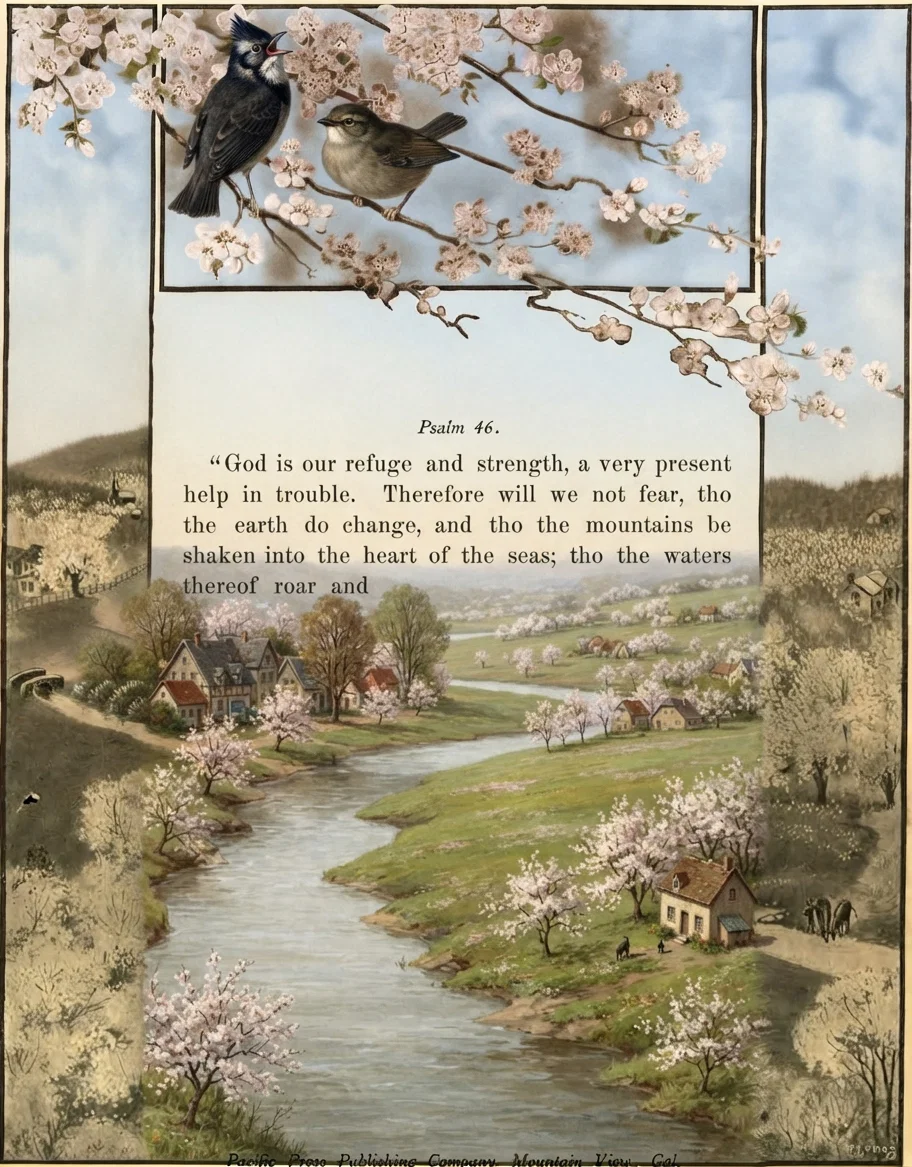
"God is our refuge and strength, a very present help in trouble. Therefore will we not fear, tho the earth do change, and tho the mountains be shaken into the heart of the seas; tho the waters thereof roar and be troubled, tho the mountains tremble with the swelling thereof. [Selah.]
"There is a river, the streams whereof make glad the city of God, the holy place of the tabernacles of the Most High. God is in the midst of her; she shall not be moved; God will help her, and that right early. The nations raged, and the kingdoms were moved; He uttered His voice, the earth melted. Jehovah of hosts is with us; the God of Jacob is our refuge. [Selah.]
"Come, behold the works of Jehovah, what desolations He hath made in the earth. He maketh wars to cease unto the end of the earth; He breaketh the bow, and cutteth the spear in sunder; He burneth the chariots in the fire. Be still, and know that I am God; I will be exalted among the nations, I will be exalted in the earth. Jehovah of hosts is with us; the God of Jacob is our refuge." [Selah.]

Our Publications

Watch this space closely each week that you may not miss any of the good books we are reviewing.

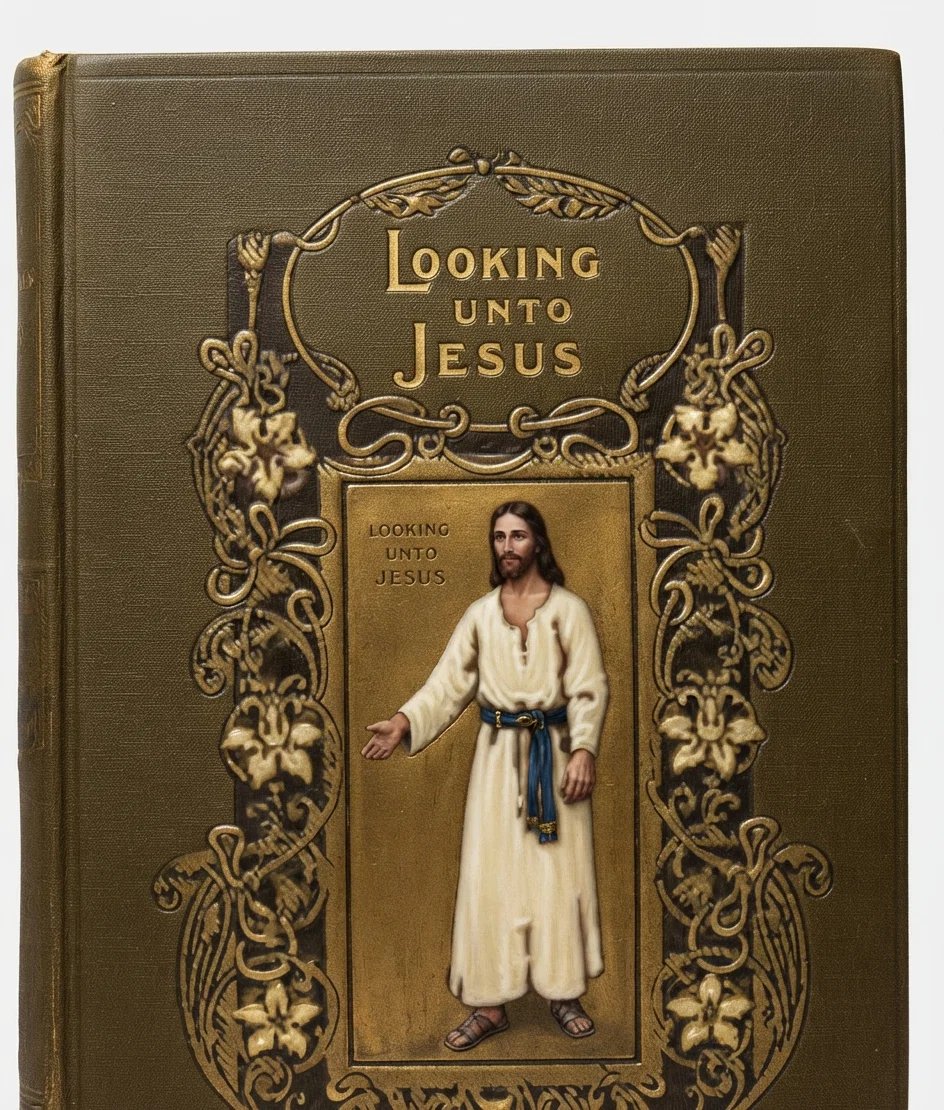
LOOKING UNTO JESUS

By Elder Uriah Smith. An unfolding of the plan of salvation in its types, shadows, and reality, and an exposition of the marvelous prophecy found in the eighth and ninth chapters of Daniel. Illustrated.
Paper covers, 25 cents; cloth, plain edges, 75 cents.

THE LOVER'S LOVE,

or John Three Sixteen

This book sets forth the great love manifest by Him who gave His life for sinners. One can not read the book without having a greater sense of what the salvation of this world and man has cost, and the desire to step to a higher standard of living.
176 pages, 75 cents.

MAKING HOME HAPPY

By Mrs. L. D. Avery-Stuttle. This little book tells how an unhappy home was made happy. It pictures before the reader in interesting story form the relations that should exist, and the lines of influence that should be guarded and cultivated in every home.
The book is bright and cheery throughout, and the good, wholesome lessons taught will appeal to old and young alike.
Beautiful cover design; 200 pages. Price, paper, 25 cents; cloth, 50 cents.

MAKING HOME PEACEFUL

By Mrs. L. D. Avery-Stuttle. All of the little folks (and some of the big ones) who have read "Making Home Happy" will be delighted to know that they can now read the sequel to that story in the new book, "Making Home Peaceful," by the same author. It is written in the same happy vein as her former book, that so delights the heart of the reader, and will prove very interesting and helpful from beginning to end.
It has been the supreme purpose of the author to show to the reader, by means of a happily-conceived object-lesson, how the true spirit of the ever-blessed Christ-love can be given tangible expression in every-day home life, and how the incoming of that love will transform a joyless abode into a happy home. Too often this must be accomplished through the ministry of pain and sorrow. Far better to read and heed a lesson of love and peace, and of escape from unloveliness and strife, such as is so plainly and clearly set forth in the pages of this book.
232 pages, attractive cloth cover, 75 cents.

MARTIN LUTHER

By Emma H. Adams. The name of this great reformer is well known in every household, and this story of his life, at home, at the university, as a monk, as a priest, at Rome, at the Diet of Worms, and finally the closing scenes of his eventful career, will be of deep interest to the young. 160 pages, illustrated.
Paper covers, post-paid, 25 cents; cloth, post-paid, 50 cents.

MARVEL OF NATIONS

Our Country, Its past, present, and future, and what the Scriptures say of it. By Uriah Smith. A portrayal of American progress since the founding of the nation to the close of the nineteenth century, when this nation stood as one of the first nations in the world. The manner of the rise of this nation and its political nature are evidences of its prophetic importance.
The important element of history is the working of divine Providence in the affairs of men. Nebuchadnezzar was taught that the Most High God rules in the kingdoms of men, and the Jews missed the golden opportunity to prolong their national existence because they knew not the day of their visitation. This work pictures the situation at the present time, how, under the fostering care of a beneficent Providence, our country has surpassed all other nations in development, and now stands forth the richest in most all essentials of any nation on the globe.
While the historical past and the prophetic present of this nation are of great interest to the American people, the principal and most interesting feature of this work is its treatise on the Scriptural future of the United States, and the setting up of the kingdom of God.
Over 255,000 of these books have been sold. Contains 324 pages, 6¼x8⅞ inches. Beautifully and substantially bound in two styles.
Cloth, plain edges, $1.25; cloth, gilt edges, $1.50.

Pacific Press Publishing Company.

Mountain View, Cal.

1109 E. 12th St., Kansas City, Mo. 285 Salmon St., Portland, Ore.

SPECIAL TERMS.

1. One new yearly subscription and one renewal, or two new yearly subscriptions, sent at one time, $2.50.
2. Two new yearly subscriptions and one renewal, or three new yearly subscriptions, sent at one time, $3.25.
3. Three new yearly subscriptions and one renewal, or four new yearly subscriptions, sent at one time, $4.00.
Sample copies sent on application.

TO OUR PATRONS.

Please be careful to write all names of persons and places plainly.
Send money by Post-office Money Order, Express Order, or Bank Draft on New York, Chicago, or San Francisco.
Orders and Drafts should be made payable to the Pacific Press Publishing Co.
Paper money or silver should be sent in a registered letter.
Registered mail is safe. Unregistered mail is at the risk of the sender.
The address label on your paper will indicate the time to which your subscription is paid. In case of non-receipt of papers, or any other irregularity, please notify us immediately.
When subscriptions expire, no more papers are sent to the party except by special arrangement.
You are requested to watch the date on your label, and renew early, and save the loss of papers. We can not always furnish missing numbers.
When requesting change of address, be sure to give both old and new addresses.
Important.—If you order SIGNS, Our Little Friend, books, etc., at the same time, use a separate sheet of paper for each. If this request is complied with, it will materially assist in the prompt and accurate despatch of the business.
When writing to the editor, be sure to use a separate sheet of paper.

A Sailor’s Joy in the Paper

A sailor on the P. M. S. S. City of Peking writes:
"I can not fully explain here the joy your paper brought me. I only wish to come myself and have a talk with you, and at the same time to have my name set down in that Lamb's book of life as a member of my Master's body. . . . The Lord bless you and your labors, and may the light shine in our hearts more and more."

THE MINUTE MAN

On the Frontier, is the title of a 326-page book written by Rev. W. G. Puddefoot, field secretary of the Congregational Home Missionary Society. "The opening of a new frontier is world-wide in its operations." The opening up of immense territories starts railways and commerce from California to Siberia.
The Indian camp, the log-house, the sod-house, breaking new ground for a town, a minute man's parsonage, all come in for full-page illustrations. Pioneer work in various states from Minnesota to Oklahoma, and from Missouri to California are all written up in a manner to carry your interest from the opening chapter to the closing page. Publishers price for this cloth-bound book $1.25. Our price post-paid only 95 cents. Write to-day, to Pacific Press, Mountain View, Cal.

EARTHQUAKE REFLECTIONS.

ONE of the most vivid impressions left upon the minds of many is the awful power of the earthquake. It did not seem possible for any building of wood or stone to survive such a manifestation of perverted power. One minute of such fearful motion would wreck any human structure of any weight which suffered it. It is God's goodness and mercy that it came when it did, and that all the after shocks were not concentrated in the first.
MAGNIFICENT courage and fortitude has been manifest by many of the sufferers. They have borne cheerfully, smilingly, hopefully, all the privations they have suffered, minimizing their own loss and putting heart and courage in others. We saw not a few endeavoring to cook food on a little fire enclosed in a few bricks on the street. They certainly knew little or nothing about either fire or cooking. Yet they seemed cheerful and hopeful. Praise God for the faculty of hope which springs eternal in the human breast, even tho often ill-founded. It is a glorious thing if it be based on the sure foundation.
A Scene on Market Street, San Francisco. Men hunting for canned foods amid the ruins.

Courage and Presumption.

This is said to be a Christian land. Many of the men who are with such zeal and courage bent on the rebuilding of San Francisco, are professed Christian men. We admire their splendid courage and grit. But sometimes it looks as if they were planning for the future leaving God out of their reckoning. The Biblical, "If the Lord will, we shall both live, and do this or that," has no part in the commercial creed of to-day. "The God of the Bible has naught to do with nature. It is great Science we will follow. Some of our great steel buildings withstood the shock of the earthquake, we will build all like them." One paper tells us that in rebuilding no device nor provision will be omitted "that can make it as safe from fire as the bottom of the sea." "When it is finished, it will burn again only when the caves of the ocean burst into flame. . . . We know now that San Francisco's only enemy is fire. We have no other to fear." Then we are told that Chicago and Baltimore will some day burn again, but new San Francisco, never. It will be "the safest city in the world."
IT is well to build solid and safe and sure as possible. But it is not well to defy God or flout His Word. San Francisco may build a thousand times stronger than the buildings which stood this time, but when man shall have exhausted God's mercy, and the Almighty shall say, "It is done," the cities of the nation shall fall, and the high towers shall be laid low in the dust, and San Francisco will be with them. San Francisco has had greater enemies than fire. Her pride, her presumption, her sin, her open shameless iniquity, are a thousand times worse foes than fire. Chinatown was bad, but these were worse, because open, flaunting, connived at by the authorities. The mightiest bulwark which a city, a family, an individual can have is a righteous character. All not founded on that, when "the elements shall melt with fervent heat, the earth also, and the works that are therein shall be burned up," shall be turned to ashes. But beyond all this lies the city and the land "wherein dwelleth righteousness." That is the abiding land, the abiding city, the abiding character.

GOD'S LOVING-KINDNESS.

ONE of the declarations of the glorious psalms, repeated over and over is that God's "loving-kindness [A. R. V.] endureth forever." Of this we are glad; but we are prone to measure it by what is pleasing to us rather than what is profitable. And when we refuse as His loving-kindness what is not pleasing, we never reap the profit.
Yet God's loving-kindness is often manifest in the sorest trials and greatest heart-breakings. He knows that we need them, need them for our salvation, need them for our growth, need them for our usefulness, need them that we may help others.
There is no growth to the bird which remains in the parent shell. It soon dies of its own corruption. The soul, anxious always to stay in its environment of ease, dies of its own selfishness.
Poor, refractory Jacob felt that the visible deprivation of sons and the famine were all against him, but out of it all the loving-kindness of God was working for his good.
God sent Joseph before His people; he was sold for a servant, cast into prison, his feet hurt with fetters, was laid in chains of iron, until the time that the word of Jehovah had tested him sufficiently to make him a saviour to Israel and Egypt; yet God's loving-kindness was in it all, and all became necessary to develop the best in Joseph.
"As an eagle that stirreth up her nest That fluttereth over her young, Spreadeth abroad her wings, Taketh them, beareth them on her pinions," so Jehovah in His loving-kindness deals with His children. Surely, it is not joy to the young eagle to be cast from the nest on the beetling crag to flutter and blunder his way to the rocks beneath; but ere he strikes the ground the parent back proves a soft resting place, and the eaglet is borne to greater heights, and again left upon the elastic air. Only so can he learn to use his wings and become king of birds. Only so must God in His providence take out from the easy position, the soft nest, the smooth waters, the monotonous sunshine, His children. They must meet hardthings; must rest on rock or crag; sail through the breakers and storm and stress, and so develop mental and moral thew and muscle. Yet we may refuse; then sometime His scribe will write: "Moab hath been at ease from his youth, and he hath settled on his lees, and hath not been emptied from vessel to vessel, neither hath he gone into captivity; therefore his taste remaineth in him, and his scent is not changed." And beyond this to Moab was utter destruction.
We may refuse God's changes as did Moab and die; or we may use the providences which God's loving-kindness permits to come, or He in wisdom sends, and by the crushing of our selfish hopes and plans, and the incoming of His life, exhale a holy fragrance which wins souls to Him, and in our triumph reveal "the glory of His grace."

CHRIST COMING AGAIN.

WHY do we believe that Christ is coming again in person?—Because He has so promised,—
(1) By His personal promise.—Just before His crucifixion, He gave His disciples this comforting promise: “Let not your heart be troubled; ye believe in God, believe also in Me. In My Father’s house are many mansions; if it were not so, I would have told you. I go to prepare a place for you. And if I go and prepare a place for you, I will come again, and receive you unto Myself; that where I am, there ye may be also.” John 14:1-3.
(2) By promise of His angels.—Just as He was ascending from earth, and the disciples were gazing after Him, “two men [angels] stood by them in white apparel; which also said, Ye men of Galilee, why stand ye gazing up into heaven? this same Jesus, which is taken up from you into heaven, shall so come in like manner as ye have seen Him go into heaven.” Acts 1:10, 11.
(3) By apostolic assurance.—As Paul was about to be executed, he wrote: “I have fought a good fight, I have finished my course, I have kept the faith; henceforth there is laid up for me a crown of righteousness, which the Lord, the righteous judge, shall give me at that day; and not to me only, but unto all them also that love His appearing.” 2 Tim. 4:7, 8. “Christ was once offered to bear the sins of many; and unto them that look for Him shall He appear the second time without sin unto salvation.”
As to the manner of His coming, He has told us that it will not be to any special locality, or in any secret manner, but “as the lightning cometh out of the east, and shineth even unto the west; so shall also the coming of the Son of Man be.” Matt. 24:23-27. “The Son of Man shall come in all His glory, and all the holy angels with Him.” Matt. 25:31. “Behold, He cometh with clouds; and every eye shall see Him, and they also which pierced Him; and all kindreds of the earth shall wail because of Him.” Rev. 1:7.
The result of Christ’s coming will be to take His people to Himself, according to His promise. “For the Lord Himself will descend from heaven with a shout, with the voice of the Archangel, and with the trump of God; and the dead in Christ shall rise first; then we which are alive and remain shall be caught up together in the clouds, to meet the Lord in the air; and so shall we ever be with the Lord.” 1 Thess. 4:16, 17. G.

A FACT AND A SURE TEST.

IT is a fact that there is no divine command for the keeping of Sunday as a sabbath. It is a fact that there is no divine command for the keeping of any day as a sabbath, save only the seventh day of the week. Candid Christians are now quite generally admitting these facts, while still they cling to the Sunday institution, hoping that their careful observance of this other day will be accepted by the Giver of the Sabbath in place of the day which He appointed and blessed for that purpose. Let us see.
When God established the Sabbatic institution, He had a purpose in view. That purpose is well stated in the record of the establishment of the institution. “And on the seventh day God finished His work which He had made. And He rested on the seventh day from all His work which He had made. And God blessed the seventh day, and hallowed it; because that in it He rested from all His work which God had created and made.” Gen. 2:2, 3.
Americans have set apart the fourth day of July as Independence Day, because that on that day independence was declared. No man has yet arisen with sufficient temerity or self-assertiveness to advise that we celebrate independence on the fourth day of any other month, or on any other day of that month.
California has set apart a day which it calls Admission Day, commemorating the admission of that state to the Union. No one now thinks of changing the celebration to some other day.
The Catholic Church has set apart a certain day on which to celebrate the birth of Jesus. Altho it is known that Jesus was not born on that day, yet Christendom is following the practise; and even those who know that the day devoted to that celebration is not the true day do not think of celebrating Christmas at any other time of the year.
Once in every year a day rolls around which each person looks upon as the anniversary of his birthday; and very frequently his friends also remember it with him and help him to celebrate it. We never heard of any one celebrating his birth on any other day than the actual anniversary of that occasion.
The reason that no attempt is ever made to change these celebrations is because they commemorate completed facts. The facts can not be changed; therefore no one thinks of trying to alter the day of their celebration. Now let us look again at God’s own reason for the establishment of a sabbath. “On the seventh day God finished His work which He had made; and He rested on the seventh day from all His work which he had made. And God blessed the seventh day, and hallowed it; because that in it He rested from all His work which God had created and made.”
There is an accomplished fact, accomplished by Jehovah Himself; and there is the particular day which He set apart to commemorate that event. He not only set it apart for that purpose, but He “hallowed” it, He “blessed the seventh day,” “because that in it He rested.” Now man, who will not presume to change even the commemorative days of purely human accomplishments, has dared to attempt to change the Sabbatic institution from the day that commemorates God’s rest and a completed creation to a day which commemorates nothing of the kind. Man has sought to change the celebration from the day which was blessed, hallowed, sanctified by Jehovah Himself, to a day upon which no blessing of Jehovah has ever rested.
The blessing which God pronounced upon that day has never been withdrawn by the One who only could withdraw it; the command to keep that day has never been repealed by the One who alone has the authority to repeal it; the law of which that command is a part has been declared by Jehovah Himself to be a perpetual law; and being a perpetual law, every precept of it must be perpetual. Not only that, but God has never appointed any other day to take the place of the true Sabbath, or to take a place alongside of it to divide Sabbatic honors with it.
God pronounced a blessing, not only upon the Sabbath, but also upon those who would keep it. See Isa. 58:13, 14. Christ enjoyed that blessing; for He kept that day, and taught His followers the unchanging obligation of the true Sabbath in these words: “It is easier for heaven and earth to pass away, than for one tittle of the law to fail.” Luke 16:17. Have heaven and earth passed away?—Then as they have not, the law of God still stands. In the midst of that law stands the Sabbath—and it still stands.
It is useless to seek to ease our conscience while disobeying that command, and claim to be obeying the command in spirit while keeping another day. We do not thus play fast-and-loose with mere human institutions. Are God’s commands and institutions of such insignificant importance that we can put our own desires and inclinations in the place of them with the assurance that God will accept them at our hands in place of obedience? If we choose that course rather than the course He has set for us, we may know of a surety that one day God will ask us the embarrassing question, “Who hath required this at your hand?” That question was asked of old of those who had forsaken the law of God (Isa. 1:10-20). They had set up institutions on their own, and made sacrifices while walking in disobedience to the law of God; and He tells them in the most straightforward language that all these things are as nothing in His sight; that obedience to His requirements is the essential thing. God’s test, as there expressed, is, “if ye be willing and obedient.”
We can not substitute human institutions for God’s institutions, and have that substitution approved by Him. Christ says, “Every plant that My heavenly Father planted not shall be rooted up.” Matt. 15:13. No one can claim that God or Jesus Christ established the Sunday-sabbath. It will be rooted up by the Father Himself. How much better to be yielding allegiance to God in the observance of His requirements than to be placing our trust in a human substitution, knowing, as we must, if we believe His Word, that such a course can not have His approval! Only by obedience can we prove our allegiance.

A PROLIFIC CAUSE OF WAR.

WHEN Jesus Christ inaugurated His reform movement in the world, there was political peace—there was but one political nation, Rome. Therefore it was not a political peace that was announced by the angels in the song of “peace on earth, good-will to men,” when the infant Saviour was born. He was in no sense a political reformer; His mission was to establish peace between sinful man and a holy God. “Being justified by faith, we have peace with God through our Lord Jesus Christ.”
While the church maintained the spirit of unity within her ranks, and held fast to the doctrine of Christ that “they are not of the world, even as I am not of the world,” there were no political wars between nations. But when dissension and division crept into the church, and professed Christians entered politics and became influential in the government, political wars followed. In time, the bitterest wars were those arising out of questions of controversy in the church. The government had to decide questions in dispute between different factions of the professed Christian church. Three kingdoms were annihilated because they took sides with one church party against another. This was the last act in the full establishment of the Papacy, and for many centuries the most warlike nations, and the most powerful military powers, have been the nominally Christian nations. And, strange as it may seem, their doctrine of peace is based on the maintenance of great armies and navies, rather than on the doctrine of faith in Christ, as promulgated in His Word.
The history of the past fifteen centuries goes to prove that there has been no element in the world so prolific of political warfare as perverted Christianity. There is no spirit with which the adversary of Christ can accomplish so much evil as through the spirit of a worldly, place-seeking church. No combination ever has caused more animosity and bitterness, with covetousness and ambition, than the combination of politics and religion, especially if the religion be a professedly Christian religion. G.

GOD'S WORD AND OTHER STANDARDS.

THE true standard can be tested by nothing but itself. Men may believe the Koran, the Vedas, the Book of Mormon, the teachings of Mrs. Eddy, the dreamings of theosophy; but they can not test the Bible by any of these.
The Bible can be tested by no other standard. Not believing it as inspired, we may compare its ethical teachings with that of the standards of other religions, and find them superior, but that is no test of its truth.
The banker does not test a questioned banknote by a counterfeit, but by the genuine. His test would be no more satisfactory if he believed his standard to be genuine when it was counterfeit, or believed the tested bill to be genuine or counterfeit. His belief or non-belief would not affect the matter. The test of a genuine or counterfeit by a false standard proves nothing. Therefore the Bible can no more be tested by false standards than can righteousness by sin, or the Righteous One by sinners.
The soul lost for years in the mazes of false isms, who truly accepts Christianity at last—who accepts Jesus Christ as a personal Saviour—does not do it because of any test which he has brought upon Christianity by these religions, does not do it by a “comparison” of ethics; no, he embraces Christ because he has found that which meets the need of his own soul. He was a sinner, and he needed a Saviour; and Christ met the need.
Did you ever see a carpenter test a square? He may do it by a square which he knows to be true, but he more frequently does it by the square itself. He puts that square flat on a board. He measures accurately three inches on one arm and four inches on the other, and if the square is square it will measure just five inches between the two points. Six, eight, and ten bear the same ratio.
The Bible may be tested by itself; that is the only test. It furnishes always agreeing witnesses, witnesses between whom there can be no collusion, to its divinity and authenticity. Its own law of witness, often repeated, is applicable to itself: “In the mouth of two or three witnesses shall every word be established.”
To put it in another form: God writes two or more times His testimony in such a way that there can be no question as to its truth. His multiplied prophecies He has in His providence produced again in the rise and fall of empires, in the histories of men and cities. His holy law has been reproduced in the life and example of Jesus Christ. “If any man willeth to do His will, he shall know of the teaching whether it be of God.” It is an infallible rule. God by His creative power in Christ Jesus will write in the heart of the yielding one the same law which he wrote centuries ago on tables of stone. Jesus Christ knew the holiness, immutability and perfection of God’s law because the law was written in His heart. The law of Sinai witnessed to the law in Christ and so witnesses in those who accept Him. Rom. 3:21, 22. “And hereby we know that we know Him, if we keep His commandments.”
The world compares the religion of Christ with other religions, and accepts after its own heart. The worldly theological school has its department or branch of comparative theology, or study of comparative religions, in which Christianity is compared with the great “historic religions” of the world, religions, the devotees of which are the decadents of earth, notwithstanding all their subtle philosophies. And these modern theological seminaries are graduating missionaries whose chief endeavor is to find basic ground for all theologies, and to convert the heathen to this broad tolerant “Christian” theology, while his religion remains the same.
There is no comparison between Christianity—the life of God sent down to men—and false religions, however beautiful may be some of their borrowed ethics; there is only contrast, contrast between the true form of life and the dead, dry forms of men’s and demon’s devisings framed and formed to satisfy the human heart with the empty husk, while Christianity offers the bread of life.
Continue reading: THE DEAD ARE UNCONSCIOUS