OUR Saviour says that we should live by “every word that proceedeth out of the mouth of God.” Matt. 4:4. This is because His “word is truth.” John 17:17. Now God’s Word says that “the dead know not anything;” also that “their love, and their hatred, and their envy, is now perished; neither have they any more a portion forever in anything that is done under the sun.” Eccl. 9:5, 6.
Yet men presume to be wiser than God’s Word. They say that dead men do know many things; that they can love and hate those who are living; that they can talk to the living, and tell things that can not be learned in any other way; and that they can even appear in bodies and show themselves.
Whom shall we believe? Shall we believe man, who can see only a little distance, and must sleep a third of the time, and eat every day, in order to exist even a few years? or shall we believe the Creator of all things? Does not the all-wise, all-powerful Creator, who made man of the dust of the ground, know more about the nature of His creation than does the creature? The unerring Word gives the logical answer: “Let God be true, but every man a liar.” Rom. 3:4. He is the “faithful and true Witness.” Rev. 3:14. His “Word is true from the beginning.” Ps. 119:160.
In the beginning God told the man that to disobey His word meant death; and when the man did disobey, death was defined to mean returning to the dust, of which he was made. It was also in the beginning that the adversary, Satan, told the man that he should “not surely die.” See Gen. 3:1-5. The man believed Satan, and the consequence has been sin and death.
Then to believe that people are conscious after death is to believe Satan’s word in preference to God’s; and Christ says that Satan is “a liar, and the father of it.” John 8:44. He was “a murderer from the beginning,” because he persuaded the man that he had life in himself, and thereby caused his death.
So when any one tells us that we are immortal, and that our dead friends are conscious of all that we are doing, we know whose word is their authority. For God’s Word says that He “only hath immortality, dwelling in the light which no man can approach unto.” 1 Tim. 6:14-16. The Gospel tells us that “the wages of sin is death; but the gift of God is eternal life through Jesus Christ our Lord.” Rom. 6:23.
And the eternal life that we get through Christ must come through a resurrection from the dead. He is “the Resurrection and the Life” (John 11:25); and “if there be no resurrection of the dead, then is Christ not risen; and if Christ be not risen, then is our preaching vain, and your faith is also vain.” 1 Cor. 15:13, 14. All the chance man has for life after death, is by a resurrection from the dead; “for this corruptible must put on incorruption, and this mortal must put on immortality” (see verses 52, 53). But this immortality is not “put on” at death, but at the resurrection, when Christ comes again. G.
THE HOLY SPIRIT AS A COMFORTER.
By E. A. Stockton
1. "Was not the Comforter, the Holy Ghost, in the earth before Jesus ascended to His Father?"
2. "If so, why does John say that 'the Spirit was not yet given'?" John 7:39.
TO the first question I answer, As the Comforter, no; as the Spirit of truth, or Holy Ghost, yes. The expression, "this spake He of the Spirit," is qualified by the words, "which they that believed on Him were to receive," and refers to the promise of the Father mentioned in Acts 1:4, 5, "Which, said He, ye heard from Me. For . . . ye shall be baptized in the Holy Spirit not many days hence." This is the Spirit to which John referred as being not yet given, and gives as a reason that Jesus was not yet glorified. Peter, speaking of this event, says (Acts 2:33): "Being therefore at the right hand of God exalted [glorified], and having received of the Father the promise of the Holy Spirit, He hath poured forth this which ye see and hear."
This leads to the inquiry in the light of John 14—
What Constitutes the Comforter?
Jesus says, in verses 16, 17: "I will pray the Father, and He shall give you another Comforter, . . . even the Spirit of truth; whom the world can not receive; for it beholdeth7Him not, neither knoweth Him; ye know Him; for He abideth with you, and shall be in you." Jesus is speaking to men with whom the Holy Ghost dwelt, and teaching them about the coming Comforter. Note the present tense, dwelleth with, and the future tense of the promise, "shall be in you."
So in chapter 15:26, we read, "But when the Comforter is come, whom I will send unto you." Again, in chapter 14:26, we have the promise, "But the Comforter, . . . whom the Father will send;" and in chapter 16:13, "When He, the Spirit of truth, is come." So that same Spirit of truth which already dwelt with the disciples, in a future fuller coming was to be the Comforter.
Now in the light of Isa. 57:15 and John 14:17, the fact of the Holy Spirit dwelling with a person does not warrant him in saying the Comforter has come to me; for He had been with the disciples three years or more, after which time Jesus points to the coming of the Spirit of truth as the Comforter as being yet in the future.
That we may understand what manner of coming of the Holy Spirit constitutes Him the Comforter, let us note some phases of His work in connection with fallen humanity. In Gen. 6:3 the Lord says, "My Spirit shall not always strive with man." Of the Jewish council, Stephen said, "Ye do always resist the Holy Spirit." There the Spirit is revealed as striving with those who resist until, as in the case of Ephraim, the fiat goes forth that he "is joined to his idols, let him alone." In Isa. 57:15 we read, "I dwell . . . with him also that is of a contrite and humble spirit."
Jesus declared that such was the relation which the Holy Spirit bore to His disciples after all His teaching. "He dwelleth with you." John 14:17. His work in this relation is said to be "to revive the spirit of the humble . . . and the heart of the contrite" (Isa. 57:15), simply because they have so related themselves to Him that that work can be done for them. While in this spiritual condition, Jesus said to His disciples, "I have yet many things to say unto you, but ye can not bear them now. Howbeit when He, the Spirit of truth, is come [as I have received the promise of My Father, Acts 1:4] He shall guide you into all the truth." John 16:12, 13. Here a future and fuller relation of the Holy Spirit was intimated agreeing with the promises, "He shall be in you," and "ye shall be baptized in the Holy Spirit not many days hence."
In the days which followed Christ's ascension, in the quiet of their abiding-place, these disciples "all with one accord continued steadfastly in prayer." In sorrow they recalled the words of the Master when He sought to teach them the things that were about to take place in Jerusalem, but which they could not bear to hear. Their own vain hopes of temporal advantages in this kingdom, which they so fondly cherished, had so filled their minds that Peter, when the Lord would teach them of His coming death, began to rebuke Him, saying, "This be far from Thee, Lord." But Jesus replied, "Get thee behind Me, Satan; . . . for thou mindest not the things of God, but the things of men." Matt. 16:23.
In the ten days of heart-humbling and prayer that followed Christ's ascension, the disciples learned more fully what He meant when He said, "If any man would come after Me, let him deny himself," and the morning of the Pentecost found them all emptied of self, awaiting the Comforter who should dwell in them. "And suddenly there came from heaven a sound as of the rushing of a mighty wind, and it filled all the house where they were sitting." Acts 2:2. There was the baptism in the Holy Spirit promised in Acts 1:5, "And they were all filled with the Holy Spirit." Here was fulfilled the Saviour's words concerning the Spirit of truth as a Comforter, "He shall be in you."
In the above study, we find (1) that the Holy Spirit strives with those who are heedlessly going on in the way of their own heart; and (2) that He dwelleth with those who heed His striving and turn to walk heavenward; (3) that when we fully realize that in ourselves dwells no good thing, that in our own nature we are children of wrath, we will seek that baptism of the Holy Spirit which unites us to the mystic body of Christ (1 Cor. 12:13) so that before God we are accounted severally members thereof; thus partaking of the divinenature, the active principle of which is love, and which is shed abroad in emptied hearts by the Holy Ghost. Rom. 5:5.
This indwelling, this partaking of the divine nature, this earnest of our inheritance, by the receiving of His fulness to the utter emptying of self, constitutes, I believe, the Comforter, of whom it is written: "Repent ye, and be baptized every one of you, in the name of Jesus Christ unto the remission of your sins; and ye shall receive the gift of the Holy Spirit; for to you is the promise, and to your children, and to all that are afar off, even as many as the Lord our God shall call unto Him."
Of the union of divine and human nature Christ has said, "I am the Vine; ye are the branches." "The root sends its nourishment through the branch." "Such is the true believer's relation to Christ," which can be established only by the exercise of personal faith. Of this faith, one of deep experience has written these words: "Our will must be wholly yielded to the divine will, our feelings, desires, interests, and honor, identified with the prosperity of Christ's kingdom." "When the intimacy of communion is formed, our sins are laid upon Christ, His righteousness is imputed to us;" but until it is formed, we have no assurance that this is true of our experiences. Hence the wise and foolish virgins, the rocky and sandy foundations.
The wreck of the unfinished Library Building at Stanford University, Palo Alto, Cal., by the earthquake of April 18.
E. A. STOCKTON.
OUR GREAT TREASURE-HOUSE
By Ellen G. White
BY MRS. E. G. WHITE
VII. A FAILURE TO STUDY AND TEACH GOD'S WORD.
IT is God's plan that old and young shall study His Word. This is necessary for intellectual and spiritual growth. God would have all realize that the truth is capable of expanding and increasing in grace and power. The student of the Word finds that an effort to comprehend truth calls forth all his powers. The truth is broad and deep and high. Were it otherwise than this, it would not be the truth. But its clearness is equal to its depth. Upon those who search the Scriptures, the truth found therein has an elevating, ennobling influence, enabling them to reach the standard of perfection.
But much ignorance of God's Word prevails, even among those who are themselves dull of comprehension. They do not bring the truth into the inner sanctuary of the soul. It is not a living reality to them, because they do not practise it. It has not been digested and converted into spiritual muscle and sinew.
Many who claim to believe the Bible do not eat the heavenly manna. Light shines upon them, but it is not appreciated. Many refuse to accept the light that God sends from heaven because it does not justify transgression of the law. They close their eyes, for fear that they will see and be converted.
Resulting Lack of Faith.
Thus it was in the days of Christ. The leaders and teachers of Israel were powerless to resist the work of Satan. They were neglecting the only means by which they could have withstood evil spirits. It was by the word of God that Christ overcame the wicked one. The leaders of Israel professed to be the expositors of God's law, but they had studied it only to sustain their traditions, and enforce their man-made observances. By their interpretations they made it express sentiments that God had never given. Their mystical construction made indistinct that which He had made plain. They disputed over insignificant technicalities, and practically denied the most essential truths. Thus infidelity was sown broadcast. God's Word was robbed of its power, and evil spirits worked their will.
History is repeating. With the open Bible before them, and professing to reverence its teachings, many of the religious leaders of our time are destroying faith in it as the Word of God. They busy themselves with dissecting the Word, and set their opinions above its plainest statements. In their hands God's Word loses its regenerating power. This is why infidelity is riot and iniquity is rife.
Incoming Delusions.
When Satan has undermined faith in the Bible, he directs men to other sources for light and power. Thus he insinuates himself. Those who turn from the plain teaching of scripture and the convicting power of God's Holy Spirit are inviting the control of demons. Criticism and speculation concerning the Scriptures have opened the way for Spiritualism and theosophy—those modernized forms of ancient heathenism—to gain a foothold even in the professed churches of our Lord Jesus Christ.
Side by side with the preaching of the Gospel, agencies are at work which are but the medium of lying spirits. Many a man tampers with these merely from curiosity, but seeing evidence of the working of a more than human power, he is lured on and on, until he is controlled by a will stronger than his own. He can not escape from its mysterious power.
In our day, as of old, the vital truths of God's Word are set aside for human theories and speculations. Many professed ministers of the Gospel do not accept the whole Bible as the inspired Word. One learned man rejects one portion; another questions another part. They set up their judgment as superior to the Word, and the scripture which they do teach rests upon their own authority. Its divine authenticity is destroyed. Thus the seeds of infidelity are sown broadcast; for the people become confused, and do not know what to believe. There are many beliefs that the mind has no right to entertain. In the days of Christ the rabbis put a forced, mystical construction upon many portions of the Scriptures. Because the plain teaching of God's Word condemned their practises, they tried to destroy its force. The same thing is done to-day. The Word of God is made to appear mysterious and obscure in order to excuse transgression of His law. Christ rebuked these practises in His day. He taught that the Word of God was to be understood by all. He pointed to the Scriptures as of unquestionable authority, and we should do the same. The Bible is to be presented as the word of the infinite God, as the end of all controversy and the foundation of all faith.
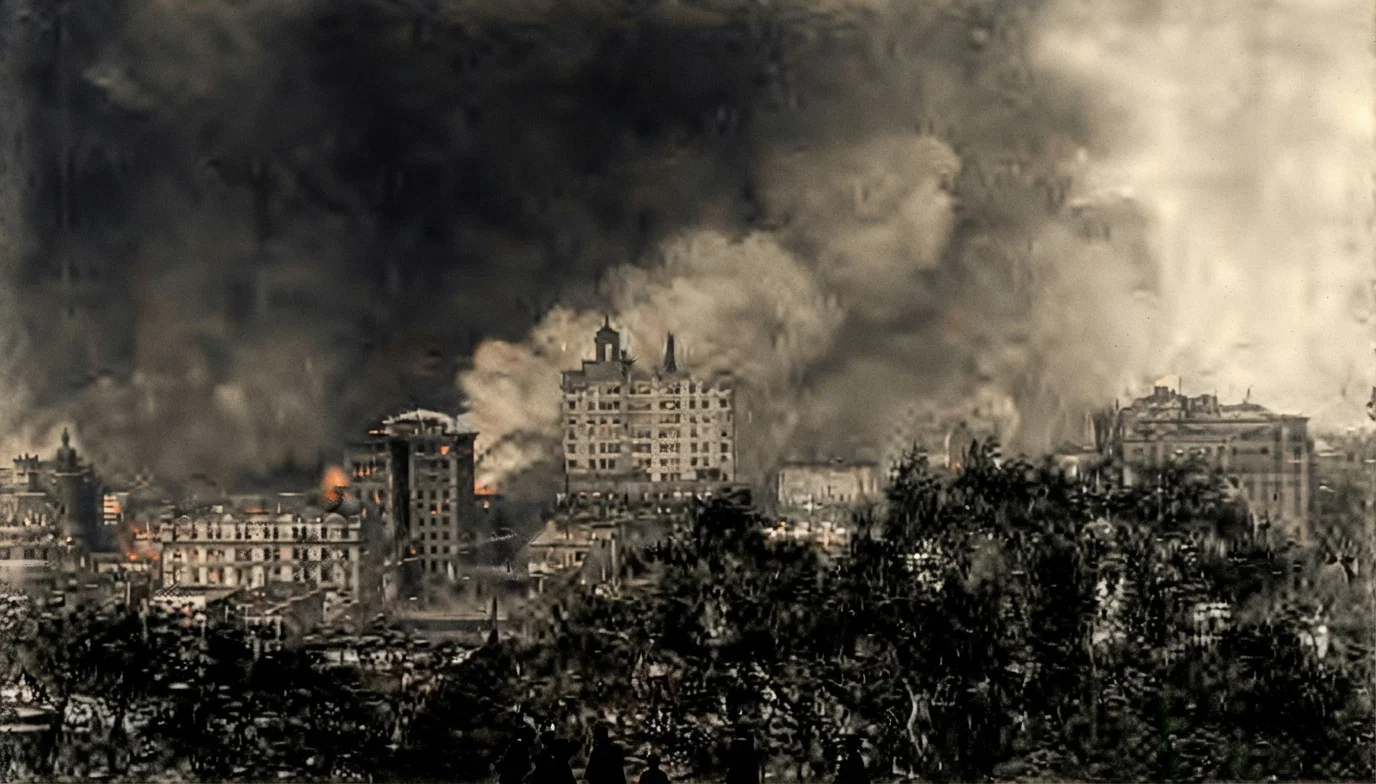
Looking from Chinatown, San Francisco. The high building in the center is Merchant's Exchange; on the left, the Hayward's Building; on the right, the Mill's Building. The photograph was taken in the forenoon of Wednesday, April 18.
The subject of Christ's teaching was the Word of God. He met questioners with a plain, "It is written;" "What saith the Scriptures?" "How readest thou?" At every opportunity, when an interest was awakened by either friend or foe, He sowed the seed of the Word. He who is the Way, the Truth, and the Life, Himself the living Word, points to the Scriptures, saying, "They are they which testify of Me."
POWER.
By Rev. A. D. Mink
A LADY on whom I called the other day interested me by her account of a trip on the Great Eastern, forty years ago. The remarkable thing about it was that the voyage was full of discomfort, and the lives of the passengers endangered. Thinking it over, the reason was not hard to find; it was not that the ship was too big, but the engine too small. Men did not dream of cutting down the size, but bent themselves to the task of giving her more power. With the modern engine the same ship could navigate any sea.
So it is with our lives; we do not attempt tasks that are too large, but we fail in that the power is insufficient. The engine is too small. Even the storm of temptation is not removed; weather it we must, but God has promised us His abiding strength. We must not lead low-pressure lives if we would cross the sea. The power was as great forty years ago as now, but the difference was with man. He had not learned to utilize and apply it. We are not to pray to be taken out of the world, but to be kept in it. The difference between two lives, one of which rides the storm and the other is submerged, is not in the ocean, but in the men; better, in the resident power of grace in their hearts. The one tries to breast the waves with an engine far too small, the other takes God's triple-expansion power.
It is as true in the church. The difference between one that succeeds and does God's will, and another that fails, is not in the field, not in surrounding conditions, but in the dynamic. The ship oftentimes is run with an engine antiquated and weak. We can not watch a modern ocean greyhound wrestling with the storm without seeming to hear her say, "It is for this I am built." The tremendous power in the engine is a match for any sea. God does not desert us in the time of need, but the Spirit waits to empower the disciple for service. —Rev. A. D. Mink.
THE TWO VITAL THINGS.
By Alexander Maclaren
"THIS do in remembrance of Me—this is My body broken for you—this is My blood shed for many for the remission of sins." There is the point out of which all the line is developed; there is the fact from which all the energy that Christ wields in the world does spring. It is the death of Christ and the resurrection of the Christ who dieth no more, from which everything else that is blessed and powerful and deep and wise and illuminating in the Christian teaching must be derived. We are not to forget His blessed words of wisdom; we are not to forget the magnetic influence of that marvelous personality, as it walked yielding light, and healing—like the beams which fall upon those affected by lupus—all manner of foulness with which it came in contact; we are not to forget the works of power which He did; but central to them all is this—He died, and He rose again.—Alexander Maclaren.
The ROYAL LAW
By F. C. Gilbert
BY F. C. GILBERT.
(A Hebrew Christian.)
Mount Sinai
II. THE LAW GIVEN TO ADAM AND HIS POSTERITY.
THE prayer of David needs oft to be repeated at the present time: "Uncover mine eyes and I shall see attentively wonders out of Thy law." Ps. 119:18. There is much in God's law at the present time that needs to be seen; and there is much in that law which God desires to reveal. The purpose of this article is to deal with the law from the time of the creation of man to Sinai, and God's dealing with man as regards the law of Jehovah.
Adam and God's Law.
Did Adam know anything of God's law? Were its precepts made known to him? Was he governed by this law? Were its commands obligatory upon him and his posterity prior to the time when Jehovah came down upon Mount Sinai in blazing glory and delivered these precepts orally to the multitude? If we were to answer the question from the narrative in Genesis without close examination, we should doubtless reply in the negative; for there the Scripture tells us very little of the history of God's dealing with Adam and the early peoples for nearly two thousand years. Tho we may not find it there, we do know it from other parts of the Bible.
In Isa. 43:27 we read, "Thy first father was a sinner." Hebrew translation. Who was the first father of men? "And God said, Let us make man in our image, after our likeness. . . . So God created man in His own image, in the image of God created He him. . . . And the Lord God formed man of the dust of the ground." Gen. 1:26, 27; 2:7. "For Adam was first formed." 1 Tim. 2:13. "And so it is written, The first man Adam was made a living soul. . . . The first man is of the earth, earthy." 1 Cor. 15:45-47. We see, therefore, that Adam was the first man, the first father, and the first man of the race to sin. But sin is the transgression of the law. 1 John 3:4. And the law which defines sin is the law which is known as the moral law, the Ten Commandments. James 2:10, 11; Rom. 7:7.
Again: We read that "where there is no law, there is no transgression." Rom. 4:15. This is because by the law is the knowledge of sin. Rom. 3:20. And, moreover, where there is no law, there "sin is not imputed." Rom. 5:12. This statement must be apparent on the face of it. But God says that Adam sinned. It is perfectly clear, therefore, that Adam knew God's law; he violated that law, and as a result became a sinner. "Wherefore, as by one man sin entered into the world, and death by sin; and so death passed upon all men, in whom [margin] all have sinned." "For all have sinned, and come short of the glory of God." Rom. 5:12; 3:23.
Why Not in Genesis?
It may, however, be asked, Why was not the law placed in the first part of Genesis? Simply because the story of Creation is not to tell us about God's law in detail, as it is to tell us the cause of man's fall, and the plan of God in devising a way of escape. But this is not the only place in the Bible where things have been omitted, and more of the details have been learned later. For instance: in Gen. 5:18, we are told of the birth of Enoch. In verses 21-24, we are informed of the rest of his life on earth. But in reading later Scriptures, we are told of other things about him which we do not find in Genesis, as in Heb. 11:5 we are told something of the testimony he received before his translation, and in Jude 14, 15 we are made acquainted with the fact that he was a prophet, and there is given a remarkable prophecy he uttered. Again: in Deut. 34:5-7 we are told of the death of Moses, and that God buried him in a valley in the land of Moab. But when the Saviour was on earth we find at His transfiguration that Moses was on the mount with Elijah. Matt. 17:1-13. But how came he to be there if he had died and was buried? There is one, and only one, way that a person can live again who has once died, namely, by a resurrection. This information is supplied to us also by Jude, verse 9.
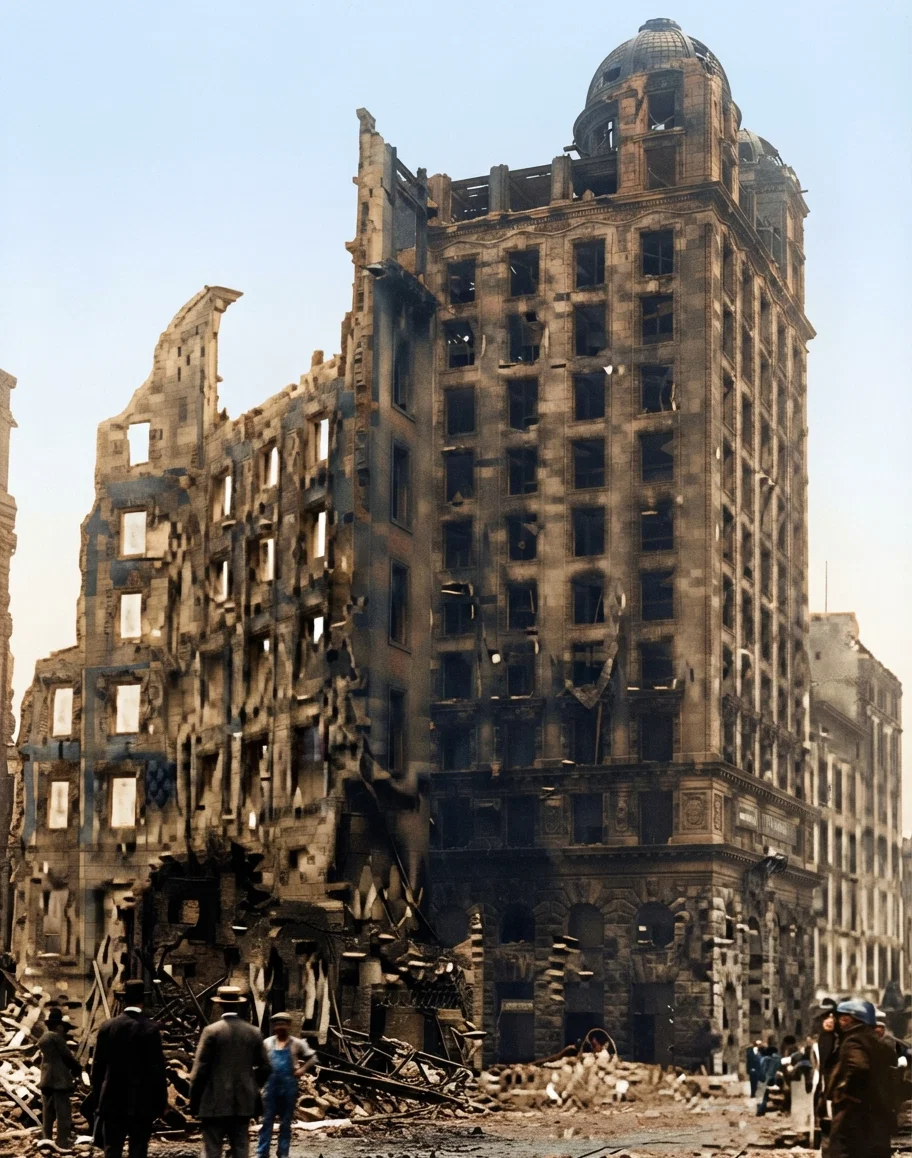
A view in San Francisco. The empty shell of the Call Building after the fire, on the right; the front wall of the Examiner Building on the left.
Once more: in Acts 20:35 Paul tells us of one statement that Jesus made that none of the evangelists or other apostles record, that the Lord Jesus said, "It is more blessed to give than to receive." But even tho these things are told us by later writers, they are just as truly inspired of God as tho we had read them in connection with the lives and history of the people when they were in activity. Even so it is with Adam and the law. The Holy Spirit inspired these men to supply these facts that were lacking, and what was involved by the action of Adam as regards the law.
Let us carry this still farther: We read that Cain was a murderer, because he killed his brother. 1 John 3:12, 15. But how could Cain be regarded as a murderer if there was no law against killing? "Where there is no law, there is no transgression," because "by the law is the knowledge of sin." Paul says: "I had not known sin, but by the law." Rom. 7:7. Cain himself finally admits that he did kill his brother, and recognized the punishment that was inflicted upon him for it. Gen. 4:13-15. God certainly would be unjust to accuse Cain of being a murderer, if he had never informed him against killing? But we know that God is just (Rom. 3:26), and will never condemn any one for what they did not know, nor could not know.
All the Law Violated.
But we find that before the law was given on Sinai every one of these precepts was violated, as will be seen by the following: Jacob accused his sons of having strange gods in the camp; and before he and his family could go to Bethel to worship the true God, they must first remove the strange gods from their midst. Gen. 35:1, 2. Joshua accused the ancestry of the Israelites of worshiping other gods on the other side of the river. Joshua 24:2. Then it is evident the first commandment must have been known, and been in force.
A view of the Call Building burning. The clock in the foreground marks the hour, 10:40 a. m. The structure on this side is the Mutual Life Insurance Building.
Laban accused Jacob of stealing his images; and went so far as to investigate all his goods to see if he could not find them, he was so desirous of having these teraphim. Rachel, having some knowledge of the true God and not desiring her father to be a worshiper of images, took them along with her. Gen. 31:19-35. Therefore some persons must have known the law of Jehovah concerning the second commandment. The third commandment is against swearing and profanity. Yet the Lord tells us that Esau violated this command-9ment, for he was a profane man; and the sin of profanity was so awful that when he sought to recover his birthright he could not secure it, tho he wept most bitterly in order to gain it. Gen. 25:31-33; Heb. 12:16. If Esau had not known the law of the third commandment, how could he have been guilty of being a profane person? He certainly knew it, violated it, and lost his life.
["Why the Law Was Given on Sinai" is the subject of the next article.]
PRACTICAL SUGGESTIONS FOR WILLING WORKERS.
By William S. Sadler
IT may be well to consider briefly some of the methods of reaching our neighbors by personal effort and through the family circle. There are few more profitable and successful ways of spreading the truth for to-day than through sociable contact and neighborly approach. After all, it is hand-picked fruit that is the best, and personal work far outweighs efforts made in public, tho of course public efforts have their place in the dissemination of truth.
1. Heart to heart personal work. By direct personal interest and judiciously conducted conversation, efforts may be made to appeal to the unconverted, and lead them to a knowledge of Christ and of the Third Angel’s Message.
2. Informal gatherings may be held in your own home. Carefully managed and prudently conducted, such gatherings can be made the means of presenting the truth in such a way that the Spirit of God will arouse an interest in the Message and bring many to take their stand for truth, who otherwise might never hear of it. Such meetings must never be allowed to assume the style of a stiff church service, or much of their influence will be prevented and their object defeated.
3. Similar gatherings may be suitably held, as occasion permits, in the homes of your neighbors. These may be either by appointment or as informal assemblies. Special wisdom of God is needed that at these times the message, the everlasting Gospel, shall be presented so that the hearers shall be favorably impressed.
4. Then there are Bible-readings. When these are carefully and prayerfully given, after proper preparation, to individuals and small companies, upon subjects in which they are interested, they may by degrees be led on step by step, till they come to a saving knowledge of the whole truth.
5. In winter, afternoon or evening studies might be arranged for at your home, to which your friends and neighbors could be invited; the local church being requested to co-operate in an effort to secure the attendance of those interested, or likely to be.
6. Under the guidance and supervision of older ones, our youth should be encouraged to do personal work for the unsaved, especially among other young people.
7. Have we fully realized the possibilities of a two-cent stamp, a little time and paper, as a means of carrying saving truths across the continent? If not, let us begin the use of the missionary letter as a means of scattering the truth.
8. Tracts are admirable for use when corresponding with friends. The “Apples of Gold Library” may be made excellent use of in this way.
9. What a world of possibilities there is in the literature we possess! Let all take hold earnestly and scatter the printed page. Periodicals, tracts, books, offer unlimited opportunities for this work, and they should be freely used. Of course, they should be distributed with discretion, care being taken to give meat in due season.
10. Invite the neighbors to dine with you occasionally. This will give you an opportunity to show them the advantages of right living, and enable you to drop seeds of truth also into the soul, while the stomach is satisfied with pure and wholesome food.
11. Cultivate the acquaintance and friendship of those in your locality. Visit them. Accept any invitation to dine with them; and always seek for opportunities to sow beside all waters.
12. Seek out the sick in your neighborhood. Prepare a wholesome dish and send or take to them. If competent, you could perhaps give some simple treatment which would be acceptable and helpful. In this way the door may be opened for you to minister to the soul as well as to the body.
13. Occasions of sorrow, distress, bereavement, etc., afford rare opportunities for Christian help work that is most welcome. At such times, be ready to seize these openings of Providence. Improve every such opportunity to perform acts of kindness, and show a heart of sympathy and love.
14. It is important that we “visit the fatherless and widows.” Is there a drunkard’s home near you? Call on the sorrowing wife. If she has children, endeavor to assist her with Christian counsel. You will find her heart good soil for seeds of truth. And her own conversion may bring about her husband’s also.
Such are a few of the lines of work that might be followed, according to varying circumstances, by almost any one with a true missionary spirit. Experience comes as we engage in this work. Mistakes made to-day should be used as guide-posts for help on the morrow. Christ says “Go, work to-day in My vineyard;” then let us respond, and go, with willing minds, and glad hearts, thankful for the privilege of doing something, however small, that will hasten His coming, and extend His kingdom upon earth. We shall find that His angels have gone before us and prepared the way. His Holy Spirit will bless the efforts we make, and water the seed sown. May God help us all to be active workers, faithful ambassadors, loyal followers, of the Lord Jesus.
W. S. SADLER.