"What is your name?" asked the teacher.
"Tommy Brown, ma'am," answered the boy.
He was a pathetic little figure with a thin face, hollow eyes, and pale cheeks, that plainly told of insufficient food. He wore a suit of clothes evidently made for some one else. They were patched in places with cloth of different colors. His shoes were old, his hair square in the neck in the unpractised manner in which women sometimes cut boys' hair. It was a bitter day, yet he wore no overcoat, and his bare hands were red with cold.
"How old are you, Tommy?"
"Nine years old come next April. I've learnt to read at home, and I can cipher a little."
"Well, it is time for you to begin school. Why have you never come before?"
The boy fumbled with his cap in his hands, and did not reply at once. It was a ragged cap with frayed edges, and the original color of the fabric no man could tell.
Presently he said, "I never went to school 'cause—'cause—well, mother takes in washin' an' she couldn't spare me. But Sissy is big enough now to help, and she minds the baby besides."
It was not quite time for school to begin. All around the teacher and the new scholar stood the boys that belonged in the room.
While he was making his confused explanation, some of the boys laughed, and one of them called out, "Say, Tommy, where are your cuffs and collar?" And another said, "You must sleep in the rag-bag at night by the looks of your clothes."
Before the teacher could quiet them, another boy had volunteered the information that the father of the boy was "old Si Brown," who was always as drunk as a fiddler.
The poor child looked around on his tormentors like a hunted thing. Then, before the teacher could detain him, with a suppressed cry of misery he ran out of the room, out of the building, and was seen no more.
The teacher went to her duties with a troubled heart. All day long the child's pitiful face haunted her. At night it came to her in her dreams. She could not rid herself of the memory of it. After a little trouble she found the place where he lived, and two ladies went to visit him.
It was a dilapidated house. When they first entered they could not discern objects, the room was so filled with the steam of soapsuds. There were two windows, but a tall brick building adjacent shut out the light. It was a gloomy day, too, with lowering clouds, that even forbade the memory of sunshine.
A woman stood before the washtub. When they entered, she wiped her hands on her apron and came forward to meet them.
Once she had been pretty, but the color and light had gone out of her face, leaving only sharpened outlines and haggardness of expression.
She asked them to sit down. Then, taking a chair herself, she said, "Sissy, give me the baby."
A little girl came forward from a dark corner of the room carrying a baby that she laid in its mother's lap—a lean, sickly-looking baby, with the same hollow eyes that Tommy had.
"Your baby doesn't look strong," said one of the ladies.
"No, ma'am, she ain't very well. I have to work hard, and I expect it affects her."
"Where is your little boy Tommy?" asked one of the visitors.
"He is there in the trundle-bed," replied the mother.
"Is he sick?"
"Yes'm, and the doctor thinks he ain't going to get well." At this tears ran down her thin, faded cheeks.
"What is the matter with him?"
"He was never very strong, and he had to work too hard carrying water and helping me to lift the washtubs and things like that. Of late he has been crazy to go to school. I could never spare him till this winter. He thought if he could get a little education he'd be able to help take care of Sissy and baby and me. So I fixed up his clothes as well as I could and last week he started. I was afraid the boys would laugh at him, but he thought he could stand it if they did. I stood at the door and watched him going. I can never forget how the little fellow looked," she continued, the tears streaming down her face, "His patched-up clothes, his poor little anxious look. He turned around to me as he left the yard, and said, 'Don't you worry, mother, I won't mind what the boys say.' But he did mind. It wasn't an hour till he was back again. I believe the child's heart was just broke. I thought mine was broke years ago. If it was, it was broke over again that day. I can stand most anything myself, but, O, I can't bear to see my children suffer." Here she broke down in a fit of convulsive weeping. The little girl came up to her quietly and stole a thin little arm around her mother's neck. "Don't cry, mother," she whispered, "Don't cry."
The woman made an effort to check her tears, and she wiped her eyes. As soon as she could speak with any degree of calmness she continued:
"Poor little Tommy cried all day; I couldn't comfort him. He said it was no use trying to do anything. Folks would only laugh at him for being a drunkard's little boy. I tried to comfort him before my husband came home. I told him his father would be mad if he saw him crying. But it wasn't any use. Seemed like he couldn't stop. His father came and saw him. He wouldn't have done it if he hadn't been drinking. He ain't a bad man when he is sober. I hate to tell it, but he whipped Tommy, and the child fell and struck his head. I suppose he'd been sick anyway. But O, my poor little boy! My sick, suffering child!" she cried, "how can they let men sell a thing that makes the innocent suffer so?"
One of the ladies went to the bed. There he lay, poor, little, defenseless victim. He lived in a Christian land, in a country that takes great care to pass laws to protect sheep, and diligently legislates over its game. Would that the children were as precious as beasts and birds.
His face was flushed and the hollow eyes were bright. There was a long purple mark on his temple. He put up one little, wasted hand to cover it, while he said, "Father wouldn't have done it if he hadn't been drinking." Then in his queer, piping voice, weak with sickness, he half whispered, "I am glad I am going to die. I am too weak to ever help mother, anyhow."
He turned his head feebly on his pillow, and then said, in a lower tone, "Some day—they ain't going—to let the saloons—keep open. But I'm afraid—poor father—will be dead—before then." Then he shut his eyes from weariness.
The next morning the sun shone in on the dead face of little Tommy.—Selected.
HELPING MOTHER.
"PLEASE, mama, can't I help you?
I'se tired of make believe,
I want to play real earnest—
Wish I could sew a sleeve."
The precious face was clouded,
The eyes had wistful grown,
The pretty lips were quivering
Like a rose by the wind waves blown.
"I'se dot so tired of kitty—
He scratched me on my head—
And dolly's been so naughty,
I'se putted her to bed.
"Put a knot in bose ends, mama,
So the thread won't all pull out,"
The little face was glowing—
Gone every tear and pout.
The little dimpled fingers
Were working hard full soon,
And baby "helped" her mama
The livelong afternoon.
At last the work was finished,
Crooked and puckered in,
But mama kissed her darling
For the "help" that she had been.
So God takes our poor striving,
Tho our seams are crooked, too—
'Tis not always what we have done
But what we try to do.
—Selected.
Small Debts and Greater Debts
By Samuel Johnson
SMALL debts are like small shot; they are rattling on every side, and can scarcely be escaped without a wound: greater debts are like cannon; of loud noise, but little danger. —Dr. Johnson.
ARE WE EDUCATED?
PROF. FRANK J. MILLER, examiner of secondary schools, is reported to have said, at the Junior Chapel of the University of Chicago, a short time ago, that only those who can answer all the following questions in the affirmative are educated:
Has education given you a sympathy for all good causes?
Has it made you easier to interest yourself in them?
Has it made you public-spirited? Do you look beyond your door-yard and take interest in a clean city?
Has it made you a brother to the weak? Have you learned the value of money and time?
Have you learned how to make and keep friends?
Do you know how to be a friend to yourself?
Can you look an honest man or pure woman straight in the eye?
Do you see anything to love in a little child?
Will a lonely dog follow you in the street?
Can you be high-minded and happy in the drudgeries of life?
Can you think washing dishes and hoeing corn are just as compatible with high thinking as going to school?
Can you be happy alone?
Are you good for anything to yourself?
Can you look out on the world and see anything but dollars and cents?
Can you look into a mud puddle and see the blue sky reflected?
Can you see good in everything?
Can you look upon the sky at night and see beyond the stars?
Does your soul claim relationship with the Creator?—School Journal.
"I'LL TAKE WHAT FATHER TAKES."
NEAR the close of a lovely June day, a company of brilliant men gathered at a garden banquet. The pavilion was set among beds of flowers, and opened toward the west.
The table was a dream of beauty with its fruits and flowers, its flashing glass and glittering silver. Some of the noblest of the land sat around the board. Among them was an eager, bright-eyed boy, brought to his first club dinner by his father, an honored judge.
Wit and wisdom sparkled back and forth, and wine gleamed like ruby and amber. The boy saw and heard everything. This was an enchanted land. For the first time he looked upon the faces and heard the voices of great men who had been his heroes from afar. Their words, their bearing, their dress, were full of interest. Yet of all this goodly company, to him his father was the king.
An empty glass stood by his plate—a dainty shell with points that caught the light like diamonds. A waiter stopped beside him with a tray of costly drinks and named them over glibly, questioning: "What will you take?"
The judge was an abstainer at home. The boy had never tasted wine. The names were strange to him. But he said with ready confidence, "I'll take what father takes." The father heard. The glass in his uplifted hand shed over it a crimson light like blood. All eyes were upon him. Was he afraid to drink? In a swift vision he saw the serpent in the cup. For policy, for pride, for social custom, should he set this deadly thing upon his best beloved? There was a hush as he set down the untasted wine and said distinctly, "I'll take water—cold water."—Crusader's Monthly.
A KNIGHT OF INDUSTRY.
By The Christian Advocate
A NEW sort of a notable has been the honored guest of American scientists this fall in the person of Sir William Henry Perkin, the English chemist. In 1856, young Perkin, then but eighteen years of age, was an enthusiastic analytical chemist. While seeking to produce a certain drug from coal-tar by chemical means, he stumbled upon a new coloring substance called anilin purple, afterward named "Perkin's violet," and now best known as "mauve." From this initial discovery was developed the entire series of coal-tar dyes or anilin colors, now used thruout the industrial world, from the calico-printers of Fall River and Manchester to the Moqui basket-makers and Navajo blanket-weavers, and, alas! at the rug-looms of the Caucasus and Central Asia. Last July the king knighted this captain of industry, and British and European scientists celebrated the jubilee of his discovery. Now America, which has reaped its full share of the fruits of the coal-tar color industry, offers its token of esteem. Germany, which was one of the first countries to pursue the line of research indicated by the discovery of mauve, now exports coal-tar by-products in the form of colors, perfumes, drugs, etc., to the value of $100,000,000 annually.—The Christian Advocate.
COPYRIGHTS &C
Anyone sending a sketch and description may quickly ascertain our opinion free whether an invention is probably patentable. Communications strictly confidential. HANDBOOK on Patents sent free. Oldest agency for securing patents.
Patents taken through Munn & Co. receive special notice, without charge, in the
Scientific American.
A handsomely illustrated weekly. Largest circulation of any scientific journal. Terms, $3 a year; four months, $1. Sold by all newsdealers.
MUNN & Co. 361 Broadway, New York
Branch Office, 625 F St., Washington, D. C.
GIPSY SMITH'S MISSION HYMNAL
Including CHURCH HYMNS and GOSPEL SONGS
The newest Sacred Songs, the famous Welsh Revival
Songs, and 400 others used by the Great English Evangelist
Boards $25, Cloth $30 per 100; 30c and 35c by mail
THE BIGLOW & MAIN CO., . . . New York or Chicago
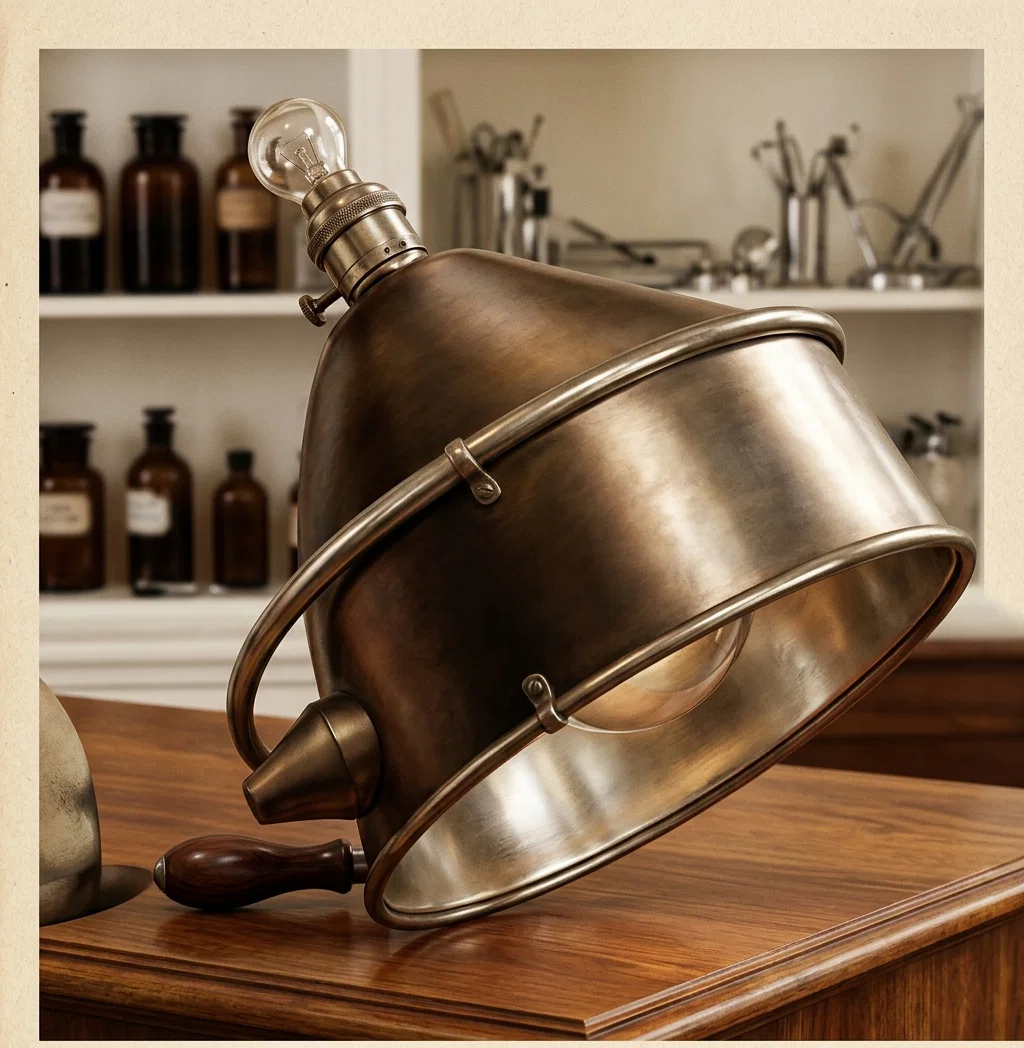
RADIODESCENT THERAPEUTIC LAMP
Relieves pain instantly
1500 c. p. light. 700 deg.
More effective than fomenta-
tions, X-rays, or drugs
in curing disease
Special discount to S. D. A. only
Made only by
Mich. Sanitarium, Kalamazoo, Mich.
Important Discovery!
With this cutter and our formula, you can make from peanuts, beans, white flour, etc., an excellent vegetable meat. This can be done at home at a cost of 5 cents a pound
CUTTER has four knives and opens flat for cleaning
FORMULA & CUTTER $4.00
FORMULA alone 25 cents
Waterloo Vegetarian Meat Formula Company
309 Iowa Street,
Waterloo, Iowa
Bank of Mountain View
By Editor
If you haven't already done so, why don't you drop us a postal asking us to send you a copy of our monthly paper, "The Bank of Mountain View Journal." It is very interesting. It is full of good ideas, and it is free to you for the asking. If you live in the East, send for a copy and see how we do it in California. We still hold ourselves ready to furnish you with information about Mountain View. Write us.
Address
Bank of Mountain View
Mountain View, Santa Clara County, California
For Sale
For Sale.—Improved, 127-acre ranch, located in a beautiful southern California valley; healthful climate; pure water in abundance. Under cultivation. Adapted to grain, gardening, fruit and berry culture, etc. S. D. A. church and school convenient. Write for particulars. C. B. Runnels, R. F. D. No. 1, Escondido, Cal.
VIEW NEW YORK HARBOR
from the convenient New York terminals of the Grand Trunk-Lehigh Valley Route. Double track. For time tables, descriptive literature, etc., write Geo. W. Vaux, A. G. P. & T. A., Grand Trunk Railway System, 135 Adams Street, Chicago.
The Applause of Others
"What is the applause of others if our own hearts deride us?"
THE "BAD BOY."
I FIND the following device very effectual in dealing with that ever present "bad boy." Is he really bad or just "bubbling" over with mischief? As a matter of course every time he does wrong he expects that "never failing" lecture, and why shouldn't he? Hasn't he had it ever since he can remember? Let him go out with the others. Of course he will think you have forgotten all about the matter—let him think so.
Then at the close of the day have a little work that you want some help with; if there is nothing on hand the library is easily disordered. Look over the room in a rather hesitating manner and ask John if he could stay a few minutes to help you. (Don't tell him to, let him think he is doing you a favor.) Then the wise teacher has just the opportunity she wants to talk with John, and the children aren't all listening to hear "Teacher lecturing John," and John doesn't know he is getting a lecture.—Selected.
Railways.
By H. W. Miller, M. D.
Peking to-day has two railroads which have succeeded in passing thru the walls, with stations located near the center of the city. Another railroad, called the Peking-Kagan line, has stations at each of the gates on the west side. This line passes north, and will connect with a southern branch of the Trans-Siberian road. It passes under the Great Wall and thru three tunnels, the longest of which will be a mile in length. When completed, this road, connecting as it will with the Peking-Hankow line, will form a very direct route from China to Russia, and will be the quickest mail route between Central China and Europe. It will also carry the tea from the great Russian warehouses at Hankow direct to Russia. This new line so far has been entirely under Chinese engineers, and only Chinese workmen are employed. Of the three roads entering Peking it is by far the best managed with reference to the conveniences offered to passengers. The other line is the one connecting Peking and Tien Tsin, trains running both ways forenoon and afternoon. This trip requires but three hours' time. Tien Tsin is the most northern commercial port of China. It is to be for North China what Shanghai and Hongkong are to Central and Southern China. This railroad has thus brought Peking in close touch with a seaport, making it convenient to ship modern conveyances of all kinds there, resulting in a great transformation in this ancient city.
General Improvements
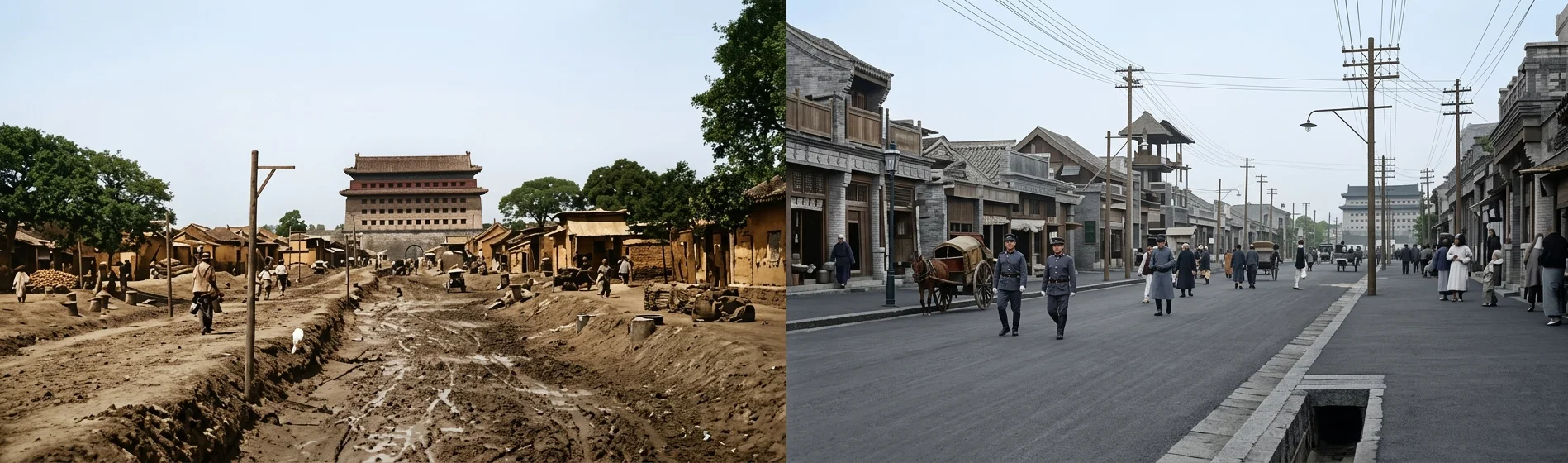
Macadamized roads, with sewers on either side, are everywhere supplanting the old mud road and trenches formerly used. Along either side of the main streets are street lamps, not over two rods apart; and corresponding to about every block, is a policeman stationed, dressed in foreign clothes and having no queue. Since this costume resembles that of the Japanese policeman, it is rather difficult to distinguish the two. On the streets are men employed, who are continually sweeping them, so they are kept like the boulevards in foreign cities. Also along each side of the street are telegraph and telephone poles. Almost all the important officials are already in communication by telephone. Carriage and bicycle shops are frequently seen, and these two conveyances are already much used. While Peking has opened no concessions for foreigners to conduct business, other than the land allotted to the legations and missionaries, nearly every foreign article is procurable, the Japanese especially having many stores and restaurants.
The Foreign Quarter.
The foreign ministers of the powers are all situated in one corner of the city, each having ample room and commodious buildings.
View of Street in Peking before Recent Improvements. View of the Same Street at the Present Time.
The American Legation is near the South Gate, Hon. W. W. Rockhill being the United States Ambassador to China. All of the countries have from one to two hundred soldiers in their legation for protection. The Germans have many more. Just across from the Foreign Ministers, the Catholics have a large, three-story hospital, and adjoining it an immense church. To the east of the Legations are thirty-two mo, or eight acres, occupied principally by buildings of the Methodist mission. There are eight large houses with all modern conveniences.
In connection with this mission are the following institutions: The Lockhart Medical College, the Peking University, the Woman's College, the Methodist Hospital, and the Woman's Hospital. All of these are buildings of modern convenience, being equipped with hot water and lighted with electricity or gas. It was surprising to find that in these buildings the most modern equipments were furnished, and nothing ordinarily used in securing comfort was omitted in their construction.
Idolatrous Temples.
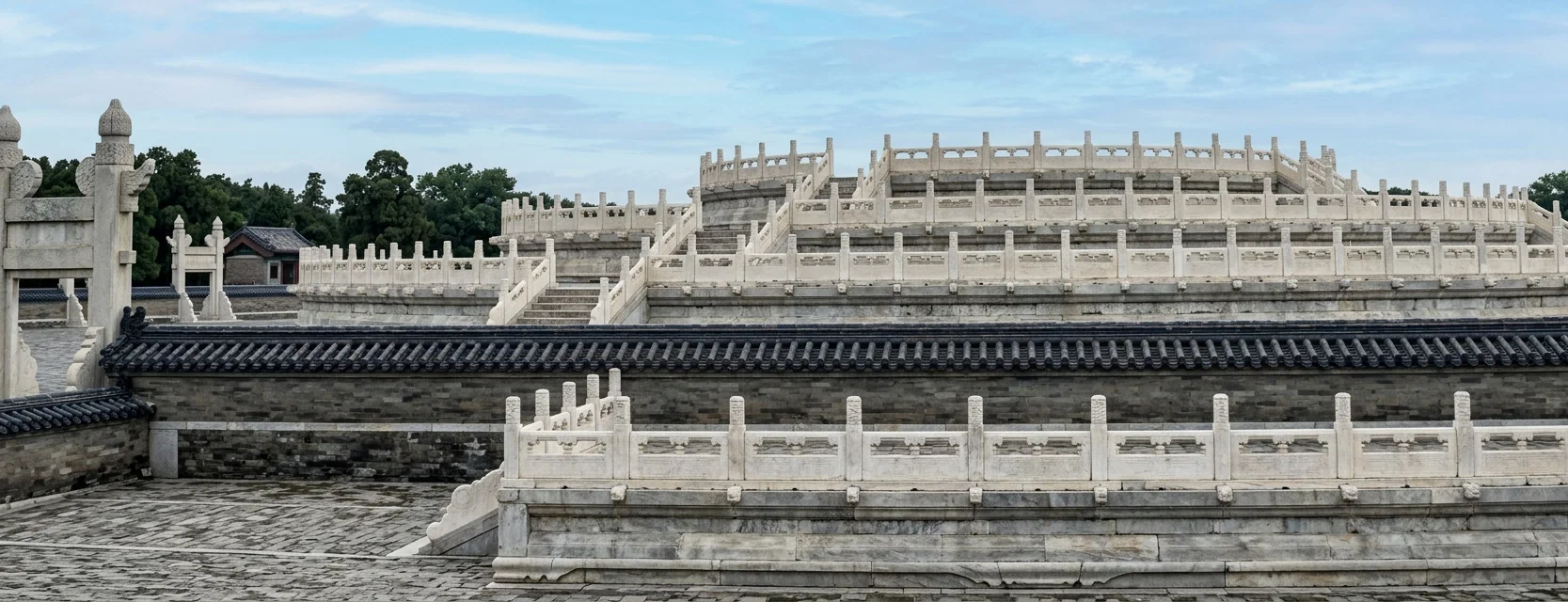
Peking, with these many modern improvements, has not cast off that which makes China a heathen nation, so that there is a great commingling of the ancient and the modern. Stepping off from the macadamized road one is soon surrounded with temples filled with idols that have been worshiped for several centuries. Four of these temples are of special interest, as they stand as models for the propagation of these debasing doctrines. One is called the "Temple of Heaven," the grounds on which it is built covering many acres. Here the emperor formerly went once a year to sacrifice to the gods. There are two large altars, one called the open altar, made entirely of white stone. It is circular in shape, being about twenty feet high and eighty feet in diameter at the top and two hundred feet at the bottom. On the inclined portion of this cone-shaped altar are four stone fences, one at the upper circumference, one at the lower, and two between. At each of the four cardinal points are steps ascending to the altar. Outside the outer wall is a furnace and several large iron kettles.
Another, the "Closed Altar" (see page 3), is of about the same construction with the addition of a tall circular building set on the top of the altar. Also to one side is a long building where the animals were slaughtered. This temple is said to be the most elaborate and magnificent structure devoted to the unknown gods in Asia. Another temple is that known as Lamma Temple. Here there is building after building filled with costly idols dressed in the richest apparel. But towering above them all is the one containing the Buddha Idol. This Buddha is seventy-five feet tall, measuring from front to rear seven feet, and laterally ten feet. Before unlocking the door of each temple the priests ask for a tip. On the13altar before the gods, and especially before the great Buddha, were a few ten cent pieces, and the priest would ask the visitors to give a little money to buy some candles, incense, etc., for the idols, but they would use the money to buy rice for themselves.
Across from the Lamma Temple is the Hall of Confucius. In the courtyard in front of this great building are several tablets containing his essays. In the Confucian temples there are no idols, only tablets with monographs engraved thereon. To these the literary class bow down in reverence and respect. Across from the Confucian Hall are the Examination Halls. Surrounding a large enclosure is a long, narrow building with narrow benches, in which the candidates for the highest degrees are examined. And in these halls are about two hundred stone tablets upon both sides of which are carved the Chinese classics. This is called the "Stone Library." Many students come here to study the classics from these stone tablets. In the center of the courtyard which this "Stone Library" surrounds, is the throne of the Emperor Kang Hsu, who reigned in the present dynasty between the years 1692 and 1723, who is classed as one of the greatest of modern scholars of the Chinese language. The emperor compiled a dictionary containing forty thousand Chinese characters, which is to-day the standard dictionary of all China. It was after this throne that the present throne of the Emperor Kang Hsu was modeled. They also have several inscriptions written by this emperor, who was considered the finest pen-man China ever produced.
Changes Taking Place.
Much time might be spent in detailed study of the antiquity of Peking and points of interest there, but even the rulers are turning away to a great extent in their devotions. The population to a great extent are Manchus, who have come from the north and have many characteristics peculiar to themselves, and distinct from the Chinese. The women have large feet, and their hair is wound upon lattice work which almost gives it the appearance of a sail. The officials composing the emperor's cabinet are half of them Manchus and the other half Chinese. On nearly every street there are from two to ten memorial arches, one of which was erected in memory of an eminent foreigner who was murdered.
There are already many missions with their headquarters at this city, but they have not extended their work very extensively in this great metropolis. The people of this city are waiting for the proclamation of the great "Threefold Message," which God is sending forth by His servants at this time. A peculiar and interesting fact to note is that while foreign countries are establishing Christian missions, Japan has just lately made an effort to establish her Pagan religion in this metropolis, and is meeting with success. Her claim for the right to do so is based on the same ground as that of other nations. So that civilization does not mean, by any means, Christianization of this land. What China stands in need of is to see the manifestation of the outpouring of God's Holy Spirit. And this will only come to pass when there are those here who are willing to be led and guided by His Word.
The Open Altar of the Temple of Heaven.
PEKING.
SINCE 1900 the ancient city of Peking has become very much better known to the outside world, as tourists, who formerly ended their trip at Japan, now make the tour to Peking. This is perhaps largely due to the more convenient methods of travel.
OUR WORK AND WORKERS.
By Editor
AT Flagstaff, Ariz., a man and his wife were baptized, February 17.
BROTHER STEWART KIME reports five additions to the rank of Sabbath-keepers at Somers, Mont.
BROTHER J. M. REES writes that ten, mostly youth, have united with the church at Wolf Lake, Ind.
THRU labors of Brethren C. J. Buhalts and B. Hagle three have taken their stand for the truth in Ligonier, Ind.
BROTHER E. B. HOPKINS recently closed a series of meetings at Winnsboro, Texas, in which two families decided to obey.
MR. AND MRS. PAUL CURTIS report that a mother and daughter at Yorkton, Saskatchewan, have begun the observance of the Sabbath.
TWO OF Sister Mary Edward's readers in Galena, Kan., were baptized early in the year. The Bible work is everywhere proving successful.
FOUR have taken their stand on all the commandments of the Lord, at Cleburne, Texas, thru the efforts of Brethren T. W. Field and H. B. French.
SISTER C. D. CRAWFORD, of Elroy, Wis., reports thru the Wisconsin Reporter that two of her readers are keeping the Sabbath, and eagerly studying the whole truth.
A YOUNG man and his wife, and a man who had wandered from the fold, have given their hearts to God, at Noble, Ill., as the result of meetings held by Brother J. J. Irwin.
BROTHER H. H. HALL, the bookman of the Pacific Press, has just returned from an extended trip East and North. He reports the outlook unusually encouraging for the book work the coming year.
THE WELCOME VISITOR (Ohio) contains the news of the death of Dr. A. W. George, who for several years has been laboring in Constantinople. The call comes, Who will take the place left vacant?
IN a business letter just received from B. J. Cady, dated Papeete, February 18, he says, "Our work is progressing here. We want to build two meeting houses this year, one in Huahine, and the other in Raiatea."
IN a letter received from one of our medical missionaries in China, Dr. H. W. Miller, he tells us that he has located his mission at Sin Jang Cheo, on the railway, where he soon expects to begin publication of tracts, etc. Our readers will certainly wish him great success in this new enterprise.
BROTHER W. H. HOLDEN writes to the Montana Bivouac, from Butte, Mont.: "Another soul has responded to the call to serve the Master in present truth. Nearly every day I am adding names to the Butte reading circle, and at present I have my hands full to keep them supplied with reading-matter."
WANTED FOR MISSIONARY WORK.
By Editor
(Always prepay postage.)
Chas. Kunz, Elida, N. Mex., can use to advantage copies of the SIGNS, Life and Health, and other denominational literature in missionary work. He will use carefully all sent to him in that new country.
SIGNS OF THE TIMES. Address, Mrs. James F. Woods, 322 S. Detroit St., Warsaw, Ind.
LATE copies of the SIGNS and other denominational papers. Address, Chas. W. Grundy, Pansy, Mo.
SIGNS OF THE TIMES, Watchman, Life and Health, Life Boat, tracts on all subjects. Also Spanish papers and tracts. Address, J. L. McElhany, 15 Calle E, Ermita, Manila, P. I.
CONTINUOUS supply of SIGNS and all other denominational papers, including Instructor and Little Friend, books and pamphlets, old and new, for use among the Indians. Address, S. B. Taft, Mechanical Instructor, Fort Defiance, Arizona.
Address Wanted
Address Wanted.—The address of Mr. and Mrs. W. S. McCoy, who united with the Roswell, N. Mex., Seventh-day Adventist Church, July 1, 1903, is wanted by Mrs. S. E. Butler, church clerk.