Your ShelfYour Projects

Signs of the Times, Vol. 33, No. 12.

What the People Say

Earlier text: A TOUCHING STORY OF A LITTLE LIFE

OUR LONDON LETTER

THE NEW THEOLOGY.

BRITAIN is in a turmoil over the New Theology. It furnishes texts for ministers of all denominations, and is discussed in the finest drawing-rooms as well as by the man in the street.
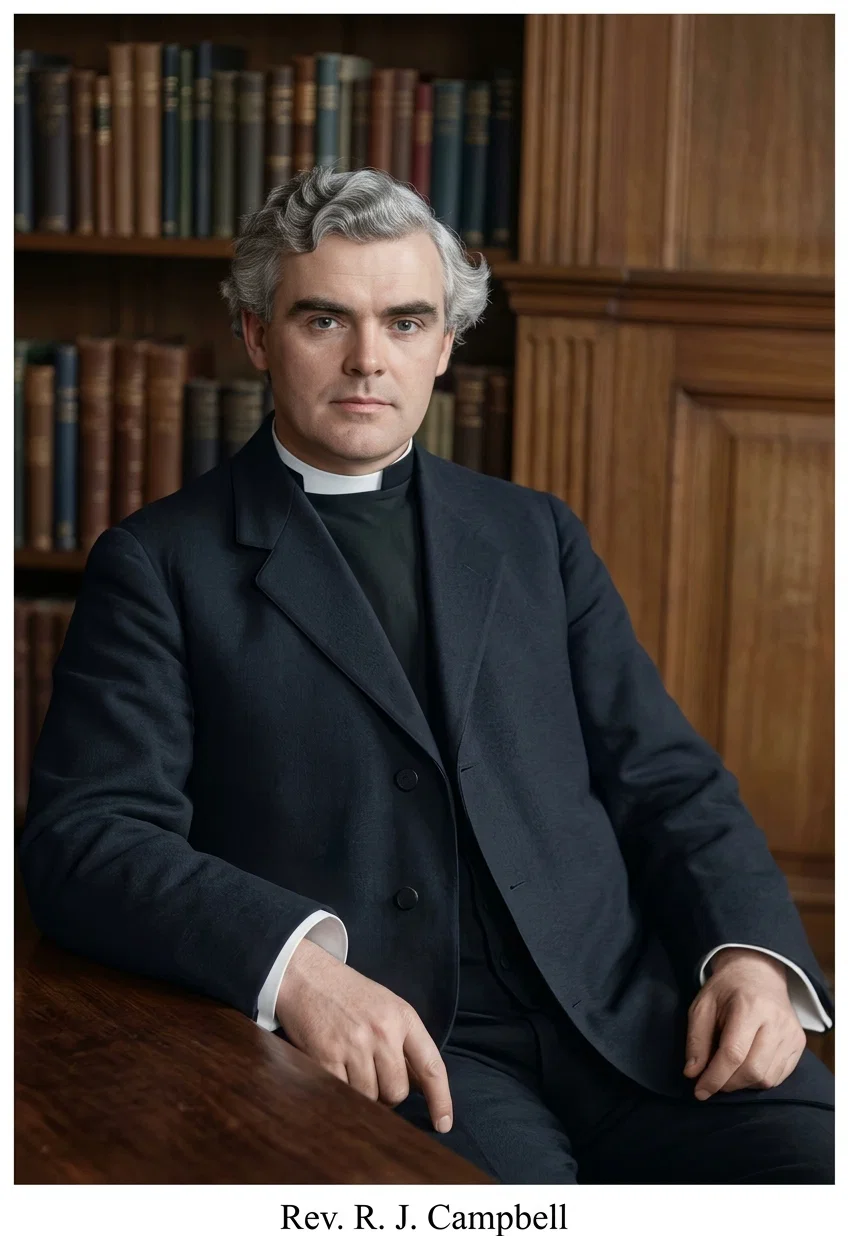
Rev. R. J. Campbell, the author of the new movement, is pastor of the City Temple, a Congregationalist church, and the leading Nonconformist place of worship in London. He has occupied this pulpit since the death of Dr. Joseph Parker in the autumn of 1902, and his wide-spread popularity and winsome personality are important factors in creating this tremendous sensation. There are, however, other contributing factors. Charles Spurgeon noted, even in his day, a "down-grade movement" in theology, and in the last few years several steps have been taken, each under some protests, which have led farther and farther away from true Gospel teaching.
Half a dozen years ago the Encyclopedia Biblica was issued from the press, being a complete Bible dictionary in four large volumes, edited by Dr. Cheyne, a minister of the Church of England. Its leading articles were written by German professors belonging to the extreme school of the higher criticism, and upholding just such doctrines as Mr. Campbell is now presenting from the pulpit. Dr. Freemantle, the Dean of Ripon, made some sensational statements about the same time, which roused a good deal of criticism. A year or two ago, a petition was circulated amongst the ministers of the Church of England, asking that permission be given to introduce the results of scholarship, as it was expressed, in their public teaching. The petition received a number of influential signatures, but nothing definite came of it.
Rev. R. J. Campbell.
Dr. Clifford.
Dr. Clifford.

WHAT THE NEW TEACHING IS.

Now we have the pastor of the City Temple, a man who, perhaps, enjoys more popularity than any preacher since Spurgeon's time, preaching views which are so far removed from Gospel truth that they may well be said to form a metaphysic or a theosophy rather than a theology. No wonder Christian Scientists, Pantheists, Unitarians, and even Mohammedans and Buddhists are claiming Mr. Campbell as an adherent of their respective creeds.
Some brief statement of the New Theology may be proper here, in order that the reader may understand whatever comment may follow. The main points, summed up practically in Mr. Campbell's own words, are as follows:
"To say that Jesus was born without a human father, is untrue." "Whatever Jesus is now, He certainly was not co-equal with God when on earth. What popular theology says of Jesus is true of the ideal humanity which is ever in the heart of the Father. Jesus was and is divine, but so are we; His mission was to make us realize our divinity; that is, our oneness with God." "We believe that the story of the Fall, in a literal sense, is untrue. It is literature, not dogma; the romance of an early age used for the ethical instruction of man." "We reject wholly the common interpretation of the atonement—that another is beaten for our fault." "Ultimately every soul will be perfected." "Sin is simply selfishness. It is that which makes against lifewardness for the race."
Even the leader-writer of the "Referee," a weekly sporting paper, can see that these views involve a departure from the fundamentals of Christianity. He says that the New Theology, to his mind, is uncommonly like the old Free Thought, and adds: "The only thing which makes it in any degree remarkable is the fact that it emanates from one who is still content to describe himself as a Christian and a minister of the Gospel." He continues: "The plain truth is that the New Theology wants to run with the hare and to hunt with the hounds; to have its cake and eat it; to destroy its foundations and to have its superstructures standing. . . . Nothing can be hoped from the half-hearted and self-deceiving attempt to abolish the mysteries of the faith and to retain their significance in their original sense."
City Temple and Holborn Viaduct.
Thomas Spurgeon, son of Charles Spurgeon, and preacher at the Metropolitan Tabernacle, is horrified at what he describes as Mr. Campbell's "open and full declaration of disbelief." Writing in "The Sword and Trowel" of the New Theology, he refers to the anomaly of "so-called Christian teachers denying and destroying the Christian faith," and says that this is done, unfortunately, "not only in the City Temple, but in SCORES OF OTHER CHURCHES." He continues:
"The church of God is only half awake, and the enemy has been busy sowing tares. Concerts have taken the place of prayer meetings, and matters social and political have preponderated over things purely spiritual. We are on the wrong track. The world is to be won for Christ, not by philanthropies, still less by philosophies, but by telling men plainly of their lost andruined state, by earnestly warning them to flee from the wrath to come, by the uplifting of the Son of the Highest as a Crucified Substitute for sinners, and by tearfully entreating men to be reconciled to God."
These are sound words, and they are needed just now when the New Theology, in some form or another, is penetrating into nearly all the popular churches.

WIDE-SPREAD UNBELIEF.

The fact is that Mr. Campbell's position differs from that of many of his colleagues merely in that he has expressed his views freely and openly, while they have temporized with theirs, often for very unworthy reasons. This becomes evident in the criticism directed against his new movement. Very few of the ministers who have attacked Mr. Campbell have referred to the word of God as their authority. IT HAS BEEN TRADITION, CREED, CUSTOM, AND ECCLESIASTICAL SANCTION they have opposed to the new views, and the result has been that the people are at a loss to know where the truth really lies. Some of them think, it would seem, that if they are to have a man-made theology, they prefer Campbell's to that offered by his critics. Mr. Campbell himself declares that he has not given up the Atonement. He says: "On the contrary, I have little else to preach about. The New Theology is an attempt to restate the Atonement in terms of the ETHICAL IDEAL." Another apologist for the movement calls it "a reasonable attempt to restate, in the light of modern thought, the saving truths which Jesus Christ brought to men." Such statements are not very intelligible to the man in the street; but so far as they refer to man-made portions of the creeds now held by the popular churches, they may be seen to have some weight. The unscriptural doctrine of natural immortality and what may be called its corollary, everlasting torment, no doubt will need a good deal of restating before people will be satisfied. When men go outside the Bible for their creeds, they must expect to get something temporary and liable to change.

AS FOR THE ATONEMENT

It is a part of all the evangelical creeds, but in many cases this is as far as it goes. Higher critics have scoffed at the idea for years, and it is a mere convention in thousands of churches where it is not formally denied. How could any true sense of the value of the Atonement exist alongside the utter disregard for God's holy law which is so prevalent? So also with sin and the fall of our first parents. Mr. Campbell comes out openly and denies in a set statement what hundreds of his colleagues are denying in a more quiet way. This, to be sure, does not justify him. No lover of the Gospel can help feeling very sad that a man of such fine attainments and one so well fitted in some ways to minister to the needs of the hungry multitudes, should be so grievously led astray. But for people who live in glass houses it is not seemly to throw stones, and some of Mr. Campbell's critics have been needlessly harsh and severe in their statements, and have not scrupled to attribute more unworthy motives.

THEOLOGICAL TRAINING.

Dr. Forsyth, head of a large Congregational college in London, attributes Mr. Campbell's heresy to lack of theological training. (Mr. Campbell, it may be said in passing, holds the degree of Master of Arts from Oxford University, and has not taken work at a divinity school.) Of course this is poor reasoning. Many of the most eminent theologians have gone astray in much the same way. Professor Adolf Harnack, the famous Berlin theologian, interviewed by a London journalist, said it was "utterly inexplicable" to him how such theories as Mr. Campbell has put forth "should
have provoked such a storm in the English religious world." The Church of England, he went on to say, seemed to him a very comprehensive one. "If a man will only hold to the historic episcopate, he may believe almost as little as he pleases or as much as he pleases. In its all-embracing comprehensiveness, it is indeed like Noah's Ark, which included both clean and unclean, both wild and tame. Accordingly I take it, it must be in the nonconformist circles that so much agitation prevails, and even there it would not have occasioned so much discussion had it not issued from the pastor of a church—the City Temple—which has always been a great stronghold and bulwark of extreme orthodoxy."

PROPHETIC WORDS.

It is quite true that the City Temple has stood, hitherto, for the theology of the Bible. Some of its friends see something almost prophetical in the following paragraph taken from a sermon preached by Dr. Parker on November 29, 1900:
"The house in which we are now assembled may one day be as a den of wild beasts. We have had our opportunities of meeting God here, of reading the holy word, and besieging, as an army might besiege a fortress, the altar, known by its crimson hue; and yet some day a man may arise who will deny the Lord that bought him, who will preach a gospel without a Saviour, a salvation without a cross; then write Ichabod upon the frontals of the place, and let it be forgotten as a thing of shame, a memorial of unpardonable treason against the throne of God."

VARIOUS VIEWS.

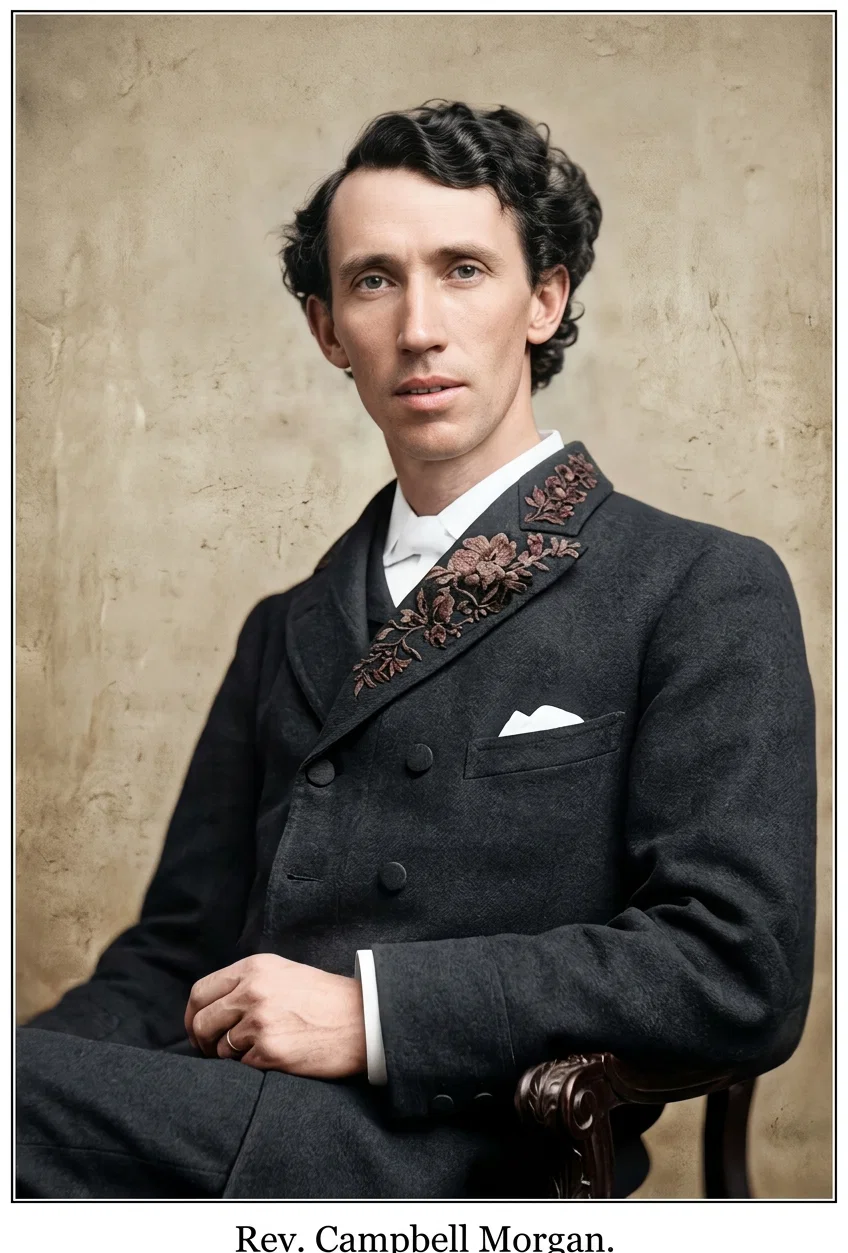
Dr. Clifford, a very prominent Baptist preacher, took sides with Mr. Campbell at the first; but owing doubtless to pressure brought to bear upon him from various quarters, he has since issued a disclaimer, so far as doctrines are concerned, tho he still expresses his warm friendship for the man. But Dr. Clifford's preaching and writings are of very much the same general stamp as Mr. Campbell's, and it is well known that he accepts the main conclusions of the higher critics; so he does not have very good ground to stand on. On the other hand, Dr. Campbell Morgan, the pastor of Westminster Chapel has been a consistent upholder of the authority of God's word. He is the man who, of all the popular preachers, has done the most so far to give the trumpet a certain sound, and it is good to be able to say that his church, which accommodates some three thousand, is packed to the doors, and many are the fervent "amens" as he lays down the fundamental propositions of what he is pleased to call the "old theology." Dr. Morgan said in a recent sermon that the many voices heard might be divided into two camps—those who believed the Bible to be the infallible word of God and those who did not. His own ministry was based on the former conviction, and he was glad to state his reasons for that view. Among other points he showed the danger of depriving the people of the Bible by giving the impression that only the higher critics could understand it. Just at present Mr. Campbell is taking a much-needed vacation in Cornwall, occupying part of his time in writing a book on the New Theology. When he comes back, no doubt the conflict will be renewed even more vigorously. Meanwhile there are most beautiful opportunities for preaching the glorious Gospel which alone can save from sin, which needs no restatement in order to meet the needs of all earth's struggling children—which is a message fresh from heaven, committed as a precious charge to the true minister of the Lord Jesus. Truly the situation today can not but remind us continually of our Saviour's solemn words: "When the Son of Man cometh, shall He find faith on the earth?"

OPENING OF PARLIAMENT.

Parliament opened last Tuesday. The address from the throne foreshadows a constitutional struggle between the Commons and the Lords. The reference is but brief, and the line of attack that the Government may take is yet unknown.

THE SUFFRAGETTES

have made another raid on the House of Commons, resulting in fifty-nine arrests. This movement is not merely an effort to secure the vote for women. It seems to include a desire for notoriety and a dislike for the simple, yet beautiful and highly important, domestic duties in which women have hitherto found their chief joy. As such it is not a good omen. M. ELLSWORTH OLSEN. London, February 15.
Rev. Campbell Morgan.

SUNDAY LAW IN CANADA.

[From Portland (Ore.) Journal.]
VICTORIA, B. C., Feb. 23.—For some time great anxiety has been felt in this province over the effect which the new Lord's Day act, passed by the Dominion Parliament at the last session, would have on its coming into force March 1. The act is a very stringent one. It forbids Sunday excursions, the printing of Sunday papers, or the sale of foreign Sunday papers.
Speculation respecting it is now somewhat quieted by the fact that it is found on looking into it that prosecution under it must be with the consent of the attorney-general of each province. Thus upon the provincial governments is put the duty of saying whether the law shall be enforced stringently or be a dead letter.
It is felt that, in British Columbia at least, the government will not take the stand of approving prosecutions, regarding the law as being too severe.
Representatives of the Lord's Day Alliance waited on Attorney-general Fulton recently and asked him to approve prosecutions for the law's violation. Fulton gave no definite reply, preferring to consult other ministers in the government before doing so.
It is regarded as almost certain that the law will not receive local sanction.

MARVELS OF THE SAVINGS BANKS.

THE savings banks of New York State gained in deposits by $70,000,000 last year. This gain alone is greater than the total savings-bank deposits of Japan or Canada, and almost as much as the total deposits of Holland.
New York's savings-bank deposits are much more than one-third those of the entire United States. They are more than those of all thrifty New England, with Pennsylvania added. They are more than those of any nation in the world save only the German Empire, and even the German Empire has not twice as many.
The savings-bank deposits of New York overtop those of all France by $500,000,000, those of all Great Britain by $360,000,000.
These deposits are $514 for each depositor and $170 for each inhabitant of the State. No other State in the Union equals the latter proportion; only California and Rhode Island reach the former. The German average deposit is $150, the average for each German inhabitant is $40.00. Denmark, Switzerland, and New Zealand have the highest foreign savings-bank deposits in proportion to population—respectively $78.00, $62.00, and $49.00.
—New York World.

Sunday-Law Crusade in Hawaii

The Hawaiian Islands are also having their Sunday-law crusade. There has been sent us an address by Prof. C. D. M. Williams to the members of the Island Legislature, and also an article in the Pacific Commercial Advertiser on the same subject. The address to the Legislature is one which certainly ought to have had its effect in helping that body to see the inconsistency of Sunday laws.

The Senate and Reed Smoot

The United States Senate refused to expel the Mormon Senator, Reed Smoot. It was found that he himself was not a polygamist, and he declared that no religious obligation he had taken could in any way affect his duty to his country. After all, has the Senate of the United States the right to reject any man legally sent to that body by a sovereign State? It seems to have been on this latter ground, rather than on any sympathy with Mormonism that the vote was taken. And yet politics had much to do with the matter. The Mormons are now Republicans, and the Republican vote retained, with few exceptions, the Senator from Utah. The Mormons are not Democrats, and the Democrats voted against the Republican Mormon. It is difficult to tell whether real principle had a place or not in the decision arrived at.

Rome's Path Over Again.

The great Italian historian, Guglielmo Ferrero, draws a likeness between the times and persons of Augustus Cæsar and Theodore Roosevelt. He points out that while Augustus Cæsar tried to check the downward tendencies in Rome, he helped them on; and so President Roosevelt is doing the same thing; that while he lets slip no opportunity of recalling to its citizens the rugged and hard duties to be fulfilled toward the race and toward society, at the same time he is laying plans that will redouble the wealth and power of the cities, the luxury of the upper and middle classes, enfeebling still more among the multitudes the very ideas that are so dear to him. And he questions whether America with its increase of riches and ancient Puritanic traditions will not be destroyed entirely by "the new spirit of pleasure-seeking." It is the same condition in which the Roman Empire was in the second century, no fear of war, invasion, or subjection to a foreign power, at the same time harboring within themselves that which will be destructive to the individual and the State; and that has been pointed out many times in this journal in the past.

MOUNTAIN VIEW, CAL., MARCH 20, 1907

We send no papers from this office to individuals without pay in advance. When persons receive copies without ordering them, they are sent by other parties, and we can give no information in regard to them. Persons thus receiving copies of the SIGNS are not indebted to the office, and will not be called upon to pay for them. Please read the papers you may receive, and hand them to your friends to read.
Our authority is the Bible, the Holy Scriptures of the Old and New Testaments. When the Common ("King James" or "Authorized") Version, or the American Standard Revised Version is used, quotations will not be designated in reference. Any Bible quotation in this paper, therefore differing from the Common Version, unless otherwise indicated, will be almost invariably from the American Standard Revised Version (Thomas Nelson & Sons, Publishers).

Next week our Resurrection Number.

A Missionary Chapter on China

In our Missions Department is an article from Dr. Miller, on Peking, which we take the liberty of inserting in the series by Professor and Mrs. Anderson. It is upon China, and dealing with time matters, would become old before the series closed. It will give us another interesting chapter on this important missionary field.

Is It a Bible Church?

The eighty-first annual report of the American Tract Society declares that "the movement for one Protestant Church in Korea is said to be in entire accord with the basis of the American Tract Society in which evangelical Christians unite, not only upon the Bible, but also upon what the Bible teaches, and thru which they disseminate these doctrines." Now if this be true, that one church will be a commandment-keeping church, which follows the example of Jesus Christ.

A Cure for Opium

A Cure for Opium.—A few weeks ago we published a news item clipped from a religious paper which we do not now recall, stating that a cure for opium has been found in Malaysia. We would be glad if any of our contemporaries or readers could tell us the paper in which this was first found. It was merely given as a matter of news, but it has aroused a number of inquiries, and we would like to learn more definite information concerning it ourselves. We should have given our authority in the note. If our exchanges from which we made the clipping can give us information, we shall be greatly obliged.

Sunday Bill Dead

Sunday-bill Dead.—Our correspondent in Washington, Mr. John S. Wightman, writes us under date of February 28 that the chairman of the Senate Committee practically assured him that the House Bill No. 16,483, for Sunday observance in the District of Columbia, was practically defeated in committee; or in other words, would not be taken up and considered, nor reported. If it did come up, there would be a full hearing. Congress adjourned, and the bill was not reported. It is good to know that there is still a love of the principles of religious liberty among rulers and legislators; not that it will always remain, for we are assured that sooner or later these laws will be passed, and religious tyranny will follow.

OUR MISSION IN INDIA.

It has been some time since we have referred to this splendid work, but all of our friends have not forgotten it by any means and there have come in some funds from time to time to cheer the hearts of the missionaries there. Up to the first of March, there has been sent direct to this office, $3,241.50. This we have forwarded to India by the way of Washington. The Southern California Conference, if we rightly remember, gave $2,500 to this fund, which they sent direct to Washington. Some of our readers have sent donations for this purpose direct to the Mission Board. Just how much has been raised for that purpose we are not able to say as we have had no report from Washington, but we think about $6,000. This will be a great help toward a mission in the mountain regions of India, and a life-saver to the missionaries who are there.
We would say for the encouragement of our readers that already work is being done among the Hindustani people. A neat, illustrated pamphlet has been gotten out on the present truth of the Gospel, printed in the Hindu tongue. We confess to our readers that we are not able to read a word of it, but we are assured by our missionaries and also by the illustrations that it contains needed truth, and that it will prove a blessing to the souls of those for whom it is designed. This will be sold among the educated native peoples by the workers, who can thus in large part support themselves. One of our missionaries, Mrs. Georgia A. Burgess, writes under date of January 21:
"The workers in India have all been much encouraged by the noble efforts of those connected with the Signs of the Times to raise means for a mountain mission. The matter met with a very hearty reception by our workers in the conference just passed, and it was decided that several of the brethren start out as soon as possible to look up a suitable location.
"The Lord has greatly blessed us since our return to India in giving us an excellent opening for our work in one of the most healthful places in India, in preserving our health, and in giving us some souls for our hire from among the Hindustani people. We hope in the next few years to see many workers from among the native people themselves raised up to carry this message to the millions of Hindustani people."
Below we give the unreceipted items to March 1, the date of our remittance to the General Conference: Previously reported ..............................$3,165.50 Mrs. S. and daughter ............................. 25.00 Lillian Glass .................................... 5.00 J. H. Landrum and wife ........................... 6.00 Mrs. Wm. Chinnock ................................ 10.00 John Reid ........................................ 7.00 H. A. St. John ................................... 10.00 W. B. James ...................................... 10.00 H. S. Austin ..................................... 1.00 H. A. Morehouse .................................. .50 A friend ......................................... 1.00 J. W. Patterson .................................. .50 Total ............................................$3,241.50
This new mission among the mountain and hill tribes of India is not designed for a place of rest, but a place of active work, so that those who have been spending six or eight months in the hot, unwholesome, fever-laden coast lands and lowlands of India, may recuperate by spending the rest of the year among the hill tribes. We shall gladly receive further donations for this splendid enterprise, and will receipt them from time to time in this paper.

Disestablishment in England

Disestablishment in England.—A London despatch, dated February 27, declares that a resolution in favor of the disestablishment and disendowing of the Episcopal Church in both England and Wales, was adopted in the House of Commons by a vote of 198 to 90. It does not commit the government to disestablishment, but it shows the tremendous growth of sentiment. It is the first time that the House of Commons has adopted such resolutions. In 1871, the last time the question was before the House, it was rejected by a large majority. An officer of the cabinet, the secretary for Ireland, Birrell, showed how the government stood by saying:
"I fail to see how continuing an established Church can be justified. The Church has done the State no good, and the State has done the Church nothing but harm. Personally, I believe that disestablishment, far from harming the Church as a spiritual body, would restore it to a position of spiritual authority thruout the land."

AN AWFUL RECORD.

IN England, suicides have increased by 200 per cent. in fifty years, and by 150 per cent. in twenty-five years. In twenty years there have been more than 50,000 in England and Wales. Other countries are worse off. According to statistics recently published by the Swiss Government, there have been 16,640 suicides in little Switzerland, 323,600 in Germany, and 274,000 in France. The authority, the Social Gazette, of England, states that in America the number is about 3,000 annually and is increasing. No figures of increase of population accompany these statistics. The population of the United Kingdom in 1851 was 27,534,000, and in 1901 it was 41,458,721. This shows 50 per cent. increase. In 1881 the population was 35,003,000, and in 1905 was 43,217,687. This shows 23 per cent. increase. We think that the number of suicides in America must have been more than 3,000 annually.—The (N. Y.) Christian Advocate.

Religious Legislation and Liberty

The Watertown (N. Y.) "Times" comes to us with a half page of an interview on religious legislation, given to a reporter by Mr. John S. Wightman, secretary of the New York Bureau of Religious Liberty. This interview states very clearly the reasons why religious legislation is opposed, and makes mention also of the great need of doing work of this kind at the present time. And right in this connection we would like to mention that there is one journal in this country that is enlisted in the warfare of freedom for every man, and that is Liberty, published at Takoma Park Station, Washington, D. C. Any of our readers who are interested in fuller discussion than the SIGNS OF THE TIMES is able to give, will receive sample copy of the journal by asking for it.

Sabbath Agitation

Copies of the New Orleans Times-Democrat and Picayune have come to us containing articles on both sides of the Sabbath question. Good! These are only indications of what may be found everywhere. It is God's time to agitate. Men may be silent, but the question will not down. Our earnest hope is that men may decide aright, and base their decisions not on tradition or expediency or anything human, but on the moral law of God, and the example of Christ Jesus.

You have reached the end of this edition.

Signs of the Times · Mar 20, 1907