In our last study, we learned that the time of the application of the great prophecy is the present, and that the harlot Babylon and her daughters were symbols of the apostate church united with the state. It is with great corrupt systems and their outworkings that the prophecy deals. We print the entire prophecy of Revelation 17 from the American Revised Version:
“And there came one of the seven angels that had the seven bowls, and spake with me, saying, Come hither, I will show thee the judgment of the great harlot that sitteth upon many waters; with whom the kings of the earth committed fornication, and they that dwell in the earth were made drunken with the wine of her fornication.”
“And he carried me away in the Spirit into a wilderness: and I saw a woman sitting upon a scarlet-colored beast, full of names of blasphemy, having seven heads and ten horns. And the woman was arrayed in purple and scarlet, and decked with gold and precious stone and pearls, having in her hand a golden cup full of abominations, even the unclean things of her fornication, and upon her forehead a name written, Mystery, Babylon the Great, the Mother of the Harlots and of the Abominations of the Earth. And I saw the woman drunken with the blood of the saints, and with the blood of the martyrs of Jesus. And when I saw her, I wondered with a great wonder.”
“And the angel said unto me, Wherefore didst thou wonder? I will tell thee the mystery of the woman, and of the beast that carrieth her, which hath the seven heads and the ten horns. The beast that thou sawest was, and is not; and is about to come up out of the abyss, and to go into perdition. And they that dwell on the earth shall wonder, they whose name hath not been written in the book of life from the foundation of the world, when they behold the beast, how that he was, and is not, and shall come.”
“Here is the mind that hath wisdom. The seven heads are seven mountains, on which the woman sitteth: and they are seven kings; the five are fallen, the one is, the other is not yet come; and when he cometh, he must continue a little while. And the beast that was, and is not, is himself also an eighth, and is of the seven; and he goeth into perdition.”
“And the ten horns that thou sawest are ten kings, who have received no kingdom as yet: but they receive authority as kings, with the beast, for one hour. These have one mind, and they give their power and authority unto the beast. These shall war against the Lamb, and the Lamb shall overcome them, for He is Lord of lords, and King of kings; and they also shall overcome that are with Him, called and chosen and faithful.”
“And he saith unto me, The waters which thou sawest, where the harlot sitteth, are peoples, and multitudes, and nations, and tongues. And the ten horns which thou sawest, and the beast,202these shall hate the harlot, and shall make her desolate and naked, and shall eat her flesh, and shall burn her utterly with fire. For God did put in their hearts to do His mind, and to come to one mind, and to give their kingdom unto the beast, until the words of God should be accomplished. And the woman whom thou sawest is the great city, which reigneth over the kings of the earth.”
3. What Is the Beast?
A wild beast in prophecy is the symbol of a persecuting power, a power antagonistic to God and His work. This was true of the beasts of Daniel 7, the lion, the bear, the leopard, and the great composite monster, symbolizing respectively, Babylon, Medo-Persia, Grecia, Rome. Such is the beast of Revelation 13.
Essentials to a Persecuting Power
There are two essentials to a persecuting power,—an intolerant religion and union with the state. The true church of God, properly enlightened, will never persecute. We have it on the authority of the adorable Head of that church, our Lord Jesus Christ. Hear Him: “If any man hear My sayings, and keep them not, I judge him not: for I came not to judge the world, but to save the world.” John 12:47. And He immediately tells us why He does not judge: He is willing to leave it to God in the final Judgment. “He that rejecteth Me, and receiveth not My sayings, hath one that judgeth him: the word that I spake, the same shall judge him in the last day.”
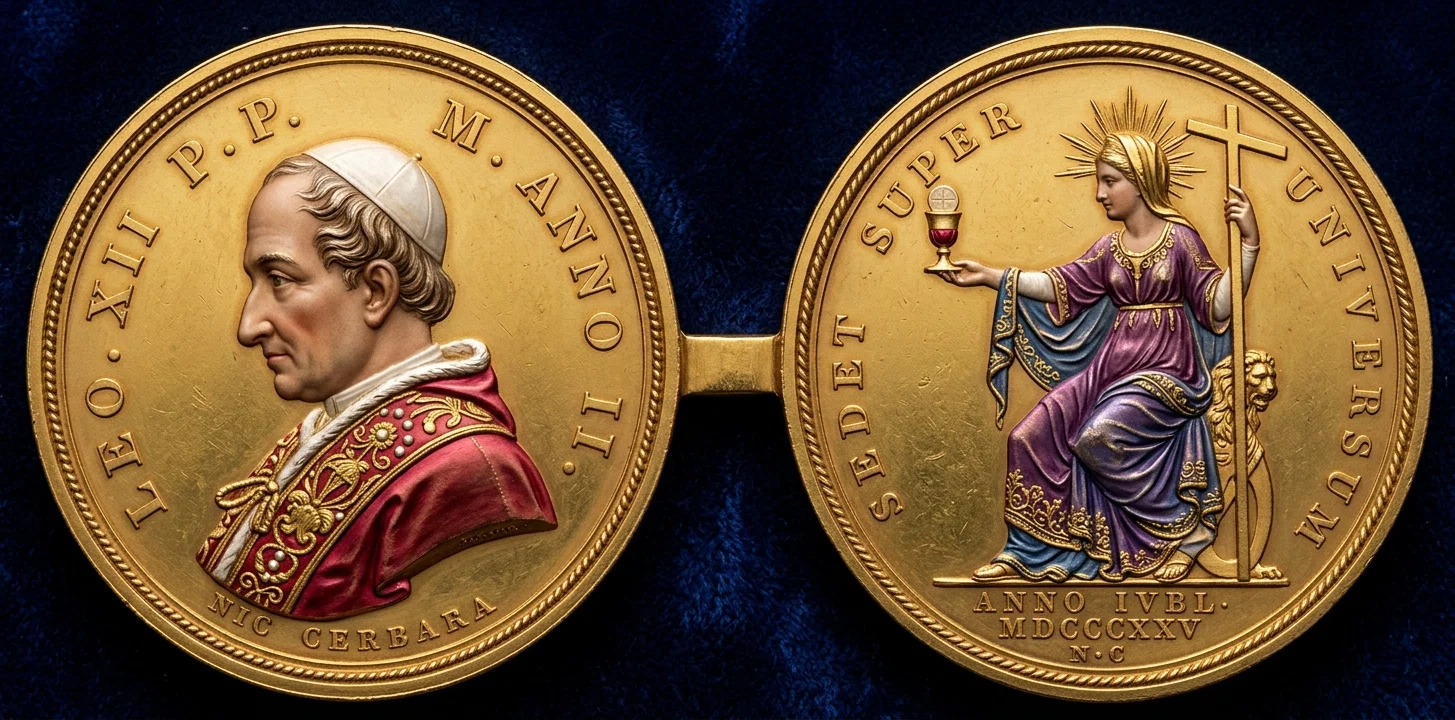
WOMAN WITH CUP, FROM ROME
(Elliott's “Horae Apocalyptica,” London, 1851)
The disciples of Christ will be willing to leave condemnation of others to God. But a church that has substituted her own ways for the way of God, her creed for His word, her councils and decrees for the Judgment of the last day, becomes inevitably intolerant. Yet if she is not connected with the state, if she cannot control civil power to enforce her dogmas or decrees, she cannot persecute. She may anathematize and excommunicate, but these acts fall lifeless save with the weak and superstitious.
A purely civil power, apart from religion, has no desire to persecute. All adherents of all religions, provided they comport themselves civilly, are equal before the law. The federal government of these United States has been hitherto a good example of this. A persecuting power must be some sort of union of an intolerant religion with civil power. Religious dogmas or institutions, or both, must be recognized in law. A true church of Christ would repudiate such union. The beast therefore stands for that intolerant system of church and state, which even in its mildest exercise of power has been a curse of the ages. It does not have to do with the present alone, but reaches far back to the beginning of symbolic prophecy and the captivity of the church. It has not always assumed the same form. It has been multiform.
Heads of the Beast
These various forms of antagonism are represented or symbolized by the seven heads. These heads are not contemporaneous, but successive. “The seven heads are seven mountains, on which the woman sitteth: and they are seven kings; the five are fallen, the one is, the other is not yet come.” Rev. 17:9, 10.
As the apostate church is represented by a city, it is proper to represent these systems which have supported her by mountains or hills. So Jerusalem is built on Mount Zion and Mount Moriah. Rome is spoken of as resting upon seven hills. It is therefore fitting that the symbolical Babylon should rest upon symbolical mountains. But these symbols are still further interpreted by inspiration. They mean kings, kingdoms, or dynasties. Both symbols, heads and mountains, are old in prophecy.
The four heads of the leopard beast represented the four kingdoms or divisions of Alexander’s empire. Compare Dan. 7:6 and 8:21, 22. Babylon is represented as a great “destroying mountain.” Jer. 51:25. The heads therefore symbolize seven distinct dynasties, or phases, under which the beast power has antagonized God’s work and persecuted His people.
Agents of the Devil
These dynasties, while often controlled by God contrary to the principles that actuated them, were agents of Satan to deceive and control the world, to oppress and persecute the church of God, to destroy the holy seed, and the Saviour, Christ Jesus. This is the lesson of Revelation 12. The dragon is a symbol of the devil. Verse 9. The woman is a symbol of God’s church. The heads are human dynasties and empires that Satan has used in his work.
The manner of his work began with the captivity of the church. Previous to that, apostate at times though she was, God preserved her unity in the kingdom of Judah, her center at Jerusalem. As long as kingdom and ruler remained, the church did not look for deliverance. But when Zedekiah, Judah’s last “deadly wounded wicked one,” filled up the iniquity of the end, the Lord declared that the mitre was to be removed, the crown taken off, the kingdom abased, and left to the overturning of the cruel powers of earth, beginning with Babylon, as it seems clear to us, and continuing “until He come whose right it is; and I will give it Him.” Eze. 21:25–27.
Longing for a Deliverer
From that time began the crying, the pain, the birth pangs of the church, longing for her Deliverer. Rev. 12:2. And then, too, began the watching and waiting of the devil to destroy the seed. Rev. 12:4. This was clearly predicted by Micah about seven centuries before Jesus the Saviour was born. Addressing the daughter of Zion, the prophet says: “Now why dost thou cry out aloud? Is there no king in thee, is thy counselor perished, that pangs have taken hold of thee as of a woman in travail? Be in pain, and labor to bring forth, O daughter of Zion, like a woman in travail; for now shalt thou go forth out of the city, and shalt dwell in the field, and shalt come even unto Babylon.” Micah 4:9, 10. See also Micah 5:2, 3.
John’s vision of Revelation 12 clearly refers to the prophecy of Micah, and Micah fixes the beginning of this seven-headed beast rule. It originated with Babylon, the beginning of all symbolic prophecy. Babylon is the first of the seven heads. The great and final overthrow of temporal rule at God’s earthly center of power began with Babylon when Jerusalem was utterly overthrown.
Babylon was cruel in her treatment of God’s people, as the prophecies of Isaiah, Jeremiah, and others clearly show. See, for instance, Jer. 51:22–32. For a specific instance of Babylon’s persecuting power, see Daniel 3. And Babylon was instigated to do this work by the fallen Lucifer, “king of Babylon.” See Isa. 14:10, 12–14.
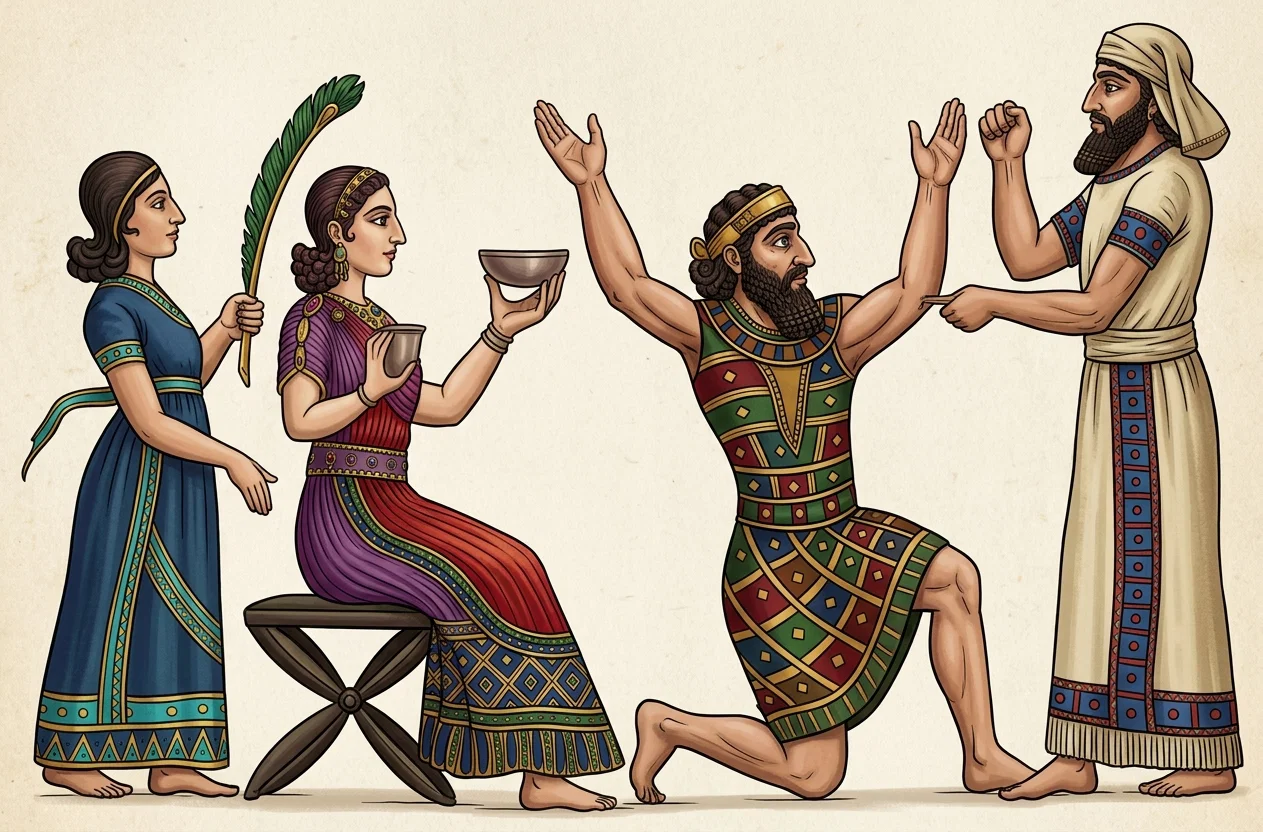
WOMAN WITH CUP, FROM BABYLON (Kitto's “Biblical Cyclopædia,” Edinburgh, 1856)
Then came Medo-Persia. Note her persecution of the righteous Daniel. Daniel 6. See the mighty plot to destroy all the Jews under the reign of Ahasuerus, or Xerxes, as told in the203book of Esther. Only by the special interference of God were His people kept from destruction.
Following Medo-Persia came Grecia, under the division of which came the greatest persecution the Jews ever suffered, told graphically in the story of the Maccabees. Antiochus IV of Syria was chief of the devil’s agents.
Under pagan Rome, the fourth head, came Satan’s effort to destroy the Deliverer, the Man Child, Christ Jesus, and the pagan persecutions that followed. Rev. 12:5, 12:2:9–11.
The pagan Roman head is the time of prophetic application of Revelation 12. It is the central period from which we look back to the woman’s pain and travail and Satan’s waiting to destroy mankind again in the person of the Second Adam, our Lord and Saviour. Had the devil accomplished this, the race would have been lost. That triumph of Christ is the “IS” of the prophecy. From that we look back to Satan’s waiting and the church’s longing of the past. From that point we are pointed forward to the long period of toil and persecution of the church under subsequent heads.
In Revelation 13, the instigator of all the evil in earthly empire, the devil, is in the background. He is simply named as giving power and authority to the great beast system, the system of the same seven heads. The beast, apostate earthly rule, is the agent of the dragon, or the devil. Rev. 13:2: “The dragon gave him his power, and his throne, and great authority.” In this chapter we again have marked the beginning of the beast power in the composition of the beast himself. There is the lion’s mouth of Babylon, the bear’s feet of Medo-Persia, the leopard’s body of Grecia, and the ten horns of Rome. Compare with Daniel 7. And the combination is infused with the spirit and energy of Satan. The persecuting power is set forth purely in its civil phase, as the effective agent.
The prophetic application of chapter 13, the “IS” of the chapter, the period or stage from which the student looks forward or backward, is during the reign of the beast under the fifth or papal head, marked by the “forty and two months”—1,260 days or years—of prophetic time, from 538 to 1798. This is the long period of papal domination, the long, dark period during which untold thousands of “heretics” died for their faith.
The beast of Revelation 13 is not, therefore, as is sometimes said, Roman Catholicism or the papacy. It is not an ecclesiastical system. The beast is more than the papacy. It is a papal beast, but it is more. Under the Babylonian head, it was the Babylonian beast. When Babylon was overthrown, and Medo-Persia succeeded, it became the Medo-Persian beast. Under the Grecian regime, the beast was Grecian. When pagan Rome succeeded, the beast was a pagan Roman beast. When, therefore, pagan Rome was succeeded by papal Rome, the beast then became the papal Roman beast. This phase lasted from 538 to 1798. The little horn of Dan. 7:8, 24, 25, is identical with the fifth head of Revelation 13, which was wounded unto death. The beast, the kingdoms of peoples, continued. The beast did not exist without a head when the union with the papacy was destroyed; it continued its existence under another head. That head, or phase, of the beast was slain. Another phase succeeded. The beast under the slain head is to be revived. The wounding of the fifth head was not the mere death of a people. It was the breaking of the papacy’s supremacy over the civil powers of the Roman Empire.
Satan’s Agent Instigator
The seven heads of chapter 17 are the same heads, the same unions of church and state. Satan, the instigator, is only suggested by the scarlet color of the beast. The beast itself is secondary. The prime earthly agent in persecution is here shown to be the gorgeously clothed harlot, who sits upon the beast, guiding it as she will, to her own ends. But the guiding has brought her untold wealth, clothed her in gorgeous array, filled her with fornication, and made her drunken with the blood of souls. It is more than a coincidence that ancient Babylon was designated by the figure of a woman holding out a cup for the world to drink, the figure of the prophecy. But the papacy has gone further. She has subscribed herself the fulfillment of the prophecy, by a similar figure on a medal struck by a pope. She assumes, by the motto on the medal, to be just what the prophecy declares, the ruler over the kings of the earth, drunken with the wine of her spiritual fornication.
There is no question as to identity. The three chapters show Satan the prime instigator, the civil powers as his executives, and the apostate church as his deceiving agency that has made all the earth drunken with the wine of her spiritual fornication. The “IS” of the seventeenth chapter is the period of the sixth head, or the present time.
“The Wilderness”
The wilderness in which was particularly revealed the character of the beast and of the harlot is better learned from Rev. 12:6, 14. It applies to that time of spiritual doubt and darkness, that hiding of truth by tradition, which existed during the Middle Ages, or Dark Ages, from the fifth to the sixteenth century. It finds its prototype in that period of Jewish history preceding the coming of John the Baptist, when the traditions of the rabbis had obscured the truth of God. Into this wilderness came John, the forerunner of Jesus, laying down the foundation paths of a clearer way in preparation for the King. Luke 3:3–6; Matt. 3:1–3; Isa. 40:3–5. “The voice of one that crieth, Prepare ye in the wilderness.” The literal wilderness in which he preached was a faint type of the spiritual desert around him.
In this “wilderness” period the true church of God is a hunted, persecuted people (Rev. 12:6, 13–16), till she was helped by the tolerance and liberty resulting from the Reformation. In this same wilderness, apostasy sat enthroned in crime, drunken with the blood of the saints and of the martyrs of Jesus. Rev. 17:3–6. The prophet is taken by the angel to that wilderness period, that he might see the meaning of that apostasy, and of its culmination during the Dark Ages; that he might see the outworking of the enforcement, by civil power, of human substitutes for God’s essentials; that he might see the evil results of sincerity in apostasy; that he might see the effect of the fullness of the reign and ruin of humanly constituted vicars of Christ, whose decrees were often given and enforced with the sincerity and devotion of fanaticism.
“And he carried me away in the Spirit into a wilderness: and I saw a woman sitting upon a scarlet-colored beast, full of names of blasphemy, having seven heads and ten horns. And the woman was arrayed in purple and scarlet, and decked with gold and precious stone and pearls, having in her hand a golden cup full of abominations, even the unclean things of her fornication, and upon her forehead a name written, Mystery, Babylon the Great, the Mother of the Harlots and of the Abominations of the Earth. And I saw the woman drunken with the blood of the saints, and with the blood of the martyrs of Jesus. And when I saw her, I wondered with a great wonder.”
The Deadly Wound
That phase which the vision places in the wilderness must pass away before her impending judgment is pronounced by the angel. This God’s messenger further states: “Wherefore didst thou wonder? I will tell thee the mystery of the woman, and of the beast that carrieth her. . . . The beast that thou sawest [in the wilderness period] was, and is NOT; and is about to come up out of the abyss, and to go into perdition.” Verses 7, 8. In the language of Rev. 13:3, 4: “And I saw one of his heads as though it had been smitten unto death; and his death stroke was healed: and the whole earth wondered after the beast; and they worshiped the dragon, because he gave his authority unto the beast; and they worshiped the beast, saying, Who is like unto the beast? and who is able to war with him?”
The head, as before remarked, gives character to the beast, and determines the phase of its existence.
Let us therefore repeat in brief: Under the Babylonian head, the beast was Babylon; under the Medo-Persian head, it bore the character of Medo-Persia; under the Grecian head, the beast was Grecia; under Roman paganism, the beast was pagan Rome; under the papal head, the beast was papal Rome, the Roman Empire, largely the civilized world, ruled by the papacy. That was the fifth head, the last that is fallen in the time when the Judgment is impending. “Five are fallen, the one is.” Rev. 17:10. “The beast that thou sawest WAS, and IS NOT.” Verse 8. It is fallen. The head lies under the death stroke. The beast of the Dark Ages, when kings bowed before the man of the Vatican, held the stirrup of his saddle like a lackey, and did penance barefoot in winter before his palace, is gone. The dark record of the slaughter of millions for conscience’ sake is over, the world thinks, over forever, will never be restored.
The prophecy declares that it shall be restored. The beast that was and is not is about to come up out of the abyss—a double prediction, as we shall later learn. M. C. W.
The next article of this series will be an explanation of the sixth and seventh heads.