General Nature of Law—Natural Law and Moral—All Such Law Points to a Source—It Is Beyond the Power of Man to Change It
By A. C. Gilbert
LAW, generically speaking, comprises a body of rules that govern, respectively, in the various activities in the universe. The multitudinous forms of life all about us are governed by certain principles commonly considered laws. The innumerable forms of action in the realms of art, science, mechanics, etc., are regulated by rules, or laws, that are inexorable.
An Impassable Barrier of Laws
Though the mind of man is able to search deep into the mysteries of life, yet he is made fully conscious of the fact that the various classes of action, or life, are protected by an impassable barrier of laws—laws peculiar to each class. We have this illustrated in the first chapter of the book of Genesis. As the Lord progressed in the several steps of the work of creation,—the flora, the fauna, and man,—we find that each department of life is governed by certain specific laws of sequences or relations. This being true, we derive the principle that the kind of life or action determines the nature of, and denominates, for our understanding, the law which applies to that kind of life or action.
To illustrate: In the realm of astronomy, we have astronomical law; in the realm of zoology and biology, we have physical law; in the realm of mechanics, we have mechanical law, or the laws of statics and dynamics; in the realm of commerce, we have commercial law; and in municipal affairs, we have municipal law.
Demands a Superior Power
Laws must be laid down by competent authority. This authority must be superior to every condition, activity, and agent to be governed. As life itself, in all its classifications, is subject to unalterable laws, evidently the author of these laws must be the Author of life. For as we reason backward, step by step, from the humblest organization to and beyond the mightiest orderly arrangement known to man,—the planetary system,—we find that every code of laws within the range of human knowledge converges toward the throne of the Creator, and centers in Him who is the Fountain of life (Ps. 36:9), the Source of all law, the Upholder of all things. “Thou, even Thou, art Lord alone; Thou hast made heaven, the heaven of heavens, with all their host, the earth, and all things that are therein, the seas, and all that is therein, and Thou preservest them all.” Neh. 9:6. See also Heb. 1:1-3; James 4:12; Isa. 33:22.
In the study of God’s care for His creation, we find that He does not dispense various kinds of energy, or law, according to the various kinds of organisms to be governed; but He sends forth His mighty power throughout the universe, directing it to the different forms of life. These various forms of life give us such terms as “physical law,” “chemical law,” “mechanical law,” etc. Hence the forces or laws of nature are but different forms, or different applications, of one all-pervading power. See Ps. 19:1-8.
Moral Law, and What It Signifies
An expression with which we all are acquainted is, “the moral law.” The word “moral” signifies conduct, behavior, mode of life, as regards right and wrong. All created beings endowed with the power of choice come within the scope of this definition. See Gen. 2:16, 17; John 6:66-68; Jude 6.
Man is a complex being, having a physical nature as well as a moral nature. As he is a physical being, the laws that govern his physical nature are conveniently termed physical laws. As he is also a moral being, the laws that govern his moral nature are moral laws. In the exercise of his mind, man is constantly confronted with moral duties. In his association with his fellow men, he is daily compelled to exercise his moral functions of choice between right and wrong. Joshua 24:15; Rev. 22:17; John 3:16.
The Ten Commandments a Perfect Law
In the study of the Ten Commandments, we find the principles of morality clearly defined. They apply to every duty and relation in life. They point out the attitude that every individual is to assume toward God and his fellow creatures. Ex. 20:1-17. The realm of moral duty as outlined in detail in the Ten Commandments, is summarized in the words of Christ to the lawyer: “Thou shalt love the Lord thy God with all thy heart, and with all thy soul, and with all thy mind. This is the first and great commandment. And the second is like unto it, Thou shalt love thy neighbor as thyself. On these two commandments hang all the law and the prophets.” Matt. 22:37-40.
The ten moral precepts are termed, in the Bible, the law. Read Ex. 24:12. Seeing these precepts are the only laws, or principles, known to human experience as governing in the realm of moral nature, they are defined by man also as the moral law. Nevin’s “Biblical Antiquities” says this: “The moral law, summarily comprehended in the Ten Commandments uttered from Mount Sinai, requires in all its precepts a spiritual obedience.”
“The moral law is summarily comprehended in the Ten Commandments, which198were delivered by the voice of God upon Mount Sinai, and written by Him on two tables of stone.”—Presbyterian “Confession of Faith,” edition 1883.
Christ Taught the Meaning of the Law
Christ Himself referred to the Ten Commandments when He spoke to the Jews about obedience to the law, and illustrated its purpose to regulate the inmost secrets of our moral nature. He said: “Think not that I am come to destroy the law, or the prophets: I am not come to destroy, but to fulfill. For verily I say unto you, Till heaven and earth pass, one jot or one tittle shall in no wise pass from the law, till all be fulfilled.
“Whosoever therefore shall break one of these least commandments, and shall teach men so, he shall be called the least in the kingdom of heaven; but whosoever shall do and teach them, the same shall be called great in the kingdom of heaven. For I say unto you, that except your righteousness shall exceed the righteousness of the scribes and Pharisees, ye shall in no case enter into the kingdom of heaven.
“Ye have heard that it was said by them of old time, Thou shalt not kill; and whosoever shall kill shall be in danger of the judgment: but I say unto you, that whosoever is angry with his brother without a cause shall be in danger of the judgment. . . . Ye have heard that it was said by them of old time, Thou shalt not commit adultery: but I say unto you, that whosoever looketh on a woman to lust after her hath committed adultery with her already in his heart.” Matt. 5:17-28.
The apostles also recognized the Ten Commandments as principles that govern the moral nature. See Rom. 7:6-12; James 2:8-12.
The origin of the moral law dates from eternity. The natural laws classified above as physical, astronomical, mechanical, etc.,—laws with which men have to do, but cannot control,—had their origin, respectively, when the first physical entity was brought into existence, when the first heavenly body began its round in the realms of space, when the first mechanical contrivance was introduced. These laws, or these manifestations of the all-pervading governing power of God, became such when the existence to be governed was begotten.
The creation of the first moral being was the occasion for the first operation of the first principle of the moral law, comprehended in the first four of the Ten Commandments, and summarized in the words of Christ, “Thou shalt love the Lord thy God with all thy heart, and with all thy soul, and with all thy mind.” Matt. 22:37. When the second moral being was created, then was brought in a second kind of relationship. This relationship was governed by the second principle of the moral law, comprehended in the last six of the Ten Commandments, and epitomized in the words of Christ, “And the second is like unto it, Thou shalt love thy neighbor as thyself.” Matt. 22:39. Thus we see that the principle of love, which “is the fulfilling of the law” (Rom. 13:10), dates its origin from the eternal past.
As Enduring as God
The enduring qualities of the moral law are measured by the length of the existence of the moral relationships that are to be governed. Throughout all the Bible, we find the eternal and unchangeable nature of God’s law revealed. The psalmist says: “Thy word is true from the beginning; and every one of Thy righteous judgments endureth forever.” Ps. 119:160. “All His commandments are sure. They stand fast forever and ever, and are done in truth and uprightness.” Ps. 111:7, 8. Christ’s own words are: “Think not that I am come to destroy the law, or the prophets: I am not come to destroy, but to fulfill. For verily I say unto you, Till heaven and earth pass, one jot or one tittle shall in no wise pass from the law, till all be fulfilled.” Matt. 5:17, 18.
Thomas Scott, D. D., on Matt. 5:18, says: “As long as the world endured, not the least word, or letter, or point, or comma, so to speak, of the whole law, should by any means lose its authority, or fail of answering the end for which it was given; and the moral law would, to the end of time, continue the standard of sin and holiness to all men, and the believer’s rule of duty.”
So long as there is need for a mechanical contrivance, so long there is need for mechanical law. So long as the science of astronomy remains, so long must there be laws to regulate the heavenly bodies. This principle will apply in our reasoning in regard to the binding obligation of the moral law, the Ten Commandments. So long as moral relationships and responsibilities exist between God and created beings, and between the created beings themselves, so long must exist the moral law to regulate these relationships and responsibilities. Or, in other words, so long as there is a moral nature, so long there must be a moral law to govern the realm of that moral nature.
The Law Needs No Revision
The fact that there have been many mechanical failures is no evidence that mechanical law is a failure. While the shores of ages past are strewn with physical wrecks, it does not follow that physical law is a fiction. Though moral derelicts are met at every turn on the high seas of life, this is no proof that the moral law is a misfortune. Because men and women in all ages of the history of sin have failed to stand the test imposed by the moral law, shall we conclude that the test needs revision, or a substitution?
All laws that are beyond the control of man are unchangeable, eternal, and perfect in their character, because they have their origin in an unchangeable, eternal, and perfect source. The moral law, therefore, is a perfect code of morals, ordained to regulate the moral standard of man. “Wherefore,” Paul says, “the law is holy, and the commandment holy, and just, and good.” Rom. 7:12.
The Perfect Law of Liberty
The apostle James speaks of the nature of the law, and our relation to it, in the following words: “Whoso looketh into the perfect law of liberty, and continueth therein, he being not a forgetful hearer, but a doer of the work, this man shall be blessed in his deed.” James 1:25.
Martin Luther, in his “Shorter Catechism,” edition 1834, says this of the law:
“Ques.—Are we under obligation to keep the moral law?
“Ans.—Yes; because it is founded upon the nature of God, and it cannot be changed; it is of universal application, which was impossible with respect to the ceremonial and civil laws. Christ demands obedience to His law.”
Our love to God includes obedience to all His Ten Commandments. Sin is the only thing in the universe that dissociates us from God, and causes us to disobey the principles of His perfect law. The moral law is the only instrument in the universe that can detect sin and define its nature. 1 John 3:4; Rom. 3:20. Therefore may the gentle Spirit of God lead our hearts in the way of truth, and make them submissive to the authority of Heaven’s sovereign law.
It Isn't Your Church—It's You
By A. A. Cone
Arranged by A. A. Cone
If you'd like to join the kind of a church
Like the kind of a church you want,
You needn't slip your clothes in a grip
And start on a long, long jaunt.
You'll only find what you left behind,
For there's nothing that's really new.
It's a knock at yourself when you knock your church.
It isn't your church—it's you.
A real church is not made by men afraid
Lest somebody else gets ahead.
When every one works and nobody shirks,
You can raise a church from the dead.
And if, while you make your own mistakes,
You'll bear with your brother's too,
Your church will be what you want to see.
It isn't your church—it's YOU.
Christianity Begets Order and Decency
By J. W. Lowe
SOME one has said that order is heaven’s first law; and I am certain that a study of the planetary system, the human body, and the works of nature in general, will prove the truthfulness of that assertion. And if the greatest order is maintained in God’s creative works, we ought surely to preserve the greatest order possible in our every act of life.
Individuals in their sinful state often act very disorderly; but when they are really converted and become Christians, their disorderly ways are displaced by those of order and decency. An improvement takes place, rather than degeneracy. The Holy Spirit coming into the life will not cause one to act less orderly and gracefully and sane than he did before its reception.
There are two different spirits at work in this world; and when even professed Christians conduct themselves in a disorderly and unbecoming manner, we may know for a certainty that they are not controlled by the Spirit of God, for God is not the author of disorder or confusion or indecency.
It is a false belief that Christianity consists in noise and contortions and ridiculous actions generally. That kind of conduct is only a caricature of true religion. The Lord is not in it. It is the work of the evil one to bring Christianity into disrepute. True Christianity will always cause one to act more orderly and sensible and refined than he or she did before conversion. The Holy Spirit soothes and refines and ennobles, and leads its possessor into ways of meekness and quietness.
J. W. Lowe.
Our Lord's Great Prophecy
By Calvin P. Bollman
Its Setting—How Portions of It Have Been Fulfilled—Other Portions Sure of Fulfillment
By Calvin P. Bollman
This is the first of some five or six articles by Elder Bollman, on the prophecy of Christ recorded in Matthew, chapter twenty-four. This article, after giving the setting when the prophecy was made, shows how completely prediction met fulfilment in the overthrow of Jerusalem by the Romans. Our readers should not fail to watch for these articles from week to week, and also to pass them on to their friends and neighbors.
Editor.
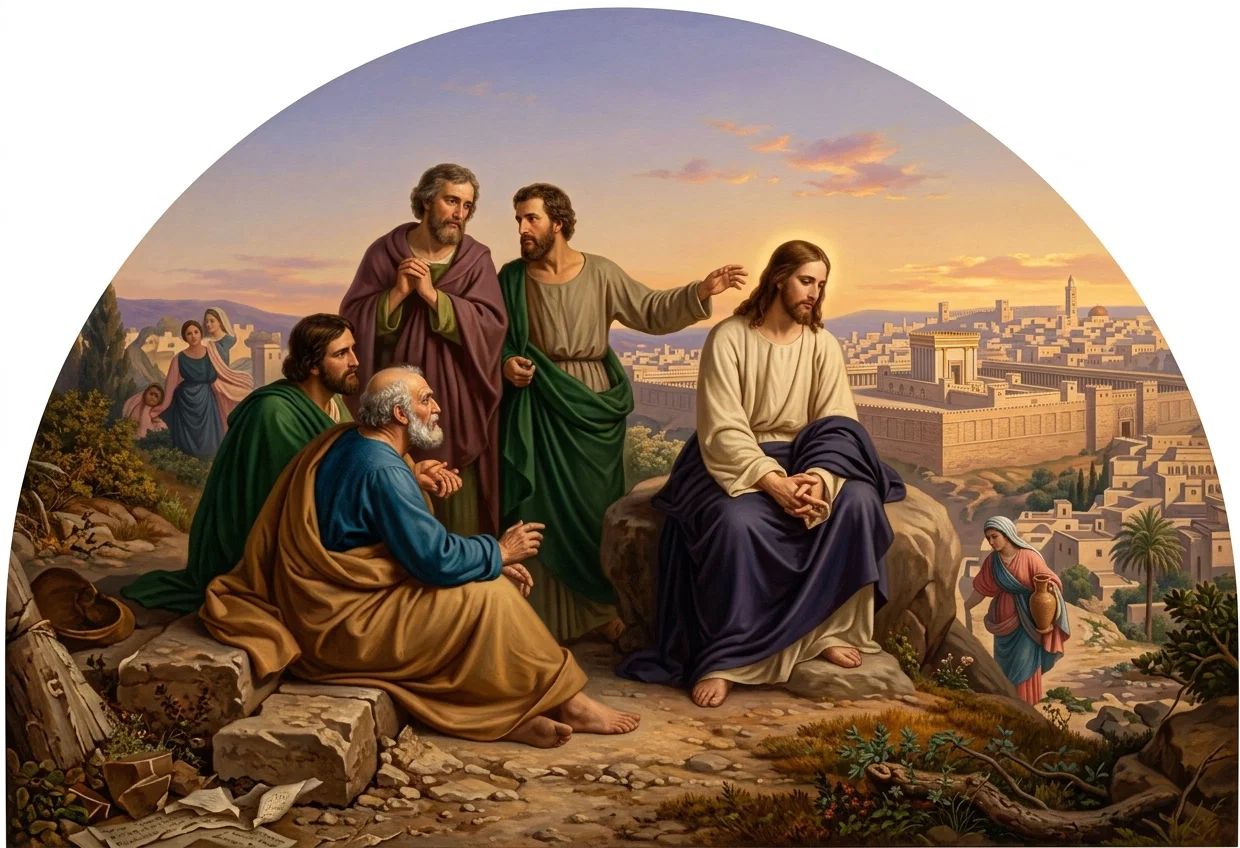
The place is the Mount of Olives, overlooking Jerusalem to the west. From this elevation, a most magnificent view could be obtained not only of the temple and its courts, but of a large part of the city.
The time was probably late in the afternoon of the third day of the crucifixion week—the week that was to see, and that did see, the completion of Christ's work on earth for the redemption of fallen humanity.
The occasion was the perplexity of the disciples over certain statements the Lord had made concerning their beloved city and temple—the city and temple which they fondly hoped might stand forever; the city to be the capital of the restored kingdom of Israel; the temple, the gathering place of the nations as they should come to do homage to the Son of David.
To Be Completely Demolished
Just a little while before our Lord's prophecy was uttered, the disciples, their hearts swelling with national pride, had come to Him “to show Him the buildings of the temple.” Jesus said to them: “See ye not all these things? verily I say unto you, There shall not be left here one stone upon another, that shall not be thrown down.” Matt. 24: 2.
Astonished and awed by the Master's words and manner, the disciples were silent; but by and by, “as He sat upon the Mount of Olives,” they “came unto Him privately, saying, Tell us, when shall these things be? and what shall be the sign of Thy coming, and of the end of the world?” Verse 3.
The Question Analyzed
The disciples' question was in reality two questions. Or shall we say three? (1) “When shall these things be?” (2) “What shall be the sign of Thy coming?” (3) “and of the end of the world?”
Evidently the disciples associated the three events; namely, the destruction of the city and the temple, the second coming of Christ, and the final destruction of all earthly things. To them it seemed impossible that the foretold destruction of their city, and especially of the temple, with its massive foundations, could take place apart from the end of the world.
But in this they were mistaken. About forty years later—well within the generation then living—the temple was burned by the infuriated Roman soldiers under Titus, and its seemingly indestructible foundations were removed, so that not one stone was left upon another.
The Destruction of Jerusalem
Deeply had Jerusalem sinned in rejecting the Messiah, and terrible was to be its punishment; and this punishment was to come not directly, as a retributive judgment, but as the result of their own hardness of heart and blindness of mind.
Throughout their history, the Jews had been a typical people; and this was to be no less true of the final judgments that would come upon them as a nation. The horrors of the siege, and of the destruction of the city, were a type of the world-wide time of trouble foretold in these words of the angel, spoken more than six hundred years before to the prophet Daniel: “There shall be a time of trouble, such as never was since there was a nation even to that same time: and at that time thy people shall be delivered, every one that shall be found written in the book.” Dan. 12: 1.
This is the time of trouble that comes upon the wicked just before the Lord appears the second time, much as the time of trouble came upon Jerusalem and its people, bringing the end of the Jewish age and nation.
Signs of Impending Judgment
There being so many points of resemblance between the destruction of Jerusalem and the final destruction of the wicked powers of earth, the Saviour, in answer to the disciples' question, intermingled the two events and the signs that should precede them severally.
From this elevation, a most magnificent view could be obtained not only of the temple and its courts, but of a large part of the city.
However, we have time and space in this study to mention only one sign of the destruction of Jerusalem; namely, that given in Matt. 24: 15.
In the first part of this same chapter, the Saviour gave His disciples a solemn caution against being deceived by any thought or suggestion that His second coming was then near at hand. In doing this, He sketched briefly—very briefly—the leading events from the time then present until His return should be due to the world, ending with the statement in verse 14, “This gospel of the kingdom shall be preached in all the world for a witness unto all nations; and then shall the end come.”
Then going back to the first question, “When shall these things be?”—meaning the destruction of the city and the temple—our Lord said: “When ye therefore shall see the abomination of desolation, spoken of by Daniel the prophet, stand in the holy place, (whoso readeth, let him understand:) then let them which be in Judea flee into the mountains: let him which is on the house-top not come down to take anything out of his house; neither let him which is in the field return back to take his clothes.” Verses 15-18.
“Abomination of Desolation”
But it may be asked, How could any one flee after the city was compassed with armies? In its details, the story is a long one; but the more essential facts may be stated in few words. Beginning at Jerusalem about A. D. 65, the fires of dissatisfaction, and a little later a revolt against the Romans, began to burn, and speedily spread over nearly all Judea and Samaria. The fortress of Masada, a stronghold to the west of the Dead Sea and near its southern end, was first seized, and its garrison of Roman soldiers put to the sword.
Soon the standard of revolt was raised also at Cæsarea and at Jerusalem. Agrippa, mentioned in Acts 25 and 26, endeavored to restore peace, but without avail. Then Cestius Gallus, the governor of Syria, and for that reason commander-in-chief of the Roman soldiers in that part of the empire, after subduing the incipient rebellion at Cæsarea, marched against Jerusalem and at once besieged it. His point of attack was the wall immediately in front of the temple. Soon a breach was made, and the Romans were about to set fire to the temple itself—thus it may be said “the abomination of desolation”8stood in the holy place—when a most surprising thing happened: Cestius suddenly suspended his operations, renounced his advantages, and withdrew from the temple wall.
It was an act so difficult to account for, naturally it was ascribed to a higher power than man. Josephus regarded it as proving the divine anger; for he believed that if the city had been captured then, all the subsequent horrors of war would have been avoided. Others supposed that this was the opportunity pointed out to the disciples by the Saviour, when they might escape to a place of safety and avoid all the coming woes of the siege. Now, it is supposed, the Christians made good their escape to Pella, a village east of the Jordan, fifteen miles south of the Lake of Tiberias; and certainly none perished, since not one was deceived by the false promises and expectations on which the multitude depended to their ruin. (“From Exile to Overthrow,” pages 304, 305.)
Preliminary Movements
Almost all Palestine was in revolt against the Romans, and some time was necessarily spent in subduing the rebellious Jews in other and less important cities than Jerusalem. When the extent of Rome's humiliation through the weak and vacillating course of Cestius Gallus was known at Rome, Vespasian, the strongest military leader in the empire at that time, was sent out to direct operations and reestablish the imperial authority in the East. He first besieged and took Jotapata. This exceedingly difficult undertaking consumed nearly fifty days, leaving Vespasian's army tired and in need of rest. Six weeks was spent in preparing for further offensive operations, and then nearly two years was devoted to subduing the rebellion outside of Jerusalem. While this was going on, the emperor, Nero, died, or rather committed suicide, and Vespasian was personally called to Rome to become emperor. His son Titus had been closely associated with him in the reconquest of Palestine, and him Vespasian commissioned to complete the conquest by the capture of Jerusalem.
Horrors of the Siege
It is needless to dwell upon the horrors of the siege of the devoted city. Two years had passed since the fall of Jotapata, and the Romans had become highly exasperated at what they regarded as sheer madness upon the part of the Jews. Judged by the standard of the times, Titus was not a cruel man, and he would gladly have avoided further bloodshed, but the Jews would not consider surrender. The city was rent by factions, and was dominated by the worst element. Many fell victims to civil strife, while nearly a million lost their lives in the siege, and more than a hundred thousand were taken captive and sold into slavery.
The people not only suffered the usual stress of a siege; but after a few weeks, famine and disease were added to the destruction of battle. Many died of starvation and of sickness, while some were driven to cannibalism. Thus not only were our Saviour's words fulfilled to the letter, but the elder prophecy by Moses, uttered nearly two millenniums before, and recorded in Deut. 28: 40-57, was also fulfilled in every detail.
And as these prophecies were fulfilled then, and as others have since been fulfilled, as we shall learn in a further study of our Lord's great prophecy, so also shall those things surely come to pass which have not yet been fulfilled, but which unfolding events unerringly show us to be even at the door. “Heaven and earth shall pass away,” says the Saviour, “but My words shall not pass away.” Matt. 24: 35.
There is yet in this twenty-fourth chapter of Matthew much of deepest interest and of greatest moment to the people of this generation.
THE SABBATH A COMMEMORATIVE INSTITUTION
By R. C. P.
Good Authorities on the Subject—Agreement That the Rest Day Points Back to Creation—Not a Memorial of Deliverance from Egypt
Alexander Campbell thus speaks of the Sabbath as a commemorative institution: “Heaven left not this fact, the creation, the basis of a thousand volumes, to be gathered from abstract reasonings, vitiated traditions, ingenious analogies, or plausible conjectures, but from a monumental institution which was as universal as the annals of time, as the birth of nations, and as the language spoken by mortals—an institution, too, which, notwithstanding its demand not only of the seventh part of all time, but of the seventh day in uninterrupted succession, was celebrated from the creation to the Deluge, during the Deluge, and after the Deluge till the giving of the law.”—“Popular Lectures,” pages 283, 284.
The Jews Claim That the Sabbath Was Instituted at Creation
The following letter upon this question was addressed by a clergyman to a Jewish rabbi:
“Battle Creek, Michigan, October 14, 1886.
“Dear Sir:
“Do the Jewish people hold that the Sabbath was set apart in Eden, or at Mount Sinai? Do they keep the Sabbath as a memorial of their deliverance from Egypt?”
To these questions he received the following reply:
“Des Moines, Iowa, October 18, 1886.
“Dear Sir:
“In reply to your inquiries, allow me to say: 1. The Jews universally celebrate the Sabbath as a weekly memorial of creation, being that God Himself rested on the seventh day, and said it should be a day of rest. 2. We do not keep the Sabbath as a memorial of our deliverance from Egypt. The fourteenth day of Nisan, or the Passover, is celebrated by the Jewish people as a memorial of their deliverance from Egypt.
“Yours truly,
“(Signed) Rabbi L. Freudenthol.”
It is very probable that the Jews know whether the Sabbath was given them for the purpose of commemorating their deliverance from Egyptian bondage or as a memorial of creation.
Let Us Illustrate the Point
Moses could consistently appeal to that people who had been delivered from Egypt, to remember God’s marvelous workings in their behalf by keeping the Sabbath which He had given as a memorial of creation, without lessening in their minds His great reason for giving the Sabbath institution. That secondary reason would appeal to only a limited number of people, and for a limited reason, compared with God’s great moral reason for giving the Sabbath to man.
It would be like a father saying to his son, “I want you to be a good boy, Johnnie, because I gave you a pony.” No one would think that the father meant to convey the impression that the fact of his having given his son a pony which the son delighted to ride and drive, was the fundamental reason for appealing to him to lead a life of loyalty to God.
Egyptian Appeal Applied to Righteousness in General
So in the case of Israel, Moses made an appeal to them to observe the Sabbath because they had been delivered from Egypt. He cited the same deliverance as a reason why they should do righteousness and be a holy people. There was some reason for this appeal, in the fact that they had been reduced to slavery in Egypt, and under the taskmaster’s lash they had been deprived of the privilege of serving God and keeping His Sabbath. Hence when Moses was sent of God to deliver them, he was sent with this message to Pharaoh: “Let My people go, that they may serve Me.”
“And He brought forth His people with joy, and His chosen with gladness: and gave them the lands of the heathen: and they inherited the labor of the people; that they might observe His statutes, and keep His laws. Praise ye the Lord.” Ps. 105:43-45.
In the light of this fact, every consistent Bible student can see the reasonableness of Moses’ appeal to that people, and that he at the same time recognized the fundamental reason for living righteous lives and keeping the Sabbath to be as God declared in giving the law.
Why Not More Frequently Mentioned?
The question has been raised, “If the law existed from the creation to the Exodus, why is the Sabbath not more frequently mentioned in the book of Genesis?” It should be remembered that the book of Genesis is not a book of the law, but an inspired history of creation, and written more than two thousand years afterward.
We have seen in an article last week, that the law was given and sin was imputed during that time. The Sabbath, requiring the observance of the seventh day of the week, was instituted and appointed for man. A history covering so long a period, and dealing with the marvelous work of creation, the Flood, the Tower of Babel, the destruction of the cities of the plain, the fall of man, and the introduction of the plan of redemption, besides many other important events, condensed into little more than fifty pages, must necessarily be very brief upon each point.
We should also remember that the same writer is the author of the first five books of the Bible. In the book of Exodus, he takes up the narrative given in Genesis, and carries it on in the history of a people who are alive at the time. In that book, as we saw last week, there is abundance of evidence that the law of God was in existence, and its observance required, before it was proclaimed from Sinai. The fact that the Lord destroyed the world with a flood because of its wickedness, and saved Noah, “a preacher of righteousness,” as recorded in Gen. 6:1-22; 7:1; 2 Peter 2:5, 6, is sufficient evidence that all the law of God was known and its observance required during the time covered by the book of Genesis. Noah could not preach righteousness without preaching all the commands of God. “My tongue shall speak of Thy word: for all Thy commandments are righteousness.” Ps. 119:172. The observance of the seventh day as the Sabbath is required by the fourth precept of that law. Clearly, therefore, from creation to Sinai the Sabbath was observed by man, for whom it was made.
The Giving of the Law
The Bible Student, a quarterly published by the Christian publishing company, St. Louis, Missouri, in the issue for the third quarter of 1907, says:
“Giving of the law. The law was given amid scenes the grandest ever witnessed upon earth. The tents of Israel were spread in the valley at the foot of the mountain, extending as far as the eye could reach. The people, with garments washed clean, and themselves sanctified, looked on in awful expectation. The presence of the Lord was visible on the top of Sinai, lighting up with glory, and causing it to tremble and shake under His footsteps, while Moses, the mediator, stood, as it were, on the summit, face to face with God Himself.
“The name. The law is often called the Decalogue. This201name is from two Greek words, one signifying ten, and the other word, and was given because the law contains ten distinct commandments.
Two Tables of the Law
“The divisions. The law is divided into two tables; the first embracing the first four, and the second the last six, of the precepts. The first table contains, in a general way, the duties we owe to God; the second table, those that we owe to our fellow men. This division is warranted by the words of Jesus in Matt. 22:37-40, where He divides the law into ‘two great commandments.’”
“‘God spake all these words.’ It is manifest that the speech was His own, not merely as to the words spoken, but as to the articulate sounds actually perceived by the ear.”
“‘The Lord thy God.’ The possessive word ‘thy’ points to the covenant between God and His people. When taken in the full depth of its meaning, it involves that God has chosen them to be His people. He is the Redeemer. He has brought His people out of the land of Egypt, out of the house of bondage. This, in the manner of Scripture and of providence, is the earnest and guarantee of their deliverance from all other and greater kinds of bondage.”
It Was a Special Occasion
“‘Which have brought thee out.’ Why, on this occasion, was not the Lord rather proclaimed as the ‘Creator of heaven and earth’? The true answer evidently is that the Ten Commandments were at this time addressed by Jehovah not merely to human creatures, but to the people whom He had redeemed, to those who had been in bondage, but were now free men. Ex. 6:6, 7; 18:9.”
“‘Thou shalt have.’ It is to be remarked, both here and elsewhere throughout the Decalogue, that the address is made in the singular and not in the plural number. The design of this is undoubtedly to render the language in the highest degree emphatic. Every individual to whom this law comes is to consider himself as being as directly and personally addressed as though it had been spoken to him alone.”
“‘The law divine.’ A converted infidel exclaimed, on reading Exodus 20: Where did Moses get this law? The Egyptian and adjacent nations were idolaters. So were the Greeks and Romans. The wisest Greeks and the best Romans never gave a code of morals like this. Where did Moses get this law, which surpasses the wisdom and philosophy of the most enlightened age? He lived at a period comparatively barbarous; yet he has given a law in which the learning and sagacity of all subsequent times can detect no flaw. Where did he get it? He could not have soared up to it. It must have soared down to him. It must be from God.”
They Knew It Before
“‘Remember the Sabbath day, to keep it holy,’ presupposes an acquaintance with the Sabbath, as the expression ‘remember’ is sufficient to show.”
“‘Six days shalt thou labor.’ This commandment not only permits labor during the six days, but enjoins it. Idleness is forbidden.”
“‘The seventh day is the Sabbath of the Lord’—the day the Lord rested and made His Sabbath, and the day that the Lord claimed of the Jewish nation as the day when they should rest and hallow His name.”
“‘For in six days the Lord made heaven and earth, . . . and rested the seventh day.’ This verse explains why the day is the Lord’s Sabbath, and why He insisted on the observance of the day.”
The Law Previous to Sinai
The following scriptures present instances in which, it will be seen, each of the ten words of the Decalogue was violated before God’s voice was heard from the mountain of Sinai. “For until the law sin was in the world: but sin is not imputed when there is no law.”
Since the ten precepts of the law were known before it was proclaimed from the mount, the question may arise, Why, then, was it spoken at Sinai? An answer to this is given: “Moreover the law entered, that the offense [sin] might abound;” or, “that sin by the commandment might become exceeding sinful.” Rom. 5:20; 7:13.
Grounded in the Very Nature of Man
The following quotations are from the Christian publishing company’s Home Department Quarterly for the third quarter of 1907:
“‘And God spake all these words.’ These laws are grounded on the very nature of man as a moral being, having essential relations to God on the one hand, and to his fellow man on the other.”
“‘I am Jehovah thy God, who brought thee out of the land of Egypt.’ In this preface to the Ten Commandments, He asserts His right to give them laws, not only in general, as He is Lord of all, but by a peculiar title He had to their obedience; whom He had taken to Himself, after a special manner, to be His people, by bringing them out of the land of Egypt, and the servitude under which they groaned there. This was a benefit fresh in their minds, and most apt to affect their hearts.”
“‘Remember the Sabbath day.’ This presupposes an acquaintance with the Sabbath.”
This is the universal testimony of both history and the Scriptures. The fourth command of the Decalogue is God’s answer as to when and for what reason the Sabbath was instituted.