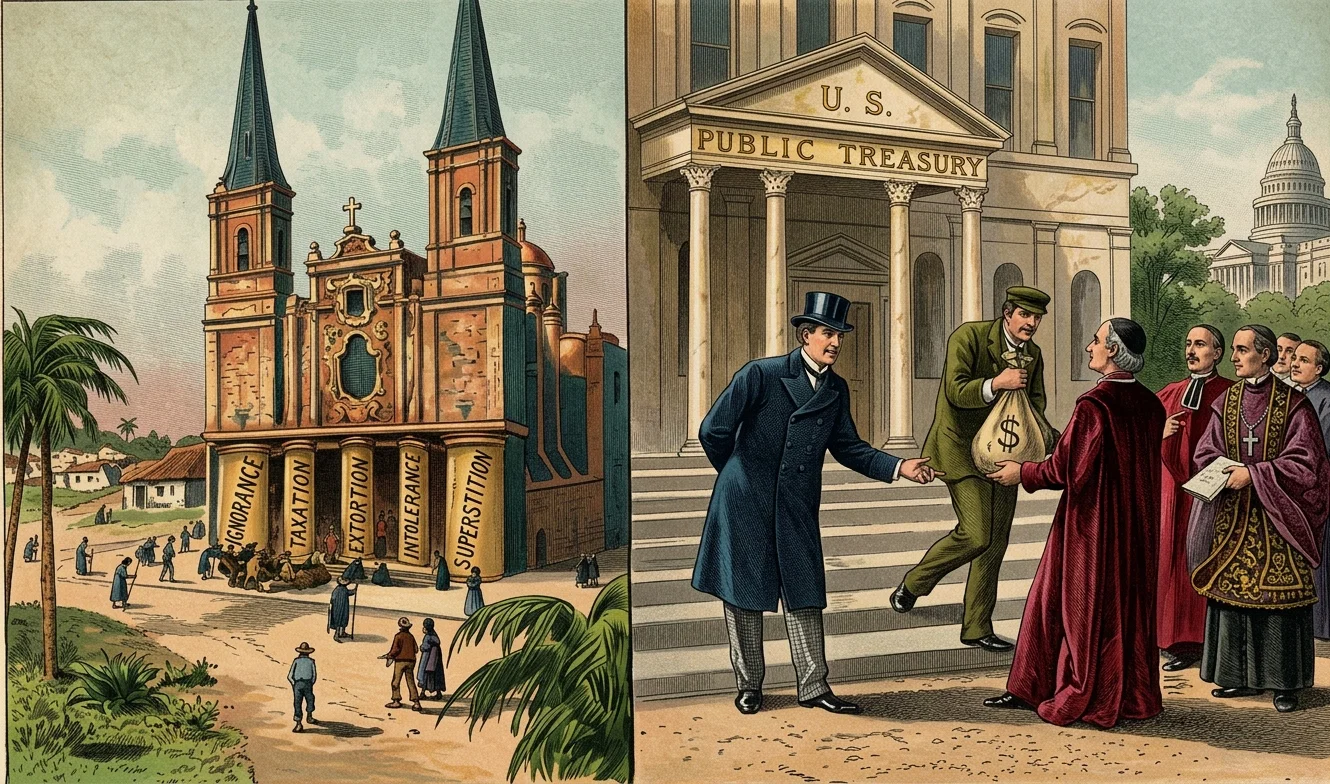
THE United States Government proposes to see that the Catholic churches in Cuba
Page 1
American Sentinel
December 1, 1898
Pacific Press Publishing Co. · New York · December 1, 1898
THE CATHOLIC CHURCH IN CUBA, TO MAINTAIN WHICH THE U. S. GOVERNMENT MAKES A “TEMPORARY” LOAN.
THE United States Government proposes to see that the Catholic churches in Cuba are kept open as they have been under the rule of Spain, and to this end will appropriate whatever funds may be necessary for the maintenance of priests and other essentials of Roman Catholic worship. This will be a “temporary loan” for such a time as may be necessary before the church in Cuba shall be able to support herself,—so say the Catholic prelates which the Government has consulted in the matter. It is a support which may be kept up indefinitely, without any compensation in return, besides being in flagrant violation of the fundamental principles of free government. What do the American people think, and what will they do, about it? See articles on next page.
SIN never suffers much from the rebukes of sinners.
IMPERIALISM for the peoples of foreign lands to-day—means imperialism at home to-morrow.
THE Government cannot support both the Catholic Church in Cuba and the principles of republican government in the United States at the same time.
God would rather an individual should do wrong, than be forced to do right
THE size of an act makes no difference in the size of the principle which it involves.
THE principles of despotism are wont to masquerade in the garb of philanthropy or of piety.
The Government Supporting the Church in Cuba.
By Editor
It is proposed by the United States Government—after due consultation with several distinguished Catholic prelates—to make a “temporary loan” of the people’s money for the maintenance of the Catholic Church in Cuba. It would be too bad for this church to be obliged to suspend operations in the island, or to be seriously crippled in her work, even temporarily, for lack of funds. So, as this Government has undertaken to supervise affairs in Cuba, and there is no appearance of funds forthcoming from any other source, they will be supplied from the United States treasury. Such is evidently the conception upon which this remarkable proposal rests.
This proceeding is of course a gross violation of the trust reposed in the officials responsible therefor, as the representatives and servants of the people, sworn to uphold the Constitution and the fundamental principles of republican government. But aside from this, the query naturally arises, What is the Catholic Church in Cuba, that it should be essential to maintain her even at the sacrifice of American principles? What great benefits for the Cuban people depend upon the continuance of her rule? What dire calamities would follow from the lessening, even temporarily, of her efficiency?
Happily the moment is opportune for finding a satisfactory answer. The evidences in the case are plain to every Protestant mind, but we do not need to apply to any Protestant source of information. A notable and trustworthy Catholic authority has spoken on the point,—even no less a person than the Spanish general, Weyler. Elsewhere in this issue we print some references to a letter written by General Weyler to the Queen Regent of Spain on the subject of what the Catholic Church has done for Spain. In this letter he states that she has done nothing at all, but on the contrary has stood in the way of all reform and progress, and has been the robber of both the government and the people. The letter is, in short, “the most frightful arraignment ever made of a religious denomination.” And coming from General Weyler, it must be accepted as a reliable statement on the subject of which it speaks. That leading citizen of Spain has had abundant opportunity to know whereof he speaks, both with reference to the Spanish government and country, and the Roman Catholic Church.
This is a statement of what the Catholic Church has done for Spain. And what is true of Spain in this respect, is true of Cuba to an equal and even greater degree. For in Cuba the Catholic Church has had full sway, without serious opposition from any source, for centuries.
And now, when General Weyler, himself an eminent Spaniard and a Catholic, denounces the Catholic Church in almost unmeasured terms as the robber of the people and an incubus upon the country,—behold! professed Protestants who stand at the head of this American Government propose to give money from the public treasury to the Catholic Church in Cuba, in violation of fundamental American law, because it is so essential that this church in Cuba shall continue on in her career unchecked!
To a true Protestant, it should be evident that the very reason why Spanish dominion in the island has been broken, is that, the bars of intolerance being let down, the people, so long robbed in purse and bound in superstition and ignorance, may have a favorable opportunity to free themselves from the yoke of a religious despotism.
And what business has the Government to make a “temporary loan” of the people’s money to any church, or for any purpose not authorized by the Constitution? That is setting a very bad example, to say the least. The principle of that proceeding has been sufficiently tested in numerous cases of “temporary loans” made to themselves by trusted employees of banks and other institutions. It is a principle which the courts and all experience have pronounced to be bad in the extreme.
What Will the People Say?
By A. T. J.
THE remaining portion of that remarkable letter of the Washington correspondent of the Baltimore Daily American—October 15, 1898, is as follows:—
“The administration fully realizes the objections that will arise in this country, from certain sources, against even a temporary sustenance of the Catholic Church in Cuba. But it has been given ample assurance by the Catholic authorities that the church shall be placed on a self-supporting basis as soon as it is possible to establish the new order that has been brought about by the Spanish evacuation.
“Archbishop Chappelle will be entrusted with liberal powers to institute such of the reforms as demand immediate introduction. It is likely that the responsibility of supporting the church in Cuba will eventually be assumed by the Catholics in this country.
“In determining to support the Catholic priests in Cuba until their church can take care of them, President743McKinley has acted wisely from other points of view than mere humanity. The Cuban priests, as in all countries whose population is densely ignorant, exercise complete control over their parishioners. Apart from the cruelty of withdrawing all aid from these priests, it is easy to believe that the new American government in Cuba would have at its very inception built up a dangerous set of enemies if the priesthood of Cuba were given reason to regret the presence of the American flag on the island. The Spanish government at Madrid could easily give the American government some dearly-bought information as to the malign influence that is in the power of a hostile clergy to exercise. Ever since the first Carlist uprising in 1833, every movement directed against the government of Spain has found its principal support in the clergy of Spain, who almost to a man are Carlists.”
Is it true that objection will arise only “from certain sources” against governmental “sustenance of the Catholic Church” and “the vast number of priests and high church dignitaries” in Cuba? Is it true that the whole people of the United States have so far forgotten the fundamental principles of the nation, or else have so far fallen under the influence of the Catholic Church, that against the Government undertaking “the entire responsibility” for the support of the Catholic Church in Cuba, objection will arise only “from certain sources”? Why will not objection arise from the whole people everywhere?
All money given by the United States Government for keeping open the Catholic churches, and providing for public worship in those churches in Cuba; all money paid by the United States Government to “the vast number of Catholic priests and high church dignitaries” in Cuba; must be obtained by taxation, must be raised in revenue, laid upon all the people. Of the money now being paid by all the people for revenue—stamps on drafts, deeds, mortgages, and what not, a portion must go to the “support of the Catholic Church,” and “the vast number of priests and high church dignitaries” in Cuba. For is it not published by this Washington correspondent that “it is the determination of President McKinley,” coached by Cardinal Gibbons and Archbishop Ireland, that “sufficient money shall be advanced by this Government to support the Catholic Church” in Cuba? Will all the people of the United States allow this thing to be carried on at their expense without protest? Our fathers who made this nation, said that “to compel a man to furnish contributions of money for the propagation of opinions which he disbelieves, is sinful and tyrannical.” They therefore abolished the practice and repudiated the principle. Will the people now sanction the revival of the practice and the reëstablishment of the principle?
The second time in this letter we are told that assurance is given “by the Catholic authorities that the church shall be placed on a self-supporting basis as soon as it is possible to establish the new order.” And again we inquire, What confidence can be placed in any such assurance in presence of the fact that this governmental support is of the same identical priests and high church dignitaries, and the same identical system, that, though having had “complete control over their parishioners” for four hundred years, yet, have never taught them to support their church and clergy, but have kept them “densely ignorant” as this correspondent declares them to be to-day? When this is the record for four hundred years of governmental support, what is the value of “ample assurance by the Catholic authorities that the church shall be placed on a self-supporting basis” while governmental support is continued? In view of such a record, no assurance, by the Catholic authorities nor by anybody else, can be ample, that the church shall be placed on a self supporting basis, while governmental support is continued.
Another, and the final consideration, which shows that no such thing as the self-support of the Catholic Church in Cuba can ever be expected, is, that while it is promised by the Catholic authorities that “when law and order are fully re-established on the distracted island the Catholic Church will be expected to support itself,” yet, at the same time, there is presented the abominable fact, which amounts in effect to a threat, that “the Cuban priests exercise complete control over their parishioners,” who are “densely ignorant,” and would prove “a dangerous set of enemies if the priesthood of Cuba were given reason to regret the presence of the American flag on the island”!!
That is to say: The government of Spain has always supported the Catholic clergy and the Catholic churches in Cuba. And now, the United States having supplanted the government of Spain in Cuba, if this Government does not “undertake the entire responsibility for their support” “the priesthood of Cuba” will be “given reason to regret the presence of the American flag on the island.” Then, having such “reason to regret the presence of the American flag on the island;” and having “complete control” of their “densely ignorant” parishioners, “the new American Government in Cuba would have at its very inception built up a dangerous set of enemies.” Therefore, to placate this “dangerous set of enemies” the Government of the United States must “undertake the entire responsibility for their support.” And accordingly “President McKinley has acted wisely” in determining that “sufficient money” shall “be advanced by this Government to support the Catholic Church!” And if anybody does not believe that it is wise thus to placate these “dangerous enemies” then “the Spanish government at Madrid could easily give” him pointers in “some dearly-bought information as the malign influence that is in the power of a hostile clergy to exercise”!!!
Then with “the vast number of priests and high church dignitaries” composing a clergy of such a “dangerous” and “malign” disposition as that, having “complete control” of their “densely ignorant” parishioners, and, upon such considerations as this, demanding governmental744support until “law and order are fully re-established,” what prospect can there be that governmental support would ever cease? because what prospect can there be that law and order would ever be fully re-established while the cessation of the governmental support of such a priesthood must be the sure consequence of the full re-establishment of law and order, and the prevention of the full re-establishment of law and order rests completely with the “dangerous” and “malign” priesthood who receive the governmental support which is to continue only until law and order are fully re-established?
Again we must remark that this argument in behalf of governmental support of the Catholic priesthood of Cuba, based upon the “dangerous” and “malign” disposition of that same priesthood, is, for cool and essential iniquity, surely entitled to the palm.
But are the people of the United States ready for all this? Will they all bear it all without protest?
A. T. J.
Thanksgiving in Colonial Days.
By W. E. C.
AMONG the papers of the late ex-State Senator Guy C. Stoddard, of Massachusetts, an old newspaper clipping was found containing a quaint account of an old colonial Thanksgiving church service and dinner. It was written in the year 1714 by the Rev. Lawrence Conant, of the old South Parish in Danvers, Mass. It contains an allusion to the religious sentiments of the people of those days, and believing it will be read with interest by SENTINEL readers, it is given herewith:—
“Ye Governor was in ye house and Her Majesty’s commissioners of ye customs, and they sat together in a high seat of ye pulpit stairs. Ye Governor appears very devout and attentive, although he favors Episcopacy and tolerates ye Quakers and Baptists.
“He was dressed in a black velvet coat, bordered with gold lace and buff breeches with gold buckles at ye knees, and white silk stockings.
“There was a disturbance in ye galleries, where it was filled with divers negroes, mulattoes, and Indians, and a negro called Pomp Shorter, belonging to Mr. Gardiner, was called forth and put in ye broad isle, where he was reproved with great carefulness and solemnity.
“He was then put in ye deacons’ seat between two deacons, in view of ye whole congregation, but ye sexton was ordered by Mr. Prescott to take him out, because of his levity and strange contortion of countenance (giving grave scandal to ye grave deacons), and put him in ye lobby under ye stairs; some children and a mulatto woman were reprimanded for laughing at Pomp Shorter.
“When ye services at ye meeting house were ended, ye council and other dignitaries were entertained at ye house of Mr. Epes, on ye hill near by, and we had a bountiful Thanksgiving dinner with bear’s meat and venison, the last of which was a fine buck, shot in ye woods near by. Ye bear was killed in Lynn woods near Reading.
“After ye blessing was craved by Mr. Garrich of Wrentham, word came that ye buck was shot on ye Lord’s day by Pequot, an Indian, who came to Mr. Epes with a lye in his mouth like Ananias of old.
“Ye council therefore refused to eat ye venison, but it was afterward decided that Pequot should receive forty stripes save one for lying and profaning ye Lord’s day, restore Mr. Epes ye cost of ye deer, and considering this a just and righteous sentence on ye sinful heathen, and that a blessing had been craved on ye meat, ye council all partook of it but Mr. Shepard, whose conscience was tender on ye point of ye venison.”
W. E. C.
Imperialism Against the Declaration of Independence.
NOW THAT the United States Government has started in on a policy of imperialism, the upholders of this policy are conscious of the necessity of justifying it in the face of the fundamental principles of republican government to which such a policy is squarely opposed. And this, accordingly, they are attempting by various means to do. And naturally, the arguments which they put forward for the purpose are both novel and startling. Here, for example, is one by the Hon. Hosea Knowlton, Attorney-General of Massachusetts, which is quoted approvingly by the New York Sun. The Sun boldly declares that there is no natural right of suffrage; that the idea that government without the consent of the governed is un-American, is wholly erroneous; and then quotes this statement by the Hon. Mr. Knowlton of Massachusetts as very “neatly” showing this fact:—
“The Declaration of Independence has nothing to do with political rights. It has always been true that a majority of our people have not had anything to say about the Government. The people of the territories have no right to vote. Until recently no colored man was allowed to vote in the South. You may say this last fact was settled by the war, but that was not what the war settled.
“The war decided that the negro should be free, and nothing more. No descendant of the Chinese nation can vote. No Indian can vote. And the largest and best-behaved portion of our population has never had the right to suffrage in any considerable part of the country.
“In other words, the great principle on which this Government was founded did not concede the natural right of suffrage. The Declaration of Independence declares for ‘life, liberty, and the pursuit of happiness,’ which, being freely translated, means the right to acquire property.
“When any one, therefore, says that there is danger that the whole body of the inhabitants of Hawaii will be precipitated upon us as voters, or that the Malays of Luzon will soon be running Congress, he does not know what he is talking about. Forty-five States manage the Government of this country, and no one else can exercise the right of suffrage until they give him permission.”
We confess that we never knew before that our patriotic forefathers of Washington’s time wrote and signed the Declaration of Independence and fought through the Revolutionary war to vindicate their “right745to acquire property”! No American history that we have yet seen intimates that they were not at the time freely acquiring property in proportion to their business ability to do so, or that Great Britain ever attempted to interfere with them in this pursuit. What history does affirm in this matter is that Great Britain proposed to tax the American colonies without allowing them political representation in parliament; which meant that she proposed to govern her American colonies without their consent. The colonies stood for the principle of government by the consent of the governed; and to affirm this principle before the world they put forth the Declaration of Independence, declaring in it, as self-evident truths, that all men are created equal, endowed by creation with certain inalienable rights, and that to preserve these rights is the only legitimate purpose of civil government. To say that all this, and the long struggle which followed, were for the purpose of vindicating their “right to acquire property,” is not only to set aside plain historical facts, but to cast contempt upon the Declaration of Independence and its signers, and to rob that document of all the meaning which has made it glorious in American history, and marvelous in the estimation of the world.
If the Declaration of Independence does not affirm the consent of the governed to be a primary requisite of just government, it does not affirm anything, and might as well be cast aside as a hypocritical play upon words.
This bulwark of American rights and liberties is now boldly attacked by the champions of imperialism for the sake of new possessions abroad; and in doing this, they of necessity sweep away the safeguards of liberty and justice at home.
“God Not for the Catholics.”
By JOHN MCCARTHY
BY JOHN MCCARTHY.
An article with the above heading appeared in a very important Spanish journal, El Diluvio, published in the great Iberian educational center, Barcelona. It reads:—
“It is a great truth, manifested hundreds of times over, that God is not for the Catholics. If anyone should doubt this, the reverses which Spain is suffering in war with the great Protestant American Republic, prove in the most eloquent manner that God has abandoned us to our own fortune; which is the fortune of a dog.
“It happens then, that in the war with the United States, we have come off defeated, because God has so ordained; and in good orthodoxy there is no need to point to this one or that as being responsible for the catastrophe. God has so wished it; and he has his reasons for subjecting us to this new trial.
“Nevertheless we are forced to recognize that the Catholic nations are very unfortunate, and carry upon their shoulders the worst shadow of the world. During the past 100 years all has been lamentations and heartbreaks, sorrow and bitterness for the Roman Catholic nations; while on the contrary prosperity, good fortune, and well-being has followed the Protestants and heretics.
“Spain fights against Protestant England, and Spain comes out of the conflict defeated. She fights against Catholic France with an allied army, composed of nearly all Protestants, and Napoleon is conquered upon the fields of Waterloo. A war is declared between Catholic Mexico and the Protestant United States, and but little lacked for preventing the entire disappearance from the map of the world of that new and growing Mexican nation.
“War is again decreed, this time between Catholic France and Protestant Prussia, and the Protestant army besieges Paris. Again the war hounds are let loose, this time between heretical Turkey and the Catholic schismatic Greece, and the Turks come triumphant even unto the historic pass of Thermopylæ. And ultimately the very Catholic Spain essays to fight the Protestant American Republic, and already the reader knows what she has done to us.
“It is in vain that our archbishops and bishops have blessed the Spanish flags and armies; it is in vain that they have offered public devotion to the virgin. God has not heard us; all, all has been for the enemy; fatal doom! doleful gate!
“It is, I repeat, the evil shadow that follows the Catholic nations. For the Protestants everything is felicity and prosperity; and notice that even the rebellion against ancient ideals is a cause of success.
“To the religious Reformation of the 16th century England owes the growth of its power and its progress in the days of modern civilization. The same causes produced analogous effects in Germany, Switzerland, Holland, and other northern countries.
“Italy realized its national unity, thanks to the anti-Catholic spirit of its cities; delivered as they had been for so long to the foreign yoke, because of the selfish interests of the “popes;” and if Catholic Austria has saved itself up till the present, she owes it to the great effort by which she broke the concordat which bound her to Rome, and gave in time religious liberty to the Austrians, recovering at the same time for the state attributes, until then hidden away beneath the cloak of the papish ecclesiastical court. And France is the second nation of the world since it has turned heretic.
“In exchange, the very Catholic Spain is almost at the point of passing the pantheon of extinguished nations: The Catholic Stuarts lost their crowns in England and Scotland. Ireland and Poland lost their independence; while the Bourbons have lost nearly all their thrones:—viz., that of France, and of Naples, of Parma, and of Módena. Only that of Spain remains to them.
“I have said, the evil shadow is girthed about the Catholic nations. It is like the shadow of the manchin-ille; which permits not to enjoy the sun’s ray, but kills instead.
“We have to die, that pleases me; still, nevertheless, it is not good to precipitate events. It is better to die of apoplexy than to die of Anæmia.
“So as not to die of anæmia, one has to give much iron to the body; and thus debilitate the enemy, inasmuch as the weaker the enemy is, the less influence is he746able to exercise upon us, the evil shadow which follows us.
“Then since God is not with us, let us remain with God!”
The above is a sad yet true picture expressed by a heart full of bitterness, almost on the verge of desperation, a soul tired of being imprisoned in the trammels of Rome. His keen eye has penetrated the superficiality of the papish system; he sees the mercenary motives which impel the many blasphemous ceremonies of Catholicism; and he sees also the judgment of God being poured out upon Spain because of her having left the true and living God, by turning her face to the altars of Baal.
It is a fact that almost every expedition in times past that has received the papal benediction, has met with defeat and disaster. Thus the people are beginning to open their eyes to the emptiness of both Romish blessings and cursings.
Oh, that poor Spain would open her doors to receive the message of salvation; open her heart to admit of the rays of the Sun of righteousness. This is the only balm for the afflicted soul of Spain. This is the only way by which Spain or any other land can be elevated from the low and immoral plain of this degenerate world.
How long, oh, Spain, will you close your eyes to the glorious truth hidden in God’s Word? How long will you remain in your priest-ridden servitude, when God wants you to step into the light and liberty of the gospel?
Turn your eyes Zionward, leave all superstition, and human tradition; then shall you receive the blessing—not from the Vatican—but from the divine Creator,—a blessing that will bring victory here in the present life, and a crown of life hereafter.
Republica Argentina.
The Holy Spirit and Sunday.—No. 14.
By C. H. Keslake
BY C. H. KESLAKE.
Jesus Christ is the author of religious liberty for all men. In him originates this principle, eternal in its nature, and broad as the universe.
Christ’s mission to earth was for the purpose of setting men free. At the beginning of his ministry he exclaimed, “The Spirit of the Lord is upon me, because he has anointed me to preach the gospel to the poor; he hath sent me to heal the broken-hearted, to preach deliverance [to proclaim liberty] to the captives, and recovering of sight to the blind, to set at liberty them that are bruised; to preach the acceptable year of the Lord.” Isa. 61:1, 2; Luke 4:18, 19.
This proclamation strikes at the bondage of sin. This will be seen from the language of Christ in John 8:31–36: “Then said Jesus to those Jews which believed on him, If ye continue in my words, then are ye my disciples indeed, and ye shall know the truth, and the truth shall make you free. . . . Whosoever committeth sin is the servant [lit. bondslave] of sin. And the servant abideth not in the house forever. If the Son therefore shall make you free, ye shall be free indeed.”
Why was this liberty proclaimed to every captive son and daughter of Adam? The answer is: “That we being delivered out of the hand of our enemies might serve him without fear, in holiness and righteousness before him, all the days of our life.” Luke 1:74, 75.
This is liberty indeed—liberty so complete that all who choose to do so, may serve the Lord, and serve him in holiness and righteousness all their life long. It is liberty to do right—to do righteousness. Without this liberty it would be utterly impossible to render acceptable service to the Author of our being. Service pleasing to him is that where the heart is yielded up unreservedly to God—service which alone is prompted by love and wrought in faith. Rom. 6:13; Gal. 5:6.
So sacred is this principle of liberty, so important is it that it shall be left untrammeled, that even God will let a man go wrong—will even let him commit sin rather than compel him by brute force to do right. Nay, such a thing as forcing a man to do right is an absolute impossibility—even with Deity. Could this have been done, there would have been no necessity for Christ to have given himself for sinners. The only force that God can possibly use to lead a soul to serve him is love, and love does not coerce; it does not make a man do a thing against his will; it simply makes him willing, and being willing, the service then rendered is a delightsome one.
It follows, therefore, that no one can of right interpose himself between the individual and his God, and by force compel him to render one single duty to God. The man or body of men who would do this—whether in legislative halls, or in church capacity, even though it is done professedly in the name of Christ—any or all such, in that thing, would thereby declare themselves the enemies of both God and man.
The logic therefore is that no man can justly judge another because of his religious belief, or even of his unbelief.
Nor do we need to depend upon mere human deductions, plain though they be. We have the highest authority and example possible in this matter, even that of Christ himself. This is what he says: “If any man hear my words, and believe not, I judge him not; for I came not to judge the world, but to save the world.” John 12:47.
All that Jesus Christ taught was the truth, for he is “the Truth.” In not a single instance did he speak of himself. Thus he testified: “But the Father which sent me, he gave me a commandment, what I should say, and what I should speak. And I know that his commandment is life everlasting; whatsoever I speak, therefore, even as the Father said unto me, so I speak.” John 12: 49, 50. And all this was in order that souls might be saved, and only that souls might be saved. Even Christ could not judge and save at the same time. And if it is true of Christ, it is equally true of his representatives.747
Now as Jesus taught that souls might be saved, there was salvation in all that he taught for all those who would believe it. Yet how few, comparatively, accepted his teachings. But notwithstanding there was salvation in every word he uttered, Christ did not even so much, as it were, turn his hand over to compel people to accept them. He made no appeal to any earthly power. And the reason for all this is plain enough. The Word of God needs no human props. It itself is “living and powerful.” Heb. 4:12, R. V. It can best do its work when untrammeled by the devices of men. But the truth is, the Word of God cannot be bound (2 Tim. 2:9); and whenever any attempt is made to enforce any doctrine professedly based upon the Word of God, such attempt is in itself good evidence that it is not the truth, and is therefore to be rejected.
No one can sit in judgment upon another on account of his religious belief without claiming to be infallible. He must be able to judge to a hair’s breadth the truth or falsity of a doctrine. Christ could have done this, and been infallibly correct; for, as stated above, he is the Truth. John 14:6. But as before stated, he could not have done this, and been the Saviour of mankind. The most therefore that the followers of Christ can be while in this world is to be laborers for the salvation of men. This is possible (Acts 13:46,47), while the other is not.
This, the founders of our Government recognized, and they determined that, so far as lay in their power to do, the principle should prevail in this country which Jesus taught—“If any man hear my words, and believe not, I judge him not.” Hence, religious liberty in the fullest sense was provided for in the Constitution. This was Christlike; this was lamblike. And we repeat again, that no other nation ever did it, and therefore no other nation but the United States can be the one symbolized by the beast with the two horns like a lamb, of Rev. 13:11.
Opposing Principles in the Office of Army Chaplain.
THE action of members of the Seventy-first New York Regiment taken in their armory recently, expressive of their opinion of the regimental chaplain, as mentioned in the SENTINEL of last week, has occasioned much discussion. The affair seems to be generally regarded as one of sufficient importance to call for investigation, to ascertain whether or not it was based on justifying grounds. Among many utterances that have been published on the subject, the following editorial from the New York Sun is worthy of note, because it points out the real root of the difficulty as arising from the nature of the office itself—from the difficulty of trying to harmonize the duties of two positions so opposite in nature as are those of military official and Christian servant. The Sun says:—
“It must be remembered, however, that the place of the chaplain in the military system is peculiarly difficult. In the community of the parish all must be equal in the eye of the pastor, except in moral and spiritual excellence. In the military system the line of division between the enlisted man and the commissioned officer is broad and impassable. The chaplain is a commissioned officer; he ranks with a captain, and the army regulations prescribe that ‘an appropriate set of quarters, equal to those of a captain, be set apart permanently for the chaplain’ at a military post, and ‘he shall not be displaced, except by a reduction when the quarters are insufficient for the garrison, and he will not then be entirely displaced nor allowed to choose others.’ Chaplains are ‘not required to turn out with troops on occasions of ceremony, but will be inspected at post chapels, schoolrooms, or libraries, as may be designated by post commanders.’”
“The chaplain, consequently, being a commissioned officer, messes with the officers, and is separated from the enlisted men by the broad gulf of distinction to which we have referred. He lives in a different atmosphere, and militia troops like those of the Seventy-first may resent the separation, made compulsory by the regulations, and attribute to the chaplain motives and indulgences because of it, with which he is not chargeable justly. He goes to them both as a commissioned officer and a spiritual guide, counsellor, and consoler. The functions are distinct radically. He must preserve the dignity and prerogatives of his military rank, yet he must minister to them as a servant of the Lord, as the servant of servants.”
“The chaplain’s duties too, are largely undefinable except by his own sense of obligation, and they impose on him in their exercise a delicacy of conduct which may render him peculiarly liable to misunderstanding and unjust criticism. He cannot throw down the barriers set up by his commission, yet as a minister of the Lord he must bear to the men an affectionate and confidential relation. It is a very trying place. Abstract Christianity and concrete war run counter to each other; and this opposition goes far to explain the accusations against Chaplain Vandewater as they are made by our correspondents. They seem to have expected impossibilities of him and to have misconceived conduct made compulsory on him because of his position as a commissioned officer.”
The simple truth is, as this statement of the facts makes clear, that the chaplain can be a success from a spiritual standpoint only by making himself a failure as a government official. No man can carry out principles which “run counter to each other” at one and the same time. And as he is bound to carry out the principles of Christianity, it is plain enough that he should refuse to be bound by the opposing principles of “concrete war,” made “compulsory on him because of his position as a commissioned officer;” and that any effort to make such conduct compulsory on him is both unjust and foolish. It is plain, in short, that the office of army chaplain is a logical absurdity and a practical failure, and ought to be abolished.
This is the lesson which ought to be learned from such events by the American people.
“No man can serve two masters.”
A STOCK company was formed, in which a credulous public subscribed liberally, paying at times several hundred dollars a share. And when shares of stock were low, individuals whose confidence remained unshaken kept up the supply of funds; so that in all the sum of $500,000 was put into the inventor’s hands between the date of his great discovery and that of his death. With this supply of cash at his disposal he managed to secure a fairly comfortable living. Meanwhile, as an evidence of good faith and of progress toward practical results, Mr. Keely occupied himself in manufacturing models of his motor; none of which however seemed exactly adapted749to the mysterious force which it was designed to display. Of these he constructed and discarded in all one hundred and twenty-nine; and yet the mysterious force refused to yield itself up as the revolutionizer of motive power. But those who have fallen heir to Mr. Keely’s wonderful discovery announce that it will not be lost to the world by his death, but that the work will be continued the same as before. A discovery which has proved itself so potent as a magnet for drawing cash from the pockets of credulous people, is too good a thing to be let drop simply because the original beneficiary under it no longer lives to reap its harvests.
A CRUSADE for legislation to enforce the observance of Sunday has been started in California. A public meeting was called in Oakland for the purpose of organizing a permanent association, whose purpose shall be to besiege the legislature until such legislation as they demand in support of Sunday as a religious day shall be granted. It is by the clergy and church people, of course, that the movement is being pushed.