Your ShelfYour Projects

Review and Herald, Vol. 92, No. 9.

THE INSTRUCTOR

Review and Herald

Feb 18, 1915

Review and Herald Publishing Association · Takoma Park Station, Washington, D. C. · Feb 18, 1915

THE INSTRUCTOR

1915 TEMPERANCE ANNUAL

The Instructor Temperance Annual is a pronounced success in contending with intemperance, and in giving a bountiful remuneration for services in its circulation. Its future usefulness in the great war against the liquor traffic is assured. It has won the confidence and the support of the best temperance workers in all parts of the United States and Canada. The temperance-loving people like it, and work for and with it. It began its work in a modest way in 1907, the 1915 number being the eighth issue. The circulation has now reached nearly a half million copies annually.
Facsimile Front Cover in Three Colors

THE 1915 ISSUE

is the climax of all our Temperance numbers in appearance and contents. It will doubtless surpass any single issue of any temperance paper published. The original impressive cover drawings are printed in three harmonizing colors, and in themselves portray the sad story of the wreck and ruin by liquor, while the thirty-four pages of the strongest temperance matter obtainable, emphasized by seventy-two striking illustrations, present every phase of the liquor traffic, the curse of tobacco, and appeals to governments for prohibitory laws.
The 1915 Temperance Annual will be a strong factor in impressing the need of a temperance reform, and will follow its preceding Temperance issues in saving many lives, restoring peace in thousands of homes, and materially benefiting communities.
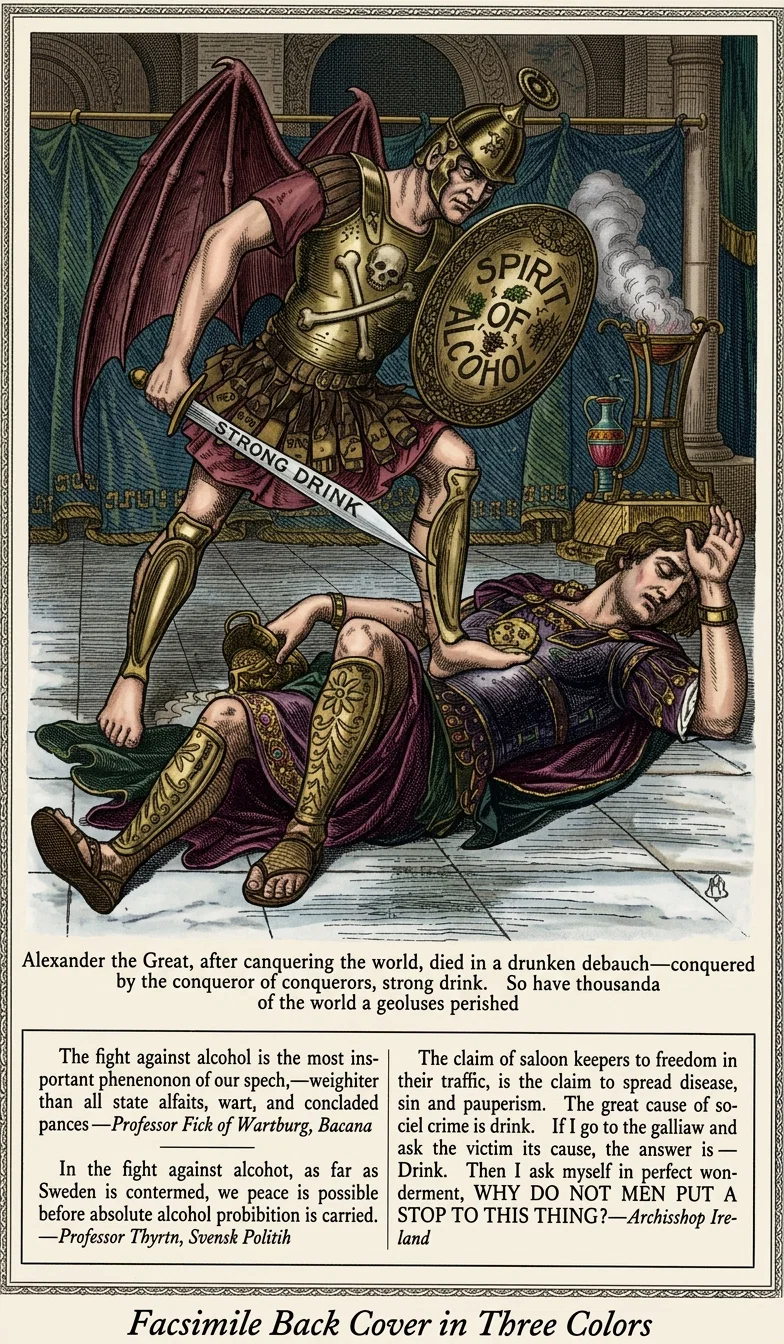
Alexander the Great, after conquering the world, died in a drunken debauch—conquered by the conqueror of conquerors, strong drink. So have thousands of the world's celebrities perished

NOW READY TO MAIL AT REGULAR PRICES

ORDER ONLY THROUGH CONFERENCE TRACT SOCIETIES

Resurrection

MRS. MARY WILLIAMS
“I will come again.” John 14: 3.
BEHOLD, the morning cometh, So much, so long desired, Predicted on the sacred page, By holy men inspired; When o’er this re-created realm One King shall reign alone, While nations lay their offerings down Before his glorious throne.
O morn of all glad morns the best, What mind can e’er portray The scenes, majestic and sublime, Of that auspicious day When, robed in immortality, Enraptured eyes behold The faces of the loved and lost— Long cherished friends of old.
No treacherous foe shall enter there, No vile usurper reign, When earth in Eden’s beauty clad Shall Eden’s bliss regain. Thrice glorious transformation then, End of all mortal woe; Reunion of the tender ties Long severed here below.
Behold, the morning hasteth on With purest bliss replete, When mercy, peace, and righteousness In glad embrace shall meet. Man in his Maker’s image formed, To perfect life restored, Shall join redemption’s matchless theme Of praise to Christ the Lord.
Troy, N. Y.

M. T. COLE

From Glory to Glory

M. T. COLE

It is the ambition of every Christian to walk with God; to be clothed with the robe of Christ’s righteousness; to stand before the Saviour without spot or wrinkle, having every stain of sin washed away in the cleansing flow from Calvary. Once we were dead in trespasses and sins, knowing not the power of the Father’s sacrifice in our behalf. But with conversion came a longing to see the coming king in all his glory.
All the angels of heaven will surround the company as they appear to mortal eyes. Then all who are faithful will be taken to heaven, there to dwell in the New Jerusalem forevermore. His promises are true; we can trust our all to their fulfillment. Let us stand fast in the Lord during the times of trial which are even now upon us, and we shall soon be changed from glory to glory. Then we shall sing the song of Moses and the Lamb, and dwell with Jesus evermore.

Dying With Jesus

T. E. BOWEN
Two deaths are allotted man because of sin. In Adam all die. This is not the death penalty for sin. This is our inheritance death. The next death—for all are made alive in Christ even though not deserving it—comes to each as the result of personal choice, personal sin. This is the second or eternal death. And, in very fact, all, both saint and sinner, must die this death, the only difference being that the child of God chooses to die that death now, while the sinner puts it off until it is forced upon him in the lake of fire.
This is the death the apostle was talking about when he wrote, “I have been crucified with Christ; and it is no longer I that live, but Christ liveth in me.” It was on Calvary’s cross that Jesus tasted the second or eternal death for every one who by faith will accept the atonement he made, and there with him let sinful self die.
Have you accepted that sacrifice? If so, with Christ you have passed from death unto life; if you have not, then with Satan and all his host you have “a certain fearful expectation of judgment, and a fierceness of fire which shall devour the adversaries.”
The choice is, Shall I yield sinful self for death now, or delay until God justly inflicts it? The answer every one must himself give to God, and himself meet the consequences. “It is a fearful thing to fall into the hands of the living God” without an intercessor. How much better to yield the sinful life to Jesus now, and take his righteousness in blessed exchange! Having him, we have life; but having him means death to self—“the old man.”

Disobedience to Be Punished

M. G. HUFFMAN
“Because sentence against an evil work is not executed speedily, therefore the heart of the sons of men is fully set in them to do evil. Though a sinner do evil an hundred times, and his days be prolonged, yet surely I know that it shall be well with them that fear God, which fear before him: but it shall not be well with the wicked, neither shall he prolong his days, which are as a shadow; because he feareth not before God.” Eccl. 8 : 11-13.
WHEREVER we present the truth in regard to the seventh-day Sabbath, and prove beyond doubt or cavil that man’s whole duty is to fear God and keep his commandments, of which the Sabbath is a very conspicuous part, we are met with the argument that God is not very particular as to what day we keep for the Sabbath, just so we keep one in seven.
If I hire a man to work for me, do I not expect that he will pay some attention to my wishes?—Most assuredly. To illustrate: I tell the man to take my carriage horse, which stands in the seventh stall, and hitch him to the spring wagon for me to take my produce to the city; but when I am ready to start, I find that the man has not obeyed my command; that instead of taking the horse out of the seventh stall as I commanded, he took one of the common everyday work horses, and that, too, out of the first stall. I ask him for an explanation why he disobeyed my command, and he answers, “I did not think that you were very particular as to what horse I took, or from what stall, just so I took a horse.” The man, thinking that I was not particular, did not obey my instructions.
“Well,” says one, “if God is particular which day we keep for the Sabbath, and how, why is it that he does not speedily execute judgment upon all who break the fourth commandment, as in the former dispensation?” That question is easily answered. In the former dispensation the Israelites had a theocratic government, under which Moses received both the civil and the ecclesiastical law direct from God, and the penalty for the transgression of either was administered speedily. God’s dealings with Israel in the former dispensation “were written for our learning, that we through patience and comfort of the Scripturesmight have hope.” Rom. 15 : 4. And they were written for our examples, that we should not “tempt Christ, as some of them also tempted, and were destroyed of serpents.” 1 Cor. 10 : 1-13.
We should always keep in mind that death is still the wages of sin. We may be emboldened to disobey the fourth commandment of God’s holy law, but we cannot annul the sentence, “The wages of sin is death.” We are free moral beings, and can do what we please. We can spurn the plain “Thus saith the Lord,” and repudiate the principles of God’s government. We can, if we choose, substitute another day for the Sabbath, thus setting aside the one the Lord made and commanded us to remember to keep holy; but we cannot repeal any part of the moral law, nor escape the punishment decreed for its violation. “We ought to give the more earnest heed to the things which we have heard, lest at any time we should let them slip. For if the word spoken by angels was steadfast, and every transgression and disobedience received a just recompense of reward; how shall we escape, if we neglect so great salvation; which at the first began to be spoken by the Lord, and was confirmed unto us by them that heard him?” Heb. 2 : 1-3.
Every word spoken by angels in the former dispensation was steadfast, and every transgression and disobedience received a just recompense of reward. Hence we cannot, with impunity, break any part of God’s holy law, nor reject light when the Lord in his mercy sends it to us. “If we sin willfully after that we have received the knowledge of the truth, there remaineth no more sacrifice for sins.” Heb. 10 : 26. Again we read: “To him that knoweth to do good, and doeth it not, to him it is sin” (James 4 : 17); “and sin, when it is finished, bringeth forth death.” James 1 : 15. The law of God will constitute the rule of judgment; for we read: “If ye fulfill the royal law according to the scripture, Thou shalt love thy neighbor as thyself, ye do well: but if ye have respect to persons, ye commit sin, and are convinced of the law as transgressors. For whosoever shall keep the whole law, and yet offend in one point, he is guilty of all. For he that said, Do not commit adultery, said also, Do not kill. Now if thou commit no adultery, yet if thou kill, thou art become a transgressor of the law. So speak ye, and so do, as they that shall be judged by the law of liberty.” James 2 : 8-12.
“Let us hear the conclusion of the whole matter: Fear God, and keep his commandments: for this is the whole duty of man. For God shall bring every work into judgment, with every secret thing, whether it be good, or whether it be evil.” Eccl. 12 : 13, 14. Christ, in speaking of the law, said that not one jot or tittle would in any wise pass from the law till all be fulfilled, and that whoever broke even the least commandment in the law would be called the least in heaven, but he who kept and taught the commandments would be called great. See Matt. 5 : 17-19.
God is now calling upon his watchmen to hold up the true Sabbath above the spurious, and call the attention of his people, who are honest and anxious to know and do his will, to the importance and significance of dropping the man-made sabbath, the first day of the week, and of accepting the true and only Sabbath that God has ever recognized, or ever will recognize, as his own. The seventh-day Sabbath constitutes the seal of God, and is a sign between man and his Creator, by which all may know him as the only true God, and Jesus Christ, whom he has sent, and in knowing him is life eternal. See John 17 : 3. But disobedience will be punished.

FRANCIS M. BURG

“Is There Unrighteousness With God?”—No. 3

FRANCIS M. BURG

Again we say that in all God’s dealings with men he is just. In every dispensation of his divine providence he has in view the highest good of his creatures. No passage of the Bible is fraught with more assurance and consolation than Rom. 8:28: “All things work together for good to them that love God.” Says this same apostle, after his wonderful reasoning concerning the Lord’s dealings with the Jews, as referred to in the first article of this series: “Behold therefore the goodness and severity of God.” Chap. 11:22. So God deals with his people,—sometimes in mercy, kindness, and goodness, sometimes in a “severe” way. In every case, whether by gentleness or by measures less pleasant to us, our Father is working for our best interests. “Whom the Lord loveth he chasteneth, and scourgeth every son whom he receiveth.”
It can be no injustice if we, the subjects of his saving grace, are asked to share in the sufferings of him on whom was laid “the iniquity of us all.” “He was wounded for our transgressions, he was bruised for our iniquities, . . . and with his stripes we are healed.” Isa. 53:4, 5. How can we stand aside and complacently see his sinless body and his sinless soul crushed beneath the infinite load, and we complain if asked to suffer somewhat with him?
We are all more or less like the two disciples who ventured to ask of Jesus that when he should sit upon his throne, they might occupy the highest places with him in his glory. Well did the Master reply, “Ye know not what ye ask.” As he further said to them, and at the same time to every one of his followers, “Ye shall indeed drink of the cup that I drink of; and with the baptism that I am baptized withal shall ye be baptized.” Mark 10:36-39. It is justly given to us to suffer with him if we are to share with him in his glory: “If so be that we suffer with him, that we may be also glorified together.” Rom. 8:17. This is the real meaning of every experience that comes in the life of a true follower of Christ. He that would be his disciple must take up his cross each day and follow him. See Luke 14:26, 27. By every experience and suffering we bear “about in the body the dying of the Lord Jesus, that the life also of Jesus might be made manifest in our body. For we which live are alway delivered unto death for Jesus’ sake, that the life also of Jesus might be made manifest in our mortal flesh. . . . For our light affliction, which is but for a moment, worketh for us a far more exceeding and eternal weight of glory; while we look not at the things which are seen, but at the things which are not seen: for the things which are seen are temporal; and the things which are not seen are eternal.” 2 Cor. 4:10-18. Sometimes the “bread of adversity, and the water of affliction,” may be given us, still the design of it all is to lead us in the way which we should go. See Isa. 30:20, 21.
So we are content to know that he leads us, and are willing to follow even though we must drink the bitter cup with him. We shall watch with him during the hour of his struggle. We shall be willing to endure the conflict though the flesh is weak.
“He leadeth me! O blessed thought! O words with heavenly comfort fraught! Whate’er I do, where’er I be, Still ’tis God’s hand that leadeth me.”
“Sometimes mid scenes of deepest gloom, Sometimes where Eden’s bowers bloom, By waters still, o’er troubled sea,— Still ’tis his hand that leadeth me!
“Lord, I would clasp thy hand in mine, Nor ever murmur nor repine, Content whatever lot I see, Since ’tis my God that leadeth me.”
Sometimes the waywardness of God’s people makes it necessary that he use severe measures with them. The history of ancient Israel affords us many examples of this: “They were disobedient, and rebelled against thee, and cast thy law behind their backs, and slew thy prophets which testified against them to turn thee to thee, and they wrought great provocations. Therefore thou deliverest them into the hand of their enemies.” Neh. 9:26, 27.
From Micah’s reference to the experience of this people, we can see the divine purpose for them. The prophet says: “I will bear the indignation of the Lord, because I have sinned against him, until he plead my cause, and execute judgment for me: he will bring me forth to the light, and I shall behold his righteousness [I shall see his justice].” Micah 7:9.
When the chastisement is upon us, we should seek to know the cause. As the prophet has said, it is because we “have sinned against him.” Whether the rod is laid upon us because of some particular overt sin, or whether the experience is a passing through the furnace so that the dross that is in us by nature may be consumed, we should recognize andacknowledge, as Micah did, that the cause is within ourselves, and should “bear” the chastisement until he brings us forth to the light. We shall then, as the prophet says, behold, or see, his justice. We shall recognize that justice demands the punishment, or chastisement, and the experience will bring us one step nearer to the preparation that we need in order to sing the eternal song in which Jehovah’s righteousness is to be declared.
Looking forward to the time when the Lord shall come to judge the world, the psalmist exhorts:— “O sing unto the Lord a new song; for he hath done marvelous things: his right hand, and his holy arm, hath gotten him the victory. The Lord hath made known his salvation: his righteousness [his justice] hath he openly showed in the sight of the heathen. He hath remembered his mercy and his truth toward the house of Israel: all the ends of the earth have seen the salvation of our God. Make a joyful noise unto the Lord, all the earth: make a loud noise, and rejoice, and sing praise. Sing unto the Lord with the harp; with the harp, and the voice of a psalm. With trumpets and sound of cornet make a joyful noise before the Lord, the King. Let the sea roar, and the fullness thereof; the world, and they that dwell therein. Let the floods clap their hands: let the hills be joyful together before the Lord; for he cometh to judge the earth: with righteousness shall he judge the world, and the people with equity.” Psalm 98.
In the final punishment, men who have rejected his mercy and his proffers of grace, who have done despite to the love that gave the richest gift that heaven could afford, will have justice and equity exercised toward them; and when sin and sinners are forever destroyed, and the subjects of grace receive the crown of everlasting life, the keynote will be touched, and the anthem that extols his mercy and his justice will swell into a volume of harmony that will make all the vast creation vibrant with his praise. “Acquaint now thyself with him, and be at peace,” and learn to know him whom to know aright is life everlasting.
Loma Linda, Cal.

A Call to Repentance

C. JENSEN
FROM the sixteenth verse of the third chapter of Isaiah to the end of the chapter the Lord speaks of the daughter of Zion as imitating the world in its pleasures, pride, and fashions; and “in that day” the worldly churches are described as seven women taking hold of one man, saying, “We will eat our own bread, and wear our own apparel: only let us be called by thy name, to take away our reproach.” Isa. 4: 1. The “one man” spoken of can be none other than “the Son of man,” who says of himself, “I am that bread of life;” “the words that I speak unto you, they are spirit, and they are life.” The “seven women,” or all the fallen churches, do not want to live by the Word of God nor be clothed with the righteousness of Christ, but desire to be governed by their own theories and traditions, and to be clothed with their own righteousness.
“In that day” when these things are observed in the pretended daughters of Zion, and the fallen churches care for no other consecration than the name and outward form of Christianity, that they be not reproached and called unbelievers, they are willing to be called by the name of the Son of man, but they are not willing to be clothed upon with the righteous life of Jesus.
“In that day shall the Branch of the Lord be beautiful and glorious, and the fruit of the earth shall be excellent and comely for them that are escaped of Israel. . . . When the Lord shall have washed away the filth of the daughters of Zion, and shall have purged the blood of Jerusalem from the midst thereof by the spirit of judgment, and by the spirit of burning.” Isa. 4: 3, 4.
“While David mused, the fire burned, then spake he with his tongue. While he mused upon the wondrous love of God, he could not but speak of that which he saw and felt.”—“Patriarchs and Prophets.” So it will be when we muse (meditate, think, or study) upon the Word and works of God; the Holy Spirit will consume the carnal mind, and write his law upon our hearts; then his glory will be seen upon us and be lived out in our lives, and we be among the remnant escaped of Israel.
When the separation has taken place in his own chosen church, and “the remnant” are escaped of Israel, there is entire apostasy, and the seven churches are then completed, and the loud cry of Revelation 18 will be given. When this message is proclaimed, there will be light and power in the camp of Israel; and as all the honest in heart are called out of the fallen churches, they take their stand with those who “keep the commandments of God, and the faith of Jesus.”
In one of the most beautiful and comforting passages of Isaiah’s prophecy, reference is made to the pillar of cloud and of fire to represent God’s care for his people in the great final struggle with the powers of evil. “The Lord will create upon every dwelling place in Mount Zion, and upon her assemblies, a cloud and smoke by day, and the shining of a flaming fire by night: for above all the glory shall be a covering. And there shall be a tabernacle for a shadow in the daytime from the heat, and for a place of refuge, and for a covert from storm and from rain.” Isa. 4: 5, 6, margin.
Those who have taken part in the three messages of Revelation 14 will surely not want to go with the world when the last warning cry is given; and it will be a sad experience for the remnant to see their brethren and sisters in the faith leave the ranks in this solemn time and walk with the world below into utter darkness, while the faithful ones are pressing onward, and making their final struggle to reach the everlasting light and glory.
The fifty-eighth of Isaiah must be read, and studied, and obeyed before we are ready to obtain the light and glory and power promised for the last days.
What shall we say when all nations shall be gathered before the Lord, “and he shall separate them one from another, as a shepherd divideth his sheep from the goats”? Shall we be among those to whom he will say, “Well done,” or shall we be among those to whom he will say, “Inasmuch as ye did it not to one of the least of these, ye did it not to me”?
Let us choose the Lord’s fast, and not our own way. Can we say we have “faith” and not have corresponding “works,” and be sure that we are ready for our Lord to come?
The spirit of prophecy already indicates that the loud cry of Revelation 18 is due; but how soon shall we be able to give it? Will the work outlined in the fifty-eighth chapter of Isaiah be done individually, or will it be done through “the church, which is his body, the fullness of him that filleth all in all”? Eph. 1:23.
To illustrate: Before we can obey the command to make light in our dwellings, we must have oil, lamps, and fire. So we must have light and comfort in our homes before we can consistently invite others to partake of our hospitality. In like manner do we need the divine light in our homes and churches before we can consistently give the message to the fallen churches, “Come out of her, my people.” May the faith of Jesus be manifest in our lives, and we be found prepared when he comes.

Joy

ALL the yellow sunshine days That I have known, that I have known, Are just a lovely golden haze That's all my own, my own.
And every pleasant, loving thing That I have heard, that I have heard, Within my heart will sing and sing Just like a *happy bird.
— C. H., in St. Nicholas.

Fight to the Finish

REGRET does not come to those who enlist in the cause of truth. James Chalmers was a pioneer missionary to New Guinea. There he labored for twenty-one years amid perils and difficulties. And Returning to his own country at the end of that time, he addressed a meeting in Exeter Hall. It is recorded that he there said: “Recall these twenty-one years, give me back all its experiences, give me its shipwrecks, give me its standings in the face of death, give me it surrounded with savages with spears and clubs, give it me back again with the spears flying about me, and with the club knocking me to the ground, give it me back, and I will still be your missionary.” This was one of the world's immortals expressing his desire to “fight to the finish.”—The Lutheran.

The Need of a Revival

ARTICLES in a recent number of the United Presbyterian and the Western Recorder (Baptist) consider at some length the need of a revival in the great Christian church. Among the evidences for this need cited by the United Presbyterian are the following: “Lack of interest in the work of the kingdom,” “a waning faith,” “inattention to the Word of God,” “neglect of prayer,” “selfish living.” The editor of this paper declares:—
Self-examination is in order. We need to look scrutinizingly into our own lives, and by the help of God to realize our own needs. Then we shall be in the spirit to receive that power without which all human planning and toiling are in vain.
The writer in the Western Recorder says that among the causes of a decline in spirituality are: (1) “The spirit of union that has obtained in some quarters;” (2) “conformity to the world and the ways of other people;” (3) “working at religion without the help of Christ;” (4) “pulpit performances.” He declares that—
the entertainment idea, which is carried out profusely, is supplanting and pushing aside the spiritual. Dancing, theater-going, moving picture scenes, and games of doubtful savor all have administered in a measure to the present low state of spiritual life among us. . . . If others have a special theatrical choir performance, we must have one, even if it makes every spiritual member bow his head and wish he were absent. To draw the crowd is the thing. The spiritual pastor must become a little more worldly to satisfy those having itching ears, or go far hence to the Gentiles. So we go, down, down, down.
If these disintegrating influences have wrought havoc in the great churches of Christendom, they will work havoc in the Seventh-day Adventist Church to the extent they are fostered in the lives of the members. We cannot join affinity with the world and maintain our living connection with Christ. We cannot permit the spirit of commercialism and pleasure loving, of indulgence in sinful or questionable games and amusements, the love of dress and display, to take possession of the lives of our members, and at the same time maintain the church in its purity and its simplicity. We can look out into the great Christian world and recognize that “Babylon is fallen;” but let us remember that the errors and backslidings from God, the apostasies from truth and from Christian living, which marked her downfall, will mark ours as well unless we individually set our faces to stem the current and maintain in our lives the power of the gospel of Christ.
The standard of Christianity in the Seventh-day Adventist Church will be no higher than the standard of Christianity in the average popular church of the world, only as the truth we hold sanctifies our lives; only as we are kept by the power of God. Holding the truth in theory will never save us. It is only as that truth is reduced to living experience in our lives that we shall be kept from falling and be transformed into the similitude of Christ’s character. Let us “look scrutinizingly into our own lives, and by the help of God realize our own needs.” By recognizing our own needs and by taking hold of the keeping power of Christ Jesus, we shall obtain the one thing needful to our salvation.
F. M. W.
Continue reading: The Worship of Relics