Your ShelfYour Projects

Signs of the Times, Vol. 39, No. 12.

Our Divine Substitute

Signs of the Times

Mar 19, 1912

Pacific Press Publishing Association · Mountain View, California · Mar 19, 1912

Our Divine Substitute

A Prophecy of our Lord written seven centuries before He came
(From Isaiah 53, Lowth's translation)
SURELY our infirmities He hath borne; And our sorrows, He hath carried them: Yet we thought Him judicially stricken; Smitten of God, and afflicted. But He was wounded for our transgressions; Was smitten for our iniquities: The chastisement, by which our peace is effected, was laid upon Him; And by His bruises we are healed. We all of us like sheep have strayed; We have turned aside, every one to his own way; And Jehovah hath made to light upon Him the iniquity of us all. It was exacted, and He was made answerable; and He opened not His mouth: As a lamb that is led to the slaughter, And as a sheep before her shearers Is dumb; so He opened not His mouth. By an oppressive judgment He was taken off; And His manner of life who would declare? For He was cut off from the land of the living; For the transgression of my people He was smitten to death. And His grave was appointed with the wicked; But with the rich man was His tomb. Altho He had done no wrong, Neither was there any guile in His mouth; Yet it pleased Jehovah to crush Him with affliction. If His soul shall make a propitiatory sacrifice, He shall see a seed, which shall prolong their days, And the gracious purpose of Jehovah shall prosper in His hands. Of the travail of His soul He shall see [the fruit], and be satisfied.

"IF YE WILL INQUIRE, INQUIRE YE."

This Inquirers' Department is conducted for the purpose of helping those who are studying the Bible. The answers are oftentimes only suggestive. They are never to be considered infallible, only as they agree with the infallible Word. The writer who may answer them does not consider that his opinion is infallible. He will simply give the best that he has, and plead with the inquirer to search the Word. Such questions only will be answered as, to the editors, seem to minister to the good of the readers and to the mission of the paper. We can not answer repeatedly in the same volume questions upon the same scripture. The name and address must accompany question, not for publication, but as an evidence of good faith, and that answer may be made by letter if deemed advisable. No letters are answered which do not contain the name of the writer. It is well always to enclose stamp for reply.

3694 — Under the Law

Why is it that the mass of Christians have made a mistake, and keep Sunday, if we are still "under the law"? Are they mistaken when they say they are no longer "under the law," because Christ fulfilled the law, and we are now "under grace"?
The expression "under the law" is greatly misunderstood. It is generally used as meaning under obligation to keep the law. It is used in that sense once in the Scripture — Rom. 3:19. Elsewhere "under the law" means under the condemnation of the law. He who sins is under the condemnation of the law. That is, he is under the law; the law is above him, suspends over him the sword of condemnation. The man who is justified by the Lord Jesus Christ has placed upon him the righteousness which Jesus Christ wrought out, and that righteousness included Sabbath-keeping. That does not place men "under the law." It takes men out from "under the law," and writes in the heart the very law that Christ Himself kept, so that the law is within the man, and not outside. The law outside condemns; the law within in Christ Jesus justifies.
The reason why the "mistake" has been made is very clear, if we will study the Sabbath question in the light of prophecy. We are told in Dan. 7:25, and elsewhere, of that power that should arise that should "think to change the times and the law," and that these would be given into the hand of that apostate power until the last days should come, and when that time comes there would be a reform regarding all these things. See Isa. 58:1, 13; Rev. 12:17; 14:6-14. We would like to have our questioner read the three following pamphlets and tracts: "The Lord's Day the Test of the Ages," giving an account of the Sabbath from the beginning to the present time. Price 10c. "Who Changed the Sabbath?" Price 2c. "'Under the Law,' or 'Under Grace?'" Price 2c.

A. C. M

3696 — The 144,000

I have been studying the thought that there will be only 144,000 living righteous people at the time the Lord comes. What about the children that will be born into the world? There will be thousands and thousands of children under the age of responsibility. What will become of them? Will they be saved, or lost, or numbered with the 144,000 living? Or is there anything to show that there will not be any children under the age of understanding, or responsibility, before the Lord comes?

A. C. M

We do not know that there is any scripture which tells us that there will be just 144,000 saved when the Lord comes. We are taught, it seems to us, quite clearly, in Revelation 14 and Revelation 7, that there will be a special class of 144,000. The Bible way of numbering is numbering the men that are of strong age. When the children of Israel entered the land of Canaan, a type of the heavenly Canaan, they were numbered from twenty years old and upwards. When our Lord fed the 5,000 and the 4,000, it said there were about 5,000 men, besides women and children, and 4,000 besides women and children. In the early church we are told that the number of men was about 5,000 (Acts 4:4), and yet we know there were many women, and doubtless children, who were with these believers. So it may be in the case of the 144,000. It may not include the women and children, and yet they would be numbered among the saved, equally well with the 144,000.
This special company which are numbered are of a special character—those who have borne great trials, and met them in the name of the Lord Jesus Christ.
Regarding the salvation of children in general, this we know, that those who died from Adam's sin will be raised from the dead through the grace of our Lord. If they have no sins of their own, they certainly have right to the salvation which He offers. The Lord does not reveal to us just what His will is concerning the irresponsible ones. The Bible is addressed to responsible men and women, and we can leave the irresponsibles with Him, knowing that what the Master does He will do well.

3692 — Every Eye Shall See Him

Please explain Rev. 1:7—"Every eye shall see Him, and they also which pierced Him." Rev. 20:6 pronounces a blessing on those who have part in the first resurrection. Surely those who pierced Jesus will not receive that blessing. What will become of them, and where will they be during the thousand years? If they are slain by the brightness of Christ's coming, there will surely be three resurrections, which I can not understand. Please explain.
There are but two general resurrections. The special resurrections which may take place are exceptions, and do not change in any way the great general resurrections. For instance, Moses was raised from the dead, and Lazarus. Many were raised from the dead when our Lord was raised, but this does not invalidate nor affect the great general resurrections of the righteous and of the wicked. Those who pierced Him, who will see Him come, are evidently some special ones who will be raised from the dead and will see our Lord appear, but will die in the brightness of His presence—simply a physical death, and not a punishment. These will be raised again at the end of the thousand years. This special resurrection seems to be hinted at by Dan. 12:2: "Many of them that sleep in the dust of the earth shall awake, some to everlasting life, and some to shame and everlasting contempt," but not all.

3693 — Parable of the Covenants, Gal. 4:21-28

Please give an exposition of Gal. 4:21-28. — H.
This scripture is an illustration of the two covenants: Hagar the type of one, Sarah the other; the child of Hagar the type of those who are brought into the nominal fold of Christ through human scheming, the child of Sarah a type of those who are brought in solely through the promise and power of the Lord Jesus Christ. Hagar bore children to bondage, for she was a bondmaid. So all those who are endeavoring to save themselves by any scheme of man are in bondage. They never can break their bondage themselves; and all they can save, or convert, to such a system are also children of bondage. On the other hand, Sarah was a freewoman, and her children were free, and she therefore represents God's order; and all those who are saved through the Lord Jesus Christ by faith are the children of Sarah and the children of Abraham, children of freedom. The two things are represented by earthly Jerusalem and heavenly Jerusalem. The Jerusalem of the earth is in bondage with her children, and was then. She rejected God and followed her own way. The Jerusalem which is above is free. She was created and exists by the promise of God. She is therefore called the mother of the children of faith. Isa. 54:1 is quoted to prove this. The apostle concludes, therefore, that those who believe are just as Isaac was, children of promise. And then, too, as Ishmael persecuted Isaac, so those who are the children of bondage persecute those who are free in Christ Jesus. Those who follow the schemes of men will use the schemes of men to suppress what they think to be error, but in the glorious outcome God will save His children. It is better to be the children of freedom in Christ, tho in bondage here, than to be the children of sin-bondage, tho they may for a while seem to be in power.

3695 — Dying and Not Dying

Please explain Gen. 2:17 and 3:17, in thus changing His word. L. H.
The first text reads, "But of the tree of the knowledge of good and evil, thou shalt not eat of it: for in the day that thou eatest thereof thou shalt surely die." 3:17 reads, "And unto Adam He said, Because thou hast harkened unto the voice of thy wife, and hast eaten of the tree, of which I commanded thee, saying, Thou shalt not eat of it: cursed is the ground for thy sake; in sorrow shalt thou eat of it all the days of thy life."
Our correspondent has not given us the full record, in the carrying out of the sentence. The first is God's sentence in brief. Man possessed not only physical life, the life of the body, the life of the flesh that all animals possess, but he also possessed the life of the spirit, the life which came from God in harmony with God's law, the higher life, which animals did not possess. In the very day man ate of the tree, he should surely lose that; and losing that, he would surely die. Death began—even physical death—at that very moment that man transgressed. This instruction was given before man sinned. In Genesis 3 we have the instruction after he sinned, the pronouncing of that sentence. That sentence involved the curse of the earth, that sorrow which came upon man, the thorns and thistles which the earth should bear, the labor which would come upon the human family; but the ultimate of the sentence is mentioned in verse 19: "Dust thou art, and unto dust shalt thou return." Man should die. That is all that is implied, it seems to us, in the fulness of God's word; there was no changing of it. Man lost spiritual life, which he held by faith and obedience, the very moment that he ate of that tree, and that made him a dying man physically, and the fulness of that act would be terminated when man should return to the dust.

Schedule for Week Ending March 30, 1912

Schedule for Week Ending March 30, 1912
Sunday | March 24 | Joshua 3, 4 Monday | " 25 | " 5, 6 Tuesday | " 26 | " 7 Wednesday | " 27 | " 8 Thursday | " 28 | " 9; 10:1-27 Friday | " 29 | " 23, 24 Sabbath | " 30 | Psalm 106

Joshua and God’s Faithfulness

We cover the remainder of the book of Joshua this week, with the exception of a part of chapter 10 to chapter 22 inclusive. These will not be of general interest, and many of the events can not be understood, concerning the division of the land, as there are no data to trace the boundary lines. This can be done only in a general way, and the division of the land is not of particular interest now. It shows this,—that God was true then, in the giving of the inheritance to the tribes, and that He is just the same God to-day, and will remember to fulfil His promises and carry out His purposes as He did then. Joshua could say, at the close of his eventful life, that "there failed not aught of any good thing which the Lord had spoken unto the house of Israel; all came to pass." After reading this record of the bringing of the children of Israel into the promised land, we can read with greater interest the 106th Psalm at the close of the week, and of the wonderful mercy which He showed, too—mercy in all their backsliding and departure from Him, and how He forgave them when they returned to Him with all their heart.

Reply to a Question Corner Correspondent

If P. B., who wrote us under date of February 5, will give his address, we will reply by letter. We do not reply to anything in the "Question Corner" even unless we have the address, not for publication, but as evidence of good faith. This is an invariable rule.

3697 — Drinking Coffee

Please give your opinion: is it wrong to drink coffee? E.
We suppose that our correspondent means the regular sale coffee, like Brazil or Java. Coffee contains a poison called caffein. This acts the same as does the active poison in tea. Taken in large doses it is a powerful drug, and the bad results that come from heavy coffee or tea drinking are caused by the constant partaking of this drug. Why, then, should we use it? We question whether any one has ever been benefited by its use, whether any one can point out the superior health of a coffee drinker, as a coffee drinker. We know there are thousands and thousands who have been injured by drinking coffee, and have been ordered by doctors to abstain from it, and many thousands will witness to the benefit of utterly breaking away from the habit. It would seem as if it were wrong, first, because it is entirely useless; secondly, because of the harm that it does and the active poison which it contains; thirdly, it is money expended for nothing, and worse than nothing, which might be used for a far better purpose. Break away utterly, and if some warm drink is used, take some harmless preparation, such as cereal coffee, or crust coffee, or corn coffee, or what may be better still in many cases, simply hot water. Years ago, when a young man teaching school, the writer sat at a table with a Methodist minister,—a clear-headed, entertaining gentleman, who told of his experience, when he was a boy, of drinking tea, and getting into his mother's tea-canister, of the longings that he had for coffee, and how, when he saw that such things as those were harming him, he stopped there and then. The advice seemed to be good, the counsel wise, and the writer concluded that there was no better place for him to stop the drinking of coffee and tea than right there and then, and he has never regretted it.

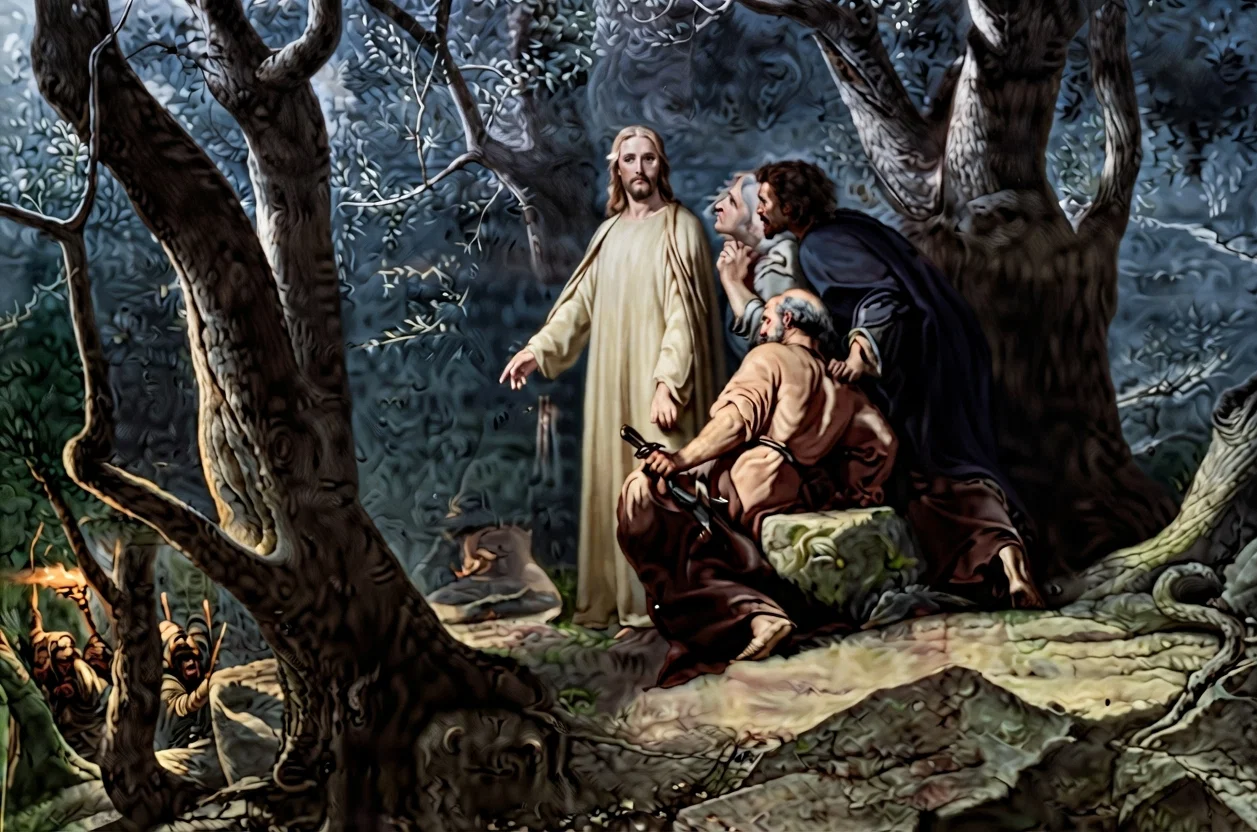
Gethsemane

By Mrs. E. G. White
HEN cometh Jesus with them unto a place called Gethsemane, and saith unto the disciples, Sit ye here, while I go and pray yonder. And He took with Him Peter and the two sons of Zebedee, and began to be sorrowful and very heavy. Then saith He unto them, My soul is exceeding sorrowful, even unto death: tarry ye here, and watch with Me. And He went a little farther, and fell on His face, and prayed, saying, O My Father, if it be possible, let this cup pass from Me: nevertheless not as I will, but as Thou wilt." It was here that the mysterious cup trembled in Christ's hand. Here the destiny of a lost world hung in the balance. Should He refuse to stand as man's surety? Satan encircled His humanity with a horror of great darkness, tempting Him to think that God had forsaken Him.
In this hour of trial Christ's human nature longed for sympathy. In the supreme agony of His soul, He came to His disciples with a yearning desire to hear some words of relief from those whom He had oft blessed and comforted and shielded in sorrow and distress, for the law of kindness was ever on His lips. The One who had always had words of comfort for them was now suffering superhuman agony, and He craved sympathy; He longed to know that they were praying for Him and for themselves. How dark seemed the malignity of sin! No earthly potentate can show himself more keenly observant of his subjects than was Jesus. He was jealous for His law as no earthly king can be, for He was the King eternal, invisible, immortal. If He could only know that His disciples understood and appreciated the terrible temptation to let the human race bear the consequences of its own guilt, while He stood innocent before God, He would be strengthened.
"And He cometh unto the disciples, and findeth them asleep." Had He found them praying, He would have been relieved. Had they been seeking refuge in God, that satanic agencies might not prevail over them, He would have been comforted by their steadfast faith. But, unheeding the repeated warning, "Watch and pray," they had fallen asleep. They knew not the necessity of watchfulness and earnest prayer in order to withstand the temptations of Satan.

Could Ye Not Watch?

As one surprised, Christ addressed them, saying, "What, could ye not watch with Me one hour?" They roused themselves, and looked sorrowfully at their Lord. "Watch and pray," He said, "that ye enter not into temptation." Then the divine Sufferer excused the disciples, saying, "The spirit indeed is willing, but the flesh is weak."
Then cometh Jesus with them unto a place called Gethsemane, and saith unto the disciples, Sit ye here, while I go and pray yonder
Christ went away the second time, and prayed earnestly, "O My Father, if this cup may not pass away from Me, except I drink it, Thy will be done." Again darkness pressed upon His soul with almost unbearable agony, and again He felt a longing for companionship, for some words which would bring relief, and break the spell of darkness that well-nigh overpowered Him. "And He came and found them asleep again: for their eyes were heavy;" "neither wist they what to answer Him." They saw His face marked with the bloody sweat of agony, and they were filled with sorrow; for "His visage was so marred more than any man."
Again Christ went away, and prayed that if it were possible, this cup might pass from Him. His soul was filled with an overpowering fear of separation from God in consequence of sin. Satan told Him that if He became the substitute and surety for a sinful world, He would nevermore be one with God, but would be under his control.

Shall the Sacrifice Be Made?

Three times the prayer ascended to God, "O My Father, if it be possible, let this cup pass from Me," always followed by the words, "Not My will, but Thine, be done." Shall the cup pass from the Suffering One? Shall the sacrifice of Christ, ordained before the foundation of the world, and symbolized in every sacrifice offered since Adam's transgression, be given up? Shall the glorious purpose of God the Father, and Jesus Christ His Son, entered upon to save a perishing world, be of no account? Shall that which angels eagerly desired to look into and understand, that which had been the burden of prophecy, that which lay at the foundation of types and shadows, fail after all, leaving Satan and his apostate forces and confederacy of evil to come off triumphant?
O, how much Christ had already suffered as the Son of Man, in order to redeem and save men! How much He had borne as their substitute! Now the time had come when all the types and symbols pointing to His suffering and death were to be fulfilled. Shall He fail, and come short in His work of redemption? Shall the prince of darkness triumph? Shall his proud boast become truth? Shall the prey be left helpless in the hands of the mighty? Or shall the captives be delivered, Satan overcome, and it be demonstrated that obedience to the law is possible, for all have been made more than conquerors through Christ?

The Universe a Spectator

It was the will of God that none should perish, but that all should have eternal life through faith in the sacrifice of Christ. Him God the Father sealed to become man's Restorer. The worlds unfallen and the heavenly angels watched with intense interest as the conflict drew to its close. Satan and his confederacy of evil, the legions of apostasy, watched intently this great crisis in the work of redemption. The powers of good and evil waited to see what answer would come to Christ's thrice repeated prayer. In this awful crisis, when everything was at stake, when the mysterious cup trembled in the hand of the Sufferer, the heavens opened, a light shone forth amid the stormy darkness of the crisis hour, and an angel who stands in the presence of God, occupying the position from which Satan fell, came to the side of Christ. What message did he bring? Had he come to tell Christ that the price to be paid was too great, that it would cost too much to save the world, and that man must be left to his doom, to be destroyed by the wrath of an offended God? Did he tell Him that He need not drink the bitter cup, that He need not bear the guilt of man?

The Assurance of His Father's Love

The angel did not come to take the cup from Christ's hand, but to strengthen Him to drink it, with the assurance of the Father's love. He came to give power to the divine-human Suppliant. He pointed Him to the open heavens, telling Him of the souls that would be saved as the result of His sufferings. He assured Him that His Father is greater and more powerful than Satan, that His death would result in the utter discomfiture of Satan, and that the kingdom of this world would be given to the saints of the Most High. He told Him that He would see of the travail of His soul, and be satisfied, for He would see a multitude of the redeemed, saved, eternally saved.
Christ's agony did not cease, but His depression and discouragement left Him. He still carried the load of guilt, and He fulfilled the demands of the divine law, and glorified the Father by drinking the bitter cup.
"Then cometh He to His disciples, and saith unto them, Sleep on now, and take your rest: behold, the hour is at hand, and the Son of Man is betrayed into the hands of sinners." The storm of the hellish host had in no wise abated, but He who was its subject was strengthened, to meet its fury. He came forth calm and serene. He had borne that which no human being can, ever bear; for He had tasted the sufferings of death for every man. "Who is this that cometh from Edom, with dyed garments from Bozrah? this that is glorious in His apparel, traveling in the greatness of His strength? I that speak in righteousness, mighty to save. Wherefore art Thou red in Thine apparel, and Thy garments like him that treadeth in the wine fat? I have trodden the wine-press alone; and of the people there was none with Me."

The Temptation of Christians

As Satan tempted Christ, so he will tempt Christ's followers. The Son of Man was betrayed into the hands of sinners. Many, for Christ's sake, will undergo a similar experience. Priests and rulers will instigate men to testify falsely against them. Christ has told us of the persecution that will come upon those that love and fear God, through men who are working in copartnership with Satan. Under the teaching of the Holy Spirit, God's people will learn more of the terrible character of sin as they feel the cruelty of those who are controlled by it. But all the cruelty manifested toward them is charged against the doers as done to Christ, who has redeemed human souls with His own blood, and has called them by His name.

The Same Strength for Us

The strength given to Christ in the hour of bodily suffering and mental anguish in the Garden of Gethsemane, has been and will be given to those who suffer for His dear name's sake. The same grace given to Jesus, the same comfort, the more than mortal steadfastness, will be given to every believing child of God who is brought into perplexity and suffering, and threatened with imprisonment and death, by Satan's agents. Never has a soul that trusts in Christ been left to perish. The rack, the stake, the many inventions of cruelty, may kill the body, but they can not touch the life that is hid with Christ in God.
"Nation shall rise against nation," said Christ, "and kingdom against kingdom: and great earthquakes shall be in divers places, and famines, and pestilences; and fearful sights and great signs shall there be from heaven. But before all these, they shall lay their hands on you, and persecute you, delivering you up to the synagogs, and into prisons, being brought before kings and rulers for My name's sake. And it shall turn to you for a testimony. Settle it therefore in your hearts, not to meditate before what ye shall answer: for I will give you a mouth and wisdom, which all your adversaries shall not be able to gainsay nor resist. And ye shall be betrayed both by parents, and brethren, and kinsfolks, and friends; and some of you shall they cause to be put to death. And ye shall be hated of all men for My name's sake. But there shall not an hair of your head perish." "In the world ye shall have tribulation: but be of good cheer; I have overcome the world."

The Promises to Abraham

By Eugene W. Farnsworth

IV—The Earth Renewed

HE Scriptures teach that God promised Abraham and his seed the earth for an "everlasting possession." This fact illumines many Scripture texts:
Blessed are the meek: for they shall inherit the earth. Matt. 5: 5.
Honor thy father and thy mother: that thy days may be long upon the land which the Lord thy God giveth thee. Ex. 20: 12.
Thy kingdom come. Thy will be done in earth, as it is in heaven. Matt. 6: 10.
Behold, the righteous shall be recompensed in the earth: much more the wicked and the sinner. Prov. 11: 31.
For the upright shall dwell in the land, and the perfect shall remain in it. But the wicked shall be cut off from the earth, and the transgressors shall be rooted out of it. Prov. 2: 21, 22.
A multitude of other scriptures proclaim the same truth.
But the world is now under the curse. At the time sin entered, we read, "Cursed is the ground for thy sake; in sorrow shalt thou eat of it all the days of thy life." When the first martyr's blood was shed, God said to the murderer, "And now art thou cursed from the earth, which hath opened her mouth to receive thy brother's blood from thy hand." When the flood of waters was dried from the earth, God declared, "I will not again curse the ground any more for man's sake."

Groaning Under the Curse

Under its heavy load of transgression, we are told, "The whole creation groaneth and travaileth in pain together until now." "The creation itself also shall be delivered from the bondage of corruption into the liberty of the glory of the children of God." Rom. 8: 22, 21, A.R.V.
There is a glorious future awaiting this earth. God has promised, "There shall be no more curse." Rev. 22: 3. "Christ hath redeemed us from the curse of the law, being made a curse for us: for it is written, Cursed is every one that hangeth on a tree." Gal. 3: 13. Christ was made a curse Himself, that He might lift the curse of God from the whole creation.
Peter, speaking of Christ and His mission, said, "Whom the heaven must receive until the times of restitution of all things, which God hath spoken by the mouth of all His holy prophets since the world began." Acts 3: 21. There is, then, to be a restitution, a regeneration of the earth, as well as a regeneration of men. The Saviour said, "Ye which have followed Me, in the regeneration when the Son of Man shall sit in the throne of His glory, ye also shall sit upon twelve thrones, judging the twelve tribes of Israel." Matt. 19: 28. "Behold, I make all things new." Rev. 21: 5.

The Earth to Be Renewed

The earth is to be renewed and brought back to its original condition. When it came from the hand of God He pronounced it "very good." By and by it will be brought back to that state again. Peter tells us how this will be accomplished: "But the day of the Lord will come as a thief in the night; in the which the heavens shall pass away with a great noise, and the elements shall melt with fervent heat, the earth also and the works that are therein shall be burned up. Seeing then that all these things shall be dissolved, what manner of persons ought ye to be in all holy conversation and godliness, looking for and hasting unto the coming of the day of God, wherein the heavens being on fire shall be dissolved, and the elements shall melt with fervent heat?" 2 Peter 3: 10-12. The fires of the great day will "dissolve," "melt" this old earth, all marred and scarred by sin. That fire will "destroy the works of the devil." 1 John 3: 8. It will "burn up the chaff with unquenchable fire." Matt. 3: 12. That is the day when "all the proud, yea, and all that do wickedly, shall be stubble: and the day that cometh shall burn them up, saith the Lord of Hosts, that it shall leave them neither root nor branch." Mal. 4: 1.
But when this raging fire has done its awful work, the earth melted and purged from every stain of sin will come forth a new earth, a renewed earth. Peter, after describing the fire and its results, continues,"Nevertheless we, according to His promise, look for new heavens and a new earth, wherein dwelleth righteousness." 2 Peter 3: 13.

Paradise Restored

This new earth is Paradise restored. In it the righteous will ever dwell. Of this beautiful home prophets have written and poets have sung. Isaiah, in his rapturous song, thus describes it:
For, behold, I create new heavens and a new earth: and the former shall not be remembered, nor come into mind. But be ye glad and rejoice forever in that which I create: for, behold, I create Jerusalem a rejoicing, and her people a joy. And I will rejoice in Jerusalem, and joy in My people: and the voice of weeping shall be no more heard in her, nor the voice of crying. Isa. 65: 17-19.

All Nature Brought into Harmony

Wonderful changes will be seen. All nature will be in harmony. The fierceness and ferocity seen among animals will vanish.
The wolf and the lamb shall feed together, and the lion shall eat straw like the bullock: and dust shall be the serpent’s meat. They shall not hurt nor destroy in all My holy mountain, saith the Lord. Isa. 65: 25.
The wolf also shall dwell with the lamb, and the leopard shall lie down with the kid; and the calf and the young lion and the fatling together; and a little child shall lead them. And the cow and the bear shall feed; their young ones shall lie down together: and the lion shall eat straw like the ox. And the sucking child shall play on the hole of the asp, and the weaned child shall put his hand on the cockatrice’ den. . . . For the earth shall be full of the knowledge of the Lord, as the waters cover the sea. Isa. 11: 6-9.
And the ransomed of the Lord shall return, and come to Zion with songs and everlasting joy upon their heads: they shall obtain joy and gladness, and sorrow and sighing shall flee away. Isa. 35: 10.
For as the new heavens and the new earth, which I will make, shall remain before Me, saith the Lord, so shall your seed and your name remain. And it shall come to pass, that from one new moon to another, and from one Sabbath to another, shall all flesh come to worship before Me, saith the Lord. Isa. 66: 22, 23.
This is the reward Christ promised when He said, "Then shall the King say unto them on His right hand, Come, ye blessed of My Father, inherit the kingdom prepared for you from the foundation of the world." Matt. 25: 34.
And thus all God’s saved children, all the seed of Abraham, all the wandering, exiled pilgrims, those sojourners, will at last reach their own country and home. What a gathering that will be!
The capital city of the new earth will form an interesting study to conclude this series of articles.

Summoned from a Sycamore

By Delwin Rees Buckner
Because his body was so bowed and bent, Not Zaccheus nor other was to blame; He simply bore about the fragile frame An all-wise Lord had leniently lent Until that fatal moment when He meant To crumble it to dust again, the same As when it slumbered without shape or name In Eden's lovely vale of violet scent. Yet fortunate for him he was so small Of stature, else he had not bent the boughs Of that lone, leaning sycamore to see The Saviour, nor had heard His urgent call To hasten down, for that day at his house He needs must share his hospitality.
Continue reading: What Shall We Do with the Fourth Commandment?