It was my privilege to attend four of the earlier camp meetings in the State of California. It has seemed best to those who have charge of the strong, growing work in this field to divide the State into six local conferences, known as the California, Central California, Northern California, Northwestern California, Southeastern California, and Southern California Conferences. It will help to a better understanding of why, in the interests of the work, so many divisions have been made, to remember that in territory California is as large as the States of Pennsylvania, New York, Vermont, New Hampshire, Massachusetts, Maine, and Delaware. Then the work has grown through the years until at the present time there are some 10,000 Sabbath keepers in the State, besides a number of institutions, some of which are among the strongest in the denomination.
The first meeting was that of the Central California Conference, held May 25 to June 4, at Hanford, a growing, substantially built city of about 5,000 inhabitants. Elder N. P. Neilsen is president of this conference. The camp was conveniently located, and the evening services were well attended by the citizens. More than eight hundred were present on the Sabbath, and at the revival services scores sought God for a deeper Christian experience. Twenty-one were baptized. Brother C. W. Fuller was ordained to the gospel ministry on the last Sabbath. A most excellent spirit prevailed throughout the entire meeting, and all returned to their homes with renewed determination to be faithful.
The second meeting was the annual camp meeting in the California Conference, held June 1-10, in the city of Oakland. Elder J. L. McElhany is president of this conference. The encampment was well located on a good street-car line, was well arranged, and everything was conducted in a systematic and orderly way. A strong spiritual work was carried forward each day. While there was only a moderate number camped on the ground, the attendance during the evening services and on Sabbath from the churches around the bay was very large, filling the large pavilion at times to overflowing. There was also a good attendance from the city, the evening services being devoted to the stirring themes of the hour. The revival work on the Sabbath was greatly blessed of God. Here, as in all the other camp meetings, the sale of literature was given special attention, and a large amount was sold. On the whole, the meeting was very encouraging, and tended greatly to strengthen the work. As in all the other meetings, the utmost unity was seen.
The next meeting was held June 8-18, in the Northern California Conference, at Stockton, a city of about 25,000 inhabitants. Elder C. Santee is president of this conference. The camp was located in a shady park, the use of which was given free of charge by the city. This was the only meeting where the business session of the conference was held, and here the delegates came together and transacted most of the business a few days before the camp meeting proper began. The utmost unity was seen in all the work of the conference, in business matters as well as in the work of the camp meeting. Brother Santee was re-elected president. The other officers chosen were substantially the same as the past year. A splendid spirit was present during the entire meeting. A strong evangelistic work has been carried forward in the city for some time, and the camp meeting served to bind off the splendid work which had been done.
Here, as in the other meetings, the revival spirit was present, and a strong spiritual work was carried forward daily. The attendance of our people was good, and all returned to their homes encouraged to press the battle to the gates as never before. On Sunday a baptismal service was held in the large church at Lodi, where the sacred rite was administered quietly and solemnly. Plans were laid for some aggressive work in the field during the summer. We were all glad to see our dear Brother Loughborough at this meeting. Though feeble from the weight of years, he attended most of the meetings, and spoke twice.
Following this meeting, the annual camp meeting of the Southern California Conference was held June 15-25, at San Fernando, where one of the strong academies is located. Elder B. E. Beddoe is president of this conference. The camp was a large one, well located and excellently arranged. A most earnest spirit of unity and co-operation characterized the meeting. The attendance was good, and on the Sabbath was very large. The Spirit of God wrought during the meeting, healing bodies as well as souls. On the two Sabbaths especially, many were led to a new and richer experience in the divine life. This was a splendid meeting in every way, and greatly blessed of God. A deep conviction that we are approaching solemn hours, and need a special spiritual preparation to stand in these trying times, rested upon us all. I did not learn the number baptized.
Besides the regular union and local conference laborers, Elder A. O. Tait, editor of the Signs of the Times, Prof. P. T. Magan, and the writer shared in the burdens and blessings of all these meetings. The influence of our schools was seen in the large number of young people present at each meeting. A strong work was carried forward for the youth and children by those having special charge of this work, and many young hearts were won for the Lord. It was truly an inspiring sight to see hundreds of young people in this one State, preparing for the work of God both at home and abroad.
Our duty to the foreign fields was given consideration at each meeting, and quite a good amount in cash and pledges was received. The home missionary work received special attention. A good work was done in all the other departments, which are under the charge of strong, experienced secretaries, in both union and local conferences.
The work in California looks encouraging in every way. The labors of the ministry are being attended with good results, and there is a spirit of unity and aggressiveness manifested everywhere. The educational work being carried forward is of a high character, and the future for the schools looks very bright indeed. The debts resting upon them are being rapidly paid. The sanitariums are all enjoying a good patronage.
Personally, I enjoyed the privileges and blessings which these meetings afforded, and also the opportunity of meeting old friends and becoming acquainted with new ones. I greatly appreciated the sweet spirit of love, unity, and co-operation which we all enjoyed together in each meeting. My wish for the work in this great State is found in 1 Cor. 15: 58: “Therefore, my beloved brethren, be ye steadfast, unmovable, always abounding in the work of the Lord, forasmuch as ye know that your labor is not in vain in the Lord.”
G. B. THOMPSON.
Manitoba Camp Meeting
By C. F. McVAGH
THE meeting at Minnedosa, Manitoba, was a most encouraging one to the laborers and people alike. Notwithstanding the rain and chilly weather during a part of the time, there was scarcely any sickness in camp, and every meeting was attended by practically all the campers, from the early morning devotional meeting to the evening preaching service. Whenever the weather was favorable,16the evening services were well attended by the townspeople also, who took a deep interest and seemed much impressed by the themes presented. Harmony and unity prevailed throughout the business sessions of the conference.
Elder Chapman, who had served as president for three years, declined to accept the office again when it was decided to lengthen the term to two years, in harmony with the recommendation of the fall council of the North American Division. At the close of the camp meeting, the vacancy had not been filled, the union president and the executive committee being authorized to find a suitable man to take the place. Nearly $2,000 was pledged for missions and home work. On the last Sabbath several surrendered to God, and the whole congregation came forward to renew their consecration and to seek a new and deeper experience. Sunday afternoon, ten were baptized in the beautiful little lake near by.
The book and literature sales exceeded those of any former camp meeting in Manitoba, as did also the Sabbath school offering. Meetings were held twice a day for the young people, and all branches of the work received attention.
I never saw a larger proportion of earnest consecrated young people at any camp meeting, and this is one of the many hopeful features of the situation in Manitoba. Among the laborers from outside of Manitoba were Elders E. W. Farnsworth and W. W. Eastman, Professor Kellogg and Professor Dick, Brethren W. L. Manfull and J. M. Rowse. Elder Schilling attended a part of the time, also the writer. Elder J. J. Graf will spend the summer in labor in the field for the Germans.
The Manitoba Conference is one of the most promising and fruitful fields, but is sadly in need of more laborers, both English and German. Brother Gulbrandsen is working for the large number of Icelandic people in the province, but is handicapped for lack of literature in that tongue. An offering was taken at the meeting for the Icelandic literature fund.
C. F. McVAGH.
July 23: Sin that is not forgiven will be punished.
July 24: The need of seeking God before the day of his vengeance.
July 25: “I am with thee to deliver thee.”
July 26: Results of forsaking God.
July 27: “The harvest is past, the summer is ended, and we are not saved.”
July 28: “Give glory to the Lord your God.”
July 29: God is our strength and refuge.
Nahum
The personal history of this prophet is veiled in obscurity. “Some think that he was an inhabitant of Galilee, and others that he was the son of one of the captives in Assyria.” His prophecy, the burden of Nineveh, is dated one hundred and fifty years after the warning delivered to that city by the reluctant Jonah. During this period Nineveh had returned to her evil ways, and become a “bloody city . . . full of lies and robbery.” In three distinct predictions Nahum foretells the overthrow and scattering of Assyria.
“This book has but a single theme, the destruction of Nineveh. The Assyrian empire stood in the eyes of the Jews as the most brutal type of heathen abominations. The monuments have confirmed their opinion. The kings of Assyria boasted of their cruelty. Asurnazirpal (B. C. 884) tells us how he ‘dyed the mountains of Nairi with blood like wool; how he flayed captive kings alive, and walled up others while still living, and impaled them on stakes; how he burned boys and girls in the fire, put out eyes, cut off hands, feet, noses, and ears.’ Asurbanipal, who captured Thebes in Egypt (chapter 3:8, 9) tells us how ‘he tore off the lips and hands of kings, and compelled a prince to wear round his neck the decapitated head of his king, and all this they profess to do at the command of Asur, their god.’ One writer says, ‘No power more useless, more savage, more terrible, ever cast its gigantic shadow on the page of history.’ This power is mentioned as early as the sixteenth century B. C. In the very height of its glory and just after it had humbled Egypt, its great rival, Nahum the prophet predicts its utter ruin. He proclaims the truth that kingdoms built on fraud, force, and cruelty must fall before God’s kingdom, reared on the foundation of truth and righteousness. The book forcibly brings before us God’s moral government of the world.”
“As a poet, Nahum occupies a high place in the first rank of Hebrew literature. His style is clear and uninvolved, though pregnant and forcible; his diction sonorous and rhythmical, the words reechoing to the sense.”
Zephaniah
“Zephaniah, son of Cushi, prophesied in the days of Josiah, king of Judah, 640–608 B. C. Two corrupt and idolatrous kings, Manasseh and Amon, preceded Josiah on the throne. Jerusalem became a hotbed of evil. The abuses in church and state seem to have continued during the early years of the reign of Josiah. The book of Zephaniah reflects as in a mirror the character of the times. The prophet was a preacher of righteousness, and denounced the evils of his age in unsparing terms. By this preaching it is believed that both people and king were moved to better things; so that when the book of the law of the Lord was found in the temple (2 Kings 22:8), matters were ready for the great reformation which followed. This return to law, order, righteousness, and spirituality stayed for a while the threatened judgment. Many scholars place this prophecy in 630 B. C. In the world at large at this time or a little later, the Scythians, the barbarous hordes from the north, pillaged and burned many cities and towns of Assyria and Syria. They penetrated to the confines of Egypt, but were bribed by great presents of the king not to invade his country. Many think that the prophet, foreseeing the havoc to be wrought by the Scythians, refers to them, and looking beyond them sees a judgment which cannot be averted. Egypt will not be able to buy her freedom from her enemies as she did from the Scythians (chapter 1:18); Nineveh will fall and be a desolation (chapter 2:13).” —Sell
The Prophet of Sorrows
Jeremiah was very young when he received the call (626 B. C.) that placed him among the prophets, to which position he had been consecrated by God himself before his birth. “I cannot speak: for I am a child,” said the youth; but God did not excuse him because of his tender years. Wonderful indeed was the ordination of the young prophet, and the solemn charge laid upon him; wonderful, also, the life of service that followed. He began to prophesy in the reign of the good king Josiah, continuing his ministry through the reigns of Jehoiakim and Zedekiah. Even after the captivity his voice was raised in faithful warning and reproof. “Like a fenced wall,” he performed the duty that was laid upon him, for forty-two years steadfastly giving the word of the Lord to kings, nobles, and people.
King Josiah, himself a young man, worked with Jeremiah for the abolishment of idol worship and the carrying out of other reforms; but after his death the people reverted to their sinful practices, and the life of the prophet was filled with sorrow.
When Jeremiah was born, Assyria and Egypt were disputing the sovereignty of the world. Before Jerusalem was destroyed, Assyria’s power had been shattered by Babylon. Egypt under Pharaoh Necho II, daring to dispute the might of this new world power, suffered a disastrous defeat at the battle of Carchemish in 604 B. C. Babylon under King Nebuchadnezzar was now mistress of the world. Jeremiah, whose message was to the nations, foresaw these changes and looked even beyond them; he predicted that even great Babylon after seventy years should fall, and a new power take its place. It seems to him the very height of folly for Judah, who would not trust in God, to attempt to contend with a world empire. He looked beyond the present great nations; beyond the present Judah, disobedient and ungrateful, and saw the rise of a kingdom greater than all, under a King who should sit upon the throne of David, and execute judgment and justice. He saw the bringing in of a new covenant where there should be no outward temple, but the righteous law should be written on the hearts of men.”
The character of Jeremiah “is most interesting,” says Canon Cook. “We find him sensitive to a painful degree, timid, shy, hopeless, desponding, but never flinching from duty. . . . Timid in resolve, he was unflinching in execution; as fearless when he had to face the whole world as he was dispirited and prone to murmuring when alone with God. Judged by his own estimate of himself, he was feeble, and his mission a failure: really, in the hour of action and when duty called him, he was in very truth ‘a defended city, and an iron pillar, and brazen walls against the whole land.’ He was a noble example of the triumph of the moral over the physical nature.”
Missionary Volunteer Department
M. E. KERN — Secretary
MATILDA ERICKSON — Assistant Secretary
MRS. I. H. EVANS — Office Secretary
MEADE MACGUIRE — Field Secretaries
C. L. BENSON
J. F. SIMON
Medical Missionary Department
W. A. RUBLE, M. D. — General Secretary
L. A. HANSEN — Assistant Secretary
H. W. MILLER, M. D. — N. Am. Div. Secretary
Abbreviated Report of the Medical Department of the North American Division Conference
Read at the Medical Convention Held at Madison, Wis., June 5-10
It is with a great deal of pleasure that I submit a report of a work that has shown such growth and vigor during the past two years, especially when we recall the days of severe trial that characterized the beginning of our various sanitarium enterprises. Those days of oppression and depression are of so recent occurrence that I need not refresh your memories, but simply confine my remarks to conditions as we find them today, and touch upon the opportunities and possibilities that open before us.
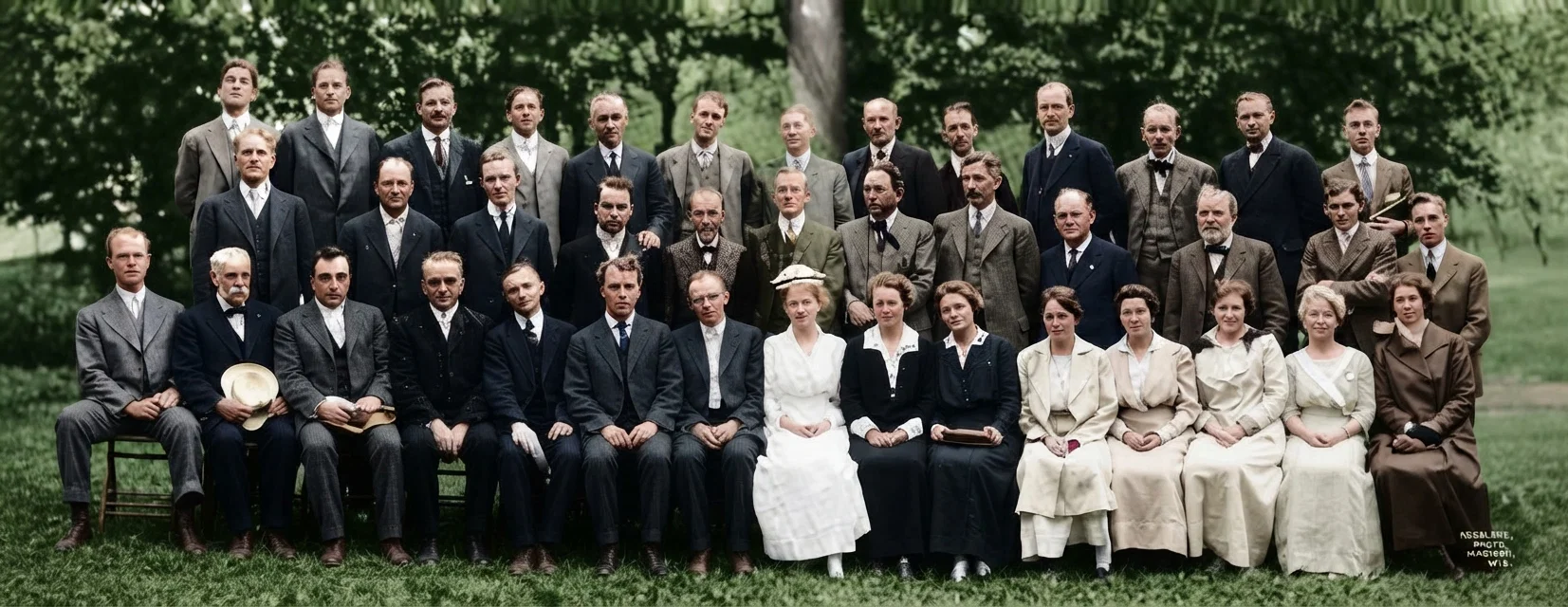
MEDICAL COUNCIL AT MADISON, WIS.
When it is recalled that the object of our sanitarium work is chiefly twofold,—to care for the invalid sick, and to train an army of workers to minister in behalf of suffering humanity,—we today, as never before, realize that we are facing the closing work of this message. These words come to us now with special emphasis: “I wish to tell you that soon there will be no work done in ministerial lines but medical missionary work.” This evidently means that the closing work of this message will be done by and through a class of workers of whom you are the representatives here tonight.
Therefore as we approach the end, we should see a great revival in medical missionary work in this denomination; and by you, my brethren and sisters, at this convention, should be perfected the best-organized movement ever yet set on foot for doing a mighty world-wide medical missionary work, a work that will reach the souls of men and women, for, after all, soul-saving is the great object of this message to a perishing world. I must therefore believe that the great God who called this medical missionary work into existence, had as its object an effective means to reach the hearts and souls of sinful men, and it is represented as being the final resource in accomplishing this work.
In view of the importance of medical missionary effort at such a critical hour in the world's history, it need not seem strange that those most busy with the management of our sanitariums have been called together for such a convention as this, and great are the problems to which we must address ourselves with earnest and prayerful diligence during the few days of this meeting.
While there are many details to work out, much in method and system to study, may we never forget the great issue before us in all such considerations,—that we are planning for an effective way of honoring and glorifying God's name in the earth, and for the salvation of souls, and for a work which will be God's last effort to rescue stubborn and rebellious men; and let us not forget in our planning to apply those principles of denominational organization which have marked our progress in past years in its evangelistic efforts, since we learn that the continuance of these efforts is to be through medical missionary endeavor.
Surely nothing less in painstaking effort and self-sacrificing endeavor will be required of those who join in the closing
of this triumphant message, than characterized the pioneers of this blessed cause; and we may feel confident that such unselfish consecration to this work will be rewarded by a manifold increase as the result of the momentum gained by this movement through the intervening years.
Times have changed. Years ago men gained fortunes and a reputation by the slow accretion of generation after generation. Today there are possibilities of amassing tremendous fortunes in less than a decade. Think you that the great God cannot through his human agents give an equal and still greater demonstration in rapidity of growth in the building of a great superstructure upon the foundation already in preparation?
We must begin to show a strength in the medical work commensurate to our opportunities. Even yet we have no competitor in our chosen field. True, there are great hospitals in our land, and learned physicians and surgeons. True, there are great and heavily endowed institutes of medical research. Also, there are learned men whose skill we admire, at whose feet we ourselves have been studying technical science; but with us as a people still lies the creation of the greatest reform movement
yet seen, one that will attract men and women of all walks in life, that will hold them true to principle, and make of them faithful and correct representatives of Christ.
The world is giving us the facilities with which to do our work. We have recognized the great benefit of the printing press, the railway, the mail system, etc., at our disposal as auxiliaries in doing our God-appointed work; also the work of historians and anthropologists in furnishing us much valuable data. So may we not lay hold upon the researches of science and better acquaint ourselves with natural law through the studies of some of the noted men of today? The work of these men furnishes us with greater facilities than those possessed by any other people, and should lengthen our arms to do a greater work for God in a shorter time than ever before. It is ours to labor and work, under the encouragement of the Spirit, to save the sick. “Whosoever drinketh of the water that I shall give him shall never thirst; but the water that I shall give him shall be in him a well of water springing up into everlasting life.” How abundantly God has promised to increase our power
as we engage in a work of reform that is to prepare a people for translation!
We are now annually graduating more than two hundred trained nurses from our fifteen training schools. We believe that we owe a greater obligation to those whom we shall graduate in the future than we owed to those trained in the past. We have secured a good representation at this convention of those to whom we look most of all to train nurses,—the superintendents of our training schools,—and we trust they will put before us, with full emphasis, their needs in order to properly qualify nurses for work in connection with this message.
We believe that to perfect this work further and carry it out successfully, we should have a general secretary who shall devote her full time to the training of nurses, working with the various superintendents of nurses. This secretary should be one of our most experienced superintendents of training schools.
We ask, What has accounted for the prosperity that has come to our medical work in the recent past? It would seem but natural that every institution should at first require time to gain a patronage, but certainly some institutions have been better equipped, and have shown more careful, skilful, and painstaking18effort in diagnosis and treatment, than others. Satisfied patients and reformed patients are still our best advertisement. In certain instances the installation of the X ray has very noticeably established confidence and improved the patronage of an institution. Other improvements have had their part.
After two of our small sanitariums which were the poorest financially at the time, made the trial of an X ray and other new apparatus, others became interested, and today our institutions for the most part are doing good work in diagnosis, and are increasing their earning capacity. One sanitarium which recently installed an X-ray machine reports $100 receipts a week from that investment. Our amateur X-ray men are diagnosing surgical conditions, and their work is being highly commended.
We have agitated for greater care in the preservation of records, in history taking, and in laboratory work; for better service, and for greater uniformity in methods. We tried to get a uniform history blank adopted, and while we did not get a uniform blank, we succeeded in creating considerable interest in the proper recording of histories. We got out a uniform menu, and while not every sanitarium adopted and used the department menu, we had sanitarium menus sent us of much neater appearance than we had before seen.
Certainly great importance should be given to thorough and conscientious work, and we believe the secret of success lies largely in the whole-hearted devotion of the physician to the work in hand. The energy and intense zeal of professional men who are striving toward their goal of fame and wealth, should certainly be even more conspicuous in such a work as ours. It is reported of a prominent surgeon, that when he was informed of the hour of the marriage of his daughter, he looked at his clinic schedule, and to his good fortune it permitted of his attending, but he had to excuse himself from the banquet following, because of the importance of keeping his regular clinic hours at the hospital. Such love of one's work and devotion to it will, if applied to the interest of our sanitariums by their management, mean nothing but progress and an ever-increasing patronage.
I wish to bring before you the important question of giving careful study to the reorganization of our institutional work. To work out the details of our sanitarium organization, we must have well in mind what we are endeavoring to accomplish. There are certain things that cannot be sacrificed, others should be eliminated, and many things ought to be changed.
We find that the pattern on which our institutions for the most part were based, was a large institution with several hundred patients, several heads of departments, a system of hydrotherapy and massage as the chief lines of treatment, and the individual rooming of patients; and this extensive system we have endeavored to follow in our numerous small institutions. With from only a tenth to a twenty-fifth of that number of patients, we are trying to keep up the same departments.
Should we not introduce some occupation for our patients, as therapy lectures, entertainments, gymnastics, auto tours, carefully prescribed? Should we not provide wards, thus increasing our capacity for patients and decreasing the help required for them? Let us study what measures give results, and eliminate useless measures of treatment.
Educational Features
“The health reform movement is to fit and prepare a people for translation.” “To make natural law plain and urge its obedience is a work that accompanies the third angel's message.”
This calls for an educational program for the people. The people today are more awake to the importance and good derived from sanitariums than ever before, and many are hungering for knowledge of how to keep well. The opportunities of access to the people through literature and public lectures were never greater. We must measure up to our opportunities. The people want instruction, and they need it. Some very definite recommendations that can be put into effect must come from this convention in order that we may reach our people first, and through them the world.
We have no literature for circulation, save a monthly health magazine, the circulation of which should be greatly extended.
I am confident that a great opportunity is before us, and if we will but move forward, a great work awaits us; a still greater movement will yet be set on foot, and rich blessings and eternal reward await those who shall engage in it.
H. W. MILLER, M. D., Sec.
Loma Linda College
By Francis M. Burg
ANOTHER good school year has closed at Loma Linda. In many ways it has been the best year in the history of the school. The most encouraging feature in any of our schools is the spiritual progress made. And while here, as in many other places, the enemy has exercised himself to hinder our work, yet we have seen very much to encourage us in the spiritual growth of a large part of our student body.
The baccalaureate and commencement exercises were simple, and, for this reason, together with the evidence that the Spirit of God was present in a marked degree, were very impressive.
Elder R. S. Owen, of San Diego, formerly Bible teacher in the college, preached a very instructive and appropriate baccalaureate sermon in the chapel on Sabbath, June 10, at the regular hour of the forenoon service. The following were the leading points presented and emphasized:—
1. Prefatory: The work of God will soon be finished; we must be in a position where he can use us.
2. The power that attended the work of John the Baptist will be manifested in twofold measure in the work that is to prepare a people for the coming of Christ. Mal. 4:5, 6; Joel 2:22, 23.
3. Practical lessons from the Bible story of Elisha’s experience:—
a. When God calls us, we must respond, however busy we may be. Everything that might become an inducement to us to return to our former occupations must be offered to God.
b. As Elisha “ministered to Elijah,” pouring water on his hands, so workers for God are to be ready for any service, however lowly.
c. Faithfulness and dependableness in the work of God, as suggested by Elisha’s refusal to leave Elijah.
d. Consciousness of our need, and a faith that will cause our petitions to go up to heaven for a large endowment of power, as Elisha asked the prophet of God for a double portion of his spirit.
e. The condition of receiving such a blessing from God is suggested by Elisha’s long-continued faithfulness. Elijah said to Elisha, “If thou see me when I am taken from thee, it shall be so unto thee.” 2 Kings 2:10.
f. Elisha had a test of his call. God told him to smite the waters of Jordan with Elijah’s mantle. His faith stood the test. He knew that God would not fail him.
g. As he healed the brackish waters at Jericho, so will the workers for God need power to change the hearts and lives of men. No defect in man is too great for God to heal.
h. As Elisha fed the multitude with the few barley loaves, so our little, if fully yielded, may be used to accomplish much for God.
i. Elisha inspired faith in others, until they digged ditches everywhere, and when in the morning they “offered the meat offering” (of consecration), the ditches were all filled with water. We have the “ditches,”—our institutions and other facilities; whatever personal qualifications we may possess,—but we need the consecration that will bring the showers of blessing in the gift of the Holy Spirit.
j. At his suggestion the widow borrowed every vessel she could, and her cruse of oil was increased to fill them all; so there may be no limit to the results following our exercise of faith in the work of God.
k. Personal work was illustrated by the case of the Shunammite woman whose hospitality Elisha had shared. He healed or restored her son, not by proxy, but by the closest personal contact. So God wants us to come into the closest personal touch with people, that his power through us may awaken them from death to life.
l. And finally at Dothan,—“They that be with us are more than they that be with them.” So may it be in our experience. If we are rightly related to God, all the combinations of power that may be arrayed against us cannot accomplish our defeat.
Elder M. C. Wilcox delivered the commencement address on Thursday evening, June 15, building upon the following beautiful and appropriate class mottoes: “Graduating Medical Class, ‘Coworkers with the Divine Physician;’ Graduating Nurses Class, ‘To Finish the Work He Gave.’”
The remarks made were particularly appropriate, and a lasting impression was left upon the graduating classes and other students, as also upon the large congregation that was present.
Dr. Newton G. Evans, president of the college faculty, after a short address of well-chosen words, presented diplomas to eleven students, gentlemen and ladies, conferring the degree of doctor of medicine; and to fourteen young men and young women, conferring upon them the title of trained nurse.19
A spirit of courage prevails in the school among the students and the members of the faculty; and with the prospects that present conditions and the promises of God offer for the future of this, our denominational medical college, the future is anticipated with hope and confidence.