Your ShelfYour Projects

Signs of the Times, Vol. 24, No. 21.

THE CITY OF OUR GOD

Signs of the Times

May 26, 1898

Pacific Press Publishing Company · Oakland, California · May 26, 1898

THE CITY OF OUR GOD.
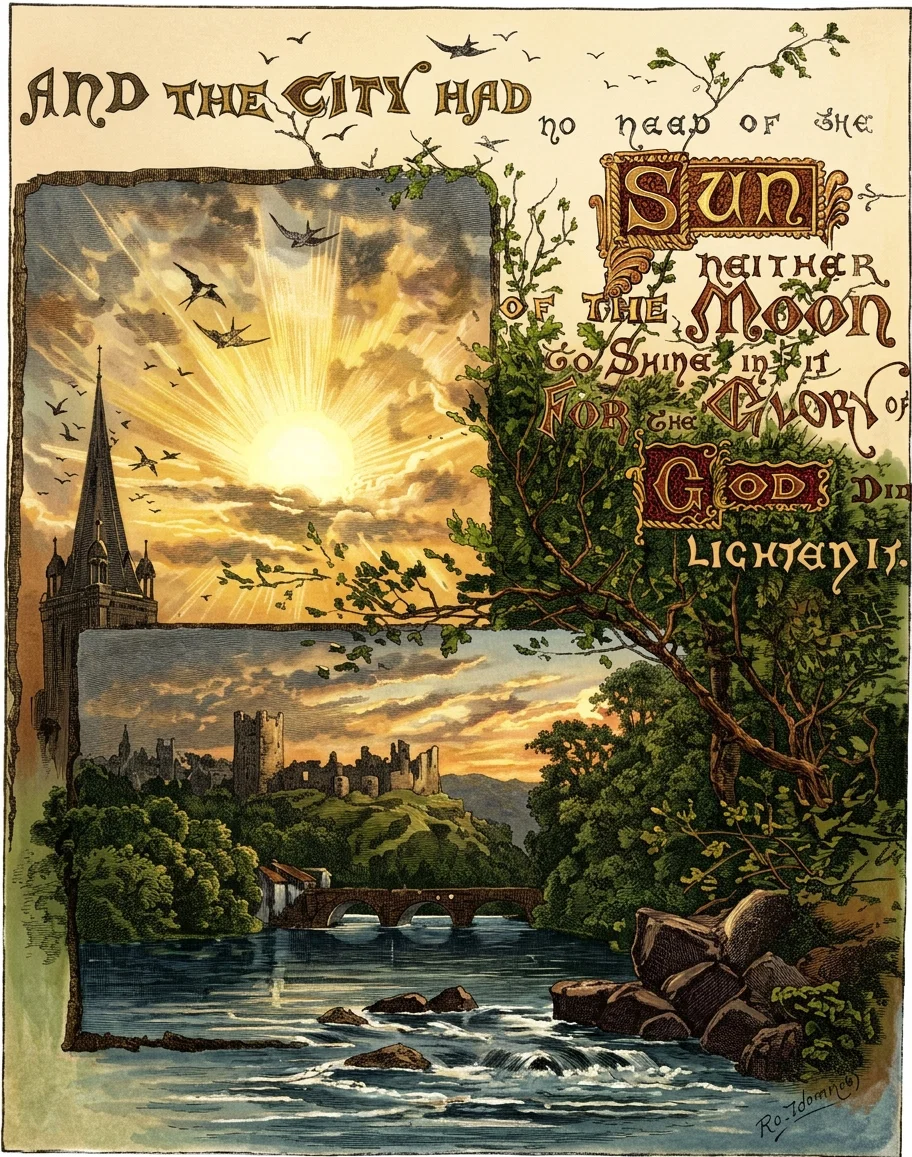
Jerusalem of old is often called the City of God, but at the best it was but a type of the true. Those who were satisfied with the earthly city, even as those who are looking to its future greatness and restoration to-day, were and are trusting in the shadow not the substance. The “Jerusalem which now is” “is in bondage with her children;” it is the “Jerusalem which is above,” which “is free,” and “the mother of us all.” It is of the latter that one of the sweet singers of Israel wrote the inspired words, “Glorious things are spoken of Thee, O City of God.”
WE can not name all these glorious things; for they are not even told us. Mortal language can not express them, mortal ears can not hear them, mortal minds can not comprehend them; for “eye hath not seen, nor ear heard, neither have entered into the heart of man, the things which God hath prepared for them that love Him.” Yet we may contemplate with profit some of those things revealed in the Word of God.
THE cities of the earth, great and glorious in renown tho they are, are disappointing. While wealth, and luxury, and opulence, and ease, are prominently manifest, they bring their possessors no happiness, while they awaken within the hearts of an opposite class bitterness, envy, and hatred. We find in the shadow of the gilded palace, filth and want and wretchedness and misery. In high life and low life are wickedness and criminality; and the festering sores of vice and drunkenness spot like a fretting leprosy the entire population. Death stalks abroad. The young, the fair, the old, the bent, the middle-aged, the strong—all at one time or another pay tribute to his advance agent, Disease, or bow to the reign of the Master. The silent city grows just outside the busy one, where lie buried the hopes of generations. Anon the tocsin of war sounds throughout the land, and the city falls a prey to a conquering foe; its walls are leveled, its houses become desolate; and the once populous center of human life, glory, wealth, and misery, becomes “a ruinous heap.” So pass the cities of earth. Babylon, Nineveh, No-Ammon, Tyre, are no more; and all others follow in the sad procession. Inspiration spake truly, “Here have we no continuing city, but we seek one to come.”
NOT so of the city of God. It is a continuous, an abiding city. There is the throne of the Eternal; for “His dwelling-place is in Zion.” Where He dwells is life. His throne is forever; the place of His throne is forever. “The Lord shall reign forever, even thy God, O Zion, unto all generations.” Here He dwells in person, and yet His presence is everywhere manifest. The glorious sun rolls in his orbit nearly ninety-three million miles away, yet he is present upon earth with light and warmth, and blessings. So, while God dwells in Zion above, yet “out of Zion, the perfection of beauty, God hath shined;” “the Lord shall bless thee out of Zion; and thou shalt see the good of Jerusalem all the days of thy life;” “the Lord that made heaven and earth bless thee out of Zion.”
From the great central Fountain in the City of God, flow unnumbered and oftentimes unheeded streams of light, gladness, and blessing.
THE City of God is a great and glorious city. Its description is given in the twenty-first chapter of Revelation. It is 375 miles square, covering an area of 140,625 square miles, nearly as large as three States like New York. It is surrounded with a wall of jasper, nearly 250 feet in height; its twelve foundations, named from the twelve apostles of the Lamb, garnished with stones most precious; each of its twelve gates, over the portals of which is the name of one of the twelve tribes of Israel, is of one solid pearl; and the city itself is “of pure gold, as it were transparent glass.” Surely such a city is a worthy capital and metropolis of the earth renewed, the kingdom of Jesus Christ, the home of the redeemed.
DO WE wonder, in view of its greatness and glory, that the Lord uses the figures He does in regard to that city and His relation to it? The holiest union of life is necessary to illustrate His union with the New Jerusalem. In this way was John shown the holy city. Said the angel: “Come hither, I will show thee the bride, the Lamb’s wife. And he carried me away in the spirit to a great and high mountain, and showed me that great city, the holy Jerusalem, descending out of heaven from God.” It is thus that the Lord speaks toZion through the prophet Isaiah: “For thy Maker is thine husband; the Lord of hosts is His name; and thy Redeemer the Holy One of Israel; The God of the whole earth shall He be called.” “Thou shalt no more be termed Forsaken; neither shall thy land any more be termed Desolate; but thou shalt be called Hephzi-bah [My delight is in her], and thy land Beulah [married]; for the Lord delighteth in thee, and thy land shall be married. . . . As the bridegroom rejoiceth over the bride, so shall thy God rejoice over thee.” Says the apostle Paul, “But Jerusalem which is above is free, which is the mother of us all.” As Christ is our everlasting Father, Jerusalem, the capital of the everlasting kingdom, is fitly called our mother; and all the people of the kingdom will be royal children, “heirs of God, and joint-heirs with Christ.” From that capital city, that home of the kingdom, shall the immortal hosts of God eternally radiate, and forever bring home fresh proofs of the excellency, wisdom, and love of God.
IT is a well-lighted city: “And the city had no need of the sun, neither of the moon, to shine in it; for the glory of God did lighten it, and the Lamb is the light thereof. And the nations of them which are saved shall walk in the light of it; and the kings of the earth do bring their glory and honor into it.” “And there shall be no night there; and they need no candle, neither light of the sun; for the Lord God giveth them light; and they shall reign forever and ever.” It is a city well watered, well wooded, and abundantly supplied with fruit: “And He showed me a pure river of water of life, clear as crystal, proceeding out of the throne of God and of the Lamb in the midst of the street of it. And on either side of the river, was there the tree of life, which bare twelve manner of fruits, and yielded her fruit every month; and the leaves of the tree were for the healing of the nations.” It is a safe and joyful city: “And there shall be no more curse; but the throne of God and of the Lamb shall be in it; and His servants shall serve Him; and they shall see His face; and His name shall be in their foreheads.” “And the gates of it shall not be shut at all by day; for there shall be no night there. And they shall bring the glory and honor of the nations into it. And there shall in nowise enter into it anything that defileth, neither whatsoever worketh abomination, or maketh a lie; but they which are written in the Lamb’s book of life.” It is a sinless city. It is said of it and its kingdom, “And there shall be no more curse.” And because there shall be no more sin, there shall be no more death. Sin and sinners, those who have identified themselves with sin, will be destroyed forever, and the life-giving smiles of God will irradiate all His creation.
“But is it a literal and real city?”—It is just as real as is its King, Jesus Christ, as is its people, the redeemed of God. It is more real than the cities of earth; for they perish, while it lasts forever. Listen to the words of the prophet as he describes that glorious state: “And I John saw the holy city, New Jerusalem, coming down from God out of heaven, prepared as a bride adorned for her husband. And I heard a great voice out of heaven saying, Behold, the tabernacle of God is with men, and He will dwell with them, and they shall be His people, and God Himself shall be with them, and be their God. And God shall wipe away all tears from their eyes; and there shall be no more death, neither sorrow, nor crying, neither shall there be any more pain; for the former things are passed away.” “And He said unto me, Write; for these words are true and faithful.” “Glorious things are spoken of thee, O City of God.” “And the Spirit and the bride say, Come. And let him that heareth say, Come. And let him that is athirst come. And whosoever will, let him take the water of life freely.” O soul, God has a mansion there for thee! Will you not accept the invitation? X.

GOD’S CHOSEN PEOPLE.

“LET your light so shine before men, that they may see your good works, and glorify your Father which is in heaven.”
These words call for earnest thought. They mean more than many suppose. If we would be lights in the world, we must open the mind to receive Him who is the Light of the world. We must have the mind of Christ. It is a precious privilege to know Christ by personal experience, and to walk humbly before God.
Satan claims this world as his kingdom. Here he has set his seat. But even amid the moral darkness some light shines. God has a little flock. His people are not popular; for the world has chosen darkness rather than light, because their deeds are evil. But Christ says to His chosen ones: “If ye love Me, keep My commandments. And I will pray the Father, and He shall give you another Comforter, that He may abide with you forever; even the Spirit of truth; whom the world can not receive, because it seeth Him not, neither knoweth Him; but ye know Him; for He dwelleth with you, and shall be in you.”
God’s loyal and faithful children are found in a world where atheists and worldly religionists abound, a world that ever since the day when Cain lifted up his hand against Abel, has rejected every provision that Heaven has made to restore the moral image of God in man. “God so loved the world, that He gave His only-begotten Son, that whosoever believeth in Him should not perish, but have everlasting life.” “In the beginning was the Word, and the Word was with God, and the Word was God. The same was in the beginning with God. All things were made by Him; and without Him was not anything made that was made. . . . And the Word was made flesh, and dwelt among us (and we beheld His glory, the glory as of the only-begotten of the Father), full of grace and truth.” But even this Gift was cast aside as worthless. “He was in the world, and the world was made by Him, and the world knew Him not. He came unto His own, and His own received Him not.”
It is amazing to the angels that those who live in God’s house, and daily receive His favors, should refuse His only-begotten Son. And God asks: “Ephraim, what shall I do unto thee? O Judah, what shall I do unto thee? for your goodness is as a morning cloud, and as the early dew it goeth away. Therefore have I hewed them by the prophets; I have slain them by the words of My mouth; and thy judgments are as the light that goeth forth. For I desired mercy, and not sacrifice; and the knowledge of God more than burnt-offerings. But they like men have transgressed the covenant; there have they dealt treacherously against Me.”
Christ, the great Teacher, said to His hearers: “Walk while ye have the light, lest darkness come upon you; for he that walketh in darkness knoweth not whither he goeth. While ye have the light, believe in the light, that ye may be the children of light.” “For ye were sometime darkness,” writes Paul, “but now are ye light in the Lord; walk as children of light.”
We are in the world, where, because of their sin, our first parents lost the beautiful Eden that God had given them. Adam and Eve were placed in the garden, and were given permission to eat of every tree in the garden but one. But they ate of the forbidden fruit, and their sin opened the floodgates of wo upon our world. From that time sin grew worse, till God destroyed the world by a flood, saving only Noah and his sons. Since that time sin has been steadily increasing. Men have not learned that God means what He says. Sodom was destroyed by bolts of fire from heaven. God threatened to destroy Nineveh. The inhabitants repented, and their destruction was averted. But they turned once more to their idolatry, their sins reached to heaven, and their destruction came.
The world is fast becoming as it was before the flood. Satan has set up his throne on the earth, and the law of God is trampled underfoot. God made the world in six days, and rested on the seventh, sanctifying it as the day of His rest. He gave it to man as a memorial of His creation, saying, “Remember the Sabbath day, to keep it holy.” But Adam’s sin is repeated. The Sabbath of the Lord is discarded and scorned, while a spurious sabbath, the child of the Papacy, is accepted by the Protestant world, and is cherished and exalted as supreme. But it has not a vestige of sacredness, more than has any common working day.
“Set the trumpet to thy mouth. He shall come as an eagle against the house of the Lord, because they have transgressed My covenant, and trespassed against My law. Israel shall cry unto Me, My God, we know Thee. Israel hath cast off the thing that is good; the enemy shall pursue him. They have set up kings, but not by Me; they have made princes, and I knew it not; of their silver and their gold havethey made them idols, that they may be cut off. . . . I have written to him the great things of My law, but they were counted as a strange thing.”
How true is this to-day! Laws enacted by finite authority are exalted above the law of Jehovah. Men trample underfoot God’s holy law, and say of God’s people, as the Jews said of Christ, “We have a law, and by our law He ought to die.” Over and over again this will be repeated. Christ has told us that in the world we shall have tribulation, but that in Him we shall have peace. Those who live during the last days of this earth’s history will know what it means to be persecuted for the truth’s sake. In the courts injustice will prevail. The judges will refuse to listen to the reasons of those who are loyal to the commandments of God, because they know that arguments in favor of the fourth commandment are unanswerable. They will say, “We have a law, and by our law he ought to die.” God’s law is nothing to them. “Our law” with them is supreme. Those who respect this human law will be favored, but those who will not bow to the idol sabbath will have no favors shown them.
All that is brought against the validity of the fourth commandment is of human invention. There is not one word in the Bible to sustain the first day of the week. It is a spurious sabbath, baptized by human enactment, and given to the world to be kept holy. But, false tho it is, the world cherishes it, thus pursuing a blasphemous course. The sins of the inhabitants of the cities and towns have reached to heaven, and it is time for men to pray in humility before God. “Therefore also now, saith the Lord, turn ye even to Me with all your heart, and with fasting, and with weeping, and with mourning; and rend your heart, and not your garments, and turn unto the Lord your God; for He is gracious and merciful, slow to anger, and of great kindness, and repented Him of the evil. Who knoweth if He will return and repent, and leave a blessing behind Him; even a meat-offering and a drink-offering unto the Lord your God? Blow the trumpet in Zion, sanctify a fast, call a solemn assembly; gather the people, sanctify the congregation, assemble the elders, gather the children, and those that suck the breasts; let the bridegroom go forth of his chamber, and the bride out of her closet. Let the priests, the ministers of the Lord, weep between the porch and the altar, and let them say, Spare Thy people, O Lord, and give not Thine heritage to reproach, that the heathen should rule over them; wherefore should they say among the people, Where is their God?”
MRS. E. G. WHITE.

THE SWEETENING BRANCH.

LIFE'S bitter wells, to which we all have come, As Israel came to Marah, needs must be. God works love's purpose, tho we seem to roam, Doubt-blinded, aimlessly; Yet there's a branch to sweeten, e'en as then; We need not drink the bitter draught of wo. There is a branch to sweeten it for men, E'en as there was for Israel long ago.
That branch grows on the tree of life divine: It is the branch that bears the healing leaves. Faith plucks, and says, “Thy will, O God, not mine!” And the grieved spirit, wine of love receives. No earthly sorrow can withstand its power; It sweetens every bitter strife and feud. And, lo, we see how in each trying hour Love works all things for good!
The sin that drives us frantic with despair, The grief that makes all life seem nothing worth, The harrowing care that whitens so the hair, The trust betrayed that takes all joy from earth,— These bitter wells from which we shuddering turn, Of our own making, God would sweeten up, And give the draught for which we fainting yearn, And sweeten with His love each bitter cup.
All things, beloved, all things, work for good,— This hour of trial, humiliation, sin, This hour of alienation and of feud, This hour's perplexity which you are in. O, take the branch of “all things work for good,” And how the surge will cease, the storm grow calm, And you will journey on with soul subdued, To rest 'neath Elim's palm!
FRANCES E. BOLTON.

THE ONE BOOK.

THERE are many books in the world, but there is only one Book. The Bible is unique. It is in a class by itself. It seeks to control everything, but it co-ordinates itself with nothing. It sets forth imitable examples of character, but it is not itself imitable. No one ever has written or ever will write a second Bible. The very phrase which every one uses, “The Bible,” signifies the uniqueness of this Book. It is a whole library in itself, and yet it is more than a simple collection of books. There is a homogeneity and consistency to the whole which lead us to speak of Scripture as being a single story, not many revelations. The Bible is the exhaustless Book. It may sometimes prove exhausting to its light-minded readers, but it never exhausts itself. “It is the wonder of the Bible,” observes Dr. Joseph Parker, who has preached more than twenty-five volumes of sermons upon scriptural subjects, “that you never get through it. You get through all other books, but you never get through the Bible.” On the basis of a rationalistic criticism, this quality of exhaustlessness is really inexplicable. But when we come to realize that, after all has been said as to scrolls and tablets and styluses and human factors and copyists, God wrote the Bible, we understand why it is that Scripture is so rich in treasures of wisdom. We see that we can not exhaust the Bible because we can not exhaust God.—N. Y. Observer.

THE DAY OF THE LORD NIGH AT HAND.

As THERE was a general though vague realization just prior to the first advent of our Lord, that that event was at hand, so there is in the world to-day a general though too often an unwelcome impression that the great day of the Lord—the second coming of Christ—is near. As never before we see “men’s hearts failing them for fear, and for looking after those things which are coming on the earth.” Luke 21:26.
Prominent among the signs that are attracting attention is the unparalleled, world-wide preparation of war. Notwithstanding the persistency with which the doctrine of the temporal millennium is taught by many, thousands who know perhaps little of the teaching of the Word of God upon this subject, but who are familiar with the signs of the times, realize in some measure that, instead of being on the eve of a thousand years of peace, the nations stand to-day upon the verge of a world-wide conflict more terrible in its awful ghastliness, more horrible in its unequaled destructiveness, than anything that history records or the mind of man conceives.
The cry of “peace and safety,” referred to by Inspiration (1 Thess. 5:3), is heard even now above the tramp of mobilizing armies, the clang of the forge fashioning instruments of destruction, and the rumbling of trains bearing armed men to the scene of conflict; yea, even above the booming of cannon already hurling death and destruction into the ranks of men made in the image of God. But it is received with an incredulous smile by the thousands already referred to, who, while not knowing that the Bible and the signs of the times testify one thing on this subject, guided by the latter alone, see in the near future not peace but war, not universal good-will but murderous hate.
The following note, clipped by the writer from a Southern paper but credited to the Union, of Manchester, N. H., serves to illustrate the statement just made:—
The Prince of Wales has got a glimpse of the millennium; he stated in a recent public speech that nations would soon be without the need of armies and navies, because of the policy of universal peace. Meanwhile he may note that Great Britain’s appropriation for the increase of its navy was the largest ever known the present year.
The testimony of Inspiration is too plain upon this subject to be mistaken by any one willing to believe unpleasant truth rather than pleasing fiction. The Saviour says plainly that the days of the coming of the Son of man will be as the days of Noah. Matt. 24:37. From Gen. 6:11 we learn that in the days of Noah “the earth was filled with violence.” The apostle warns us “that in the last days perilous times shall come” (2 Tim. 3:1); while both Old and New Testaments unite in foretelling universal carnage just preceding the second coming of Christ.
The writer will not consume space in quoting scriptures already familiar to readers of the SIGNS OF THE TIMES, but will simply refer to a few texts, citing proof that they apply in the last days. Turn to Jer. 4:19-21. Read there that graphic description, written more than twenty-five hundred years ago, of last-day conditions and terrors; and note that it applies just before this earth is reduced again to the condition described as “without form, and void,” when there will be no man left and all the birds of the heavens shall have fled. Verses 23, 25. Compare also verse 22 with 2 Tim. 3:1-5, noting particularly that both texts refer to a season of spiritual declension and religious formality at the very time that the terrors of the last days are about to burst, not only upon a wicked world, but upon a careless, indifferent, pleasure-seeking church.
Then turn to Joel 3:9-14, compare verse 13 with Rev. 14:18-20, and note that both scriptures refer to the destruction of the wicked powers of this earth at the second coming of Christ. Keeping this thought in mind, contrast what the Lord says in Joel 3:9, 10, with what the nations say as recorded in Micah 4:2, 3, especially in verse 3. Observe also verses 4 and 5. In verse 4 the nations (people) lay claim to divine authority for their cry of peace and safety; but to all such false claims the Lord makes answer in Eze. 13:7: “Have ye not seen a vain vision, and have ye not spoken a lying divination, whereas ye say, The Lord saith it; albeit I have not spoken?” Observe also the compromise suggested in Micah 4:5 and ask yourself candidly if the God of the first and second commandments (Ex. 20:3-6) could by any possibility be a party to it. No, these are not the words of the Lord, but words spoken presumptuously in the name of the Lord. And this is evident even from the connection; for after the people have spoken, suggesting a compromise dishonoring to God, saying peace when there is no peace, the Lord Himself tells, from verse 6 to the close of the chapter, what He will do: He will gather His people, and the kingdom shall be given to the Lord Jesus Christ, even as promised in Ps. 2:8, 9. When and how the Lord gathers His people we learn from Matt. 25:31-34.
With these Old Testament prophecies agree perfectly the predictions of the New Testament touching the same point. Rev. 11:18 tells us that “the nations were angry, and Thy wrath is come, and the time of the dead, that they should be judged, and that Thou shouldest give reward unto Thy servants the prophets, and to Thy saints, and to them that fear Thy name,small and great; and shouldest destroy them which destroy the earth.” And again, in Rev. 16:13, 14, just before the Lord comes as a thief, the spirits of devils, stirring up for the last great conflict all the evil passions of men, gather them together to battle. Can we not now see in the light of current events how even the nations of the Western Continent must certainly be involved in the final clash of arms, which, according to the sure word of prophecy, can not be far off? “Let all the inhabitants of the land tremble; for the day of the Lord cometh, for it is nigh at hand.” C. P. B.

AWAKE!

Awake, ye “mighty men,” awake! Proclaim to “Gentiles” near and far, Your “pruning-hooks” to “spears” now make; Prepare, ye “mighty men,” for war.
No battle-ax nor bows prepare, That warriors used in days long past; No shield nor helmet donned with care Can save thee from the cannon’s blast.
When iron war ships now afloat Steam o’er the billows for their prey, The child of God begins to note The omens of the coming day.
We hear the weak say, “I am strong, We fear ye not, ye mighty host;” And thus the war-cry rolls along, And thus responds the warrior’s boast.
But through the darkness now we see The glorious love-light of His eye, And when the earth distressed shall be, We glory in our King, so nigh.
GEO. H. SMITH.
Lincoln, Neb.

LAY SERMONS.

“And the Lord said, I am Jesus whom thou persecutest; it is hard for thee to kick against the pricks.”
We remember this story of Saul, who was on his way to Damascus, breathing out threatenings and slaughter against the disciples of the Lord, and who, as he neared that ancient city, was stayed in his course by the bright light which shone from the heavens, and he fell speechless to the earth, hearing at the same time the voice which cried, “I am Jesus whom thou persecutest; it is hard for thee to kick against the pricks.”
How often are we, like Saul, kicking “against the pricks,” rebelling against God’s dealings with us, and dissatisfied because God’s way is not as our way. If we look very carefully and seriously at ourselves, searching our hearts and the motives which govern us, we shall see how prone we are “to kick against the pricks,” or, in other words, to rebel against everything which conflicts with our desires and interferes with our hopes and purposes.
It is doubtful if there are many who accept with a full comprehension the meaning of those words of the Master, “Except ye be converted, and become as little children, ye shall not enter into the kingdom of heaven.” The little child is perfect in its trust, unquestioning in its love, ready to be led and guided, ready to follow wherever the parent’s feet shall tread. If we were like the little child in this, how different, how much more joyous, would our Christian life be! We should live close to the Saviour, should feel the very touch of His hand, the light of His smile, and the continued joy of His presence. Ah, how much of spiritual life and gladness we miss through failure to live near the Master, and to become as little children in our loving trust in Him!
We “kick against the pricks” whenever we struggle to have our own way in opposition to God’s way. We do so whenever we are unwilling to yield submissively to His providences, saying, If only things could be thus and so, then would I be content.
Struggling Christian, do you not believe in the wisdom and tender mercy of our Father? Does not He who sees the end from the beginning know what is best for His children, and will He not give them that which is best for them if they will but trust Him?
Trust is the powerful lever which lifts our hearts to heaven, and I want to say to you, O trouble-burdened soul, just try the method of trust when your heart is heavy! Say to yourself with the dawn of every new day, I will begin this day by taking my troubles to God. I will carry them to the mercy-seat, and I will lay them down, and I will leave them there. And then, if thought of them comes to disturb me again, I will say, I have nothing more to do with these troubles, for I have taken them to God in prayer, and I will not think of them any more, or feel any further anxiety about them, because I have put them away from me into His hands, believing that God will dispose of them in the way that will be best for me; and I am not going to dishonor Him by any further worry or anxiety about them. If you could do this, how soon would you feel the light shining from heaven—the light of God’s presence in your heart, and sing for very gladness that you are in His hands!
“A sacred burden is the life ye bear: Look on it, lift it, bear it solemnly; Stand up and walk beneath it steadily; Fail not for sorrow, falter not for sin, But on, and up, until the goal ye win.”
Peace is the goal, and nearer it we may Come day by day if we submissive pray; Sorrow can never walk the path we tread, When we through trust in Christ are forward led. —Eliza A. Otis, in Los Angeles Times.

THE WINE OF BABYLON THE FIRST.

The Origin of the Religions of the Nations.

“The religion of the Assyrians resembled that of the Chaldeans [Babylonians] so closely as to be almost identical with it in its higher divinities,” we are told in the “Pictorial History of the World,” p. 169. When we remember that Babylonia, or Chaldea, existed prior to Assyria, in fact, that Chaldea “stands forth as the great parent and original inventress of Asiatic civilization” (Id., p. 152), and that in the beginning of the Chaldean Kingdom they became idolaters, it is easy to see that Assyria received its religion from Babylon.
Concerning Persia we read: “Among the pure Semites, or Aryans, direct worship of the sun was paid from the beginning and still later. Thus among the Assyrians and afterward among the Persians, whose sun-worship is one and the same.”—Schaff-Herzog Ency. The Persians borrowed their sun-worship of the Assyrians, and the Assyrians borrowed their worship of the Babylonians. Where, then, did Persia’s worship originate?
“The religion of the Phœnicians evidently sprang from the source from which those of Chaldea and Assyria were derived.”—Pict. Hist., p. 184. We have already seen that these religions were cradled in the lap of Chaldea.
“The Carthaginians were indebted to the Tyrians [Phœnicians], not only for their origin, but their manners, language, customs, religion, and commerce.”—Rollin, vol. 1, book 2, part 1. The Tyrians received their religion from the Babylonians, so that must have been the origin of the Carthaginian religion.
The chief god of Phœnicia was Baal—the same as the Babylonian Bel—who was called Baal with some other name to distinguish what attribute of the great god he represented. As a destroyer he was called Baal-Molech; we generally distinguish him by the latter part of his name only. Milcom, the “abomination of the children of Ammon,” was the same as Molech (see 1 Kings 11:5, 7), and so of Babylonian origin. Molech “is essentially identical with the Moabitish Chemosh.”—Smith’s Bible Dict., art. Molech. Thus we see that the heathen worship of Palestine was no more nor less than something which was at the first brought from Babylonia.
In “Fathers of the Catholic Church,” p. 305, we find a quotation from Talbot W. Chambers, D.D., in which he says, “The chief object of worship among the Syrians was Baal”—the sun. We have already showed that Baal was the chief object of worship among the Phœnicians, who borrowed their religion from Babylon. Therefore the Syrian religion originally came from Babylon.
“The striking resemblance of the Chaldean system to that of classical mythology seems worthy of particular attention. This resemblance is too general, and too close in some respects, to allow of the supposition that mere accident has produced the coincidence. In the pantheons of Greece and Rome, and in that of Chaldea, the same general groupings are recognized; the same genealogical succession is not unfrequently to be traced; and in some cases even the familiar names and titles of classical divinities admit of most curious illustrations and explanations from Chaldean sources. We can scarcely doubt but that, in some way or other, there was a communication of beliefs—a passage in very early times from the shores of the Persian Gulf to the land washed by the Mediterranean—of mythological notions and ideas.”—Pict. Hist., p. 152. The evidence given in the above that the religions of Greece and Rome and those of ancient Babylon were derived from the same source, is beyond dispute. But as Greece and Rome did not exist till after Babylon had for centuries followed this system of worship, it is easy to see where the worship came from.
We might go on to show that it is the belief of those who have investigated the subject with care, that the Egyptian religion originated in the same place with all these other religions. But, as it is unnecessary to establish that point, we will not take the time to give the testimony.
We see, then, that all the nations of whom we have very authentic historic knowledge, borrowed their religion from Babylon. Therefore, whatever we find as a result of the Babylonian, Assyrian, Persian, Syrian, Phœnician, Carthaginian, Palestinian, Greek, or Roman heathenisms, it is but the direct outgrowth of that first revolt against the Word of God away back in the days immediately following the Deluge. Whatever we find practised in any of these countries, we can point to and name what the Lord named it when it was in embryo,—Babylon, confusion, in contradiction to union, which is given by the Spirit of God.
C. L. EMERSON.
Continue reading: A UNIVERSAL WAR