Your ShelfYour Projects

Signs of the Times, Vol. 30, No. 39.

HOSANNA IN THE HIGHEST

Signs of the Times

Oct 5, 1904

Pacific Press Publishing Company · Mountain View, California · Oct 5, 1904

"HOSANNA IN THE HIGHEST."
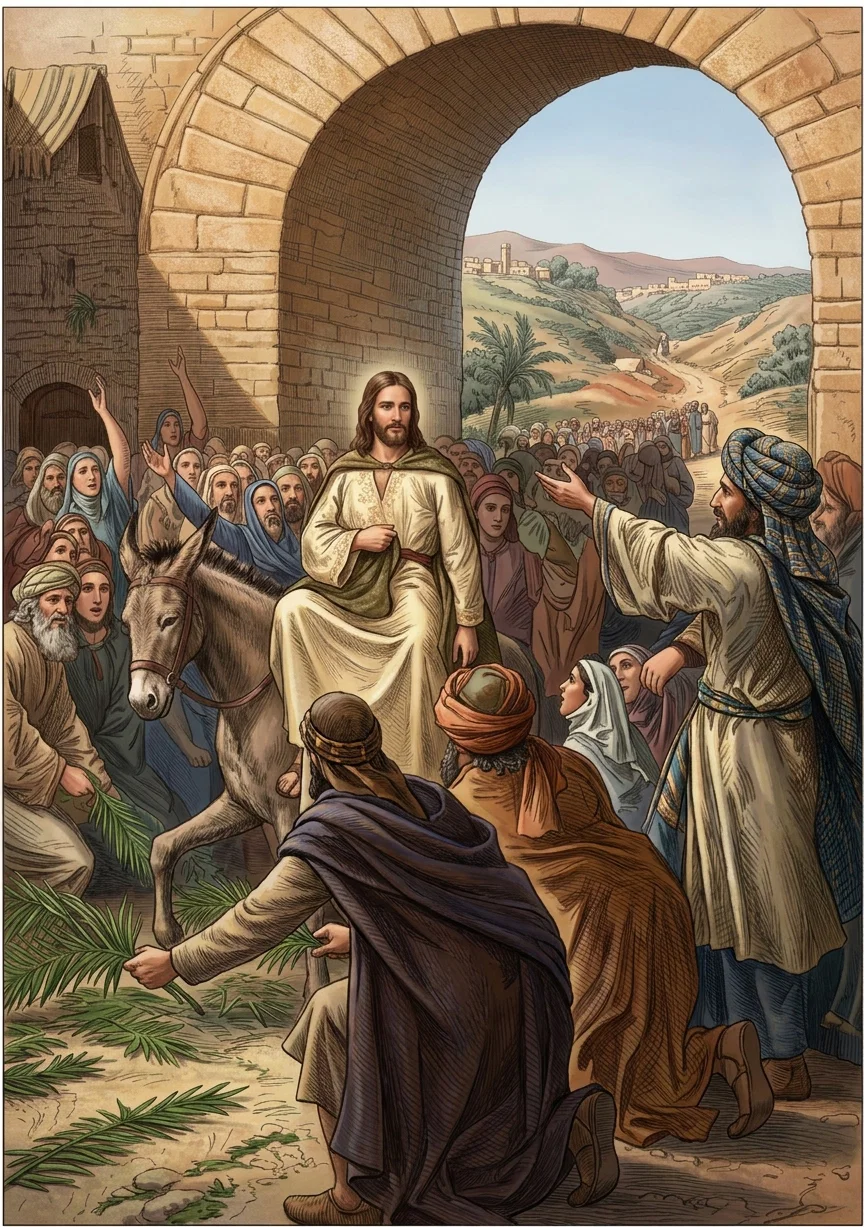
“Behold, thy King cometh unto thee.”
THE only record we have of Jesus’ riding, excepting in a boat, was on the day of His entry into Jerusalem in the role of a King. The reason that He rode on that day was that it might be fulfilled which was spoken by the prophet, saying, “Tell ye the daughter of Zion, Behold, thy King cometh unto thee, meek, and riding upon an ass, and upon a colt the foal of an ass.”
Two of the disciples had been sent to a certain place to procure the colt. They brought the colt, and put their garments on him, and Jesus rode upon it. “And the most part of the multitude spread their garments in the way; and others cut branches from the trees, and spread them in the way. And the multitudes that went before Him, and that followed, cried, saying, Hosanna to the Son of David; Blessed is He that cometh in the name of the Lord; Hosanna in the highest. And when He was come into Jerusalem, all the city was stirred, saying, Who is this? And the multitudes said, This is the Prophet, Jesus, from Nazareth of Galilee.” Thus reads the account as given by Matthew.
THAT was a great day in Jerusalem. It was a day when the “common people,” who had “heard Him gladly,” rejoiced to see Jesus occupying a position of triumph. It was one of the times when the impulse of the rank and file was wiser than the judgment of their “rulers.” Can we safely assume that such is not sometimes the case even in our day? There is evidence that it is sometimes even so, and that, as on that occasion, the rulers too seldom acknowledge the fact until too late. There were three conditions of mind in that throng, each of which it is well to contemplate. The “most part of the multitude” rejoiced exceedingly; the chief priests, the scribes, and the Pharisees were indignant, and Jesus was sad.
ALL of the Jews were expecting the Messiah, one who would deliver them from the Roman yoke and become a King to whom all others would be subservient. Many of the people, having heard the wise teaching of Jesus, and having seen the manifestations of His wonderful power and goodness, “hoped that it was He who should redeem Israel.” This, however, was the first indication on His part that He was really about to assume the kingship, and their joy knew no bounds. But, as was shown a few days later, their rejoicing was based entirely upon outward appearance, and not upon genuine faith. Had they known what was to transpire in so short a time, they would have derided Him even then. The Spirit of the Lord moved upon them just as it would have actuated the stones that lay in the street if thepeople had refused to respond to its promptings, and thus fulfil the prophecy.
THE rulers of the people—the chief priests and the scribes—were indignant because of their jealousy. They were envious of the honors that the people were bestowing upon Jesus, in spite of their adverse counsel. They were envious of the influence that Jesus, a poor man of Nazareth, was wielding over the people, while their own influence was waning in a corresponding degree. So manifest was this feeling on their part, that when they afterward brought Him before Pilate for condemnation, he saw that “for envy they had delivered Him.” Their anger was intensified when, after Jesus had ridden to the temple, He further manifested His power, and His disregard for their prestige, by clearing out of the temple the unholy merchandizing which they had sanctioned, and in which they were peculiarly interested.
THE procession had formed outside the city, first by His immediate disciples marching with Him, and then by others joining as they went toward the city. “And when He drew nigh, He saw the city and wept over it, saying, If thou hadst known in this day [margin, ‘this thy day’], even thou, the things that belong unto peace! but now they are hid from thine eyes.” Jesus was sad because He knew what was in the heart of man, and because He could discern the future. It could not be much joy to Him to receive the momentary applause of a multitude, the majority of whom would, at the behest of their rulers, be demanding His crucifixion within a week’s time.
But it was not what they would do to Him that caused His greatest grief; it was the consequences to themselves that evoked His bitterest tears. Hear His further lamentation for the already doomed city, doomed for the rejection of the One who alone could save: “For the days shall come upon thee, when thine enemies shall cast up a bank about thee, and compass thee round, and keep thee in on every side, and shall dash thee to the ground, and thy children within thee; and they shall not leave in thee one stone upon another; because thou knewest not the day of thy visitation.”
It was indeed a sad sight to see a people so highly favored fail to discern the day of their visitation, the day when the Crown of all their blessings had come to bestow upon them a “peace that passeth all understanding.” But were they the only ones who would be likely to make such a mistake?—Certainly not, else the story of their failure had not been written. “For whatsoever things were written aforetime were written for our learning.” Then it is our privilege, our province, to know the day of our visitation, the day of our opportunity. And wherein have all the failures of past ages been made? Was it not through unbelief of the Scriptures? It therefore behoves us of this day and generation to heed the lessons and warnings set forth in the sure Word, and to examine ourselves whether we be in the faith.
JESUS is coming again with a much more glorious display of triumph than that manifested when He entered Jerusalem, “meek, and riding upon an ass.” He will come in the clouds of heaven, in the glory of the Father, and all the holy angels with Him, and every eye shall see Him. There will be no mistake as to His identity then. All will know and recognize Him. Those who have been feeding upon His Word will know the day of their visitation; they will be looking for Him, and will love His appearing. They will triumphantly cry aloud, “Lo, this is our God; we have waited for Him, and He will save us.” And they will be “caught up together to meet the Lord in the air.” They also who have not heeded the lessons written for their learning will know Him, too; and they will “wail because of Him,” and “say to the mountains and rocks, Fall on us, and hide us from the face of Him that sitteth on the throne, and from the wrath of the Lamb.”
THERE is yet time to “make our peace, calling, and election sure;” but that time is now. “Now is the day of salvation.” The warnings and pleadings and tears of Him who gave His life for the vilest of sinners, are yet available; but the time that is sure is to-day. Let us be among those who, at the next triumphal procession of our Lord, will join in the grand triumphal song of the waiting ones, “We will be glad and rejoice in His salvation;” “Hosanna in the highest.”

TRUTH COMES TO LIGHT AND TRIUMPHS AT LAST.

BY D. T. BOURDEAU.
ALTHO truth is of divine origin and brings more and more happiness to those who advance in its knowledge, reaping the advantages it offers, yet it is often antagonized, especially when it asks the abandonment of views which are, as it were, stereotyped by the force of habit and by long-established customs and practises.
Those who are familiar with history will acknowledge that till now a large proportion of the great advancements in art, science, or religion have met with opposition raised, in certain cases, by prejudice,—a decision passed hastily and without ripe reflection,—in other cases, by selfish and sinister motives.
It was prejudice that led certain persons to accuse Gutenberg of sorcery, when his first printed works appeared; but Gutenberg did succeed, and is now considered as one of the benefactors of humanity. It was prejudice that led individuals in high stations to condemn Galileo when he declared that the world turns. This illustrious man had a scientific truth at heart, which, tho opposed, could not be suppressed, but triumphed.
It was prejudice which, in 1807, led a crowd of Americans on the shores of Hudson River to accuse of folly, Fulton, the inventor of steamboats, when he announced that he would cause a boat to go without sails, against wind, waves, and tide. Fulton succeeded, notwithstanding obstinate opposition and even mockeries which he met, and the injustice with which he was treated; and he gained his object because he had a truth at heart, which it was impossible to bind and suppress, and which the world needed. Influenced by prejudice, learned men and statesmen in France did, in 1833, direct terrible opposition against one of their countrymen who spoke of the construction of railroads in his country, on which cars would run by steam. Some said, “Where can a sufficient amount of iron be found to establish those lines?” Others said, “How can those heavy wagons be taken over mountains?” But the truth came to light, and the thing succeeded.
What trouble and expenses prejudice brought upon the philanthropic Parmentier when he introduced the culture and use of potatoes in France! Frenchmen were afraid of this Americanplant. They said: “Perhaps it is a poisonous plant. Our fathers lived without knowing and using this plant, and it is not necessary that we use it as food.” To succeed, Parmentier had to cultivate it himself. He went farther. He paid soldiers to keep his field of potatoes, that the passers-by might see that there was something precious. He cooked large quantities of potatoes, and then exposed them to the country people, that they might taste of some and take some with them as they passed by. And to-day Frenchmen are as fond of potatoes as are Americans.
In all these cases, and in many others that could be mentioned, truth came to light and triumphed, in spite of prejudice and opposition. And this may be said of the truths embraced in the great religious movements of the past which God has approved. It was thus with the message proclaimed by Noah, with that of Moses, during the passage of the Israelites from Egypt to Canaan, with that of David and of ancient prophets who came after that man of God to lead the children of Israel to reform and advance in the way of truth. The same thing is true of the message of John the Baptist and of that of the Son of God. These distinguished personages were put to death, but the truths they had proclaimed took a new impetus under the ministry of the apostles and of those who, with them, exalted the cause of Christ and the virtues of the Crucified. And Paul expressed a glorious truth when “suffering trouble as an evil-doer, even unto bonds,” for the sake of the Gospel. Though those who wanted to bind and suppress the truths he proclaimed, he said to Timothy a little before his martyrdom, “But the word of God is not bound.” 2 Tim. 2:9.
As truth reveals God’s character, it is as impossible to annihilate it as it is to annihilate God Himself. The efforts put forth to suppress it cause its beauties and attractions to appear. The qualities of a good thing can be better seen when they are put in contrast with those of a bad one. The truths of salvation appear especially beautiful and attractive when they are compared with the principles that led the enemies of our Lord to put Him to death to hide and annihilate the truth.
“We can do nothing against the truth, but for the truth.” 2 Cor. 13:8. Those who oppose the truth hurt themselves. Like Paul before his conversion, they “kick against the pricks.” Acts 9:5. They do violence to their consciences, oppose the God of truth, and impeach His veracity and that of those who love and vindicate the truth.
Take, for example, the truth that Jesus Christ is near when He is near. He then says, “Know that the Son of Man is near, even at the doors.” Matt. 24:33. French translation, “Surely I come quickly.” Rev. 22:20. Those who have seen certain signs of His coming respond, “Behold, the Bridegroom cometh.” “Even so, come, Lord Jesus.” Matt. 25:6; Rev. 22:20. Others oppose this doctrine, saying, “My Lord delayeth His coming.” “Where is the promise of His coming? for since the fathers fell asleep, all things continue as they were from the beginning of creation.” Matt. 24:48-51; 2 Peter 3:1-4. Is not this opposing God and those whom He approves, and impeaching their veracity?
And are not those guilty of the same inconsistencies who would limit to Catholics and to the heathen the proclamation of the near coming of Christ and the needful preparation to meet Him? Are Catholics and the heathen the only ones who compose the nations, kindreds, tongues, and peoples of our world?
Our Lord comes to all, and all need to know that He is near when He is indeed near, and then to be invited to prepare for His coming.
Why not then help the truth to have a free course, that we may triumph with it, and reap the advantages it grants to those who honor it? In case of indecision as to what is truth, carefully study the Word of truth. It would be wise in this regard to listen to the words of Gamaliel: “And now I say unto you, Refrain from these men, and let them alone; for if this counsel or this work be of men, it will come to naught; but if it be of God, ye can not overthrow it; lest haply ye be found even to fight against God.” Acts 5:38, 39.

GOD’S PLAN VS. HUMAN THEORIES.

BY B. E. FISK.
THE plan of salvation, as set forth in the Scriptures, forms such a complete system of truth that a change in any particular destroys the entire harmony of the arrangement. Hence, when men attempt to improve on this plan by substituting something more according to their ideas they find themselves face to face with difficulties which require other changes until the original design is nearly lost sight of.
For example: The orthodox world generally accepts the Bible doctrine of the literal, personal return of our Lord to this earth, and at the same time teaches that at death believers enter the joys of heaven. Thoughtful people everywhere realize that something is wrong with this theology. Surely, if the righteous dead, or a great portion of them, have been in heaven hundreds or thousands of years, there would be no need that Christ should come to take them to the mansions spoken of in John 14:2, 3. So to produce harmony there is an effort made to prove that all the promises relating to the second advent are to be regarded spiritually, and intended to teach the extension of Christian principles in the world, the upbuilding of Christ’s kingdom in the hearts of men, and that the long-cherished hope of a personal return is a delusion.
A series of articles in a Baptist denominational paper teaches this doctrine, the writer stating his purpose to aid Christian thought in this direction.
Long ago the Spirit revealed to Peter that such doctrines would be taught and then pointed to as a sign of the last days. 2 Peter 3:3, 4. A careful study of this chapter shows that Peter attributes this belief to ignorance of God’s great plan for redeeming a sin-stricken world, and says in verse 10: “But the day of the Lord will come.” Let us base our faith on the inspired Word rather than on theories of men.
Richburg, N. Y.

FEAR NOT.

BY ELLA CORNISH.
Fear not, little flock; ’tis the Father’s good pleasure To give you the kingdom Christ’s gone to prepare. He’ll save you and keep you His own chiefest treasure, If only you’re constant in faith, love, and prayer.
Fear not, tho the devil, with cunning deception, Is seeking to bind you in fetters of sin, The light of God’s Word and the Spirit’s detection Will cause you, in Jesus, the victory to win.
Fear not, tho the powers of heaven are shaken, And earth be removed far, far from its place; Jehovah is left, tho all else be taken; Sufficient for you is His excellent grace.
Fear not, tho the signs all around be alarming, And men’s hearts are everywhere failing for fear, The nations, in anger, are gathering and arming; These things but proclaim that His coming is near.
Fear not, but rejoice, with your heads upward lifted; For soon, very soon, the dear Saviour will come, Then the sin-clouds of earth will forever be rifted, And we’ll dwell in safety with Jesus at home.
Asylum, Neb.

PROVERBS

BY F. D. STARR.
HERE is the book for the business man. If all would follow the maxims contained in this volume, business would flourish, poverty would scarcely be known, and there would be only honest transactions among men.
According to the Septuagint this book might properly be called the parables of Solomon, for the Greek translation of Prov. 1:6 is, “To understand a parable and a dark speech,” etc. Also in Eccl. 12:9, where it says the preacher set in order many proverbs, the Greek says parables. In 1 Kings 4:32, we read that Solomon spake 3,000 parables. We find that in the New Testament also the words proverb and parable are interchanged. For instance in Luke 4:23, where the word proverb occurs, the original Greek word is parable. Also in the Old Testament in such passages as Deut. 28:37; 1 Sam. 10:12; 24:13 and many others, where the word proverb is found, the Greek word is parable.
It is stated of our Lord in Matt. 13:34, “Without a parable spake He not unto them.” The same word is here used that is so often translated proverb, as well as parable. So we see that the Saviour in using this method of teaching was simply doing what Solomon and others have done before Him, using similitudes teaching by comparison. The Spirit of Christ which was in them took the same course as it did when manifested in Himself. As Solomon spoke 3,000 proverbs, there must be a large majority of them that have never come down to us, for in this book we have less than one-third that number of proverbs and some of these are credited to other authors, as stated in ch. 30:1 and 31:1. This is but one of many evidences that there was much that was written by inspiration that was not included in the Bible. But enough is contained in it to furnish us thoroughly with all needed information. As we see by John 21:25, we could not make use of all that might be written by the inspired pen.
Perhaps, as it seems to the writer, the most prominent thought in the book of Proverbs is the necessity of our being willing to receive reproof. “He, that being often reproved hardeneth his neck, shall suddenly be destroyed, and that without remedy.” Ch. 29:1. Let us notice some of the other statements about reproof: “He that refuseth reproof erreth.” 10:17. “He that hateth reproof is brutish.” 12:1. “He that regardeth reproof shall be honoured.” 13:18. “He that hateth reproof shall die.” 15:10. “A scorner loveth not one that reproveth him; neither will he go unto the wise.” 15:12. In fact there is no other book in the Bible that says so much about reproof as this book does. It is so natural for people to prefer to be flattered and commended rather than reproved. But a friendly reproof is to be highly valued. Says David: “Let the righteous smite me; it shall be a kindness; and let him reprove me; it shall be an excellent oil, which shall not break my head.” Ps. 141:5.
A very familiar expression, so often used in this book, is the loving term, “My son.” It is interesting to note the many instances in which it occurs. “My son, if sinners entice thee, consent thou not.” 1:10. “My son, forget not my law.” 3:1. “My son, keep thy father’s commandment, and forsake not the law of thy mother.” 6:20. The Apostle Paul uses one of these quotations in Heb. 12:5. “Ye have forgotten the exhortation which speaketh unto you as unto children, My son, despise not thou the chastening of the Lord, nor faint when thou art rebuked of Him.” This exhortation to which the apostle refers is found in Prov. 3:11. The rendering varies somewhat in Hebrews from our version in Proverbs, but is a reproduction of the Septuagint version, from which the apostles usually quoted.
The subjects of chastity, temperance, diligence, and obedience to God’s holy law are specially dwelt upon in this book. We notice some of the instruction on these points. “Where there is no vision, the people perish; but he that keepeth the law, happy is he.” 29:18. “He that turneth away his ear from hearing the law, even his prayer shall be an abomination.” 28:9. Think of the inconsistency of the man who refuses to keep God’s commandments and still claims to lead a religious life, and says, “Lord, Lord,” while he does not do what the Lord has said.
What more startling warnings in regard to intemperance could be given them than are found in this book? “Wine is a mocker, strong drink is raging; and whosoever is deceived thereby is not wise.” 20:1. “Who hath woe? who hath sorrow? who hath contentions? who hath babbling? who hath wounds without cause? who hath redness of eyes? They that tarry long at the wine; they that go to seek mixed wine.” 23:29, 30. How true is this statement concerning the woe and degradation that has come to our world on account of intemperance! O, that the poor drunkard might be aroused by these admonitions, and, with God’s help, reform and lead a temperate life!
The direful results of a life of shame are so vividly described in this book as to startle the transgressor away from his downward path. “Her house inclineth unto death, and her paths unto the dead. None that go unto her return again, neither take they hold of the paths of life.” Ch. 2:18, 19. “But he knoweth not that the dead are there; and that her guests are in the depths of hell.” Ch. 9:18. In contrast to this, read the description of a virtuous life as found in the last chapter. Thank God for the timely warnings of this book. Let us study them well.

Japan Requires Christian War Interpreters

The Japanese Government has insisted that interpreters hired by foreign war correspondents must be Christians. It wishes those who go with foreigners to the seat of war to be men who will not soil the Japanese name by dissolute lives. Japanese officials know the high moral influence of the teachings of Jesus Christ.

A Living Character

A LIVING character affords the only colors in which God could paint His idea of a man.

THE HOLY GHOST.

Is It a Person? or a Power Sent from God?

BY L. D. SANTEE.
WHILE all agree as to the divinity of the Holy Spirit, all are not agreed in regard to the personality of the Spirit. Converts are baptized in “the name of the Father, and of the Son, and of the Holy Ghost.” Matt. 28:19. The Father and the Son are persons. Let us see what the Scriptures teach in regard to the Holy Spirit.
Jesus says, “Nevertheless I will tell you the truth: It is expedient for you that I go away; for if I go not away, the Comforter will not come unto you; but if I depart, I will send Him unto you.” John 16:7. Why expedient? Could some other person do better for the world than the world’s Redeemer? The answer is plain. Jesus, being a person, could only be in one place at once.
When Lazarus was sick, Jesus was not in Bethany. But the Holy Spirit, “which proceedeth from the Father” (John 15:29), not being a person, could be world-wide in its ministry.
Read the promise of God in Acts 2:17. “And it shall come to pass in the last days, saith God, I will pour out of My Spirit upon all flesh.” Again in verse 38, Peter said to those who would repent, and be baptized, “Ye shall receive the gift of the Holy Ghost.”
The coming of the Holy Ghost gave power (Acts 1:8), and was better for the church than even the visible, bodily presence of their Lord.
The Scriptures often speak of the Holy Ghost in a way that would be out of place if it were a person: “I will pour My Spirit upon thy seed” (Isa. 44:3); “I will pour out My Spirit upon all flesh” (Joel 2:28); “On the Gentiles also was poured out the gift of the Holy Ghost” (Acts 10:45). Had it been a person, these expressions would not have been used.
Why are we never told to pray to the Spirit?—Because it cometh from the Father, and does His will. In thirteen of Paul’s letters, we find this invocation, “Grace be unto you, and peace, from God our Father, and from the Lord Jesus Christ.” If the Spirit of God, or the Holy Ghost, is a person, why is the grace of the Spirit never invoked?
We are made “in the image of God” and it is natural to conclude that we have His attributes, only in a lesser degree. We all recognize that we have a magnetic influence over each other. Especially is this observable in the mesmerist, or the hypnotist. That God has this same attribute in an infinitely higher degree, seems reasonable. All comparisons fall short when we compare the finite and the Infinite, but this will give an idea of my meaning.
I read in Acts 10:38 that “God anointed Jesus of Nazareth with the Holy Ghost and with power.” Again, John 20:22, “He breathed on them, and saith unto them, Receive ye the Holy Ghost.” Evidently it is not a person.
Is not the influence of the Spirit of God like the wireless telegraph, that reaches to the farthest limits of His universe?—an agent, that God uses in accomplishing His purpose? I read that, “the Lord made heaven and earth, the sea, and all that in them is.” How?—“The Spirit of God moved upon the face of the waters.” Gen. 1:2. Again I read, in John 6:44, “No man can come to Me, except the Father which hath sent Me draw him.” How does He draw him?—“And the Spirit” says, “Come.” Rev. 22:17.
The Spirit of God is all-pervading. David asks, “Whither shall I go from Thy Spirit? or whither shall I flee from Thy presence?” and after compassing infinity of space, “Even there shall Thy hand lead me, and Thy right hand shall hold me.” Ps. 139:7-10.
Through this agency, God gives to His children any gift that He desires them to possess. The Scriptures were received in this way. 2 Peter 1:21. In this way God satisfies our needs. Luke 11:13.
After the church apostatized, they passed a decree in the Council at Nice, A.D. 325, that the Holy Spirit was a PERSON.
It is said by some, The Spirit of God must be a person, for the Bible when speaking of it, often uses the pronoun, “He.” But is there any real argument here? Recognizing God as the mover, and His Spirit as the instrument, it would be proper to say, “He did it,” or, “It was done by the Holy Spirit.” In neither case have I misstated facts or done violence to language.
Herman Heinfetter has given us a literal translation of the Vatican Manuscript, which is one of the oldest three known in the world. Where the personal pronoun “He” is used, in speaking of the Holy Spirit, he has changed it to “it.” He says, “There are upward of three hundred references to the Holy Spirit under its various titles, and in all but five, the Greek word is neuter, and is connected with neuter pronouns, articles, and adjectives.”
Prof. J. H. Thayer of Harvard University, Cambridge, Mass., speaking of John 14:17, says, “The pronouns in verse seventeen, are neuter in the best manuscripts.”
Says Prof. Chas. Gardner of Chicago, “The true antecedent of these pronouns in John (14:17 and 16:13, 14) is to pneuma and this is neuter of course, and a true grammatical rendering makes the pronoun neuter.”
Lastly, we shall copy from “The Christian Layman,” page 224, “In the original Greek, to pneuma, is neuter gender, and if it is a person of any sort, it is the only person in heaven or earth that is of that gender. Again it has no proper name, and if it is entitled to personality, it is the only person in the universe that has no name. The Holy Spirit, is not a proper name. It is only the appellation of a thing or power. Proper names do not have the English article before them. We do not say, the Jesus, the Peter, the Paul, the John.”

THE CERTAINTY AND BLESSINGS OF HIS FATHERHOOD.

Have You Been Born Again?

BY JENNIE L. IRELAND.
“VERILY, verily, I say unto thee, Except one be born anew, he can not see the kingdom of God.”
At the present time the idea largely prevails among professed Christians that all will enter heaven, no matter what their character now. Resting upon this, souls quiet the voice of conscience, quench the Spirit of God, resist its wooings, and close their ears to the calls of mercy. What foundation have they for their hope of heaven?—None whatever. They are building upon an imaginary foundation. They assume knowledge, and make that assumption the foundation of their character-structure. Such can meet only with disappointment and utter failure.
Christ, the Ruler of the kingdom, knows what is essential for entrance to that realm. He is not willing that any should perish, but He will not force any one to become a subject of His kingdom. To those who honestly desire to enter the kingdom of heaven, He clearly points out the way. If they choose to go that way, He will lead them step by step from grace to grace, from victory to victory, until qualified to stand in the presence of the King of glory.
One can not enter the kingdom of heaven, says Jesus, unless he is born anew. “That which is born of the flesh is flesh.” An individual does not reason and argue to convince himself that he is flesh, born of flesh. He does not imagine this to be true. It is an unquestionable fact. So also with that new birth of which Jesus spake—born of the Spirit. It is not imagination, or a vague, unreal conception of the human mind. A spiritual babe is born into the kingdom of God, and is welcomed there. A place has been prepared for it, and the Father’s joy is to watch it grow and develop, and to supply all its needs “according to His riches in glory.” Spiritual food is abundantly supplied—the milk of the Word. Opportunity for spiritual exercise is given, as vigorous development demands, under the watchful eye of a loving Father.
Just as the babe of flesh gradually grows in perception of the realities of life, so the sensibilities of this spiritual being enlarge to the realities of the kingdom of heaven into which it is born. That soul is passing from the darkness of sin into the ever-increasing light of eternal day. Every moment brings its opportunity for exercise in spiritual things, and this exercise results in development. Every development brings within reach new realities of purest joy. These all are but a foretaste of the fulness of life that is to be revealed at the second coming of Christ.
“As many as received Him [Jesus], to them gave He the right to become children of God, even to them that believe on His name; who were born, not of blood, nor of the will of the flesh, nor of the will of man, but of God.”
To be a child of God, and to know that you are His child, this is the all-desirable experience, the knowledge which satisfies the soul. By nature we are all born sinners, but God is not the father of sinners. Blood does not make us children of God. Being born by the will of the flesh does not give us this right. The will of man can not make sons and daughters of God. They must be “born of God”—born “by the will of God,” “born anew,” born from above.
There is only one way of opening the human heart to this wonderful work, “Believe on the Lord Jesus Christ, and thou shalt be saved,” and this salvation will be wrought through this new birth, and the following development.
It is the will of God that all should be born anew, and thus possess the right to be His children, “for God so loved the world, that He gave His only-begotten Son, that whosoever believeth on Him should not perish, but have eternal life.”
Shall not all perish who do not believe on the name of this Son? Can one be a member of God’s kingdom without that new birth? Can one be born of God and not know his Father? “He that believeth not is condemned already, because he hath not believed in the name of the only-begotten Son of God.” Be not deceived. Build not your life on vain hopes or imaginations, but on the sure foundation which God provides. Only in the way pointed out by Him is there escape from eternal destruction.
“Behold, what manner of love the Father hath bestowed upon us, that we should be called the children of God; and such we are.” The Father knows His child. The child knows its Father, and is at rest in His presencein harmony with His rulings. There is a loving bond of union between them.
Yet this child was once of the flesh, born in rebellion to God. All its tendencies were opposed to God. Sin was its lawful inheritance. Being in the realm of darkness, where all is perverse, its life was all marred and distorted. To rescue it from merited destruction, God gave all the fulness of heaven in the gift of His Son. It was a wonderful price for such a low, dwarfed, perverted specimen of the living soul, yet God so loved this lost one.
And when its heart opened to the name of Jesus, God wrought that miracle of miracles, the new birth, and spiritual life began, and God rejoiced over this helpless little one as it entered His kingdom. He acknowledges it as His own, even before the marrings of its former life are removed. He now ministers to it love, mercy, goodness, truth, and light. As He ministers, the little one learns to know Him, and as it grows into His likeness, the imperfections are removed, till it stands perfected in His likeness.
“Beloved, now are we the children of God, and it is not yet made manifest what we shall be. We know that, if it shall be manifested, we shall be like Him; for we shall see Him even as He is.”
Healdsburg, Cal.

How They Became Convinced

[Believing it would be of interest to our readers, the editor of the SIGNS OF THE TIMES has asked Sabbath-keeping ministers and evangelical workers to tell in a few words the scripture or scriptures, the truths and principles, which constrained them to accept the unpopular truth of the seventh-day Sabbath. These testimonies must not exceed 500 words. Let us hear from all.]
CLXXVIII.
When a young lady I heard of Adventists, and while away from home on a visit I heard one of our strong Methodist preachers prove that the “Millerites” were false teachers. I went home armed with some texts to show to my parents. But, during my absence, Brother I. C. Adrian and others had come to Manchester, N. H., and my parents after hearing them, had become Adventists. They began talking their new ideas to me, and, before I could get in a word of defense, they had used all my texts and a dozen more to prove their position. I could say nothing. Loving and believing my Bible, I soon accepted the light on the near coming of the Lord and the state of the dead.
I had heard of Seventh-day Adventists; for one of them once came to one of our tent meetings (First-day Adventist) and distributed some Sabbath tracts. He gave me one, and I dropped it in the straw at my feet. A sister said to me, as she saw how I despised him and his message, “They are right on the day, if there is any Sabbath in this dispensation.”
Not long after that, about forty-three years ago, Elder Loughborough and Moses Hull came with a tent to Manchester. When informed of the fact, I said, “They may come or go, I will not go across the street to hear them,” and I hurried my preparations to get out of town for an intended visit, taking my little boy with me. The town was wonderfully moved. My friends sent for me to come home, saying, “This is too good for you to miss.” When I arrived, I was immediately invited to hear the new ministers. Not to stay at home alone, or to seem obstinate, I went, but I told them plainly, “You need not expect me to go as wild as the rest of you; and, as for that seventh-day nonsense, I will have none of it.”
Elder Loughborough preached, and opened his sermon by reading the fourth commandment. “Six days shalt thou labor,” he read; “but the seventh day is the Sabbath.” It never sounded to me like that before. He showed us where the days began and how we knew the seventh day when it came, and God never had changed it. I was dumb. Truly there was no Sabbath but the seventh day, and I must keep it. I kept the next Sabbath. The arguments of my first-day friends kept me wavering for some time. First I kept one day, then the other, sometimes both days, or neither; until the sanctuary question was presented. That cleared away all the fog, and settled my mind completely; and it has stayed settled ever since. Praise the Lord.
MARY E. CLEMENTS.
Continue reading: FOR OUR ADMONITION
