Signs of the Times, Vol. 33, No. 42.

THE GIVER

Signs of the Times

Pacific Press Publishing Association

THE GIVER.
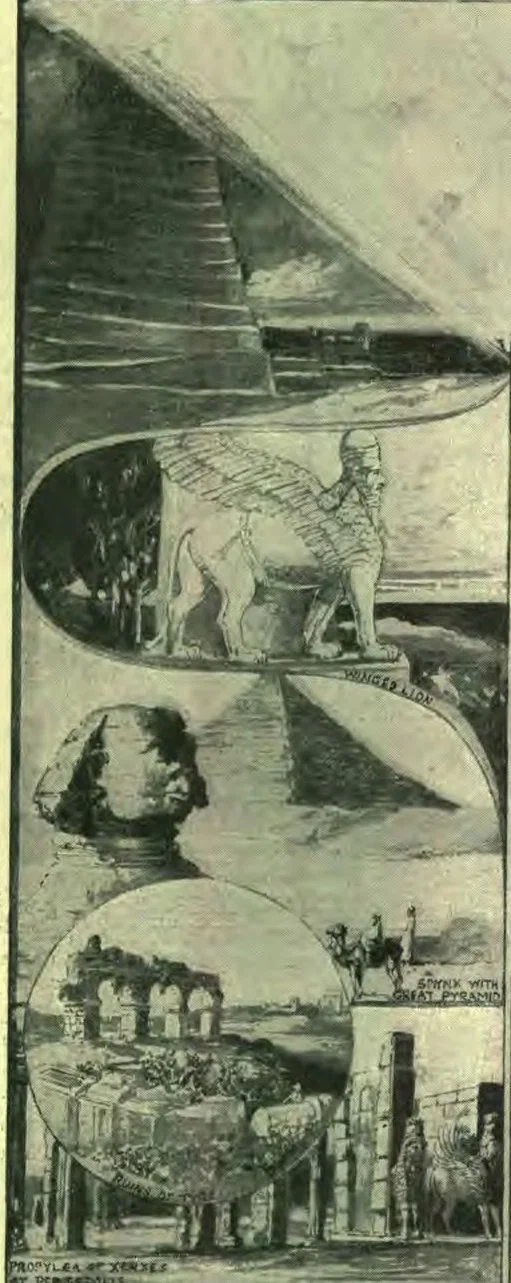
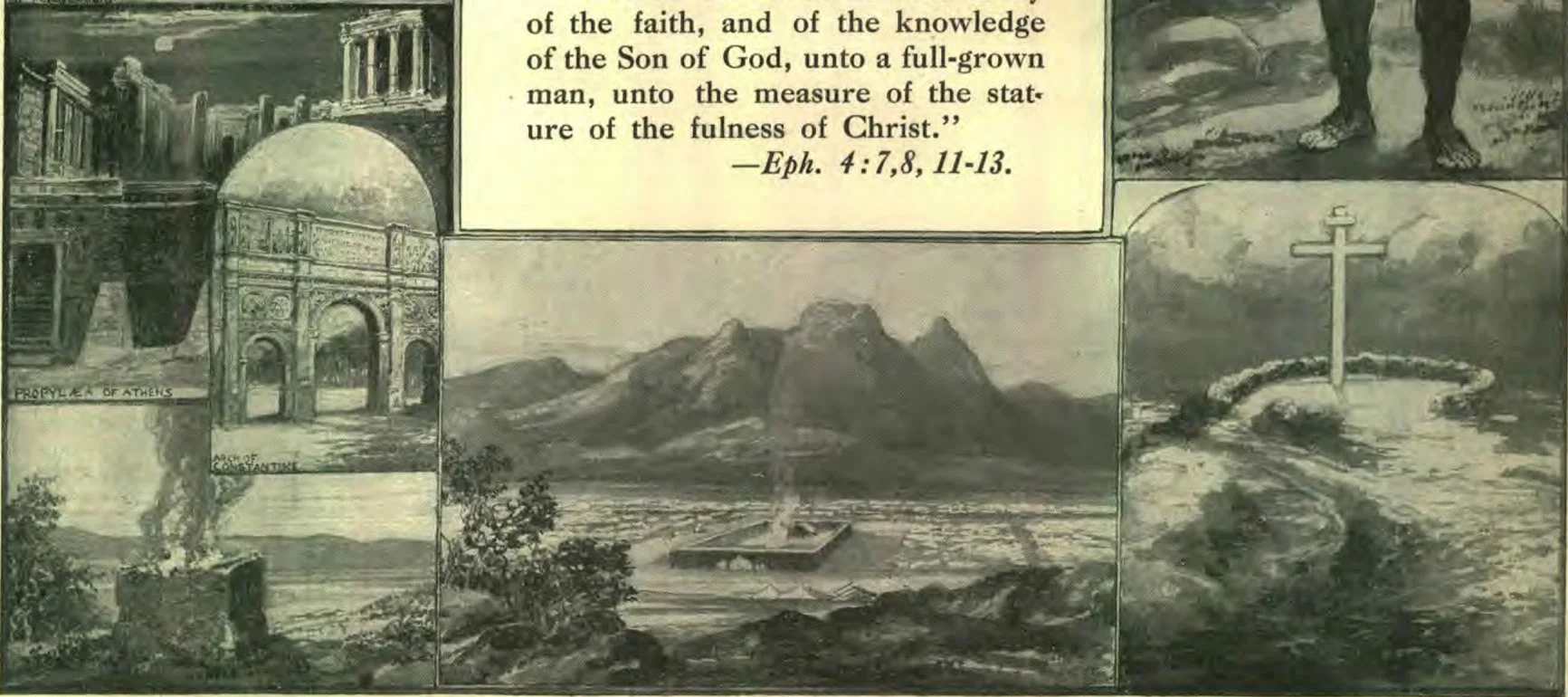
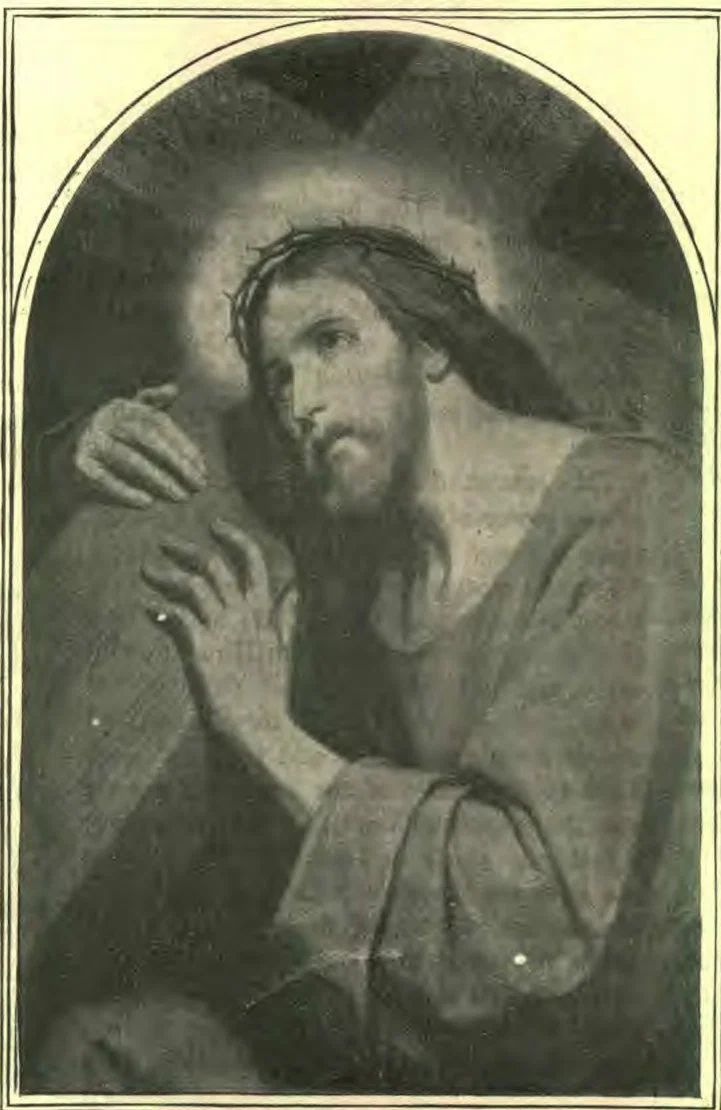
"But unto each one of us was the grace given according to the measure of the gift of Christ. Wherefore He saith, When He ascended on high, He led captivity captive, and gave gifts unto men."

THE GIFTS.

"And He gave some to be apostles; and some, prophets; and some, evangelists; and some, pastors and teachers."

THE PURPOSE.

"For the perfecting of the saints, unto the work of ministering, unto the building up of the body of Christ."

FOR HOW LONG.

"Till we all attain unto the unity of the faith, and of the knowledge of the Son of God, unto a full-grown man, unto the measure of the stature of the fulness of Christ."
—Eph. 4:7,8, 11-13.

With Our Inquirers

"If ye will inquire, inquire ye."
[All questions to this department will be answered which to the editors will seem to minister to the good of the readers and to the mission of the paper. The same question can not be answered repeatedly in the same volume. The name and address must accompany question; not for publication, but as an evidence of good faith, and that answer may be made by letter if deemed advisable. It is well always to enclose a stamp for reply.]
NOTE.—The SIGNS OF THE TIMES endeavors to answer questions just as quickly as it can after receiving them. To be fair to all it must answer them somewhat in the order in which they are received. Not always can we print them in that order, because the exigencies of the limited space which is given to this department call for answers of different sizes, and so the order is sometimes broken, but we endeavor to answer them in order as far as we can. We must also be brief. We have probably fifty questions on hand at the present writing. We can only ask our questioners to be patient.

2256.—Telling Truth and Confessing Sin.

If one has told a falsehood to some person who was in nowise harmed by it, no one's reputation was injured by the lie, if one lies "on himself" instead of telling the truth, or the full truth, but doing no harm to the one to whom he lies, does God demand of him to confess it to the ones to whom he told it? ANXIOUS INQUIRER.
The purpose of confession is to clear oneself of sin. He who goes on in sin is in partnership with Satan. He who truly confesses his sin, gives up that partnership and yields himself and all that he is to God. It would be a pretty difficult matter for many souls to confess the individual falsehoods which they had told in word and conduct, but they certainly could say to those with whom they associate and before their acquaintances that they had broken from all such things as that, and in the future would stand for God and for truth. As to whether we should confess our sins to others or not depends on the nature of the offense. If we have wronged others in any way and it lies in our power to make that wrong right, the Lord asks us to do it, and to do it without fear or favor. If the sin has not injured others, but is a matter between your own conscience and God, go to Him and tell Him all about it, and then pursue such a course before the world and your associates as will show to them that you are indeed a child of God; and then tell the truth; whatever may come, stand by the truth. What others may do or think, we can afford nothing else but truth. And then when we have done what the Lord has impressed our consciences to do, trust Him and joy in Him and do not worry over the past. If we have a heart to do that, and there are other things that ought to be confessed, according to God's promise in the third chapter of Philippians, He will reveal even that to us. He does not want us to walk with worried heart, but cheerful and hopeful.

2257.—Full Forgiveness.

Can I trust God for full forgiveness of sins without telling people about the sins? I can not see now how I ever could say any untruth. I am considered by others to be pretty good, at least I used to think so; I also meant to be, but I see I have failed entirely. It is certainly impossible to live a good life without Jesus. If I could only trust Him fully, my joy would be complete. ANXIOUS INQUIRER.
All sin is primarily against God because it is His law that we transgress. If we have wronged or injured a person and it is possible for us to make amends, if our sin has injured or has had a tendency to lead others away, we should do all in our power to take every stumbling-block out of the way, but it is never the duty of any one to go to those whom we have not wronged and confess individual sins. God is our great, true Friend, and one whom we ought to make our holy Confidant, by telling to Him all our mistakes and failures. Why can you not fully trust Him? Has He not power? Has He not wisdom and knowledge? Has He not love? Has He not all the qualities essential for One you can fully trust? Then why not trust Him? Do not allow your doubts or your sins or your failures or mistakes to come in between you and His great, loving heart of power. You are trusting in your own strength or are discouraged by your own sins. Always remember that while we were "without strength," "Christ died for the ungodly," and if reconciled by His death, much more we shall be saved by His life. Rom. 5:5-11.

2258.—Sabbath Work.

A worldly man has a dairy. He employs a Sabbath-keeper. At times he goes away on business, not returning until after the Sabbath begins. Is it right for the Sabbath-keeper to milk for him and help separate the cream, providing the dairyman has no one to do it? Should he take pay for it? V. J. L.
The question is not entirely clear. If the Sabbath-keeper is working for the farmer right straight along, helping to milk the cows would naturally be supposed to come into his daily work, milking more or less as occasion demanded. But in this case it would seem as tho he had to milk a little more and do a little extra work, and this does not come into his regular work. As a matter of mercy and kindness cows ought to be milked on the Sabbath. In an ordinary way that milk is to be taken care of with a minimum amount of labor. All this the Sabbath-keeper ought to consider before he hires out, doing nothing whatever but what is in harmony with the obligation resting upon him. Concerning some of these questions where conditions are not clearly stated we can give no definite instruction, and in the ultimate all such questions of conscience must be decided by the individual, between himself and God. But always give God the benefit of the doubt.

2259.—The Higher Powers. Rom. 13: 1-5.

Please explain from the first to the fifth verses of Romans 13. You say that God designs to keep the Church and State forever separate. When law is good, why should they be kept separate? J. W.
The church has its place; the State has its place. If sin had never entered, there would have been no church such as we now know it, nor would there have been any State. God would have been King, and all His children subject to Him. When man sinned, the State came in as a necessity to keep men civil and prevent them from taking their neighbor's lives, property, etc. It can only pertain to the outward acts; it can never touch the conscience and soul of man. The church is in the world for the purpose of saving men. It can not do it thru civil law; it can only do it by appealing to their hearts and persuading them to yield to the power of the Lord Jesus Christ. When the church gets to trusting in the State, she leans upon a broken reed, shuts out Jesus Christ as her illustrious and all-sufficient Head, becomes more and more dependent on the mere human that can help her none at all. The powers that be are ordained of God simply to regulate civil things, but God never designed that His children should obey civil powers when those powers act contrary to His will. See Daniel, chapters 3 and 6, and many other scriptures.

2260.—The Undying Worm and Unquenchable Fire.

Please explain the meaning of Mark 9:43-48, especially the expression, "Where their worm dieth not, and the fire is not quenched." G. M. Y.
The word there rendered "hell" is from the Greek word gehenna; and that is from the Hebrew word meaning the Valley of Hinnom. The Valley of Hinnom was just outside of Jerusalem, first noted for the worship of Moloch, with all its horrible rites, under the idolatrous kings of Jerusalem. It was afterward defiled and turned into a dumping-ground for all the refuse of the city. Upon this filth the worms constantly preyed, and to avert pestilence constant fires were kept burning to consume what the worms did not devour. The ever-present worm and the ever-burning fire thus became symbols of absolute and complete destruction, for the worm did not die until that which it devoured was consumed, nor did the fire cease burning until all that was cast into it was reduced to ashes. Jesus used that as a symbol of the fate of the incorrigibly wicked. See Isa. 51:7, 8 for the figure of the worm, "For the moth shall eat them up like a garment, and the worm shall eat them like wool;" that is, utterly destroy them. For the unquenchable fire compare 2 Chron. 36:19-21 with Jer. 17:27. The latter text declares that if Jerusalem would not hallow the Sabbath and obey God He would kindle a fire in the gates thereof which should devour the palaces of Jerusalem, "and it shall not be quenched." That is about as strong as language can make it, but 2 Chronicles 36 tells us that that fire that was kindled in the gates of Jerusalem burned up the house of God and all the palaces with fire and destroyed all the goodly vessels thereof, "to fulfil the word of Jehovah by the mouth of Jeremiah, until the land had enjoyed its sabbaths." The unquenchable fire burned up the palaces of Jerusalem. Another case in Matt. 3:12, "He [Christ] will gather His wheat into the garner, but the chaff He will burn up with unquenchable fire." One class will be preserved, the other destroyed; the wheat is kept, the chaff is consumed. No one expects chaff to burn forever. The thought is that the fire is unquenchable until that which is cast into it is consumed. And so Isa. 66:24 declares that it will be the carcases [dead bodies] of the wicked which are consumed by the worm and devoured by the fire; so that these terms mean simply absolute and final destruction. "The wages of sin is death." See Rom. 6:23; 2 Thess. 1:7-9.

2261.—Differences Among Christians.

A letter from a good brother, F. F. F., shows great perplexity over the differences between Christians over the questions of the Sabbath and baptism. Referring to a former letter from this office, he wonders why there should be any contention over these things even tho there be differences, if it is so that the Lord saves persons on all sides of the controversy, and wonders whether there are not degrees in Christianity.
In reply let us say, (1) God's requirements are always the same—that His children shall possess a character like His. The negative side of that character is expressed in the "Thou shalt nots" of the Ten Commandments; the positive side in "Thou shalt love the Lord thy God with all thy heart," and "thy neighbor as thyself." He who knows the positive side of character will refrain from doing that which God has prohibited.
2. Man finds himself far short of the glory of God or that which He requires of man, for "all have sinned and come short" of that glory.
3. But God has made provision whereby poor, blinded, fallen, sinful men can attain that character thru the Lord Jesus Christ. In order that that may be the case the word of His Gospel is sent out to all the world.
4. In order that that word may be operative there must be absolute faith on the part of the receiver. That means complete submission to God and acceptance of God's word. Having complied with this condition, there follows the matter of teaching. It is very easily conceived that to no soul that ever lived did all the light of God come at once; that soul did not see every practical duty at once; in the very nature of the case, he could not; and yet seeing but one duty, he may give himself as wholly to God as the soul who sees a hundred duties and yields to every one of them. Both of them are in the school of Christ, one as truly a child of God and a disciple of Christ as the other; and if both die at the same time, one would as truly be saved as the other.
But the test may last much longer than that. To the latter may come the light of the Sabbath and baptism.He may joyfully accept them both, and go forward. The same test may come to the other who formerly saw much greater truth than the latter, and yet he may be so unconsciously blinded with prejudice and erroneous teachings that he can not see the light of the Sabbath or what true baptism means. He does not wilfully reject light. He is blinded as was Peter who could see only the salvation of the Jews, and is not able to see the advance light which the Lord in His providence brings him. Still God may not condemn him for this, and certainly it is not for Christians to condemn him. A little later on the Lord brings it to him in another way, and later still perhaps another way, and so will His truth be brought to bear upon every soul who professes His name in this world, until that soul comes either to see it or to utterly reject it. In the last final test which will go to the world, there will be multitudes in the valley of decision. Joel 3:14. What has brought them there is the preaching of the last great Threefold Message of the everlasting Gospel. When probation ends, God's church will stand without a mediator, will endure thruout the plagues which shall fall thruout the sinful earth; they will do this because they have made Him their shield and buckler. Psalm 91.
Therefore while we may not judge others as to the light they have received, as to whether they have rejected duty or not, as to their standing before God, yet as to our own safety we have no right to take any one else's conduct of the past or the present for a guide for the future for one moment. We have no right to think that if this man is safe in not following the whole Scriptures or all the light we will be safe in walking in his footsteps; there is but one Example, and that is Jesus Christ; but one great moral rule, and that is the Decalogue. Our only safety lies in following with all our heart the light which comes to us, and trusting in the Lord Jesus Christ for the cleansing and power and grace to do it.

2262.—Redemption and Creation.

It is said that "when the New Dispensation came in, a new order of things came," that "the redemptive work of Christ was a greater work than the creative work of God the Father," "old things passed away and all things became new," that the spirit of God's commandments as alluded to is carried out by the first-day observers, the letter of the law being unimportant. F. F. F.
In the first place, there was absolutely no change in moral requirement in passing from one dispensation to the other, there could not be, for God is the same unchanging Being in all ages and in all times.
The only change there could be, which necessarily must be, was the changes which were wrought in the forward step in the progressive work of God. Type gave way to antitype, shadow gave way to substance, all the sacrifices of the past were met in the one Sacrifice, and all the laws and requirements and ordinances which surrounded that system of sacrifices expired by limitation when the sacrifice ceased. The crucifixion of Jesus Christ did not do away with God's moral law, but magnified it and made it honorable in showing that the law was so holy that the Son of God must die to release man from its claims.
2. It is a mistaken idea that the creative work was of God the Father, while the redemptive work was of the Son. The words of Jesus, "I and My Father are one," express a great, eternal truth. John 1:1-3; 1 Cor. 8:6, and other scriptures, very clearly show that all that God ever did for the world is done thru Christ Jesus, and so when He came to redeem it, it was not simply that He gave Himself, but God gave Him.
3. Further, the work of redemption is simply a work of creation. He who is in Christ Jesus is a new creature or a new creation. 2 Cor. 5:17, margin. Eph. 2:10 reads, "For we are His workmanship, created in Christ Jesus for good works, which God afore prepared that we should walk in them." See also chapter 4:24. It takes creative power to redeem, and so the Sabbath, the memorial of creation, is ever a sign to the children of God that Jehovah is the God that sanctifies. Eze. 20:12, 20.
4. It is not in God's plan or God's work that old things are passed away and all things are become new, but in the experience of the souls who have given up the sin and the old man, and have given themselves to the Lord Jesus Christ. Such are made new creatures. It is with them that old things are passed away and all things are become new. Formerly they were unreconciled with God, at enmity with God's law, but now they stand reconciled and love all God's requirements. "O how love I Thy law! it is my meditation all the day." "This is the love of God, that we keep His commandments."

2263.—Lax Divorce Laws and Their Fruitage.

Are not the lax divorce laws of the various States filling our land with adulterous (bastard) children, and does not Deut. 23:2 still apply to them? W. G. W.
There is no question but what the lax divorce laws have a strong downward influence, yet there is something else behind the divorce laws to be considered, and that is the unrestrained lusts of humanity. There are countries in this world that boast that they have good laws respecting marriage and divorce, like Mexico and some others, for instance; but in some of these various countries the marriage bond is disregarded everywhere, and the transgression of the seventh commandment is considered a light thing. If there were the strength of Christian teaching there ought to be, there would be fewer divorces than at the present time. Of course, when the lax laws exist and divorces can be obtained so easily, it is a constant temptation to people who meet with marital troubles to resort to the divorce courts to settle them. The temptation would be removed and the difficulties settled perhaps in the right way were it not for these laws. A country like this ought to have uniform marriage and divorce laws.
However, we do not believe that that shuts illegitimate children out from the kingdom of God. There were necessarily some things in the laws regulating that typical people of Israel that are not necessary nor practical in the great world, and the Lord knew that this would be so. Every moral principle that obtained then is binding now, but the matter of legal regulation pertaining to that nation alone the Lord has not placed upon the world itself. Read Paul's epistles to the Corinthians and see how merciful God was, and how the worst among the heathen were converted. While he tells us that "neither fornication, nor idolaters, nor adulterers, nor effeminate, nor abusers of themselves with men, nor thieves, nor covetous, nor drunkards, nor revilers, nor extortioners, shall inherit the kingdom of God;" yet all these characters may be saved, for he continues, "Such were some of you; but ye were washed, but ye were sanctified, but ye were justified in the name of the Lord Jesus Christ, and in the Spirit of our God." 1 Cor. 6:9-11.

2264.—Kill and Eat. Acts 10: 13.

Why did the Lord tell Peter to kill and eat? Acts 10:13. J. F.
The incident to which you refer is only one of several things which come into the Lord's great lesson to Peter. Peter felt that his mission was with the Jews alone and that to them only came salvation. The Lord wanted to teach him that the Gospel was to all the world, and He did it by the object-lesson recorded in Acts 10:9-16. It was not given to teach Peter that he ought to eat every manner of fourfooted beasts and creeping things of the earth and birds of the heavens; it was not a matter of diet at all. Peter considered those things unclean; Peter considered the Gentiles unclean, just as he looked upon those beasts and creeping things. The Lord therefore used those animals to represent the Gentiles. Peter himself did not take it as having to do with the question of diet. Verse 28 shows that Peter learned the lesson, "Unto me hath God showed that I should not call any man common or unclean;" and also verse 34, "Of a truth I perceive that God is no respecter of persons." And again, chapter 11:12, "And the Spirit bade me go with them, making no distinction."

Spiritual Gifts—Given by Christ

By J. N. Loughborough
THE three and one-half years' sojourn of Christ with the disciples, during which they saw a manifestation of His tender love, so endeared Him to them that they were filled with grief at His mention of leaving them. But He said to them, "It is expedient for you that I go away; for if I go not away, the Comforter will not come unto you; but if I depart, I will send Him unto you." John 16:7. "When He, the Spirit of truth, is come, He will guide you into all truth; for He shall not speak of Himself; but whatsoever He shall hear, that shall He speak: and He will show you things to come." Verse 13. "The Comforter, which is the Holy Ghost, whom the Father will send in My name, He shall teach you all things, and bring all things to your remembrance, whatsoever I have said unto you." John 14:26.
Again, "I will pray the Father, and He shall give you another Comforter, that He may abide with you forever; even the Spirit of truth; whom the world can not receive, because it seeth Him not, neither knoweth Him." John 14:16, 17.
This is the power of which Christ spoke in giving to His disciples the great Gospel commission, "Wait for the promise of the Father, which, saith He, ye have heard of Me. For John truly baptized with water; but ye shall be baptized with the Holy Ghost not many days hence. . . . Ye shall receive power, after that the Holy Ghost is come upon you; and ye shall be witnesses unto Me both in Jerusalem, and in all Judea, and in Samaria, and unto the uttermost part of the earth." Acts 1:4-8.
This "promise of the Father" respecting the Gospel work is found in the prophecy of Joel, "I will pour out My Spirit upon all flesh; and your sons and your daughters shall prophesy, your old men shall dream dreams, your young men shall see visions: and also upon the servants and upon the handmaids in those days will I pour out My Spirit." Joel 2:28, 29.
On the day of Pentecost, Peter spoke of that outpouring of the Spirit on this wise,
"This is that which was spoken by the prophet Joel." "This Jesus hath God raised up, whereof we all are witnesses. Therefore being by the right hand of God exalted, and having received of the Father the promise of the Holy Ghost, He hath shed forth this, which ye now see and hear." Acts 2:32, 33.
WHAT OUR GIFTS COST.
It is thru the working of the Spirit that Christ is to be with His Gospel ministers to "the end of the world." Matt. 28:20. This is evident from the further testimony of Peter, when he said, "Repent, and be baptized every one of you in the name of Jesus Christ for the remission of sins, and ye shall receive the gift of the Holy Ghost.
For the promise is unto you, and to your children, and to all that are afar off, even as many as the Lord our God shall call." Acts 2:38, 39. From this we learn that the work of the Spirit is coextensive with the Gospel work, even to "the end of the world."
We read of Christ, "When He ascended up on high, He led captivity captive, and gave gifts unto men." Eph. 4:8. The gift of the Holy Spirit was the first of His gifts. It is called the Spirit "of power, and of love, and of a sound mind." 2 Tim. 1:7. By it we are baptized into the body of Christ. 1 Cor. 12:13. It bears witness with us that we are children of God. Rom. 8:16. And it helps our infirmities (verse 26). It accomplishes these things thru its manifestations, dividing to every man severally as He will. 1 Cor. 12:11.
There is not only the gift of the Holy Spirit spoken of, but also the gifts of that Spirit. These, to the beholder, are a demonstration of the presence of that Holy Spirit in the believer. Of this working the apostle says, "The manifestation of the Spirit is given to every man to profit withal. For to one is given by the Spirit the word of wisdom; to another the word of knowledge by the same Spirit; to another faith by the same Spirit; to another the gifts of healing by the same Spirit; to another the working of miracles; to another prophecy; to another discerning of spirits; to another divers kinds of tongues; to another the interpretation of tongues: but all these worketh that one and the selfsame Spirit, dividing to every man severally as He will." 1 Cor. 12:7-11.
This delineation of the working of the Spirit is in exact harmony with the apostle's statement respecting the gifts which Christ placed in the church after His ascension, "He gave some, apostles; and some, prophets; and some, evangelists; and some, pastors and teachers; for the perfecting of the saints, for the work of the ministry, for the edifying [building up] of the body of Christ: till we all come in the unity of the faith, and of the knowledge of theSon of God, unto a perfect man, unto the measure of the stature of the fulness of Christ." Eph. 4:11-13.
Returning to apostolic instruction respecting the work of the Holy Spirit, we read, "And God hath set some in the church, first apostles, secondarily prophets, thirdly teachers, after that miracles, then gifts of healings, helps, governments, diversities of tongues. Are all apostles? are all prophets? are all teachers? are all workers of miracles? have all the gifts of healing? do all speak with tongues? do all interpret? But covet earnestly the best gifts: and yet show I unto you a more excellent way." 1 Cor. 12:28-31.
This instruction is followed by a whole chapter on charity,—perfect love,—which will abide when the perfect state shall come in, when there will no longer be need for the gifts, when the Lord says, "Before they call I will answer." The apostle does not say that there is a more excellent way than to have the gifts of the Spirit of God manifested in the church, but that there is a more excellent way than for one to simply earnestly desire the gifts while they fail in having a full manifestation of the love of God in the heart, which love is the first-fruit of the Holy Spirit.
That he did not teach that love would supersede the manifestation of the gifts in the church is seen in the first words of chapter fourteen, "Follow after charity, and desire spiritual gifts, but rather that ye may prophesy." 1 Cor. 14:1.
The apostle compares the church of Christ, in which the gifts are all manifest, with a human body where all the members move in harmony: "For the body is not one member, but many. If the foot shall say, Because I am not the hand, I am not of the body; is it therefore not of the body? And if the ear shall say, Because I am not the eye, I am not of the body; is it therefore not of the body? If the whole body were an eye, where were the hearing? If the whole were hearing, where were the smelling? But now hath God set the members every one of them in the body, as it hath pleased Him. And if they were all one member, where were the body? But now are they many members, yet but one body. And the eye can not say unto the hand, I have no need of thee; nor again the head to the feet, I have no need of you. . . . God hath tempered the body together, having given more abundant honor to that part which lacked: that there should be no schism in the body; but that the members should have the same care one for another." 1 Cor. 12:14-25.
When the Lord ascended up on high He formed His church to be a visible representation of Himself on earth. To accomplish this He sent the Holy Spirit as His representative. The Spirit thru the manifestation of those gifts has its work of building up and perfecting His people. As the need for such work still exists, it is the blessed privilege of the church to ask and receive that Spirit, that thru its working we may be members of that "glorious church" which Christ shall present to Himself at His appearing, "not having spot, or wrinkle, or any such thing; but that it should be holy and without blemish." Eph. 5:27.
Continue reading: Gifts and Talents