Your ShelfYour Projects

Signs of the Times, Vol. 40, No. 3.

The Christ

Signs of the Times

Jan 21, 1913

Pacific Press Publishing Association · Mountain View, California · Jan 21, 1913

The Christ

By Richard Chenevix Trench
He might have reared a palace at a word, Who sometimes had not where to lay His head. Time was when He who nourished crowds with bread, Would not one meal unto Himself afford. He healed another’s scratch, His own side bled; Side, hands, and feet with cruel piercings gored. Twelve legions girded with angelic sword Stood at His back, the scorned and buffeted. O wonderful, the wonders left undone, Yet not more wonderful than those He wrought! O self-restraint, surpassing human thought! To have all power, yet be as having none! O self-denying love, that thought alone For needs of others, never for its own!

Question Corner

"IF YE WILL INQUIRE, INQUIRE YE."
This Inquirers' Department is conducted for the purpose of helping those who are studying the Bible. The answers are oftentimes only suggestive. They are never to be considered infallible, only as they agree with the infallible Word. The writer who may answer them does not consider that his opinion is infallible. He will simply give the best that he has, and plead with the inquirer to search the Word. Such questions only will be answered as, to the editors, seem to minister to the good of the readers and to the mission of the paper. We can not answer repeatedly in the same volume questions upon the same scripture. The name and address must accompany question, not for publication, but as an evidence of good faith, and that answer may be made by letter if deemed advisable. No letters are answered which do not contain the name of the writer. It is well always to enclose stamp for reply.

3967 — With Him in Paradise

Please explain Luke 23:43. Is the punctuation wrong in that verse? Should it not read, "Verily, I say unto thee to-day"?
It seems so to us. Rotherham, in his "New Testament Critically Emphasized," twelfth edition, revised, has an extended note on Luke 23:43. We quote in part: "And Jesus said to him, Verily, to thee I say, this day, with Me shalt thou be in the Paradise." It is left for the reader to determine whether the words 'this day' should be joined (a) with the former part of the sentence, or (b) with the latter. In favor of (a) may be urged (1) the fact that 'semeron,' 'this day,' does not always stand first in the clause to which it belongs (see Luke 2:11; 5:26; 22:34; Acts 20:26; 22:3; 24:21; 26:29); (2) that being essentially a demonstrative word, it will bear any reasonable stress which may be laid upon it, whether it be placed before or after the words which it qualifies; (3) that it is far from meaningless if regarded as belonging to the opening words of asseveration ('Thou dost ask to be remembered then: verily thou art assured now. As on this the day of My weakness and shame, thou hast faith to ask, I this day have authority to answer'); (4) that the latter part of the verse is thus left free to refer to the very matter of the supplicant's request ('Thou dost ask to be remembered when I come in My kingdom: thou shalt be remembered then, and with distinguished favor: thou shalt be in My kingdom; shalt be with Me in the very Paradise of My kingdom, in the garden of the Lord. See Isa. 51:3; Eze. 36:35; compare Gen. 2:8; 3:2; Rev. 2:7—in that most central and blessed part of the coming kingdom, of which thou dost believe Me to be the destined King!')" Further, it may be said, the thief did not ask Jesus to remember him when He went to heaven. He had heard our Lord preach, evidently, some of His powerful sermons in which He spoke of His coming again, as He often did, and the thief asked, "Lord, remember me when Thou comest into Thy kingdom," not, When Thou goest to the Father.
The throne of God is in the third heaven, by the Tree of Life. See 2 Cor. 12:2, 4; Rev. 22:1, 2. But the Tree of Life is in the midst of the Paradise of God. But Jesus Himself declared, two days after this, when Mary would worship Him, "Touch Me not; for I am not yet ascended to My Father." John 20:17. Jesus therefore did not go to Paradise on that day, but He did say to the thief on that day, "Verily I say unto thee to-day, thou shalt be with Me in Paradise." Think of the circumstances. Jesus was rejected by His own people, dying upon the cross a malefactor, condemned to death by both Sanhedrin and court. Surely it would seem as tho no one could have faith in Him at that time. It would seem as tho He had no power to promise anything, but the dying thief had faith in his blessed Lord, and our Lord had the authority by faith to promise, "As thou hast asked, so will I give." There is a wonderfully blessed thought, looking upon the text in this way. It shows the simple faith of the thief believing in Jesus because of His character, and it shows the triumphant faith of our Lord believing in His power to save, even tho He were dying upon the cross.

3968 — Selling to the Gentiles

Is Deut. 14:21 still in force? If so, how must I understand James 2:8; Rom. 13:10; Matt. 22:39, 40? If my neighbor is not of my faith, should I give unto him things which I would not partake of myself? P. T. O.
The text reads: "Ye shall not eat of anything that dieth of itself: thou shalt give it unto the stranger that is within thy gates, that he may eat it; or thou mayest sell it unto an alien: for thou art an holy people unto the Lord thy God." The thought is not that he was to deceive the neighbor, or deceive the alien into buying that which was supposed to be good food. Supposition is that the neighbor would know it, and that the alien would know it. The neighbor, of course, is supposed to be not one of Israel, because it would be just as illegitimate for him to eat it as it would be for the one who owned it. It is quite common among some nationalities to eat an animal which dies of itself. We have known an old-country man in this land to insist on the purchase of a yearling which had died of itself, with the carcass fearfully bloated, altho it is not implied in this scripture that the thing is diseased; but it was a perfectly proper thing to sell to the stranger or to the alien that which they themselves ate, and the condition of which they perfectly knew; and I do not know why that would not be perfectly proper to do to-day. Certainly the principle is a right principle.
Regarding these other texts,—"Thou shalt love thy neighbor as thyself,"—if we were the neighbor, and our friend should have meat that he was about to throw away, and which we considered good for food, why, we would think that he ought to treat us just as we would treat him if we were in his place. On the other hand, however, if we knew that meat was diseased, and would cause sickness to himself or his family, of course we ought to refuse it under all conditions.

3969 — Baptized Again

According to Heb. 6:1-6, if Satan should cast down a member of the church of Christ to the ground, how must such a one be renewed again? Could he be so restored as to serve God without a second baptism? P. T. O.
It seems to us that it would depend on how far he had fallen away from the Lord. If one had utterly departed from God and joined himself to the world, and had of necessity to go over the same ground that the sinner would go, we see no reason why he should not be baptized. He comes in as a new creature, as a different man. But if a child of God has simply fallen, overcome by temptation, yielded to the sin, has been overthrown by the enemy, but returns, we do not see why a second baptism is necessary. "A just man falleth seven times, and riseth up again." Paul, in speaking of his own experience, says, "Cast down, but not destroyed." The Lord does not call one less His child if he shall happen to fall under the power of the enemy for a little time on the battle-field. He would still encourage him to go on. A wife might fail in her wifely duty to the husband, but still she is married to him. When one, of course, turns utterly away from God, and resists every means that the Lord has of winning that soul back to Him, he will find no place for repentance. He will have no true desire to repent, because the Spirit of God can not impress him. There is always acceptance when there is genuine repentance. The unpardonable sin is the unrepentable sin.

3970 — The Seven Last Plagues

Will the seven last plagues fall upon the infants and small children of the wicked? M. E.
We do not know. There are some things that God has not revealed to us. The Bible preeminently deals with responsible creatures, those who are old enough and have knowledge enough to appreciate their duty toward God. The warnings are to these, the promises are to these. Creatures that are not responsible, God takes into His own hand, and we may be sure of this, that He is too good to prove unkind, and too wise to err. Naturally, it would seem that in the awful perils and diseases of the last days, all small children would hardly survive them, and would probably be carried away by disease before the severe plagues began to fall. What our effort ought to be is to plead with all responsible creatures to make their peace with God. We can safely leave all the children and little ones to Him.

3971 — The Affliction of the Israelites; When Did It Begin?

Will you please harmonize Gen. 15:13 and Ex. 12:40. What time did the Israelites' affliction commence, and when did it terminate? L. R. H.
Boothroyd, the eminent Hebraist, contends that the text in Ex. 12:40 should read as does the Septuagint and Samaritan versions: "Now the time of the sojourning of the children of Israel and of their fathers, which they had dwelt in the land of Canaan and in Egypt, was four hundred and thirty years." That is, it includes all the time from the first promise to Abraham to the time when they went out of Egypt. That promise is found in Genesis 12. The 400 years, of course, would begin thirty years later. Upon this Boothroyd has this note: "400 years. This period must be dated from Abraham's arrival in Canaan, from which to the birth of Isaac was twenty-five years (Gen. 12:4, 17:1, 12); Isaac was sixty years old at the birth of Jacob (Gen. 25:26); Jacob was 130 at his going down to Egypt; which three numbers make 215 years, and the same period Jacob and his children dwelt in Egypt (Gal. 3:17)." By this period Boothroyd evidently has in mind the 430 years of Ex. 12:40, because the years which he adds up amount to just that. This would make the 400 years' affliction from the time that Ishmael turned against Isaac, or mocked him (Gen. 21:9), which would be in 1891. There the 400 years began, and ended in 1891, when the children of Israel went out of Egypt. For the beginning of the persecution in Canaan, see Gal. 4:29, 30.

3972 — Is It True?

It is said that Seventh-day Adventists are unscriptural and antichristian in their doctrines; for instance, in abstaining from eating meat. 1 Tim. 4:1-6,—"And commanding to abstain from meats, which God created to be received with thanksgiving by them that believe and know the truth." And again in Matt. 6:25, "Therefore I say unto you, Be not anxious for your life, what ye shall eat, or what ye shall drink." T. E. W.
Let us just remark this, that Seventh-day Adventists nowhere command to abstain from meats, nor do they forbid to marry. There are many among them, the vast majority of them, who do not eat flesh foods because they believe that it will glorify God better not to do it. They believe that fruits and grains and nuts and vegetables furnish a better and more wholesome diet. God wants His children to have the best, and choose the best, and eat that which is good, and that is what they are all endeavoring to do. But they have found that flesh foods are diseased, very seriously so according to the testimony of the experts, much more so than in the days of our Lord. Certainly our critics would not have us eat vegetable food that is poisoned; and when we are sure that a great deal of the flesh foods are poisoned by disease, why should they insist that we should eat them? Why are they not willing to allow gospel liberty? Of course we teach these things; that is our duty. We point out the best food; that is our duty; and we do not insist, nor demand, that any one shall follow just what we say. We want every man to be assured in his own mind. Matt. 6:25 has no reference whatever to kind of food, or quality of food. It has reference to this one thing, that the burden of our life should not be our eating or drinking or clothing. It should first of all be what will glorify God. "Seek ye first the kingdom of God, and His righteousness."

Our Bible Band

Schedule for the Week Ending January 25, 1913
Sunday January 19 Genesis 32, 33
Monday ” 20 ” 35
Tuesday ” 21 ” 36
Wednesday ” 22 ” 37
Thursday ” 23 ” 39, 40
Friday ” 24 ” 41
Sabbath ” 25 Psalms 7, 8, 9
We omit in this week's reading the story of the misfortune of Dinah and the awful sin of Judah. Among the specially strong features in the week's reading is the victory gained by Jacob through faith, in his wrestling at the Brook Jabbok with the Angel of Jehovah, when his name was changed from that of Jacob, “the supplanter,” to Israel, “the prevailer with God.” From that time, the old patriarch's life was more peaceful. He goes back again to Bethel, but before he does this, he and his household put away all their foreign gods and their foolish trinkets. Chapter 36 gives us the generations of Esau, and the rest of the week is taken with a part of the always interesting story of Joseph, whom the Lord was fitting for a preserver of the holy Seed. Psalms 7, 8, 9 are excellent spiritual lessons of God's power and wisdom and goodness.

Righteousness of Law and Faith

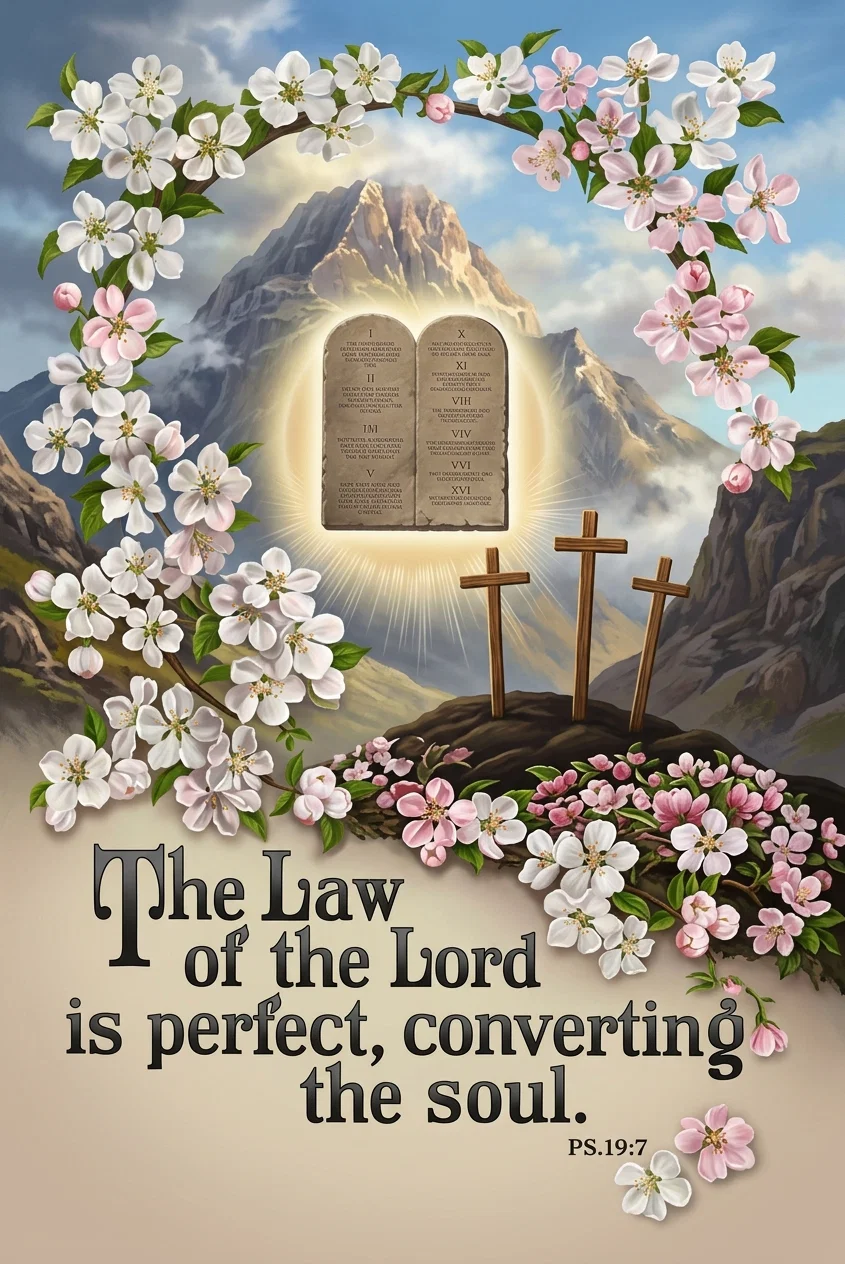
THAT which reveals and condemns sin must necessarily reveal righteousness. The law of God is the righteousness of God. Ps. 119:172; Isa. 51:6, 7. It is God’s revealed will. Ps. 40:8. Sin is only the negation of righteousness, or the transgression of God’s law. Did not the law reveal righteousness, we should not know its negation, sin; for the sin is shown in its being the negative, or the exact opposite of that which the law requires. Therefore if the law does not reveal to us its requirements, which is perfect righteousness, it can not reveal to us the opposite of its requirements, which is sin. But by the law is the knowledge of sin (Rom. 3:20); therefore the law reveals to us righteousness. “The testimony of the Lord is sure, making wise the simple.” “The commandment of the Lord is pure, enlightening the eyes.” Ps. 19:7, 8. “For the commandment is a lamp; and the law is light; and reproofs of instruction are the way of life.” Prov. 6:23.
But altho sinful man may find righteousness in God’s holy law, he can not obtain it there. The prize is revealed, but it can not be grasped; the jewel is before his eyes, but he can not lay hold of it by any means which he possesses. But to him who hungers and thirsts after righteousness, God will reveal the way to obtain it; in a more abundant way than he can ask or think, the hungerer will be filled. This way is our Lord Jesus Christ, or the way of the gospel.
“For therein [in the gospel] is the righteousness of God revealed from faith to faith.” Rom. 1:17. Righteousness is revealed as obtainable. Faith lays hold of it; it is obtained. The prize is grasped. What man could not obtain in the law because of the sinfulness of the flesh, he has obtained in the gospel by faith in Christ. And, while he gets the righteousness of God by the gospel in a different way than he could the righteousness of God by the law, it is the same righteousness; for it is witnessed, or proved, or attested, by the law. Rom. 3:21.
That this is true may be shown in other ways. He who is made righteous through Christ, who walks not after the flesh, but after the Spirit, in him is fulfilled the righteousness of the law. Rom. 8:4. That is, the righteousness received by faith is identical with the righteousness required by the law.
And he who walks in this faith, through the Spirit fulfils, or fills up, or keeps, the righteousness demanded by the law. The proof that he has received the righteousness of God by faith, is shown in the fact that he keeps the commandments of God. 1 John 2:3.
Again: The righteousness of God imputed to us through the gospel is termed justification, or accounting righteous. That is, believers in Christ are accounted righteous, as righteous as God; for they are clothed in the righteousness of God. But “the doers of the law,” those who have never transgressed it, are likewise justified, or accounted righteous, before God. Rom. 2:13. The believer and doer are equally just. The angels are doers of God’s law. The righteousness of God is fulfilled in them. The law is to them righteousness and life. Faith in our Lord Jesus Christ is righteousness and life to fallen man; for faith in Christ brings pardon and peace for all past sins; faith in Christ enables him to obey God’s law; and the keeping of that law is the righteousness of faith.
The law of God condemns the transgressor of his sin, and drives him to Christ for pardon. The law of God in Christ, received by faith, converts the soul and changes the son of disobedience to a child of God. “For by the obedience of One shall many be made righteous.” Praise God for His law; praise Him for the great Saviour from its transgression.

The Better Way

THE Word of God has but very little to say upon many important subjects; yet that little is so plain and definite that, among the followers of the Word, there is generally no disagreement. Other subjects are set forth more fully by direct statement or plain allusion; and, strange to say, it is in regard to the latter class that the most disagreement is found among Christians. It would seem at first thought, that those matters about which the Bible said so much would be most easily made clear to all, but it is not so. The second coming of Christ is a subject that is of this character. The kingdom of Christ is another.
Now there are reasons why there is not a more general agreement upon such subjects. What are they?
1. Men get an idea from some one else, or in the imagination of their own mind, as to how a certain subject ought to be understood, and then they endeavor to warp theScriptures to their idea. This is an entirely wrong way. It is wresting the Scriptures.
2. Another class seize upon a certain text of Scripture designed only to teach a certain phase of the subject, regarding all other testimony upon the same subject as of little importance. Such views are at the best but one-sided, and very often lead to extremes, even to fanaticism.
The only true doctrine taught in the Scriptures on any subject, is that which harmonizes, or shows the harmony between, all the testimony, and at the same time gives all of its parts their relative importance.
Among the subjects variously understood is that change which must take place in a man to fit him for a home in the kingdom of God. This transformation in its various forms, phases, and steps is frequently mentioned in the Bible, especially in the New Testament. In its different phases, it is presented as forgiveness of sins, imputed righteousness, justification, righteousness by faith, being converted, sanctification, adoption, etc. It is illustrated by death of the old man and creation of a new man, by marriage, by being born again, by a building, by the vine and its branches, and in other ways.
Now it is manifest that that view which would base itself upon only one class of texts,—like those that pertain to conversion,—or upon one illustration,—like that of being born again,—must be one-sided and very likely to be extreme. The only true doctrine is that which will give due weight to all these scriptures, and to each class its proper place. This will bring harmony. Plain, positive texts will give form to inferences and make clear the object of the illustrations. Other methods will result in confusion, and tend to careless indifference on the one hand, or fanaticism on the other.
If we have preconceived motives, we must put them away or hold them in subjection to the consensus of testimony. If we think that former investigations in a certain line are sufficient, we are very likely to be mistaken. Where all these lines converge will be found the truth; and that truth will give due importance to every part, and each part will shine brighter and clearer in its own place, reflecting the effulgence of all. This is the true way to study God’s Word, and if it is studied in this way, with a heart which is open and free to receive the truth, and which cries out with unutterable longing to have the will and truth of God wrought in it, the truth will be found. In this way, we may “understand righteousness, and judgment, and equity; yea, every good path.” Prov. 2: 9. To such the way of truth will be indeed the path of the just that shineth “more and more unto the perfect day.”

Sensitiveness

EXTREME sensitiveness is overweening selfishness coupled with great weakness. Sensitiveness, we mean, which is always imagining personal slights, neglects, or insults. Surmise is ever fruitful with such. “Why, Brother A did not speak to me this morning;” “Brother B just nodded when I spoke to him last night;” “Sister C has been talking about me; for I saw her talking with Sister D and they looked over toward me and laughed; they must have been laughing at me;” “I am not appreciated and trusted.” So it goes, and the poor soul is constantly more or less miserable brooding over a supposed something that some one thought or some one said, that some one never thought or never said or never had a thought of saying or thinking.
If the sensitive individual did not think so much of self, he would not care what folks said, without imagining that they did say what they didn’t say. If they were strong in character, had strong faith in God, or were absorbed in their legitimate work, they would have no time for surmises. If they did their own legitimate work first and sought some greater thing later, they would find it a blessing of strength. Legitimate work close at hand, even tho made up of common, menial tasks, is work for God if done aright, and a mighty comforter of the smaller hurts of life.
Let the sensitive get a view of his own sinful heart and his own mental incapacity; let him get a love for others, a disposition to do the work which God would be pleased with, faith that God will do just what is right whatever man may do or say, and the sensitiveness will depart and strength will come. After all, what does it matter what men may say if we are doing what is right? “If God be for us, who can be against us?”
Now do not say, “The editor had me in mind when he wrote that.” Be assured he did not. But if its truth touches you, let it do its work.

The Seven Heads of Revelation 17

A CORRESPONDENT, referring to a question recently answered in the “Question Corner,” thinks that we have an altogether wrong view of the seven heads of Revelation 17, and that these heads represent Egypt, Assyria, Chaldea, Medo-Persia, Grecia, Rome, and the United States. We are told that “at the time that John received the revelation of Jesus Christ, five of these satanized kingdoms had fallen, Rome was then in power, and the United States was yet to come.”
We are sure that our correspondent has not thought around the question on all sides. In the first place, let him go back to the 13th chapter of Revelation. The beast of the 17th chapter is the same as the beast of the 13th chapter, only in a later phase. It is the one beast on which all these heads appear. They belong to one general system of dynastic church-and-state government. The United States is represented by another beast, with two horns like a lamb, and which spake as a dragon, depicted in the same chapter. It is not the same beast; it is not a head of that beast; it is a totally distinct beast, coming up in an entirely different territory, living at the same time that the seven-headed beast lives, and doing its work in the presence of the seven-headed beast, when that other beast is living. This disposes of the one conception, that the United States is one of the heads of the seven-headed beast. In the nature of the case, it can not be.
2. The beast represents the great system of church-and-state government antagonistic to God; the seven heads, seven great dynasties beginning at a certain time in the past, and continuing until Christ our Lord shall come. It is true that Egypt was a persecutor of God’s children, it is also true that Assyria was. It is just as clearly true that the Philistines were, that the Midianites were, that the Amalekites were, and other powers; but they do not belong to that system. That system begins with Babylon, and it begins with Babylon at the time that the kingdom was taken away from Israel, and Israel (or Judah, rather) went into captivity to Babylon. If we would learn the beginning of the sevenfold system of government, let us compare the story of the birth of the Man-child of Revelation 12 with the fourth and fifth chapters of Micah. That very clearly shows that Babylon is the very beginning of this beast power, and that from the time when Judah went into captivity.
3. It is not a church, however corrupt it may be, which makes the beast. It is not proper to speak of a corrupt ecclesiastical body as the beast. It is only when that ecclesiastical body is united with state power that we have the beast. The deadly wound which one of the heads received, did not mean the utter wiping out of that dynasty, or the utter destruction of the ecclesiastical power connected with it, but the separation, or breaking of this union.
4. These heads, beginning with Babylon, are as follows: Babylon, Medo-Persia, Grecia, Pagan Rome, Papal Rome, church-and-state Protestantism, and the Papacy restored.
5. The Revelation is not to be considered from the standpoint of the chronology of John’s day. God sent and signified by His servant John, and among the signs that He used was John himself. John stood in the place of God’s children. He represented them not only for his own day, but for their days as well. He represented them not only at the time when the Lamb of God ascended up on high as Priest, but he represented them as they will live upon the earth at the last generation, and see Christ coming in the clouds of heaven. He therefore represented God’s children not only in the beginning of the great lines of prophecy, but in the end also, not simply in some particular stage of these lines of prophecy, but also in other stages. For instance, we have three times over the seven heads presented,—once upon the dragon, showing that they were moved and actuated by Satan; but the chronological view-point of that prophecy is at the first advent, when our Lord was caught up to God and to His throne. Their second appearance is upon the beast, when one of the heads, namely, that which persecuted God’s children for 1,260 years, was wounded unto death, but that deadly wound was healed. The third time that the heads are presented before us, is in Revelation 17. But the chronological view-point of this prophecy is just before the judgments of God fall upon the earth. They are then impending. It is one of the seven angels that had the seven bowls of wrath, that comes to John and says, “I will show thee the judgment of the great harlot.” But in order that the servant of God may understand why the judgment, God reveals the sin and the wickedness of that harlot during the “wilderness” state, contrasting this “wilderness” state with the wilderness state of the true church in the twelfth chapter; the true, driven and persecuted and hunted to death, the false, riding in triumph upon the governments of the earth.
6. The last phase of this beast power is not yet manifested. It will endure only a little while, and will go down into the pit of destruction. From the chronological standpoint of the time which John represented, when God’s judgments are impending, five of these heads had fallen,—Babylon, Medo-Persia, Grecia, Rome Pagan, Rome Papal. Another was upon the stage of action in the old-world dynasties, and that is the mixed conditions that we find in Europe to-day, divided up into governments, but all working to one and the same end, the church connected with the government, and all of them more or less intolerant of dissenters. The one that is to be, is the church of Rome restored by the powers of earth, bringing back the same phase of the beast power that is described in the first part of the chapter.
7. When the Lord Jesus Christ comes, judgment will be pronounced upon all the nations of the earth. The nations will then be judged, and judgment will be executed upon them. See the prophecies of Daniel 2 and Daniel 7. Consequently, those nations will never be seen in this world or elsewhere again, and at the end of the thousand years, when the wicked dead are raised and come up with all their old animosity against right and truth, with all the love of war in their hearts, they will not come up as subjects of so many nations, nor will they—nor could they—organize as nations. Under what nation would Nimrod be counted, or Nebuchadnezzar, or Alexander, or Hannibal? For the later phases of nations have taken the places of the ancient ones. They will simply come up with the same characters they possessed when they went down, and they will be marshaled into new armies by Satan, who deceives them. For all the old national lines and boundary-lines were obliterated when Christ the Lord came one thousand years before. During the thousand years and at their close, the incorrigibly wicked will as individuals receive their just deserts, and the long night of sin will forever pass away. And He that sitteth upon the throne shall say, “Behold, I make all things new.”

With Christ, Not Men

SOMETIMES there are persons who imagine themselves quite good singers because they can sing so easily and readily when accompanied by a good choir and musical instrument; but if called upon to lead a small meeting in singing, they make utter failure.
There are Christians whose cases are very similar. When attending some good, warm, spiritual meeting, they get warmed by the warmth of others, and think that they have received a great measure of strength, and have contributed greatly to the success of the meeting; but if these same persons are called upon to stand alone for Christ amid a Babel of strange tongues and dispositions, they yield to the influences of Satan.
The real test of union with Christ is to stand alone, whatever influences may be around us. “Let every man prove his own work, and then shall he have rejoicing in himself alone, and not in another.” Union with Christ will enable the Christian to stand uncorrupted wherever duty calls. Men may prove cowards; he will gather renewed courage. His source of life and growth is from above. “Blessed is the man that trusteth in the Lord, and whose hope the Lord is. For he shall be as a tree planted by the waters, and that spreadeth out her roots by the river, and shall not see when heat cometh, but her leaf shall be green; and shall not be careful in the year of drought, neither shall cease from yielding fruit.” Jer. 17: 7, 8.
Continue reading: Studies in Ephesians