Your ShelfYour Projects

Signs of the Times, Vol. 37, No. 26.

Men Needed To-Day
Earlier text: Out of Babylon to Zion

The Outlook for War

Japan and America

THERE are several military men in the world of more or less prominence who believe that there lies before America a fearful war with Japan. Among these is Admiral Fournier of France. He declares that "American interests in Asia are hostile to the Japanese. Japan has at present no means of retaining her empire excepting by diplomatic skill or the victories of war. This is especially the case in regions which the United States can control commercially only by supporting China and maintaining the rule of the open door."
This eminent naval authority summarizes complications as follows: "The naval forces of the United States will some day far excel those of Japan, and will probably equal those of England, in spite of the latter's efforts to maintain the maritime supremacy. Japan, therefore, will be obliged to call upon her English ally for help. If, on the other hand, the United States should combine with the Triple Alliance of Germany, Austria, and Italy, France would be compelled to unite her forces with England and Japan."
Of course he does not profess to know just how forces may line up in the great future war, but he is sure that sooner or later it will come.
Several prominent men in America, like General Bell, Ex-Secretary Shaw, Mr. Jacob Schiff, Senator Newlands, and others, contend that there is danger of war with Japan, and great danger. They feel, too, that it is imminent. If Japan should strike now, she would at least win temporary victories, and would gain advantages which it would take America many years to overcome. This, however, the Japanese papers almost in toto deny. They go on to say that they have never talked war with America; that they are friendly with America, and in all their diplomatic dealings with America there is not a single case in which they have assumed an aggressive attitude, and on the contrary they have invariably been in the position of a defendant.
The Osaka "Asahi," in an able editorial, after the remarks which we have stated in substance, says:
"During the past few years we have had to defend our legitimate rights against the aggressive diplomacy of America. Beyond that we have never said a word about her activities."
"Americans seem to be haunted by the idea that Japan is determined to dominate the Pacific; and inasmuch as they can not tolerate such an ambition, they think they must deal a crushing blow at us before we become too powerful. Whether Japan cherishes so great an aspiration it is unnecessary to discuss; but if she does, it will be entirely commercial and absolutely peaceful, which no nation need fear. We of course hazard no prophecy that American interests will never conflict with ours; but we believe that any controversy arising out of such conflicts can be and ought to be disposed of in an amicable manner by mutual restraint, tolerance, and concession."
Another Japanese paper says that Japan need not be disturbed by the spasmodic alarm of the Americans who predict an American-Japanese war, and counsels the nation to be patient with such a demonstrative people as we are, declaring that in the race of nations the most patient is the ultimate winner. This we gather from "The Literary Digest" of April 30. The "Asahi" goes on to say:
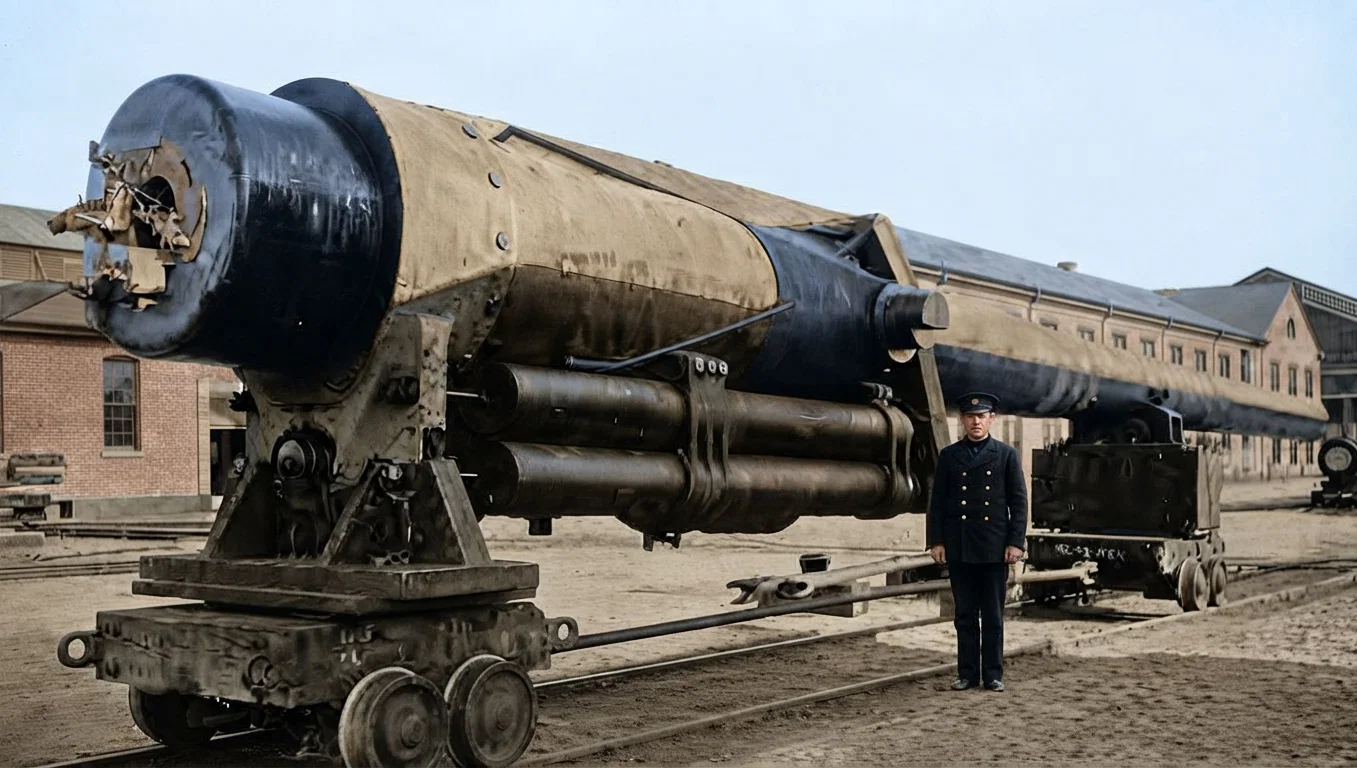
Monster 14-inch Gun at Washington Navy Yard. One year was required to complete it. It shoots a projectile weighing 1,400 pounds with a velocity of 3,600 foot-seconds, representing a muzzle energy of 65,600 foot-tons. The new Dreadnoughts will be fitted with these monsters of destruction. (Photo Copyright Clinedinst, Washington, D. C.)
"Let the Americans do all the talking they want. As for ourselves, we will go on with our own work, which is no other than the cultivation of the arts of peace."

Another paper says:

"We have sincere admiration for the pride of the American nation; but the constant indiscreet display of that national trait may, we fear, become annoying to its neighbors. Patriotism without modesty is liable to become arrogant provincialism. We ourselves have not been free from this undesirable tendency. Permit us to venture on giving a hint that America be more careful in criticizing the affairs of the Far East. She should inquire into the real conditions and aspirations of our country, and, above all, conform, in conducting her foreign affairs, to the methods, formalities, and proprieties commonly followed by other powers."
And that is splendid advice. Another paper feels equally the importance of giving instruction to America:
"The insulation and independence of America have developed a type of candor which is extremely unconventional. This characteristic is not without its admirable features; but when carried too far it often entails unexpected regrettable results. In our own country the common dictates of modesty would require of men of Mr. Schiff's or Ex-Secretary Shaw's prominence and influence great circumspection, when criticizing the acts of a nation with which their country maintains the relation of an unwritten alliance."
Now all this is good, and on the face of it ought to be taken for what Japan says; and yet if constant irritation is kept up, it will be difficult to tell what may grow out of it. This we do know, that God's Word has predicted universal war, and the constant tendency to emphasize war preparation is sure sooner or later to bring about the very thing which men now seem so eager to repudiate. The great war preparation that is going on will certainly not make for peace. An extra big battle-ship will stir up the same spirit in another power, and so the increase will go on until the nations can bear it no longer, and then will come the break.

America

The new program for the United States Navy as outlined by the House Committee on Naval Affairs, according to the Washington correspondent of the New York "Herald," is as follows: two battle-ships of a design similar to those heretofore constructed, costing about eleven million dollars each; two fleet colliers at one million each; one repair ship to cost one million dollars; four submarines to cost about five hundred thousand dollars each. The battle-ships, according to the provisions of the bill, will have to be as large as twenty-six thousand tons, but the maximum weight is not fixed. Each ship will be armed with ten 14-inch guns. Tonnage will be as large as will be necessary to carry this number of guns; that will be in the neighborhood of twenty-seven thousand. But beyond that there is talk of a thirty-two thousand ton battle-ship costing eighteen million dollars, with broadside batteries of 14-inch guns.
There are strong men who are against this naval program. Some of these men, like Representative Tawney, sees national bankruptcy in the endless expenditure. Others, like the New York "World," count it false economy. "How foolish," that journal says, "to squander eighteen million dollars for one battleship, when there is already in existence a five thousand dollar flying machine capable of carrying enough brains, brawn, grit, and nitro-glycerin to send it to the bottom in an instant."
The misuse of funds is shown in what "The Independent" calls a "significant pamphlet" issued by the New York Peace Society, in which it is shown that the cost of one battleship would establish fifty manual training schools teaching the rudiments of a trade to seventy-five thousand people a year; or would buy the White Mountain forest reserve, containing 250,000 acres; or would build a macadam road between New York and Chicago; or would build and equip forty eight-story Y. M. C. A. buildings, etc., whilethe cost of the two new super-Dreadnoughts that Secretary Meyer wants would be sufficient to dredge the proposed six-foot channel in the Mississippi River from St. Paul to New Orleans, or would practically wipe out tuberculosis from New York City.

Our Latest Battleship

launched is the Florida; not a Dreadnought, but a super-Dreadnought. "The Literary Digest" tells us that when it was launched it floated within a few hundred yards of a replica of the little Half Moon in which Hudson sailed into the New York Bay three hundred years ago; and the picture brought home the development of naval architecture during three centuries, and threw into relief by comparison the tremendous powers of destruction leashed in a modern battle-ship. The New York "Herald" declared that if the Florida were "turned loose in the days of the Invincible Armada, the Florida could have eaten her way through all the navies of the world from that day until the development of the steel-clad ship, even if all had been massed against her in one Titanic battle." "The Literary Digest" remarks, "The fleet of Nelson would have melted away under the secondary battery of sixteen 5-inch guns, while a single broadside from her main battery of ten 12-inch rifles would have carried away any single battle fleet ever gathered together in the days of wooden fighting ships."
The Utah is a sister ship to the Florida. These are the largest units now in the navy; but two others, the next two to be launched, are the Wyoming and Arkansas, with main batteries of twelve 12-inch guns, and displacement of twenty-six thousand tons; and these again we are told are to be eclipsed by the two fighting monsters armed, rumor has it, with 14-inch guns to be authorized by Congress at this session. The British Colossus is more than twenty feet longer than the Florida, but with a little lighter armor.
All this and much more might to told of the tremendous preparation for war. Even men of the world feel that Armageddon lies before. The Scripture of truth points it out as certainty. All this preparation for war is not of God nor is it making for peace. The real incentive to war is told us in the book of the Revelation,—three unclean spirits that are out in all the world stirring up the souls of men to the great war of God the Almighty. The only peace in which humanity can hope is that which comes through the life and righteousness of Jesus Christ.

Hard Times and Prosperity

I N an article on "Pinching the Pocket-book," in the July "Cosmopolitan," Mr. Hutchins Hapgood shows that the class which suffers most in rising prices for the commodities of life is the salaried class, forming about one eighth of all the wage-earners. Many of these have known little or no change in salary. Among these are clerks, ministers, journalists, teachers, and college professors.
For instance, the 65,700 general office clerks in the United States received an average wage of $2.18 a day in 1897, and $2.20 a day in 1907, while the cost of living had increased from 25 to 30 per cent.
The condition of teachers is pronounced "deplorable." A thoroly prepared, postgraduate teacher in a university (the estimate is based on one hundred of the best paying in America) at the age of twenty-eight may hope to receive a salary of $1,250 a year; at thirty-one, a salary of $1,750; at thirty-three, a salary of $2,250; and at thirty-five, when the successful teacher is supposed to become a professor, a salary of $2,500, the average of the men who reach the top. The average of the majority is much lower. "There are, for instance, a few institutions which pay annual salaries of $200 to $339, to FULL professors; and there are thirty-one institutions which pay to FULL professors salaries of from $400 to $599. At the extreme top is one institution—and one only—that pays an average salary to full professors of $5,000 a year." The same is true of bank clerks.
In many cases children's education is sacrificed, and the children are forced to become wage-earners. Mr. Hapgood declares that "the editor who receives $5,000 a year salary can no longer save a cent, and he sees with terror that his growing children will soon need more money for their education than he can possibly afford." And he well asks what effect these pinched salaries must have upon the mind of clerk, editor, minister, and teacher.
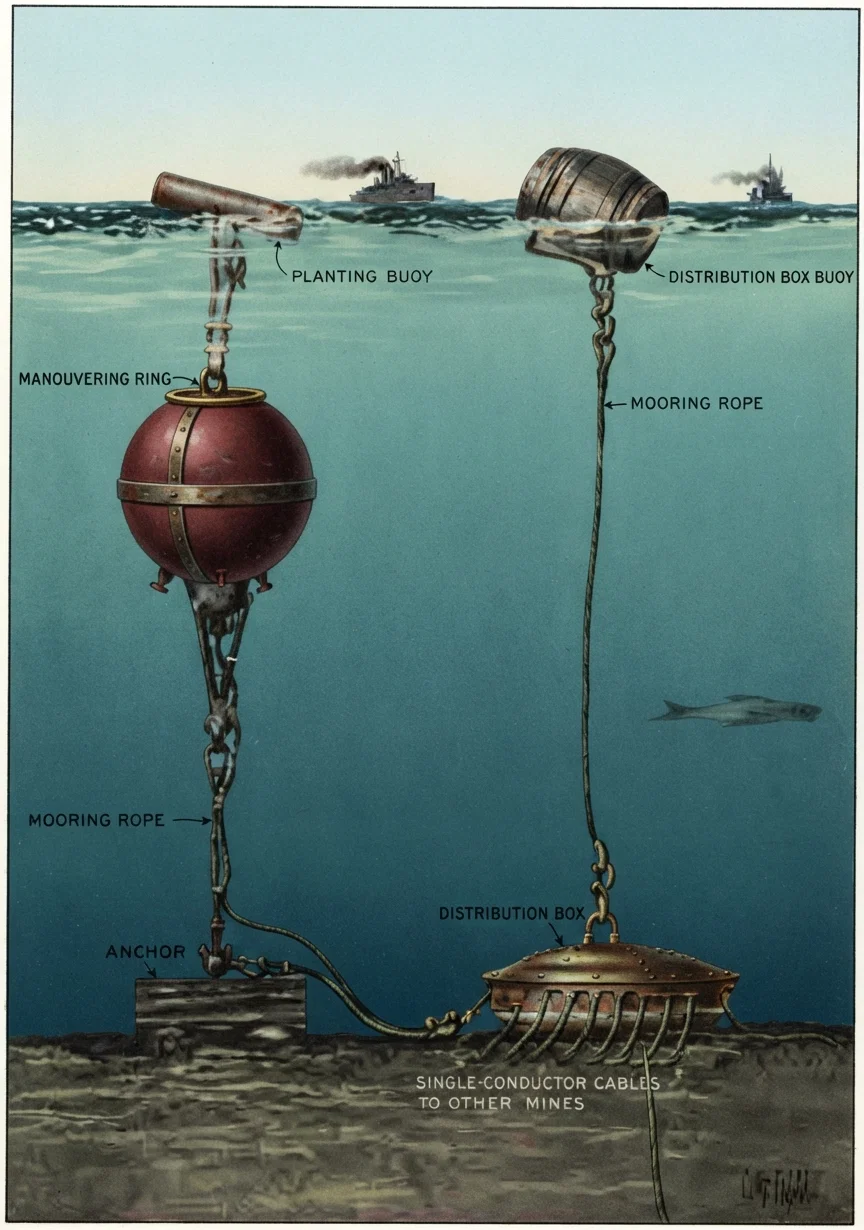
A Complete Submarine Mine. The buoy above at the left shows where the mine is planted. The sphere is the mine. Charged with 100 lbs. of nitroglycerin it costs $500. Exploded under a battleship it would sink it. Groups of these are planted across channels to keep out the enemy. They are controlled from the shore and are therefore harmless to known friendly ships. The submarine mining is said to be a great triumph of electrical engineering, the operations of which are kept secret. (From the "Scientific American.")
Mr. Kirby talks of the "Labor Trust's" relation to higher prices. George Lewis, editor of the "Financier," shows how many are working for less than nothing, and the debts to the retailers are piling up. "The average yearly earnings of wage-workers at the present is about $500;" and it has been found by different official investigations that it costs to maintain a family of five from $750 to $800 a year. Mr. Lewis concludes: "There is no question that the debt of the wage-earners is now being shouldered by the retail dealers." We opine that many are living by pinching economy below the income.
Yet in the same issue Mr. Gage Tarbell, a capitalist, treats of the "Riot of Extravagance," and declares that "the general extravagance of the age has much to do with the present high cost of living. The country is suffering from too much politics, too much legislation, too much graft, too much unnecessary expense of every kind." The general air of extravagance, it is rightly said, breeds a general spirit of unrest, the values of services are affected, and inferior labor is the result, with higher prices on the products of labor. "The Increase in Women's Clothes Bills" is another pointed article, by J. J. Goldman, an expert.
But there is no definite relief promised the consumer. On and on the thing must go till a break comes in a financial crisis or a revolution. These among other conditions are signs of the end. The relief to the average salaried worker lies largely in new adjustments, in new plans of economy, in the elimination of extravagance, in simple, economical living, in placing ourselves under the guidance of God.
—★—

Languages in Church Services

Languages in Church Services.—English is used by 85 per cent of all religious organizations in their church services. A recent bulletin of the United States census shows that the vast number of foreign birth and language which have come to these shores have adopted the English language. Had this not been the case there would be many more services in foreign tongues. Seventy-seven denominations, however, use the German language also, 25 the American Indian languages, 22 Norwegian, 21 Swedish, 19 Danish, 15 French, 13 Italian. There are 41 individual languages tabulated in church worship; New York alone uses 29 of these; Pennsylvania comes next with 28; Illinois with 26; Ohio with 24. Five other states report 21 each; while three states, South Carolina, Georgia, and Kentucky, report only three languages; and seventeen other states less than 10. This shows that foreign born and alien tongues are not so widely scattered as some might suppose.

For Public School Moneys.

A recent number of The Western Watchman tells us that the Pittsburg section of the American Federation of Catholic Societies held in that city May 22 urged a division of the school tax, and urged measures suggested to make that solution of the school question acceptable to the American people. The contention is that there are nearly a million and a half of children throughout the entire United States attending parochial schools, and that $36,000,000 is in that way saved to the nation. But that can hardly be said. It is not saved to the nation in any way, but to different localities. It will certainly be a wrong principle for the United States to adopt any plan by which any portion of its public funds shall be used for sectarian purposes. While we say that, we believe in parochial schools; we believe in religious education; but we do not believe that the state is prepared to give that religious education, nor do we believe that the state should divide its public money for that purpose. However, the matter will be agitated and agitated again and again. It will be brought into politics, and will be there urged as the report in the Watchman intimates.

The Cult of the Dog.

In ancient Egypt the Cat was worshiped; in modern England and America the Dog. The poet Tennyson became a peer, but he did not know the plutocratic, aristocratic, deified Dog when he penned the line, "He will treat thee little better than his dog." The fashionable dame of New York — we are slow to believe that all of them do — furnishes a luxurious room for her Dog, has for him a French maid, who puts him to bed at night, rubs him down when he gets up in the morning, brings to him his breakfast, and cares for him as tenderly as if he were a human. One dog has a special automobile built for him. When he is led out to walk on a wet pavement, his feet are encased in costly shoes. For these pets beautifully cut clothes are furnished, costly, little pocket-handkerchiefs, combs and brushes with silver monograms, etc., etc., ad libitum, ad nauseam. Sapphire earrings and diamond bracelets, flounced dresses, Russian sable, and other costly paraphernalia and material and time and talent are devoted to the service of the Dog. A little distance away from these petted dogs, in both New York and London, men, women, and children are starving, dying, for the necessaries of life, for what the money spent on the dogs would buy, and both the dogs and the needy people would be better for the change.

Shiloh: the Man of Sorrows

Chapter XVIII.—In "the Fulness of the Time"

It was the first time that the family from Bethany, Lazarus, Martha, and Mary Magdalene, had ever listened to this story,—or rather, to these facts, as told to the household of the widow Adah, and her guests, by Matthias.
To Lazarus it was a tale of deep interest. His heart was touched and his spirit quickened as never before. Manlike, he fell to philosophizing over the strange narration, and to comparing the different parts of the story, that he might the better judge of its reasonableness. Then, carefully, deliberately, systematically, for the hundredth time, he reviewed the rolls of the prophets, more especially of Daniel the seer, to make sure whether the time was fully ripe for the appearance of the promised Shiloh. The sixty-nine prophetic weeks, or four hundred eighty-three years, since the command of King Cyrus to rebuild Jerusalem, were, just then, PRECISELY fulfilled.
Having satisfied himself entirely upon all these questions, when he closed his eyes in slumber that night, Lazarus of Bethany was a firm believer in the Christ of Galilee. Tho he had not a complete understanding of His wonderful mission, still, ever thereafter, despite the cavilings of the priests and the persecutions of the Pharisees and rulers, his faith continued firm. His was a beautiful faith; it knew no doubt, no hesitancy, no wavering; and the blessing which was the promised inheritance of those who not having seen, yet believe, was his.
Martha, the careful, the troubled—thankful indeed if the long-looked-for Messiah had at last come, but fearing lest, after all, there might be some mistake!
What! was it possible that even in her day the power of the Cæsars would be broken? that the city of Jerusalem would be the proud capital of the nations, and that the Shiloh of Jacob would reign gloriously upon the throne of David?
But as Martha fell asleep that night, she was troubled—troubled lest the favored nation be not ready for her King; troubled lest the desired One meet with no better reception among the people of her day than did Moses in the days of old.
Then, she was troubled for Mary, her beautiful sister, her beloved Magdalene. Dim forebodings troubled her. So sweet of temper, so mild of disposition, so calm, so unsuspecting of evil, so innocent,—her sister! From childhood this sister had been carefully reared, jealously guarded, lovingly nurtured; and the disposition which this had developed was sweet and gentle, loving and beautiful and true,—but clinging and dependent as the tender vine. What if Simon, her betrothed, really loved her not! Martha felt in her inmost soul that he was entirely unworthy the love of so guileless a heart as Magdalene's; and Martha was troubled, and troubled she fell asleep.
Magdalene, the true of heart and the pure of life, the easily satisfied and the easily led, the light-hearted, the optimistic, the castle builder! Magdalene could not sleep; she was too joyous. Had it not been abundantly proved that the Shiloh had at last come? How favored was Israel! How blest was Jacob! How incomparably happy was Jerusalem—the chosen of God—the city of the great King. Sleep? Could she sleep when such blessings were about to come to her people? Sleep when on the morrow her eyes would, without question, behold Him—the Longed-for—the Desire of the Nations? No warning doubt chilled her heart; no unbelief cast its hateful shadow across her spirit.
The calm moon, almost full, threw a flood of opalescent light upon the quiet ford. Bethabara slept.
The latticed windows were sharply outlined upon the floor of her apartment, and the calm beauty of the night beckoned her with dim, shadowy fingers.
Throwing her cloak about her, with hair unbound and sandaled feet, she passed the outer court, and sought a quiet retreat in the garden, where she had often wandered. The winter's storms had chilled the flowers, and they were dead, and the trailing vines rustled beneath her feet; but the cool evening air kissed her brow, and caressed the truant tresses of raven hair,—and she was happy.
"Magdalene, Mary, whither goest thou, queen of the night?" For an instant the voice startled her, and she had almost cried out in terror; but the soft, familiar tones reassured her.
"Simon, is it thou? verily the evening wooed me with her gentle charms, and I could not sleep."
"And verily thou hast wooed me with thine, Magdalene, my beloved—my betrothed!"
Over in the palms and reeds which bordered the winding Jordan, the night bird called to his mate, and the discordant note of the cormorant was heard.
The moon hung lower and lower in the sky, until a misty cloud veiled her saddened face from sight. The air seemed chill and cold, as in that other garden when sin first entered with its noxious breath.
The face of nature seemed changed. It was a different world to her, as Mary Magdalene, astonished and humbled, once again entered her chamber, with poor heart throbbing and beating like a captive bird against the walls of its prison. The beautiful flowers which had grown in the garden of her soul's purity, had been despoiled of their bloom—their petals scattered by the hideous fingers of lust.
In the morning, Mary Magdalene arose, her dark eyes red with weeping such as she had never known, her soul sick, and her heart filled with strange terror and unaccustomed dread. Again she sought the cooling shades of the garden; but the scenes of the evening before were hateful to her soul, and she wandered on, till the soft murmurs of the Jordan fell upon her ear.
The sun was already tinting the light clouds above the hills of Moab, and the pale stars had gone out in the purple sky. She walked on until the overflowing Jordan kissed her sandaled feet with cool, moist lips.
Suddenly she became aware that there were others near her, conversing in low tones; but she saw them not. Evidently they were concealed among the palms and reeds everywhere abounding. The light breeze bore the words of the speaker to her ear, and she heard her own name spoken lightly, and in the same instant recognized the soft, seductive tones of Simon of Bethany. He was conversing carelessly with one of the Roman officers whose duty it was to guard the fords.
"Thou callest her beautiful, Emil?"
It was the voice of Simon; and the soldier replied quickly:
"The girl is beautiful as Diana,—thy betrothed, didst thou say, Simon?"
"Verily, Emil, she was betrothed unto me by her father; and she seemed fair unto me, also; but of a truth she is fair no longer. The father is dead, and the brother and sister look not upon me with favor. My bonds are even now cut asunder, for the wench hath not the virtue of a true daughter of Israel, and verily she is hateful unto me. Within a month I wed another, Prisca, the daughter of one Elkanah, a nobleman of Jerusalem."
A wild scream from among the reeds at their side startled the men. Quickly they found her, unconscious, cold and white as the foam of the Jordan; and hastily they bore her back to the home of Adah.
"Behold!" exclaimed Simon to Martha, who hastened to meet them. "Behold, we have found this woman by the river among the palms, tho why or when she came thither, we wot not."
Even as he spoke, Mary Magdalene opened her dark eyes and looked wildly about her, while shriek after shriek like that of the demons of darkness, broke from her foaming and blood-stained lips.
But Simon was like Amnon, the son of David; for the hatred wherewith he hated her, was greater than the love wherewith he had loved her.
"Of a truth, this woman, thy sister, seemeth to be possessed with Beelzebub!" he exclaimed coldly, as he turned upon his heel and walked rapidly away toward Jericho.

Modern Discovery and the Bible

LIEUTENANT LYNCH has floated down the Jordan, and explored the Dead Sea; and his sounding-line has fetched up from the deep physical confirmation of the catastrophe which destroyed the cities of the plain.
Robinson, and Wilson, and Bartlett, and Bonar, have taken pleasure in the very dust and rubbish of Zion; and they come back declaring that the Bible is written on the very face of the Holy Land.
Since Laborde opened up the lost wonders of Petra, its stones have cried aloud, and many a verse of Jehovah's Word stands graven there with a pen of iron in the rock forever.
Skepticism was wont to sneer, and ask, Where is Nineveh, that great city of three days' journey? But since Botta and Layard have shown its sixty miles of enclosing wall, skepticism sneers no longer.
Hidden in the sands of Egypt, many of God's witnesses eluded human search till within the last few years; but now, when Bibles increase, and are running to and fro through the earth, and when fresh confirmations are timely, God gives the word, and there is a resurrection of these witnesses; and from their sphinx-guarded sepulchres old Pharaohs totter into court, and testify how true was the tale which Moses wrote three thousand years ago.
"In my youth," said Caviglia, when Lord Lindsay found him in the East, "I read Jean Jacques and Diderot, and believed myself a philosopher. I came to Egypt, and the Scriptures and the pyramids converted me." And even so, a visit to Palestine, the reading of Keith's "Fulfilment of Prophecy"—nay, the mere sight of the Assyrian antiquities, has given faith to many a doubter; just as we could scarcely imagine any one reading Dr. Stroud on the "Physical Cause of Christ's Death," or Mr. Smith on the "Shipwreck of St. Paul," without carrying away the firmest conviction of these historical facts, and, consequently, of all those vital truths which the facts by implication involve.—Dr. J. Hamilton.

Failure of Half Way

A MISSIONARY in Swaziland, in South Africa, told a native that feathers make a good bed. The native went to his kraal and spread a few feathers on a board; and when he awoke the next morning he was stiff and sore, and complained that the missionary was "a liar." The trouble was not in the missionary, but in the fewness of the feathers. In our Christian life, if we sow sparingly we reap sparingly. If we rob God and His poor of the fellowship that belongs to them, doing only what we must to keep up the appearance of righteousness, we need not wonder if, at times, we only have joy enough to keep us miserable in our souls. But on the other hand, the hilarious giving of the second mile means joy and victory in our own lives, a living fellowship with the Lord, and the Gospel for those who will not have it unless we practise such giving. In which mile do we live? —Christian Witness.

The New Testament Sabbath

"The New Testament Sabbath." B. S. L. 137. An examination of the various New Testament texts thought by some to teach Sunday sacredness.
"Paul Preached . . . till Midnight." "Ready to Depart on the Morrow." From "New Testament Sabbath"
Fully illustrated. Sixteen pages; one dollar a hundred.
"Who Changed the Sabbath?" B. S. L. 187. Biblical and historical sketch of the change of the Sabbath.
One of the most widely read of our Sabbath tracts, 33,000 copies having been shipped out the past year.
Sixteen pages; one dollar a hundred.

Leaflets on the Sabbath

One each of the following, with complete catalog, post-paid, 25c
"Elihu on the Sabbath." B. S. L. 192. The author of this popular treatise is unknown. The manuscript, with just the word "Elihu" for a title, was handed to James White over half a century ago; and editions by the score have been printed since.
Last year's sales in English alone were 24,000 copies; and we have no means of knowing the sales in the various foreign languages into which it has been translated.
Sixteen pages; one dollar a hundred.
From "Who Changed the Sabbath?"

The Lord's Day

Among the more comprehensive and yet inexpensive studies on the Sabbath is "The Lord's Day, the Test of the Ages," by the editor of the SIGNS OF THE TIMES. The following from its table of contents shows its scope:

The Patriarchal Dispensation

The Institution of the Sabbath
During the Patriarchal Dispensation
Sabbath Reform

The Levitical Dispensation

The Sabbath Affirmed
During the Levitical Dispensation
Close of the Levitical Dispensation

The Christian Dispensation

Christ and the Sabbath
The Gospel of Christ and the Sabbath
Sunday in Apostolic Times
The Change of the Sabbath
The Testimony of Men
The Close of the Christian Dispensation
Copiously illustrated by original drawings and diagrams. Contains 125 pages; only 10 cents, post-paid.

LIBERTY

THE OFFICIAL ORGAN OF THE RELIGIOUS LIBERTY BUREAU
AN illustrated, 48-page, quarterly magazine, published as an exponent and advocate of true religious liberty; defending Christianity and the rights of conscience; upholding the Bible as the infallible word of God; recognizing the church and state as ordained of Heaven for specific and distinct purposes, but vigorously protesting against the alliance of the church with the state in the attempt to advance religion and to promote the state.
Price 25 cents per year. Liberal terms to agents.
Address, LIBERTY, Takoma Park, D. C.

Life and Health

A PRACTICAL health journal, published with a view of meeting hygienic needs in every home; teaching how to care for the health and how to preserve life; prescribing simple home treatments to assist nature in throwing off diseases rather than adding more poison by using drugs or unnatural stimulants as remedies: teaching how to avoid disease as far as possible, how to manage in the home when sickness does come, and how to combat the disease by simple remedies which nature provides.
Send for sample copy and special rates to agents. Price 10 cents per copy or $1.00 per year.
Address, LIFE & HEALTH, Takoma Park, D.C.

IN THREE DAYS

SAN FRANCISCO

Overland Limited

TAKES YOU

To Chicago

ACROSS GREAT SALT LAKE

AND

HIGH SIERRA BY DAYLIGHT

Luxurious High-class Equipment

Electric Lighted Throughout
Pullman Drawing-room Stateroom Vestibuled Sleeping-cars Careful and Attentive Dining Service Parlor Observation-car with Library and Cafe Ladies' Reading-room Gentlemen's Smoking-room Daily News Bulletins Latest Papers and Magazines

Southern Pacific

New Nurses' Class at Glendale Sanitarium

Los Angeles, Cal.

A new class for the training of medical missionary nurses will be started at Glendale Sanitarium during the month of June. This school is affiliated with San Fernando Academy, where a year of preparatory work is given. Term at Glendale, two years. If desired, advanced medical work can be arranged for at Loma Linda after graduation.
Arrangements are such that students can work their whole way, as allowances are liberal. Full particulars upon application. Intending students please apply at once to Dr. Belle Wood-Comstock, Glendale Sanitarium, Glendale, Cal.

Schools versus Saloons

[By Thomas Jordan Jarvis, Ex-Governor of North Carolina]
THERE is an eternal conflict between the schoolroom and the barroom. The schoolroom makes men, the barroom destroys them. The schoolroom takes the child and trains him to a useful life. The barroom takes the boy and trains him to a life of wrongdoing. The schoolroom fills the home with bright, happy boys and girls. The barroom fills it with ignorant, aimless, lawless inmates. The schoolhouse fills the pulpit with educated, eloquent ministers of the Gospel and pews with godly men and women. The still-house fills the jails and penitentiaries with criminals and murderers. The schoolroom sends men to the legislature, to the bench, and the executive office. The barroom sends them to the scaffold and hell. The schoolroom gives to the community an intelligent, thrifty, enterprising, refined manhood and womanhood. The barroom gives to it a thriftless, lawless, ignorant, worthless citizenship. The schoolroom carries light and knowledge into the home and community. The barroom carries darkness and sorrow and death into the home and community. The schoolroom leads to higher and better things. The barroom leads to lower and baser things. The schoolroom stands for the good, the barroom for the bad.
The people that multiply and replenish the schoolrooms and destroy the barrooms are building for their posterity a future that will grow brighter and greater as they continue to multiply and replenish the schoolroom and utterly destroy the last trail of the barroom. Shall the schoolroom or the barroom triumph? There is no middle ground.
Continue reading: Whose Boy Is in Danger?