Your ShelfYour Projects

Signs of the Times, Vol. 37, No. 26.

Men Needed To-Day

Signs of the Times

Jul 5, 1910

Pacific Press Publishing Association · Mountain View, California · Jul 5, 1910

Men Needed To-Day

[Lowell on Wendell Phillips]
He stood upon the world's broad threshold; wide The din of battle and of slaughter rose; He saw God stand upon the weaker side, That sank in seeming loss before its foes. Many there were who made great haste and sold Unto the cunning enemy their swords; He scorned their gifts of fame, and power, and gold, And underneath their soft and flowery words, Heard the cold serpent hiss; therefore he went And humbly joined him to the weaker part, Fanatic named, and fool, yet well content So he could be the nearer to God's heart, And feel its solemn pulses sending blood Through all the wide-spread veins of endless good.

"IF YE WILL INQUIRE, INQUIRE YE."

This Inquirers' Department is conducted for the purpose of helping those who are studying the Bible. The answers are oftentimes only suggestive. They are never to be considered infallible, only as they agree with the infallible Word. The writer who may answer them does not consider that his opinion is infallible. He will simply give the best that he has, and plead with the inquirer to search the Word. Such questions only will be answered as, to the editors, seem to minister to the good of the readers and to the mission of the paper. We can not answer repeatedly in the same volume questions upon the same scripture. The name and address must accompany question, not for publication, but as an evidence of good faith, and that answer may be made by letter if deemed advisable. No letters are answered which do not contain the name of the writer. It is well always to enclose stamp for reply.

3172.—The Negro

Can you give us Bible evidence as to the origin of the Negro? A. W.
The Bible origin of the races of mankind is stated in Genesis 10. Noah had three sons, Shem, Ham, and Japheth. The European or Aryan races sprang from Japheth; the Semitic, of which the Jew and the Assyrian are types, sprang from Shem; the darker races, such as have inhabited Africa, from Ham. That is why it is that Africa has been called the land of Ham. The Negro is one of the Hamitic races.

3173.—The Oldest Church

The Roman Catholics claim on the ground of Matt. 16:18 that Peter was the first pope, and it seems to look that way. Will you please explain? W. P. M.
This has been explained often in the SIGNS. The text teaches nothing of the kind. Jesus had inquired of His disciples as to who men said that He was, and they had told Him the different opinions that men expressed. He asked His disciples, "But whom say ye that I am?" and Peter, impressed by the Spirit, said, "Thou art the Christ, the Son of the living God." What did Jesus reply? He said that flesh and blood had not revealed that to him. It is not something which Peter had found out or which he by any superiority had learned, but the Father in heaven revealed it, and because of this Jesus said, "I say also unto thee, that thou art Peter [stone], and upon this Rock [this One whom thou hast confessed] I will build My church; and the gates of Hades shall not prevail against it." Peter himself tells us in the first part of the second chapter of his first epistle who the Rock is,—the One on whom we are builded, and that is Christ; and that those who are builded in Christ are simply living stones. Paul expresses the same thing when he declares that there is but one Rock on which we can build, and that is the Rock Christ Jesus. 1 Cor. 3:11. So the Rock on which God's church is built is Christ; and every one who confesses Christ, yielding himself to Him as did Peter, is a living stone upon that Rock. See also the last part of Ephesians 2, and many other scriptures.
"The keys of the kingdom of heaven" simply means the opening of the door of the kingdom to others. God graciously granted the privilege of that to Peter. He first preached the Gospel on the Day of Pentecost, showing just what that Gospel meant, to the Jews; and he also preached it to the Gentiles down in the house of Cornelius, according to Acts 10, thus opening to both Jews and Gentiles the Gospel of Christ. In other words he was a man having keys, who unlocked treasure-houses to masses of waiting and needy people. But that Peter was superior to the other apostles is emphatically denied. Read what the apostle Paul says in Gal. 2:7-14 of Paul's rebuke to Peter. Again the apostle declares that he was "not a whit behind the very chiefest apostles." 2 Cor. 11:5.
If Peter had been the first pope, it would naturally seem that he would preside at the councils of the church. The first council was held at Jerusalem, the account of which is given in the fifteenth chapter of Acts; but while Peter was present at that council, he himself did not preside, nor did he give sentence. It was James who presided, and it was James who gave the sentence of the council.
Then as to the binding and the loosing. That is true of every true minister of Christ who preaches God's Word. It is explained by the prophets, as for instance Jer. 1:10. The Lord tells the young prophet that "I have this day set thee over the nations and over the kingdoms, to pluck up and to break down and to destroy and to overthrow, to build and to plant." How did he do it? This is explained in the 18th chapter, verses 7-10. The power is in the Word of God which the prophet proclaimed. If the nation that the Lord had thought to destroy would heed that Word, the Lord would turn from His wrath and save the nation; but if the nation which He sought to save turned from righteousness, that nation itself would be destroyed. And so when the apostles went out and preached the Gospel of Jesus, he that believed should be saved, but he that believed not should be condemned. So in the very word that they preached there was the condemnation or the salvation, the binding or the loosing. And only so has God placed that gift in His church.

3171.—Times of the Gentiles

Does Luke 21:24 mean that God will reject the Gentiles to such an extent that He will again turn to the Jews? And also Rom. 11:25, the last part of the verse? I understand that the Jews are building and inhabiting Jerusalem as a fulfilment of this prophecy. G. A.
First, the times of the Gentiles evidently refer to those prophetic times which God has spoken of by His prophets and concerning which He has given periods or limitations, as for instance the 1,260 years of papal supremacy referred to in both Daniel and the Revelation, and the 2,300 years during which time God's worship and service should be trampled under foot. Then indeterminate years follow. Prophetic definite time ended, as we understand, in 1844. Indefinite time follows this, preceding the Lord's coming. Thus the rule of all Gentile nations will be ended, and "Jerusalem which is above, which is the mother of us all," will welcome her children. There is nothing in the text which would intimate that then would the Lord turn to the Jews as a nation and restore them; for every Jew has now the same opportunity as every Gentile.
Rom. 11:25 has reference to a different thing. The statement is that blindness in part has happened to Israel until the fulness of the Gentiles be come in. In other words, the Jews as a nation rejected Christ, but it does not mean that the Jews as individuals are rejected. When the Jews would not carry on the work which God gave them to do, the privilege of doing that work must go to the saved of all nations, peoples, tongues, and kings; but the Gospel must be received by them as individuals. No nation as a nation would be converted. No people could say that they were responsible for the work of salvation which God would do in the earth, consequently the Jewish nation was set aside. But what is the "fulness of the Gentiles"? That fulness is met in Jesus Christ. He was the fulness of both Jew and Gentile. John says of Him, "Of His fulness we all received, and grace for grace." John 1:16. And Paul in writing to the Gentiles declares, "For it was the good pleasure of the Father that in Him [Christ] should all the fulness dwell." Col. 1:19. And he tells us further the blessed fact, "For in Him dwelleth all the fulness of the Godhead bodily, and in Him ye are made full." Col. 2:9, 10. Therefore the fulness of both Jew and Gentile is found in Christ Jesus our Lord, and it is found nowhere else; and that came in when the Jews rejected Jesus Christ. He died upon the cross for all, and His apostles were sent out into all the world to preach that Gospel freely to all, to whomsoever it came; and in its acceptance there is neither Greek nor Jew, male nor female, but all are one in Christ Jesus.
Our querist's reference to Heb. 9:27 we do not understand. It seems to us that the text is very clear. It declares, "It is appointed unto men once to die, but after this the judgment." It does not say how long after. It does intimate, however, that the judgment will not come before death, but after death, and that death determines the character; and however death may leave us, there the judgment finds us. Hebrews deals in finalities. It is ever pointing forward to the end, to the climax. Men live here, but the judgment lies beyond.

3174.—Holiness to the Lord

I read in the notes of the present Sabbath-school quarterly, also in "Desire of Ages," page 556, that we must have "Holiness to the Lord" on all deeds, receipts, ledger books. Does that mean our property deeds, tax receipts, and the like?
The simple meaning of this is not that these words shall be written upon day-books, ledgers, deeds, receipts, bills of exchange, etc. That is not the thought of it at all; but it means that all these transactions shall be with a heart of integrity, and that all this business shall be done just right, as before the Lord. Merely writing or printing "Holiness to the Lord" upon these various books and documents, would simply mean nothing; but it does mean that if the transactions outlined in these various documents are searched out, it will be found that on our part there has been faithfulness, righteousness, and holiness in every respect.

3175.—Putting Away One's Wife

Can any one put away his wife and be married to another without fornication if he finds out that his wife is helpless, useless, and untrustworthy? How must he do?
The true and Christian way to do is to bear with his wife. He ought to have found out some of those things before he was married. The Bible gives but one cause of putting away, and that is fornication. Sometimes the uselessness and helplessness of one's wife depend largely upon the husband. It is a misfortune of course if one has a wife of this kind, or a wife has a husband of this sort; but the better way is to bear patiently the burden which one has chosen, and so develop even stronger character for God.

3176.— The Tree of Isa. 66: 17

Please explain Isa. 66:17. Is the tree spoken of some truth? CANVASSER.
Among the idolatries of the days of the prophet were the sacred trees or "groves." Certain trees were dedicated to certain worship, and it is the figure of that time which the prophet uses evidently to point out future idolatries. "They that sanctify themselves and purify themselves to go unto the gardens [or margin, "in the gardens"], behind one in the midst [or one tree, or asherah, a sacred grove or a tree dedicated to sacred idolatrous worship], eating swine's flesh, and the abomination, and the mouse, they shall come to an end together, saith Jehovah." The meaning of which simply is that those who indulge in such abominable idolatries shall perish with their idols.

3177.—Elder and Licentiate

What is the difference between an elder and a licentiate minister? C. A. A.
A licensed minister is one to whom is given a license by a church or body to improve his gift. He is supposed to have been called of God, and the license is simply permission on the part of the church, who accept the responsibility to say that he is a worthy character and is entitled to demonstrate under their direction as to whether he has the true gift of the ministry. An elder is a licensed preacher who has been tested, is ordained to the ministry, and is therefore sent out as one trustworthy and competent to exercise the gift of the ministry.

Faith Not to Be Prescribed by Men

By Mrs. E. G. White
AMONG the different denominations there seems to be a determination developing to bind the consciences of their members. They are building up barriers about their own sects, and forming a purpose to listen to nothing outside of their own doctrines. They are restricting themselves from hearing anything new, or any doctrine presented by any other people than those who belong to their own church. But it would be well for them to inquire from what origin this determination arises, and who has sent forth this order. Certainly the Lord has made no such restrictions; for He has His message, and His messengers are to go forth and present it to the people, in warnings, reproofs, and instruction in righteousness; and He has given the people directions as to what they shall do. The apostle says, "Prove all things; hold fast that which is good."
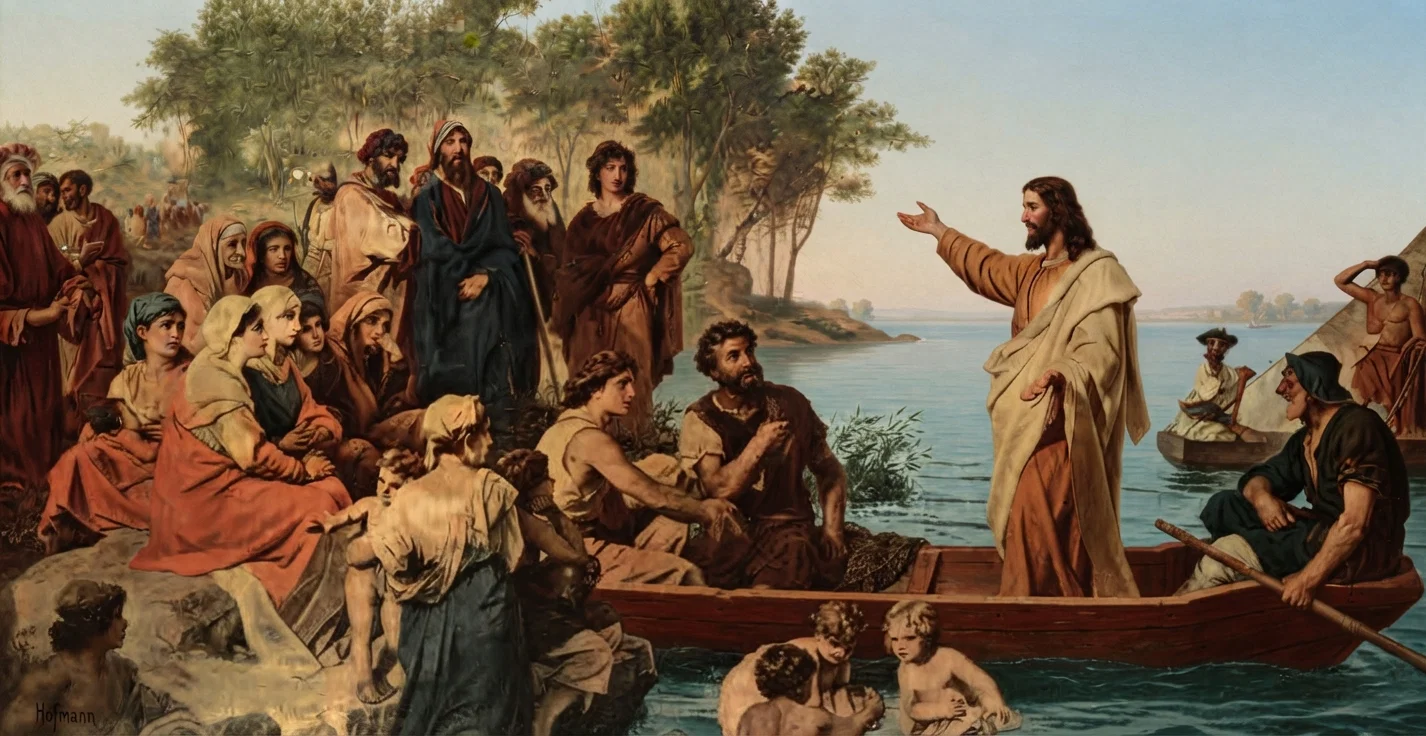
Jesus, the World's Great Teacher, Giving Instruction from the Boat of the Humble Fisherman
Ministers of popular churches are many of them softening down and diluting the plain Word of truth. They are obscuring the light, and changing the message, in order to accommodate it to the prejudices, and adjust it to the opinions and habits, of the people. Thus they cater to the taste of the world-loving members of the church. But while they are so free to change the truth of God, on the other hand they advise their members to exercise the greatest caution lest they hear the message of God from the messengers He chooses to send to the people.

Light from the Word

O, let there be no cautioning of the people on the danger of studying the Word of God! Let there be no concealment of truth, no measures taken to evade or ignore truth. Let no one entertain the erroneous idea that the people of this or that denomination are in need of no more light. Open the door of the heart, place yourselves in a position where you may catch new revelations of the character of God. Light comes from the very throne of God. When some familiar truth presents itself to your mind in a new aspect, when a text of Scripture suddenly bursts upon you with new meaning, like a flash of light that scatters the mist, and you see the relation of other truths to some part of the plan of redemption, God is leading you, and a divine Teacher is at your side. Will you not then open the door of your heart to receive more and more of the heavenly illumination?
It is by contemplation of heavenly things that the soul is brought into fellowship and communion with the Spirit of God; and the soul that is teachable, that is continually seeking for fresh rays of light, will be blessed with brighter and brighter views of divine things. But there are many classes of religious teachers who seem to be determined to close every avenue whereby fresh rays of light from heaven may come to the people. They would bind the members of their churches by certain rules and regulations that forbid them to go to other places of worship, or listen to messengers outside of a certain class of teachers. In this way men and women are led to give up the liberty that God has ordained for them, and they fail to improve the mind and gather up the divine rays of light which emanate from sources outside their own church.

More Light Beyond

"Ye are not your own; for ye are bought with a price." We are God's property, and are to honor and glorify God. But we do not honor and glorify God when we become the servants of men, when we consent to have our liberty restricted by men or by councils of men. We have been bought with the precious blood of Christ, in order that we may be just and generous to our own souls. I beseech you therefore by the mercies of God, that you break every band that would restrict your liberty in Christ. God has light to impart to all His children that is of a more radiant character than any we have received, and you have no right to bind yourself in such a way as to shut yourself away fromthe light. You have no right to do after the inventions of any society of men, who would circumscribe the limit of your thought, and cause you to become a mere mechanical Christian.
You have many things to learn, and much to unlearn. You will have to sit at the feet of the great Teacher and learn of Him concerning themes that are higher and nobler than the themes which now engage your attention. I am free to address you who have shut yourselves away from the light, because I know that a higher Teacher than man is calling you. You have lost much in your religious life, because you have failed to improve the opportunities that have been presented to you from "the Father of lights." Fresh rays of light from heaven are always given that the character may be transformed, that the soul may be able to contemplate truth in a new relation. When Jesus is welcomed into the heart, He will refine and mold and fashion the character. Those who receive Him more fully, will not have less energy in their religious life, but their religion will be a higher, holier type than ever before. They will work in such a way that their usefulness will be increased. God would have His professed children reach a higher standard, and ever go on, still reaching up to that which they have not attained. They should cherish every divine inspiration, for as His property He requires this of them.

No Prescribing of Faith

No man or woman is to bind himself in such a way as to become a slave of men in any way. No man or set of men has the right of laying out to others what they shall or shall not do in religious matters, or in any way prescribing their faith. A voice speaks to us to which we are bound to listen. It is the voice of Christ, who says, "Follow Me." He says, "He that followeth Me shall not walk in darkness, but shall have the light of life." The Christian is never to be tame and dull. Those who are imbued with the Spirit of Christ, will work in the Master's vineyard, and the heavenly fire of the soul will ever be kept burning. Our security is in Christ, in studying the Guide-book he has given. Those who are studying the ways and methods of men, and following their customs, are deceived if they think that they are following the directions of God in the matter.
Jesus says: "Come unto Me, all ye that labor and are heavy laden, and I will give you rest. Take My yoke upon you, and learn of Me; for I am meek and lowly in heart: and ye shall find rest unto your souls." The service of Jesus does not consist in outward show simply. It is not a matter of form and ceremonies, of parade, exclamation, gestures, noise, and a display of the commonplace passions. Pure religion consists in keeping the heart and mind in communion with the great Leader, Jesus Christ. It consists in having the inward adorning of a meek and quiet spirit. The indwelling Holy Spirit will give life and tone and style that will not be after the inventions of men, not in imitation of any earthly, human leader, but after the Pattern, Christ. Religion does not consist in playing upon words, in uncouth gestures; bodily exercise profiteth little in this matter. There is no divine eloquence in this kind of exercise.

A Distinguishing Mark

The religion of Jesus Christ is ever to be distinguished from all other religions by its holiness of character. In true religion will be found great truths clearly defined in words, and inwrought in the life of its professors as a principle from the divine Author. In true religion the Holy Spirit will work in connection with human agents, confirming the truth of God. Every part of the service of Christ will be characterized by decorum and reverence. The truth of Christ can not be confined to a certain range; yet it will be active to create for its environment, manners and habits and practises that will be in harmony with its Author. Everything will be done decently and in order. Wild methods and strange freaks and confusion are not authorized by the God of order. The methods employed by the church of Christ should be such as will win souls from allegiance to the prince of darkness, and cause them to take their stand under the blood-stained banner of Prince Emmanuel.
Some may say that these methods of reaching men will not avail to reach those who are poor and low down in the scale of humanity. But this matter must be regarded in an altogether different light by those who would be soldiers in the army of Christ. Do not cherish the error that you must follow after a pattern presented to you by some man. Study your Bible more, and let the habits and practises of men have less and less of your attention. Do not dishonor your God by thinking that it requires but little knowledge of what saith the Scriptures, to be a useful worker in His cause. You are to study the manner of the great Teacher, and keep His example ever before you. No human being is to be your pattern. The Lord of heaven is to be the Teacher and Pattern for every one who would win souls to God.

Higher Criticism

IX. Higher Criticism—Whither?

IN the previous articles we have seen that Higher Criticism is the child of the Papacy; that it has been adopted and baptized by the leading Protestant divines of the world, and its actual infidelity has filtered from the learned institutions of the Protestant world into the churches of all Christendom. For this reason we have considered it advisable to give extended space in studying the movement. It has been made clear that it is an effort to account for the Bible by the theory of evolution. It discounts or denies all historical accounts of the Scriptures as fable, rejects the miracles as legend, and repudiates the fall as a myth. The Bible itself is considered a patchwork in which hundreds of writers have had a hand, giving us as a result a book "gangrened with error from cover to cover." Most of the books of Moses are openly claimed to be a forgery to deceive the people.
Higher Criticism teaches doubt as the highest and first requisite in studying God's Word. It makes the Saviour a superfluity if not an absurdity, for "sin is a quest after God." It talks learnedly of Christ's mistakes and hints at His prejudice. His infallibility is denied, His authority ignored. Miracles are naturalized, minimized, or evaporated. The real inspiration of the Bible is denied, and prophecy regarded as human sagacity instead of divine foreknowledge. In fact nearly all the grand truths of the Bible are openly repudiated, or denial covertly insinuated. We are flatly told never to mind what the Bible says anyway—just to trust our instincts instead. God is cast from His throne, and reason worshiped instead.
The Ingersolls of to-day are in the pulpit. Twenty-six years ago one minister said to his congregation: "You will notice, as I conduct these services from Sunday to Sunday, that there are large parts of the Bible that I do not read. I select chapters or parts of chapters from both the Old Testament and the New. . . . Large parts of it I pass by. For what reason? Simply because I wish to be perfectly frank and open as to what I believe, and because I do not choose to spend half my morning, after I have read a passage, in telling you that I do not believe it literally, and in explaining to you in what sense I do take it. The time will come when we have passed through the transition hour, when the results of the criticism of the Bible have been settled, when the thoughts of men have found their place,—the time will come, I say, when I shall be able to read any part of the Bible from the pulpit, and not be misunderstood. I shall not be understood to believe a miracle, because I read the account of it. I shall not be understood to accept as history an Old Testament legend, because I read it as a lesson."—M. J. Savage, "Beliefs About the Bible."
Is it possible that infidelity can stalk so boldly in the pulpit, and Christians not be concerned? Will those who believe the Bible any longer drink the muddy waters of unbelief because they come from the pulpit? Whither are we drifting, that such conditions not only exist, but are rapidly increasing?

The Danger to the Church To-Day

is not from its professed enemies, but from its avowed friends and defenders; not from the scoffing unbeliever, but from the minister behind the desk; not from the fool who says in his heart, "There is no God,"but from the minister who preaches to his congregation that he does not believe what God says; not from some talented Ingersoll who lectures on "the mistakes of Moses," but from the world-renowned theological professors who lecture to ministerial students on the "mistakes of Christ."
This sort of teaching paralyzes missionary work abroad and evangelical work at home; for if sin is a necessary condition of evolution, and after all a quest for God, why bother to save any one from it? Thus religion is degraded to a pleasing fable or a process in the development of evolution.
Higher Criticism leads to endless confusion by destroying the standard; and as the destruction becomes more general and complete, the confusion is greater. And it prepares the way for the renewed success of Rome. For many Protestants are losing faith in the divine authority of the Scriptures, and there remains in the world little or nothing authoritative except the claim of Rome and the pretensions of the pope. Infallible authority men will have somewhere; and if they find the Bible shorn of it by the New Theology, they will seek it elsewhere, as Newman did, and as countless others are doing, in the pope.
Let the Rallying Cry of "the Bible and the Bible only" be once more proclaimed by Protestants from pew and pulpit, and such a reform as the world never saw before would sweep over the land. Nay, let but one denomination accept the Bible as it reads, as their infallible authority, and stand firmly and boldly upon its God-given truths, and they could alone effect a reformation as wide-spread and deep as the Reformation which gave Protestantism birth. And since the whole effect of the New Theology is to discount and discard the law of God, which defines sin and is a schoolmaster to bring us to Christ, such a reformation is sadly needed.
Since Higher Criticism claims that the books in which God's holy law is recorded were the forgery of a millennium later than Sinai, the law is degraded to a mockery, and made the sport of their varying theories. Thus its sacredness is absolutely evaporated, its binding claims denied, and the way paved for the wholesale repudiation of the entire law by all Christendom. Already we see the woful results of its disregard; and in the logical teaching of the New Theology that "sin is a quest for God," a premium is put on crime.
Higher Criticism is Satan's method of preparing the church for its inevitable repudiation of God's law—inevitable unless Higher Criticism is completely banished from its pulpit, ejected from its doors. Dear reader, there are a people who have never allowed the infidelity of Higher Criticism to mold their creed, who stand boldly upon the original Protestant ground of "the Bible and the Bible only," who bow to the infallible authority of that Word in all things, who believe that "sin is the transgression of the law," and who recognize the fact that God's law is the transcript of His character and so unchangeable and holy that to redeem us
from its transgression God had to give His only-begotten Son to die a heartrending death for us—even the death of the cross.
Seventh-day Adventists recognize the fact that the New Theology is only a subtle device of Satan's in his last great effort to take the world captive in his snares. The popular churches are fast being lulled to sleep by its "peace and safety" cry, and Protestantism has long since lost its meaning.
But the message is going forth to the ends of the earth that "Babylon the great [apostate Protestantism] is fallen. . . . Come out of her, My people, that ye be not partakers of her sins, and that ye receive not of her plagues." Rev. 18: 2-4. Those who are being called out by this message, accept the whole Bible as their standard, and stand upon the belief that "Thy Word is truth;" and as the controversy waxes fiercer between those who believe God's Word and those who denounce it totally or in part, all who love the Bible, and "all them that love His appearing," will be compelled to take sides in the great final controversy. Which side will you take?

Blessed of the Father

"COME, ye blessed of My Father, inherit the kingdom prepared for you." Matt. 25: 34. These words will be spoken by Jesus, at His coming, to those standing on the right hand. Why are these favored at this time above others?—Because they heeded Christ's invitation to come. "Behold, now is the accepted time; behold, now is the day of salvation," "to make your calling and election sure." Now every one is invited to come: "And the Spirit and the bride say, Come. . . . And whosoever will, let him take the water of life freely." While now all are invited, then only "the blessed of the Father," those who have availed themselves of present blessing freely offered to all, will accept it. As it is said of Christ, they loved righteousness and hated iniquity, therefore their God hath anointed them with the oil of gladness above their fellows. Heb. 1: 9.
No one can claim this unction, however, until he can say with the psalmist, "O how love I Thy law! it is my meditation all the day. Thou through Thy commandments hast made me wiser than mine enemies." Ps. 119: 97, 98. Here is where the superiority comes in—righteous in the righteousness of God.
Loving righteousness means to love the commandments of God with all our heart. "Thy testimonies that Thou hast commanded are righteous [margin, "righteousness"] and very faithful." Day and night must be our meditation upon the law of God. We read, "Blessed is the man, . . . his delight is in the law of the Lord; and in His law doth he meditate day and night." Ps. 1: 1-3. "Blessed are they that do His commandments, that they may have right to the Tree of Life, and may enter in through the gates [no other way] into the city." Rev. 22: 14.
"Strive to enter in at the strait gate: for many, I say unto you, will seek to enter in, and shall not be able." These words will then be heard: "Depart from Me, ye that work iniquity." Matt. 7: 23. "Go from My presence, ye who live in sin."—"Twentieth Century New Testament." "Sin is the transgression of the law." 1 John 3: 4. "Depart from Me, those working lawlessness."—"Emphatic Diaglott."
But let us look on the brighter side. "What are these which are arrayed in white robes? and whence came they? . . . These are they which came out of great tribulation, and have washed their robes, and made them white in the blood of the Lamb. . . . For the Lamb which is in the midst of the throne shall feed them, and shall lead them unto living fountains of waters: and God shall wipe away all tears from their eyes." Rev. 7: 13-17. JOHN P. GAEDE.

A Shelter in the Time of Need

By Delwin Rees Buckner
THE towering trees as by an ax are riven By pointed lightning, falling from the clouds,— The needle that doth stitch Day's evening shrouds; Against my window-panes are hail-beads driven,— Some gems estrayed from heav'n's adorned dome; The wild winds, furious, do rage and chafe; But in the storm—thanks be to God—we're safe Within our modest, humble, cozy home.
What need of worry for the future days? Are we not safe within the present hour? God knows our wants; He knows that we are frail; But—if we let Him—He will plan our ways. He finds the bird a shelter in the bower, And for the hare a covert in the vale.
Ambato, Ecuador.

Habit of Procrastination

A BRIGHT boy heard and was deeply impressed by the text, "My son, give Me thine heart." Satan whispered, "Time enough yet," and he put it off. Ten years later a brilliant young collegian heard the same text under circumstances which seemed to make that the time of his salvation. Again the tempter whispered, "Time enough yet." Twenty years later a statesman of no mean renown listened to the same text from an aged bishop, and felt it to be a message to himself. This time the tempter said, "Visit foreign countries before you give God your heart." A traveler in Paris was stricken with cholera. His greatest suffering was agony of soul because he was not prepared to die, and had not now time to get ready. His last words were, "Too late." The boy, the collegian, the statesman, and the traveler were one. Procrastination is Satan's best game.

Steering Against Popular Applause

HE who spreads his sails to the winds of popular applause, steers with his back to the future,—is the gist of an old adage which has been proved true over and over, time and again. Let your sails be rigged so as to take advantage of and be adjustable to whatever winds God may send. Do this, and you will be reasonably certain of being able to steer your bark safely across the sea of life.

Habit Is a Cable

"Habit is a cable; we spin a thread of it every day and at last we can not break it."
Continue reading: Out of Babylon to Zion