In a former article on mission work in Sierra Leone, I referred to the advantages taken of the natives by those professing to be missionaries, and the sad experiences that followed. This trafficking has increased, and with it added difficulties. The man who poses as a missionary, and at the same time carries on a trading business of any kind, is looked upon by the natives with suspicion.
Some honest, faithful workers have struggled on, fighting hard against the tide of heathenism in its different forms, and the evils brought in by unsanctified laborers, professing to be working for the Lord, and at the same time filling their own coffers. The time will come when such work will meet its reward.
Prior to the year 1855 mission work was carried on by the Baptists, Methodists, and the Church Missionary Society of England. Just what time the Sudan Mission was established, I am unable to say. Rev. Smith, superintendent of that mission, informed me that he had labored in this field for more than thirteen years. Their work extends farther into the interior than any other missionary society. It was while laboring with this society, that Brother Chaney, now working in Basutoland, accepted this message. He was opening a mission at Falaba on the head waters of the Niger River. He began work here in 1892, and in 1895 accepted the message for this time. The Sudan Mission is under the direction of the society of the “Christian Alliance” of America; and has accomplished something in the hinterland of this colony.
In the year 1855, the United Brethren of the United States began work on the island of Sherbro, on the southwestern coast of this colony. Their principal efforts were to establish industrial schools. Success attended their labors, and they soon had missions established along a line about twenty miles from the coast, for quite a distance. Several industries were started, such as a sawmill, farming, and other enterprises.
They had, however, many trials to encounter, and there was shown on the part of the natives much dissatisfaction at times. Opposition to Christianity has increased among the natives, and but few, comparatively, ever truly accept Christ. The large number of those in this colony that accept the gospel, are descendants of those who were once slaves in the United States and other countries, and have returned to their home land.
In the city of Freetown churches are numerous, and there are large gatherings. Preachers may be seen on nearly every corner, and from an outward appearance one would think that everything was favorable to Christianity. But not so. Paganism and the faith of Islam are making headway here in the city of Freetown, and the professed church seems unable to cope with this tide of evil which is sweeping down upon it. The atmosphere itself seems impregnated with the terrible influence of evil. Heathenism has set itself like solid walls of brass against Christianity, and their object is to stamp out its influence from their shores. This will appear from the efforts made by the different tribes only a few years ago.
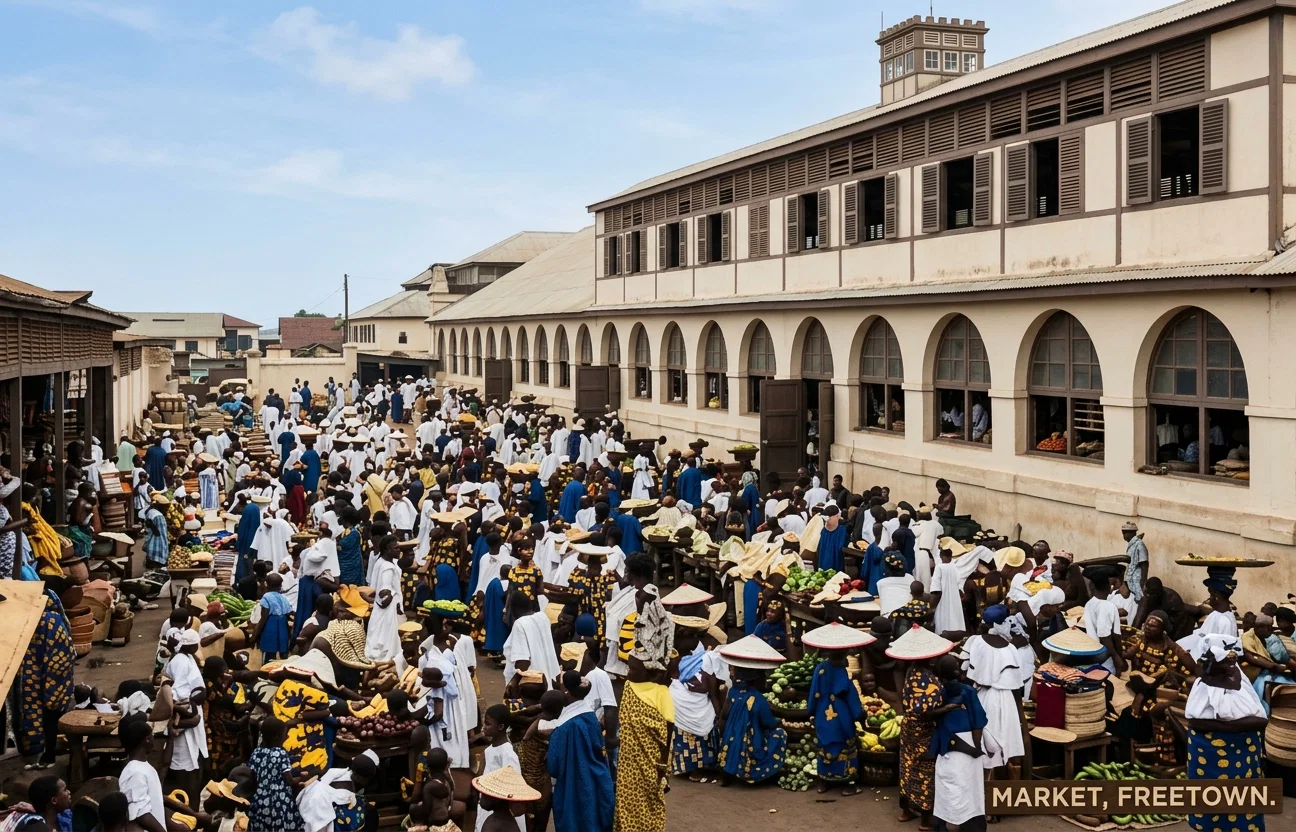
PUBLIC MARKET, FREETOWN, SIERRA LEONE
From the time this colony was taken over by the government of Great Britain, there have been unceasing difficulties with the natives. War has been its history. At one time Freetown was entirely burned, and its inhabitants scattered, but they rallied, and the town was rebuilt, but over and over the records show difficulties.
Probably the saddest experience, not only to the civil government of Sierra Leone, but to the different missions, was in the months of April, May, and June, in 1898. A tax had been levied on all houses throughout the colony, including the native huts, of three shillings each (about seventy-two cents), but the natives refused to submit to the requirements of the government. Some, however, paid the tax. All the Mendie tribes south and west of the Rokelle River promptly paid when the government called on them, but the Timnies, north and east of the same river, utterly refused to pay. This brought on war, and Biabura, king of the Timnies, stood his ground against the British soldiers so successfully for a time that it seemed they would not be subdued. This gave courage to the Mendies, and they, too, sounded the battle-cry. Their object was, however, even greater than that of the Timnies.
The Timnies opposed only the taxation; but the Mendies decided to obliterate Christianity, stamp out the English language, capture all valuable stores, and fully reinstate their former religion. To accomplish this end, they decided to kill not only the white man, but also the creoles of the colony, including their own children that had accepted some of the customs and habits of the white man. Merciless were their efforts. Their own offspring many times were their victims. I have been informed by the Mendie boys working for me on our mission building, who took part in the conflict on the part of their own people, that if any one was found wearing a garment made of English cloth, he was at once killed. More than three thousand met their end during this short conflict.
The United Brethren probably suffered more than any other missionary society. Their mission stations were all destroyed, and nearly all their missionaries, including three men and five women from America, were brutally murdered. A man who was a prisoner with Rev. and Mrs. L. A. McGrew, but escaped the hands of the slayers, personally gave me in detail the several days' experiences they were compelled to pass through. I do not relate these things simply to tell what has occurred, but that you may know the great need of a Saviour for this poor benighted land.
I will mention one other devoted worker, who lost his life during the conflict, the Rev. W. J. Humphrey, M. A., principal of the Fourah Bay College, Sierra Leone. In his last letter to the bishop of Sierra Leone, he gave a thrilling account of the experiences they were passing through at Port Lokoh, in the Timni country. The next report that was sent, gave the account of his sad death when he was trying to get relief12to one of their mission stations. After making the third effort, he was met by a band of Timnies, and his head was almost severed from his body.
Shall we be discouraged, and give up these poor people to the enemy of all truth? There is power in the third angel's message to meet the situation. We need men and women who have faith in God, who believe this message with all their hearts, to help us in this dark land. We need the prayers of our dear brethren and sisters, who are acquainted with God; we need means, so that the work may soon be finished in this dark, dark corner of the earth.
We are thankful for the kind care of our Heavenly Father since coming to this field, and for the liberal supply of means to start the work. It seemed for a time that we would be compelled to leave the field on account of failing health, but that fear is all past. One month's time in our new mission home, although unfinished, has been a great help to us healthwise. By the time workers can reach us, we shall be prepared to receive them in the new home.
Freetown, Sierra Leone.
C. E. RENTFRO
By C. E. Rentfro
Portugal
C. E. RENTFRO
Probably no country has done more in opening up the world for the “running to and fro” than has Portugal. While within her borders the truth has been suppressed, yet she was used of God to prepare the way for enlightening the world. In the days of discussion about the round-world idea this country stood foremost in her discoveries.
In the end of 1484 a man whose surname is the name for God, accompanied by Martin Benhaim, the inventor of the astrolabe and maker of the famous globe of Nuremberg, with two ships started from Lisbon on a voyage of exploration. In their discoveries the Portuguese raised crosses, many times of wood, or wrote on the bark of cork trees. Up to this time their discoveries stopped at one degree and fifty-two minutes south latitude. At the sixth degree Benhaim came to the Kongo River, called “Zaire” by the natives, some of whom he carried home to teach him the language. In 1486 he returned and went as far as twenty-two degrees south. He also left marks at the cape of Santa Maria, and at Cape Negro and Cape Cross.
Aug. 2, 1486, two ships under the command of Bartholomeu Dias sailed from Lisbon, in order to find a certain powerful African king. On the way south they passed all marks into unknown seas. He found Spencer Bay. After fighting with the wind and waves for five days, the tempest became the pilot, and took them on south. The weather became very cold, which frightened them much. Finally changing their course north, they sighted land which enclosed a small bay, which they called “Bay of the Cattle Herders,” known to-day as Flesh Bay. Going eastward, they encountered what is known now as Mossel Bay. A little farther was Algoa Bay, which he named Santa Cruz. Here the sailors refused to go farther, and on their return discovered the Cape of Good Hope, named by King John II and by Dias, Cape Tormentoso, or stormy.
Some may be interested to know how Portugal was connected with the discovery of America by Columbus in 1492. He had been fighting the Venetians by sea off the coast of Portugal. His ship catching fire, he leaped into the sea, and made his way to shore. Joining himself to Portuguese fishermen, he finally married a daughter of an owner of a small island. Although the king of Portugal was prejudiced by preconceived ideas of a western sea route to India, the Portuguese had a not unimportant representative in the discovery of America—a woman, the wife of Columbus.
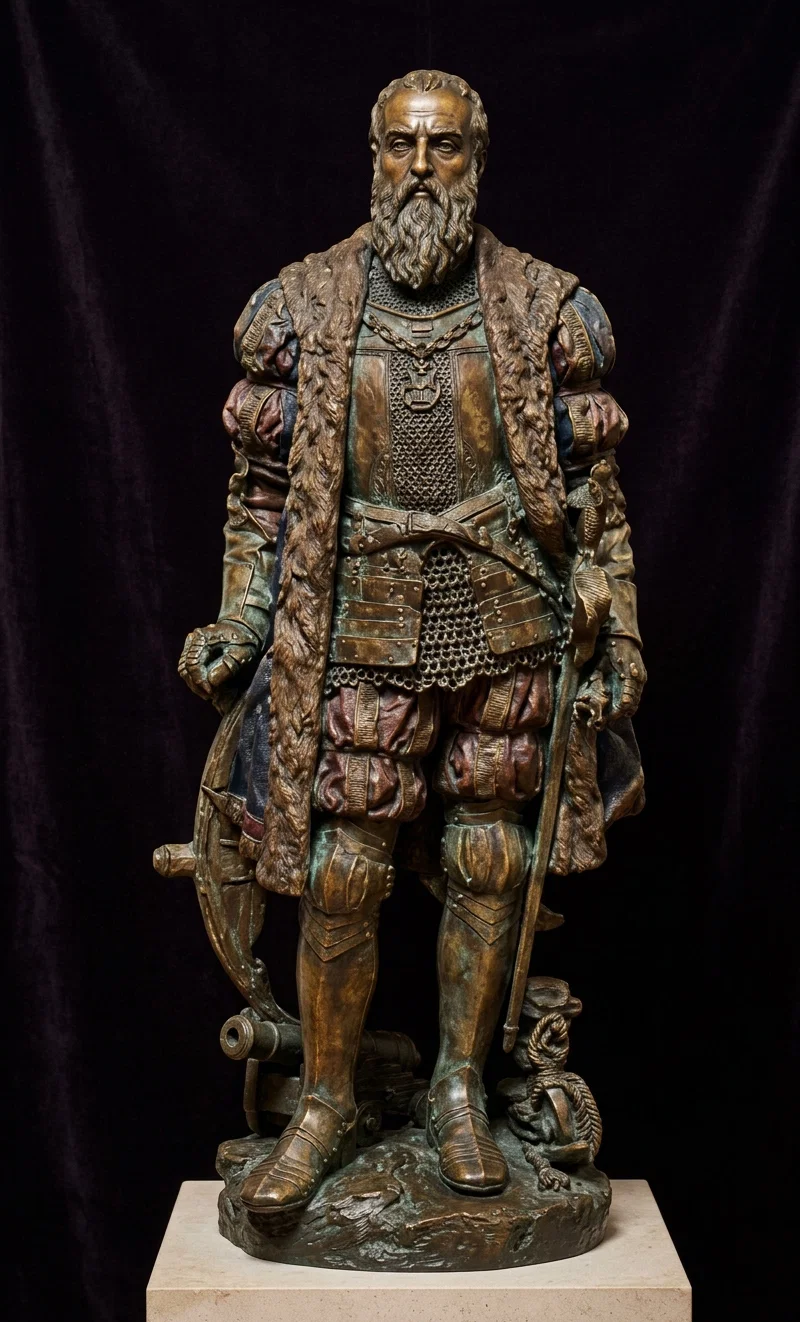
STATUE OF VASCO DA GAMA IN LISBON
July 8, 1497, Vasco da Gama embarked at Lisbon with four ships for a voyage to find the way to India by a western route. In seven days they arrived at the Canary Islands. A fog scattered the flotilla, and they united at Cape Verde. They were three months in reaching St. Helena, and November 19 they saw the Cape of Good Hope, or Tormentoso, both names verified, after battling three days with wind and waves. They rounded the Cape, November 22, and anchored in Mossel Bay. Here calm weather kept them until December 7. On leaving this place, their route changed from the known to the unknown. Reaching Inhambra and Quilimane, on the west coast of Africa, they thought they had reached the place all desired. After they learned differently, they captured some Moors, whom they forced to act as pilots. On April 14 they arrived at Melinde, and on the twenty-fourth set sail for Calcutta. On May 17 they sighted India, and on the twentieth anchored in an Indian port, some distance from Calcutta.
From this place they sent a man to Calcutta, who caused great surprise. The people took him to the house of a Moor who spoke Portuguese, Spanish, and Italian. This man, on seeing the Portuguese, said, “Whom did you bring here?” Great was the surprise of the Portuguese to hear his native tongue in that land. This Moor accompanied the man aboard, and on arriving, said, in Portuguese, “Good venture! Good venture, many rubies, many emeralds. Many thanks you must give to God, who brought you to a land where there is so much riches.”
Great was the happiness of Vasco da Gama in hearing these words in his own tongue. Eleven months he had fought wind, waves, fears, and mutiny, and to hear these words brought tears of rejoicing to the eyes of all. Well they might rejoice for “a great act,” wrote another, “finished, to be realized not only for Portugal, but for all the countries of Christendom.”
Many times King Don Manuel climbed the mountains of Cintra, a few miles from Lisbon, to look for the sails of Vasco da Gama, thinking of the glory to the name of Portugal. His return was hailed with great rejoicing. He was given three hundred dollars as a donation, a heritage to himself and posterity of a rental of sixty dollars a year in one place, one hundred and thirty dollars in another, forty dollars in yet another, and seventy dollars by the king. He was also named Admiral of the Indian Sea. The Portuguese raised a monument in his memory, and a statue in the Geographical Society, which is shown in the illustration. On the four hundredth anniversary, money was coined in honor of the event.
In 1498 ships went to America, and in 1500 Pedro Alvares discovered Brazil. In 1519 a Portuguese, whose name in English is Magellan, having left Portugal and connected with Spain, left Europe for the first circumnavigation of the globe. Nov. 27, 1520, he passed through the Straits of Magellan.
Japan was first visited by the Portuguese, says the history of P. Chagas, Volume VI, and some say that they were the first to discover Australia. They furnished the name “China,” and “Mandarin” comes from the verb mandar, meaning “to send.”
The everlasting gospel is sadly needed by the more than nineteen million inhabitants of Portugal, its islands and possessions in east and west Africa and India. May God hasten the day when this shall be accomplished.
Carcavellos, Portugal.
Spending for Home and Heathen Work
Of every dollar given for Christian work, we spend ninety-eight cents on our home work, and two cents for the heathen.
The Nations Shall Worship
“ALL the ends of the world shall remember and turn unto the Lord: and all the kindreds of the nations shall worship before thee.” Ps. 22: 27.
China
By W. C. Hankins
KULANGSU, AMOY.—The year 1906 has opened very favorably. While I can not give a detailed account of all that is being done in the province, yet a few instances with which I have been personally acquainted will serve to illustrate the way in which the Holy Spirit has been working.
A few months ago, a young native preacher—a former pupil of Brother Keh—came in from the country, and spent several days with us, studying the different points of the truth. Since that time he has been carrying on a correspondence with Brother Keh, asking questions on points that were not quite clear to him.
Sunday evening, January 14, Brother Keh brought a letter from him, for me to read. In this he told how he had resigned his position with the other missions, and taken a public stand for the Sabbath. He is an intelligent young man, and if he remains true to the Lord, we hope to secure him as teacher of the boys' school, which we expect to start at To Kang (pronounced Do Gân’g). We have said nothing whatever to him about working for us; we are leaving that in God's hands.
Then on Monday evening, another young native preacher came in, and announced his intention of keeping the Sabbath and joining our mission, if we would receive him. He had been here and had studied with us a few times; but as he had been studying the matter for himself ever since he heard the truth from Brother Timothy last year, there was very little left for us to do. He is taking the step under very trying circumstances, and seems already to love the truth very much. His mother and grandmother were both Bible women for one of the missions here. His mother very strongly opposes the step he is taking, and that means a great deal in China. But it does not seem to shake his determination to obey God, although it makes him very sad.
When he first thought of keeping the Sabbath, he intended to start into business; but afterward he thought how ashamed he would be if the Lord should come and find him engaged in making money, instead of preaching the gospel, so he is hoping to be able to help in spreading the good news of the soon-coming Saviour. He has spent some time with us, studying the message, and last week spent his first Sabbath with us. We invited him to speak to our little company, and he gave a splendid sermon on the temptations of Christ in the wilderness. As he could get no boat going to his home on Monday, he spent part of the day with an old schoolmate and very dear friend, to whom he told the news of the Saviour's soon coming, and invited him over to see us. He came over in the afternoon, and stayed the remainder of the afternoon and evening with us, studying the Bible. He was here again to-day, and studied with me two hours, and expects to come again to-morrow.
Sunday and Monday evenings of last week we learned of the stand taken by these two young ministers, and then again on Tuesday evening came the glad news that a young man, who first heard the truth at To Kang, our country chapel, and who had gone with our workers to Canton to the convention held there, had finally decided to give up his tobacco, and obey the Lord in all things. This young man can speak some English, and may be of value to our work here later on.
Thus three young men in one week have taken their stand for the truth. They are all experienced in gospel work, and, if thoroughly consecrated, will be of great value to the work here, or perhaps in some of the other places where the Amoy language is spoken.
Surely, God has been with the work here, and to him belongs all the praise. We are seeking to let him work in his own way, and not interpose any of our own plans, and thus interfere with his work. But we seek to keep in that close relationship to him that will enable us to hear when he speaks, and to follow where he leads. We have not a word of discouragement to write. We have no desire to return to the States to labor, but are well content to labor here until the Lord comes, if our lives shall be spared till then.
Our hearts yearn to see more laborers in this vast field, that the work may be finished quickly. Let a few workers enter each province, gather a number of consecrated native helpers together, and by the Lord's help, we can carry this message to all China in a few years. China is ripe for the harvest. I am glad to see the reinforcements coming, but they are not nearly enough. But of course we know that in good time there will be plenty of workers for this field; and we can only pray the Lord to send them quickly.
We are very much interested in the reports in the REVIEW of the work throughout the fields, also in the other articles. We look for the paper almost as eagerly as for our letters from home. Our courage is good, and we are daily more thankful for the privilege of working in China. W. C. HANKINS.
A. C. SELMON, M. D
By A. C. Selmon
SIANG-CHENG.—The work in our station has never looked more promising than it does now. I have one young man who is really converted, is paying his tithe, and is a good Bible student and preacher.
Mrs. Selmon's girls' school has just opened, after the New-year season, and the interest is good. The prospect for a large number of girls was good until this trouble, which has frightened the people.
For some time I have felt that we ought to do something to get the truth before the missionaries here in China. There are many true, consecrated ones among them, and without doubt a large number have never had their attention called to this message. I mentioned this at our council, and we raised twenty-seven dollars, gold, to send them the special message series of the Signs. We will put at least one set, and, in case it is a large place, several sets of the special Signs in over five sixths of all the mission stations in China. I wrote out two hundred and ninety addresses. The time is ripe for this work. The Centennial Missionary Conference will be held next May, and a missionary union will no doubt be formed, and allotments of territory will be made. We expect to follow up the Signs with other literature.
About three weeks ago we completed our song-book. We did not get out a very large edition, for we shall not need many for a while at least. It was quite a task for us to get out a book of this size, small as it is, because of the language. Mrs. Selmon and I spent about a month compiling and correcting the collection we have.
A. C. SELMON, M. D
Australia
By Edith M. Graham
Sydney, New South Wales.—On the whole, our work is advancing encouragingly. We are much pleased to see how our people are taking up the burden of the island mission work. They have fully accepted it, and mean to stand by it. I think we shall not at any time call for any increase of the appropriation from the General Conference, and we hope to lessen it by degrees, until we can support this part of the work. We have started the mission in Singapore, and supported it entirely from this field, and we mean to continue to do so. In a few weeks we shall send a laborer to the Philippines, and he will be supported from here. We have already a canvasser there, whose fare we paid, but who is self-supporting. Another canvasser leaves to-day for Singapore. We pay his fare, and he will support himself when there. Now we are searching for some one to go to Fiji for a time, and work with the school there, with a view to going to New Guinea later, taking some of the Fiji students with him. We feel impressed to push forward the work in these islands as fast as we possibly can.
We are getting out literature for the Malays now. A tract on the second coming of Christ is on the press. “Christ Our Saviour” is being translated, and will be pushed forward as rapidly as possible, so that our workers may have it to canvass with. We have also started a monthly news-letter, which is prepared in English, and then translated into the languages of our island missions, and sent to the native churches and isolated Sabbath-keepers. It consists of instruction on general lines, selections from the spirit of prophecy, and items of news from this field and the other islands. The natives have so little reading-matter, and so little to connect them with the work as a whole, that we think this will help to keep up their interest in the truth and the work.
We have other literature in course of preparation. An edition of “Christ Our Saviour,” in Maori, has just been finished, and is ready for distribution in New Zealand. A condensed edition of “Daniel and the Revelation,” in Rarotongan, is on the press, and we are preparing to get out some tracts about eight pages in length, in Rarotongan, Fijian, Tongan, etc., for extensive distribution. We are believers in literature—14I suppose partly because we sell so many books here.
We have just learned from Brother G. F. Jones that the first Sabbath-keeping family is established in Java. They accepted the truth in Singapore, and have moved to Java. Another family who have accepted the truth in Singapore intend to go to the Malay Peninsula soon, and we shall then have our first Sabbath-keeping family there. And so the little lights are being set up in new places. Edith M. Graham.
A Church-School at Indiana, Pa.
By J. W. Watt
In view of what the Lord has said in the Bible and the Testimonies with reference to educating our children for him and his work, and for a home in the world to come, the writer has been for some time deeply interested in the subject of Christian education. Realizing the great need in our conference, we have taken steps toward the establishing of a school near Indiana, Pa. The plan for this work is briefly as follows: we have secured a tract of land which we propose to divide into small lots of five, ten, or fifteen acres, or more, to suit the purchaser, and encourage a few families of our people to purchase small homes and engage in the cultivation of the soil, raising small fruit, vegetables, and perhaps poultry. In this way they can support themselves, and at the same time give financial support to the school. The students will thus be provided opportunity for manual training as they assist their parents in tilling the soil. We hope thus to have a co-operative school that will be strictly industrial also. Perhaps in the future, if there is a demand for it, we shall provide for other lines of industrial work aside from cultivating the soil. Our location we think is a good one. We are not far from the center of the conference in a good farming district, where fruit can be raised, and where we shall have a good home market for our products. We have very fine springs of soft water on the farm; and while we can not locate every family near a spring, good water can be obtained by digging a well. Fuel is very cheap. We are within four miles of the county seat, which has two railroads, and another will be built soon, if we are correctly informed, which will touch one part of the school farm. We are only seventy-two miles from Pittsburg, which will give us a good market for any products from the farm which we may desire to ship.
The conference committee look with favor upon this school enterprise, and will do what they can to encourage the work. While we have secured this tract of land and are ready to sell the same to our brethren at a very reasonable price and on easy terms, we have no money in sight with which to erect a schoolhouse; therefore we, by the advice and sanction of the conference committee, extend to our brethren throughout the conference an invitation to assist us financially in this matter if they feel clear to do so. Any sum of money, large or small, received for this purpose will be greatly appreciated. We do not expect to put up a large, expensive house, but a plain frame building large enough to meet the needs of the work.
Already there are four families of us who are interested in this matter. Are there not a few more families who have children to educate who will be glad to co-operate with us in carrying out this plan for the establishment of a school in our conference? Those who have read the Testimonies know that the Lord has spoken plainly with reference to taking our children out of the public schools. The Lord does not speak to his people upon any point unless the instruction he gives is necessary for the good of his children. If our children are not saved in the kingdom of God, how sad it will be! Let us think seriously of this matter, and pray earnestly that God may guide, and that we may be able to do his will in all things. We shall be pleased to correspond with any one who may be interested in this work. May the Lord help us to walk in the light and do our whole duty.
J. W. WATT.
R. F. D. 8, Indiana, Pa.
The British Union Conference
By Edwin E. Andross
Looking over the past year, we see many evidences of the Lord's blessing in the various divisions of this union conference. During the first quarter of 1906 we baptized 111, making our total membership 1,630. The tithe amounted to $5,245.12, the Sabbath-school offerings to $323.30, and the First-day offerings to $175.79. We had seventy-eight canvassers handling our books in the field, and they reported sales amounting to $7,991.67.
In the North England Conference, four tents have been placed in the field, and have begun work with very favorable prospects of success. The South England Conference has two in operation, and two others will be started soon. Two tents are pitched in Wales, and two in Scotland. We are not using tents in Ireland, but have two portable halls that are used the year round. Elder Altman has located his family in Dublin, and has begun work with encouraging prospects. This is really our first effort in the Catholic portion of Ireland, and we request the prayers of our people in its behalf. Perhaps there is no other country where it will be more difficult to labor than in the south and west of Ireland, which are almost wholly given over to Catholicism. Our laborers in the north of Ireland are meeting with some success in their efforts, and are of good courage, though the work so far has moved somewhat slower there than in England.
The last year has been the most successful one in the history of our college work. Five of our young men have gone forth from the school this year into the ministry, and are laboring in tent work. Three will doubtless return for another year's work in college, while two will remain permanently in the field. Two young men and three young women are doing Bible work, and several of our students are acting as tent masters. A large number have gone out into the canvassing field, and are doing most excellent work. Two young women are beginning the nurses' course at the Caterham Sanitarium; a few are employed in the publishing house; and Peter Nyambo, a young colored man from our Plainfield Mission in Nyassaland, will soon be on his way to German East Africa, whence, in company with one of our missionaries from the German East African Mission, he will cross into the British Protectorate, and after finding a suitable location establish a mission station.
Our brethren are very earnestly taking hold of the plan of opening up mission work for the natives in British East Africa, and we hope that in this way a live interest will be awakened throughout our churches on behalf of those in the darkness of heathenism. Our purpose is to do all in our power to assist in carrying this gospel message to the world in this generation.
Our sanitarium and publishing work are each steadily growing. While we have a great work before us, we believe that He who began this work will also finish it in the allotted time, and hence we are of good courage.
E. E. ANDROSS.
Southern New England
By William A. Westworth
This report of our camp-meeting is delayed a little on account of the press of other work, and yet we feel that we should not omit to testify to the goodness of God and his presence with us at our late gathering at Middletown. The help of our Heavenly Father was manifest from the beginning. The weather was delightful as we arranged the camp; and had we been called upon so to do, we could have held our first meeting on Tuesday night. By Wednesday night every arrangement and detail was perfected, and our workers were free to rest throughout Thursday and to welcome our brethren and sisters as they came on the ground. This condition we believe contributed largely to the success of our work.
The representation at the camp was a larger one than that at Willimantic one year ago, and the spirit of energy, courage, and consecration was everywhere manifest. The last Sabbath of the meeting witnessed a large outpouring of the Spirit of God. Ministers and people alike laid aside everything that had hindered in any way their usefulness; hearts were turned to God; consecration for service was renewed; and victories were gained which caused our hearts to unite in thanksgiving to our Heavenly Father for his mercy and long-suffering to us, his erring children. This work of triumph we believe was the result, to some extent at least, of a heart-searching and a straightening up in individual lives all through the previous week. We thank God for the advance step thus taken.
We were favored with the presence and assistance of Elders Ketring and Fitzgerald throughout the season, and for a part of the time with the help of Elder F. C. Gilbert and Professors Griggs and Cottrell, besides having a full attendance of all our workers in the local field.
The condition of our conference is encouraging, and we press forward with confidence that the coming year will be a successful one to the praise of God. Our force has been increased from four, one year ago, till at the present time we enter our tent season with fourteen upon the conference pay-roll. During the past fiscal year our tithe has increased over twenty-five per cent, so that although we have largely increased our working force, our cash balance is considerably in advance of what it was one year ago, and our property has also been increased several hundred dollars.15We are thankful to God that we have a good equipment, all paid for, and that we are thus able to press forward, unembarrassed by any debt.
During the camp the needs of various enterprises were presented, and donations were received, as follows: for foreign mission work, one hundred dollars; for the Jewish mission work, centered in Boston, about eighty dollars; and for the expenses of the home work, outside the regular lines supported by the tithe, one hundred and sixty-five dollars.
During the latter part of the meeting there was considerable interest manifested on the part of the townspeople, and we hope that this interest, now being followed up by a tent effort, will bring some souls to the full knowledge of this saving message.
Wm. A. WESTWORTH.
Tennessee
By J. S. Washburn
NASHVILLE.—We left Washington for Nashville on Wednesday, May 9. Our journey through the mountains of North Carolina and Tennessee was most pleasant. The mountain scenery of North Carolina is truly beautiful, not so awe inspiring nor so grand as the Rocky Mountain scenery, but really much pleasanter.
Since our arrival in Nashville we have seen much to encourage us to believe that the Lord is here, and that he will help us in our work in the South.
The purchase of the sanitarium property is a great advance step. This is a country place, within easy touch of Nashville. The situation is high; the view is wide, and we believe it is as pleasant and healthful a situation as can be found in the vicinity of this important Southern city. The owner died only last January. He was a professor in the Vanderbilt University, a man of culture and refinement, as everything about his place indicates—beautiful trees and grounds, and a really elegant home.
Through the great kindness of the brethren, the money has been secured; and by a direct providence, the Rinallis property, which had been purchased for a sanitarium, was transferred on this bargain, at an advance in its value of one thousand dollars.
Property is advancing in this city. Nashville is building up rapidly. We found great difficulty in renting a house as a home, but finally, by that which seems to us a great providence, we secured a very pleasant situation, just across the street from our tent.
This is an excellent climate. I have suffered more from the heat in Iowa, or in Washington, D. C., than in Nashville. A sunstroke is almost unknown here. The nights are nearly always cool.
Our tent, which was donated by the California brethren, is sixty by eighty feet, as it is pitched at present, and is really a fine tent in appearance. It is comfortably seated, and the platform is more tastefully decorated and fitted up than I have known in any previous tent-meeting. It is beautifully lighted also, with electricity. We are situated on the street-car line, in an enclosed lot with an abundance of shade, in an excellent neighborhood, not in the most aristocratic part of the city, and yet in a part where nearly every one owns a comfortable home. We have never found people more friendly and more pleasant.
Our first meeting was well attended, and the average attendance has been above that of any tent-meeting in my experience. The smallest congregation we have ever had, I think, is seventy-five. Our average week-night attendance has been about one hundred and fifty, and sometimes more. Sunday nights the tent has been filled. We have twice quite largely increased the seating capacity of the tent, and last Sunday night every seat was taken, and a large number were standing; and a more attentive, interested congregation we have never seen. At the close of the meeting a large number acknowledged that they believed the ten commandments should be kept.
The ex-mayor of the city, who is also president of one of the city banks, attends quite regularly. A thinking, intelligent class are greatly interested in the meetings. We pray, not only that their intellects may be convinced, but that their hearts may be converted, and that a large number will accept the truth as a result of this effort.
One interesting feature is that the papers give us daily reports. These are quite brief, but if we should take a hundred copies or more, they would give us a column. The editor of one of the leading papers has promised to publish a photograph of the tent, with quite a lengthy report. We are hoping to get in a brief history of the advent movement. The Lord has given us favor with the people.
Will not all the readers of the REVIEW pray that the work may be established here, and that through the sunny Southland, once stormed by war and still suffering from its terrible effects, the glorious message of truth may run and be glorified?
We have just received from Sister White thirty dollars to help on tent expenses. As we have had to buy a number of extra seats, this is very welcome. The expenses have been quite heavy, and if any reader of the REVIEW desires to follow this good example, such aid would be most thankfully received. Send any donations of this kind to Elder Geo. I. Butler, Twenty-fourth Ave. N., or to the writer at 610 Meridian St., Nashville, Tenn.