Your ShelfYour Projects

Signs of the Times, Vol. 37, No. 30.

Fruit-Bearing

Signs of the Times

Aug 2, 1910

Pacific Press Publishing Association · Mountain View, California · Aug 2, 1910

Fruit-Bearing

Abide in Me, and I in you. As the branch can not bear fruit of itself, Except it abide in the vine; No more can ye, except ye abide in Me.
I am the Vine, Ye are the branches: He that abideth in Me, and I in him, The same bringeth forth much fruit: For without Me ye can do nothing.

"IF YE WILL INQUIRE, INQUIRE YE."

This Inquirers' Department is conducted for the purpose of helping those who are studying the Bible. The answers are oftentimes only suggestive. They are never to be considered infallible, only as they agree with the infallible Word. The writer who may answer them does not consider that his opinion is infallible. He will simply give the best that he has, and plead with the inquirer to search the Word. Such questions only will be answered as, to the editors, seem to minister to the good of the readers and to the mission of the paper. We can not answer repeatedly in the same volume questions upon the same scripture. The name and address must accompany question, not for publication, but as an evidence of good faith, and that answer may be made by letter if deemed advisable. No letters are answered which do not contain the name of the writer. It is well always to enclose stamp for reply.

3203.—Future Conditions

Does Isa. 11:8, 9 refer to the new earth? B. M.
We do not understand that it does in just the way it is expressed there. On the new earth we do not believe that there will be nursing children or children just weaned. Our Lord explicitly tells us, Luke 20:35, "But they which shall be accounted worthy to obtain that world, and the resurrection from the dead, neither marry, nor are given in marriage." Many of the prophecies of the Old Testament are what might be called double prophecies. They refer to things close by as well as far away. If God's children had yielded to the Lord Jesus Christ when He came, absolutely and wholly, all these conditions and other prophecies in the Old Testament would have come to pass, and there would have been a gradual conversion and conquering of the earth on the part of the Jewish people. There would have been peace in all their borders, and that very spirit of peace which was in the hearts of God's children would have extended to the animal kind, just as is predicted in this prophecy under consideration. But they did not do this; consequently the prophecy can only be fulfilled in harmony with the new covenant, and with God's purpose toward all the nations of the world, not through the Jews, but through Christ alone. But just as peace is predicted in Isaiah 11 of the happy state that would have been if the Jews had wholly yielded to Christ, the same and even greater conditions of abundant peace will be manifest in the new earth.

3205.—Jewish Calendar

Was the ancient Jewish calendar copied from the Egyptian calendar, and was this one lost or changed before the coming of our Lord and Saviour Jesus Christ?
M. M. M.
There is no reason to believe in any way that the ancient Jewish calendar was copied from the Egyptian calendar. On the other hand there is every reason to believe that the ancient Jewish calendar was a distinct calendar of its own, as shown in the very beginning of the year, which is recorded in Ex. 12:2, where the Lord spoke to Moses, declaring, "This month shall be unto you the beginning of months: it shall be the first month of the year to you." That there may have been a similarity between the Jewish calendar and the Egyptian is easily understood, inasmuch as the week was in existence among all the nations. It is strange how men will conclude that the things of God as revealed in His Word sprang from idolatrous nations around them. Why is it not just as easy to conclude that the customs of the nations around the Hebrew people were themselves perversions of the truth? In the beginning God's children, like Adam, and later
on Noah, understood things as they were. They were right. Nearly all idolatrous religions, especially so-called race religions, can be traced back in some respects at least to the true primitive religion as revealed in God's Word.
In the great reformations of Bible record, God restored in great measure what had been lost by the heathen nations. To His own people, when they responded to His call, the truth was given, and this truth is revealed to us in the Word of God. We do not need to go either to Egypt or to Assyria for help or light.

3202.—The Emmanuel Movement

Please explain the Emmanuel Movement. When and by whom did it originate? What is its object and plan of work? H. J. P.
The name of the movement came from the Emmanuel Church in Boston, Mass., where in November, 1906, a class for the treatment of nervous disorders was organized. That grew out of the Emmanuel Church Tuberculosis Class, which sought the cure of consumptives in the slums, without removal from their homes, by approved medical methods "plus discipline, friendship, encouragement, and hope." As success seemed to attend that class, the rector of the church, Rev. Elwood Worcester, and others, after consultation with leading neurologists, or nerve doctors, determined to begin a similar work among the "nervous and morally diseased." At the head of that meeting was Dr. James J. Putnam of the Harvard Medical School, but who is not now associated with the movement. In a letter to the Boston Herald of November 20, 1908, he said, "While I have a high respect for the characters and purposes of its founders, I am convinced that the movement is a mistake." The fundamental principle formulated was this:
"The effective cooperation of physician and minister is of value to many sick persons. Since character is an important factor in the care of many diseased conditions, especially of the nervous system, we believe that any one who can help guide, strengthen, and enlighten the patient by the influence of moral and religious teaching, will be of genuine assistance to the patient and to the physician in charge of the case. In rendering such assistance at the physician's request and with his cooperation, we believe the clergyman to be entirely upon his own ground, fulfilling in relation to the individual that time-honored office of ethical and spiritual instructor which in the past he has exercised chiefly at long range to congregations from the pulpit."
The sick were therefore received only after examination by and on approval of a physician whose report was filed with the church records. No person was to be treated or referred to any specialist unless approved by a physician. It therefore rested wholly with the physicians to decide whether the patient should be referred to a neurologist or other specialist.
Really all organic diseases were to be treated by physicians, but inorganic and nervous disorders by the minister in connection with physicians. Suggestion crept into it more or less, which smacked to some extent of hypnotism. Dr. James Putnam, before mentioned, said, "It is clear that clergymen without adequate preparation are assuming responsibilities of a kind that physicians are not qualified to assume until after years of study and training."
The International Encyclopedia year-book 1908 says that "it is also admitted by the Emmanuelists that while 'the active agent in all so-called moral recoveries in faith,' they 'have made the freest use' not only of suggestion, but of subsidiary aids, such as electricity, massage, and, to some extent, chiefly with alcoholics, hypnotism."
We have heard very little of it during the last year. It does not seem to have made great progress. If it had placed healing on the pure basis of faith, it might have made greater progress; but the element of faith seemed to have entered in only as a help to the patient, but not a power in healing.

3204.—The Eighth Day, and So Forward

Please explain Eze. 43:27. Does this scripture refer to either the seventh-day Sabbath or the first day of the week? It has been handed to me as proof that Ezekiel prophesied of the change of the Sabbath.
All that our correspondent needs to do is to read the context from verse 19 to 27 inclusive. She will there learn that the sanctuary which was shown to Ezekiel, after it was built, was to be dedicated, and that on each day a definite offering was made, and that offering was kept up for seven days. Then the altar was purged and purified and ready for service. Then he tells us, "Upon the eighth day, and so forward," all the regular offerings should be brought forward upon the altar. It has absolutely no reference to any day of the week, but simply the seven days of that dedicatory feast or service, and the beginning of a new time of service, which was the first day of that dedicatory feast, or what is called "the eighth day, and so forward." All common days following were to be like that eighth day. The use of that text to prove a change in the Sabbath shows how hard pressed people are for arguments. We knew one writer—we hope he repented—who quoted the text "upon the eighth day of the week."

3206.— All of the Commandments

Please give me all the commandments in the Bible, be the commandments ever so slight.
We have not space to publish a Bible. Our querist will have to take some unabridged concordance and trace through such words as "law," "commandment," "precept," etc. Then he will not get all the commandments. The word "commandment" and its derivatives alone occur in the Bible not less than 800 times. The Lord says through Hosea, "Tho I write for him My law in ten thousand precepts, they are accounted as a strange thing." Hosea 8:12, R.V. The text is suggestive of what the Bible is. It is God's law drawn out in all manner of precepts. To learn the commandments in the Bible, read the Bible.

The Secret Place

3207.—The Secret Place. Eze. 7:22.—A. K.—The secret place of Eze. 7:22 would refer primarily to the holy temple of God; but it would also be symbolic of the very place where God should dwell, things and places which should be dedicated to Him alone. Because the Jews had no regard for the holy things of God, the Lord declares in verse 24 that the things which they regarded as holy should be defiled, and the things which they held to themselves as sacred would be profaned by the nations which should come upon them.

Angels and Wings

3208.—Angels and Wings.—A. K.—Angels are represented in nearly all art with wings. The Bible does not speak of them, however, as having wings. It speaks of the cherubim as having wings, and the seraphim; but these may be great bodies of angels, and the wings like the wings of an army. Wings are not the only conceivable method of locomotion through the air or space. We do not know how many things God may have for His creatures apart from the mechanism which is known to man. He may have many different ways by which His messengers may be transmitted from place to place without mechanical devices.

The Four Quarters of the Earth

3209.—J. M. J.—Four Quarters.—"The four quarters of the earth" referred to in Revelation and elsewhere simply means all parts of the earth. It is a general expression including all points of the compass, and so embracing within its circle the whole earth. The angels standing on the four corners of the earth are represented as holding the winds of universal strife or war. The four quarters of the earth means from every direction, north, east, south, or west.

Chronology

3210.—Chronology.—A. K.—There are chronologists who think that no time has been lost in any way. This they conclude from the concurrent agreement of various cycles, of sun, moon, and heavenly bodies. There are other chronologists, however, who tell us that we do not know the exact time, nor can we know it. There are some periods in the world's history that are quite indistinct. The Septuagint, for instance, does not agree with the Hebrew version regarding the ages of some of the patriarchs.

Man's Sin and Saviour

IV. Faith in Its Simplest Expression in the Patriarchal Age

SIN means death. "By one man sin entered into the world, and death by sin; and so death passed upon all men, for that all have sinned." Rom. 5:12. "And as it is appointed unto men once to die." Heb. 9:27.
And when a person dies, according to the concurrent testimony of every Bible writer, he ceases to live. He does not live anywhere at all. Sad reality! Hence we read of Hezekiah, "Set thine house in order: for thou shalt die, and not live." Isa. 38:1.
"And all the days that Adam lived were nine hundred and thirty years: and he died." "And all the days of Seth were nine hundred and twelve years: and he died." Gen. 5:5, 8. And thus it is written of every one, save Enoch, in that long list of patriarchs, as given in the fifth chapter of Genesis. His record follows:
"And all the days of Enoch were three hundred sixty and five years: and Enoch walked with God: and he was not; for God took him."
Well, well, that sounds more as we now talk concerning such as have died. I like that expression, you say, better than the two which precede,—the expressions concerning Adam and Seth.
Yes, it would seem so indeed, had Enoch died, and his body gone into the grave; but such was not the case. For "Enoch was translated that he should not see death; and was not found, because God had translated him." Heb. 11:5. Enoch never died at all. "God took him."
In order, therefore, to save us from death, and from the sin which caused it, "God gave His only-begotten Son." "Christ died for us."
"We see Jesus, who was made a little lower than the angels for the suffering of death, crowned with glory and honor; that He by the grace of God should taste death for every man." Heb. 2:9. And in this way,

Christ Became Man's Substitute

He bore our sins, our sicknesses, our death, in order that we might bear His righteousness, His health, His eternal life.
"For He [God] hath made Him [Christ] to be sin for us, who knew no sin; that we might be made the righteousness of God in Him." 2 Cor. 5:21.
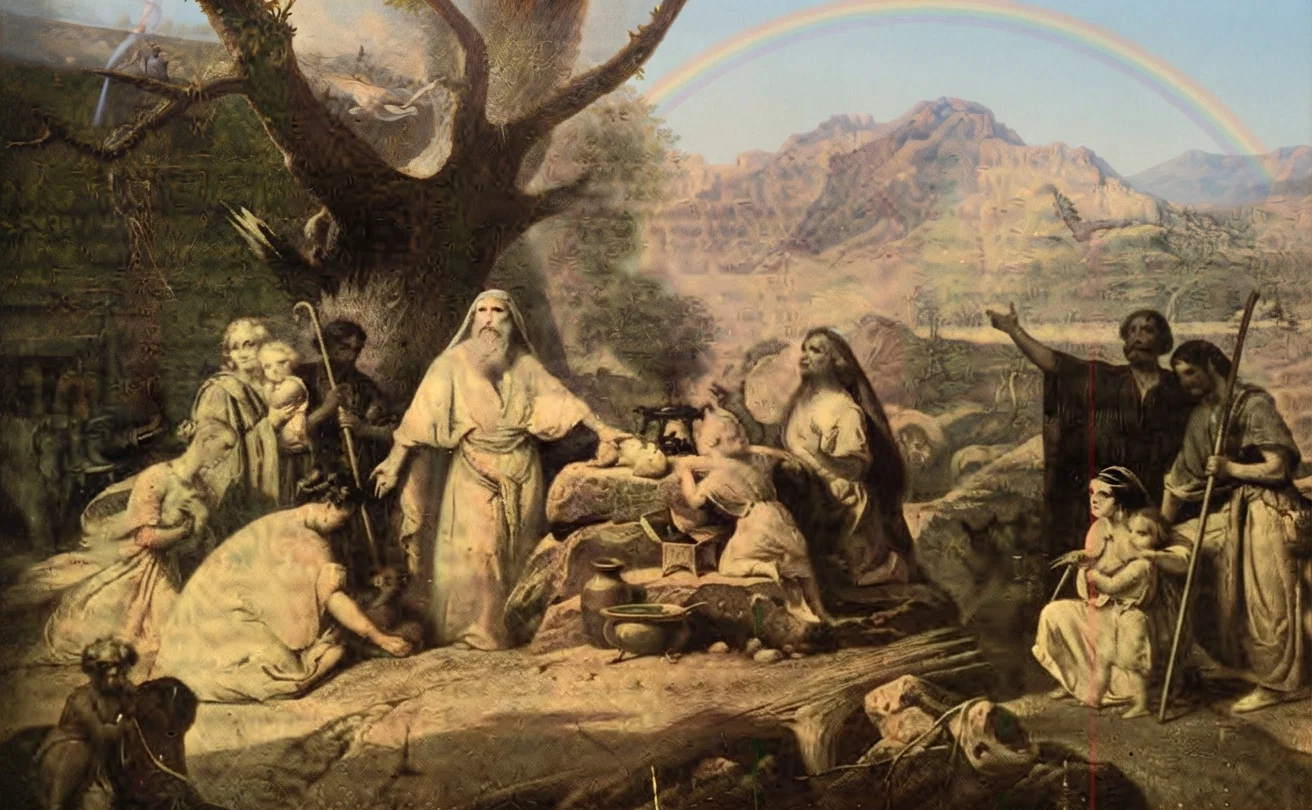
NOAH OFFERING SACRIFICE AFTER THE FLOOD
"Himself took our infirmities, and bare our sicknesses." Matt. 8:17.
"For when we were yet without strength, in due time ["according to the time," margin] Christ died for the ungodly." Rom. 5:6.
And this was all because "God so loved the world, that He gave His only-begotten Son, that whosoever believeth on Him should not perish [cease to exist], but have everlasting life." John 3:16.
We sometimes receive the testimony of men in reference to such things as they have seen and heard. And, "If we receive the witness of men, the witness of God is greater. . . . He that believeth on the Son of God hath the witness in him: he that believeth not God hath made Him a liar; because he hath not believed in the witness that God hath borne concerning His Son."
But what is the "witness" that God has testified, the which, if I refuse to believe, I have, to myself, made "God a liar"? I should tremble at the thought.
"And the witness is this, that God gave unto us eternal life, and this life is in His Son. He that hath the Son hath the life; he that hath not the Son of God hath not the life." 1 John 5:9-12, A. R. V.This, then, is the object of the shame He bore for us, His sufferings and death, — that we might be delivered from death, from sin which leads to death, and thereby share His righteousness unto life eternal.
To make the matter plain, that a Substitute had been provided, the Lord, in addition to the promise made to the guilty pair, on the first day of their transgression, provided a typical substitute for sinners, in the innocent lamb they were taught to offer.
In the first bleeding victim they were to "behold the Lamb of God, which taketh ["beareth," margin] away the sin of the world." John 1:29. Here, first, did they witness the agonies of death, and the sufferings of their divine Substitute. And as they beheld the innocent sufferer, their sorrow for sin became more real, and their repentance deepened.

Faith versus Works

"And in process of time it came to pass, that Cain brought of the fruit of the ground an offering unto the Lord.
"And Abel, he also brought of the firstlings of his flock and of the fat thereof. And the Lord had respect unto Abel and to his offering; but unto Cain and to his offering He had not respect. And Cain was very wroth, and his countenance fell." Gen. 4:3-5.
Here, at a very early date, the Lord allowed two principles to be demonstrated, — the principle of righteousness by faith, and that of righteousness by works; of salvation through Christ, and of self-salvation. Abel trusted in Another, Cain in himself. Abel’s offering caused repentance and heart-sorrow; Cain’s was followed by anger and wrath. And the failure of his self-appointed offering to meet the approval of God, engendered in his heart envy, jealousy, and murder.
And it was not primarily in the fact that Cain’s was an offering of fruit instead of a lamb, that he was not accepted of God. He had an entire misconception of the plan of salvation. Had it been possible for man to save himself, no Saviour would have been needed or given. "The wages of sin is death;" and nothing short of this can meet the demand of infinite justice. Man may meet this himself if he chooses; but having met it in his own person, he has no reserve of life with which to continue an existence. His career is ended. But in the person of his Substitute, the just penalty of an infinite law is met; the sinner’s enmity against God is taken away; and by his voluntary acceptance of pardon and grace, he is re-accepted into the family of God.

Faith Kept Alive by Sacrifice

In the same manner as that which was practised by Abel, the faith in a Redeemer to come was kept alive throughout the patriarchal age. Hence Noah, after the terrible Deluge was past, offered before God "of every clean beast, and of every clean fowl."
It was likewise true of the patriarch Abraham, that wheresoever he pitched his tent, "there he builded an altar unto the Lord, and called upon the name of the Lord." Gen. 12:8.
But never did Abraham understand so well the price paid for his salvation as when,
at the command of God, he was required to offer up his only-begotten son. Tho the act was not completed, tho the messenger of the Lord arrested his arm in the final act of this great drama, yet Abraham’s sorrow had compassed as much as if the final part had been accomplished. And Isaac, the willing partner in this great sacrifice, also understood better the voluntary offering of God’s dear Son for the saving of an ungrateful race.
And so great became Abraham’s faith in God and in His great plan of saving the race, that he was named the "father" of all who should believe. "And if ye be Christ’s, then are ye Abraham’s seed, and heirs according to the promise." Gal. 3:29.
Thence forward the "seed" of Abraham should play the greatest, if not the only, part in the plan of salvation. In reference to Christ, his "Seed" was the alpha and omega of salvation’s plan. But of his literal descendants, it was not so. It is true, however, that to these were committed "the lively oracles of God;" and therefore the study of God’s dealings with ancient Israel forms an important part in tracing the subject before us. This we hope to begin in our next.

At the Pool of Bethesda

‘‘Now there is at Jerusalem by the sheep market a pool, which is called in the Hebrew tongue Bethesda, having five porches. In these lay a great multitude of impotent folk, of blind, halt, withered, waiting for the moving of the water.’’ John 5:2, 3.
HAT a pitiable scene is presented by this house of mercy at Jerusalem, named Bethesda! The marble floors of its five colonnades are covered with a miserable multitude, whose silent aspect is a cry of wo, and whose bare presence in such a place is a confession of affliction and infirmity. The sick, the feeble, the blind, are all here for the same purpose, and hoping to receive help from the same source.
Here two faithful sons have brought their poor paralyzed old father, and set him down with his feet in the edge of the pool, and they are watching eagerly at his side, ready to take him up and rush in at the first movement of the healing wave. Close by their side sits a mother, with anxiety and sorrow written in every line of her face, as she looks tenderly and caressingly upon the paler face of her infant child; and she is there hoping to secure the baptism of the agitated waters in behalf of her poor babe, that she may not be left to bear the burden and the wo oflife’s journey alone. There a young wife, with the hectic glow of consumption burning upon her wasted cheek, leans, panting for breath, upon her husband’s strong arm, feeling that but for one earthly tie, it were better for her if the bitterness of death were already past. Here an aged mother is trying to persuade her affectionate daughter to lead her home, and let her lie down upon her bed and die in peace, without seeking to prolong a life that has already had too many sorrows. Here the blind have been led by friendly hands, and seated on the margin of the pool, with their sightless eyeballs seeking in vain for light in the noontide blaze of the sun. Here the wretched paralytic lies helpless, with the half of himself already dead, and wishing that the other half would die, too, or that both might live together. Here are some so withered, and old, and poor, that one would wonder what life could be worth to them, unless indeed the healing waters can give them back the days of their youth.
Some are attended by many friends, who cheer them with words of hope, and relieve their sufferings with every possible attention. Some have exhausted their utmost strength in dragging themselves to the house of mercy alone. Some are uttering cries of impatience and pain; some are sinking and fainting with exhaustion; some are waiting in calm and trustful silence for the rippling of the water when it shall be swept by the viewless angel’s wing. The long colonnade is crowded through its whole extent, and the wants and woes of the human race are represented by the multitude drawn together by the mysterious power of that healing fountain.
Among the friends of the afflicted and the throng of idle spectators, a Stranger enters the portico unobserved. He passes along with a quiet step and a pitying look, till His eye falls upon the most helpless and wretched of all the company. For thirty-eight years that miserable man has been bound to a crippled and suffering body, and the long and dreadful servitude has crushed his spirit and broken his heart. The luster of life has faded from his eye, and the expression of interest from his face. His whole personal appearance is most wretched and revolting, and the rest of the company shrink from approaching or addressing him. He is shunned the more carefully for the reason that his infirmity is known to have been caused by his own sin, and he is looked upon as smitten of God, and accursed. He has no one to help him when the favored moment comes to enter the water. The troubled wave betrays the presence of a new life that never quickens him. For years he has spread his miserable mat upon the stone floor at the very edge of the pool, waiting for the all-healing angel to descend; but never has he been able to enter the troubled water in time to be made whole. And he has grown so old and impotent, and his long misery has so nearly crushed the life out of him, that many wonder why he need exhaust his little remaining strength in creeping down to his old place, when his continual coming has done him no good. Many wish he would not come to shock the sensibilities of others with the sight of his wretchedness.
On him the quiet Stranger looks with a pitying eye, till his attention is arrested, and then He puts the startling question, ‘‘Wilt thou be made whole?’’ Made whole! For what other purpose has he dragged his crippled frame to that healing fountain? For what else has he longed and groaned in spirit for thirty-eight years? What other blessing could he crave so earnestly, while the faintest gleam of hope continued to shine in his enfeebled and darkened mind? But now it seems almost like mockery to ask him the question; for there is no eye to pity, and no arm to help him. The healing movement of the waters is all for others, not for him.
But the wretched man has not half uttered his despondency, before the eye that is fixed upon him seems to kindle with a benignant and divine light. The countenance of the Stranger assumes a most fascinating and commanding majesty which nothing can resist. The helpless creature already feels that he could travel to the ends of the earth at one word from such a face as that. And no sooner thought than uttered; the quickening and creative word comes; ‘‘Jesus saith unto him, Rise, take up thy bed, and walk.’’
There is no delay, no doubt, no question. The diseased and despondent listener feels new life rushing through every fiber of his frame. Hope flashes like a new heaven upon his darkened mind. He can, he will, he must obey that voice; and in the act of obedience, he becomes at once the strongest and soundest man in the multitude. He who it was thought would be the last to receive aid from the healing fountain, is the first to be made whole without its help.
The eyes of all are fixed upon him with astonishment as he springs to his feet, throws the matting on which he was lying across his arm, and walks forth with the firm and elastic step of youth. Excited spectators crowd around him; the colonnade is filled by additional numbers attracted from without; the sick forget to watch for the movement of the water; the Sabbath stillness that reigned through all the porticoes a moment before is broken by the clamor of many voices; every one is asking who has done this mighty work; and in the meantime, the mysterious Stranger, whose word alone has made the man whole, disappears, and is nowhere found.

The Lost Sheep

How MANY sheep are straying, Lost from the Saviour's fold! Upon the lonely mountain They shiver with the cold. Within the tangled thickets Where poison vines do creep, And over rocky ledges, Wander the poor lost sheep.
Chorus O come, let us go and find them; In the paths of death they roam. At the close of the day 'twill be sweet to say, "I have brought some lost one home."
O, who will go to find them? Who, for the Saviour's sake, Will search with tireless patience Through brier and through brake? Unheeding thirst or hunger, Who still from day to day Will seek, as for a treasure, The sheep that went astray?
Say, will you seek to find them? From pleasant bowers of ease, Will you go forth determined To find the least of these? For still the Saviour calls them, And looks across the wold, And still He holds wide open The door into His fold.
How sweet 'twould be at evening, If you and I could say, "Good Shepherd, we've been seeking The sheep that went astray. Heartsore, and faint with hunger, We heard them making moan; And lo, with joy returning We bear them safely home." —Anonymous.

Need of Solitude

JOHN the Baptist, preparatory to the taking up of his life-work, went apart into the wilderness to be alone. Solitude is the preparation for the great moments of life.
In the mutual life solitude is strength. If we cultivate this habit of solitude, we find that it is not so dreary a thing as the inexperienced believe, and a man’s life is happier for its moments of healthful solitude, and has a strength that is missing in the lives of those who never go apart.—New York Observer.

Love One Another

By Mrs. E. G. White
A NEW commandment I give unto you, That ye love one another.” How much? — “As I have loved you, that ye also love one another.” Do we regard this commandment sufficiently? Do we permit it to control mind and heart, and mold the character? “By this shall all men know that ye are My disciples, if ye have love one to another.” Thus believers are to bear to the world the credentials which will testify that they are indeed the children of God. Jesus says: “The glory which Thou gavest Me I have given them; that they may be one, even as We are one: I in them, and Thou in Me, that they may be made perfect in one; and that the world may know that Thou hast sent Me, and hast loved them, as Thou hast loved Me.”
What can I present before my brethren and sisters that is more important for their study and practise than the prayer of Christ? The entire seventeenth chapter of John is full of marrow and fatness. Are there not urgent reasons why we should take heed to those words of Christ? Is it not time we sought for the unity for which the Saviour prayed? Shall we not open our hearts to the melting love of Jesus? Shall we not let that love take the place of the coldness and hardness that have been too often revealed in the character? May the Lord have compassion upon us; may He forgive our perversity, heal our backslidings, and unite the hearts of all that believe the truth in that oneness for which Christ prayed, that we may be one even as He and the Father are one.

Do You Know Him?

By Mary S. Young
"Do you know the loving Saviour? Is He of your life a part? Have you ever felt His presence? Has He healed your aching heart? If you've been to Him a stranger, You have lost a priceless Gem; For without Him there is danger, And He's coming soon again— Coming in the clouds of glory, With His angels bright and pure, To reward His friends so lowly, That for His sake will endure. Then by faith let His love fill thee, Till the day you see His face; Through the ages it will thrill thee, With its satisfying grace. Brooklyn, N. Y."

Why Not Stick to Your Text

By Mrs. C. J. Goodwin
“ALL things work together for good.”
“Yes, that’s a good text, and you surely believe it.”
“I wish I could.”
“Why, don’t you believe the Bible is inspired by God?”
“Yes, but I don’t see how it could be for my good to upset that cut glass vase, and break it all to pieces. It was a present to Dora from an aunt that died. It cost more money than I could earn in two weeks, but Dora said there was no need in thinking of buying another, for it was given her by dead Aunt Lillie; later she told me not to feel bad, for she might have done the same thing herself. The lady who sews for Dora said Dora had never told her a thing about it. She later asked Dora if it could not be mended, who then said, ‘O, please do not mention it to Ella, for she feels so bad about breaking it!’ Really, I did not know how thoughtful Dora was; I wish I could treat with as much pity the children’s mistakes.”
“You can, dear, if you allow the Lord to make you perfect in weakness. And right here let me say I think the broken vase is already working ‘together for good,’ both for you and for Dora. It has helped Dora to pity you more than her own loss, and it has shown you what grace can do, for before Dora was converted she was very impulsive and hasty; besides, it has caused you to long for more of the fruits of patience. ‘Tribulation worketh patience, and patience experience.’ When we learn to rejoice in tribulation, we can soon help impatient friends to find Christ, the source of all blessings, the One that causeth all things to ‘work together for good to them that love Him.’ Praise the Lord when things go wrong, and the mountains of difficulty crumble and fall. The trials will lighten, the pain ease, the lowliest hour soon pass into one of hope, if we praise the Lord with heart and voice for the manifold blessings that crown our life. ‘O taste and see that the Lord is good!’”

Importance of Now

"Behold, now is the accepted time; behold, now is the day of salvation." "To-morrow" is the devil's great ally,—the very Goliath in whom he trusts for victory. "Now" is the stripling whom God sends forth against him. A great significance lies in that little word. It marks the point on which life's battle turns. That spot is the Hougomont of Waterloo. There the victory is lost or won. Men do not often join issue against God on the person of Christ or the ministry of the Spirit, on the ground of acceptance or the necessity of faith; on all these points, and many others, the carnal mind readily acquiesces in the doctrine of Scripture, like willows bending to the breeze, but resists Christ's claim to be admitted now, as a rocky shore resists the onset of the waves. The worldly will freely agree to be Christian to-morrow if Christ will permit them to be worldly to-day.—Arnot.
Continue reading: Out of Babylon to Zion