Your ShelfYour Projects

Signs of the Times, Vol. 28, No. 32.

THE RIGHTEOUS SHALL FLOURISH LIKE THE PALM TREE

Earlier text: REVEALING GOD
THE CHILD By Mrs. Mary Wood-Allen, M.D.

THE CHILD

By Mrs. Mary Wood-Allen, M.D.

IX.—PURITY.

TWO men stood looking over an expanse of country. One saw the stony soil, the narrow valleys, the rough hills, and meager crops and exclaimed, “What a miserable farming country!” The other saw the bold outlines, the changing shadows, the reflection of sea and sky in the silent pool, and exclaimed, “What a beautiful picture!”
The same landscape, but each saw in it what his own education and experience made him capable of seeing. This is true of all travelers. London to each man who visits it is his own peculiar city. It will be a different place to each. The man of fashion will not see what the archæologist sees, the sporting man has a different city from the manufacturer. Even so with life. One whose vision has been made keen to perceive beauty will see it everywhere; while he who knows nothing but utility will see nothing worthy but that which serves his purpose. One who is like Bunyan’s man with the muck rake sees only filth, but one who has the vision of a true seer
“Finds tongues in trees, Books in the running brooks, Sermons in stones, and good in everything.”
To such an one is given the promise of the Saviour, “Blessed are the pure in heart; for they shall see God.”
Who does not long for such a vision? But we are apt to imagine that such a blessing is reserved for our portion after death. The truer interpretation is that even now, with a heart made clean, we can see God in all His works, and be lifted up into that clearer atmosphere which finds in all processes of life only a manifestation of God.
To many ignorance and innocence seem synonymous terms, and they therefore believe that the innocence of the child is best maintained by keeping him ignorant of certain phases of life. To these, the word that heads this article will open a vision of darkness and danger from which they would earnestly warn the unwary feet, or lead the ignorant safely past the dangers with blindfolded eyes. These have not the anointing which opens the eyes to the blessed vision of God. The word purity suggests to them the results of impurity, and they misunderstand the attitude of the one who claims that it is wise to instruct the young in purity. The apostle tells us that if there be anything pure, lovely, and of good report, we are to think on these things. That is what we mean to do; that is what we desire to be wise enough to do. If our sight is not clear we pray for the purification of heart which shall enable us to see God now and here, see Him not only in inanimate nature, but in the vital facts of human existence, in the basic fact of life itself.
We know that these facts can not always remain hidden from the knowledge of the child, and we are culpably unwise if we think that he is ignorant because we have not talked to him ourselves. On every side are those who are ready, yes, anxious to enlighten his ignorance even before he has himself become aware of it. The problem before the parent then is, “Shall I allow my child to remain uninstructed by me, thus leaving him a prey to evil knowledge communicated by vicious companions, or shall I myself be his teacher, giving him that pure truth which shall dignify and glorify these mysteries of life?”
God has made no secret of life’s origin. If the child has no other teacher, nature herself will enlighten him. To the eye of the All-Father, His processes are still “good,” and what we need is to see Him in them all.
The child who begins to think arrives in time at the query as to why he is here. It is no evil impulse that prompts this inquiry, but a divinely-implanted eagerness to know, and it is therefore an evidence of intelligence. I have known mothers to be so shocked at this most natural question of their child that they have considered it a proof of his total depravity. Their own education has made it impossible to see God in this seeking for knowledge. The child’s inquiry, coming from a pure heart, may be simply and purely answered, and cause him no embarrassment; but the parent whose thought is untrue, whose vision is distorted, needs a special presentation of the matter in order that he shall be able to answer the questions as to the origin of life frankly, himself unembarrassed.
If we can remove the personal element, we shall make the way easier for ourselves. Let us study life from a standpoint outside of ourselves. We can imagine that the great All-Father, desiring to express Himself upon the earth, considered all possible plans for the perpetuation of life. That he chose one plan, is the evidence that it is in itself pure and good, for God is too pure to behold evil. Then in the plan itself we can find no impurity. It is a plan that maintains from the lowest forms of organic life up to the highest.
We may wonder why God did not create each individual by His own hand, and we feel that that would indeed have been a glorious destiny, but would it have been in truth as grand a heritage as that which man has received from God in being permitted to share in His creative power? It would indeed have been a marvelous thing to have come direct from the hand of God, but how much more marvelous it is to be permitted to call into being creatures like ourselves, endowed with divine possibilities, and capable of receiving the gift of God’s grace in immortality!
Truly life itself is not so wondrous as the power to impart life to others; to write upon other souls the record of our thoughts, ambitions, moods, or tempers; to make or mar other lives by our own lives, generations before those others come into existence. If procreative power were cleansed of the thought of sense-pleasure, if it had never been degraded from its high purpose, we should be able to see in it the most glorious vision of God. And instead of shrinking from the study of it as unclean, we should bow ourselves before its contemplation as in the very presence of the Infinite.
The father or mother who has this blessed vision of God, will be able to be the wise and pure instructor of the child; able to explain to him his relation to his parents in a way that shall bind him to them with ever-endearing ties of deepest affection. It will need study to become possessed of the scientific facts. It will require especial preparation of heart that the facts may be wisely presented. Out of this reverent study of the origin of life will arise a truer appreciation of man’s destiny. A new meaning will be given to the words father, mother, child. The home will be cleansed of that which defiles. Marriage will have a deeper significance, and the whole of life will be purified and ennobled.

ANEMIA.

[D. H. Kress, M. D., in Australian Good Health.]
ANEMIA, better known as poverty of blood, is becoming a very prevalent disease. It is surprising to see the number of pale-faced and nervous young women in every city, town, and village, and even in the country where nature has an opportunity and is doing her best to paint roses on the cheeks of all.
Recently at the close of a lecture a young woman came to me and said, "Doctor, I am very nervous, do not sleep well, and am also troubled with deafness." I inquired, "Have you had your ears examined to see if there is any local disease." She replied, "Yes; but the doctor said there was no local difficulty, that I was suffering with poverty of blood, that I needed more iron in my blood. He advised me to take tincture of iron. I have been taking it for some time, but am not improving."
The question naturally arises, What are the causes of anaemia? The causes, no doubt, are many. I shall only call attention to what I consider two of the principal causes of anemia in young women. It will be noticed that the disease usually makes its appearance in young ladies after reaching their teens; before this period it is of rare occurrence.

Why Is This?

It is well known that poisonous products are constantly being formed in the human body by the breaking down of tissue from muscular and mental activity. These wastes are mostly eliminated from the body through the lungs. Every ten minutes sufficient poison is thrown off through this channel alone to cause death.
It is through the rapid interchange of gases that takes place in the lungs by having pure air brought into almost immediate contact with the impure blood, that the blood is kept freed from impurities.
So-called blood purifiers never can purify the blood. Nature recognizes but one blood purifier, and that is pure air, and we need plenty of it. The Creator has given us none too much lung capacity to keep the blood pure. Up to the age of twelve, the girl is permitted to dress loosely and play with her brother in the open air. It will be noticed that up to this time she is also usually in equal good health. Now a change occurs. The boy is still allowed his freedom, but the girl has to have her waist placed in corsets. The lungs are thus constricted, which makes exercise impossible. Not a sufficient amount of air can now be taken into the lungs to keep the blood pure. Is it any wonder that soon the nerves shriek out because of the impurities and irritants circulating in the blood, and headaches, backaches, nerve-aches, and nervousness result?
Another cause of anemia is the use of tea. The evil resulting to the human family from the use of tea is greater than from the use of alcohol, great as I know that evil to be. It takes one part in one hundred of alcohol to kill a man, but it does not require near that amount of theine, the poisonous principlecontained in tea. A strong man accustomed to the use of alcohol could take an ounce of pure alcohol without it's causing death, but even one-tenth of that amount of theine would result fatally. Theine is therefore ten times more powerful than alcohol.
There are two and one-half grains of theine in every cup of tea as ordinarily made; one-eighth of a grain will kill a frog. Two cups of tea contain five grains, or sufficient to kill a rabbit. Three cups contain seven and one-half grains, or enough of this poison to kill a cat, in spite of the proverbial nine lives. Aside from this, every pound, or sixteen ounces, of tea contains four ounces of tannin. Tannin interferes with the digestion of the food, especially the albumens, thus impoverishing the blood. Tannin also destroys the iron contained in the food. It is well known that the system can not appropriate an inorganic substance, as iron. The vegetable kingdom feeds upon these minerals and changes them into other forms, which can be utilised by man.
The grains, vegetables, and fruit all contain iron, and a sufficient amount to fully supply the needs of the human body. To ascertain the effect of tannin upon the iron contained in the food and blood, place a small amount of tincture of iron in a glass half full of water, now add to it a half cup of tea and note the result. It becomes as black as ink. Tea destroys the iron contained in the food and blood and causes anemia. The physician recognizes that the blood needs more iron, and so recommends the use of tincture of iron, or some other iron preparation, but the patient takes the iron, drinks more tea, and makes more ink. Is it any surprise that anemia is a condition that is so difficult to overcome? There is but one way of getting rid of anemia; that is by removing the causes. Stop the use of tea, give the lungs an opportunity to take a bountiful supply of air to purify the blood, eat pure food, and take plenty of out-door exercise.

A MAGNIFICENT REVENGE.

A FEW years ago, while Robert Stewart was governor of Missouri, a steamboat man was brought in from the penitentiary as an applicant for pardon. He was a large, powerful fellow, and when the governor looked at him he seemed strangely affected. He scrutinized him long and closely. Finally he signed the document that restored the prisoner to liberty.
Before he handed it to him he said, "You will commit some other crime, and be in the penitentiary again, I fear."
The man solemnly promised that he would not. The governor looked doubtful, mused a few minutes, and said:—
"You will go back on the river and be a mate again, I suppose?"
The man replied that he would.
"Well, I want you to promise me one thing," resumed the governor. "I want you to pledge your word that when you are mate again you will never take a billet of wood in your hand and drive a sick boy out of a bunk to help you load your boat on a stormy night." The steamboat man said he would not, and inquired what the governor meant by exacting of him such a promise.
The governor replied: "Because, some day, that boy may become a governor, and you may want him to pardon you for a crime. One dark stormy night many years ago, you stopped your boat on the Mississippi River to take on a load of wood. There was a boy on board who was working his passage from New Orleans to St. Louis, but he was very sick of fever and was lying in a bunk. You had plenty of men to do the work, but you went to that boy with a stick of wood in your hand and drove him with blows and curses out into the wretched night, and kept him toiling like a slave until the load was completed. I was that boy. Here is your pardon. Never again be guilty of such brutality."
The man, cowering and hiding his face, went out without a word.
What a noble revenge that was, and what a lesson to a bully!—Brotherhood Star.

JEOPARDIZING THE HOME.

A warning note, that women and girls in this country are being drawn into commercial and manufacturing pursuits to an extent that jeopardizes the welfare of future mothers, and is a menace to a happy home life, was sounded by Prof. D. L. Kiehle, of the chair of pedagogy in the University of Minnesota, before the department of superintendents of the National Educational Association, in session recently at Chicago. His address touched a popular feeling in the minds of the thousand or more educators from all points of the compass, and that portion stating that home life and surroundings are above all sordid gain, was applauded.
"In this age of commercialism and industrial conditions," said Professor Kiehle, "no provision has been made for motherhood. This phase of life seems to have been brushed aside. In fact, we are making money-earners of our daughters in commercial pursuits. While women will have every right to an equality with men in matters of education, they are outside of their sphere when that portion of their education fitting them for the duties of home life and motherhood does not take precedence over everything else."

EVERY DAY.

TAKE a little holy time Every day, Lift your heart into the light On your way. Take a little resting spell As you go, Watch the clouds against the sky Hanging low.
There is always peace somewhere, Deep and still, You will come to it and know 'Tis His will. Enter at the shining gate Open wide, Deeply breathe and gently wait— There abide.
Listen for the guiding voice, God's to you, Every little daily task That you do. This will take off all the jar And the fret, Easily you will forgive And forget.
What the Father takes from you Is no cross, Whole your life is given to you With no loss. That which drops from out the years Is not life; Only that which lasts is saved; Cease from strife.
Strange how eagerly we grasp, For a day, That which perishes and falls In decay. Only trust the Father's love And His care; Life will be all heaven to you Everywhere. —Emma Miner.

HOW TO GET RID OF ANTS.

THE surest way to dispose of the ant nuisance is to find their nests and pour down the holes a spoonful of bisulphide of carbon. This gives off a poisonous gas, much heavier than air, which sinks down into the holes and destroys the insects. Cover the nests as soon as you have poured the liquid down. Be careful in using, as it is highly inflammable. Here is another recipe, which we clip from a floating paragraph; it is easily tried: "Mix five cents worth of tartar emetic in an equal amount of white sugar, make it quite moist with cold water, put it into small dishes, and set it on the shelves where the ants are troublesome. The ants will disappear quite as mysteriously as they came, and there will be no dead ones lying around on shelves and floor. Do not throw the mixture away, but save it for further attacks, as it can easily be moistened and used again."—S. F. Examiner.

Restoring Flattened Mattresses

MATTRESSES that have become flattened will fill out to the original shape, if placed in the sun and pure air for a few hours each day when house-cleaning is in progress.

New England

CONSERVATORY OF MUSIC
GEORGE W. CHADWICK, Director.
Our new buildings, costing nearly $1,000,000 to erect and equip, are now finished. We offer greater facilities, master teachers and more thorough instruction, than elsewhere to be had, here or abroad.
Our present enlarged facilities and magnificent resources should lead you to send for our year-book, which we mail free.
FRANK W. HALE, General Manager, Boston, Mass.

The World-Famous

Puritan Pure

Water Still

Is a practical scientific invention that furnishes pure water for every one.
Water distilled by the Puritan is the acme of purity. It is purified, aerated, revitalized with sterilized oxygen.
Common distilled water is invariably flat and insipid, because it is not aerated and revitalized with oxygen. Our process overcomes all this.
Price, $8.00 Agents Wanted
F. J. SILSBEE, General Agent 858 1/2 Twentieth Street, Oakland, Cal.

Old Indian War Pensions

Congress has just passed a law granting pensions to the survivors and to the widows of deceased soldiers of the Oregon, Washington, and California Indian Wars of 1847 to 1856. Full information will be sent by BYINGTON & WILSON, No. 728 Seventeenth St., Washington, D. C., or Branch Office, No. 442 Parrott Building, San Francisco, Cal. Fees limited by law.

Christ and the Sabbath

CHRIST AND THE SABBATH: Or Christ in the Old Testament and the Sabbath in the New, by Elder James White.
Paper covers, fifty-six pages, sent post-paid for ten cents.
Address, PACIFIC PRESS, Oakland, Cal.

SOME FEATURES OF HINDUISM.

A Religion of Ingratitude.

THE words "thank you" and "please" are not found in the languages of India. The newcomer wonders at this, but acquaintance with the people and their religious beliefs readily explain the omission. Among the natives the oriental idea prevails, that every man gets his deserts, good or bad, as the case may be. As they express it, "Every man's fate is written in his forehead, and according to that he receives." He is not indebted to any for acts of kindness, for all he receives is his just due. This is the teaching of Indians to-day; it has been the teaching of their fathers and forefathers for ages. "When they knew God, they glorified Him not as God, neither were thankful." Their ancestors became unthankful, and so much so that even the expression "thank you" became obsolete. The following from Pandita Ramabai, a converted Hindu, shows the fatalism of the Hindus:—
In former years, when I was an orthodox Hindu, I never knew the pleasure of expressing gratitude by giving thanks to those who did me some kindness. The Hindu religion never teaches to give thanks; for its chief doctrine is that man gets only what his karma, or action, buys for him. If he is blessed with a good wife, it must be supposed that he had given a lovely little maiden in marriage to some learned Brahman in his previous existence; if he is rich, it is because he gave money to the Brahmans in his former life; if any one is kind to him—if some one gives him money, food, clothing, comfort, or help in any shape—it must be taken for granted that the friend who does him kindness is his debtor, owed him money, food, clothing, kind words, comfort, etc., etc., in some one or other of the series of lives which the giver and the receiver lived before they were born in this present time.
According to this belief, no one is obliged to give thanks to any one, not even to God. In all the prayers addressed to millions of gods and goddesses, not a word of thanksgiving is to be found in any of the Sanskrit religious books. The people in India are in many cases better than their religion; and tho they do not really have any idea of thanking their benefactors, they show their gratitude by some word or action which gives expression to their feelings. The old orthodox Hindu, wishing to express gratitude for some great kindness done to him, says in a very affectionate manner, "O this person must have been my debtor in the former life; that is why he has done or is doing this kindness to me. I bless him; may the god have mercy upon him; may this poor, poor debtor of mine be happy in this and in the next life!"
The gods are not supposed to give anything to men unless men do something to obtain their favor. The Hindus are a generous people naturally. They like to share their blessings with others; but their religion has so marred this good nature that they do everything in a mercenary way. If they give anything to any one, it must be given to the Brahmans, and to the devotees of some gods and goddesses, that they may obtain some great blessing in many lives in future. What a great contrast the Hindu religion presents to the teaching of Christianity. "In everything give thanks." To give thanks to God and to the friends who have done us some kindness makes a Christian very happy. The Hindu is a stranger to this pleasant feeling, and so he loses one of the greatest pleasures of this life.

A System of Man-Worship.

The Hindus worship men, beasts, and creeping things. The confession of their faith is found in Rom. 1: 23: "And changed the glory of the uncorruptible God into an image made like to corruptible man, and to birds, and four-footed beasts, and creeping things."
Of the four general divisions of caste, the highest is the Brahman. They are twice born, and are therefore above all others, and are very highly regarded by other castes, and even worshiped. They are lords of creation, and the universe is their property. Manu, the reputed author of the most renowned law-book of the ancient Hindus, says:—
Since he was the first born, and since he holds the Vedas, the Brahman is, by right, the Lord of all creation. . . . Thus whatever exists in the universe is all the property of the Brahman; for the Brahman is entitled to all by his superiority and eminence of birth. A sudra [a man of low caste], whether bought or not, the Brahman may compel to practise servitude; for he was created by the Self-existant merely for the service of the Brahman. . . . A Brahman may take possession of the goods of a sudra with perfect peace of mind; for since nothing at all belongs to him as his own, he is one whose property may be taken away by his master.
The following syllogism, says Dr. Wilson, has gained universal currency in India: "The whole world is under the power of the gods; the gods are under the power of the mantra; the mantras are under the power of the Brahman; the Brahman is therefore our god."
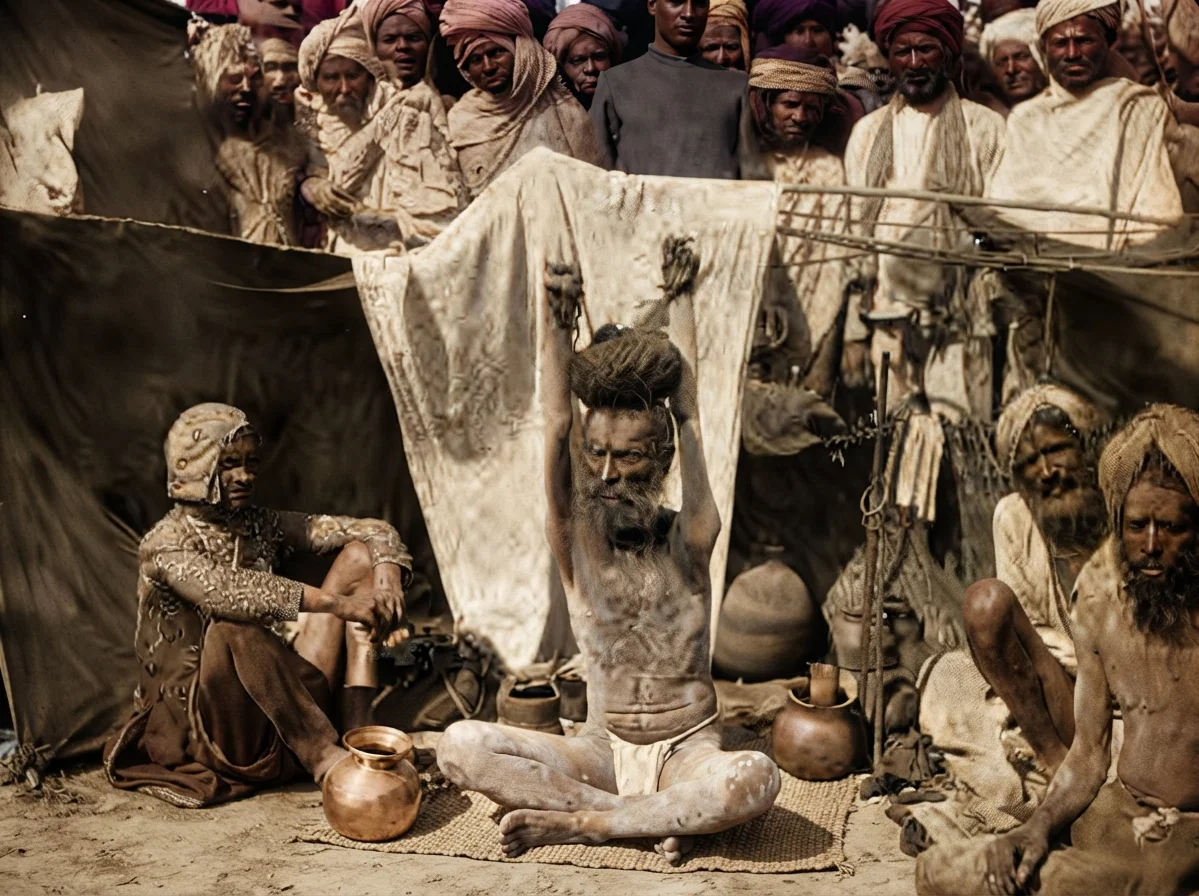
Hindu Fakir, or Fanatic, Who Has Held His Arms Above His Head until They Have Withered and Grown into that Position.

Worship of Four-footed Beasts and Creeping Things.

To the Hindus the cow is a sacred animal. He who takes the life of a cow offends the Hindu. "He that killeth an ox is as if he slew a man." Altho they mistreat the ox, and make him pull heavy burdens under pain and torture, they do not think it right to kill except for sacrifice. The following from the hymns of the Rig-Veda is one expression among many showing their devotion to the cow. "To me the cows seem Bhaga [god of good fortune]; they seem Indra [god of the blue sky thunder]; they seem a portion of the first-poured Soma [the moon-god]; these present cows, they, O ye men, are Indra. I long for Indra with my heart and spirit."
The serpent with its deadly venom is worshiped; and instead of destroying this minister of death, the Hindu pays homage to it, and allows it in some instances to live in his house. So little has been done to destroy these animals that they are prevalent outside of the cities, and thousands of people are killed as the result. Twenty thousand were killed by snake bites last year.

A Religion of Self-Righteousness.

Hinduism is a doctrine of justification by works. There is no faith in it. Its devotee seeks salvation through self-righteous deeds. He resorts to penance to free himself from sin, and to the most terrible torture of body to make himself good. The accompanying picture shows a fakir who has held his hands up since infancy. The Hindus call him a holy man, and go great distances to see him. He has become so good and his mind so holy that he has forgotten his bodily existence. He will not have his nails trimmed or hair combed. The hair is matted upon his head, full of grease and filth. The more hideous his appearance through neglect of the body, the better. It shows that his thoughts are above the world.
A few months ago the writer visited a native festival, and the cruel sights of self-inflicted torture were abhorrent. One man was lying in the sun, beating himself upon the chest. He had been doing this for days. Another was lying on a bed of sharp spikes. How he could endure such torture is a marvel. The people going by threw him money for his righteous deeds.
What a deliverance God has for these people,—a salvation for body and soul without pain or penance. "Come unto Me, all ye that labor and are heavy laden, and I will give you rest." Some are coming, and, thanks be to God, they are finding rest. The Orient wants a thousand consecrated voices to say, Come; and then many more weary, heavy-laden souls will respond, and be emancipated from the sins of self-righteousness. J. L. SHAW. Calcutta, India.

SOURCE OF STRENGTH.

O LORD I find so many things Too hard for me, too high, too deep. There's not a day but to me brings Some task too hard, some way too steep.
I find myself too frail and weak Thy gracious will and way to do; And so I pray, "Unto me speak Some word my courage to renew."
The gracious answer comes at length, Unto "the faint He giveth power," And unto such as have no strength He giveth His from hour to hour.
And so, altho the flesh is weak, Still, Lord, Thy power upholdeth me; And I will still Thy presence seek, For there is naught too hard for thee.
Kelseyville, Cal. MISS E. BATTERSON.

The Secret of Success

THE man who makes a success of anything is the man who is full of the thing. But he who does not have the work inside will not make success without.

The One-Eyed Man Is King

"Among the blind the one-eyed man is king."

THE DARK AGES REVIVED.

Is it the twentieth century or the tenth? An almost incredible story is told in La Semaine Religieuse, of Geneva, concerning the passing over to Protestantism of a Carmelite monk in Gratz, Austria. His name is M. Ientsch; he is 54 years old, and greatly esteemed for his character and zeal. By the study of the Scriptures he had been led to the conclusion that the Roman Catholic Church was not the true church of Christ. He therefore quitted his monastery, and placed himself under the instruction of a Protestant pastor.
His superior, however, prevailed on him, on some pretext, to re-enter the monastery. Immediately he was imprisoned in his cell until he should retract his heresies. On his refusal, he was secretly transferred to a Franciscan monastery. Thence he was taken to Brixen, to a community of Sisters of the Cross, where, according to one report, he was subjected to a series of cold douches; but, according to another, was made to undergo the terrible punishment practised by the Inquisition in the Middle Ages of causing ice-cold water to fall drop by drop upon the victim's head. By the intervention of his friends, however, M. Ientsch has escaped his tormentors, and is enjoying his freedom of conscience in Germany.—Missionary Review.

OUR WORK AND WORKERS.

ON the 12th ult., three candidates were baptized at Oxford Mills, Iowa, by Brother J. H. Kraft.
THE brethren at Lincoln, Neb., are building a new house of worship, with a school-room annex.
A HOUSE of worship is being erected at Muncie, Ind., under the direction of Brother J. S. Shrock.
BROTHER J. W. WATT desires us to note that his present address is 148 Washington Street, Barre, Vt.
ON the 13th ult., a church of nine members was organized at Erskine, Minn., by Brethren L. Johnson and J. C. Christensen.
A CAMP-MEETING is announced for Erin, Tenn., to commence September 4. This meeting is for Tennessee River Conference.
ON the 13th ult., a church of fourteen members was organized at Prentice, Wis., by Brethren Wm. Covert and H. W. Reed.
FIVE tent companies are at work in Nebraska Conference,—at Beaver City, at Burr, at Newman Grove, and at North Platte.
THE first annual session of the Georgia Conference will be held at Alpharetta, in connection with the camp-meeting, August 15-25.
AN educational convention was commenced on the 4th inst., to continue till the 18th, at Anniston, Ala. The convention is under the auspices of the Southern Union Conference.
A NOTABLE feature of the late camp-meeting in South Dakota was the interest taken in the establishment of an intermediate industrial school. A committee was chosen to take special oversight of the matter.
THE missionary boat, the Sentinel, which has been in service in New York Harbor for several years, recently made a trip to Buffalo through the Erie Canal. Captain Johnson designs to labor a while in Buffalo Harbor.
THE Ohio Conference and camp-meeting will be held at Coshocton, August 7-18. It is announced that Brethren A. G. Daniells, W. W. Prescott, Wm. Covert, and W. A. Spicer, in addition to local conference laborers, will be present.
THE tent at Prairieton, Ind., in which Brethren S. S. Davis and C. H. Bliss have been holding meetings, was recently given over to the W. C. T. U. for an evening, and a large congregation listened to an address by a Mrs. Pierce, of Terre Haute.
THE Minnesota Worker says: "A sister at Mankato had been praying for the Lord to open the way for her to sell 'Christ's Object Lessons.' When the plan was presented she took five books and sold them to the first five persons she canvassed."
A LETTER from Brother W. G. Kneeland to the Dakota Worker reports the work in Trinidad, W. I., as moving ahead. They issued a leaflet entitled "The Voice of the Volcano, or God's Call to Repentance," which is being widely circulated, and is said to be doing a good work.
THE Advocate of Christian Education says: "No branch of work among Seventh-day Adventists is succeeding better just now than the church-school, and it is especially successful in places where it had been deemed impossible. Surely the Lord has guided in this matter, and the work manifestly is His."
A SAN DIEGO paper, the Western View, gives a very appreciative notice of the new vegetarian cafe, on the corner of Fourth and C Streets. The Western View is published by ladies of culture, who are supposed to be good judges of culinary excellence, and their hopes that the cafe is there to stay is encouraging to the management. The institution is under the auspices of the California Medical Missionary and Benevolent Association.
Continue reading: INDIVIDUAL WORK FOR INDIVIDUALS