In a recently-published book by Henry Clay Trumbull, bearing the above title, the following interesting experience is given, which well illustrates the importance of individual work in bringing souls to Christ:—
One Sunday I passed with a near relative. There I met a gentleman whom I had never seen before, but who was connected with my relative. I sat with him at the table, and we had pleasant conversation. In the evening the gentleman was out at church service, and the lady of the house was suffering from the headache. I urged her to retire, while I would sit up, and close the house after the visitor came in. As I did this, I sat by the sitting-room fire, on the cold winter night. When the visitor was in, and the house was closed, we still sat together there.
He spoke of the service that he had attended, and he was evidently much impressed by the sermon.
“You don't often hear a sermon like that, especially from such a minister,” he said. “The minister brought us right up face to face with the judgment seat, and there he left us. There were no soft words to ease us down, such as, ‘But I trust this is not for you, my brethren.’”
Then, as if soliloquizing as he sat there looking into the fire, he added:—
“I tell you that, in the great day, we who go over to the left hand will not feel very kindly toward the men who have glossed this thing over, when they had a chance to tell us the plain truth.”
The impressed man was much older than myself—old enough, perhaps, to be my father; but he had been brought to my side in a condition of mind to need help, and I was there to speak for Jesus. It was not a question of seniority, nor of long acquaintance, to be considered by one who represented the Eternal. Laying my hand lovingly on his knee, as he sat by my side looking thoughtfully into the fire, I said:—
“My friend, what do you mean by ‘we who go over on the left hand?’ You belong on the right hand, and you ought to recognize this. The Judge is your Saviour. You ought to trust Him fully as such.”
“I suppose I ought to,” he responded.
“Well, do you not?”
“I can't say I do.”
At this I drew my chair around so that I could look directly into his face, and I said earnestly, feeling the full force of my words:—
“This is God’s doing, and you must recognize it. God has brought us to this house to meet for the first time in our lives. He has planned it so that you should go out to that evening service, and hear that impressive appeal. And now, while all others in the house are asleep, and you and I sit here facing the question of questions for your soul, I can not leave you until you settle it. I speak for the Saviour when I urge you to commit yourself to Him for now and for evermore.”
Then reaching out my hand, I said:—
“My friend, you realize what all this means, and its importance. Now, promise me that this night, before you sleep, you will, on your knees, tell your loving, longing, waiting Saviour that you've delayed this thing altogether too long, but that you won't do so any longer. Tell Him that you trust Him because He is the Saviour, and you are one whom He wants to save. Give me your hand on this, my friend, and then go to your room, and do what you know to be your duty.”
My companion evidently felt that it was a crisis hour with him, and he could not evade the sense of this. My hand was outstretched to him. For some time he said not a word, but I saw that he was quivering with intense emotion. Meanwhile I was praying in my heart for a blessing on him in his conflict of soul. Then, with a convulsive movement that shook his strong frame, he put out his right hand, and clasped mine as tho it were for life. I realized that he had given himself to his Saviour. Rising, I asked God's blessing upon him, and bade him good night, and we parted. I went to my room for the night, and to pray for him, and he went to his room to pray for himself.
Before he came downstairs in the morning, I left for my home. I never saw him again. Before the day closed, he left that house for his home. By a severe railroad accident on his way home he was fatally injured, and soon died. A younger brother of his was an office-bearer in one of the Fifth Avenue churches in New York. When he learned that the loved brother had thus committed himself to the Saviour while he was yet in life and strength, he was indeed rejoiced and grateful; and we thanked God together.
CHILDREN'S FUNERALS IN PEKING.
A WRITER in Woman's Work for Woman quotes this from Mr. Holcomb: "If you lived in Peking you would be surprised never to see a child's funeral pass; but if you go into the street very early in the morning, you will find the explanation. You will meet a large, covered vehicle, drawn by two oxen, having a sign across the front stating its horrible office, and piled to the brim with the bodies of children. Sometimes there are a hundred in the cart at once, thrown in as garbage, nearly all of them naked, a few of them tied up in old reed baskets, and fewer, never more than one or two, in cheap board coffins. These carts go about the streets each night and pick up these pitiable remains, some of them mutilated by dogs. They are thrown in like so much wood, and taken to a pit outside the city wall, into which they are dumped, then covered with quicklime. Does it make you sick to hear of such a thing? I have lived seven years in the city where that is a daily occurrence."
A Day of Peace and Gratitude
"If one fair day in all thy life
Seem strangely calm and free from strife,
One glad, sweet day, from sorrow free,
If God with peace hath prospered thee,
Then give thy gold in grateful praise,
That all may know His wondrous ways."
PUBLICATIONS WANTED.
CLEAN copies of the SIGNS OF THE TIMES for missionary work among old soldiers. Also health journals and the Life Boat. Address, post-paid, E. P. Shaffer, U. S. Soldiers' Home, Los Angeles Co., Cal.
LATE clean copies of the SIGNS OF THE TIMES, Review, Life Boat, Good Health, and tracts on the Sabbath. Address, post-paid, Wm. Kennedy, 430 Fourteenth Street, Durango, Col.
LESSONS BY MAIL ON MEDICAL ELECTRICITY
By Prof. G. L. Abell
OR HOW TO USE THE BATTERY
By Prof. G. L. Abell, Member of the Board of Directors of the
Electro-Medical Society of San Francisco
Learn how to use the battery and treat yourself. Many diseases
are quickly cured by the proper application of electricity. The course
embraces the treatment of every organ and part of the body. The
lessons are written in plain language and are illustrated. Course,
five dollars. Send for circular. Address,
PROF. G. L. ABELL
School of Chemistry and Electro-Therapeutics
36 Geary St., San Francisco, Cal.
A HANDY TEXT-FINDER
Every Bible student feels the need, and knows the value of a convenient and accurate text-finder.
Those who have not used a copy of
WALKER'S COMPREHENSIVE CONCORDANCE
do not know what a practical volume it is.
It is printed from clear, distinct type.
The caption words are in full-faced letters so that they stand out clearly on the page.
It is rigidly alphabetical in its arrangement.
Proper names and appellatives will be found in their alphabetical order instead of being placed by themselves, and are accented to assist in pronunciation.
No irrelevant or needless matter is introduced.
It is a concordance simply—not a commentary, not a dictionary, nor a compendium of Bible information.
50,000 more references are given than appear in Cruden's Unabridged.
922 Pages, 9x6 inches, and only 1 3/4 inches thick. Cloth bound.
Post-paid to any address, $1.25
Address, Pacific Press Publishing Co., Oakland, Cal.
Branches { 11 West 20th Street, New York City, N. Y.
18 West 5th Street, Kansas City, Mo.
SUGGESTIVE QUESTIONS
THE SABBATH SCHOOL INTERNATIONAL SERIES
LESSON 8.—AUGUST 23.—THE LIVING TEMPLE REVEALS THE MYSTERY OF GODLINESS.
14 "Then Daniel returned answer with counsel and prudence to Arioch the captain of the king's guard, which was gone forth to slay the wise men of Babylon; he answered and said to Arioch the king's captain, Wherefore is the decree so urgent from the king? Then Arioch made the thing known to Daniel. 16 And Daniel went in, and desired of the king that he would appoint him a time, and he would show the king the interpretation.
17 "Then Daniel went to his house, and made the thing known to Hananiah, Mishael, and Azariah, his companions; 18 that they would desire mercies of the God of heaven concerning this secret; that Daniel and his companions should not 19 perish with the rest of the wise men of Babylon. Then was the secret revealed unto Daniel in a vision of the night. 20 Then Daniel blessed the God of heaven. Daniel answered and said, Blessed be the name of God forever and ever; for 21 wisdom and might are His; and He changeth the times and the seasons; He removeth kings, and setteth up kings; He giveth wisdom unto the wise, and knowledge to them that 22 know understanding; He revealeth the deep and secret things; He knoweth what is in the darkness, and the light dwelleth 23 with Him. I thank Thee, and praise Thee, O Thou God of my fathers, who hast given me wisdom and might, and hast now made known unto me what we desired of Thee; for Thou 24 hast made known unto us the king's matter. Therefore Daniel went in unto Arioch, whom the king had appointed to destroy the wise men of Babylon; he went and said thus unto him: Destroy not the wise men of Babylon; bring me in before the king, and I will show unto the king the interpretation.
25 "Then Arioch brought in Daniel before the king in haste, and said thus unto him, I have found a man of the children of 26 the captivity of Judah, that will make known unto the king the interpretation. The king answered and said to Daniel, whose 27 name was Belteshazzar, Art thou able to make known unto me the dream which I have seen, and the interpretation 28 thereof? Daniel answered before the king, and said, The secret which the king hath demanded can neither wise men, enchanters, magicians, nor soothsayers, show unto the king; 29 but there is a God in heaven that revealeth secrets, and He hath made known to the king Nebuchadnezzar what shall be 30 in the latter days. Thy dream, and the visions of thy head upon thy bed, are these: As for thee, O king, thy thoughts came into thy mind upon thy bed, what should come to pass hereafter; and He that revealeth secrets hath made known to thee what shall come to pass. But as for me, this secret is not revealed to me for any wisdom that I have more than any living, but to the intent that the interpretation may be made known to the king, and that thou mayest know the thoughts of thy heart."
SUGGESTIVE QUESTIONS.
To whom was entrusted the work of putting to death the wise men of Babylon?
What question did Daniel ask of him? With what result?
What request did Daniel then make of the king?
What did he promise that he would do?
With whom did Daniel then confer about the matter?
What was to be the subject of their prayers to God?
How much depended upon receiving a specific answer to their prayers?
What response was made to their petitions?
How was this response acknowledged?
In his prayer of thanksgiving what did Daniel acknowledge as being wholly of God?
Name the seven ways in which he declared that this wisdom and power of God are manifested.
For what personal experience did he thank and praise the Lord?
What earnest request did he then make of Arioch? What promise accompanied this request?
How did Arioch respond to this request? What did he say before the king?
What question did the king then ask Daniel?
In what statement did Daniel emphasize the fact that Babylonish wisdom could not meet the kings need?
Whom did he declare to be the source of all wisdom? What had the God of heaven made known to the king?
What subject was occupying the mind of the king the night of the dream?
What was then made known to him? By whom?
What humble estimate did Daniel place upon his own ability?
For what purpose did he say the secret had been revealed?
NOTES.
1. IT was a "secret" or "mystery" which Daniel and his fellows were seeking, upon the revelation of which their life depended. The word rendered "secret" occurring in the singular and plural seven times in Daniel 2, is "mystery" in the Septuagint, and is so transferred. It is the same word so often found in the writings of Paul, denoting the wonderful union between God and man. Note its uses in Daniel 2, and read "mystery" and "mysteries" instead of "secret" and "secrets," with the exception of verse 22, where "secret" comes from a different word. This mystery is defined in 1 Tim. 3:16 and Col. 1:26, 27. It was God's purpose to reveal to the king the Gospel of Christ, "the power of God unto salvation," "the mystery of godliness," "Christ in you the hope of glory."
2. IN making known to Daniel the dream and its interpretation, the God of heaven revealed the working of this divine principle to establish the kingdom of heaven upon the earth, and showed how that the world-kingdoms one after another, and finally all together, would perish because of the rejection of this same divine principle. But this divine principle is the gift of God's life to make men right in His sight, in order that by sharing His righteousness they may share in His eternal existence. This is justification by faith. The real thing, then, which is set forth in this chapter is justification by faith, not as an abstract teaching, but in its concrete outworking in the history of the world. This will appear more fully in the next lesson.
3. WHEN it was put to the test, the religion of Babylon, the wisdom of its wise men, failed because they did not believe that the gods dwell with flesh. The religion of Jerusalem, as represented in Daniel, the wisdom which is from above, met the same test and triumphed, because Daniel knew the experience of justification by faith, the great truth of Christianity that God does dwell with flesh.
4. ALL history finds its true interpretation in the person and work of Jesus Christ. When we have found this Man of the tribe of Judah, we shall find the true key to history. The Bible throws more light upon history than history throws upon the Bible.
11 "AND it came to pass in the second year, in the second month, on the twentieth day of the month, that the cloud was taken up from over the tabernacle of the testimony. And the children of Israel set forward according to their journeys out of the wilderness of Sinai; and the cloud abode in the wilderness of Paran. And they first took their journey according to the commandment of the Lord by the hand of Moses."
29 "And Moses said unto Hobab, the son of Reuel the Midianite, Moses' father-in-law, We are journeying unto the place of which the Lord said, I will give it you; come thou with us, and we will do thee good; for the Lord hath spoken good concerning Israel. And he said unto him, I will not go; but I will depart to mine own land, and to my kindred. And he said, Leave us not, I pray thee; forasmuch as thou knowest how we are to encamp in the wilderness, and thou shalt be to us instead of eyes. And it shall be, if thou go with us, yea, it shall be, that what good soever the Lord shall do unto us, the same will we do unto thee."
33 "And they set forward from the mount of the Lord three days' journey; and the ark of the covenant of the Lord went before them three days' journey, to seek out a resting place for them. And the cloud of the Lord was over them by day, when they set forward from the camp."
35 "And it came to pass, when the ark set forward, that Moses said, Rise up, O Lord, and let Thine enemies be scattered; and let them that hate Thee flee before Thee. And when it rested, he said, Return, O Lord, unto the ten thousands of the thousands of Israel."
Golden Text.—"For Thy name's sake lead me and guide me." Ps. 31:3.
Special Helps.—"Patriarchs and Prophets," chapter 33, pp. 374-376; article "Journeying," page 6 of this paper.
SUGGESTIVE QUESTIONS.
(1) What special date is mentioned in this lesson? What event occurred on that date? How long was this after the departure from Egypt? Verse 11. Note 1. (2) What followed the lifting of the cloud? Where did the cloud again rest? Verse 12. (3) According to whose commandment did the people move? Verse 13. Note 2. (4) What invitation did Moses extend to his brother-in-law? On what did Moses base his promise? Verse 29. Note 3. (5) What was Hobab's reply? Verse 30. (6) How then did Moses vary his appeal? Verse 31. (7) How did Moses still further show his earnestness? Verse 32. (8) How many days' journey was it to Paran, where the cloud rested again? What was the position of the ark during the march? Why was it thus carried? Verse 33. Note 4. (9) What was the position of the cloud? Verse 34. Note 5. (10) As the ark set forward, what did Moses say? Verse 35. Note 6. (11) What did Moses say when the cloud rested? Verse 36.
NOTES.
1. The Israelites had been encamped at Sinai eleven months and five days. It was not a waste of time, however, for much had been accomplished. Moses had spent nearly three months of the time in the mountain with God. He had received much instruction about the organization and drilling of his untrained hosts, and about the building of the tabernacle. The organization had been completed, the tabernacle built, and the people had been sufficiently instructed to warrant a successful journey to the promised land—provided they would walk humbly in the light that had been given them.
2. The march was now conducted in the order prescribed by the Lord. In the successful movement of such a large body of people—men, women, and children—together with all their belongings, more than ordinary executive ability was necessary. In the lesson, verses 14-28 are omitted; these verses contain the order of march by tribes, and the names of their leaders.
3. "We will do thee good" was a promise made on the strength of God's promise to Israel. Moses believed the promise of God, therefore he could confidently extend the promise to any who would join Israel. This is true missionary work, just what every true Israelite should do to every unbeliever. There was already in sight the visible earnest of the promise. There were the manna, the guiding pillar, the tabernacle, and the people themselves who had been rescued from Egyptian bondage by divine power. These were all-sufficient vouchers for the further promises of God to His people. If any individual feels the need of assurance that God's Word is sure, he has only to remember the daily benefits received from His hand.
4. The ark, containing the commandments of God, went ahead to indicate the way of the people. With Christ in the cloud watching over and protecting them, and the law of God going before to seek out a resting place for them, we have a people typical of those who, in the judgment day, will be found keeping "the commandments of God and the faith of Jesus." Rev. 14:12. No trouble ever befell Israel as long as they trusted and obeyed their Deliverer. "Great peace have they which love Thy law; and they shall have no stumbling block." Ps. 119:165, margin.
5. "The cloud of the Lord" spread out as a protection from the sun's hot rays in daytime, and became a great pillar of light at night. The protection of the Lord in time of trouble is referred to in Ps. 91:1 as "the shadow of the Almighty." See Ps. 84:11.
6. "Rise up, O Lord," etc. David takes this expression of Moses as the text of the sixty-eighth psalm, the first verse of which is, "Let God arise; let His enemies be scattered; let them also that hate Him flee before Him." The seventh and eighth verses also refer directly to the scene described in this lesson; indeed the whole psalm is based on Israel's deliverance from Egypt and portrays the antitypical redemption of the true Israel.
SMITH-PREMIER
97 per cent of the 16 leading banks in this city use
SMITH-PREMIER
TYPEWRITERS
Partly used machines sold
New machines rented
Art catalogue free
L. & M. ALEXANDER & CO.
Exclusive Pacific Coast Dealers
110 Montgomery Street, San Francisco
CHICAGO
IN LESS THAN
3 DAYS
From
San Francisco at 10 a. m.
Chicago, Union Pacific
& Northwestern Line
DOUBLE Drawing-Room Sleeping Cars,
Buffet, Smoking and Library Cars,
with Barber. Dining Cars—meals a la
carte. Daily Tourist Car Service at 6 p. m.,
and Personally Conducted Excursions
every Wednesday and Friday at 8 a. m.
from San Francisco. The best of every-
thing.
R. R. RITCHIE
617 MARKET ST.
PALACE HOTEL
GEN. AGENT PACIFIC COAST
SAN FRANCISCO
OR S. P. COMPANY'S AGENT
A Little Letter to the Children
By Editor
DEAR CHILDREN: Do you all take OUR LITTLE FRIEND? If you do not, you will surely want it, and if you do, you will just as surely want your little friends to have it too. Notice some of the things which it will have during the coming year:—
Miss Olive Henton will tell you about some of the things she saw in Alaska, and with these she will show you some of the pretty pictures she took while there.
Grown people and children in China, Japan, Australia, islands of the ocean, Africa, Mexico, and other countries, will also tell you of the strange people they know in those far-away lands.
"Old Ben's Cobblestones" is rather a strange name, isn't it? but it is not as strange as Old Ben's talks will be good. In them you will find out many new things about air, water, salt, sugar, bread, etc.
"Uncle Milton" will tell you in how many more ways you can help mother, while others will explain about how to keep the body well and strong, how homes are built without hands, etc.
The price of the paper is only 50 cents a year, and where five or more are taken, it is 45 cents each a year. It is published every week. Will you subscribe?
OUR LITTLE FRIEND, Oakland, Cal.
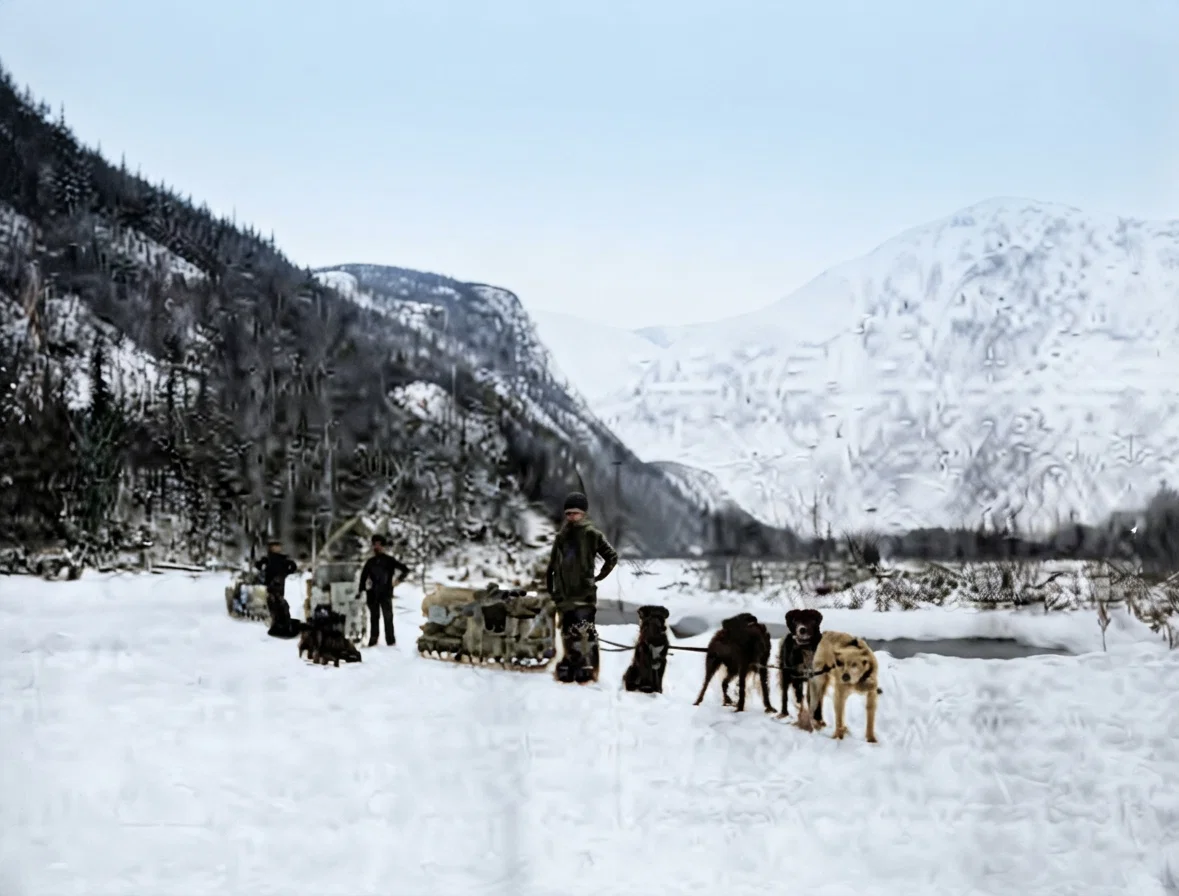
AN ALASKAN DOG TEAM
Of Interest to Parents
By Editor
We have fifty-seven complete sets of back papers containing the articles on "THE CHILD" by Mrs. Dr. Mary Wood-Allen
As long as these last they will be sent for . . . 25c per set post-paid
We also have a limited number of back papers containing all of her articles except the one on "Temperance"
One new yearly subscription and one renewal, or two new yearly subscriptions, sent at one time, $2.50.
Two new yearly subscriptions and one renewal, or three new yearly subscriptions, sent at one time, $3.25.
Three new yearly subscriptions and one renewal, or four new yearly subscriptions, sent at one time, $4.00. Sample copies sent on application.
TO OUR PATRONS.
By Editor
Please be careful to write all names of persons and places plainly.
Send money by Post-office Money Order, Express Order, or Bank Draft on New York, Chicago, or San Francisco.
Orders and Drafts should be made payable to the Pacific Press Publishing Co.
Paper money or silver should be sent in a registered letter.
Registered mail is safe. Unregistered mail is at the risk of the sender.
Postage-stamps in five or ten cent denominations will be accepted for small amounts.
The address label on your paper will indicate the time to which your subscription is paid. In case of non-receipt of papers, or any other irregularity, please notify us immediately.
When subscriptions expire, no more papers are sent to the party except by special arrangement.
You are requested to watch the date on your label, and renew early, and save the loss of papers. We can not always furnish missing numbers.
When requesting change of address, be sure to give both old and new addresses.
Important.—If you order SIGNS, Our Little Friend, books, etc., at the same time, use a separate sheet of paper for each. If this request is complied with, it will materially assist in the prompt and accurate despatch of the business.
When writing to the editor, be sure to use a separate sheet of paper.
OUR GENERAL AGENTS.
By Editor
The literature published by the Pacific Press Publishing Company, of Oakland, California, may be obtained at the following agencies. As far as is convenient to our patrons, we prefer that orders be sent to the nearest agency.
General Eastern Agency—Pacific Press Pub. Co., 11 W. 20th St., New York, N. Y.
General Central Agency—Pacific Press Pub. Co., 14 W. 5th St., Kansas City, Mo.
General Southern Agency—1025-1027 Jefferson St., Nashville, Tenn.
Arizona Tract Society—Box 128, Prescott, Ariz.
Arkansas Tract Society—Springdale, Ark.
Atlantic Tract Society—11 W. 20th St., New York, N. Y.
Battle Creek Tract Society—271 W. Main St., Battle Creek, Mich.
California Tract Society—Box 534, Oakland, Cal.
Canada—Canadian Union Conference, 571 Yonge St., Toronto, Ontario.
Carolina Tract Society—910 East Ave., Charlotte, N. C.
Chesapeake Conference—C. D. Zirkle, Sec., 903 Woodley St., Baltimore, Md.
Colorado Tract Society—1112 S. 11th St., Denver, Colo.
Cumberland Tract Society—21 Hanson St., Lexington, Ky.
Dakota Tract Society—115 South Main Ave., Sioux Falls, S. D.
Florida Tract Society—Orlando, Fla.
Georgia Tract Society—243 S. Boulevard, Atlanta, Ga.
Illinois Tract Society—324 Dearborn St., Chicago, Illinois.
Indiana Tract Society—1311 Central Ave., Indianapolis, Ind.
Iowa Tract Society—603 East 12th St., Des Moines, Iowa.
Kansas Tract Society—821 West 5th St., Topeka, Kan.
Louisiana Tract Society—826 3rd St., New Orleans, La.
Maine Tract Society—North Deering, Me.
Manitoba Tract Society—462 Selkirk Ave., Winnipeg, Man.
Michigan Tract Society—226 Wash. Ave. N., Lansing, Mich.
Minnesota Tract Society—Box 989, Minneapolis, Minn.
Missouri Tract Society—14 West Fifth St., Kansas City, Mo.
Montana Tract Society—108 Grand St., Helena, Mont.
Nebraska Tract Society—1505 E St., Lincoln, Neb.
New England Tract Society—South Lancaster, Mass.
New Jersey Tract Society—140 Sheridan Ave., Paterson, N. J.
New York Tract Society—317 West Bloomfield St., Rome, N. Y.
Ohio Tract Society—Academia, Ohio.
Oklahoma Tract Society—Box 202, Oklahoma City, Okla.
Ontario Tract Society—15 Churchill Ave., Toronto, Ont.
Pennsylvania Tract Society—Box 614, Williamsport, Penn.
Quebec Tract Society—S. Stukely, P. Q., Canada.
S. D. A. Mission Board—Battle Creek, Mich.
So. Cal. Tract Society—516 Hill St., Los Angeles, Cal.
Tennessee Tract Society—415 Woodland St., Nashville, Tenn.
Texas Tract Society—510 Jackson St., Dallas, Texas.
Upper Columbia Tract Society—College Place, Wash.
Utah Tract Society—Box 286, Springville, Utah.
Vermont Tract Society—190 N. Winooski Ave., Burlington, Vt.
Virginia Tract Society—Chester, Pa.
Western Oregon Tract Society—201 2nd St., Portland, Or.
Western Washington Tract Society—309 2nd Ave., North Seattle, Wash.
West Virginia Tract Society—812 7th St., Parkersburg, W. Va.
Wisconsin Tract Society—203 High St., Oshkosh, Wis.
A Spendthrift World
"A Spendthrift World" is what a great Eastern paper calls it, in recording some of the budgets of nations. It declares: "Certain it is that the governments of the United States, Great Britain, France, and Germany, which are nearer to the peoples than any others, have been plunging into heavy expenditures for many years past." The idea is conveyed that the people are with the governments in this extravagance. In the matter of naval and military expenditures between the years 1870 and 1901 the expenditures of the United States have increased from $80,000,000 to $175,000,000; Great Britain, during the same period, from $120,000,000 to $615,000,000; Germany, from $56,000,000 to $120,000,000; France, from $117,000,000 to $204,000,000. During this same period, there has been corresponding municipal extravagance. To all this there will come a pay-day; and who can predict the sad results?
If I speak with the tongues of men and of angels,
BUT HAVE NOT LOVE,
I am become sounding brass, or a clanging cymbal.
And if I have the gift of Prophecy,
And know all Mysteries and all Knowledge;
And if I have all Faith, so as to remove Mountains,
BUT HAVE NOT LOVE,
I am nothing.
And if I bestow all my Goods to feed the poor,
And if I give my Body to be Burned,
BUT HAVE NOT LOVE,
It profiteth me nothing.
LOVE suffereth long, and is kind;
LOVE envieth not;
LOVE vaunteth not itself,
Is not puffed up,
Doth not behave itself unseemly,
Seeketh not its own,
Is not provoked,
Taketh not account of evil;
Rejoiceth not in unrighteousness,
But rejoiceth with the Truth;
Beareth all things,
Believeth all things,
Hopeth all things,
Endureth all things.
LOVE NEVER FAILETH:
But whether there be Prophecies, they shall be done away;
Whether there be Tongues, they shall cease;
Whether there be Knowledge, it shall be done away.
For we know in part,
And we prophesy in part;
But when that which is Perfect is come,
That which is in Part shall be done away.
When I was a child,
I spake as a child,
I felt as a child,
I thought as a child:
Now that I am become a man,
I have put away childish things.
For now we see in a mirror darkly;
But then face to face:
Now I know in part;
But then shall I know fully even as also I was fully known.
But now abideth
FAITH, HOPE, LOVE,
These three;
And the greatest of these is
LOVE.
Comfort Ye My People
"Comfort Ye My people."-God sometimes comforts by casting down. He casts down that He may build up.
Revealed to Ourselves
But He does not cast us down from any true eminence. He but leaves our bubble of self-righteousness and self-exaltation to burst of its own weakness. In other words, He reveals us to ourselves; He shows us just what we are and where we are.
Comfort for Sinful People
So when God says, "Comfort ye, comfort ye My people," He does not do it by telling them how good they are. He would not hide from them the fact that they are sinners; but He would have them understand that God is merciful; that their sins were covered, their iniquities forgiven. Where sin abounds, grace superabounds.
The Gospel Message
The Gospel Message.—And then He reveals the true Gospel message: "The voice of one saying, Cry. And one said, What shall I cry?" And here is the message which Peter declares to be the Gospel: "All flesh is grass, and all the goodliness thereof is as the flower of the field; the grass withereth, the flower fadeth, because the breath of Jehovah bloweth upon it; surely the people is grass. The grass withereth, the flower fadeth; but the Word of our God shall stand forever." Isa. 40:1-8.
All Flesh Is Grass
God does not degrade humanity by calling it grass; He places it on no lower level. He does not mar or stain it in the least. He tells of its true condition: "All flesh is grass." How frail and weak it is; how it is blown about by every wind oftentimes beaten down to the ground. How short is its life. To-day it is in the field alive and green; to-morrow it is cut down and withered. How utterly hopeless it is as a support, a stay, a dependence in any form. It is eaten and trodden down by the wild beast; it is ruined by flood, it is burned by fire. Truly the man would be foolish who preferred it to the enduring, living life-giving Rock.
Man Is Like Grass
Yet such is man—as the grass. Such he has been all the ages,—tender, frail, weak, pliable, vacillating, bending before every wind, and dying in a few days of old age. To what has any one of them amounted apart from God? Call the long roll of the ages: Nimrod, Alexander, the Pharaohs, Homer, Cicero, Cæsar, Shakespeare, Ingersoll, and many more who have achieved world-wide fame, eminent in statecraft, in tyranny, in war, in letters, in oratory; they have passed away as the grass, and have left no permanent stamp upon the world for good. "They all do fade as the leaf."
The Enduring Word of God
But God abides. His Word endureth forever. It is of Him, heavenly. It has within it all the potency of His power, His wisdom, His goodness, and for all eternity. That Word received into the willing heart is incorruptible seed to beget new life in the soul, and connect it with heaven. It is the bread of life upon which the soul may feed and grow. It is the living material which, if received and used, will build us up characters for eternity. It is the guide from this earth to a better world. It is a shield to ward off all the darts of the enemy. It is, in short, "the power of God unto salvation to every one that believeth;" it is the comfort of God to His people.
Who Is “Thy Neighbor?”
By Editor
Who Is "Thy Neighbor?"—Mr. Gompers says that trade-unionism has evolved a system of ethics one rule of which is, "Thou shalt not take thy neighbor's job." That is good. It however is not new. It is but one application of the commandment, "Thou shalt not steal." But this applies to all men, does n't it, Mr. Gompers? Or does Mr. Gompers mean by "neighbor" only a union man? We can hardly believe that. We know that "Thou shalt not steal" in a man's heart does not look for a union label. "A man's a man for a' that." And the neighbor, according to the scripture, is the one who recognized his brother's need. In the illustration given by the perfect Man, he happened to be a non-union Samaritan "scab," instead of one who bore the Jewish union label. If these are Mr. Gompers' principles, good.