Your ShelfYour Projects

Review and Herald, Vol. 92, No. 10.

Heaven’s Unspeakable Gift

Review and Herald

Feb 25, 1915

Review and Herald Publishing Association · Takoma Park Station, Washington, D.C. · Feb 25, 1915

Heaven’s Unspeakable Gift

Christ was treated as we deserve, that we might be treated as He deserves. He was condemned for our sins, in which He had no share, that we might be justified by His righteousness, in which we had no share. He suffered the death which was ours, that we might receive the life which was His. “With His stripes we are healed.”
By His life and His death, Christ has achieved even more than recovery from the ruin wrought through sin. It was Satan’s purpose to bring about an eternal separation between God and man; but in Christ we become more closely united to God than if we had never fallen. In taking our nature, the Saviour has bound Himself to humanity by a tie that is never to be broken. Through the eternal ages He is linked with us. . . . Christ is our brother. Heaven is enshrined in humanity, and humanity is enfolded in the bosom of Infinite love. . . . By love’s self-sacrifice, the inhabitants of earth and heaven are bound to their Creator in bonds of indissoluble union.
The work of redemption will be complete. In the place where sin abounded, God’s grace much more abounds. The earth itself, the very field that Satan claims as his, is to be not only ransomed but exalted. Our little world, under the curse of sin the one dark blot in His glorious creation, will be honored above all other worlds in the universe of God. Here, where the Son of God tabernacled in humanity; where the King of glory lived and suffered and died,—here, when He shall make all things new, the tabernacle of God shall be with men, “and He shall dwell with them, and they shall be His people, and God Himself shall be with them, and be their God.” And through endless ages as the redeemed walk in the light of the Lord, they will praise Him for His unspeakable Gift, Immanuel, “God with us.”—Mrs. E. G. White.

THE WORK

AND

THE WORKERS

Total sale of the Free Press Extra of the Protestant Magazine, February 1–17, 200,000 copies. Large orders still coming in. Let the good work go on!
Many patriotic lodges and societies are circulating the Free Press Extra of the Protestant Magazine, and are passing resolutions based upon our “Petition to Congress,” found on the next to the last page of the Extra.
We have printed 250,000 copies of the Free Press Extra of the Protestant Magazine, and are holding the forms for a fifth edition. Prices: single copy, 5 cents; 5 to 999 copies, 1 cent each; 1,000 copies, $8.00. When mailed by publishers: 10 copies to different addresses, 15 cents; 100 copies, $1.50.
A Florida business man who had previously donated some $40.00 to help circulate the Protestant Magazine, writes: “The American Citizen says you have issued a Free Press Extra, 16 pages, $8.00 per 1,000. For the inclosed check for $8.00 please spread 1,000 where they will do the most good. Send me sample copy only, and mark “Personal.”
Priest D. S. Phelan, editor of the Western Watchman (Roman), said this in his sermon at Mt. Carmel Church, St. Louis, Mo., Jan. 25, 1914: “If the Catholics were united, we could walk over the world. We are respectable people, we are intelligent people, we can hold our own anywhere. In the pulpit, the world must listen to us. WE CONTROL THE PRESS OF THE UNITED STATES.” Don’t you think it is about time you circulated some more copies of the Free Press Extra of the Protestant Magazine?
The March or “Growing Old Gracefully” number of Life and Health contains much other vital matter besides the above-named symposium by our Seventh-day Adventist veterans, J. O. Curliss, J. N. Loughborough, and H. A. St. John. This number contains thirteen departments: “General Articles,” “The Consultation Room,” “Stimulants and Narcotics,” “For the Mother,” “The Human Machine,” “Home Cooking School,” “Editorial,” “As We See It,” “Medical Missionary at Work,” “Questions and Answers,” etc. A good seller. Get it. Sample copy, 10 cents. Send $1.00 for 20 or $2.00 for 50 copies.
The February 13 issue of Harper’s Weekly devoted two full pages to “The Pro-Papal Program,” a reply by W. W. Prescott, editor of the Protestant Magazine, to Dr. Francis C. Kelley’s “Anti-Papal Panic” article in a previous issue of the same magazine. On the first page of this same issue of Harper’s Weekly appears an excellent editorial entitled “Against Free Speech,” which is aimed directly against the anti-free-press bill introduced in Congress by Congressman Gallivan of Massachusetts. Speaking of the Protestant sects, the editor well says: “It is none of those religions or creeds that the bill protects from criticism, but the beliefs of the Roman Catholics. If so, wise Catholics will take no steps in support of a bill so subversive of the fundamental American right of free speech.” This makes six articles that have thus far appeared in Harper’s Weekly on the “Anti-Papal Panic” topic.
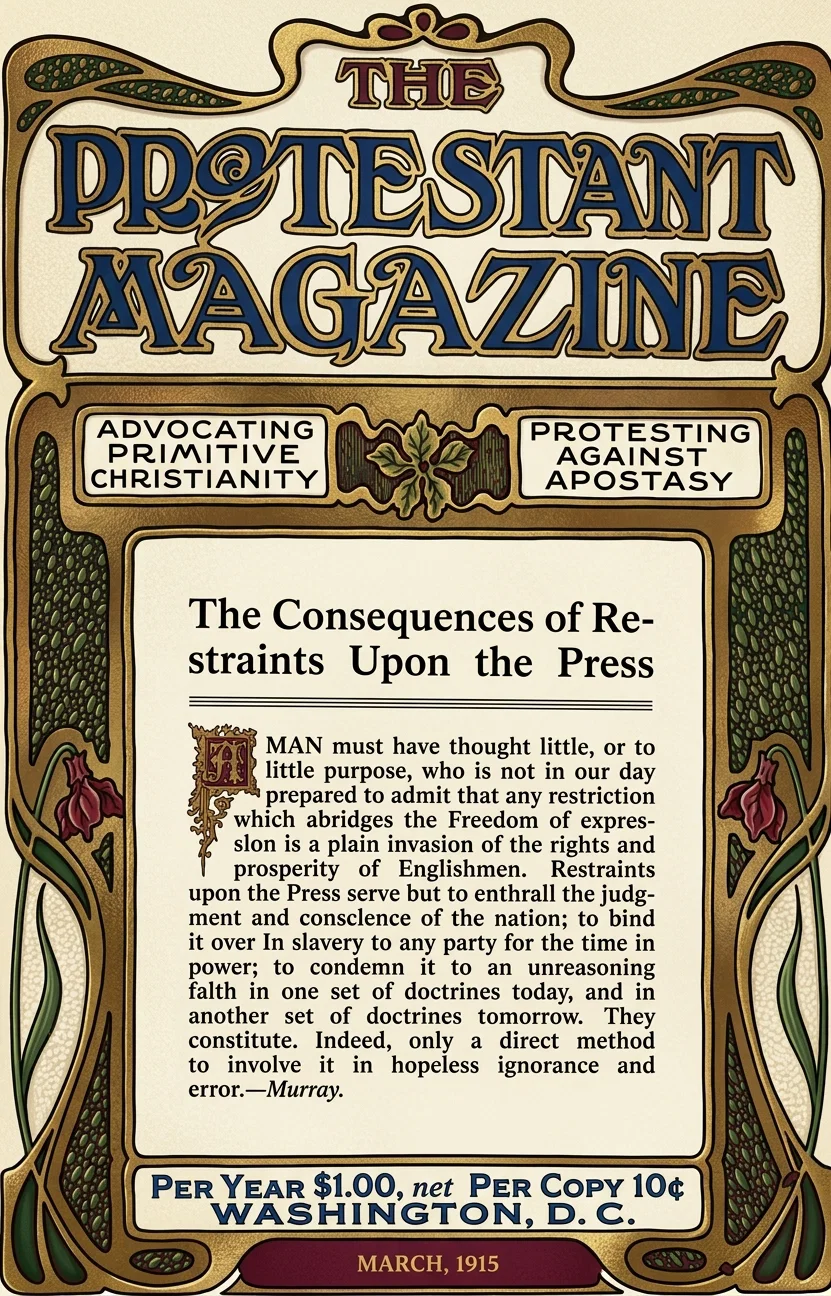
The March issue of the Protestant Magazine we have called the “Congressional Free Press Hearing” number. It contains the speeches delivered by the three Roman Catholic Congressmen in favor of the three Fitzgerald and Gallivan bills aimed at the freedom of the press, also the able arguments of the Protestant clergymen and laymen who opposed the bills. The arguments and verbal fireworks in this remarkable hearing are well worth reading and preserving for future use. This great March number should be given the WIDEST PUBLICITY POSSIBLE. The “Picture Section” of four pages contains the pictures of Congressmen Fitzgerald, Gallivan, and Maher, also of Rev. Randolph H. McKim; Rev. G. F. Williams, president of the American Federation of Patriotic Societies; Rev. W. Russell Collins, of the Converted Catholic; Prof. C. S. Longacre, editor of Liberty; Sanford B. Horton, of the Columbia Religious Liberty Association; Rev. Howard G. England, of the District of Columbia Guardians of Liberty; Rev. Clarence A. Vincent, pastor of Mount Pleasant Congregational Church; and Mr. John D. Bradley, president of the Washington Secular League. Send $1.00 for 20 or $2.00 for 50 copies of this powerful number. It also contains leading statements of the press—secular, Protestant, and Romanist—upon this hearing before the House of Representatives Committee on Post Office and Post Roads,—a hearing that brought out the truth concerning Rome’s methods in America and her opposition to free speech and free press, as no other hearing has ever done. This number will be mailed to 5 or more names and addresses, by the publishers, at the rate of 5 for 25 cents, or 20 for $1.00. Order TODAY.

Where the “Protestant” Free Press Extra Is Going—No. 2

Up to Wednesday noon, February 17, orders for 193,510 copies of the Free Press Extra of the Protestant Magazine had been received from the following twelve union conferences, as follows:—
Atlantic Union, 20,066 copies, as follows: Massachusetts, 4,000; Greater New York, 5,875; New York, 5,186; Western New York, 2,555; Northern New England, 1,600; Southern New England, 1,750.
Columbia Union, 23,679 copies, as follows: Chesapeake, 1,025; District of Columbia, 1,068; New Jersey, 17,220; Ohio, 9,440; Eastern Pennsylvania, 1,745; West Pennsylvania, 200; Virginia, 2,171; West Virginia, 810.
Lake Union, 59,759 copies, as follows: Northern Illinois, 2,050; Southern Illinois, 1,305; Indiana, 35,005; East Michigan, 10,643; North Michigan, 2,666; West Michigan, 5,595; Wisconsin, 2,495.
Southern Union, 4,600 copies, as follows: Alabama, 500; Kentucky, 975; Louisiana, 200; Mississippi, 1,550; Tennessee, 1,375.
Southeastern Union, 12,910 copies, as follows: Cumberland, 1,350; Florida, 7,175; Georgia, 3,235; North Carolina, 1,150.
Southwestern Union, 5,825 copies, as follows: Arkansas, 600; New Mexico, 125; Oklahoma, 2,255; Texas, 1,570; South Texas, 1,275.
Central Union, 18,841 copies, as follows: East Colorado, 6,726; West Colorado, 150; Kansas, 3,385; Missouri, 5,040; Nebraska, 1,615; Wyoming, 1,925.
Northern Union, 11,775 copies, as follows: Iowa, 7,150; Minnesota, 3,325; North Dakota, 700; South Dakota, 600.
Pacific Union, 3,445 copies, as follows: Arizona, 1,000; California, 320; Southern California, 1,125; Utah, 1,000.
North Pacific Union, 17,955 copies, as follows: Montana, 1,225; Southern Oregon, 500; Western Oregon, 1,210; Southern Idaho, 375; Upper Columbia, 12,000; Western Washington, 2,645.
Canadian Union, 205 copies, as follows: Ontario, 205.
Western Canadian, 50 copies, as follows: Saskatchewan, 50.
Miscellaneous orders, 13,100 copies.
Grand Total ........ 193,510
The prices of this Free Press Extra are given elsewhere. Let the good work continue. This document should be placed in every home in America.
A. J. S. BOURDEAU.

Directory of Judges and Attorneys

WE have the 1915 directory of all judges and attorneys in the United States and Canada. If you have no suitable names and addresses to which to send the “War” Liberty, the Free Press Extra, or the March issue of the Protestant Magazine, send $1.50 to your tract society for every 100 copies of the Extra you wish to have the publishers mail for you, or $1.00 for every 20 copies of Liberty or of the Protestant Magazine (10 February and 10 March, if desired) you would like to have addressed, wrapped, and mailed for you by the publishers.

"The Heavens Declare the Glory of God"

MRS. L. R. REYNOLDS
The heavens declare thy glory, God! A thousand voices hath the night; Her eloquence, with grandeur shod, Proclaims thy majesty and might. The arching dome, so deep, so vast, Immensity of boundless space, Our finite minds can never grasp. Faint glimpses only may we trace With our poor, feeble, mortal eyes; But with compelling force we're told There must be One, all-great, all-wise, Who doth the universe uphold.
Unnumbered orbs on nothing hung, Launched out in space, yet, by command, In perfect harmony are swung, Each guided by unerring hand.
And, gazing on the stellar plain, With rev'rend eyes and marveling, Our tongues are dumb, for words are vain; Our thoughts too deep for uttering. The blinding glory is too much, We stand amazed; nor do we see The utmost gates of space that touch The borders of eternity.
Wichita, Kans.

Prayer

D. E. LINDSEY
“I exhort therefore, that, first of all, supplications, prayers, intercessions, and giving of thanks, be made for all men.” 1 Tim. 2: 1.
No other subject is so frequently brought before us in the Holy Scriptures as that of prayer. The reason is plain: prayer is the very life of experimental religion. It is an exercise that should form the basis of all duties. Conditionally, it is the procurer of all blessings, the averter of all dangers. Prayer may be either a silent address of the heart or the express utterance of the lips. It may be for oneself, for others, for the church, or for the world at large. At present, we have to do more especially with public prayer in God’s house.
Living amid the evils of the last days, we ought to be moved to most earnest supplications for the prevention of these evils where they affect our brethren or our work. Our hearts should be deeply stirred. How many, almost heartbroken over the bereavement of a loved one, or, still more distressing, over a wandering boy or a wayward girl, have asked us to pray for them. How often the cry of distress comes to us for help, and our cries go out to God for the desired relief! Blessed privilege! How blessed to believe that the Lord hears the most humble cry of faith! We may ask for special blessings, for things needed, for strength to perform some important work.
We should make intercession for others, such as Abraham made for mercy on Sodom, or as Moses made for the forgiveness of Israel’s idolatry, or as Christ made for those who placed the crown of thorns upon his brow,—“Father, forgive them; for they know not what they do,”—or as Stephen made, when he prayed, “Lord, lay not this sin to their charge.”
We may thank God for blessings which come to the unjust as well as to the just,—for sunshine and rain, seedtime and harvest, health, prosperity, success in worthy enterprises, peace within our borders,—and even for the trials by which we are proved; for relatives, the church and all its privileges, Christian associates, the spread of the gospel, the triumphs of the cross, and the tokens of a soon-coming Saviour.

Application

Do you merely hear or do you join in the public prayer? I fear we are losing of the fervor of the primitive worshipers in this exercise. “Blessed be the Lord God of Israel forever and forever. And all the people said, Amen, and praised the Lord.” 1 Chron. 16: 36. In Ps. 106: 48 we read: “Blessed be the Lord God of Israel from everlasting to everlasting; and let all the people say, Amen. Praise ye the Lord.” In 1 Cor. 14: 16: “Else when thou shalt bless with the spirit, how shall he that occupieth the room of the unlearned say Amen, at thy giving of thanks, seeing he understandeth not what thou sayest?”
We cannot thus pray for all men unless we are in the possession of the spirit of benevolence. Our prayers will be unavailing unless our hearts are right before God. I pray God to cleanse our hearts from all unrighteousness, and then he will not be robbed of the praise due his holy name.

Elijah a Type of the Remnant Church

GEO. O. STATES
I HAVE thought much of the experience of Elijah, and have received much encouragement in reading of the trials of this man of God. The Lord’s professed people had forsaken the true God and gone into idolatry until but few remained loyal to God. Elijah saw that through worldly influences the Lord’s people were fast departing from the true God, and earnestly prayed that the judgments of God might come upon them in order to save them from total apostasy. The Lord heard the prayer of his servant, and the rain was withheld. In the years of famine which followed, God’s servant had to trust implicitly in the true God. No worldly powers would or could give him any aid.
In the closing of the third angel’s message God’s people will be forced by the conditions surrounding them to cut loose from every worldly association and trust in the Lord, and in him alone, as fully as did Elijah.
As verily as Elijah came to a place where the ravens brought him bread and flesh, as verily as the barrel of meal and the cruse of oil did not fail, so will it be in the time of trouble. “I saw the saints leaving the cities and villages, and associating together in companies, and living in the most solitary places. Angels provided them with food and water, while the wicked were suffering from hunger and thirst. Then I saw the leading men of earth consulting together, and Satan and his angels busy around them. I saw a writing, copies of which were scattered in different parts of the land, giving orders that unless the saints should yield their peculiar faith, give up the Sabbath, and observe the first day of the week, the people were at liberty, after a certain time, to put them to death.”—“Early Writings,” pages 282, 283. As God provided for his servant, so will he provide for the remnant people.
Those who have watched the trend of the churches and of the various worldly organizations can see that we are fast coming to the time when Protestantism, Spiritualism, and Catholicism will unite in enforcing the mark of the beast. Those who have observed the growth of Spiritualismcan readily see that “Spiritualism is now changing its form, and, veiling its more objectionable features, is assuming a Christian guise.” I can see the developing of the very condition for which we have looked for so many years—the uniting of all the powers of earth to persecute the remnant church. As we enter the time of trouble, the blame for the terrible conditions that come upon the world will be laid upon God’s people; but as God protected Elijah, so will he surround his people with heavenly angels, and preserve them from evil.
Cedaredge, Colo.

The Value of a Human Soul

J. E. CALDWELL, M. D.
“ONE soul is of more value to Heaven than a whole world of property, houses, lands, money. For the conversion of one soul we should tax our resources to the utmost. One soul won to Christ will flash heaven’s light all around him, penetrating the moral darkness, and saving other souls.”—“Testimonies for the Church,” Vol. VI, pages 21, 22.
The worth of a thing is generally expressed in terms of a unit of value. In most civilized countries the unit is a piece of money of some convenient and well-understood denomination, as the dollar in this country and the pound sterling in Great Britain. Fractions of these units express all small values, while multiples of them express greater values. Every kind of material wealth is generally reduced to its money equivalent, to have its value expressed.
Some immaterial values have also been reduced to money equivalents, and we hear of decisions in court by which a money value is placed upon sorrow, disappointment, or bereavement, in a suit for breach of promise or for the alienation of affections of a loved one by another. Another curious form of expressing men’s estimate of worth in dollars, or the money value put upon human suffering, is met when outlaws kidnap a person and hold him for the purpose of demanding a redemption price.
An eminent jurist once objected to the plan of salvation on the ground that, as he stated, it would be unjust to allow the innocent to suffer for the guilty, allowing the latter to go free. He did not believe the Creator would be a party to an unjust act. In answering his objection the following allegory was given: A young daughter of fond parents, who were well-to-do, was kidnapped and carried away into the mountains and hidden in a cave. After a few weeks spent by the distracted parents in a vain search for the child, word came to them from the bandit that their daughter was well and strong, and was being well cared for and tenderly treated; but, with this news, there came a demand for forty thousand dollars as the price of her redemption, backed up with the announcement that if the demand was not met the child would be subjected to cruel treatment, and perhaps to a life of suffering and shame.
One who heard of it said: “O, that is too much! I would not pay such a price. If it were ten thousand dollars I might, perhaps, pay it.” But what said the loving father and mother, whose hearts were benumbed with indescribable dread at thought of what might happen to their loved child? They could ill afford the sacrifice; but when they were convinced that that was the only way of ever seeing their little one again, they promptly made arrangements, and when the amount was turned over and their daughter was again restored to their fond embrace in the quiet home, they felt well repaid for their sacrifice.
Now suppose the price fixed had been one hundred thousand dollars or half a million or five million. Would the larger price named have caused the parents to refuse the ransom, provided they had the means? You doubtless reply, No. You would gladly pay the price and recover the child.
The only conclusion tenable in considering this story is that if the one making the sacrifice sees in what he receives that which is, to his mind, a full equivalent to the price he pays, he is not a party to an unjust act. He alone must be the judge. One cannot pass judgment on the value of a voluntary sacrifice intelligently made by another. In this connection it may be remembered that the Scriptures declare, “He shall see of the travail of his soul, and shall be satisfied.” He shall see in the thing gained a full equivalent for his sufferings. Who, then, can declare the sacrifice an injustice?
This same illustration may serve to suggest to us at what an immense price the All-father holds the souls whom he has created. Since he is the Creator and Judge, it must be conceded that he alone can show the value of a soul. This is indicated in the sacrifice he has made for the redemption of souls lost in sin, who are subject to destruction. But we are taught that his sacrifice grew out of his character of love. “Hereby perceive we the love of God, because he laid down his life for us.” The one who thus sacrificed himself was the “Majesty of heaven, the King of glory.” He was the express image of his Father, “upholding all things by the word of his power.” It was said of him that “all things have been created through him, and unto him; and he is before all things, and in him all things hold together.” Col. 1: 16, 17, R. V., margin.
We are assured that if it had been seen that only a single soul would have accepted the offered salvation, God’s heart of love would have impelled him nevertheless to make the sacrifice, just the same, for that one soul. How great must be the worth of a single soul in the sight of Heaven! It is too vast for even the strongest imagination. This must have been in the heart of the great Shepherd when he left the “ninety and nine” and came to seek and to save the one sheep that was “gone astray.”
In contemplating the great fact that we have been made the beneficiaries of his sacrifice, can we count any sacrifice
or any self-denial for the other objects of his love, too great for us to make? John said, “Hereby perceive we the love of God, because he laid down his life for us: and we ought to lay down our lives for the brethren.” 1 John 3: 16.

A Serious Question

M. E. STEWARD
WHEN our Lord comes to earth again, he will find a people who “keep the commandments of God.” One of these commandments relates to Sabbath observance. This people will keep the Sabbath as God requires it to be kept; otherwise he could not designate them as commandment keepers.
Is it not of the utmost importance that we know precisely what the Lord calls Sabbath keeping? Isaiah makes it very plain to all who believe in understanding the Bible as it reads, literally: “If thou turn away thy foot from the Sabbath, from doing thy pleasure on my holy day; and call the Sabbath a delight, the holy of the Lord, honorable; and shalt honor him, not doing thine own ways, nor finding thine own pleasure, nor speaking thine own words.” Could anything make the meaning clearer?
The company brought out by the third angel of Revelation 14 comply with these specifications of Isaiah 58. When the third message first arose, the Sabbath was kept in this strict way; there then, was no worldly conversation, and the mind was stayed on divine things. As far as I knew there was no talking about crops or trades or occupations on the Sabbath; nor did the sisters have anything to say about their cooking or sewing. Neither men nor women were planning about their work, even in their own minds. No doubt it could truly have been said of Adventists at that time, “Here are they that keep the commandments of God.” Those Christians enjoyed the blessing of Heaven. Sweet brotherly love bound the hearts of the believers together. Humility of dress and soul distinguished them.
In “Patriarchs and Prophets,” page 307, we read: “God has given man six days wherein to labor, and he requires that their own work be done in the six working days. Acts of necessity and mercy are permitted on the Sabbath, the sick and suffering are at all times to be cared for; but unnecessary labor is to be strictly avoided. . . . Those who discuss business matters or lay plans on the Sabbath, are regarded by God as though engaged in the actual transaction of business. To keep the Sabbath holy we should not even allow our minds to dwell upon things of a worldly character.”
Not only are we in danger of not properly observing the Sabbath as it passes, but we are in danger of failing to realize all that it stands for and of enjoying it when we come up to it so wearied in body and mind that it is hard to comprehend anything in full. God gave the Sabbath to man to be a blessing, not a yoke of bondage. We may well ask if there isnot a way to avoid this exhaustion by better systematizing our work. And would not the one who so carefully prepared for the Sabbath, not only find it “a delight,” but most sweetly delight himself in the Lord?
A woman who had just accepted God’s Sabbath wrote: “I have had the privilege of keeping one of God’s holy Sabbaths, and now I have the privilege of keeping another.” It is indeed a privilege, for his Sabbath is a precious day.
And now, when we see God’s “judgments are in all the earth,” shall we not diligently “learn righteousness”? Let us seek a oneness with the heart of the decalogue, that we may “dwell in the secret place of the Most High,” and “abide under the shadow of the Almighty.” Then, indeed, will “his truth . . . be thy shield and buckler.” O, the privilege of being on the Lord’s side, of knowing that he is our salvation, though called to part with everything earthly! And we are never to forget that “the love of the Saviour is infinitely more tender than a mother’s love.”
Sanitarium, Cal.

“Unto All Men”

O. P. WILSON
“As we have therefore opportunity, let us do good unto all men, especially unto them who are of the household of faith.” Gal. 6: 10.
THERE are many ways in which we may do good to our fellow men. The preceding quotation from Paul’s letter to the Galatian brethren is, to my mind, a counterpart of the golden rule, given by Christ in his Sermon on the Mount: “Therefore all things whatsoever ye would that men should do to you, do ye even so to them: for this is the law and the prophets.” Matt. 7: 12. What is more beautiful to see than a family, a church, a school, in which all the members live in harmony with the golden rule, each loving the others as himself? Yet in the ranks of Seventh-day Adventists, as it was among the Jews, there sometimes arises the question, “Who is my neighbor?” This often causes much dispute, and we, too, sometimes regard as strangers and enemies those not of our faith.
The parable of the good Samaritan teaches a lesson to all who are troubled concerning how to treat their fellow men. “They [the Jews] had no doubt as to the heathen and the Samaritans. These were strangers and enemies. But where should the distinction be made among the people of their own nation, and among the different classes of society? Whom should the priest, the rabbi, the elder, regard as neighbor? They spent their lives in a round of ceremonies to make themselves pure. Contact with the ignorant and careless multitude, they taught, would cause defilement that would require wearisome effort to remove. Were they to regard the ‘unclean’ as neighbors? “This question Christ answered in the parable of the good Samaritan. He showed that our neighbor does not mean merely one of the church or faith to which we belong. It has no reference to race, color, or class distinction. Our neighbor is every person who needs our help. Our neighbor is every soul who is wounded and bruised by the adversary. Our neighbor is every one who is the property of God.”—“Christ’s Object Lessons,” page 376.
The Bible points out not only numberless duties which it is well for us to perform, but also several things we should not do. The apostle Paul says: “Recompense to no man evil for evil. Provide things honest in the sight of all men. If it be possible, as much as lieth in you, live peaceably with all men.” Rom. 12: 17, 18. In another place he says that we are to “owe no man anything, save to love one another: for he that loveth his neighbor hath fulfilled the law.” Chap. 13: 8. Now to owe a man does not mean money merely. To love one another means that we “render . . . to all their dues: tribute to whom tribute is due; custom to whom custom; fear to whom fear; honor to whom honor;” and we might add to this, a right example and a Christian influence.
There is much to be said about our daily walk, or our example, for we are our brother’s keeper. “Let us walk becomingly, as in the day; not in reveling and drunkenness, not in chambering and wantonness, not in strife and jealousy.” Rom. 13: 13. “For none of us liveth to himself, and no man dieth to himself.” “We have many members in one body, and all members have not the same office: so we, being many, are one body in Christ, and every one members one of another.” In such a house, members are not regarded as strangers and foreigners, but as brethren. Instead of addressing one another as Mr., Miss, or Mrs. —, they will say Brother or Sister —. Paul, in his letter to the Ephesians, said: “Now therefore ye are no more strangers and foreigners, but fellow citizens with the saints, and of the household of God. . . . In whom all the building fitly framed together groweth unto an holy temple in the Lord.” Eph. 2: 19–21.
If God’s people are to be “no more strangers and foreigners, but fellow citizens with the saints, . . . built upon the foundation,” and growing into an holy temple, “fitly framed together,” they will be far from following the ways of the world. “Love not the world, neither the things that are in the world. If any man love the world, the love of the Father is not in him.” 1 John 2: 15. Conformity to the standards and customs of the unbelieving will not help our fellow men; and what is more true, it will be a dishonor to them who are of the household of faith. Union with the world may appear at first in little and apparently innocent things. These innocent (?) little things may be in our dress, our talk, or our dealings with men. The uttering of one careless word, the wearing of a ring, a pin, or of feathers on our hats, may cause some of our brethren or sisters to doubt our sincerity, and later determine their destiny. It may be that a minister of the gospel, a teacher, a Bible worker, or an editor of one of our papers, while departing from the simplicity of dress which should characterize the children of God, does not realize that these little (?) things are an index to his character, or that his influence is “unto all men.” Nevertheless it is; else why would the apostle have said when writing to the Thessalonian brethren, “Abstain from all appearance of evil”? To be popular may be up-to-date; but it is the worldly element, both inside and outside the church, who love such popularity.
Loyalty to the church is loyalty to God; and when popularity, display, and fashion come into the church, God is dishonored. It matters not whether we are farmers, or teachers, or preachers, we are as one man in the church of Christ. “For as many of you as were baptized into Christ did put on Christ. There can be neither Jew nor Greek, there can be neither bond nor free, there can be no male and female; for ye are all one man in Christ Jesus.” Gal. 3: 27, 28. Christ prayed that all his people be one, even as he and his Father are one. “Neither pray I for these alone, but for them also which shall believe on me through their word; that they all may be one; as thou, Father, art in me, and I in thee, that they also may be one in us: that the world may believe that thou hast sent me.” John 17: 20, 21.
In the light of the teachings of Christ and the apostles, can any of us say that we live unto ourselves? “Let no man deceive himself. If any man thinketh that he is wise among you in this world, let him become a fool, that he may become wise.” 1 Cor. 3: 18. Our Saviour has warned us against empty honor and worldly titles. “But be not ye called Rabbi: for one is your Master, even Christ; and all ye are brethren. . . . Neither be ye called masters: for one is your Master, even Christ.” Matt. 23: 8, 10. “Seekest thou great things for thyself? seek them not;” for that is not doing good “unto all men.” “If then ye were raised together with Christ, seek the things that are above, where Christ is, seated on the right hand of God.” Col. 3: 1.

Strength in Prayer

DAILY beset by temptation, constantly opposed by the leaders of the people, Christ knew that he must strengthen his humanity by prayer. In order to be a blessing to men, he must commune with God, pleading for energy, perseverance, and steadfastness. Thus he showed his disciples where his strength lay. Without this daily communion with God, no human being can gain power for service. —“Counsels to Teachers,” page 323.

Giving Thanks for God’s Mercy

The “O give thanks unto the Lord; for he is good: for his mercy endureth forever.”

The Blessing of Contentment

THERE is no condition in life so health-giving as that of being in harmony with one’s environment. If we can feel that God has placed us where we are; that he has assigned to us our work, and that it is for us, even under the most forbidding circumstances, to do the best we can cheerfully and lovingly, it will relieve much of life’s pressure, and take away much of the discontent which otherwise comes to us. “Contentment is a pearl of great price, and whoso purchaseth her at the expense of ten thousand desires, maketh a wise and happy choice.” The apostle Paul teaches this lesson of contentment when he says: “I have learned, in whatsoever state I am, therewith to be content. I know both how to be abased, and I know how to abound: everywhere and in all things I am instructed both to be full and to be hungry, both to abound and to suffer need.” In Let us seek to adjust ourselves to our environment, even though we may feel that we have made a mistake and have been brought into our present situation by an unwise choice or by selfishly choosing our own way. In spite of all discouragements let us seek to do the best we can where we are. We should make wrongs right, confess the sins we have committed against God and against our fellows, and then by prayer, by submission, by confidence in God’s leadings, believe that he will adjust every circumstance in life and cause even an unfavorable situation to work for our good and for his glory.

Daily Spiritual Manna

To the children of Israel the Lord gave fresh manna every day. This bread from heaven was designed to teach them that to the Father above they were indebted for every good and perfect gift, and that as they partook of this physical food and from it obtained strength and nourishment, so they could feed upon Christ, and in communion with him find strength for their spiritual natures. We need continually a fresh supply of spiritual manna. Too often, like some of the Israelites, we are prone to look to yesterday’s supply, forgetting that the storehouse of heaven is open to meet our daily need. We cannot trust to the experiences of the past for help. We must look to God daily for a fresh unction, for new power, for a daily infilling.
Continue reading: The Fight, the Faith, the Crown