The time-honored custom of consuming the flesh of animals which has prevailed in Western nations for so long, has flourished unchecked throughout the centuries in consequence of the popular belief that such a form of diet is both natural for man and necessary.
In all probability the cruelties which are involved in the flesh traffic, and the wholesale massacre of sentient creatures which flesh-eating necessitates, would have been stopped long ago in Christian lands were it not for the prevalence of this popular delusion. No thoughtful or humane person who is fully acquainted with the nature and extent of these barbarities, would attempt to justify them by advancing any other argument than stern necessity. As soon, therefore, as this—the only legitimate defence of the custom—is successfully refuted, and Christendom is made to realize that flesh-eating is not only unnecessary but also unnatural and a violation of God's physical laws, the voice of conscience may be trusted to bring about such an awakening of humane sentiment concerning this matter that the era of butchery and bloodshed will ultimately be brought to an end.
Man's physical structure reveals conclusively, and beyond all question, his Creator's intention concerning his method of living, and this revelation is one which is not only irrefutable, tangible, and capable of demonstration, but it also demands from us the fullest respect and obedience. Notwithstanding the erroneous ideas upon the subject which may have been held or taught by good men in bygone ages when the human race was existing in a state of semi-barbarism, this unanswerable fact confronts us—Man is created a “frugivorous” or fruit-eating creature, and neither his internal organs, his teeth, nor his external appearance, resemble those of carnivorous animals. To eat flesh, therefore, in any form is to violate a law of our being which must bring penalty upon us. Man is violating that law in many lands, and the widespread disease which exists where such violation is taking place, points in an unmistakable manner to the manifestation of cause and effect.
A considerable number of medical men are now being awakened to this fact, and are forbidding their patients to eat animal food—not only as a means of cure for such diseases as gout, rheumatism, etc., but as a preventive measure against complaints of various kinds. The following testimonies, which could be multiplied ad libitum, will be sufficient to corroborate the foregoing statements:—
The natural food of man, judging from his structure, consists of fruit, roots and vegetables.—Prof. Baron Cuvier.
Certainly man was never made to be a carnivorous animal.—Professor Ray.
No physiologist would dispute with those who maintain that man ought to live on vegetarian diet.—Dr. Spencer Thompson.
The teeth of man have not the slightest resemblance to those of carnivorous animals, and whether we consider the teeth, jaws, or digestive organs, the human structure closely resembles that of the frugivorous animals.—Prof. Wm. Lawrence, F.R.S.
The anthropoids and all the quadrumana derive their alimentation from fruits, grains, and other succulent vegetable substances, and the strict analogy which exists between the structure of these animals and that of man, clearly demonstrates his frugivorous nature.—Sir Richard Owen, F.R.S.
Comparative anatomy proves that man is naturally a frugivorous animal, formed to subsist upon fruits, seeds, and farinaceous vegetables.—Prof. Sylvester Graham, M.D.
It has been truly said that man is frugivorous. All the details of his intestinal canal, and above all his dentition, prove it in the most decided manner.—F. A. Pouchet, M.D.
It is, I think, not going too far to say that every fact connected with the human organization goes to prove that man was originally formed a frugivorous animal. This opinion is principally derived from the formation of his teeth and digestive organs, as well as from the character of his skin and the general structure of his limbs.—Prof. Sir Charles Bell, F.R.S.
There is no doubt that fruit and vegetable food purifies the blood, while meat inflames and is the source of many diseases, which are the punishment for breaking the natural law and command.—Dr. Josef Drzewiecki.
Flesh is an unnatural food and therefore tends to create functional disturbance. As it is taken in modern civilization, it is affected with such terrible diseases (readily communicable to man), as cancer, consumption, fever, intestinal worms, etc., to an enormous extent. There is little need to wonder that flesh-eating is one of the most serious causes of the diseases that carry off ninety-nine out of every hundred people that are born.—Josiah Oldfield, M.A., M.R.C.S., L.R.C.P.
I believe consumption is constantly communicated to human beings by eating diseased meat.—Dr. Marsden, M.O.H.
All the bloodshed caused by the warlike disposition of Napoleon is as nothing compared to the myriads of persons who have sunk into their graves through a misplaced confidence in the value of beef tea.—Dr. Milner Fothergill.
I do not consider flesh food (chemically and physiologically speaking) is a necessary food for man. There is no question about it that, owing to the evils likely to arise from imperfect supervision of private slaughter-houses, the present widespread ingestion of flesh is responsible to an appreciable extent for many diseases which now exist, and which vegetable eaters avoid. We have diarrhea, cramp, trichina disease, tuberculosis, carbuncle, malignant pustule, and the various forms of tapeworms through eating diseased meat.—J. Edwin Cooney, M.D., M.O.H.
The preceding evidence of anatomists and physiologists is corroborated by the testimony of thousands of living witnesses in various parts of the world and in all climates, who declare—after long experience—that they are healthier, happier, stronger, and more humanely disposed, whilst subsisting on a rational and bloodless diet than when they lived upon flesh food.—Herald of the Golden Age.
HOW TO GET THERE.
“TAKE a car.”
No, don’t; rather consider a moment how much we abuse our privilege of car-riding.
Many a time a brisk walk, to accomplish an errand or to reach a friend’s house, would do us good. The fresh air, the wholesome exertion of walking, the chance of meeting a friend on the way, the things we observe as we walk, are all in favor of walking, provided one is in10good physical condition and the weather “fair to middling.”
Observe the woman who habitually uses the “cable.” She hails it to tide her over a few blocks, even though she waits for it on a windy corner and stands while she rides, crowded among other women hanging upon straps. The jarring while standing is much worse than the fatigue of walking even for delicate women. Besides, very many who ride find that the nickels ooze out of the purse incalculably fast, and think with regret of trifles they go without which they might possess if they had the courage or energy to walk more.
So, my dear school-girls, wives, and mothers, if you want to reach grandmotherhood and a better bank account, and be, as Dr. Holmes said, only “seventy years young,” with firm step and the bloom of youth which no cosmetic can counterfeit, don’t so often “take a car.”—Christian Work.
LOVE
The sweetest lives are those to duty wed,
Whose deeds, both great and small,
Are close-knit strands of an unbroken thread,
Where love ennobles all.
The world may sound no trumpets, ring no bells;
The book of life the shining record tells.
Thy love shall chant its own beautitudes
After its own life working. A child's kiss
Set on thy singing lips shall make thee glad;
A poor man served by thee shall make thee rich;
A sick man helped by thee shall make thee strong;
Thou shalt be served thyself by every sense
Of service which thou renderest.
—Mrs. Browning.
A DAY AT THE HELPING HAND AND MEDICAL MISSION.
By B. F. Richards
(641-647 Commercial Street, San Francisco.)
FROM 5 o’clock in the morning till 12 at night, business is conducted at the mission. Frequently as early as 3 in the morning, the hurrying footsteps of the watchman can be heard as he is going to call some man who has given an emphatic order the night before, “Be sure you call me at 3, for I have struck a job and must be there in time.” When the call is made, the sleeper is given his clothing, which has just been brought from the fumigating-room, and as he pulls on each garment it is quite laughable to listen to the remarks made about the strange yet strong sulphurous odor that has so suddenly come up before him.
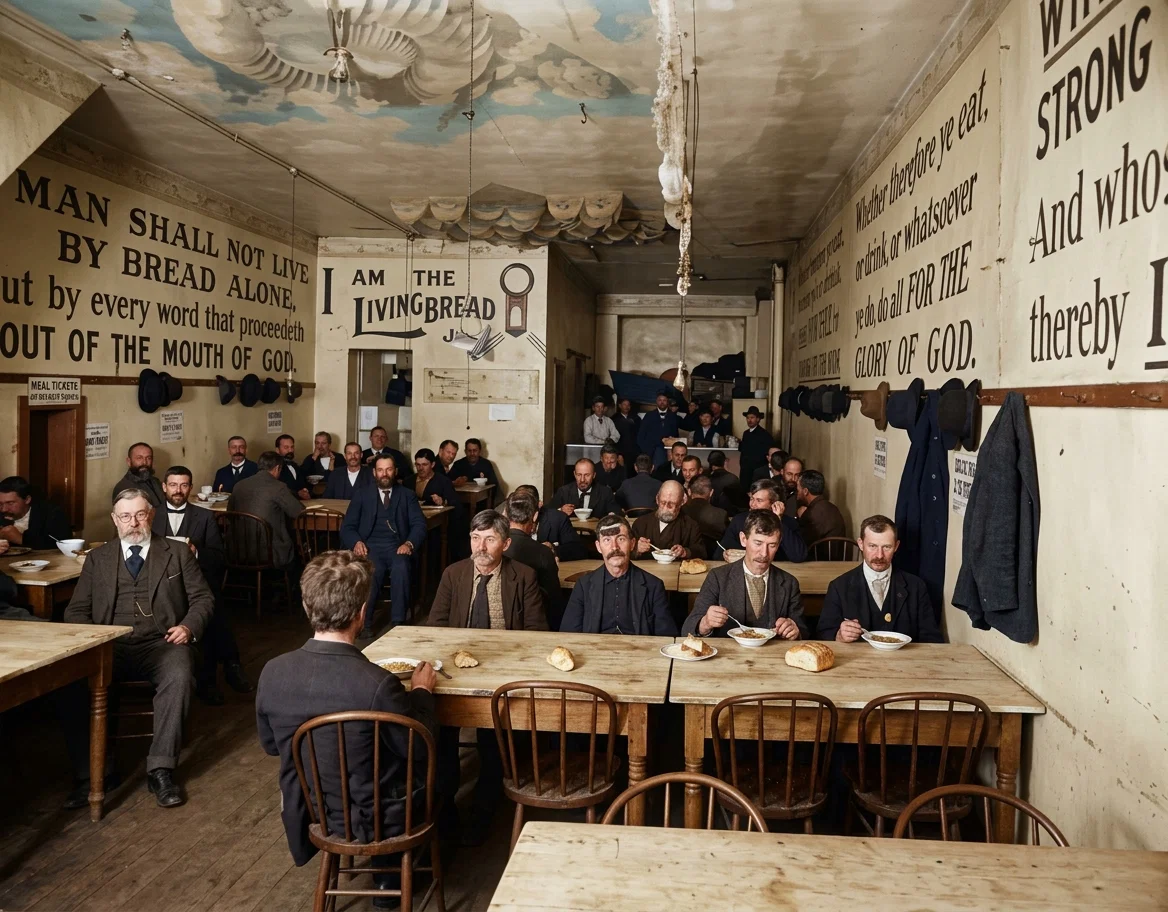
The first place of interest in early morning is in the dining-room. From 5:30 to 8 o’clock, men in all conditions of life may be seen. Some have just come from the streets, where they have been all the night; others come from “dives, brothels, cheap Chinese wine joints,” and other places of vice. Faces and clothing alike show the terrible battle they are passing through, and the awful havoc the devil is making among them.
Will this cruel, destructive work of butchery ever stop, we ask? Is there no power with which we can harness up the voice, and with the tones of thunder say: “STOP, you have done too much already. He who has been made in the image and likeness of my Master and my God, you have crippled, deformed, misused, and abused so that he is a travesty and a counterfeit on man whom the Lord made upright”?
Yes, there will come a time when the destroyer will be destroyed. The edict has gone forth: “I will bring thee to ASHES upon the earth in the sight of all them that behold thee. . . . Thou shalt be a terror, and NEVER SHALT THOU BE ANY MORE.” So, thank the Lord, the author of all this misery will soon come to an end.
From the dining-room we go to the laundry. Steam is seen rising in clouds from the tubs as the men are rubbing their garments back and forth over the wash-boards. From here they go with sentinel-like step up the stairs and ladder till the roof is reached. Here clothes-lines are always ready; it is now but the work of a moment to hang the11scanty wardrobe in the sun and air—two priceless gifts from our Father in heaven. Then the men sit down with a look of satisfaction on their faces, which seems to say, “There, that’s a good job and well done.”
The morning hour of 10 has come, and from each department in the mission can be seen the workers wending their way toward the room of the chaplain. Let us look in a moment; some one is reading the Bible. The best of attention is given; for each worker, who is a soldier and sentinel, is there for his “rations and ammunition,” which will enable him to make a vigorous fight in the battle which is waged each day. As the men come from this room, a happy, determined look is seen on each face. Why should they not be happy and determined? Look at the command of Him who made ALL things: “Have not I commanded thee? Be strong and of a good courage; be not afraid, neither be thou dismayed; for the LORD THY GOD is with thee whithersoever thou goest.” Joshua 1:9. This is God’s promise, yes, His COMMAND, to every soldier of His. So, dear reader, if you are a soldier of the Lord, enter the battle where you are, and go in to win; for the Lord is with you.
The dinner hour has come; so have hungry men from all over the city. Well-dressed men are here, hungry for a vegetarian dinner. They are taking a broader view of the motto, “Live and let live.” Love is kind, is gentle; surely there is no love in the act of taking life; and gentleness is entirely missing when the butcher holds down to slay the innocent, good, gentle lamb or calf, as it looks up into his face in such a pleading way, as if it was saying, “Spare me, spare me; I never sought to do you harm; I love my mother and freedom, and the things that God has made for both you and I to enjoy.” Love would spare.
Some men come and eat with us who are sick and feeble and need wholesome articles of food, that are well cooked, free from spices and condiments of every description, where fats and grease never enter, and where the tired and worn-out stomach finds rest. The poor, ragged, and garment-patched men eat with us; for their dimes and nickels are scarce, and pennies are looked upon as a “rarebit” frequently. Even without this commodity none are turned hungry from the door.
The 3 o’clock daily meeting is looked forward to with considerable pleasure by some members of our large and ever-changing family. Here the study of the Bible is carried on. Bibles are distributed, and men are invited to enter the class, some of whom have never had a Bible in their hands before. Others are students of rare ability; some have been preachers; some, doctors, lawyers, reporters, stenographers; some are infidels and skeptics. Here are mechanics of all branches. Frequently the time of two hours is taken up and well spent in this class.
The routine work of the day is past; the time for the evening meetings is here. Every worker in the house again repairs to the room of the chaplain to thank God for the work of the day, and to ask Him to take full control of hearts, bodies, minds, and souls, as all are dedicated to Him. We are now ready. Hymn-books are distributed, the song is selected, singing is begun, and praises to God ring through the chapel, mission, and street for fully fifteen minutes; then words of exhortation are given by Elder Dexter or the writer; then prayer service is engaged in, and afterwards comes the sermon. Men then are given an opportunity to seek the Lord; testimonies are borne, and if there is ever a place made sacred by the presence of the Spirit of God, it is the chapel of the Helping Hand and Medical Mission.
Here are some of the words of testimony from men who have been rescued from dingy prisons of the enemy:—
“For twenty years I have been a good worker for and with the devil; he has abused me daily every step of the way. He clothed me in rags and fed me on worse than husks. I had given up in despair, but my steps were guided to this mission, and, glory to God, here I found the Saviour.”
“My mother’s prayer has been answered. I have committed every crime possible for man to do, but murder. I have gone down lower than the animal, wallowed in the gutter, come to the point where I would kill myself; but you people told me so many times that Jesus was mighty to save! I could not see how it was possible for Him to do anything for me; but, O, praise the Lord, I have found Him, and He is mine!”
“I know every trick, nook, and crook of the devil, and have worked in all of them. For nearly twenty-five years I have been a terrible drunkard, and for a year and a half I have not drawn a sober breath. What a wreck he has made of me! but I am through; from this night I will work for Jesus.”
“All taste for tobacco and whisky is gone. Jesus has done it, and I am going home to see my poor old mother. I have broken her heart, but it shall be healed, with the help of God.”
“I thank God for this mission; for it is here I learned about His holy Sabbath day.” (This speaker is over seventy years old.)
Another asked, “Can you tell how a poor drunkard can be saved? I am drunk now, but I want to be free from this terrible power; tell me what I can do to be saved.” (This poor man surrendered all to God.)
We have so many who have been maimed, bruised, made blind; but, thank the dear Lord, they have seen and tasted that He is good!
After this meeting is over, we go into the street, and here we have a feast with the Lord. People come from every direction, and while we are talking to them, the best of attention is given. Well-dressed men and women attend our street meetings. Here, too, we find the “poor, maimed, halt, and blind,” who seem to be so grateful for the Word of God so plainly spoken and so full of love to them.
While on the street we have the privilege of pointing the bruised and bleeding to the medical department, where they receive kind attention from Doctor Moran and Brother Hare, the nurse.
The following is a report of work done for the month of June:—
| | |
|---|---:|
| Penny lunches served | 29,138 |
| Beds occupied one night | 2,269 |
| Baths given | 638 |
| Garments fumigated | 5,059 |
| Persons using free laundry | 159 |
| Garments distributed | 1·6 |
| Medical treatments given | 300 |
| Men furnished employment | 723 |
| Bible-readings given | 63 |
| Men requesting prayers | 67 |
| Men professing Christ | 20 |
| Sermons preached | 30 |
In addition to the above, meetings on the streets have begun, and from the start good attention has been given, and audiences ranging from fifty to over one hundred have listened to the Gospel. So we have great reason to praise the Lord.
B. F. RICHARDS, Chaplain.
San Francisco, Cal., July 1, 1898.
MEN WHO SHOULD NOT MARRY.
Not long since a writer in the New York Times gave a list of men who should not marry. We copy out of that list and comments thereon the following, from the Pacific Ensign, with the suggestion, brother, that if the truth strikes too close home, there is grace in Christ to effect a reformation.
The man who talks about “supporting” a wife when she is working fourteen hours a day, including Sundays.
The man who thinks his wife exists for the comfort and convenience of his mother and his sisters.
The man who provides himself with a family and trusts Providence to provide the family with a home and something to eat.
The man who thinks that women are angels.
The man who thinks that nobody but an angel is good enough to be his wife.
The man who thinks a woman ought to give up a thousand-dollar salary and work in his kitchen for her board and a few clothes, and be glad of the chance.
The man who thinks a five-year-old worsted street gown is the proper sort of toilet for a dinner party or a reception.
The man who labors under the delusion that his wife’s money belongs to him.
The man who thinks a parlor carpet ought to last fifteen years.
The man who has seventy-five dollars worth of fishing tackle and can’t afford a new set of curtains for the dining-room.
The man who always leaves his wife at home when he takes his summer vacation.
The man who doesn’t know what on earth a woman wants with money when she has a bill at the dry goods store.
The man who thinks a sick wife would feel better if she would “just get up and stir around.”
The man who forgets his manners as soon as he crosses his own threshold.
The man who thinks he can keep house better than his wife does.
The man who thinks it is “all nonsense” for a woman to want a ten-cent bunch of pansies or violets, when she hasn’t seen a flower for five months.
The man who thinks a woman’s bonnet ought to cost about seventy-five cents.
The man who thinks there is “no place like home”—for grumbling and growling.
If the man who considers a bunch of flowers a useless extravagance will contrive to marry a woman who does not care for flowers, there will be no marital trouble on that score. If the man who objects to paying milliners’ bills will select a woman who knows how to make her hats, they may live in peace all their lives; and so on through the whole list. But the chances are that the sensitive, beauty-loving woman falls a prey to the coarse, unesthetic man, and inevitably that marriage becomes sooner or later a failure. The intellectual woman is thrown into the hands of the man who is marrying just to get a maid of all work, and divorce or separation becomes more than a remote possibility.
Conversely, the frivolous society woman makes a victim of the earnest, home-loving man; the slovenly, careless woman, who can not keep house, manages to attract a man who loves cleanliness, beauty, and order in all things, and happiness is never found at that hearthstone. All that misery could easily be avoided.
“How long have you known your husband?” asked one woman of another.
“Twelve years,” was the reply.
“Why, I thought you were engaged for several years before your marriage.”
“So I was,” said the married woman with a sigh, “but I never knew John till I got married to him.”
No matter how long the courtship, people generally are total strangers to each other when they stand up before a minister and promise to live together as husband and wife until death parts them. They have discussed Shakespeare and Browning, and if married life were a Shakespeare club or a Browning society, all would be well with them. But he has a certain ideal of wifehood and home life, and of this ideal she is as ignorant as she is of Sanskrit or Hottentot. She, too, has her idea of what a husband and a home should be, but she never talks to her betrothed on such commonplace themes as this.
They take the leap in the dark at a flower-decked altar, and in nine cases out of ten add another figure to the sum total of unhappy marriages.
Everybody has two personalities: One is an elegant cultured individual of easy manner and amiable speech, who discusses poetry and philosophy in the drawing-room; the other is a plain, ordinary man or woman, full of whims, and fancies, and habits. There should be some legal or social writ of habeas corpus or summons that would bring this hidden self to light during the days of courtship. It would be an uncanny intrusion, but the number of inharmonious marriages would be immensely reduced.
THE TOWN OF NOGOOD.
My friend, have you heard of the town of Nogood, on the banks of the river Slow, where blooms the Waitawhile flower fair, where the Sometimeorother scents the air, and the soft Goeasys grow?
It lies in the valley of Whatsheuse, in the province of Leterslide. That tired feeling is native there. Its the home of the reckless Idontcare, where the Giveitups abide.
The town is as old as the human race, and it grows with the flight of years. It is wrapped in the fog of idlers’ dreams. Its streets are paved with discarded schemes, and sprinkled with useless tears.—New Haven Register.
Look Up, Not Down
By Edward E. Hale
Look up and not down; look forward and not back, look out and not in; and lend a hand.—Edward E. Hale.
Good Deeds Ennoble
“He who does a good deed is ennobled instantly; he who does a mean deed is, by the action itself, contracted.”
GOD’S WORK GOES ON.
By Josephine Pollard
God’s work goes on in spite of war and famine,
The dreaded pestilence of baneful blight.
In spite of all the selfish greed of mammon
That toils amid the shadows of the night;
In spite of evil hearts and hands essaying
To crush the temple that we build upon,
The law and order so divine obeying,
Unmoved by man’s device—God’s work goes on.
No human power can interrupt its mission;
As well attempt the planets to remove,
Or change a single star from the position
It holds amid the galaxy above.
And so, when all our plans prove unavailing,
When busy hands and throbbing hearts are stilled,
Doubt not, but rest assured and still; unfailing,
God’s work goes on—His plans are all fulfilled.
—Josephine Pollard.
Our Work and Workers.
THREE camp-meetings will commence on the 11th inst.—at Wilmington, Del.; Tiffin, Ohio; Clinton, Missouri.
BROTHER W. A. Hennig reports the baptism of eight persons at St. Joseph, Mo.; also the addition of four members to the church at Kansas City.12
AT the last quarterly meeting of the church at Head Harbor, N. S., five members were added.
BROTHER A. E. Place, president of New York Conference, gives notice that a camp-meeting will be held at Rochester, September 8-18.
NOTICE that the Vermont camp-meeting will be held at Bennington, September 1-10, is given by Brother K. C. Russell, president of the conference.
BROTHER C. A. Pedicord, who has been connected with the book work in Michigan, has been called to California to act as State canvassing agent.
A CHURCH of twenty-one members was organized at Onawa, Iowa, July 2, and the next day nine persons were baptized in Guard Lake by Brother J. S. Hart.
ON a recent Sabbath five persons were baptized and added to the church in Brooklyn, N. Y., and other candidates awaited a like opportunity the next Sabbath.
FROM Honolulu comes the report that Brethren A. G. Haughey and W. S. Huffaker are having an excellent interest in meetings which they are conducting in that city.
BY special invitation, Brother R. M. Kilgore, superintendent of District No. 5, presented the views of Seventh-day Adventists before the State Chautauqua at Springdale, Ark.
THE financial report of the children’s school at Pieterlen, Switzerland, shows a cost of twenty cents per day for each child. This includes board, room, fuel, lights, tuition, books, mending, and washing.
IN connection with meetings being held in Custer, S. D., by Brother J. H. Wheeler, eight had resolved to obey the Word of God, and the same report stated that as many more were on the point of deciding.
TENT-MEETINGS in progress at Kearney, Neb., are reported to be increasing in interest. Six had taken their stand for the truth at last account, and the Sabbath-school had grown to a membership of twenty-two.
A REPORT in the Review, of the recent camp-meeting at Mitchell, S. D., says: “Brother W. J. Wilson, from Dunbar, Neb., spoke in behalf of an industrial home for the blind, and a paper to be published for them in a print that they can read with their fingers. He said that a large and very pleasant site had been secured at Dunbar, and that he is receiving hearty material support wherever he goes.”
BROTHER J. E. Fulton, our missionary at Suva, Fiji, who came to California a short time ago to place his wife under medical care, left this city for Seattle, Wash., on the 20th ult. From there he was to take steamer on the return voyage to Suva. Having been in Fiji about three years, Brother Fulton has become fairly well acquainted with the native tongue, and is preparing literature for publication in that language.
MEDICAL work has been connected with the mission at Clinton, Iowa. Brother C. Santee tells some of the results in a report to the Workers’ Bulletin, mentioning two special cases: “A young man came to the mission a few weeks ago so crippled with rheumatism that he could not walk. He has gone home well, having gained twenty pounds under treatment. Another young man came with his right arm withered and paralyzed. With three weeks’ treatment he was so helped that he is now able to use his arm and do carpenter work right along.”
THAT THE seventh day is the Sabbath is a truth so plain that even children can understand that it is taught in the Bible. A boy of fifteen years recently went into a tent-meeting in Glenwood, Iowa. He told the brethren who conducted the services that he kept the Sabbath, and on being asked how he came to see the truth on that subject, he replied: “O, I read the Bible through three times, and all the history I could find, and I couldn’t find anything for Sunday! Everybody says that Sunday is the first day of the week, so Saturday must be the seventh day. The Bible says the seventh day is the Sabbath, so I keep that day.”
1 “And God remembered Noah, and every living thing, and all the cattle that were with him in the ark; and God made a 2 wind to pass over the earth, and the waters assuaged; the fountains also of the deep and the windows of heaven were 3 stopped, and the rain from heaven was restrained; and the waters returned from off the earth continually; and after the 4 end of an hundred and fifty days the waters decreased. And the ark rested in the seventh month, on the seventeenth day 5 of the month, upon the mountains of Ararat. And the waters decreased continually until the tenth month; in the tenth month, on the first day of the month, were the tops of the mountains seen. And it came to pass at the end of forty days, 6 that Noah opened the window of the ark which he had made; and he sent forth a raven, and it went forth to and fro, until 7 the waters were dried up from off the earth. And he sent 8 forth a dove from him, to see if the waters were abated from 9 off the face of the ground; but the dove found no rest for the sole of her foot, and she returned unto him to the ark, for the waters were on the face of the whole earth; and he put forth his hand, and took her, and brought her in unto him into the ark. And he stayed yet other seven days; and again he sent 10 forth the dove out of the ark; and the dove came in to him at eventide; and, lo, in her mouth an olive leaf plucked off; so Noah knew that the waters were abated from off the earth. 11 And he stayed yet other seven days; and sent forth the dove; 12 and she returned not again unto him any more. And it came 13 to pass in the six hundred and first year, in the first month, the first day of the month, the waters were dried up from off the earth; and Noah removed the covering of the ark, and 14 looked, and, behold, the face of the ground was dried. And in the second month, on the seven and twentieth day of the month, was the earth dry. 15 “And God spake unto Noah, saying, Go forth of the ark, 16 thou, and thy wife, and thy sons, and thy sons’ wives with 17 thee. Bring forth with thee every living thing that is with thee of all flesh, both fowl, and cattle, and every creeping thing that creepeth upon the earth; that they may breed abundantly in the earth, and be fruitful, and multiply upon the 18 earth. And Noah went forth, and his sons, and his wife, and 19 his sons’ wives with him; every beast, every creeping thing, and every fowl, whatsoever moveth upon the earth, after 20 their families, went forth out of the ark. And Noah builded an altar unto the Lord; and took of every clean beast, and of every clean fowl, and offered burnt-offerings on the altar. 21 And the Lord smelled the sweet savor; and the Lord said in His heart, I will not again curse the ground any more for man’s sake, for that the imagination of man’s heart is evil 22 from his youth; neither will I again smite any more every thing living, as I have done. While the earth remaineth, seed-time and harvest, and cold and heat, and summer and winter, and day and night shall not cease.”
SUGGESTIVE QUESTIONS.
(1) Review carefully the main features of the last two lessons. (2) What did the Lord do? Vs. 1, 2. Note 1. (3) When did the waters begin to decrease? V. 3. (4) When and where did the ark find a resting-place? V. 4. Note 2. (5) When were the tops of the mountains seen? V. 5. (6) In what manner did the waters decrease? Vs. 3, 5. See margin. (7) At the end of forty days more, what did Noah do? (8) What other bird did he send forth? and what did this bird do? Vs. 8, 9. (9) At the end of seven days more what did he do? V. 10. Note 3. (10) What emblem did the dove bring back? What did it mean to Noah? V. 11. (11) How long before he sent the dove again? With what result? V. 12. (12) When did Noah look out and find the ground dry? Vs. 13, 14. Note 4. (13) What command did he now receive from the Lord? Vs. 16, 17. (14) How did he regard that command? Vs. 18, 19. (15) How did Noah now show his gratitude to God and faith in Christ? V. 20. Note 5. (16) Did the Lord accept the offering? What did He say in His heart? V. 21. (17) What did He say should not cease so long as the earth remains? V. 22.
Suggestive Readings.—“Patriarchs and Prophets,” pp. 111-116, or “Christian Education,” pp. 190-197.
NOTES.
1. God remembered.—He never forgets His own. He may seem to at times; but He can not. They are connected with Him by the great life current. Fountains of the deep, etc.—It was at this time that earthquake, storm, tidal wave, and convulsions of nature buried continents, upheaved continents and islands, buried vegetation for coal, and broke and formed strata innumerable.
2. Ararat.—The meaning of the word is “holy land,” or “high land.” A mountain, or range of mountains in Armenia, north of Assyria. The particular elevation is in question. The highest, a volcano, is 17,750 feet, and is covered with perpetual snow.
3. Seven days.—On or after the Sabbath. What is more reasonable to suppose than that Noah especially sought God on that day?13
4. On the tenth month, etc.—Compare with chapter 7:11. The flood began on the second month, the seventeenth day of the month, of Noah’s six hundredth year. Noah went into the ark on the tenth day. He came out on the twenty-seventh day of the second month of Noah’s six hundred and first year. Hence he was in the ark one year and twenty-two days.
5. An altar.—So the children of God should do everywhere, and God will bless those who thus remember Him.
6. To confirm.—“If God’s revealed will is so difficult to be understood, certainly men should not rest their faith upon mere suppositions in regard to that which He has not revealed. God’s ways are not our ways, neither are His thoughts our thoughts. Human science can never account for His wondrous works. God so ordered that men, beasts, and trees, many times larger than those now upon the earth, and other things, should be buried in the earth at the time of the flood, and there be preserved to evidence to man that the inhabitants of the old world perished by a flood. God designed that the discovery of these things in the earth should establish the faith of men in inspired history.”—Spirit of Prophecy, vol. 1, p. 90.
ADDITIONAL STUDY.
(1) Does the Lord ever forget His children? Isa. 49:15, 16. (2) How long was Noah in the ark? (3) What in this lesson shows that Noah regarded the weekly division of time, and therefore the Sabbath? (4) Note that Noah came forth from, as well as went into, the ark at the command of God. What lesson do you learn from this? (5) Why did Noah make an offering of every kind of clean beast and fowl? Why offer clean beasts and fowl? (6) What evidence does the earth itself give of a universal flood?