Your ShelfYour Projects

Signs of the Times, Vol. 24, No. 31.

THE GREAT AND THE GREATEST THINGS

Signs of the Times

Aug 4, 1898

Pacific Press Publishing Company · Oakland, California · Aug 4, 1898

THE GREAT AND THE GREATEST THINGS.
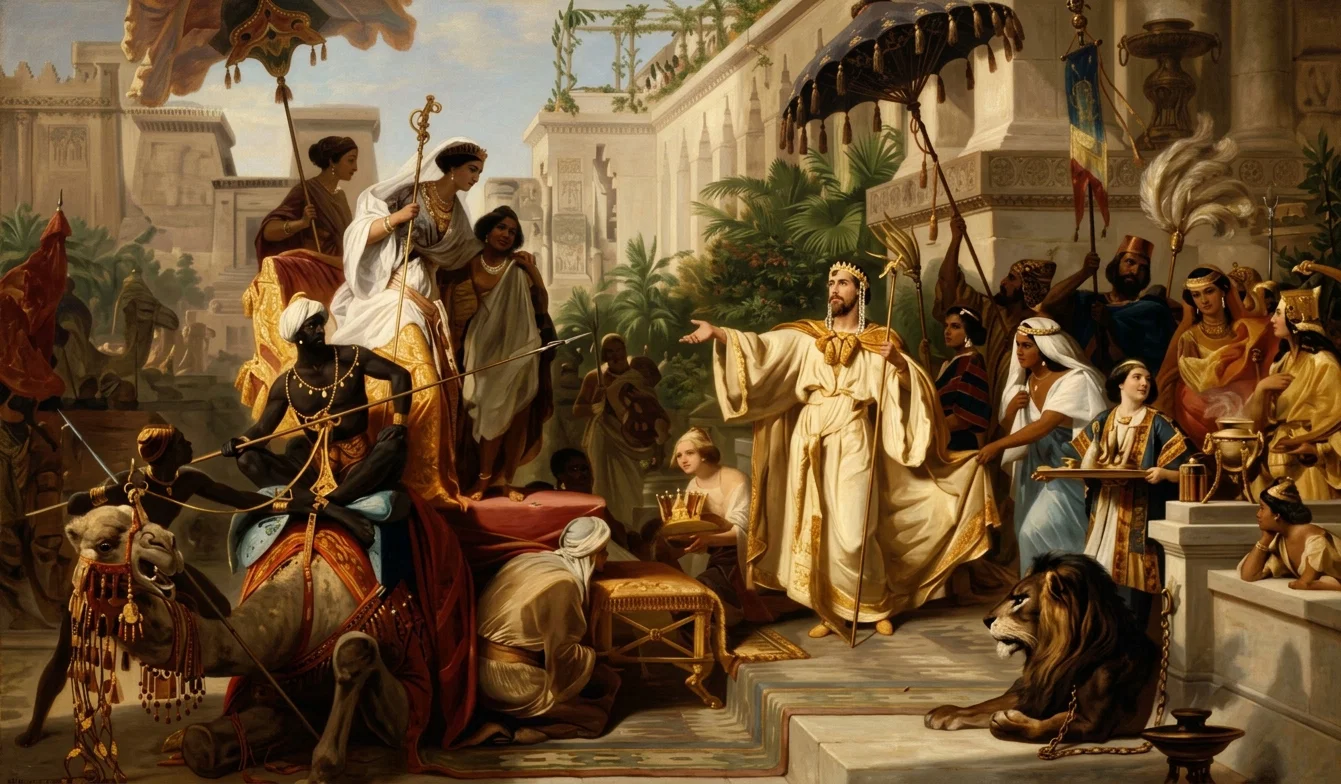
In the height of its greatness and glory the kingdom of Israel stood at the head of the world's mighty nations. The shining light of that kingdom in its day of splendor was its king, Solomon, the wise.
“And when the queen of Sheba heard of the fame of Solomon, . . . she came to Jerusalem with a very great train, with camels that bare spices, and very much gold, and precious stones.” I Kings 10:1, 2.
Born a prince, educated to rule, the reins of government were placed in his hands at a most auspicious moment. The bloody days of the nation in its wars for subduing the heathen of the land were well over. Israel's arms had been victorious, and the din of battle had changed to the pleasant note of busy husbandry and outspreading traffic. The flower of the nation's prosperity burst in all its glory.
These events came to pass not in an obscure corner of the earth. Great things had the God of Israel in mind when He wrought so wondrously for His people in bringing them from servitude in Egypt to be the greatest nation in the midst of great nations. With mingled emotions of envy, fear, and awe surrounding nations had watched the marvelous progress of this peculiar people, whose God so mysteriously yet mightily revealed Himself in their behalf. Thus was He teaching the nations who knew Him not to know Him, the only God.
And God was with Solomon, and because of his humility and request for wisdom, told him:
“Lo, I have given thee a wise and an understanding heart; so that there was none like thee before thee, neither after thee shall any arise like unto thee. And I have also given thee that which thou hast not asked, both riches, and honor; so that there shall not be any among the kings like unto thee all thy days.” 1 Kings 3:12, 13.
And the promise was fulfilled. “And God gave Solomon wisdom and understanding exceeding much, and largeness of heart, even as the sand that is on the seashore. And Solomon's wisdom excelled the wisdom of all the children of the east country, and all the wisdom of Egypt. For he was wiser than all men; than Ethan the Ezrahite, and Heman, and Chalcol, and Darda, the sons of Mahol; and his fame was in all nations round about.” 1 Kings 4:29-31.
With the ushering in of peace and plenty there flocked to his courts ambassadors from every part of the world, and the marts of the enlarged and beautified cities of fair Canaan teemed with the commerce of merchant princes from near and far. The temple, pride and glory of the chosen people, and diadem of the earth, was builded; cities sprang up here and there,—“cities of store,” and cities for chariots, and cities for horsemen; men of war, and servants, and princes, and captains, and rulers of chariots, and horsemen multiplied; great enterprises, the wonder of the world, were undertaken; ships sped to distant countries over the Great Sea and through the Red Sea, fetching “gold, and silver, ivory, and apes, and peacocks;” nations became tributaries, “and they brought every man his present, vessels of silver, and vessels of gold, and garments, and armor, and spices, horses, and mules, a rate year by year.” 1 Kings 10:25.
“And when the queen of Sheba heard of the fame of Solomon concerning the name of the Lord, she came to prove him with hard questions,” bringing presents many and valuable. “And Solomon told her all her questions; there was not anything hid from the king, which he told her not. And when the queen of Sheba had seen all Solomon's wisdom, and the house that he had built, and the meat of his table, and the sitting of his servants, and the attendance of his ministers, and their apparel, and his cupbearers, and his ascent by which he went up into the house of the Lord; there was no more spirit in her”—literally, it took her breath away. 1 Kings 10:1-5.
In all this the queen saw the hand of the Lord, and her words of admiration were turned to words of praise to the God of heaven: “Blessed be the Lord thy God, which delighted in thee, to set thee on the throne ofIsrael; because the Lord loved Israel forever, therefore made He thee king, to do judgment and justice.” 1 Kings 10:9.
“And all the earth sought to Solomon, to hear his wisdom, which God had put in his heart.” Verse 24.
“So King Solomon exceeded all the kings of the earth for riches and for wisdom.” Verse 23.
Yes, King Solomon in the height of his power was gloriously adorned, and very great.

A Comparison by the Great Teacher.

“Consider the lilies of the field, how they grow; they toil not, neither do they spin; and yet I say unto you, That even Solomon in all his glory was not arrayed like one of these.” Matt. 6:28, 29.
This is a remarkable statement. But it is so, because the Lord says it is, and as we apply ourselves to consider the matter, as our great Teacher asks us to do, we discover a few faint glimmerings of its truth. The proposition illustrates the vast difference between the artificial and the natural. The pomp and glitter of the greatest earthly kingdom, the throne with all its appurtenances adorned and bedecked with the gems and diamonds of earth, the apparel of rarest texture and costliest fabric, the ease and luxury which alone unlimited riches and treasures can buy, all these and the unsurpassed worldly glory of them is less, far less than the beauty of the adorning of the humble lily of the field.
Not the power and wealth and skill and wisdom of all the kings of the earth, and of all skilled artificers, can reproduce the simple lily as it stands appareled by the hand of the Creator. There is a fabric the fineness of whose texture and the delicacy of whose tintings and perfumes are forever beyond the skill and wisdom of mortal hand. There is a structure whose pillars and walls, and arches and architraves, and balconies and balustrades, are living members, throbbing, pulsating with the mysterious inflowing life of the Master Builder. There is a temple whose corridors and chambers speak in infinite accents the glories of Him who inhabits them and adorns and beautifies by His glorious presence. Yes, indeed, here is a glory beside which the artificial, even the glory of a Solomon, fades into obscurity.

The Lesson of Faith.

“O ye of little faith” were the words addressed by the Master to those who heard the lesson. They are addressed to us to-day. There were those then who were anxious about their food and raiment, and the cares and business of this life occupied their attention and took their time. Even the professed children of God were anxious concerning such matters. Is the situation materially different to-day, unless it be for the worse? Are you anxiously planning and looking ahead to the morrow concerning food and clothing? Whether or not you are a professed child of our heavenly Father, He wants to teach you to trust Him to supply every need of this life, even the little things of life.
How forcibly is the lesson urged home to our comprehension! “Why are ye anxious concerning raiment? Consider the lilies; . . . yet I say unto you, that even Solomon in all his glory was not arrayed like one of these. But if God so clothe the grass of the field, which to-day is, and to-morrow is cast into the oven, shall He not much more clothe you?” Notwithstanding the lily is so marvelously beautiful, and its adornment immeasurably beyond the glory of Solomon and his throne, yet it is but grass of the field. It endures, with its glory, for only a day. But in that day it subserves its purpose, existing for the praise and revelation of its Maker.
But you, O man, who are you, whom God says He will “much more clothe”? Why does He promise to bestow on you such extraordinary care? O, He will make a man, even one who is the chiefest sinner, “more precious than fine gold; even a man than the golden wedge of Ophir”! Isa. 13:12. He has made you and me to reveal in and through us His mighty power to save from sin; He has made you to be a revelation of Him not for a day, but to reveal Him and praise Him eternally. He has made you a marvelous temple, a temple formed in His image, for His own indwelling, and He will, if you will to let him, clothe you with the beauty of holiness, His own righteous garment. Altho He is the “high and lofty One that inhabiteth eternity,” and dwells in “the high and holy place,” yet He also dwells “with him that is of a contrite and humble spirit.” Isa. 57:15. This is the adorning of priceless worth, the shining raiment, far surpassing and transcendently glorious.

The Method of Obtaining.

“Ye can not serve God and mammon. Therefore I say unto you, Be not anxious for your life, what ye shall eat, or what ye shall drink; nor yet for your body, what ye shall put on. Is not the life more than the food, and the body than the raiment?” “For after all these things do the Gentiles [who serve mammon only] seek; for your heavenly Father knoweth that ye have need of all these things. But seek ye first His kingdom, and His righteousness; and all these things shall be added unto you.” Matt. 6:24, 25, 32, 33, R.V.
We have seen why a man is of more importance than the grass of the field, and of more value than the birds of the heaven. Then how reasonable, how simply reasonable it is in view of God's purpose concerning us, that we should seek first of all the inward adorning of a meek and quiet spirit—His kingdom and His righteousness! And then the kind Father speaks to us in visible words—a world of living, infinite, ringing words—through every sprig of grass, every flower of the garden or field, every leaf of every tree, every bird of the air, in short, through every one of the myriad forms of life in the natural, visible creation, that “all these things”—the food and raiment, the necessary things for our life here—will be added unto us. Shall we trust Him, and Him only?

An Example.

The Teacher weaves into His lesson a notable example as proof that God does as He says He will. This example is the same Solomon whose outward adorning is contrasted with the adorning of the lily. The Lord asked Solomon in a dream to name what he would that the Lord should give him. What a field for choice!—riches, honor, power, long life, all that the natural heart might dictate. No, the young man feared God, and he asked for wisdom to properly perform his duties, and that he might “discern between good and bad.” He sought God first and His righteousness and wisdom. “And the speech pleased the Lord,” and because Solomon thus sought Him, the Lord said, “Behold, I have done according to thy words; lo, I have given thee a wise and an understanding heart; . . . and I have also given thee that which thou hast not asked, both riches, and honor.”
Creative, redeeming, keeping power is just the same now as it was 2,900 years ago, or 1,900 years ago. The riches of money and honor may not be ours as they were given to Solomon. The desire for them even must be subordinated to the service of one Master. The lesson He taught was not that the added things would be this sum or that amount, but enough for all needs, and He knows what are our needs. The example is used to show that God fulfils His promises.
And those promises are as certain as is the certainty of the existence of the visible creation around us. No proof is required to demonstrate the latter. We know it. It is self-evident. So our Father wants us to know the fulfilment of his divinely appointed plan; for it is both plan and law,—“Seek ye first His kingdom, and His righteousness; and all these things shall be added unto you.” Let us try it, and prove Him. This is the greatest thing in the world. L. A. PHIPPENY.

DID THE APOSTLES CHANGE THE SABBATH?

DO THE writings of those connected with our Saviour in His earthly ministry anywhere indicate that a new Sabbath day was set apart for the Christian dispensation? Peter, above all others, labored for his own nationality. Does he anywhere teach that the Sabbath of the past had given way to one in commemoration of Christ’s resurrection? Paul was the great apostle to the Gentile world. Did he set forth the claims of a new Lord’s day?
If Christ wrought no change in the law of God, we can not conceive for a single moment that one of the apostles would assume the responsibility of so doing. The abrogation of the law should be as public as its promulgation. From the blazing peaks of Sinai, amid thunder and lightnings, with a voice that shook the earth, the law of God was proclaimed. We can not for a moment believe that any abrogation or change in the divine precepts would be brought about covertly or insidiously, but that it would be as broad and frank and open as is the character of Christ and Christianity. And a careful study of all the epistles of the apostles, not excepting those of James and Jude and the beloved disciple, reveals neither by plain declaration or even by suggestion an abrogation or change.
The first day of the week is several times mentioned in the New Testament Scriptures, but not in one single instance is it called the Lord’s day or sabbath; nor is there attached to it, either directly or indirectly, any suggestion of sacredness or holiness. The reader will observe this if he will look up the eight passages cited, the only instances where the first day of the week is mentioned: Matt. 28:1; Mark 16:1, 9; Luke 24:1; John 20:1, 19; Acts 20:7; 1 Cor. 16:2.
In the twentieth chapter of Acts is found the only record in the New Testament of a religious meeting on the first day of the week, and by a close study of the text the reader will observe that this was upon the dark part of the first day, which could have been no other time than what we call Saturday night, as the Bible reckons time from sundown to sundown. On the next morning, in the light part of the day, Paul started off on a journey from Troas to Assos, across the peninsula, to join his companions, who, during his meeting Saturday night at Troas, had been laboring hard to bring the boat around the peninsula to meet him at the appointed time.
In the Corinthian letter specific directions are given to the church-members to lay aside a part of their income for the Jerusalem collection. It will also be observed that this money was not to be given at the church in the public congregation, but each was to lay aside the offering by himself in his own home.
By some it is argued that every record we have of the meeting of Christ with His disciples after the resurrection was upon the first day of the week. That this was not the case may be abundantly proved, but even if it were so, that of itself would prove nothing for the sacrednessof the first day. When He first met with them on the day of His resurrection, they had no faith that He had risen from the dead, and were upbraided by Him in consequence. See Mark 16:14. And the other occasion on which He met with them was the time when He found them engaged in their old avocation, that of fishing on the Sea of Galilee. If this was upon the first day of the week, it certainly does not speak favorably of the manner in which the disciples regarded it.
In contrast with this mention of the first day of the week in the New Testament writings, the seventh day, the day on which the Jews met in their synagogs for worship, which could have been no other than the seventh day of the week, is always spoken of as the Sabbath, thus showing the recognition given this day by Christian writers in the Christian era, writing under the direction and inspiration of the Lord. See Acts 13:14, 15, 42; 17:2; 18:4.
In the last two references cited, it is observed that the same course is predicted of Paul as of Christ, that it was customary for him to meet on the Sabbath day for divine worship. And this great apostle, during his last journey through Asia, when he met the elders of the church at Ephesus, in that which he predicted and which proved to be his last meeting with them in this world, declared that he was free from the blood of all men, in that he had not shunned to declare the whole counsel of God. And yet in his epistle to the Ephesians, as well as the historical record of his meeting with that church, as likewise in his epistles to other believers, we find not one word regarding a change in the institution of the Lord’s Sabbath. There can be but one conclusion, and that is that Paul in nowise attached sacredness to the first day of the week, for certainly if he had, he would have counted it a part of the counsel of the Lord and plainly incorporated it in his instruction to the church.
Hence we must conclude that the apostles had no authority, nor did they assume the authority, to change the Sabbath commandment. Like their divine Lord, they regarded the holy character of the one universal Sabbath, set apart at the beginning of time for the benefit of the race of man. F. M. W.

HUNGERING AND THIRSTING.

“BLESSED are they which do hunger and thirst after righteousness; for they shall be filled.”
Hunger is not a bad thing. The man who has never been hungry does not know the satisfaction there is in eating. Only those who know what real hunger is, can appreciate the real value of food, and can enjoy it.
The sad case of the poverty-stricken is not that they get hungry, but that they have no food with which to satisfy their hunger. It is deplorable when one has nothing to eat, but it is a good thing to feel downright hungry when there is abundance of good food at hand to supply the need.
The blessedness of hungering after righteousness lies in the fact that “the gift by grace,” even “abundance of grace and of the gift of righteousness,” is provided for all through Jesus Christ. To every hungry and thirsty soul the Lord calls, “Come ye to the waters.” “Eat ye that which is good, and let your soul delight itself in fatness.”
Some one asks, “How can I hunger and thirst after righteousness?” Ah, it is a simple matter, as simple as longing for daily bread! Christ is “the desire of all nations.” He alone can satisfy “the desire of every living thing.” Have you ever known what it was to be dissatisfied? “What a question! Ask me rather if I ever knew what it was to be perfectly satisfied.” Just so; you have never known absolute satisfaction; there has always been a longing for something, you know not exactly what, but something different from what you had. Well, that was the hunger of the soul for Christ, who is righteousness. You didn’t know it, but the full, conscious possession of Jesus Christ would satisfy that unrest and longing, just as cool water will satisfy the thirst of the body.
Still more; Christ is “the bread which cometh down from heaven.” He is “the living bread.” This is not a figure of speech, but the statement of an actual fact. To demonstrate it, God fed the Israelites in the desert forty years with manna. He rained down bread from heaven, and it was “spiritual meat,” which, if they had eaten by faith, would have given them life everlasting. But it was daily bread, to satisfy their ordinary hunger. So it is that the demand of our bodies for food can be satisfied only by Christ. He is “the life.” If we but recognize Him in the gifts of God, then in satisfying our daily hunger with the food which He provides for us, we shall be filled with righteousness. “O taste and see that the Lord is good.” “There is no want to them that fear Him.”
E. J. WAGGONER.

COUNTING THE COST. No. 3.

The atonement of Christ has been made to save all the sons and daughters of Adam from the penalty of the violated law, on condition that they repent of their transgressions, and are converted through the exercise of faith in Christ. The Lord God of heaven is to be glorified by the obedience of His subjects. This wonderful plan of salvation devised in heaven was not to vindicate transgression. In satisfying the claims of justice, Christ does not release the sinner from his obligation to keep that law. By His death Christ makes it possible for us to keep that law. The sinner is held under obligation to the law. Altho Christ died in the sinner’s stead, the sinner is liable to all the penalty of the law if he does not comply with the conditions of the Gospel; and these prescribe obedience, if he would be benefited by the obedience offered. The atonement was made to take away the sin of the world. The suffering of Christ upon the cross is a living testimony borne to all human intelligences that sin is the transgression of the law. And in bearing the penalty of transgression, Christ speaks to every soul, saying, “He that spared not His own Son, but delivered Him up for us all,” that through His merits He should become an accepted substitute for the sinner, “how shall we escape if we neglect so great salvation?” God will save no man while he continues in transgression after the light has come. The great sacrifice of the Son of God was made that it might be possible for man to become obedient through faith. “For God so loved the world, that He gave His only-begotten Son, that whosoever believeth in Him should not perish, but have everlasting life.” The atonement in the offering of Christ for the sin of the world is the great argument that the law of God is binding upon every human being. “Think not that I am come,” said Christ, “to destroy the law, or the prophets; I am not come to destroy, but to fulfil. For verily I say unto you, Till heaven and earth pass, one jot or one tittle shall in nowise pass from the law, till all be fulfilled.”
The same evidence that was given by God to prove His divine authority gave a representation of His character when there was no power to save, when no arm brought salvation. In the depths of omnipotent wisdom and mercy the Father took the work of salvation into His own hand. He sent His only-begotten Son into the world to live the law of Jehovah. The law, revealed in the character of Christ, was a perfect manifestation of the Father. And by His perfect obedience and the sacrifice of Himself, which He through the eternal Spirit once offered up unto God, He has fully satisfied the justice of the Father, and purchased not only reconciliation, but an everlasting inheritance in the kingdom of heaven for all those whom the Father has given Him.
The everlasting inheritance is purchased only for the elect. Says the apostle Peter: “According as His divine power hath given unto us all things that pertain unto life and godliness, through the knowledge of Him that hath called us to glory and virtue; whereby are given unto us exceeding great and precious promises; that by these ye might be partakers of the divine nature, having escaped the corruption that is in the world through lust.” “Wherefore the rather, brethren, give diligence to make your calling and election sure; for if ye do these things, ye shall never fail; for so an entrance shall be ministered unto you abundantly into the everlasting kingdom of our Lord and Saviour Jesus Christ.”
Christ is everything to us. We can not even repent unless divine impressions are made upon the heart. While Christ pardons none but the penitent, those whom He pardons are first made repentant. Those who have that faith which works by love and purifies the soul, have direct testimony in the Word of the grace bestowed by an ever-living Saviour. Without the saving grace of God, man can not endure the test of temptation. He is fit for no good work. Did the wonderful miracles wrought by Christ bring the Jewish nation to repentance?—No; the Jews who witnessed these miracles wickedly charged Him with performing these through Beelzebub, the prince of the devils. Bethsaida and Chorazin, tho they witnessed miracles of sufficient power to have convinced the cities of Sodom and Gomorrah, did not submit to the evidence of truth.
These wonderful manifestations of the power of God produced the same effect upon the Jews as the power of the Gospel now exerts upon the multitude. They are convicted, but not converted. They are determined not to yield their will to the will of God. The danger of resisting the heavenly manifestation is presented before them, but they frame excuses for not yielding. Many are deceiving their own souls. They do not love Jesus, nor accept the terms of salvation. They act out the same spirit as did the disciples who turned from Christ because they did not immediately comprehend His words, “Except ye eat the flesh of the Son of man, and drink His blood, yehave no life in you.” The Holy Spirit’s power is working upon mind and heart; the understanding is convinced, the conscience is aroused, and yet Christ says of them, “Ye will not come unto Me, that ye might have life.”
A test will come to every soul. The natural faults of character, if not determinedly overcome for Christ’s sake, will completely master the human soul. Daily there is a battle to be fought which will cost mortification. It may cost reputation; but Jesus risked all this and a hundred-fold more that He might bring salvation within the reach of every soul. All the humiliation that man could bring upon Him He endured, that through His amazing condescension man might become the sure stepping-stone to His fellow-man, so sinful, so weak in moral power. Why, then, should fallen man be unwilling for Christ’s dear sake to become a partaker of shame and reproach?
When the grace of God works upon the heart, a fervent zeal, a heavenly spirit, a melting, overflowing sympathy for souls that are impenitent, is seen in the life. The humble follower of Christ delights to contemplate His wondrous, surpassing beauty. He has discovered that the Word was made flesh, and dwelt among us, and he loves to think of His matchless charms. Day by day a transforming power is at work upon his own life and character, and is filling his soul with an inexpressible love. He finds that the Saviour is willing to be his guide in this life, and his portion through eternity. His heart is won, his choice is made. He yokes up with Christ, and has a compelling power in winning souls to the Saviour. He can not change the heart, but He may convince of the truth which defines their duty and convicts of sin.
This subject is but dimly comprehended. It will bear searching, and the patient, persevering, diligent seeker for truth will be rewarded. Every spiritual muscle is to be put to the stretch to comprehend the Word. And after long-continued taxation, of intellect, of patience, of the whole man, he will find an infinity beyond. The prayer of the great apostle, whose heart was burning to know and understand these things, should be our prayer: “That He would grant you, according to the riches of His glory, to be strengthened with might by His Spirit in the inner man; that Christ may dwell in your hearts by faith; that ye, being rooted and grounded in love, may be able to comprehend with all saints what is the breadth, and length, and depth, and height; and to know the love of Christ, which passeth knowledge, that ye might be filled with all the fulness of God.”
MRS. E. G. WHITE.

THE HEAVEN OF LOVE.

I rose at midnight and beheld the sky Sown thick with stars, like grains of golden sand Which God had scattered loosely from His hand Upon the floorways of His house on high; And straight I pictured to my spirit’s eye The giant worlds, their course by wisdom planned, The weary wastes, the gulfs no sight hath spanned, And endless time forever passing by.
Then, filled with wonder and a secret dread, I crept to where my child lay fast asleep, With chubby arm beneath his golden head. What cared I then for all the stars above? One little face shut out the boundless deep, One little heart revealed the heaven of love.
—F. G. Scott, in his book, “The Unnamed Lake.”

WORDS

If the merely idle word is one day to be accounted for and judged, what of the untrue, the impure, the profane, the malignant, and cruel words with which this earthy air is continually charged? Only a movement of the lips, a moment’s stirring of the air, and all is silent, as tho the word had never been spoken; yet a fellow-creature’s happiness has been blighted; a heavy burden has been made still heavier to bear; a heart has been robbed of its guilelessness and trust; the seed has been sown of a career that ends in ruin and death.
Those words are not dead. Tho they seem to be buried in everlasting oblivion, yet when the judgment throne is set and earth’s myriads are gathered together to be by their words justified or by their words condemned, they will return with solemn, reverberating echo out of the darkness of the past, and fall with dismay and shame on the ears of those who spoke them.
And those other words—faithful, pure, benign—passing to and fro among men like white-winged angels, carrying messages of love and hope and healing from heaven; words almost divine in their ennobling influence, helping us ever onward and upward along life’s journey—these, too, will awake from their sacred slumber, and, amid the grateful murmur of the multitude whom they have gladdened, comforted, and saved, their blessed sound will be heard on earth once more.—The Equitable Record.

THE PROBLEM SOLVED.

For many years there has been made very conspicuous the query, “What shall we do with our boys?” Various and numerous have been the suggestions. Until recently the most popular solution of the problem, and which it was supposed would in some mysterious way include all others, has been a rigid enforcement of Sunday observance by civil law. Just now, however, this universal cure-all is overshadowed by the circumstance of war. Practically, the “Christian” people who have been so worried over the question, “What shall we do with our boys,” deem it solved by the idea of teaching them to fight. An Epworth League Convention was recently held at Wheeling, W. Va., and a report to the Newburg Monitor has this significant paragraph:—
The burden of almost every sermon was, “Christians must be more patriotic.” Whenever a reference was made to the present war with Spain, it was cheered to the echo. One speaker said he would “like to give the sultan of Turkey a dose of Christianity with a hundred-ton Krupp gun, red hot.” And then said he would like to do the same for every Spaniard on the American continent.
Nothing will so stimulate a boy to emulation as the now popular fad of lionizing military or naval heroes, yet many of the most noted of these heroes are also noted for their profanity, which crops out very conspicuously in the heat of battle. Often their profane expressions on noted occasions get into the papers and pass current as part of the heroism. As boys are human, and naturally desirous of praise and covetous of renown, every special attention shown to the military arouses the youthful aspirations. And as the public attention is given more particularly to officers, the boys naturally aspire to be officers, and to imitate the great heroes. And this aspiration is patronizingly called patriotism.
So now we see every effort made to encourage this ambition of the boys. As they congregate in squads and march to the beat of the drum, they are consciously aware that they are the objects of attention. If they can procure uniforms and small guns, and make a pretty good display, they receive considerable applause; if they can not afford these, ordinary clothing and sticks will do. The writer recently noticed a boy of about ten years industriously drilling himself. He had a stick for a rifle, and was going through what “motions” he knew, or thought he knew, giving the commands to himself. As he marched, he gave himself the step by commanding, “Left—left—left.” As these boys are encouraged to emulate military life, their waywardness in other respects is more or less condoned; for the masses of the people become lax in individual discipline and in ordinary social proprieties by the fad of familiar catering to the military.
Another thing that tempts the boys to ape the military calling is their natural desire to attract the attention of the girls. They see the now quite common custom of ladies, old and young, suddenly dropping the conventionalities ordinarily deemed prudent and modest, the moment they come in contact with the military—especially if the uniform has certain official insignia upon it. Of course this otherwise imprudent familiarity on short acquaintance, or no acquaintance, is condoned by society on the ground of patriotism. But the boys see it, and envy it. They see even “society” ladies, old and young, making much ado over men in uniforms, whom they could not have been induced to notice but for the uniform. Thus the street urchin sees in the uniform the possibility of recognition by ladies of a class otherwise inaccessible.
The clothing manufacturers, as well as toy gun and bunting dealers, find profit in catering to the new idea of what to do with our boys. The peasant “overalls” and “jumpers” for boys are made with military stripes on the legs and chevrons on the sleeves. Thus this garment, which ordinarily indicated common labor or crude play, or perhaps poverty, is suddenly transformed into a military suit, and the plebeian youth or the street gamin is suddenly promoted—in imagination—to a higher grade. Now if he gets into a fight with his companions, he can simply imagine that they are Spaniards and his offense is condoned because of his patriotism. He is on the way to recognition by the ladies and no end of imaginary glory through the blood of his fellow-creatures.
It must not be understood that this as yet unwritten yet practically adopted theory concerning the uplifting of the boys, means that they shall enter the prize ring. O, no; that is morally bad, demoralizing—even tho an American should whip a Spaniard! There is not gore or glory enough in that kind of fighting to win anything more than a belt. The fighting that is now encouraged, from the pulpit to the kindergarten, is not mere pounding with the knuckles—that is brutish—it is military fighting that the boys must learn. The insigniais more gorgeous,—there are stripes and straps, gilt buttons and glittering armor, with the possibility of epaulets, gold cord, and plumes, and perchance high boots and spurs. Military fighting is that which kills, or maims for life; that which burns cities, sinks ships, wrecks trains, destroys commerce, sets nation at variance with nation, and people with people.
Such warfare may be waged in the name of humanity, yea, in the name of Christianity. A “Christian nation” (so called) may indulge in such fighting. Logically a Christian nation is a nation of Christians; its warfare is Christian warfare; therefore it is Christian “to kill and to destroy;” and the soldiers of such a Christian nation are its most active missionaries. Now do you not see how easy it is to train our boys to be Christians, to be Christian warriors—missionaries, forsooth!—fit companions on sight for the girls, without further commendation than the uniform? Is it not a grand conception, one that can be so easily instilled into the boys? Then they take so kindly to this new process of elevating their position in the world, and especially in society. It is so natural for them to learn to fight. Why didn’t we “Christian” people think of this militarism as an elevating, Christianizing experiment long ago? It would have saved so much anxiety, so many tears, so much care, so much self-denial, so much prayer!
But, alas! there is one serious objection to it all: It will not stand the righteous judgment of God, before whose bar we must all appear, and face the standard of His Word,—“All they that take the sword shall perish with the sword.” Matt. 26:52. That is, all who depend upon the sword, which represents all human government, will perish with such government, when it shall be supplanted by the kingdom which the God of heaven shall set up, and which will “fill the whole earth.” See Dan. 2:31–45. All the service that will be recognized in that day will be service under the command of Him who said, “The Son of man is not come to destroy men’s lives, but to save them.” Luke 9:56.
What, then, is the true solution of the problem, “What shall we do with our boys?”—Teach them the Word of God. See Deut. 4:1–13; Prov. 22:6; Matt. 22:34–40; John 3:16; Mark 16:14–16; Rom. 6:22; 1 John 5:1–5. “Wherewithal shall a young man cleanse his way? by taking heed thereto according to Thy Word.” Ps. 119:9. “He that is slow to anger is better than the mighty; and he that ruleth his spirit than he that taketh a city.” Prov. 16:32. W. N. G.

OUR NEED AND HIS LOVE.

In the Word the Lord has shown How the hearts of men have grown Hard as adamant within, Darkened by a veil of sin. Sole of foot to head between Is no soundness in them seen.
Wounds and bruises, sores are found, They have not been closed or bound, Nor has ointment been applied That they might be mollified. Thus describes He sin’s vile taint; Head is sick, and heart is faint.
Then He shows their worship vain While they in this state remain, But they who rebellious stand Still are creatures of His hand, And the love of God most high Says again, “Why will ye die?”
Wash you, make you clean, and turn From your sins, and duty learn. Come and let us reason now: I can not your sins allow; But tho scarlet be their glow, They shall be as white as snow; And tho crimson be their stain, They shall be as wool again. Wouldst thou share that goodly land? Willing then and faithful stand. Thus we see the wondrous grace Proffered to a fallen race.
In that fall we’ve each our part, Needing each a change of heart. O, then let us as we read Sense our sins and feel our need, Earnestly our sins confess, And be clothed in righteousness!
E. H. BATTERSON.
Los Angeles, Cal.
Continue reading: WHY DID CHRIST DIE?