1. WHAT did our Lord declare would be a marked sign of the end of the world or age?
"And because iniquity shall abound, the love of many shall wax cold. But he that endureth unto the end, the same shall be saved." See Matt. 24: 12-14.
2. What does the apostle Paul say will be a noted feature of the last days?
"This know also, that in the last days perilous times shall come." 2 Tim. 3: 1.
3. For what reasons may these perilous times be expected?
"For men shall be lovers of their own selves, covetous, boasters, proud, blasphemers, disobedient to parents, unthankful, unholy, without natural affection, truce-breakers, false accusers, incontinent, fierce, despisers of those that are good, traitors, heady, highminded, lovers of pleasures more than lovers of God." Verses 2-4.
4. Among whom will these sins be found?
"Men . . . having a form of godliness, but denying the power thereof." Verses 2, 5.
NOTE.—The times are not perilous because these sins are found among worldlings; for there they have always been found, the natural works of the flesh. What makes the times perilous is that these sins abound in the professed church of Christ, those who make a profession, who have a form of godliness, but deny its power. When that body designed of God to lift up a standard to the world, loses its power, it takes off all restraint of crime and sin; and we witness its effects to-day in the increase of sin and crime.
5. How do backslidden religionists deny the power of godliness?
"They profess that they know God; but in works they deny him, being abominable, and disobedient, and unto every good work reprobate." Titus 1: 16.
NOTE.—This does not mean disobedient to church creeds, or councils, or human traditions, but disobedient to Him whom they profess to know.
6. Should we accept such religionists as our standard or teachers?
"From such turn away." 2 Tim. 3: 5.
"Come out of her, my people, that ye be not partakers of her sins, and that ye receive not of her plagues." Rev. 18: 4.
7. What must we do "that we may work the works of God"?
"This is the work of God, that ye believe on him whom he hath sent." John 6: 28, 29.
8. What will those do who truly believe and love Christ?
"If ye love Me, keep My commandments." John 14: 15.
"This is love, that we walk after His commandments." 2 John 6.
"He that saith he abideth in Him ought himself also so to walk, even as He walked." 1 John 2: 6.
Forgiving an Injury
By Lady Elizabeth Carew
THE fairest action of our human life
Is scorning to revenge an injury;
For who forgives without a further strife,
His adversary's heart to him doth tie;
And 'tis a firmer conquest, truly said,
To win the heart than overthrow the head.
—Lady Elizabeth Carew.
DECADENCE OF RELIGION.
THERE are two sure indexes of the condition of religious life in a church, namely, the prayer-meeting and the family altar. It has been known by nearly all, that, judged by the former, the spirit of devotion in the great religious denominations was at low ebb. It has also been observed by a few, now becoming known to all through recent and wide discussion, that the practise of family prayer is rare indeed, except in ministers' families and among a few old-fashioned professors. Among many expressions in this line are the following:—
"A number of prominent clergymen have expressed their convictions that family worship is on the decline. The reasons generally given are the hurry of our modern life and the way in which secularism presses us upon every side. The perusal of the morning paper might be abridged with profit, and the family started aright for the day. When the flame is allowed to die on the family altar, need we wonder that the home lacks the spiritual tone and unity of Christian interest which we have a right to expect?"—North and West (Presbyterian), Minneapolis.
"The custom of gathering, at morning or evening, to hear the head of the family read the Bible and lead in prayer is the exception, not the rule, in the Christian homes of the United States. It is still observed in some parts of New England and in those sections of the west where New England traditions still persist, and of course is usual in ministers' families and not unknown in other homes all over the country. But it is not common in most communities. Reasons are easy to find. City people nowadays live so far from their work that early trains or street-cars must be 'caught' immediately after breakfast, and the toilers return only in time for a late dinner. The evenings are full with other things. It is probably true that fifteen minutes could be spared either at the beginning or the end of the day, but all the rush and hurry of the time are against it. The old custom was pleasant, and formed a spiritual bond for the family which nothing else can quite replace. If it is really true that it can not be reinstated, some partial substitute is greatly to be desired, if only an hour on Sunday afternoon or evening, or something more than a mere formal grace before meals. It is surely not right that children should never hear their parents speak upon religious topics except in church."—The Standard (Baptist), Chicago.
"If no reformation takes place in this particular, it will not require the gift of miraculous foresight to predict the gradual decline of the church herself, and the loss of many souls through backsliding. We appeal to our ministers and people everywhere to fan the fires to a new flame on the family altar. Give this matter earnest attention. Let every father of a Christian family pray daily in the presence of his children. Let him pray affectionately, tenderly, fervently. Let him gather his family about him to hear him read God's holy Word. Let there be a revival of family religion, an intensifying of family devotion, a reinstatement of the family altar, with all its sacred associations. The neglect of this means of grace is in some cases a positive crime. We plead for a reformation on this matter."—The Evangelical Messenger, Cleveland, O.
It will be seen that the fact of the decline of family prayer is admitted by all. The reasons stated are outwardly and generally admitted correct; but the evil results from the life within, as well as from the pressure without. Religion is not to that home a reality, a blessing, where family prayer is neglected. Nor can there be a substitute for it. A paltry hour or half hour a week will have but little effect on lives crammed so full of the world for the remainder of the week that time can not be often taken for seeking God. The hurry and worry and bustle and work of the age, with its multitudinous duties and temptations render family prayer all the more necessary. But when it is admitted that family worship of God can not be revived, it will easily be seen that the devil will furnish the substitute. That substitute is even now called for in the demand that the public schools shall give, through what will generally be unconverted teachers, religious instruction. We see the fulfilment of our Lord's words, "And because iniquity shall abound, the love of many shall wax cold." Matt. 24:12. But State law will never revive it. The only sure basis of revival is faith in God and heart conversion.
THE PINT OF ALE, JOHN.
IT is a difficult matter to one accustomed to small daily indulgences to realize the expense thus incurred.
A Manchester (England) calico printer was asked on his wedding day by his shrewd wife to allow her two half pints of ale a day as her share of home comforts. John made the bargain cheerfully, feeling it hardly became him to do otherwise, inasmuch as he drank two or three quarts a day. The wife kept the house tidy, and all went well with them; but, as she took the small allowance each week for household expenses, she never forgot the 'pint of ale, John.'
When the first anniversary of their wedding came, and John looked around on his neat home and comely wife, a longing to do something to celebrate the day took possession of him.
'Mary, we've had no holiday since we were wed, and only that I haven't a penny in the world, we'd take a jaunt to the village and see the mother.'
'Would thee like to go, John?' she asked.
There was a tear with her smile, for it touched her heart to hear him speak tenderly, as in the olden times.
'If thee'd like to go, John, I'll stand treat.'
'Thou stand treat, Mary! Hast got a fortin left thee!'
'Nay, but I've got the pint of ale,' said she.
'Got what, wife?'
'The pint of ale,' she replied.
Whereupon she went to the hearth, and, from beneath one of the stone flags, drew out a stocking, from which she poured upon the table the sum of three hundred and sixty-five threepences ($22.81), exclaiming:—
'See, John, thee can have the holiday.'
'What is this?' he asked in amaze.
'It is my daily pint of ale, John.'
He was conscience-stricken, as well as amazed and charmed.
'Mary, hasn't thee had thy share? Then I'll have no more from this day.'
And he was as good as his word. They had the holiday with the old mother, and Mary's10little capital, saved from “the pint of ale,” was the seed from which, as the years rolled on, grew shop, factory, warehouse, country seat, and carriage, with health, happiness, peace, and honor.—Selected.
"DECEIVING AND BEING DECEIVED."
By Editor
IN a recent issue, referring to the efforts to secure a religious clause in the constitution of the proposed federal government of Australia, we stated that the advocates of such a clause do not hesitate to use deception regarding the provisions of the Constitution of the United States. On this point, and the attitude of the Pilgrim Fathers, we take the following from the Bible Echo, of Melbourne:—
A Good Reply.—Seeking precedential support for the idea that the Federal Constitution should contain a formal recognition of God, a writer, signing himself "Elector," in the Launceston (Tas.) Examiner, of July 20, in addition to making the erroneous statement started by such men as Professor Harper and Dr. Rentoul of this city, that "a recognition of the divine Being is found in the American Constitution," says: "The Pilgrim Fathers commenced their colonial life with humble and hearty acknowledgments of the divine Being," to which another writer, "Liberty," in the same paper four days later makes the following pertinent reply:—
"Yes, they did, and this is how they did it. Before leaving the ship they drew up a code of laws even more exacting than those from which they had escaped. No man could vote or hold office in the State unless he was a member of the church. All were forced to attend church service, and all heretics were banished. It was not long before they whipped the Baptists through the streets, and hung the Quakers on the common. Is this what 'Elector' calls a 'hearty acknowledgment of the divine Being?'"
"Declarations of faith in a civil document may look very nice and seem very devout and quite harmless altogether on paper; but they are out of place, and, as all history shows, they are taken advantage of by religious bigotry, and made the foundation for religious legislation and the tools for the worst of tyrannies."
A MORTIFYING MISTAKE.
By Anna M. Pratt
I STUDIED my tables over and over, and backward and forward, too;
But I couldn't remember six times nine and I didn't know what to do,
Till sister told me to play with my doll and not to bother my head.
"If you call her 'Fifty-four' for awhile, you'll learn it by heart," she said.
So I took my favorite, Mary Ann (tho I thought 'twas a dreadful shame
To give such a perfectly lovely child such a perfectly horrid name),
And I called her my dear little "Fifty-four" a hundred times, till I knew
The answer of six times nine as well as the answer of two times two.
Next day Elizabeth Wigglesworth, who always acts so proud,
Said, "Six times nine is fifty-two," and I nearly laughed aloud!
But I wished I hadn't when teacher said, "Now, Dorothy, tell, if you can."
For I thought of my doll, and—sakes alive!—I answered—"Mary Ann!"
—Anna M. Pratt.
INCREASE OF MOB LAW.
"THE lynching in Versailles, Ind.," says the New York Voice: "is one of the most striking illustrations yet given of the inevitable tendency of mob law. Five men had been arrested and jailed for burglary. Two or three of them had been indicted, but not tried, and the others had been simply arrested on suspicion. They were all securely jailed, and with public opinion what it was, there was little chance of their escaping punishment for any burglary that could be proved against them. Their crime was not one that civilized countries anywhere now adjudge to be a capital crime. Nor was it one that, like rape, arouses uncontrollable passions on the part of any well-ordered community. Three of the men were less than thirty years old. In the dead of night a mob of 400 men took possession of the jail, dragged out the five men and strung them up, having previously shot and pounded them until it is questioned whether several were not dead before they were hung.
"And the hopeless feature of this most discouraging affair is the fact noted in the reports that 'none of the citizens seem to deplore the action of the mob, but on the contrary, the hanging of three or four more members of the gang is being talked of.' The governor of the State has taken prompt action, sending on a deputy attorney-general to see that the violators of law are brought to justice; but he is severely censured for not having taken any decisive action in previous cases of white-cap outrages, for which Indiana is noted. We do not know that this censure is merited, but the logic that connects this greater outrage upon the law with the previous lesser outrages is correct, and while we are about it we might as well trace the origin back a step further. This frightful epidemic of lawlessness that seems to be breaking out in so many different places is part of an inevitable harvest that comes to every community that lets the laws be trampled on with impunity in lesser matters."
And the reason for all this is disregard of the law of God and lack of faith in him. When men fear God, they will execute justice and judgment; and when men have faith in God they will not take vengeance in their own hands. Civil laws enforcing morality will not cure the condition; Sunday-laws obtain in Indiana now. What is demanded is more Gospel in preaching and living on the part of pastor and church,—a Gospel which will lead men to obey God.
THE TARANTULA.
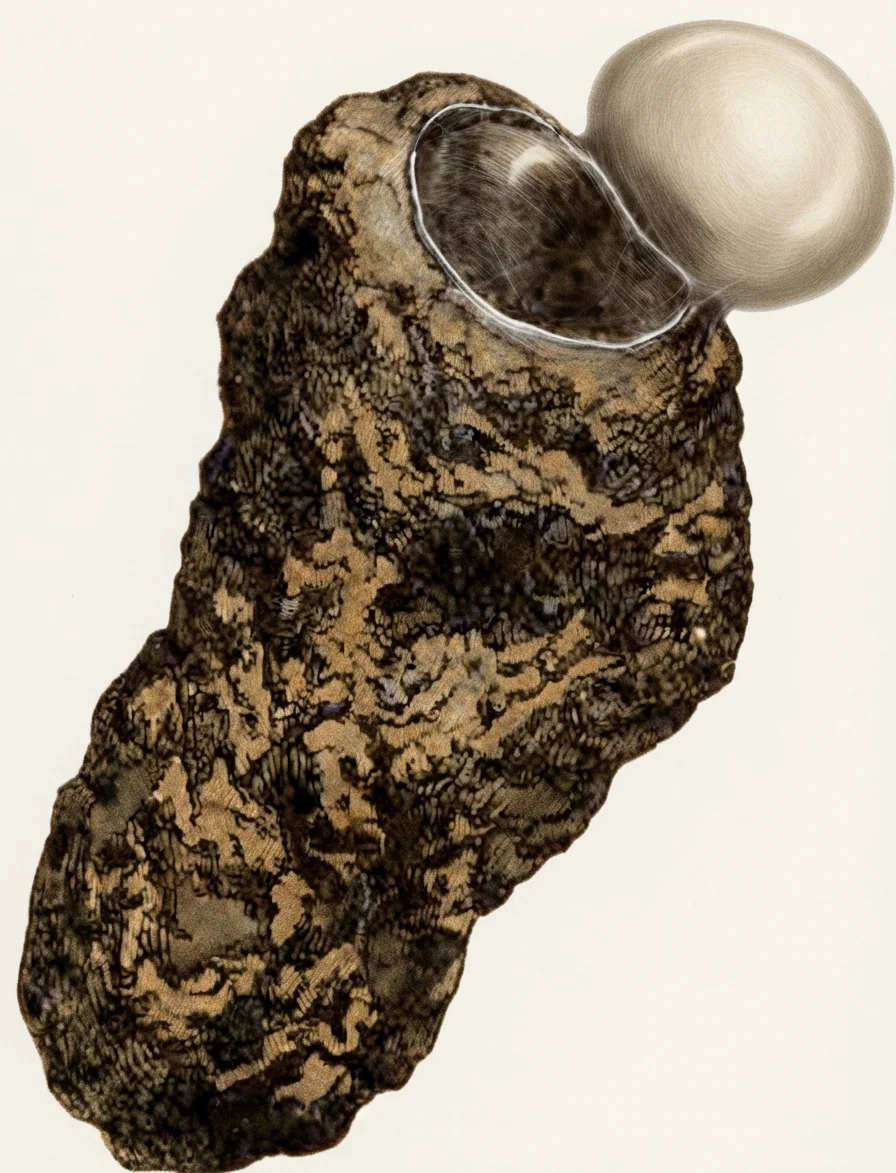
THE tarantula is a large, burrowing spider, which dwells in a shaft-like hole it sinks in the earth. Its appearance is most repulsive, and inspires any one who examines it with a feeling of profound disgust. As it stands, it frequently covers an area as large as the palm of a man’s hand, and over its body and legs there bristles a thick covering of red-brown hair. It may be said that its home is in many lands, but its greatest size is attained in tropical and semi-tropical countries. In the south of Europe, along the Mediterranean coast, it has been known for centuries as the “mad spider,” because the symptoms following its bite are similar to those of hydrophobia. There the peasantry, especially those of Sicily, regard it with mingled feelings of hate and superstitious dread.
They will tell you that the only chance of recovery from its bite is for the patient to commence dancing without delay, and to continue until he falls senseless from exhaustion,—a remedy which, ridiculous as it seems, has something to be said in its favor, when we know that the one danger to be overcome is the tendency to sleep, says the Chambers’ Journal. As long as this can be successfully avoided, the patient is in no danger; but if he gives way, and allows himself to fall into a stupor, then he is likely to succumb, even from the comparatively mild poison of the European variety.
It is in the tropical countries of South America, however, where all forms of insect and vegetable life attain their highest development, that this great spider is most deadly. And farther north, in the provinces of Mexico, where it is quite as numerous, its poison is only a slight degree less dangerous. There we have met it everywhere, and studied its habits. In the orange orchards, the vineyards, and the open prairies we have watched it attack enemies many times its own size, and marveled at the ease with which it overcame them. Even its own kind are not exempt from its fierce onslaught, and we remember once seeing a pair of them meet on the upturned root of a fig tree, and fight a duel to the death—the death of both.
Of man it seems to have no fear whatever, and will attack without hesitation either his hand or foot, if it comes within striking distance. In doing so it stands upon its four hind legs. It opens wide its enormous fangs until the mandibles protrude in a straight line from its face; then, with all the muscular force it is capable of, launches itself forward, sinking them, with a vicious thrust, deep into the flesh of the enemy.—Selected.
A Tarantula's Nest.
SKETCHES FROM THE ORIENT.
By H. P. H.
II.
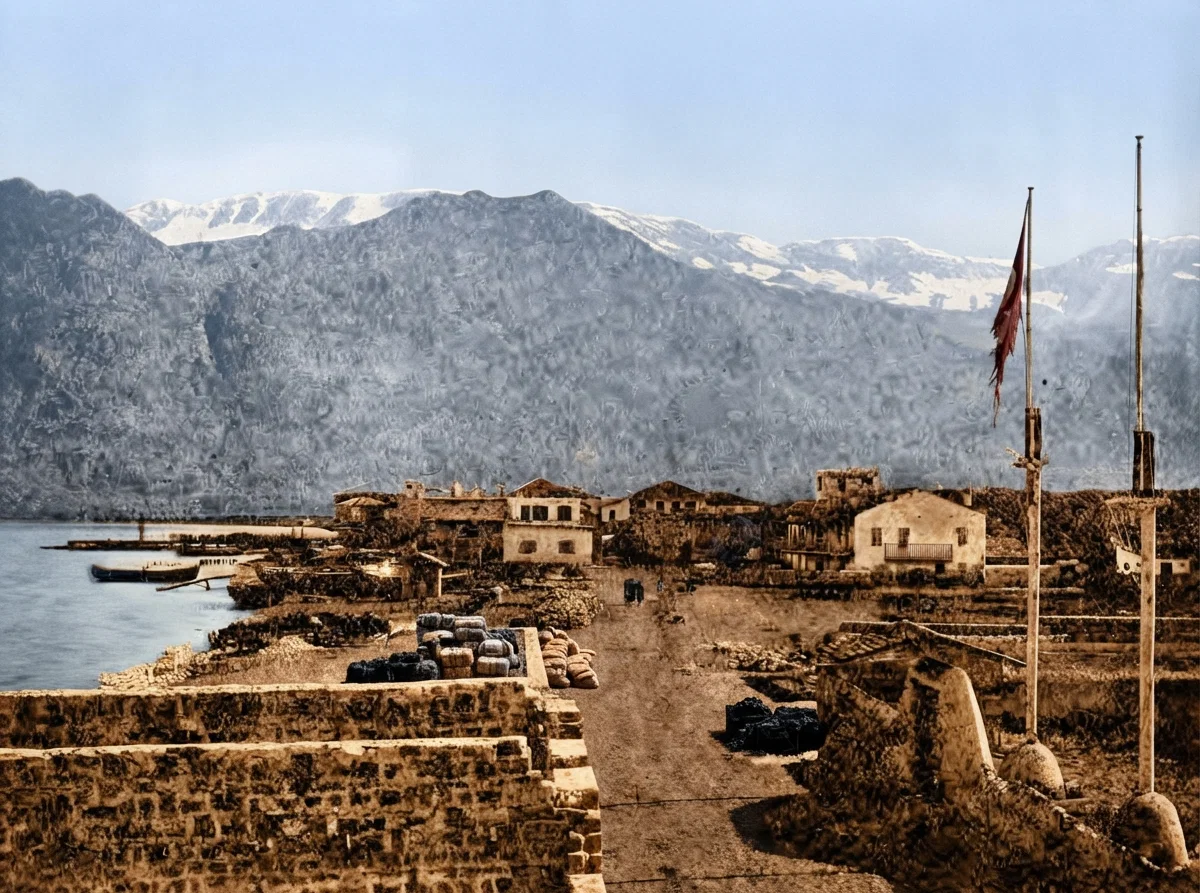
AFTER a short visit in Cilicia we came by steamer from Mersina across the bay of Iskanderoon, the northeastern extremity of the Mediterranean, to Alexandrette, or Iskanderoon, as it is called in Turkish. This town, a view of which is given in the accompanying illustration, is hemmed in by mountains, which rise quite precipitously from the sea. It was founded in memory of the passage of Alexander the Great on his famous campaign into Egypt, Persia, and India. A short distance above Alexandrette is Issus, the point where Alexander first met Darius. It is here that the great conqueror with a comparatively small army met and completely routed the Persians, whose army numbered 600,000. Where the battle was fought there is but little more space between the mountains and the sea than at the point shown in the illustration. The haughty Persian monarch had been made to believe by court flatterers that Alexander had fled in terror of the great Persian host, and under this delusion led his vast army into the narrow defile, where but a small portion could operate in battle; here he was suddenly surprised and defeated, his wife, mother, and other relatives falling into the hands of Alexander. At this time Alexander had not become so much infatuated with his victories, and treated the unfortunate family of Darius with remarkable kindness and respect.
Alexandrette, a town of 2,500 population, is now the chief port for northern Syria, taking the place of ancient Seleucia, the port of Antioch. This district, once the pathway of Assyrian and other conquerors, was also the battle-ground and field of victory of the first preachers of the Gospel. A day's ride on horseback from Alexandrette southward brings one to Antioch, where the disciples were first called Christians. Here is where Paul began his first decided work, and whence he was sent on his mission to the Gentiles. His first work was in Pamphylia, Pisidia, Phrygia, and Lycaonia, the countries which Alexander spent nearly a year in conquering before his famous battle at Issus. Thus these two great conquerors spent considerable time on the same battle-field, but how much more lasting and worthy the victory and11crown of the one than of the other! How much more glorious was the end of the great apostle than that of the great warrior!
This field, of such great historic fame, continues to be one of interest in modern times. About the time that the first angel's message began to be preached in America, missionary work was begun in Turkey by the American Board of Foreign Missions. Nearly from the first, Syria received attention, and a college for the education of young men was established at Aintab, a city a short distance inland from Issus. Here many young men were educated for teachers and other Gospel workers. A chief feature of the work of the board in Turkey has from the first been the education of the youth. Several colleges and many high schools have been established, in which some 19,000 are now under instruction. During 70 years the board has developed quite a strong work in this field; it now numbers 12,000 communicants and over 800 native laborers. A prominent feature in the work of the missionaries among the Greeks and Armenians was to impress their minds with the fact that the Scriptures, and the Scriptures only, should be the guide in doctrine and practise. This was necessary to lead them to abandon the traditions of the fathers and commandments of men. This principle having been firmly fixed, a great work has been done in preparing the way for the present truth. In several cases, we have observed the practical working of this principle when presenting the commandments. As the missionaries would urge the traditions and sophistries of men in favor of Sunday-keeping as against the plain Word of God in favor of the Sabbath, the people had but to use the arguments which the missionaries themselves had taught them in favor of the Word vs. tradition.
The first work in behalf of present truth in this part of Turkey was in Cilicia, and in Syria, at Alexandrette and Aleppo. On first hearing the truth, several in these regions gladly accepted it. Altho landing entire strangers at Alexandrette, we did not keep our first Sabbath here alone. The Lord wrought in behalf of the truth in this district; from our first experience here, we believe that the Lord has many people in these regions, and we hope that soon the good work may be continued and greatly extended. H. P. H.
SIMPLICITY IN DRESS.
SOME weeks ago, having occasion to cross from Jersey City to New York, I observed on the opposite side of the ladies’ cabin of the ferry-boat, in which I was seated, two young women of probably eighteen years of age, who appeared to derive excessive entertainment from scanning and criticising the apparel of those of their own sex who successively entered the cabin. Each lady, as she came inside the door, was rapidly “looked over” by the two giddy watchers, who would then exchange meaning glances, arch their eyebrows, and give way to a remark, giggle, or laugh. Evidently, dress was in all their thoughts. In noting their general demeanor, it seemed to me that those girls were such as would surrender everything that they might themselves become the recipients of the favors and bestowments of that fickle and withal merciless goddess—Fashion. For I have not forgotten what was said to me some years ago by a friend who had just returned from the city of Washington, when, in referring to the frivolity and the licentiousness prevailing there, he repeated the remark of a high official—that it was not in most cases mere “badness” that led so many young women astray, as it was the craving to be richly and fashionably dressed, to gratify their love of adornment and display.
A worthy woman said to my wife, when discoursing upon this subject in connection with benevolent work among the poor and the outcast, that upon a certain occasion, dressed in elegant attire, she had made a visit to a home for the fallen. Upon leaving the house, she felt decidedly pleased with herself at the orderly behavior of the inmates, and the seemingly respectful attention with which they had received her moral remarks. Afterward, however, when the matron observed that “the girls were so glad to have you come, for indeed it did their eyes good to feast on so fine a dress, and to see the latest fashion,” she said that she felt humbled to the dust, and as tho she could sink through the floor. The lesson was never forgotten, for she has always since then been careful to dress with simplicity when duty called her to such places.
Corroborative of the above is the following: A repentant female convict in one of our penitentiaries pleadingly said to a benevolent woman visitor, that she wished the ladies who came to the prison to speak and pray with them would dress more simply; for the prisoners’ thoughts were often so drawn away to the visitor’s fine or fashionable attire that they received no good impressions whatever, but rather the reverse. Her own fall had been caused by dress. A visitor to our county prison, looking upon a number of young women who had been locked up overnight for disorderly conduct, wondered that she should see females so finely dressed in such a place. She was given to understand that it was the love of gay attire which, more than aught else, had been the cause of their downfall.—Christian Cynosure.
REST AT HOME.
By D. E. W.
STRIVE on, strive on, my soul,
Thy Saviour bids thee come;
Fear not, faint not, my soul,
There's rest for thee at home.
D. E. W.
FAITH.
I CAN not tell how the lilies
From their beds creep up so far;
I can only pluck them gently,
And think how fair they are.
I do not know how the planets
Swing out into space so free,
But I know that One controls them,
And that is enough for me.
I know not whence comes music
From the song-bird's swelling throat,
But I feel the heavenly sweetness
That dwells in every note.
I can not read His purpose,
Nor solve each mystery,
But all that He sends is righteous,
And that is solace to me.
I know that the flowers must wither,
And the stars be dimmed some day;
The song will sink into silence,
And all things pass away.
But I also know of a Saviour,
Whose face I shall sometime see
He rules with a love eternal,
And that is enough for me.
—Anon.
OPPONENTS OF THE BIBLE.
THE American Bible Society has received recent letters from Peru which state that four of the men who have been most prominent in obstructing the circulation of Bibles and evangelical work in that country have died within twelve months.
PORT OF ALEXANDRETTE, SYRIA.
They are the Bishop of Arequipa, who in 1889 observed Mr. Penzotti selling a New Testament in the street, and ordered a gendarme to arrest him and his colporters; La Jana, who stopped the entry of Bibles at the custom-house in Callao, on the ground that he needed to consult the government respecting the legality of clearing such publications; Quinones, who ordered the mission schools to be closed; and the padre Veza, the parish priest of Santa Rosa, who had been conspicuous in throwing obstructions in the way of evangelical work —Christian Advocate.
OUR WORK AND WORKERS.
By Editor
ELDER S. H. LANE has been re-elected president of Illinois Conference.
THREE candidates were baptized at Keokuk, Iowa, September 11, by Elder D. P. Gaede.
AT Pine Valley, near Neillsville, Wis., the Reporter notes the addition of seven to the church.
THE Minnesota Tract Society reports orders for 1,268 books from canvassers for fall delivery.
AT the recent camp-meeting held at Logansport, Ind., twenty-five brethren were baptized. Brethren O. S. Hadley and P. G. Stanley were ordained to the Gospel ministry.
THE book, "Rise and Progress of Seventh-day Adventists," by Elder J. N. Loughborough, has been published in the German language, and is now ready for orders. Price, $1.00.
THE address of the Welcome Visitor, the Ohio Conference paper, as also the headquarters of the Ohio Sabbath-school Association, has been changed to 152½ Birch Street, Cleveland.
ELDER D. T. SHIREMAN reports the addition of six members to the church at Asheville, N. C.
ELDER G. A. IRWIN, president of the General Conference, has been confined to his house recently with sciatic rheumatism.
As a result of Bible readings and other missionary work in Philadelphia, the past year, thirty-six persons decided to come over on the Lord's side. Elder E. A. Merrell has had charge of the work.
THE secretary of the Minnesota Tract Society reports orders for 1,400 books from canvassers for fall delivery. The most of these were for the larger works, such as "The Great Controversy," "Prophecies of Jesus," and "Daniel and Revelation."
ELDER A. T. JONES, of the General Conference Committee, gives us an encouraging item concerning school work. He was present at the recent opening of Union College, at College View, Neb., and says that 169 were enrolled the first day, and more came in afterward, making about 180. The prospect is good all round for a good year. In Battle Creek College 380 are entered.
The Dent on a Human Soul
By Edward Judson
THE dent you make on a human soul can never be obliterated.—Edward Judson.
23 "AND when many days were fulfilled, the Jews took counsel
24 together to kill him; but their plot became known to Saul.
And they watched the gates also day and night that they
25 might kill him; but his disciples took him by night, and let him
down through the wall, lowering him in a basket.
26 "And when he was come to Jerusalem, he assayed to join
himself to the disciples; and they were all afraid of him, not
27 believing that he was a disciple. But Barnabas took him, and
brought him to the apostles, and declared unto them how he
had seen the Lord in the way, and that he had spoken to him,
and how at Damascus he had preached boldly in the name of
28 Jesus. And he was with them going in and going out at Jeru-
29 salem, preaching boldly in the name of the Lord; and he spake
and disputed against the Grecian Jews; but they went about
30 to kill him. And when the brethren knew it, they brought him
down to Cæsarea, and sent him forth to Tarsus.
31 "So the church throughout all Judea and Galilee and
Samaria had peace, being edified; and, walking in the fear of
the Lord and in the comfort of the Holy Ghost, was multiplied.
32 "And it came to pass, as Peter went throughout all parts, he
33 came down also to the saints which dwelt at Lydda. And
there he found a certain man named Æneas, which had kept
34 his bed eight years; for he was palsied. And Peter said unto
him, Æneas, Jesus Christ healeth thee; arise, and make thy
35 bed. And straightway he arose. And all that dwelt at Lydda
and in Sharon saw him, and they turned to the Lord.
36 "Now there was at Joppa a certain disciple named Tabitha,
which by interpretation is called Dorcas; this woman was full
37 of good works and almsdeeds which she did. And it came to
pass in those days, that she fell sick, and died; and when they
38 had washed her, they laid her in an upper chamber. And as
Lydda was nigh unto Joppa, the disciples, hearing that Peter
was there, sent two men unto him, entreating him, Delay not,
39 to come on unto us. And Peter arose and went with them.
And when he was come, they brought him into the upper
chamber; and all the widows stood by him weeping, and show-
ing the coats and garments which Dorcas made, while she
40 was with them. But Peter put them all forth, and kneeled
down, and prayed; and, turning to the body, he said, Tabitha,
arise. And she opened her eyes; and when she saw Peter, she
41 sat up. And he gave her his hand, and raised her up; and
42 calling the saints and widows, he presented her alive. And it
43 became known throughout all Joppa; and many believed on the
43 Lord. And it came to pass, that he abode many days in Joppa
with one Simon a tanner."
QUESTIONS.
1. Give an account of Saul's conversion. Where
did he first begin to preach?
2. While he was there preaching, what did the
Jews propose to do?
How did they proceed?
How was their plan frustrated?
To what place did Saul at once go? How was
he regarded by the brethren?
6. Who vouched for his sincerity? What did he
say?
What did Saul then do at Jerusalem?
How did he speak? What did the unbelievers
seek to do?
What measure was taken for Paul's safety?
What resulted to the churches from Saul's
conversion? How did they improve this rest?
With what results?
Where did Peter go in the meantime?
Whom did he find there? What was his
trouble?
What did Peter say to him? What followed?
How effective was this miracle?
Describe the character of Dorcas. Where did
she live?
What did the disciples do when she died?
For whom did they send?
When he came, what did they do?
Tell how Dorcas was brought to life.
How extensively was this miracle known?
What was the effect of it?
21. Where did Peter remain?
SUGGESTIVE QUESTIONS.
1. With the first part of this lesson, and the pre-
ceding one as well, the first chapter of Galatians
may profitably be studied. Read also 2 Cor. 11: 32,
33.
2. Verse 23 says that "after many days were ful-
filled, the Jews took council to kill him;" how long
a time does this cover? Where did Saul go in this
time?
3. How long did Saul stay in Jerusalem on his first
visit after his conversion? With whom did he
dwell?
4. When miracles were wrought by the hand of
Peter, to whom did the people turn? On whom did
they believe? When Simon the sorcerer did great
works, to whom did the people turn? Is there any-
thing in this that will help us to discern between the
work of the Lord and the work of Satan?
5. Why was the healing of Æneas recorded?
John 20: 31. What lesson does it contain for us?
What significance in the fact that Peter uses the
present tense, "maketh," instead of the future,
"will make"?