Your ShelfYour Projects

Signs of the Times, Vol. 23, No. 39.

Editorial

Signs of the Times

Oct 7, 1897

Pacific Press Publishing Company · Oakland, California · Oct 7, 1897

Editorial

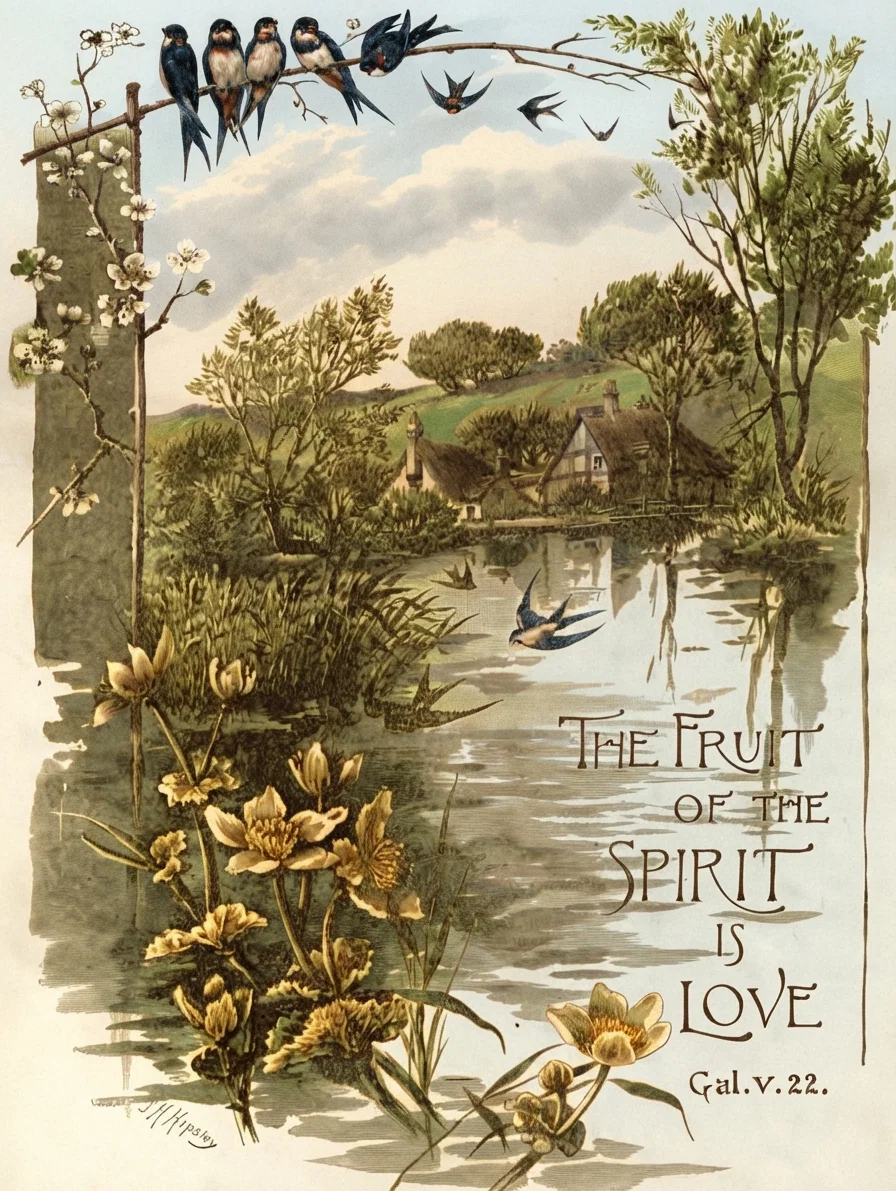
"The Fruit of the Spirit Is Love."

"Fruit" is that which is brought forth; the result or consequence of a thing; that which springs from its very nature. The fruit of a thing always reveals the character of that which bore it.

The Spirit.

The "Spirit" of the text is the mighty beneficent energy or life of God, that through which God imparts all life and power; by which creation was wrought (Gen. 1:2; Ps. 33:6; Job 26:13); by which all is upheld; and by which all shall be restored. It is "the Spirit of Life," "the Eternal Spirit," "the Spirit of Holiness," the blessed "Comforter" of the people of God. "If any man have not the Spirit of Christ, he is none of his." Rom. 8:9. He who is not controlled or led of the Spirit is not of God. "The minding of the flesh is death; but the minding of the Spirit is life and peace." Rom. 8:6, margin. For the flesh and Spirit "are contrary the one to the other." Gal. 5:17.

"Led of the Spirit."

There are many in these days who claim to be "led of the Spirit." It is with them "the spirit;" the Word of God, the experiences of others, are nothing to them. They do not need the Word; they have "the spirit." They do not need God's law; they are taught by the spirit. And they will frequently quote, "If ye be led of the Spirit, ye are not under the law." Gal. 5:18. Such persons may be deceived, and those who are deceived may and do deceive others. The claim to sinlessness which many of them make is often inconsistent with their actions. How may they know whether they are deceived or not? How may others know?—By the fruit borne in the life. If the life of these persons is a sin-perverted life, the fruit will reveal it. If the life is the normal life of God that also will be revealed.

"The Fruit of the Spirit Is Love."

This is the fruit which the life of that person must bear who is "led of the Spirit." And yet claim is laid to love with as little reason as it is to the spirit of love, because of a wrong conception of what love is. Such judge divine love, the love "shed abroad in our hearts by the Holy Ghost which is given unto us" (Rom. 5:5), by the imperfect human love of the world. It is to them an emotion, a passion, an ecstasy. It is something that one must feel. It, in their mind, must make one happy and life easy. But—

What Is Love?

Love is a principle, a power, a life, which eventuates in doing, in serving, in sacrificing. Words are only one form of its expression, and the weakest form of all. Here are God's definitions of love: "Love is the fulfilling of the law." Rom. 13:10. "And this is love, that we walk after his commandments." 2 John 6. "For this is the love of God, that we keep his commandments; and his commandments are not grievous." 1 John 5:3. "The fruit of the Spirit is love;" love is the keeping of the commandments of God; the fruit of the Spirit, therefore, is the keeping of the commandments of God.

The Spirit of Christ.

The Spirit was given to Christ without measure. John 3:34. Before Christ came to this world, he thus spake by the Spirit through David: "Lo, I come; in the volume of the book it is written of me, I delight to do thy will, O my God; yea, thy law is within my heart." Ps. 40:7, 8. When he came he fulfilled this prophecy. "My meat," said he to his disciples, "is to do the will of him that sent me." John 4:34. "I have kept my Father's commandments," he tells us near the close of his earthly career, "and abide in his love." John 15:10. Of our Lord's conduct in this respect there is no question; he kept the royal law, the Decalog, in its every particular. What does that mean to us?—He says, "Follow me." And his beloved disciple writes, "He that saith he abideth in him [Christ] ought himself also so to walk, even as he [Christ] walked."1 John 2:6. "Leaving us an example," says Peter, "that ye should follow his steps." 1 Peter 2:21. What more do we wish? Do we have love for God? He says, "If ye love me, keep my commandments." John 14:15. "Ye are my friends, if ye do whatsoever I command you." John 15:14.

"Not under the Law."

He who thus loves God is not under the law. He only is under the law who is condemned by it, who is out of harmony with it, who transgresses it. He is a sinner, for "sin is the transgression of the law." 1 John 3:4; Rom. 7:7. He who is in harmony with the law loves the law. It is in his heart. He is neither under the law or above the law; he is with the law. The law is in him; for Christ lives in him; and the law in Christ is "the law of the Spirit of life." Rom. 8:2. By walking after that Spirit he fulfils in his life "the righteousness of the law," in other words he keeps it. Rom. 8:4. Walking after the Spirit of God, he keeps the law of God, and brings "forth fruit unto God" (Rom. 7:4), and against him there is no law of God (Gal. 5:18-23). That spirit, therefore, which would lead us to transgress God's law is not the Spirit of God, but the spirit of the flesh, "at enmity with God," and not subject to his law. Rom. 8:7. The fruit of the Spirit is love. The Spirit is the Spirit of God. The "love is of God." And love keeps God's commandments. Therefore, "let us not love in word, neither in tongue; but in deed and in truth." 1 John 3:18.

Love above Feeling.

We would not decry feeling or emotion. The happiest, holiest, purest, most enjoyable feelings known to mortals those know who are at peace with God, and who keep his commandments. "O that thou hadst hearkened to my commandments! then had thy peace been as a river, and thy righteousness as the waves of the sea." Isa. 48:18. "And the work of righteousness shall be peace; and the effect of righteousness quietness and assurance forever." Isa. 32:17. But feeling may change. Sickness, perplexity, the wrong conduct of others, may bring sadness and sorrow, or physical discouragement; but love abides. The devoted unselfish mother loves her child. At one time she may be in the enjoyment of rest and ease with no anxiety as to his welfare. Joy and gladness light up her face; but these are not the evidences of love. Such in the days of prosperity are often seen with the most selfish mothers. Again we see her. Her son is ill, irritable; querulous, and complaining. The mother is worn and weary with ceaseless vigil and labor. Physical strength is well nigh exhausted, and feeling is departed; but love abides. As dearly as in the sunshine of yesterday she loves her boy; and her love is manifest in the doing. Our Lord's life was not all sunshine. We read of no exuberant feelings of joy, no manifestations of ecstasy. "His visage was so marred more than any man," but his love did not lessen. God's love was shown for his Son when by the Jordan and on the "holy mount" his voice was heard. "This is my beloved Son in whom I am well pleased;" but God loved him not less in the wilderness of temptation, in the Garden of Gethsemane, or when enshrouded in the darkness of Calvary. Love is above all feeling; it is an eternal, abiding, life-giving principle.

THE HOPE OF THE WORLD.

AN article appears in a recent number of the Independent (September 16) which is worthy of more than a passing notice. It is written by Addison Ballard, D.D., and is entitled "Christianity, a Return to Judaism." By "Judaism" Dr. Ballard means the Judaism of Christ. He says (Italics his, the bold face ours):—
Jesus tells us that all the world needs in the way of either devotional or ethical religion is that it keep perfectly the Ten Commandments, epitomized so long before by Moses himself as whole-heart love to God and equal love to our neighbor. Jesus gave no new, either heart-law or life-law. He added not one jot to that which had already been given. There was nothing to be added. He declares, therefore, in effect that to say the "religions" of the world is to use a false plural; that there is but one religion—that of love. By saying that "on these two commandments hangs all the law," he declares them to be the one and only religion of the past. By saying that on these hang all the prophets, he proclaims that they are the one and only religion of the future; that, in short, there never has been, is not now, and never will be any other religion—the religion for all men and for all time; and, we may add, for all eternity.
What is this but to say that all the world needs in the way of ethics or religion is that it be thoroughly Judaized?
Himself a Jew, no other Jew was ever so perfectly loyal to Judaism as Jesus was. He not only affirmed and reaffirmed the law; he kept it; the only Jew who ever did keep it wholly. He was always pre-eminently and consistently Judaistic in both his teachings and his life. He needed not to return to Judaism; he had never departed from it.
He was thoroughly loyal to the Judaic way of return for those who had proved themselves disloyal to their one acknowledged Head. That way was through sacrificial offering. The ark, which held the law, was kept in the "holy of holies," the presence-chamber of Jehovah. There was no way of reaching the ark but by the altar of sacrifice. Altar, victim, and ark were inseparably connected.
The writer then goes on to show that the Jews in the days of our Lord had departed from their organic law, even as the United States had departed from its organic law in the days of Lincoln; and that as true Americanism was to be judged by its basic principle, the equality of man as set forth in the Declaration of Independence, so Judaism should be judged, not by what it was held to be by the Pharisees in Christ's day, but by its basic principles.
The Hebrew nation, too, was "conceived in liberty" and brought forth from bondage; but it was dedicated to the much broader and deeper proposition, that "supreme love to God and equal love to our neighbor is the full sum of universal human duty." But it was another and an altogether unique element in Judaism that it provided for the forgiveness of individual transgression against its organic law and for a return to it, through a suffering and sacrifice other than those of the offender himself. And just this, as I understand it, Christianity means and is.
Then coming to the basis of true conversion, the broken heart and contrite spirit, Dr. Ballard asks, "Where is this broken and contrite heart to be found?" And he answers:—
For myself, I find it only at the feet of Him who is at once for me both ark and altar, both priest and sacrifice. Here, "cut from the olive tree which is wild by nature," I find myself "grafted contrary to nature" into that "good olive tree" which the greatest of Christian apostles tells me is Judaism—the still firm, immovable "root," not upborne by the ingrafted Gentile branches, but itself upbearing them. Here, here only, do I find myself returning through penitent, grateful love to whole-heart love to God and equal-heart love to my neighbor. Here, and only here, do I find the clue which leads me safely and rejoicingly out of, and past, the whole bewildering labyrinth of tangled traditions, theologies, catechisms, sects, and creeds; and out of the darker and more bewildering labyrinth of my sins.
When, speaking in metaphor, all the true Israel of God shall meet at length in one common assembly, the meeting-place will be again on the broad plains about the base of Sinai. Thither, to this "one fold," is the Good Shepherd pointing ever his one flock. But it will be far otherwise than it was when his people were first led thither by Moses. The same two tables of the Law will indeed be there. They will still stand high aloft, crowning the summit of the once awful mount, but no longer shooting lightnings through black, enveloping smoke-clouds followed by peals of affrighting thunder. They will shine, rather, from afar and to all nations with a mild and winning luster; for instead of the old and terrifying "Thou shalt not," the two tables are now turned toward one another and are become one in the changed figure of a cross; and on its extended arms is now seen emblazoned "Love to God and Love to man"—an "ideal to draw the nations to higher and higher reaches of civilization and progress."
Here, too, will be solved at last the now perplexing question of Christian unity; and not that only, but of Christian and Jewish unity as well. For when, gathered out of all nations, we shall meet in concert on the heavenly plains, what will our one song be but the "Song of Moses and the Lamb"? And what is that song but the blended song of the "way" and of the lost way found?
Such is the law of God to him who finds Jesus Christ. Such is God's message at this present time, to this present generation. With the love of infinity, God sends that message to "heal Babylon," to bring unity. "Fear God, and give glory to HIM; for the hour of His judgment is come; and worship HIM that made heaven, and earth and the sea, and the fountains of waters."
Then follows in this message the result of rejecting it, the fall of Babylon. And then God's solemn warning against all false worship and false religions epitomized in the worship of the beast and his image, and the reception of his mark. And then God gives us a description of the characters of those who receive this message, who return to the Judaism of Christ Jesus: "Here is the patience of the saints; here are they that keep the commandments of God, and the faith of Jesus." See Rev. 14:6-12. This is God's message of "the everlasting Gospel" to draw the men of all nations, not merely to "higher reaches of civilization," but to higher reaches of God-likeness, to the glory and blessing in Christ Jesus. Truly the hope of the world is a return to the Judaism of Christ Jesus.

ONE SURE THING.

IN the book of Proverbs much is said about surety, and people are more than once warned against going surety, not only for a stranger, but even for a friend. In the eleventh chapter, verse 15, we read, "He that is surety for a stranger shall smart for it; and he that hateth suretyship is sure." In the margin we have in the place of "suretyship," "those that strike hands." That is, a man can not be safe unless he refrains from giving his hand as surety for another.
But read further, and see what is said in the twenty-first verse: "Tho hand join in hand, the wicked shall not be unpunished; but the seed of the righteous shall be delivered." Notice that the words "tho" and "join" are in Italic type, indicating that they are not in the Hebrew. The literal Hebrew, as indicated in the margin of the Revised Version, is "hand in hand." Here, then, we find an instance of giving the hand, or, as rendered, "My hand upon it!" In two translations before me, I read, "One can give his hand for it, that the wicked shall notbe unpunished; but the seed of the righteous shall escape." So sure is it that God will see that justice has its due! Men are often tempted to think, as did David, that the wicked have the best of it, and that in unrighteousness is the most prosperity to be found; but let no one be deceived in this matter. So sure is it that wickedness will be punished, and that the reward of the righteous will not be forgotten, that one may safely give his hand upon it, and be a surety for it. It is the only sure thing in this world. E. J. W.

APPLIED GOSPEL.

WE can not hope to reach the soul until we have first touched the body. In our work in Bethesda Mission, 406 South Clark Street, Chicago, we used to give the hungry men who came in something to eat, before we attempted to talk to them. We seasoned the food with song and prayer, however, passing it in connection with the praise service, often spicing it with testimonies, which they relished, because they were being made comfortable meanwhile. It is a wonderful privilege to be allowed to go to men and women who are degraded, and teach them that they shall be able to put on the divine nature, and so escape the corruption that is in the world through lust; and we can well afford any experience or training which will qualify us for it. There is no joy like that of being used to rescue a life from degradation.
A good many years ago I found a woman in a house of sin. I had heard of her as one who was altogether lost, and who was constantly leading astray those whom we were trying to help. She was called "Old Mag," and I saw her in imagination as an old hag, carrying the history of her degradation in every feature. I had often spoken of visiting her, but had been restrained from the effort by those who said, "You do not know what you are thinking about to propose such a thing." But at last I heard that she was ill, and determined to see her, even if I went alone. So, accompanied by one of our W. C. T. U. women, I went. We found her in a cottage, to which she had been moved to die, adjacent to the saloon and notorious house which she had managed so long.
As we entered, I was surprised to find a beautiful woman, of not more than thirty-five years, her face brilliant with the hectic flush, and her dark eyes with fever. She said, as we made known our errand:—
"What made you come to see me?"
"I came because I had to come; I had a special message to you; I had to come and deliver it."
"A message for me?"
"Yes, a message for you."
Then I began to repeat some of the gracious promises of the Gospel: "For God so loved the world, that he gave his only-begotten Son, that whosoever believeth in him should not perish, but have everlasting life." "This is a faithful saying, and worthy of all acceptation, that Christ Jesus came into the world to save sinners; of whom I am chief." "Whosoever will, let him come." "Come, let us reason together;" until at last she interrupted me by raising her hand and saying:—
"I have heard all those before. They are not for me."
"What makes you think they are not for you?"
"O, I am such a sinner! You don’t know what a sinner I am, or you wouldn’t come and say those words, and pretend they are a message to me."
"But they are to you," I said, "a direct message to you, because you are a sinner. These words were spoken to sinners, and if you were not a sinner, you could have no claim on them, nor on the Christ who spake them."
"But I am such a sinner; you don’t know!"
"He who sent the message knows. If you are a great sinner, you have a great Saviour. You can never be more than a sinner, and your Saviour can never be less than a Saviour. When you take a great sinner and a great Saviour and bring them together, you get a great salvation. And that is what you are to have,—a great salvation."
"But what could I do? Where would I go? No one but bad people would have me around," she said bitterly.
Then, as a part of the Gospel, we told her that she was to be taken up out of that house, to a home. She was to be lifted up by the power of God in every sense of the word,—taken up bodily out of that place of sin, and taken care of as a daughter of our Father, and a sister of our Lord.
"Can such a thing be possible?" she gasped. "Who will have me?"
"Somebody will; I know it, and will prove it," I answered out of the faith that was given me for her.
"If you can, I shall believe," she said, with despairing incredulity.
By the grace of God I was able to keep my word. She was taken out of that place to the home of one of our W. C. T. U. women, and there cared for as a loved and honored guest, rejoicing in a salvation that could reach her soul, through a body all diseased and polluted as it was with sin, until she died.It is only by such a demonstration of the Gospel, that will be willing to first take hold of the material part, and provide a material salvation from material dangers and losses, that the poor sinner will be able to believe in the spiritual power by which salvation can be made to "strike in" to soul and spirit.
In teaching the Gospel always say "we." Just as soon as you remove your own personality to one side, as something apart from your congregation, you remove yourself from that fellowship which makes you one with them, and a barrier has sprung up between them and you which it is impossible to pass over. Jesus made himself one with us. "Wherefore in all things it behooved him to be made like unto his brethren, that he might be a merciful and faithful high priest in things pertaining to God, to make reconciliation for the sins of the people. For in that he himself hath suffered being tempted, he is able to succor them that are tempted." Heb. 2:17, 18. Christ, made like unto his brethren, entering into fellowship with their temptations, is invincible.
A drinking man said to me one day:—
"You talk about Christ being able to help such a man as I am, but I want you to tell me, do you think he was ever drunk? Do you think he ever knew the anguish of the appetite for strong drink?"
"We are told," I replied, "that he was tempted in all points like as we are. That ought to be enough. It means all that can possibly be in the appetite for alcoholic drink. He was never drunk, for he never sinned, but he was tempted in all points like as we are, and knows just what it means; for he carried our flesh,—yours, just as it is, with all the appetites and passions and diseases which affect it."
"Well," he said, "if I could just once believe that he felt what I feel when I want a drink, it would give me comfort."
"We will pray that you may come to see just how he entered into fellowship with you in this peculiar temptation."
And after many days of earnest seeking he found Christ just as he was, made of his own flesh, his brother in temptation, as well as his Saviour.
In Heb. 7:25 we learn the extent of this Gospel: "Wherefore he is able also to save them to the uttermost that come unto God by him, seeing he ever liveth to make intercession for them." An uttermost salvation! It reaches away out beyond the outmost limits of sin. Men and women down in the depths know well enough that a salvation that is not to the uttermost is not worth anything. If it does not touch the outer and inner boundaries of sin, if it does not go beyond the man and leave a margin of Christ white and clear, it is not worth much to him. We must know it as uttermost for ourselves, or we can never teach it as such; and if we do so know it, we can never call it less.
In one Gospel meeting where this was the theme, the men took it up after the leader, each in his own way. Among those present was a half-drunken man, very ragged, very dirty, who had been persuaded to come in by one of his old companions, a recent convert. He sat listening as attentively as a man half drunken could, while many of his old friends gave their testimony. After a while he raised himself partly from his chair, and said:—
"Didn't you say anybody might speak?"
"Certainly, anybody can speak in this meeting," I said.
"Well, I have something to say, then. I don't know very much about your God—never heard very much about him—but I want to say, if he expects to do anything at all for such fellows as we be, he'd better make it uttermost. You're all right. Go ahead; tell them more of that sort."
When he sat down, another man arose, and said:—
"I appreciate what that man said. Sin can destroy to the uttermost, and if God does intend to save such fellows as we are, he must match an uttermost power to destroy with an uttermost power to save."
This from men just out of the saloon—the last speaker had been sober only about two weeks. It was to me a wonderful commentary on the Gospel.
One evening, as I was about to step into the pulpit, to conduct a Gospel service, a man came from the audience, and accosted me, saying:—
"I want to ask if you intended to say last evening that if we were born again we could not sin."
"Why do you ask me a question like that?" I said.
"Because of what you said. I want to know if you intended to say it; for it was a startling statement."
"Please tell me just what I said."
"You said that if we were truly converted, and born again, we could not sin."
I opened my Bible to 1 John 3:9 and said: "This is what I read, instead of said, 'Whosoever is born of God doth not commit sin; for his seed remaineth in him; and he can not sin, because he is born of God.' You see those were not my words, they were the words which the Book spake; not I. I would not have dared say them; but since God said them, I do not dare keep them back. I am very glad, indeed, that he fastened them onto your memory, so that you have not been able to forget them. As you must remember them, remember that they were not my words, but God's. The Gospel is to the uttermost. It is not for me to explain these words; they do not need an explanation. They belong to those things which are so plainly told that it is not worth while to stop to talk about what they mean, but only to receive or reject them. Let God prove it to you for yourself, and then you will know it as he intended you to know it."
We will find people who need a Gospel which will touch the labor problem, that will help to settle the controversies which take root in the slum, and branch out all through avenue and palace. Every day we shall meet these vital questions in some form. People will come into the mission who would give anything for a job. They would almost be willing to buy a job, if they could. It is not true that none of them are willing to work, that they are idle because they are lazy. Some of them are, but many are not. Multitudes would work, but there is no work for them; and we must help to make practical to them the words of Christ, "But seek ye first the kingdom of God, and his righteousness; and all these things shall be added unto you." Christ left those words for his people to verify. They are an essential part of the Gospel message. Christ came to make it possible that food and raiment should be provided to the needy. He cares for the fowls of the air, and feeds them. The young lions roar, and he hears their cry; he feeds every living thing. His ears are open to the cry of the hungry; but he employs human helpers for all this work for men, and he is asking for help from you and me, in applying his Gospel to the world's needy ones.
MRS. S. M. I. HENRY. Sanitarium, Battle Creek, Mich.

BUT WHY NOT STICK TO THE WORD?

The Pulpit of the Cross, a “High Church” paper, published at Omaha, Neb., in its issue of August 28, in its leading editorial article, answers a correspondent who objects to “Fasting Communion,” that is, partaking of the consecrated elements before eating on that day, on the ground that it is not Scriptural, that there is nothing in the Bible to sustain it. As a part of the reply to this correspondent the Pulpit of the Cross presents the following:—
But our critic has accused us of “strange inconsistency.” We wonder if he himself is so inconsistent as to observe the ancient custom of keeping holy the first day of the week instead of the seventh? What authority, we should like to know, can he find in the Holy Scriptures for observing Sunday instead of Saturday as his Sabbath? There is not one-half as much in the New Testament to justify a Sunday Sabbath as there is to justify Fasting Communion. On the subject of this great change, the Scriptures are entirely silent. If in the matter of the Sabbath we have nothing to fall back upon except the Bible, then the argument of the Seventh-day Adventist is well nigh unanswerable. The only valid reason he who charges us with inconsistency can give for keeping holy the first day of the week is the authority of those “ancient customs” which he faults us for reverencing so highly. We keep Sunday as a day of religious rest and worship, because the church has always from the very beginning kept it in honor of CHRIST’s resurrection from the dead. That is the sole and only justification we have for our practise. Therefore unless our anonymous friend is a Seventh-day Adventist he is inconsistent in observing the LORD’s day after the “ancient customs,” while he calls the equally ancient custom of Fasting Communion “disloyalty to CHRIST.”
But why not go back to the more ancient custom of the observance of the Sabbath which has the authority of not an apostatizing church, but the Word of God and the example of Jesus Christ?

Sincerity

Sincerity.—The other day a traveling journalist assured the readers of a London daily that the Chinese were sincere in their religious life, and should be let alone. It is a familiar saying, and very often it is taken for granted, that the man who is sincere is also right. But the Bible couples “sincerity” with “truth” in the service of God. A man may sincerely enough take the wrong road in traveling, but it can never lead him to his destination; nor would it be reasonable for any one to plead his sincerity as a reason for not pointing out to him the right way.—Present Truth.

SLANDER.

SLANDER is worse than gossip, for gossip is often good-natured, but slander is always venomous. “The poison of asps” is under the slanderer’s lips. Slanderers are the “asps” of society, both in the snake-like secrecy of their attack, and in the deadly venom of their bite; and nothing good can be said of them or of their progenitor who serpentined his way into Eden and slandered God.—Anon.

“WAIT ON THE LORD.”

O SOUL, why wearied be with God at thy right hand?
He bids thee wait and see and not impatient stand.
Of courage strong be thou, and He shall strength impart.
Wait, wait, says Jesus, wait, and I will guide thy heart.
Sure I had fainted now unless I had believed,
And seen Thy goodness in the land in which I lived.
But still there’s room for faith and confidence and love;
And thus by trusting God I’ll reach my home above.
O soul, if doubt and grief, like floods, come sweeping o’er,
If sympathy and love thy heart is yearning for,
O, look to Jesus then, who for thy life hath died,
And for thy sins and guilt was mocked and crucified.
He now is standing there at God’s right hand in heaven,
Pleading for thee and me, that we might be forgiven.
He tells us if we come to places dark and hard
To just stand still and see th’ salvation of our Lord.
We need not fret nor faint because our friends seem cold,
Or try to win them back by acts which might look bold;
But pray instead to God, who never waits too late,
Then fix our gaze above and patient stand and wait.
C. L. RICHARDS.
College View, Neb.

“RIGHTLY DIVIDING THE WORD.”

UNDER the above head, “C. D. M.” in the Advance, September 9, calls another correspondent to account for supporting the practise of ‘tithing’ from the Old Testament. C. D. M. claims that since the Old Testament belonged to a different ‘dispensation,’ it is of neither value nor authority at the present time. But it is clear that it is not tithing, so much as the Sabbath, which this correspondent is anxious to destroy. The subject of tithing is the occasion which leads him to say the following:—
Not to perceive this distinction pitches everything into confusion. And it is out of this confused vision that the Sabbath controversy has sprung. Failure to see a succession of dispensations, and at least two Testaments, must inevitably result in giving by far the longer end of the lever to the Sabbatarians. . . .
The Jews lived under the Old Testament, which we call the law. To refer to what Christ did settles nothing for us, for Christ was a Jew, and he lived under the law. Furthermore, during the days when he was forging a New Testament, the New Testament dispensation, of course, had not begun, for, (Heb. 9 : 16) “Where a testament is, there must also of necessity be the death of the testator; for a testament is of force after men are dead; otherwise, it is of no strength at all while the testator liveth.” Ye are not under the law.
If more unchristian and destructive no-lawism than the above has been uttered by a Congregationalist (as it is fair to suppose), we have not been pained by seeing it. It is also as inconsistent as it is painful. To push the analogy between the “will”—testament—of a man and the Old and New Testaments so far as to destroy the former, is far from being logical or exegetical. To ignore the fact that the New Testament is the product of the Old; that the Old infolds the New, and the New unfolds the Old, is equally unscholarly and unjust. But the depth of unchristian non-loyalty is reached when the stigma of Judaism is fastened on Christ, under the assertion: “To refer to what Christ did settles nothing for us, for Christ was a Jew, and he lived under the law.” Startling as this new form of unbelief may be, it has one element of consistency in that it throws away the Jewish Christ with the Jewish Scriptures; but it leaves the world a little lonely with only a “Jewish Saviour,” whose example is nothing to those who pretend to hope in him for salvation. Is this the latest liberal orthodoxy of reckless no-lawism? And all to get rid of the Sabbath?—Sabbath Recorder.
Continue reading: TRUST IN THE LORD