Pacific Press Publishing Association · Mountain View, California · Aug 20, 1912
IF YE WILL INQUIRE, INQUIRE YE
By Editor
This Inquirers' Department is conducted for the purpose of helping those who are studying the Bible. The answers are oftentimes only suggestive. They are never to be considered infallible, only as they agree with the infallible Word. The writer who may answer them does not consider that his opinion is infallible. He will simply give the best that he has, and plead with the inquirer to search the Word. Such questions only will be answered as, to the editors, seem to minister to the good of the readers and to the mission of the paper. We can not answer repeatedly in the same volume questions upon the same scripture. The name and address must accompany question, not for publication, but as an evidence of good faith, and that answer may be made by letter if deemed advisable. No letters are answered which do not contain the name of the writer. It is well always to enclose stamp for reply.
How many books does the Bible show there are in heaven, and what are they? Please explain in full. W. B. R.
It is impossible for any mortal to tell how many books there are in heaven. We do not know. We can not understand, nor is it needful that we should know God's method of bookkeeping. There is certainly the Book of Life, which may be of many volumes, so far as we know, in which are written the names of those who will be saved, from the beginning to the end. The names written indelibly in that book, which will never be blotted out, are the names of characters. When one is called and responds to that call, his name is written in the Book of Life as a candidate for one of those characters. If he is faithful to the end, all his sins will be blotted out, and his name will be retained. If he is unfaithful, his name will be blotted out of the Book of Life, but the name of the character will remain, and some one else will be called to possess it. See Rev. 3:5. There are also the books of record, in which are kept the names of all beings, and an account of the deeds which they do. Doubtless there are many books of this kind. Rev. 20:12 speaks of the judgment of the wicked. The dead were judged out of those things written in the books, according to their works. The book of remembrance mentioned in Mal. 3:16 may be another book: "Then they that feared Jehovah spake one with another; and Jehovah harkened, and heard, and a book of remembrance was written before Him, for them that feared Jehovah, and that thought upon His name." This may be a book in which the deeds of the righteous alone are recorded. Evidently it is this book of which David speaks: "Thou tellest my wanderings: put Thou my tears into Thy bottle: are they not in Thy book?" God had there recorded the tears of contrition. The writing of the deeds of the wicked is referred to in Isa. 65:6: "Behold, it is written before Me: I will not keep silence;" and in Ps. 50:21, "I will reprove thee, and set them in order before thine eyes." It is to the Book of Life that Moses evidently refers in Ex. 32:32: "Yet now, if Thou wilt forgive their sin—; and if not, blot me, I pray Thee, out of Thy book which Thou hast written." From these scriptures it would appear that there is, first the Book of Life, in which the names of all characters who will be saved are written from the very beginning; the book of records of the wicked; and the book of records of the righteous. And then doubtless there are books of record in which are the names of all, irrespective of character.
3829—The Holy Spirit a Personality
By Editor
Can't we say that the Holy Spirit is a personality, as long as the personal pronoun is attributed to it? T. A. Z.
The use of the personal pronoun is not of itself proof that the Holy Spirit is a personality, and yet the work of the Spirit is the work of a personality. By the Spirit both the Father and the Son come personally to every soul that receives the Spirit. In that wonderful sense which no human being can comprehend, the Spirit comes to each soul as a personality. And yet it does not have what we would call human personality of being in one place only at one time, that is, such personality as has our Lord Himself—in one place as He is in no other place. The Holy Spirit may be in any number of places at one and the same time, bringing the special presence of God in each of these places. In the office of the "Signs of the Times" there are fourteen different telephones all connecting with the manager. The manager may connect all these with him at one and the same time. He could issue a general order so that the foreman of each department could hear his voice at the same time. In a way he is personally present in every department. Every department hears his voice. The marvelous invention of the telephone makes him present in fifteen different places at the same time. So it is that God's Spirit makes the Father and the Son present in as many different places as God may direct, at one and the same time. We know somewhat of the working. We understand how it is to some extent of the Lord's ways and methods. We see the effects, but we know almost nothing of the nature and the power that Infinity uses to communicate with man. Let us be willing to leave it there. In some instances the Spirit is represented as the great life of God. In some it is spoken of as a power that is poured out and shed forth. To the individual it comes as the representative of the personal God. Therefore it may be spoken of as a personality, and looking at it from another view-point, as not a personality.
What does Paul mean by saying of works being burned, but the man himself saved, "Yet so as by fire"? How does the fire save the one that suffers loss? Y. D. B.
Read the context of the scripture. First Paul tells us that as a wise master builder he had laid the foundation, and that foundation was Christ Jesus. The foundation was good, but caution was needed in building upon it. If any man built on it gold, silver, costly stones, they would endure the fire. If any man built upon it wood, hay, and stubble, the building would be burned, for "each man's work shall be made manifest: for the day shall declare it, because it is revealed in fire; and the fire itself shall prove each man's work of what sort it is." That fire will be kindled by the transcendent glory of Christ when He shall come the second time. A multitude of scriptures teach this. Everything that is identified with sin will be burned. Everything identified with Christ will be preserved. One minister may do faithful work, and build on the foundation Christ Jesus characters which are likened to gold and silver and precious stones. They will endure. The fires of the last day will not touch them. Like the three Hebrew children, they will pass through the fire untouched. But a minister may also gather souls that are worthless characters, that are unestablished, those who make profession of religion but do not know its inward power to cleanse and transmute. Such are likened to wood and hay and stubble, and being identified with sin when Christ comes, will be burned. Now "if any man's work shall abide which he built thereon, he shall receive a reward. If any man's work shall be burned, he shall suffer loss; but he himself shall be saved; yet so as through fire," not that the fire saves him, but he will be tested to the uttermost. The clause itself, "yet so as through fire," may apply not simply to the man's work that shall be burned, but to the man's work that shall be saved, for the great testing shall be by fire. Let the servant of God labor to the end of building on that Foundation material joined in life and character to Christ Jesus. See the tract "Tormented Forever and Ever," Bible Students' Library, No. 111. Price by mail, two cents single copy.
3832 — Abode of the Fallen Angels
By Editor
Where is the abode of the fallen angels at the present time? A Reader.
It is said of the head of the fallen angels that he "as a roaring lion, walketh about, seeking whom he may devour." 1 Peter 5:8. He is called by the apostle Paul "the prince of the power of the air, the spirit that now worketh in the children of disobedience." Eph. 2:2. From these texts we would gather that Satan and his angels are everywhere in this world. So our Lord met them in His own ministry. So the children of God meet them now. Satan of course has his headquarters and his organization, his armies, his delegations. This is indicated in Rev. 2:13, "I know where thou dwellest, even where Satan's throne is." Where that may be we do not know, but we may be assured that it is at that very spot of earth which Satan feels to be the most strategic point in attacking the cause and work of God for humanity.
One of the lines of work which Satan carries on is manifest in spiritism. These fallen spirits, working on the false belief that man survives the grave,—lives while he doesn't live,—come to the living in the guise of the spirits of the dead. We must conclude that this is the case, from the following: The Scriptures declare that "the dead know not anything." They also declare that Satan is a deceiver, that he appears as an angel of light. Therefore, when beings appear to the children of men and claim to be the spirits of those who have died, we may know that the claim is a false one, and we are shut up to the conclusion that it is simply an angel of evil in a false guise, fitted to deceive. As to the prophecies of his last-day deceptions, see 2 Thess. 2:9; 1 Tim. 4:1; Rev. 13:13, 14; also chapter 16:13, 14.
3833—"I Am a Worm"
By Editor
In Ps. 22:6, in David's prophecy of Christ, our Lord is made to say, "But I am a worm, and no man." I do not understand it. M.
The large part of that psalm is a prophecy of the humiliation of our Lord, acting as substitute for man, taking upon Himself man's weaknesses, man's infirmities, man's sins,—taking them upon Himself so absolutely as to identify Himself with man in all man's failings and sufferings. It was these things weighing upon the human Son of God which led Him to pour out His soul in agony for God's help. Compare Heb. 5:7. Note also the expression which the prophet uses of God's own children in Isa. 41:14: "Fear not, thou worm Jacob." Our Lord felt Himself brought very low indeed. He had taken upon Himself Jacob's sins, and He felt Himself as God had designated Jacob; and yet He pleads also the very promises which God makes concerning Jacob. See also Isa. 41:10. In the light of Psalms 22 and 55, as compared with Heb. 5:7 and other passages, we can better appreciate the great sacrifice which our Lord made for us.
3834—Moses and Paul
By Editor
How can you say Moses was in the kingdom, when Paul says plainly that we have not received the promises yet? Heb. 11:13. A. J. F.
We have not said that Moses was in the kingdom. No one will be in the kingdom as promised to Abraham until the earth is restored, because that kingdom is constituted of the earth, with the new Jerusalem as its capital. Being in the kingdom as promised to Abraham, of which Hebrews 11 speaks, is one thing; having a part with God in glory is another. That Moses was translated is clearly evident, because he was with Christ on the holy mount, when a vision of the future kingdom was seen. See Matt. 17: 1-9, and elsewhere. The kingdom to which Abraham looked, according to Rom. 4:13, embraced the whole world—not this world in its present condition, but this world redeemed from the curse. We do not know of any one who has spoken of Moses as being in the kingdom. Just where he is—that is another thing. He is with God and His angels somewhere. Those things need not worry us.
3835 — Destroyed Without Judgment
By Editor
Please explain Obadiah 16. Do the heathen pass into eternity without a day of judgment? W. B. R.
We must understand this text in connection with others which declare the day of judgment for all. "We shall all stand before the judgment-seat of Christ," we read in Rom. 14:10. And the same truth is expressed in John 5, that all shall come forth to the resurrection of judgment, or the resurrection of life. The prophecy in Obadiah is a prophecy of the nations. "For as ye have drunk" — that is, Edom — "upon My holy mountain, so shall all the nations drink continually. Yea, they shall drink, and swallow down, and shall be as tho they had not been." When our Lord comes the first time it will be the destruction of the nations of earth, and when He comes at the end of the thousand years it will be the destruction of all those who have identified themselves with sin as individuals.
Our week's reading is wholly on the Gospel of Matthew, concluding with chapter 15. The only additional reading is Psalm 88, for August 30. But one chapter a day is given of this Gospel, giving the reader plenty of time to meditate as he reads, and drink in of the wonderful lessons of the Master. Imagine yourself with Him. Become one of His company.
Signs of the Times
"Even as we have been approved of God to be entrusted with the Gospel, so we speak; not as pleasing men, but God, who proveth our hearts."
EDITORIAL
By Editor
Up to Jerusalem
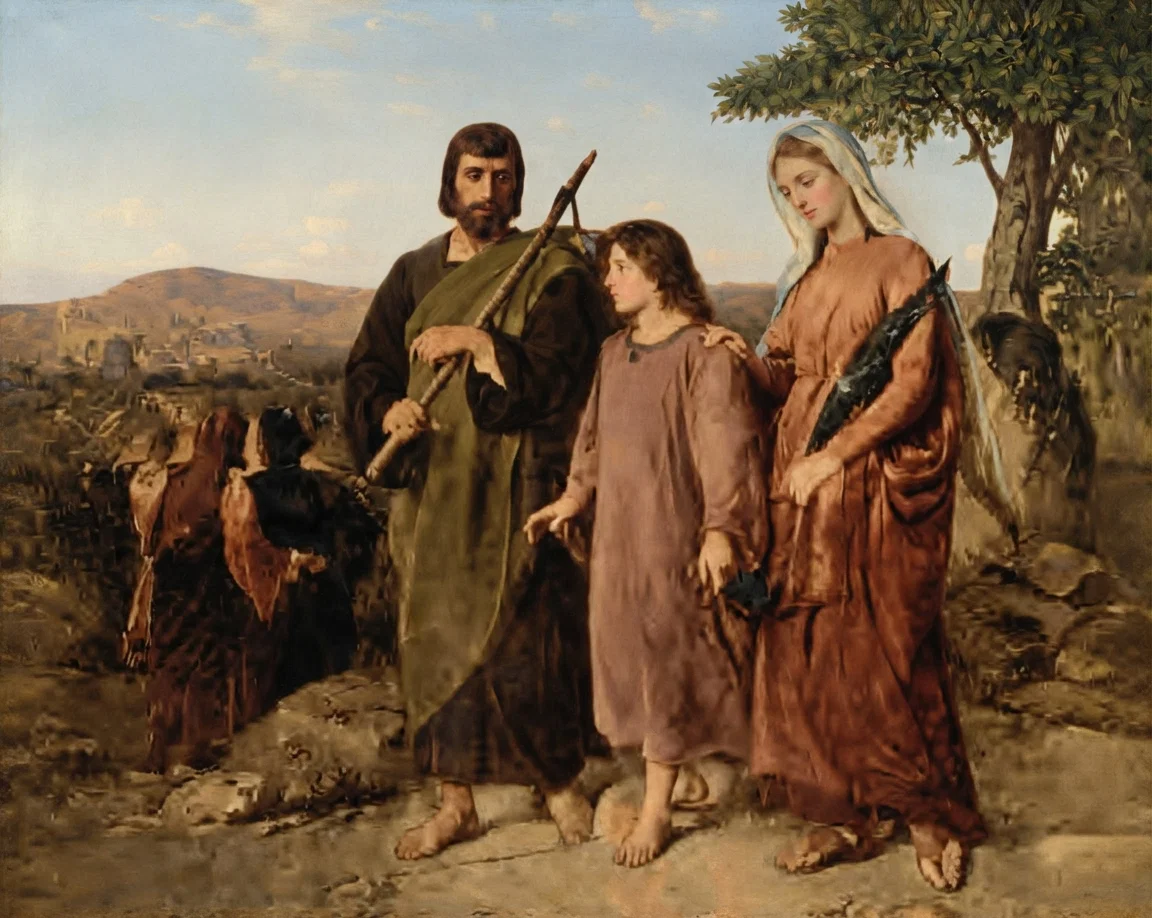
IT was customary for the devout parents of Jesus to attend the Passover at Jerusalem every year. Luke 2:41. They seem to have been careful to observe all the commandments of the Lord, both moral and ceremonial. When Jesus was twelve years of age He went up to Jerusalem to the Passover. According to Jewish custom, a boy became "son of the law" at the age of thirteen, or in his thirteenth year. As a son of the law, in His thirteenth year Jesus attended the feast with His parents. Henceforth He was peculiarly responsible to God. He must meet the obligations required of those older, but He was yet subject to His parents.
SUCH a time must have been of great interest to the religious boy. He was awakening into manhood—He was no longer to be the child, but was to play the man before God. He would go up to the great annual feasts with His parents, and be received as one who would be reckoned in the future as a true Israelite.
To JESUS this must have meant much more than to ordinary boys. His absorption of the sacred books of the Scriptures made the occasion of more than ordinary interest. Quirinus was now Roman governor of Syria. Coponius was procurator at Jerusalem. Annas was high priest. The times were quiet. There were no local wars or uprisings. The entire journey could well be given to conversation and meditation on the purpose and object of the Passover gathering.
WHAT that journey must have meant to the active, fertile mind of the Boy, versed in Jewish history, can only be faintly imagined. He passed through the great plain of Jezreel, or Esdraelon, famous for the victories of Gideon and Barak, and the defeat and death of good King Josiah. Away over to His right, as the company journeyed southward, Mount Carmel reared its head on the western shore of Palestine, by the "Great Sea." Here God had wrought mightily through the great prophet Elijah. At His left arose Mount Tabor, whence
Barak descended to fight Sisera with his nine hundred chariots of iron. A little later He crossed the ancient river Kishon, the swift waters of which swept away the chariots and forces of the Canaanite general, who himself was slain by Jael, the wife of Heber the Kenite. Jesus doubtless called to mind, "The stars in their courses fought against Sisera." He crosses the ground where God wrought with Gideon and his three hundred men. Here His heart must have turned to sadness as He recalled that in this very valley, also, good King Josiah had been killed by Pharaoh-Nechoh. It was a step in the downfall of Judah because of their sins. At His left Mount Gilboa would remind Him of the utter defeat of Saul and Jonathan, the disastrous result of Israel's choice of king.
ON THE WAY TO JERUSALEM
THE BOY recalls, as they pursue their journey southward and pass in sight of Dothan, the faithful Joseph's career, and also the prophet Elisha. Later He leaves at His right Samaria, built by wicked King Omri, capital of the kingdom of the apostate ten tribes with their awful history of disobedience and destruction. He passes through Shechem, prominent in Israelitish history since Abraham built there an altar, and Jacob in that vicinity dug his famous well. In the days of our story it was the headquarters of the Samaritans, as it is today. The Boy and His company pass between Ebal and Gerizim, the "mount of blessing" and "mount of cursing," from which the blessings and curses of the law were rehearsed to Israel shortly after their entrance into the promised land.
HE leaves Shiloh, with its story of that famous boy prophet Samuel, to the left, full of the memories of the checkered history of God's people connected with that one-time center of worship. Later the company pass through Bethel, "House of God," forever made famous in Jacob's experience of discouragement and dream. There were many other places of historic and sacred interest, which we have not space to enumerate.
AND then comes Jerusalem, with the glorious marble temple for its center. The company in which Jesus traveled has now, doubtless, been swelled by many others as the city is near. Joyfully they converse, or chant the "Psalms of Ascent" (120-134)
to the accompaniment of the flute, awakening their souls to the true spirit of worship, as they near the Holy City.
"I was glad when they said unto me,
Let us go unto the house of Jehovah."
"They that trust in Jehovah
Are as Mount Zion, which can not be moved, but abideth forever.
As the mountains are round about Jerusalem,
So Jehovah is round about His people
From this time forth and forevermore."
IF our readers will peruse these psalms, meditate upon them with their ancient use in mind, they will appreciate in their own souls how the fountains of spiritual truth in the hearts of the devout must have been
stirred to their depths as these inspired songs were chanted with the holy city in sight, crowned with the symmetrical temple of marble and gold, "which could hold within its gigantic girdle not fewer than 210,000 souls."
DID the spiritual nature of the Boy Jesus discern all the shallowness of this worship in general? We do not know, but we believe that it did. Never since Solomon's time was the worship more elaborate, the appointments of the temple more ornate and gorgeous. But never, even in Solomon's day, had ritualism and form so dominated and absorbed the controlling elements among the Jewish people. The traditions of the fathers were making void the commandments of God, and the deeper meanings of God's worship were obscured by the selfish rulers who were seeking honor and glory for themselves.4
“’Tis not the broad phylactery, the stubborn fast, the stated prayers, that makes us saints.”
THE BOY, reared in the greater simplicity of Galilean life, with reverence for the Word which had been written in His heart from babyhood, must have discerned it all. He must have seen that the saving from Egyptian bondage which the Passover commemorated meant salvation from the heavier, more accursed bondage of sin; that if the sin were not repented of, the sprinkling of blood availed nothing—the doom of Egypt’s first-born would be the fate of all of Israel, God’s first-born tho they were called, who identified themselves with sin. In a few short years from the time when the Boy visited Jerusalem, He would be taken from that city to die, a criminal because of His loyalty to God.
THAT time and those days have mighty lessons for the professed Israel of God in these days. Heart-holiness, acceptance with God, do not depend upon great wealth, massive structures, costly temples of worship, elaborate, ornate ceremonials, robed and mitered priests, learned and critical exegetes, hoary human traditions. Union with God is not found in these. Life eternal does not flow from such broken cisterns, and rarely do such things become the channel through which that life flows. Oftener such traditions bind the soul to the narrow, cramping, crushing, dead forms, put out his eyes to the glory of the simple truth, make void the commandments of God that tradition may be observed; and in consequence the power of the human,—persuasion downward or coercion by civil power,—is substituted for simple faith in the Word of God and loyalty to the person and teachings of our Lord Jesus Christ. He, “the Word made flesh,” is all-sufficient, but He must become incarnate in us. His life must take the place of our life, His law of righteousness and life our law of sin and death, His interests ours, His business our business. In other words, the Spirit and Word of the Infinite must possess us, not cramped, fettered, crushed, by outer forms of men, but molding and shaping all our outward conduct. Even thus may we all journey, not to an earthly Jerusalem soon to be destroyed by the Roman, to be desecrated by the Mohammedan, but to the city of the great King, eternal as its Maker, and where her “children shall be all righteous,” and inherit God’s kingdom forever. W.
Proselyting
By W.
MINISTER of Christ, by whatever name you may be called, do not be alarmed at the charge of proselyting, or proselytizing. Preach the message that God gives you, and that He bids you preach, whether among Roman Catholics, Methodists, Baptists, Seventh-day Adventists, Disciples, or pagans. Have you truth that they have not? Minister it to them as good stewards of the manifold grace of God. If they are desirous of knowing the right way, they will gladly receive it. No true minister of Christ labors for souls simply to get numbers. It is to convert the sinner. For that purpose the disciples of Jesus Christ preached to the Jews in the synagogs, Roman Catholics preached to pagans, Protestants preached to Roman Catholics, Methodists preached to Baptists, and Baptists to Methodists, and Disciples to both. They preached, each and all of these we presume, believing that they had something needed by those to whom they preached. Preach the Word to all, believers or unbelievers.
It was to professed children of God that Jesus Christ preached almost wholly for over three years, and His commission to His disciples was, to begin at Jerusalem. God’s messages always begin with His professed children. Messages of new or downtrodden truth begin there. He would have His own people receive and absorb the message first, and then use them in giving it to others. If they refuse, He passes on and accepts those who will give it. This has been true through all the ages. It is equally true to-day. Let men say what they will, but let the minister preach the Word.
W.
“A Name to Live”
By R.
THERE are many things in this wide world that have no life. Gold and silver, the rocks and the sand, have no vital power. We do not, however, hold them in less esteem for that. They are not supposed to be alive. They awaken no expectations, and therefore cause no disappointment, in that they do not have life.
But the Bible speaks of those who have a name to live and are dead. This is an inconsistency; it is in fact a contradiction.
The deaf can not respond to sound, the blind can not see the light; the former do not know any of the beauties of melody and harmony of sound, the latter can not gaze upon the wonders of the sky and the mystic splendors of the earth. But we do not censure them—they are unfortunate.
But if we saw a man deliberately destroying his eyes, or maliciously ruining his hearing, we would then blame him for his deaf or blind condition.
This is exactly what, in the spiritual world, many do. They have a name to live. They are supposed to have spiritual existence, to have spiritual life; but by yielding to sin, they have become dead. They have deliberately destroyed their own spiritual lives.
If a man had a very valuable watch, and we caught him putting sand and dust into the delicate mechanism, we should think something was wrong with his brain. Without any good object or purpose, he is destroying an object of value to himself. Likewise with the one who chooses to lose spiritual power and sensitiveness. He takes into his life that which will hinder and destroy one of the most sensitive things God ever made—the human soul.
Life is known by its response to its environment. The bird responds to its environment of the air, and wings its unwearied flight aloft and afar. The fish responds to its environment of the water, and moves in graceful lines whither it will. Man is endowed with a wider response to a larger environment than any other being in the world; yet many deliberately choose to cut themselves off from one great portion of their environment, the spiritual. They destroy their outlook and their uplook, and hinder any advancement heavenward. Having a name to live—that is, having powers and capacities—they not only refuse to use them and develop them, but take a course that eventually destroys them.
Who has not seen the young man with the fine heart and noble purposes become engrossed in money getting, until he grew to be close, miserly, sordid, and mean? He sacrifices everything, all the higher aspirations and inspirations, that he may get wealth merely to possess it. The noble qualities are given up, death to all the higher portions of his own being is accepted. Having a name to live, he has become by choice dead.
But every human being in the world who turns away from the noble opportunities that are his through his heritage in Christ, as outlined in the Scriptures, is but repeating the experience of the one mentioned. For wealth, or society, or pleasure, or honor, or fame, he chooses a way that seems right to him, rather than the one that will call into action his best powers. And worst of all, some of those who have tasted of that life and gone for a time in that way, turn back. Having a name to live, they choose to die. He who chooses to become maimed, or to be deprived of a portion of his faculties or his existence, is unreasonable. And yet in the spiritual sense many choose to do this very thing. Christ Himself said, “They will not come unto Me, that they might have life;” and another scripture reads, “They that hate me love death.” R.
The Power of Prayer
By Trench
WHY are we ever overborne with care, Why should we ever weak or heartless be, Anxious or troubled, when with us is prayer, And joy and strength and courage are with Thee? — Trench.
Counterfeit and Genuine
By White
How long does it take a lie to become the truth? How long must a counterfeit bill pass before it becomes genuine? How long must black be called white to make it white? Of course we know that the common-sense answers to these are that the lie remains the lie, the counterfeit remains a counterfeit, black never becomes white. But, reader, this is just as true in religion as it is in common ethics, commerce, or physics. Apply it to one of the great questions before the world at the present time, the Sabbath. The Sunday can never become the Sabbath of the Lord by calling it so. It bears not the image and superscription of God. It is not current coin in the kingdom of heaven. It does not bear the hall-mark of genuineness. Under-officials may assume power to change it, may conspire with the counterfeiters to despoil and cheat the subjects, but it is counterfeit still. And God would have His children discern that from the great detector, His Word. When the fulness of time has come, all its hollowness and sham will be revealed.
But let it be understood that by this note we are not condemning the honest souls who have observed it in the past and who still observe it. They have been blessed of God and are blessed, not because of passing the counterfeit, or receiving it, in their ignorance and thoughtlessness. Whatever blessings they receive, they receive in spite of the error. But in these last closing days before Christ comes, He would have all His children know the truth, and among the downtrodden truths to be restored is that of the Sabbath. See Isa. 58:13, 14. W.
Harmony with Apostate Powers a Sign of Enmity to God
By Mrs. E. G. White
By Mrs. E. G. White
As many as received Him, to them gave He power to become the sons of God, even to them that believe on His name: which were born, not of blood, nor of the will of the flesh, nor of the will of man, but of God." These are the chosen of God; they are those to whom Christ addresses the words: "Fear not, little flock; for it is your Father's good pleasure to give you the kingdom. Sell that ye have, and give alms; provide yourselves bags which wax not old, a treasure in the heavens that faileth not, where no thief approacheth, neither moth corrupteth. For where your treasure is, there will your heart be also."
The people of the world are so engrossed in temporal affairs that eternal realities seem of subordinate importance to them. They can not distinguish truth from error. In spirit and in practise they are repeating the history of the Jews, and in these last days the chosen of God who keep His commandments will be objects of contempt, both to those in high position and to those in the common walks of life. "For we wrestle not against flesh and blood, but against principalities, against powers, against the rulers of the darkness of this world, against spiritual wickedness in high places. Wherefore take unto you the whole armor of God, that ye may be able to withstand in the evil day, and having done all, to stand."
In this age of the world there are those who live in the midst of the corrupt society of the world to whom the Lord says: "Thou hast a few names even in Sardis which have not defiled their garments; and they shall walk with Me in white: for they are worthy. He that overcometh, the same shall be clothed in white raiment; and I will not blot out his name out of the Book of Life, but I will confess his name before My Father, and before His angels. He that hath an ear, let him hear what the Spirit saith unto the churches."
". . . These things saith He that is holy, He that is true, He that hath the key of David, He that openeth, and no man shutteth; and shutteth, and no man openeth; I know thy works: behold, I have set before thee an open door, and no man can shut it: for thou hast a little strength, and hast kept My word, and hast not denied My name. Behold, I will make them of the synagog of Satan, which say they are Jews, and are not, but do lie; behold, I will make them to come and worship before thy feet, and to know that I have loved thee. Because thou hast kept the word of My patience, I also will keep thee from the hour of temptation, which shall come upon all the world, to try them that dwell upon the earth. Behold, I come quickly: hold that fast which thou hast, that no man take thy crown."
Source of Enmity Against Sin
We are to know the meaning of the words: "I will put enmity between thee and the woman, and between thy seed and her seed; it shall bruise thy head, and thou shalt bruise his heel." The enmity that exists in the heart against evil has no natural existence, but is an enmity that has been created through the agency of the Holy Spirit. "As many as received Him, to them gave He power to become the sons of God, even to them that believe on His name." The natural man is in transgression, and his nature is in harmony with that of the first transgressor. There is no natural enmity between fallen men and fallen angels; both are partakers of the same spirit through indulgence in evil. It is according to the law of the synagog of Satan that in the controversy of the evil against the good, fallen men and fallen angels shall unite in a desperate companionship. From the beginning Satan has worked continually to dethrone the Creator, and whatever may be the divisions among evil men and evil angels, there is no division in their opposition to God. They are banded together as with iron cords to oppose the Creator and Redeemer of man. Satan is determined to deprave human nature utterly through making of none effect the commandments of God. He originates traditions, and through his maxims he succeeds in assimilating to his own nature the nature of those who do not yield allegiance to God's law.
Key to All Religious Persecution
The harmony of nature between Satan and evil men is the key to all religious persecution from the day when Cain killed Abel to the present time. The same principle that actuated Satan in the courts of heaven to war against God is now working in the children of disobedience, and actuates them to manufacture spurious commandments that contradict the statutes of Jehovah. It is the power of apostasy that exalts religious potentates to the place of God. The false is honored above the true; and thus it is that the Sabbath of the fourth commandment is trampled in the dust, while the spurious sabbath is exalted by earthly powers.
The origin of false commandments may be clearly discerned by the principles which underlie them. All that is not in accordance with the known and expressed will of God, is at enmity with God, and has its origin in the synagog of Satan. The will of God is expressed in His law, and sin is the transgression of the law. Those who disregard the commandments of God, and teach for doctrines the commandments of men, are working in Satan's line, and are in harmony with the great leader of apostasy. When the Jews were claiming Abraham for their father, while not doing the works of Abraham, Jesus said to them: "Ye are of your father the devil, and the lusts of your father ye will do. He was a murderer from the beginning, and abode not in the truth, because there is no truth in him. When he speaketh a lie, he speaketh of his own: for he is a liar, and the father of it." "He that committeth sin is of the devil; for the devil sinneth from the beginning. For this purpose the Son of God was manifested, that He might destroy the works of the devil."
Result of Rejecting Light
Light is shining amid the moral darkness of this age of the world. The Holy Spirit is working on the hearts of men to convince them of sin, and of righteousness, and of judgment to come. But those who refuse the light, and accept the excuses that Satan may frame as reasons why they should not obey the truth, will manifest satanic enmity against those who obey God rather than man. Those who steadfastly follow the practise and customs of the world in the very face of light and truth, will obstinately oppose the commandments of God, and render unswerving loyalty to him who first rebelled against God, and was expelled from the courts of heaven; but in the face of the enmity of the world, those who truly believe in Christ will take Him for their example in all things. Jesus says, "I have kept My Father's commandments, and abide in His love." The beloved disciple said: "He that saith, I know Him, and keepeth not His commandments, is a liar, and the truth is not in him. But whoso keepeth His word, in him verily is the love of God perfected: hereby know we that we are in Him. He that saith he abideth in Him ought himself also so to walk, even as He walked. Brethren, I write no new commandment unto you, but an old commandment which ye had from the beginning."
The human race do not stand in the righteousness of character which Adam possessed at his creation. Altho neglect to keep the requirements of God is sin, and the wages of sin is death, yet there is no claim made that man may have eternal life except through the obedience and righteousness of Jesus Christ, who is the representative and head of all humanity. The sinner can find hope only through dependence upon the perfection of Christ. We are to avail ourselves of the merit of the sinless offering that was made through the death of the only-begotten Son of God. "Behold, what manner of love the Father hath bestowed upon us, that we should be called the sons of God: therefore the world knoweth us not, because it knew Him not. Beloved, now are we the sons of God, and it doth not yet appear what we shall be: but we know that, when He shall appear, we shall be like Him; for we shall see Him as He is. And every man that hath this hope in him purifieth himself, even as He is pure."