Signs of the Times, Vol. 57, No. 41.

The MASTER KEY to the World's Situation

Signs of the Times

Oct 21, 1930

Pacific Press Publishing Association · Mountain View, California, U.S.A. · Oct 21, 1930

The giant Dornier seaplane, as it appeared outside its hangar during tests that were made on Lake of Constance, Switzerland, following the installation of its American motors. The tests were declared entirely satisfactory. An attempt will soon be made to fly this great ship across the Atlantic. It cruises at a speed of 120 miles an hour.

The MASTER KEY to the World's Situation

This is the first of a series of eight articles on acute world problems in the light of Bible prophecy and the second coming of Christ.
John L. Shuler
The swift march of events from day to day is a subject of overwhelming interest to all living. We need not only to watch these events in the current news, but we especially need to study what is now taking place in the light of what God's word declares will happen in the closing years of this age.
It has been said that “history repeats itself.” Solomon of old understood this fact. He declared, “The thing that hath been, it is that which shall be; and that which is done is that which shall be done.” Ecclesiastes 1:9. This world of human affairs travels in a circle, even as our sphere itself does in the solar system. Hence we read, “That which hath been is now; and that which is to be hath already been.” Ecclesiastes 3:15.
In connection with the final movements in earth's career, past history will be repeated on a more extensive scale and at a far quicker pace, while old controversies will be revived with new power.
The first advent of Jesus Christ, terminating in His crucifixion and resurrection, marked a great climax and consummation in earth's program. The world was prepared through a long process for the coming of the Son of God. From Paradise lost to Bethlehem the centuries were preparing for the coming of the promised Seed. As the successive and progressive processes of creation on the different six working days in Genesis 1 prepared the earth for man, so all history prepared the way for the advent of the Son of man. The divine Hand was on the lever of circumstances, and all streams converged to one center. “When the fullness of the time was come, God sent forth His Son, made of a woman.” Galatians 4:4.
Calvary marked such a wonderful climax and crisis in the divine plan for this earth that many prophecies of centuries were then fulfilled in the space of one single day. There are at least twenty-four Old Testament prophecies bearing on the betrayal, trial, death, and burial of our Lord Jesus Christ, which were uttered by several different prophets at different times during the five centuries from about 1000 to about 500 B. C., which were all literally fulfilled within twenty-four hours on the day of His crucifixion. We list these briefly, giving the Scripture referenceof prophecy first, with the record of fulfillment following.
1. Zechariah 11:12. Sold for thirty pieces of silver. Matthew 26:14, 15.
2. Psalm 55:12-14; 41:9. Betrayed by a friend. Matthew 26:49, 50.
3. Zechariah 11:13. The money cast to the potter. Matthew 27:5-7, 9, 10.
4. Zechariah 13:7. The disciples forsook Him. Matthew 26:31, 56.
5. Psalm 35:11. Accused by false witnesses. Matthew 26:59, 60.
6. Isaiah 50:6. Smitten and spit upon. Matthew 26:67.
7. Isaiah 53:7. Dumb before His accusers. Matthew 27:12, 14.
8. Isaiah 53:5. Wounded and bruised. Matthew 27:26, 29.
9. Psalm 22:16. Hands and feet pierced. Luke 23:33; John 20:25, 27.
10. Isaiah 53:12. Crucified with thieves. Mark 15:27, 28.
11. Isaiah 53:12. Prayed for His persecutors. Luke 23:34.
12. Psalm 109:25. People shook their heads. Matthew 27:39.
13. Psalm 22:8. People ridiculed Him. Matthew 27:41, 43.
14. Psalm 22:17. People astonished. Luke 23:35.
15. Psalm 22:18. Garments parted and lots cast. John 19:23, 24.
16. Psalm 22:1. His forsaken cry. Matthew 27:46.
17. Psalm 69:21. Gall and vinegar given Him. John 19:28, 29.
18. Psalm 31:5. Committed Himself to God. Luke 23:46.
19. Psalm 38:11. Friends stood afar off. Luke 23:49.
20. Psalm 84:20. Bones not broken. John 19:33, 36.
21. Psalm 22:14. Heart broken. John 19:34.
22. Zechariah 12:10. His side pierced. John 19:34.
23. Amos 8:9. Darkness over the land. Matthew 27:45.
24. Isaiah 53:9. Buried in a rich man's tomb. Matthew 27:57-60.
That was surely a great and decisive day, when things moved so rapidly that twenty-four prophecies of former centuries were fulfilled within the space of twenty-four hours.
But the second advent of Jesus Christ and its attending events will mark even a greater climax and consummation in God's program for this world than His first advent. In connection with that supreme crisis in earth's career, many ancient prophecies will be fulfilled in rapid succession. Prophecies of stupendous developments and gigantic changes will come to pass very quickly at that time; for centuries people have wondered if they would ever come true. God will cause every force to fall into line for the appointed, final shaping up of earthly affairs for the great consummation of His plan for man.

OUTSTANDING MOVEMENTS

There are certain outstanding movements of our day that are destined to be among the principal actors in the final scenes in earth's great drama. Among these we shall mention nine:
1. The great world peace movement, with its League of Nations, its World Court, its Disarmament Conferences, etc.
2. The superdevelopment of deadly and destructive war appliances,—the great war preparedness movement.
3. The renaissance of the nations of the Far East.
4. Zionism,—the plan to restore the national life of the Jewish people in Palestine.
5. The rapid growth of spiritualism.
6. The ascendancy of the papacy; the growing influence of the Catholic hierarchy among the nations.
7. The decadence of Turkey during the past one hundred fifty years; the decline of the political power of Islam.
8. Church federation,—the growing sentiment in favor of a union of churches.
9. The religio-political movement, the growing demand for religious legislation; the ascendancy of the church to civil power.
These movements or developments have come forth during recent decades, and are now numbered among the predominant features of this day. There are prophecies in the word of God that speak plainly and definitely concerning each of these nine movements. Prophecy shows that they will all soon come to a head in the setting of the stage for the final world crisis of this age.

POWERS WILL CONVERGE

Every element of power and every movement of humanity will all converge toward this great objective, as the spokes of a wheel to the hub. All these movements mentioned above, when understood in the light of God's prophetic word, will be found to be tending toward this one end. They may apparently seem so diverse and detached from one another in their nature and design that the majority of people will not recognize that they have any appropriate relation to one another. They will seem like the scattered pieces of a jig-saw puzzle when the child faces it for the first time. But with a little study, the child will find the right starting point, and then so lay each additional piece in its proper relation to those already placed that each piece will at last be found to fit into one scheme, forming the one complete figure of a horse or an elephant, as the case may be.
This is an illustration of what a proper understanding of Bible prophecy will do in reference to these nine movements. Every one will be found to fit into its proper place in God's outline of the final crisis.
The prophecies of the Bible contain light for our day. The sure word of prophecy furnishes a key to a correct interpretation of the times in which we live. So let all thoughtful men remember this: No one can really understand the unprecedented conditions of the times, find the right way out, and know how to relate himself rightly to the present situation, except by having a knowledge of the Bible prophecies that pertain to our day.

FUTURE PROGRAM REVEALED

How thankful we should be that God has not left His children to grope their way in darkness, without any knowledge of what is yet to come! Through a knowledge of the prophetic word, we may be informed of coming developments, and see the outcome of the present situation. It will be a matter of absorbing interest to trace out in future articles some of these wonderful prophecies of coming developments.
When Moses saw the burning bush in the desert, he said, “I will now turn aside, and see this great sight, why the bush is not burnt. And when the Lord saw that he turned aside to see,” God revealed Himself to Moses in a definite program for that hour for the relief of His oppressed nation. (Exodus 3.) So if we will turn aside to note what His word says to us to-day, we shall learn God's program for this time.

The Gospel Is Good News

THE gospel is not good advice. The gospel is good news. It is news so good that when we take it home life is changed down to its very depths.—George H. Madison.

Peace Requires Adequate Defense

PEACE unprotected by ample facilities for its defense is a vain dream.—Raoul Peret, French Minister of Justice.

GRENVILLE KLEISER

Aspiration

GRENVILLE KLEISER

I'd like to be a butterfly, And flit from flower to flower, To fill the air with beauty rare, Reflect both sun and shower.
I'd like to be a violet, Of native modesty, Exhale perfume in every room, With true humility.
I'd like to be a giant tree, To serve as sentinel; A near retreat from storm or heat, Where men might safely dwell.
I'd like to be a mountain high, Majestic, noble, strong; All could climb to heights sublime, Beyond the reach of wrong.
I'd rather be a child of God, And see creation fair, To truly know the way to go, And find Him everywhere.

PROOFS of the PENTATEUCH

Further evidence is here presented corroborating belief in the Mosaic authorship of the first five books of the Bible. The first part of this article appeared last week.
R. G. ENGSTROM
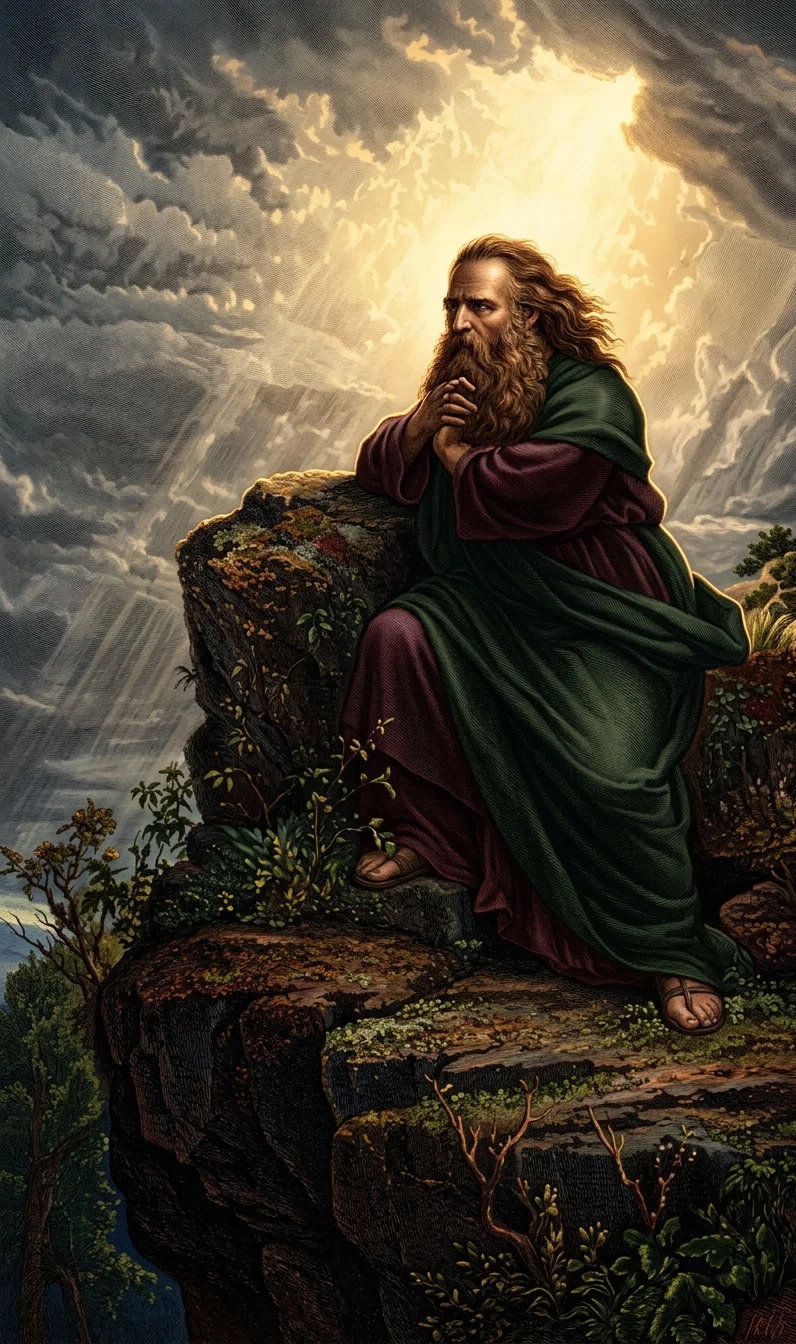
Moses, the great leader of the children of Israel, whose authorship of the Pentateuch has been contested by the modernists.
Last week the author introduced his discussion with the assertion that the Bible must be either accepted in its entirety or rejected altogether. As it would be quite needless to exhaust all the questions subject to controversy, he picked out a few of the outstanding ones. Last week plausible arguments were presented against the theory of the dual authorship of the Pentateuch; scientific discoveries and observations substantiating the Bible story of the Flood were also presented.
The destruction of the cities of the plain is one of the Old Testament’s most spectacular word pictures, showing God’s judgment as it was meted out to unrepentant men in the form of fire and brimstone. What conditions may we find pointing to the trustworthiness of this account?
The whole region of the great plain around the Dead Sea is found to be a burnt-out region of oil and asphalt. A thorough investigation by the Xenia Theological Seminary under the direction of Dr. Melvin Grove Kyle, made recently on the southwest shore of the Dead Sea, yielded some compelling discoveries. To quote Dr. Kyle:

DISCOVERIES POINT TO ACCURACY

“There is along the lower part of this plain a great stratum of rock salt, which on the western side of the plain shows itself in that great salt mountain known as Jebel Usdum. At its base is a stratum of rock salt 150 feet thick. . . . Mixed with the layers of salt and falling down over them also is a marl in which is much free sulphur, lumps of which we picked up along the sea. When the explosion of the gases took place, this stratum of salt mixed with sulphur was ruptured with the other strata, and the salt and sulphur carried up into the heavens red-hot, and also rained down upon Sodom and over the whole region, precisely as the Scriptures describe the rain of fire and brimstone from heaven. Mixed with the salt and sulphur was also the asphalt. These ruins witness to the great catastrophe that scattered the salt and sulphur far and wide, incrusted the mountain peaks, and so blasted the earth that it took 2,500 years of climatic influences to wash out the soil and make the plain again fruitful.” Thus are found to-day all the elements of the great tragedy that Genesis 19 records.
Of unusual significance also is the discovery of numerous pottery remains of the early bronze age, about 1800 B. C., known also as Abraham’s time. These have been dug up in the lower end of the valley at Mt. Jebel Usdum. But the astounding fact is that, while the relics belonging to this age are numerous, there occurs a break at this point, showing not a vestige of any further civilization for the next 2,500 years! An all-consuming catastrophe plainly must have destroyed all life and society itself in this section, just at the time when the last pottery was made. So the spade continues to confirm the Book.

DID WRITTEN LANGUAGES EXIST?

The argument that Moses could not have written the books accredited to him because a written language had not yet come into use in his age has been conclusively answered by the findings of recent archæology. It has been shown that the Mosaic era was a literary age, when written records were common, when it would have been strange for a leader not to put his deeds into written form.
The discovery of the famous code of Hammurabi, inscribed on a block of diorite nearly eight feet in height, and originally erected in the Babylonian temple of Marduk, shows a high state of literary and legal advancement. Hammurabi was the famous king who unified the Babylonian states and formulated the 282 sections of the legal code bearing his name.
At the ruins of the ancient Ur of the Chaldees, tablets have been found in which a man named Abraham bought an ox, another tablet shows a man named Abraham leasing land, and a third tablet gives Abraham’s receipt for land paid. This shows that Abraham was a common name at this time.
The Tel el Amarna letters, discovered in Egypt in 1887, yield overwhelming evidence to the existence of a high state of culture and communication. These three hundred or more epistles written some years before Moses, tell of great flourishing cities, of religious practices, of Egypt’s difficulties in extending her western territory, of numerous other subjects. The Mosaic era, instead of being an ignorant age, was a flourishing literary period.

OPPRESSION A HISTORICAL FACT?

Here again the findings of archæology come with a startling confirmation of the Mosaic record.
The recent expedition of the University of Pennsylvania to the Holy Land found an engraved stone monument of Rameses II on which he had noted the fact that he had collected certain Semites and made them build in his honor the city of Raamses-Mera-Amen, on the eastern delta of the Nile. This exactly fits the story in the first chapter of Exodus, which tells how the Israelites built the city of Raamses.
In ancient Pithom, the name of “Raamses” may be found stamped on the bricks used in some of the ancient houses. In palaces have been found pictures of slaves mixing straw and mud, just as the inspired story tells. And, stranger still, even as the Bible records how Pharaoh, in his attempt to make their oppression still more rigorous, compelled Israel to make bricks without straw, even so, some of the houses in Pithom have actually been found made with strawless bricks!

NEW TESTAMENT WRITERS TESTIFY

Finally we present the testimony of the Master Himself and of His colaborers in the beginning of the Christian era. Christ and His church on earth have been so immeasurably the most moving power in this world that His testimony and that of the inspired writers of the New Testament must carry a most convincing appeal.
Jesus believed implicitly in the writings of Moses, and taught them as the basis for a belief in Him, going even so far as to say that they could not believe Him unless they believed Moses.
“Do not think that I will accuse you to the Father: there is one that accuseth you, even Moses, in whom ye trust. For had ye believed Moses, ye would have believed Me: for he wrote of Me. But if ye believe not his writings, how shall ye believe My words?” John 5:45-47.
“Abraham saith unto him, They have Moses and the prophets; let them hear them. And he said, Nay, Father Abraham: but if one went unto them from the dead, they will repent. And he said unto him, If they hear not Moses and the prophets, neither will they be persuaded, though one rose from the dead.” Luke 16:29-31.
Jesus believed the creation record of Genesis: “The Pharisees also came unto Him, tempting Him, and saying unto Him, Is it lawful for a man to put away his wife (Continued on page 9)for every cause? And He answered and said unto them, Have ye not read, that he which made them at the beginning made them male and female?” Matthew 19:3, 4.
Proofs of the Pentateuch (Continued from page 3)

JESUS TAUGHT VALIDITY OF DELUGE

In one of His most stirring appeals He taught the validity of the Deluge. “As it was in the days of Noe, so shall it be also in the days of the Son of man. They did eat, they drank, they married wives, they were given in marriage, until the day that Noe entered into the ark, and the Flood came, and destroyed them all.” Luke 17:26, 27.
He showed His faith in the trustworthiness of the account regarding Sodom’s doom: “Likewise also as it was in the days of Lot; they did eat, they drank, they bought, they sold, they planted, they builded; but the same day that Lot went out of Sodom it rained fire and brimstone from heaven, and destroyed them all.” Luke 17:28, 29.
Paul believed the worth of Genesis, and used it as the basis of many sermons: “The God of this people of Israel chose our fathers, and exalted the people when they dwelt as strangers in the land of Egypt, and with an high arm brought He them out of it. And about the time of forty years suffered He their manners in the wilderness.” Acts 13:17, 18.

OLD TESTAMENT WRITERS QUOTED

As we look into the epistles, we find that many chapters in Genesis are quoted by the New Testament writers, and used by them as their most convincing arguments for the veracity of the gospel.
Exodus is likewise indorsed by the same witnesses. Jesus said plainly that Moses was its author. (Mark 12:26.) Paul testifies in like manner. (2 Corinthians 3:13.) We come to Leviticus, and find the same certain authority there. The Master shows His implicit confidence in the fact that Moseswrote the laws recorded there. (Matthew 8:1-4.) Paul again adds his evidence. (Hebrews 7-9.)
Numbers and Deuteronomy are attested to in identical manner. Jesus believed that Moses wrote them. Paul, Peter, James, and John all show their utmost confidence in the books of the Pentateuch. Their most powerful arguments stand with granite fastness on a foundation of Mosaic references. And in the closing chapters of the Bible itself, the promise of the new earth with its Edenic beauty is accepted with confidence because it sets forth a new creation like unto the first creation of Genesis, only now to remain forever, never to be marred by sin. So we see that the New Testament is built entirely on the foundations of the Old.
We have reviewed a few of the facts that attest to every candid mind the trustworthiness of the five books of Moses. We have had opportunity of making only a few “soundings,” but in every instance the inspired record comes off more than conqueror. While it is true that not everything recorded has been verified, yet whenever the findings of science and archæology have unearthed any remains or historical record bearing on the point in question, the Book stands vindicated. The records of ancient days were “written for our admonition, upon whom the ends of the world are come.”

The HOUR of GOD'S JUDGMENT

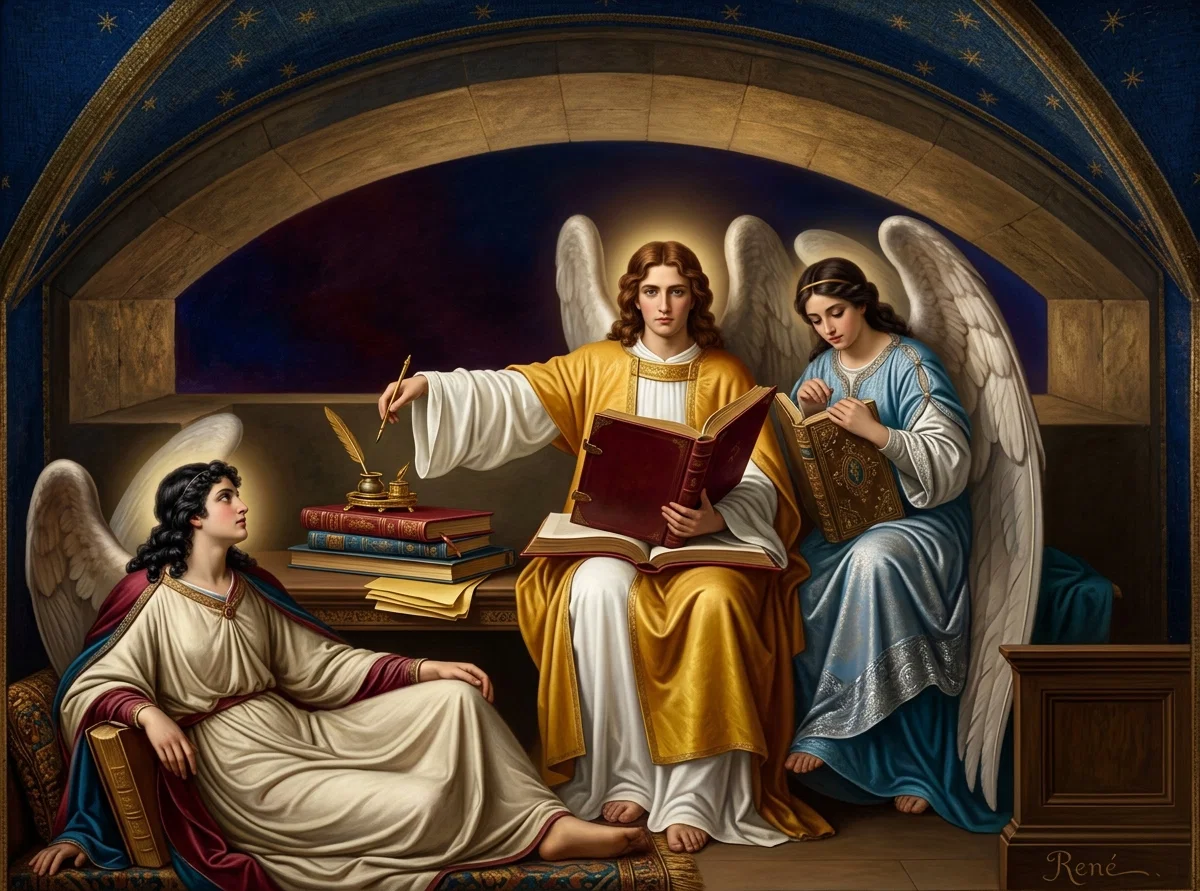
The angels keep an accurate record of every word and action, whether good or bad, and will present that record as evidence in the judgment.
VARNER J. JOHNS
The nations were angry, and Thy wrath is come, and the time of the dead, that they should be judged, and that Thou shouldest give reward unto Thy servants the prophets, and to the saints, and them that fear Thy name, small and great; and shouldest destroy them which destroy the earth. And the temple of God was opened in heaven, and there was seen in His temple the ark of His testament.” Revelation 11:18, 19.
When Jesus comes the second time, His reward is with Him “to give every man according as his work shall be.” The second coming of Christ is a time of awards and punishments. The long-promised inheritance becomes a glorious reality and the crown of immortality a treasured possession in that great day. The destiny of every man is decided for eternity before Jesus comes. The investigative judgment, “the time of the dead, that they should be judged,” must take place before the reward of eternal life can be given to the righteous or the sentence of eternal death be pronounced upon the wicked.
Jesus is coming soon! Great lines of Bible prophecy culminate in this our day and announce with certainty the nearness of the coming of the Christ. And with equal certainty we may know that the heavenly tribunal is now in session, that the records of men are in review before the judgment bar of God, and that the “hour of His judgment is come.” The longest time prophecy of the Bible announces the very year of the beginning of the judgment; and, friends, the hour of God's judgment is come!

TEMPLE OF GOD OPENED

“The temple of God was opened in heaven, and there was seen in His temple the ark of His testament,” is the reading of my text. It is of the sanctuary in the heavens, and of the “holy of holies,” and of the “ark of His testament,” and of the “cleansing of the sanctuary,” and of the day of judgment, that I shall write at this time. In order to visualize the temple in heaven and the ministry of Jesus, our great High Priest, it will be well for us to have a picture of the tabernacle on earth and of its service; for the earthly tabernacle was a miniature of the heavenly temple, and was built according to the pattern of the tabernacle in the heavens.
The tabernacle was a beautiful structure, its framework built of acacia wood overlaid with gold; its covering of fine white linen interwoven with cherubim; its curtains of variegated blue, purple, and crimson; its protective coverings of goats' hair, of sheepskin dyed red, and of badger skin tanned to a light blue; and its articles of furniture reflecting the beauty of finest gold. There were two apartments,—the holy place, with its altar of incense, its table of shewbread, and its golden candlestick, and the most holy place, with its ark of the testament.
The ark was designed primarily for the safe keeping of the tables of the law. The sacredness of the ark was derived from the utmost sacredness of the tables of the testament within. The law of God was the acme of sacredness, the center of sacred things, because it not only gave a testimony of the will of God but also of the character of God. His holiness, His righteousness, His unchangeableness, His all-greatness, were reflected in the law upon which His throne was established. Above the law was the mercy seat, and at either end of the ark, with their wings outstretched over the mercy seat, were the golden cherubim. A bright light, of divine origin, called the Shekinah, or manifest presence of God, rested continually between the cherubim. Here, indeed, was a miniature of the throne of God.

JOHN SAW ARK IN TEMPLE

How significant it is that as John the revelator was given a vision of the temple of God in heaven, he saw within that glorious temple “the ark of His testament”! The original law, of which the Ten Commandments were a transcript, are in heaven above. Dare anyone lay unholy fingers upon that law? Dare anyone minimize its importance, trample underfoot its precepts, ignore its heart-searching message? To attempt to change a jot or a tittle of that law would be an attempt to undermine the foundations of God's throne. I tremble when I think of the judgment, and of that law which is the standard by which men are judged, and of the men who dare to discredit the Ten Commandments.
There were daily ministrations in the court of the tabernacle and in the holy place. There were many offerings, but of the greatest importance was the sin offering. Sin, according to the definition given by Inspiration, is “the transgression of the law.” The broken law demanded the death of the sinner. The broken law demanded the shedding of blood. The guilty sinner brought an innocent animal, confessed his sin upon the head of the offering, and then with his own hand took its life. Some of the blood was then sprinkled by the priest before the broken law. This could not take away sin, but was a manifestation of the sinner’s faith in the coming Redeemer,—Jesus, the Lamb of God.
In this way the sins of the entire encampment accumulated day by day in the sanctuary, being brought in by the blood of the animals that died for their remission. The sins were cleansed from the sanctuary on the tenth day of the seventh month. This was known as the day of atonement. It was a day of affliction of soul, of seeking God in prayer, of confessing of sin. Two goats were brought to the gate of the court, lots were cast upon them, one being chosen for the Lord's goat, the other as the scapegoat. Upon the Lord's goat the high priest laid all the sins that had been accumulating during the year. The blood was then taken and brought in directly before the law in the most holy place and there sprinkled for the remission of all the sins that had been confessed and brought into the sanctuary. Then, bearing the sins of all the people in his own body, and having made an atonement for them, the high priest came out and laid them upon the scapegoat. The scapegoat was led into the wilderness and left there to die; thus the sins of the encampment were separated forever from the people of God.

DAY OF ATONEMENT

The day of atonement was the annual atonement, or covering of sin. The blood was sprinkled in front of the golden cover. The assurance that their sins were covered meant everything to the people of God. At this service the sin was canceled, or blotted out. “Blessed is he,” says the Bible, “whose sin is covered.” Some people seek to cover theirown sins but find out in the end that nothing is hidden from the all-seeing eye of God. Our heavenly Father wants us to confess our sins and forsake them, and He, in His infinite love, has promised to cover them and remember them no more. I have before me a quotation from a Denver paper that shows how, even to-day, the day of atonement is regarded as a day of judgment.
'Jews of Denver cast off their sins in ceremonies of Hebrew New Year. Denver Jewry is celebrating the Hebrew New Year; and Monday, Tashlach, 'the throwing off of sins,' occupied the day in the Jewish sections of the city. . . . The Jewish New Year is known as the day of memorial, or the day of judgment, whereon the pious Jew confesses his sins.'
The new covenant has a sanctuary as well as the old. It is the tabernacle in heaven. The new covenant has a sacrifice for sin,—the Lamb of God, slain 'once for all' on Calvary's cross. The new covenant has a priesthood as well as the old, Jesus being our great high priest, who ministers in our behalf before the throne. The new covenant has a cleansing of the sanctuary as well as the old,—the time of investigative judgment when the sins of men are blotted out from the books of record or their names are blotted out from the book of life.
The entire book of Hebrews pictures for us the importance of the service of the heavenly sanctuary. The first two verses of the eighth chapter summarize the message of the entire book. 'Now of the things which we have spoken this is the sum: We have such an High Priest, who is set on the right hand of the throne of the Majesty in the heavens; a minister of the sanctuary, and of the true tabernacle, which the Lord pitched, and not man.'
Our interest is centered, not so much in the earthly tabernacle as in the heavenly tabernacle, not so much in the ministry of the priests of Israel as in our great High Priest. Jesus is our advocate, our representative, before the throne of God. When the Son of God took upon Himself human flesh, He forever identified Himself with the human family. And the beautiful thought in the temple service is that Jesus is not only the 'Lamb of God,' the sacrificial lamb, but He is also our minister, the great High Priest.

HEAVENLY SANCTUARY CLEANSED

It was necessary that the pattern of things in the heavens, the great original tabernacle, should have its 'cleansing' service, its day of judgment. And the very time of the beginning of this great work was foretold in the prophecy of the book of Daniel, chapter 8, verse 14. 'He said unto me, Unto two thousand and three hundred days; then shall the sanctuary be cleansed.' The prophetic days of the ninth chapter, which locate so definitely the coming of the Messiah in A. D. 27, His crucifixion in A. D. 31, and the beginning of the time of the Gentiles in A. D. 34, began in 457 B. C. These 'days,' it is said, were 'determined,' or 'cut off,' from the longer period of 2300 'days' of chapter 8. The date 457 B. C. marks the beginning, therefore, of the two thousand and three hundred days, the longest time prophecy of the Bible. It is not much of a mathematical problem to add 2300 to the historical date 457 B. C. and to find the year A. D. 1844, which marks the beginning of the 'cleansing' of the heavenly sanctuary, or the beginning of the investigative judgment.
In this year the proclamation of the threefold fold message of Revelation chapter 14 was begun. This is the message that goes to 'every nation, and kindred, and tongue, and people,' and prepares the world for the coming of Jesus. Its result is the gathering together of a people of whom it is said, 'Here is the patience of the saints: here are they that keep the commandments of God, and the faith of Jesus.' The grand finale in theproclamation of this message is the appearance of a “white cloud” in the heavens, a cloud of shining angels, and “upon the cloud” one who is called the “Son of man.” It is indeed significant that when the year 1844 came men of God carried forward the soul-stirring message of Revelation 14:7, “The hour of His judgment is come.” That message has swelled into a “loud cry.” Into all the world, in 384 of the tongues of earth, the great threefold message has been proclaimed. When the work is finished, when the warning has been given, when the truth has been proclaimed, Jesus will come to redeem His commandment-keeping people.
Before Jesus comes the second time, He will lay aside His priestly robes; He will leave the heavenly sanctuary; and He will come as a king in His glory. As He leaves the sacred place, the decree will go forth, “He that is unjust, let him be unjust still: . . . and he that is holy, let him be holy still.” The judgment work will have been completed, and the destiny of men settled for eternity. As the typical cleansing of the earthly sanctuary was accomplished by the removal of the sins by which it had been polluted, so the actual cleansing of the heavenly sanctuary is accomplished by the removal, or blotting out, of the sins there recorded. How important it is that we should “hold the beginning of our confidence steadfast unto the end”! Either our sins will be removed from the books of record or our names will be removed from the book of life. Let us so live and so relate ourselves to Jesus and to His word that our “sins may be blotted out, when the times of refreshing shall come from the presence of the Lord.” Then when Jesus comes, we shall welcome Him with joy and be prepared to live with Him eternally.
Continue reading: The Absence of Thomas