Signs of the Times, Vol. 40, No. 43.

The Controversy of the Ages

Signs of the Times

Nov 11, 1913

Pacific Press Publishing Association · Mountain View, California · Nov 11, 1913

“Before the entrance of evil, there was peace and joy throughout the universe.”

The Controversy of the Ages

Invisible Armies in Conflict—Whence Came the Devil, and Why Does Sin Exist?—The Controversy Begun
By MRS. E. G. WHITE
If the veil which separates the visible from the invisible world could be lifted, and the people of God could behold the controversy that is going on between Christ and holy angels, and Satan and his evil hosts, concerning the redemption of man; if they could understand the wonderful work of God for the rescue of souls from the bondage of sin, and the constant exercise of His power for their protection from the malice of the evil one, they would be better prepared to withstand the devices of Satan. Their minds would be solemnized in view of the vast extent and importance of the plan of redemption and the greatness of the work before them as co-laborers with Christ. They would be humbled, yet encouraged, knowing that all heaven is interested in their salvation.
To many minds, the origin of sin and the reason for its existence are a source of great perplexity. They see the work of evil, with its terrible results of woe and desolation, and they question how all this can exist under the sovereignty of One who is infinite in wisdom, in power, and in love. Here is a mystery of which they can find no explanation. And in their uncertainty and doubt, they are blinded to truths plainly revealed in God's word and essential to salvation. There are those who, in their inquiries regarding the existence of sin, endeavor to search into that which God has never revealed. Hence they find no solution of their difficulties; and such as are actuated by a disposition to doubt and cavil, seize upon this as an excuse for rejecting the words of Holy Writ. Others, however, fail of a satisfactory understanding of the great problem of

The People of the Valleys

The Heroism and Glory of the Waldenses
An Unbroken History from the Days of the Apostles
By H. H. Hall
This article on the Waldenses is one of six or eight that are to appear in our columns. Mr. Hall has given much study to the subject, and to many it will be new to learn that the history of this intensely interesting people is traced back to the days of the apostles. They held closely to the pure doctrine taught by Christ, and were in continuous conflict with the apostasy that sought to compel men, by cruel persecutions, to conform to bigoted religious decrees. The articles are a timely warning in this age when great religious majorities are seeking to combine for the control of the world.
EDITOR.
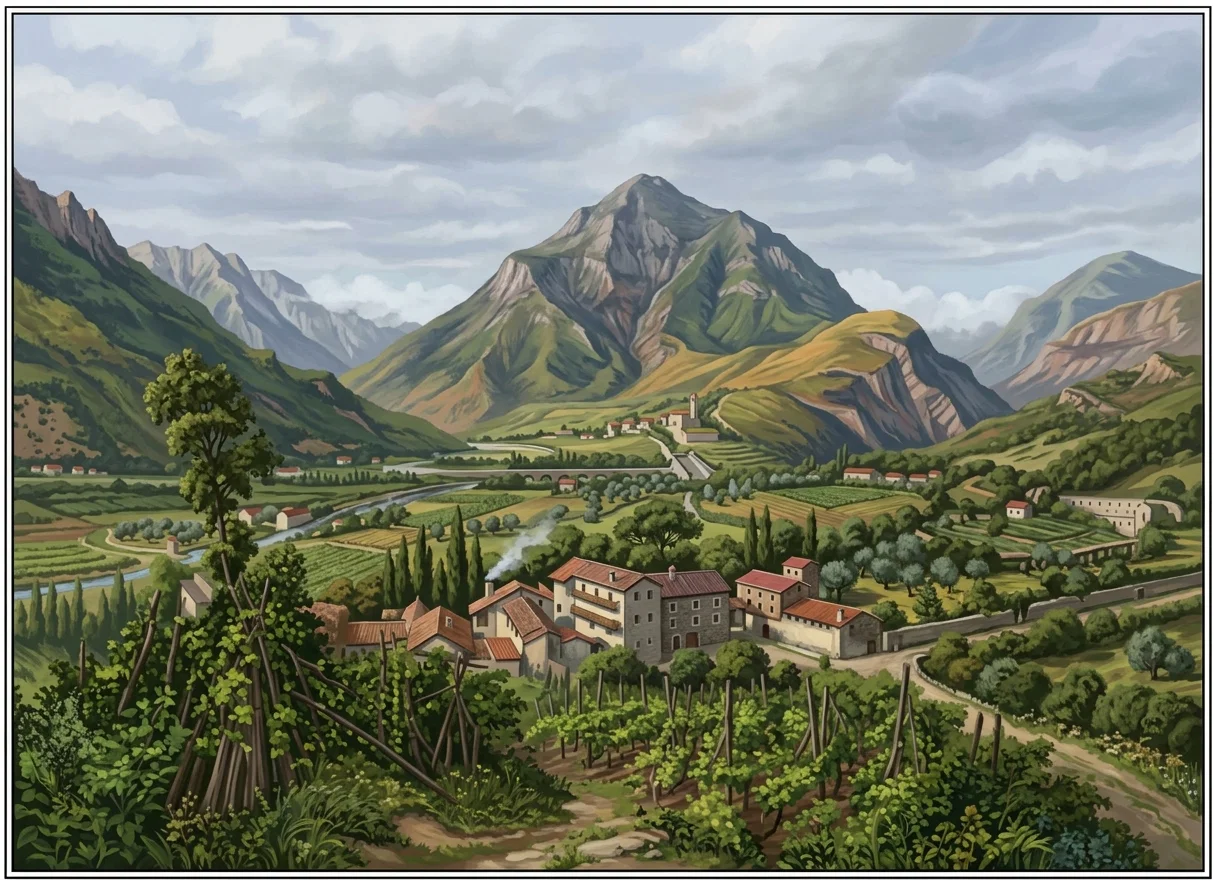
In the valleys of the high Alps which form the boundary between northwestern Italy and southeastern France, have lived from “time out of mind” the “men of the valleys”—for such is the meaning of the name “Vaudois,” or “Waldenses.” Their little territory, some eighteen miles long and fourteen wide, is deeply furrowed by seven valleys, each having its own gate of ingress and egress, and so opening into each other as to justify Leger, a veteran Waldensian pastor and historian, in saying, “The Eternal, our God, having destined this land to be the theater of His marvels and the bulwark of His ark, has by natural means most marvelously fortified it.” (Wylie’s “History of the Waldenses,” page 7.)
These valleys, which are watered by mountain torrents formed by the melting of the mountain snows, rapidly narrow as one ascends them, and are soon lost in a series of deep and densely wooded ravines, accessible only to the practised foot of the mountaineer. Above are towering peaks, frightful precipices, and caverns of unknown depth, which so often were ways of escape to the “hunted men of the valleys.”
In this little district of less than three hundred square miles, with its limited crop-raising area, its long, severe winters, and their accompanying heavy snows and frequent avalanches, lived a people numbering at times 23,000 souls. Why should such a company as this live in these cramped quarters? Why did they not occupy the beautiful Piedmont Valley at the foot of their mountain? Let us see.

Descendants of the Apostles

First let us hear what they have to say through one of their leading pastors and military men, Henry Arnaud:
LA TORRE — THE WALDENSIAN CAPITAL
“Neither has their church been ever reformed, whence arises its title of evangelic. The Vaudois are, in fact, descended from those refugees from Italy, who, after St. Paul had there preached the gospel, abandoned their beautiful country, and fled, like the woman mentioned in the Apocalypse, to these wild mountains, where they have to this day handed down the gospel from father to son, in the same purity and simplicity as it was preached by St. Paul.”—“The Glorious Recovery by the Vaudois,” page 14 of preface, translated by Acland.
That this belief was common among them is shown by their petition to Philbert Emmanuel, duke of Savoy and prince of Piedmont, in 1659:
“We likewise beseech your royal highness to consider, that this religion we profess, is not only ours, nor hath it been invented by men of late years, as it is falsely reported, but it is the religion of our fathers, grandfathers, and great-grandfathers, and other yet more ancient predecessors of ours, and of the blessed martyrs, confessors, prophets, and apostles; and if any can prove the contrary, we are ready to subscribe and yield thereunto.”—Gilly’s “Waldensian Researches,” page 42.
This opinion is upheld by the following facts and citations.

Early Christians Driven to the Mountains by Persecution

We know that Paul’s ministry in Rome, some three hundred miles south of the Piedmont valleys, was very successful, enabling him to say, “All the saints salute you, chiefly they that are of Caesar’s household.” Phil. 4:22. We know also of the terrible persecution of the Christians under Nero, to which Paul fell a victim; and of those which followed in the second and third centuries, “which drove many of the Christian fugitives from Milan on one side and from Lyons on the other, to the Alpine retreat.”

Admissions of Their Enemies

Bernard of Clairvaux, whose death occurred in 1153, says:
“They are rustics, and laymen, and thoroughly contemptible. I am aware they boast that they and they alone are the body of Christ. They boast that they are the successors of the apostles, and call themselves Apostolicals.”—Bernard, sermon 66, Gilly’s “Waldensian Researches,” pages 43, 44.
Less than one hundred years later, about 1230, Reinerus the inquisitor takes the Waldensians to task as follows:
“The heresy of the Vaudois, or poor people of Lyons, is of great antiquity. Among all sects that either are or have been, there is none more dangerous to the church than that of the Leonists, and that for three reasons. The first is, because it is the sect of the longest standing of any; for some say that it hath been continued down ever since the time of Pope Sylvester; and others, ever since that of the apostles. The second is, because it is the most general of all sects; for scarcely is there any country to be found where this sect hath not spread itself. And the third, because it has the greatest appearance of piety; because, in the sight of all, these men are just and honest in their transactions, believe of God what ought to be believed, receive all the articles of the Apostles’ Creed, and only profess to hate the Church of Rome.”—Bib. Patr., tome 13, page 299, quoted on page 22, Gilly’s “Excursion.”
Thus we see their deadly enemy—and one who had been a Waldensian himself, by the way—admitting, in the thirteenth century, that the Waldensians—“Leonist” and “Waldensian” were used interchangeably—were said to have flourished from the time of Pope Sylvester, who is supposed to have baptized Constantine the Great, and who occupied the papal chair from 314 to 335 A.D.

Other Evidences of Their Antiquity

In the beginning of the fourth century, under Constantine, the apostasy foretold by the apostle Paul in 2 Thess. 2:3, 4
“We well know that this sentence of the gospel is ill understood, ‘Thou art Peter, and on this rock will I build My church; and I will give unto thee the keys of the kingdom of heaven.’ Under pretext of which words, a coarse and ignorant people, destitute of all spiritual knowledge, put their trust in Rome for the attainment of everlasting life. Whereas the ministry belongs to all the true superintendents and pastors of the church, who perform it as long as they are in this world; and when they have paid the debt of nature, are succeeded by others of equal authority and power.
“Return, O ye blind, to your light; return to Him who enlightens every man that cometh into the world. For all you, who keep not to this light only, walk in darkness, and know not whither you go. For if God shall be believed when He promiseth, by how much the more when He sweareth! ‘Though Noah, Daniel, and Job were in it, as I live, saith the Lord, they shall deliver neither son nor daughter.’ And it is to this end that He makes this declaration, namely, that none should put their trust in the merits or intercession of saints.”—“The Glorious Recovery,” pages 24, 30, by Acland.
This brief sketch of Claude’s life will suffice to explain why the Waldenses point to his example as an authority for making the Bible their rule of faith and practise. Some of them even go further, and point to him as the one under whom they separated from the Church of Rome. This is indicated by the following dialogue between a Waldensian president or moderator, M. Peyrani, and Napoleon Bonaparte:
“N. How long have you formed an independent church? “P. Since the time of Claude, bishop of Turin, about the year 820.”—Gilly’s “Excursion,” pages 81, 82.
To this agrees the report of Rorenco published in 1632 at Turin:
“Marcus Aurelius Rorenco, the grand prior of St. Roch, when he was commissioned to make inquiries concerning them, under the title of ‘A Narrative of the Introduction of Heresy in the Valleys of Piedmont,’ delivered in a return which stated that ‘those Apostolicals, as they called themselves, were of an origin of which nothing certain could be said, furthermore than that Claude might have detached them from the church in the eighth century, and that they were not a new sect in the ninth and tenth centuries.’”—Gilly’s “Researches,” page 40.
As Rorenco lived in the valley, and was considered by the Roman Church to be one of their most able instruments in suppressing the doctrines of the Vaudois, and therefore had access to all the available documents, his conclusion is a significant one.

Conclusion

But time would fail us to tell of Peter de Bruys, Henri, Arnauld, and Waldo, who followed on in the path that had already been blazed. Passing over, for the time being, their work and persecution during the time intervening between the days of Claude and those of Luther, it will be intensely interesting to know that in 1526 Gonin, a Waldensian pastor, brought Luther’s writings from Germany. In 1530 they sent representatives to Switzerland and Germany with a Latin document containing an account of their discipline, worship, and doctrine. They were joyfully received by the Reformers, and in 1532 the famous synod or convention was held in the valleys, which was attended not only by the Waldensian representatives, but by Reformers from French Switzerland and even Bohemia. What a meeting of the old church and the new! The Vaudois decided to translate into French and print both the Old and the New Testament as their gift to the Reformation. Says Wylie:
“That book which the Waldenses had received from the primitive church—which their fathers had preserved with their blood—which their barbes had laboriously transcribed and circulated—they now put into the hands of the Reformers, constituting them along with themselves the custodians of this, the ark of the world’s hopes.”—Wylie’s “History of the Waldenses,” page 61.
From the foregoing, we may confidently conclude that while the Waldensians may not have had a separate organization until the ninth, tenth, or even the twelfth centuries,
(a) They were descendants from the original apostolic church.
(b) They resisted the corruptions that were successively introduced into the Roman Church.
(c) Men of God were their bishops and leaders.
(d) They held to the Bible as their rule of faith; and as the difference between them and their former associates became more and more marked, they withdrew into the mountains and valleys.
(e) They retained their identity and their faith until the time of the Reformation, when, by way of showing their appreciation of that Word which had made their history possible, this little and poor people collected fifteen hundred gold crowns for an edition of the Bible in French, which was published in the year 1535.

“All Is Mind”

We often read arguments parallel to those in an article before me, which states: “Nothing is save what was first thought out by mind.” “All is mind.” Again, that this “New Thought” runs down from the Vedanta, which is of Hindu origin; also claims that these new thoughts are the very oldest, and that their new way of application “will evangelize the world”; namely, that “one power exists, and that we are the source,” which is equivalent to what we heard from one Blanchard Hall woman. Striking her breast, she exclaimed, “I am Christ! You are Christ!” And so puny man — including woman — with mind egotistical, is laying claim to be as God, because he can “make gardens and build houses,” and even chain the mighty elements that God created for man’s use.
But let me suggest: It is a different task to utilize the tree, from what it is to vitalize the seed that grows the tree. To breathe God’s free air is quite a different thing from making it. The infidel may tell you everything is governed by the laws of nature. Surely; but who conceived and put into working order the laws of nature?
The hen made the egg, the egg made the hen. Yes, here is a law of nature; but who conceived and formed the chemicals, and imbued the things with life-germinating power? Who formed the underlying possibilities of chemistry and electricity?
Every tree, flower, or blade of grass, every human of every race, and every animal or reptile or insect — everything animate and inanimate — was in thought of the great Creator, who conceived and spoke, and it was done. Truly “nothing is save what was first thought out by mind.”
Man is the greatest workmanship of that mind, and was made in the image of God. But when Lucifer, the light bearer in the heavenly courts, thought to usurp God-power, he fell; and there is a day of which God declares, “I will cause the arrogance of the proud to cease, and will lay low the haughtiness of the terrible.”
That nothing can be accomplished without conception and then wish and effort of will, we do not deny; and that a man can will so hard as to defraud his neighbor, we are sure. That he can clutch his gold so tightly as to rob both God and man, we also know. But the question: Is it right? Is it even profitable? Leave Bible, and the beautiful thought of eternal future restitution, out of the case. Would this “setting the whole mind and heart” on any earthly thing bring true happiness, even if it brought worldly gain? Selfishness never brings the highest type of consolation. Much less could it “evangelize the world.” Conceptions of human power never will do it. Walking in the footsteps of the Master, which means love — humble, obedient, self-sacrificing — that is the power to “evangelize the world.”
But does the universal gluttony of the age, the awful greed for gold, the extravagance and waste, the giddy rush for amusements and display, the recklessness of life called sport, the raising of armies and navies and munitions of war in every land, look like universal brotherhood and Christlike humility and love? Does it look like instruction in the beautiful life and sacred teachings of the lowly Nazarene? I need not answer. Mrs. A. H. McAdoo.

Study of the Word “Let”

I HAVE of late had a very interesting study tracing through the Bible the use of the word “let.” This word first occurs in the record of creation week as found in the first chapter of Genesis. Here we read of what was done on each day of the first week of time. “Let” is used in the imperative mode, taking the form of a command, as, “God said, Let there be light.” Gen. 1:3. The word is also used as a command in many other scriptures. But whether used as a command, entreaty, or prayer, it always contemplates the accomplishment of that which is spoken of.
In the old English, “let” gained the meaning of hinder as well as permit. In King James’s Version of the Scriptures there are some instances where the word is thus used. One of these is in 2 Thess. 2:7: “He who now letteth will let, until he be taken out of the way.” If, in this case, “let” was used in the sense of permit, the permitting would not stand in the way of “the man of sin.” “Let” in this instance was used in the old English sense of hinder.
In Isaiah’s prophecy we read, “I will work, and who shall let it?” Isa. 43:13. The translators undoubtedly saw the obscurity in this translation, and so they placed in the margin, “turn it back,” as another meaning of the word “let,” which they had used in the text.
As late as 1878, when I commenced labor in southern England, I found some of the elderly men still using the word “let” in the sense of hinder, saying such and such things occur without let or hindrance; thus using both terms, but clinging to the old use of “let.”

“LET” AS A COMMAND

We will notice a few cases where “let” is thus used. “Let them make Me a sanctuary; that I may dwell among them.” Ex. 25:8. “Let your heart therefore be perfect with the Lord our God, to walk in His statutes, and to keep His commandments, as at this day.” 1 Kings 8:61. “Let them praise Thy great and terrible name; for it is holy.” Ps. 99:3. “Let everything that hath breath praise the Lord.” Ps. 150:6. “Let not thine heart envy sinners: but be thou in the fear of the Lord all the day long.” Prov. 23:17. “Let them give glory unto the Lord, and declare His praise in the islands.” Isa. 42:12. “Let the priests, the ministers of the Lord, weep between the porch and the altar.” Joel 2:17. “Let the heathen be wakened, and come up to the Valley of Jehoshaphat.” Joel 3:12. “Let your light so shine before men, that they may see your good works, and glorify your Father which is in heaven.” Matt. 5:16. “Let your loins be girded about, and your lights burning; and ye yourselves like unto men that wait for their lord, when he will return from the wedding; that when he cometh and knocketh, they may open unto him immediately.” Luke 12:35, 36. “Let no man deceive himself.” 1 Cor. 3:18. “Let no man seek his own, but every man another’s wealth.” 1 Cor. 10:24. “Let all things be done decently and in order.” 1 Cor. 14:40. “Let him that is taught in the Word communicate unto him that teacheth in all good things.” Gal. 6:6. “Let all bitterness, and wrath, and anger, and clamor, and evil speaking, be put away from you, with all malice.” Eph. 4:31. “Let the word of Christ dwell in you richly in all wisdom teaching and admonishing one another in psalms and hymns and spiritual songs, singing with grace in your hearts to the Lord.” Col. 3:16. “Let the peace of God rule in your hearts.” Col. 3:15. “Be careful for nothing; but in everything by prayer and supplication with thanksgiving let your requests be made known unto God. And the peace of God, which passeth all understanding, shall keep your hearts and minds through Christ Jesus.” Phil. 4:6, 7.
J. N. Loughborough.

The Sabbath

O BLESSED day of peaceful rest, Of all the days supremely blessed! From worldly care and labor free, We come, O Lord, to worship Thee!
When great creation's work was done, And man his race had but begun, God did ordain this day of rest; By Him 'twas sanctified and blessed.
May all the world honor the Lord, Love and obey His holy word; With His law written in their heart, From His commandments ne'er depart.
Mountains shall crumble and decay; Heaven and earth shall pass away; But still unchanged God's word shall be, The same to all eternity.
Eson Carpenter.

My First Lesson about Eternal Torment

WHEN I was about ten years of age, a neighbor of ours, who had spent his life in sin, died, and was buried in a lone cemetery not far from our home. Shortly after the funeral services were over, a playmate of mine told me that the man had been sent away to be punished with burning in a great lake of roasting brimstone, and that he would remain there through the endless ages.
My parents had never told me about such a place as my young friend described, and so I was not quite willing to accept his version of the situation. I told him that I saw the man put in a coffin, and that he was dead, and that the coffin was fastened very tight, and buried deep down in the ground. I did not believe a dead man could possibly get out of his grave. I believed that if the dead man's grave should be opened, he would be found there just as he had been left when the ground was placed upon him.
When I had stated my objections to the theory which my friend had been advocating, he admitted that the dead man's body was yet in the grave, but he said the man had a soul which left the body while he was dying, and it went away to that lake of fire and brimstone faster than a bullet could fly. When I asked him how he knew about a soul that had gone away to be burned, and to live in a great fire, he said it had been told to him by people who knew it to be so. But I thought that if what he had declared about the case of our neighbor was true, then my mother would know of it. I therefore went to her very soon to learn what she had to say about the matter. I stated to her the substance of what my friend had said of our dead neighbor's soul now being in a lake of burning brimstone, and I desired her to tell me what she thought about it. When I had finished my recital of the conversation between us, she said the boy had got hold of a false theory about the dead and about future punishment. She said she had heard these things many times, but that they were contrary to the teachings of God's word.
Then she told me that the wicked were not now suffering punishment, nor had the righteous yet gone to their reward. She also spoke of a judgment to come, and the resurrection from the dead, and how the cases of all classes of people would be determined by the Lord in the judgment, and that God would do all things just right with every one.
And this, the first lesson that I received from my mother upon the great theme of man's nature and destiny, has served as a balance in my hope and in my study for more than sixty years.
WILLIAM COVERT.

The Beautiful Valley of Rest

By L. D. SANTEE
I LOOK from the uplands of being, And a joy to my spirit is given. I grow tenderly sober in seeing The light and the glory of heaven. Beyond the tall mountains of gladness Is the home of the pure and the blest; And there, with no echo of sadness, Lies the beautiful valley of rest.
A glory gleams soft o’er these mountains, Reflected from shadowless skies; While mingled with music of fountains, The songs of the ransomed arise. There are isles in an ocean of splendor, There are joys that no tongue can express, And there, where the radiance is tender, Lies the beautiful valley of rest.
That home is awaiting in heaven For all who for heaven are prepared. To them will the white robes be given, For them are the mansions prepared. They will bask in the sunlight of gladness, With a joy that no tongue can express. They will rest with no echo of sadness, In the beautiful valley of rest.
The sins of the earth leave no traces On the beautiful forms that we love. There’s a rapture of joy on their faces As they rise to the mansions above. We shall drink of life’s soft-flowing fountain, And dwell with the holy and blest; And near to the evergreen mountains Lies the beautiful valley of rest.
No wickedness there, no deceiving, Through all of eternity’s years; No hopes that have failed, and no grieving, No cheeks that are furrowed with tears. But sweeter than prophet’s glad vision, Or the glory that shines in the west, Between the tall summits Elysian, Lies the beautiful valley of rest.
There are lives that are faithful to duty, Who have followed their Saviour below. They will stand with the King in His beauty, Where the roses of Paradise blow, Their eyes with a love-light are shining, Whose mission on earth was to bless. Where the roses of heaven are twining, Lies the beautiful valley of rest.

THE COMING MILLENNIUM

What Events Immediately Precede It?
The Reign of Peace and Righteousness
By ALLEN MOON
“MILLENNIUM” comes from two Latin words,— milli, one thousand; and annum, year. The word “millennium” is not found in the Bible, but mention is made of a special period of one thousand years in which Satan will be bound. Without a careful comparison of scripture with scripture, well-meaning people conclude that the binding of Satan, the instigator to sin, means a reign of righteousness and peace for men in the flesh for a period of one thousand years. And further, it is taught that this period precedes the second coming of Christ to raise the righteous dead and to immortalize the living righteous. The word of God must determine the truth or falsity of these claims. Human theory is of no value in determining that which the mind of God only has conceived.
The state of the world until the second coming of Christ, is clearly outlined in the word of God. The inspired apostle wrote: “All that will live godly in Christ Jesus shall suffer persecution. But evil men and seducers shall wax worse and worse, deceiving, and being deceived.” 2 Tim. 3: 12, 13. There will be those who will live godly in the world up to the very time of His coming, but all such shall suffer persecution; and logically, these suffer persecution at the hands of evil men and seducers, who wax worse and worse until the very end.
This accords with the Saviour’s interpretation of His own parable of the wheat and the tares. At the request of His disciples for an interpretation,
“He answered and said unto them, He that soweth the good seed is the Son of man; the field is the world; the good seed are the children of the kingdom; but the tares are the children of the wicked one; the enemy that sowed them is the devil; the harvest is the end of the world; and the reapers are the angels. . . . The Son of man shall send forth His angels, and they shall gather out of His kingdom all things that offend, and them which do iniquity. . . . Then shall the righteous shine forth as the sun in the kingdom of their Father.” Matt. 13: 37-43.
This scripture does not in itself reveal the connection between the harvest at the end of the world, and the reaping by the angels, and the second coming of Christ; but taken in connection with another statement of the Saviour’s, it is made plain. In speaking of the events of the last days, He said:
“And then shall appear the sign of the Son of man in heaven: and then shall all the tribes of the earth mourn, and they shall see the Son of man coming in the clouds of heaven with power and great glory. And He shall send His angels with a great sound of a trumpet, and they shall gather together His elect from the four winds, from one end of heaven to the other.” Matt. 24: 30, 31.
How clear the connection here shown between the second coming and the harvest, or gathering time, in which the angels take part! Note, the elect are gathered from the four winds of heaven, but the tribes of earth mourn, showing that His second coming does not occur at the time of a universal reign of peace and righteousness, or there would be none to “mourn” because of His coming.
Let us pursue the study a little further, and see how this event affects the two classes referred to. The apostle, in writing of it, comforts God’s people by saying:
“For the Lord Himself shall descend from heaven with a shout, with the voice of the Archangel, and with the trumpet of God: and the dead in Christ shall rise first: then we which are alive and remain shall be caught up together with them in the clouds, to meet the Lord in the air: and so shall we ever be with the Lord. Wherefore comfort one another with these words.” 1 Thess. 4: 16-18.
The harvest of the righteous then results in their being gathered up, both those who had not died and the resurrected ones, to meet the Lord in the air. There is not a statement in the word of God that can be taken as authority for the belief that the Son of God will set His foot on the earth at His second coming. Therefore it is evident that He, with the saints, will not spend a thousand years in this sin-cursed world.
But what about the wicked who “mourn” at the sight of His coming? In another word picture of this event, we have the answer clear and distinct, as follows:
“And I looked, and behold a white cloud, and upon the cloud one sat like unto the Son of man, having on his head a golden crown, and in his hand a sharp sickle. . . . And another angel came out of the temple which is in heaven. . . . And another angel came out from the altar, which had power over fire; and cried with a loud cry to him that had the sharp sickle, saying, Thrust in thy sharp sickle, and gather the clusters of the vine of the earth; for her grapes are fully ripe. And the angel thrust in his sickle into the earth, and gathered the vine of the earth, and cast it into the great wine-press of the wrath of God.” Rev. 14: 14-19.
And still another view of the same event is set forth in the following language:
“And He was clothed with a vesture dipped in blood: and His name is called The Word of God. . . . And out of His mouth goeth a sharp sword, that with it He should smite the nations: . . . and He treadeth the wine-press of the fierceness and wrath of Almighty God. . . . And I saw an angel standing in the sun; and he cried with a loud voice, saying to all the fowls that fly in the midst of heaven, Come and gather yourselves together unto the supper of the great God; that ye may eat the flesh of kings, and the flesh of captains, and the flesh of mighty men, and the flesh of horses, and of them that sit on them, and the flesh of all men, both free and bond, both small and great.” Rev. 19: 13-18.
The Lord would not leave men in doubt regarding so important an event as His second coming, and existing conditions just prior to that event. When He was about to depart from earth, He said to His disciples:
“But as the days of Noah were, so also shall the coming of the Son of man be. For as in the days that were before the Flood they were eating and drinking, marrying and giving in marriage, until the day that Noah entered into the ark, and knew not until the Flood came, and took them all away; so shall also the coming of the Son of man be.” Matt. 24: 37-39.
The Saviour’s words make it clear that there is no place for a reign of peace on earth before He comes again. The reign of peace is after His coming. In a study next week, we will endeavor to locate the millennium and the principal events connected with it.
Continue reading: The Promises of His Coming