Your ShelfYour Projects

Signs of the Times, Vol. 29, No. 4.

THE GLORIES THAT DO NOT FADE

Signs of the Times

Jan 28, 1903

Pacific Press Publishing Company · Oakland, California · Jan 28, 1903

THE GLORIES THAT DO NOT FADE.
THROUGH all the accomplishments of the human there runs the sad minor strain of continual decay. True it is that all the glory of man is as the flower of the grass. The grass decays and the winds toy with its fragile fragments. So the glory of man fades and withers, and the tireless winds of time bury it in the debris of other things. Time is busy from dawn till twilight, from twilight till dawn, finding sepulcher for the faded glories of human greatness. Not a State is reared or a king enthroned but adds to this occupation of the great leveler, Time.
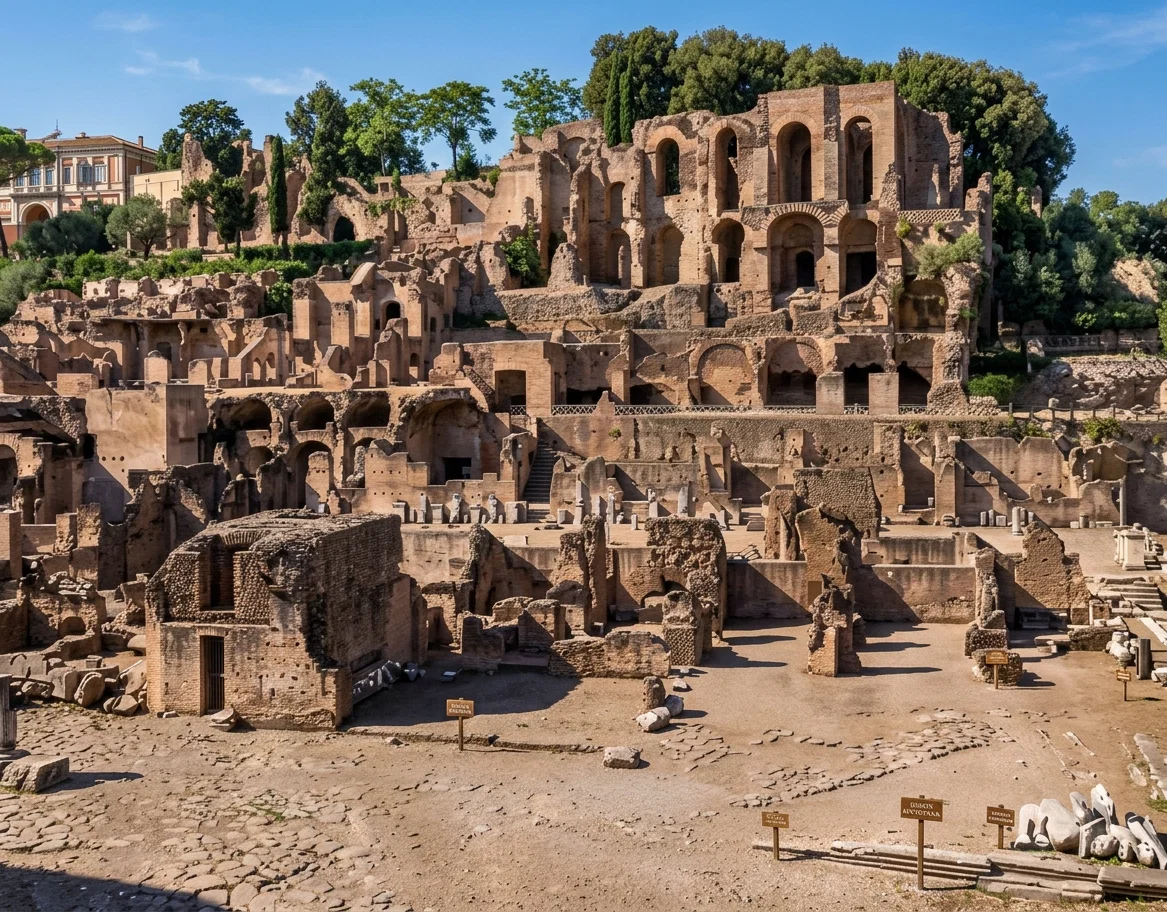
The Palace of the Caesars, Rome.
THERE is an enduring substance; there is a name that will not pass away; there is a glory which shall never grow dim nor wither in the blasts of the ages. These are the things upon which God has placed the seal of righteousness, because they partake of the nature of the divine and have in them none of the disintegrating elements of the unregenerate human. Everything that partakes of sin, of selfishness, of the purely human, will be cleansed out of the imperishable eternal as the dross from the gold, and the royal seal stamps it to endure. That process makes a man more precious than the golden wedge of Ophir, for even gold is not imperishable, but a man may be. Humanity in harmony with divinity, in tune with the Infinite, by the irrevocable decree of God, must stand forever.
THAT does not mean the human race en masse; but as individuals. Each separate particle of gold must give up every particle of dross that has been clinging to it, or the product is not pure. The gold which can not be separated from the crushed ore to which it clings, goes with the worthless refuse of the grinding. So it is with man. He who can not be separated from his sin must go down with it in the wreck of Satan's conspiracy against God.
IN mercy to us God is holding before our very eyes to-day evidences of the transitory, perishable nature of the very best that man has to bequeath to his posterity. Children of to-day clamber over the crumbling ruins of the men of yesterday, ruins of the work of the greatest genius of the past, and are bound to read in them the fact that nothing visible has yet withstood the impartial test of time. All that has depended upon the human has gone down into dust at the touch of the alchemist of age. The fragments of Egypt's glory are whirling to-day in the dust-storms of the desert. The remnants of her idol temples totter and tumble in sight of the children of those who reared them. So with Babylon; so with Greece; and so with Rome. The palace of the Caesars is glorious no more. Once its polished sides were glorious to look upon; its marble halls were resplendent with ivory and bronze and gold; the wealth of a universal nation was lavished upon its splendid maintenance; in its polished niches stood vases, tripods, and statues of gold and silver; on each side of the porticus was a large library, one Latin and the other Greek; in one of its spacious halls the Roman senate met from timeto time, and there stood the bronze colossus of Augustus Cæsar himself, fifty feet high; between its marble columns were statues of the fifty Danaids and fifty bridegrooms in marble on marble steeds; here was a temple of Vesta, dedicated when this Cæsar was made pontifex maximus; and this was but one of the mighty and magnificent buildings that crowned the Palatine Hill. Where is it all to-day?—Slumbering in the same dust that binds the hands and the hearts of the men who planned and reared these time-harrowed testaments to human glory. The same Tiber, Nile, Euphrates run by these ruins to the sea, and the same God is waiting still for man to recognize his need of Him if he would have that glory which fadeth not away.
THE Lord has not only taught us this lesson in the crumbling ruins of human glory; He has taught it in His written Word as well. Christ, Himself, tells us, “Without Me ye can do nothing.” “All flesh is as grass, and all the glory thereof as the flower of grass. The grass withereth, and the flower falleth; but the Word of the Lord abideth forever.” “The fashion of this world passeth away.” Satan offered Christ the kingdoms of this world and the glory of them if He would worship him. Christ knew that any glory outside of God was a glory that could not endure, and He brushed aside the flattering temptation. Would you know the same thing? Then imitate His choice and take the glory that brightens and widens and deepens while the ages roll on. Having made that choice, even tho you should be laid away in death, you have the assurance that you will be “raised in glory,” bearing “the image of the heavenly.” “The God of all grace, who called you unto His eternal glory in Christ, after that ye have suffered a little while, shall Himself perfect, establish, strengthen you.” 1 Peter 5:10. That is a glory worthy the most ardent seeking, a glory as enduring as eternity, a glory to which the fleeting, evanescent glories of this world are not worthy to be compared, a glory as free to the peasant as the prince. Share in it—it is your privilege. God is holding out the gift to-day—take it and learn to know the joys of that better world.
C. M. SNOW.

LESSONS FROM THE FIRST CHAPTER OF REVELATION.

BY MRS. E. G. WHITE.

Verses 1-10.

The Revelation of Jesus Christ, which God gave unto Him, to show unto His servants things which must shortly come to pass; and He sent and signified it by His angel unto His servant John; who bare record of the word of God and of the testimony of Jesus Christ, and of all things that he saw.”
There should be a closer and more diligent study of the Revelation, and a more earnest presentation of the truths it contains,—truths that concern all who are living in these last days. Into the very designs and principles of the church of God these truths are to enter. If we take up the study of this book in a receptive frame of mind, with hearts susceptible of divine impressions, the truths revealed will have a sanctifying influence upon us.
To encourage a study of this book, God declares: “Blessed is he that readeth, and they that hear the words of this prophecy, and keep those things which are written therein: for the time is at hand.”
The Revelation is regarded by many as a closed book. Not a few ministers declare that it can not be understood. But it is our privilege to know something in regard to it. By no means should we become weary of looking into it because of its apparently mystical symbols. Christ can give us understanding. The benediction pronounced upon those who read, and hear, and keep the words of this prophecy, may be ours.
The Revelation was written to the seven churches in Asia, which represented the people of God throughout the world. “John to the seven churches which are in Asia: Grace be unto you, and peace, from Him which is, and which was, and which is to come; and from the seven Spirits which are before His throne; and from Jesus Christ, who is the faithful witness, and the first begotten of the dead, and the prince of the kings of the earth.”
Banished to the solitudes of the Isle of Patmos, John was favored with the presence of Jesus Christ. How comforting are the words of the aged apostle as he wrote to the churches of his Saviour! “Unto Him that loved us, and washed us from our sins in His own blood, and hath made us kings and priests unto God and His Father; to Him be glory and dominion forever and ever.”
“Behold, He cometh with clouds; and every eye shall see Him, and they also which pierced Him; and all kindreds of the earth shall wail because of him.” Whether we be saved or lost, we shall sometime see the Saviour as he is, in all His glory, and shall understand His character. At His second coming, conviction will be brought to every heart. Those who have turned from Him to the trivial things of this earth, seeking selfish interests and worldly honor, will in the day of His coming acknowledge their mistake. These are the ones spoken of by the Revelator as “all kindreds of the earth,” who “shall wail because of Him.” Let us not be content to be numbered among the “kindreds of the earth.” Remembering that our citizenship is in heaven, let us lay hold on the hope set before us in the Gospel.
“And they also which pierced Him.” These words apply not only to the men who pierced Christ when He hung on the cross of Calvary, but to those who by evil-speaking and wrong-doing are piercing Him to-day. Daily He suffers the agonies of the crucifixion. Daily men and women are piercing Him by dishonoring Him, by refusing to do His will.
The Lord desires us to be men and women in Christ Jesus. Our natural dispositions are to be softened and subdued by His grace. Then we shall not be continually crucifying Him afresh. Our Saviour lived on this earth a perfect life. He is our Example. If we now follow Him, doing His will in all things, we shall in the world to come live with Him forever. Let us keep Him constantly in view. It should be our life-purpose to glorify Christ. This is the great purpose that has inspired Christians in every age. It is by cherishing this purpose that we make sure of eternal salvation. Let us learn to know Him whom to know aright is peace and joy and life everlasting.
“I am Alpha and Omega, the beginning and the ending, saith the Lord, which is, and which was, and which is to come, the Almighty.”
“I, John, who also am your brother, and companion in tribulation, and in the kingdom and patience of Jesus Christ, was in the Isle that is called Patmos, for the Word of God, and for the testimony of Jesus Christ.”
In his old age the apostle talked continually of Christ, and the people tired of his words, which rebuked their stubborn refusal of Christ as their Saviour. To rid themselves of John’s testimony, they banished him to Patmos. But in sending him to that lonely isle, they did not place him beyond the reach of Jesus. It was there that he was given a wonderful revelation of his Saviour and of the things that were to come to pass on the earth; and it was on Patmos, too, that he wrote out the record of his visions that we have in the book of Revelation,—a record that will be present truth until all the events foretold shall have taken place.

THE TREASURE BOOK.

It is one of the wonders of this Christian age that the Christian people of the earth know so little of the great Treasure Book.
Many a one who finds time to attend half a dozen meetings a week, is all too busy to spend one quiet hour in the study of the Word of God for himself. The minister reads his Bible, brings out the jewels, and people are satisfied with the few that fall to their lot. But let me tell you that another man's study will not strengthen the fibers of your heart to stand against trial and temptation when it comes to you.
The Bible is uninteresting to those who have not learned what it is or how to use it. Until gold was discovered in the Klondike that was an uninteresting country. But when the miner went there with his pick and his shovel, his pan, and rocker, and sluice-box, and began to pull out the gold that was hidden from unseeing eyes, it became the center of interest to the Western World. Still, even then, many an adventurer went to the North, and was disappointed that the gold must be sought with the pick and the shovel.
As it pleased God to mix treasure with the clay and gravel of that uninviting land, so it has pleased Him to store all the gold of Christian possibility in His Word, and the instruction to the human race is, “Seek it as silver, and search for it as for hid treasure.” Adventurers go idly to the Word of God, expecting to carry away its riches, but they never find them.
EDISON DRIVER.
Fresno, Cal.

THE PATH OF THE JUST.

[By the late T. R. Williamson, of Oakland, Cal.]
“The path of the just is as the shining light, that shineth more and more unto the perfect day.” Prov. 4:18.
The path of the just shines more and more Unto the perfect day. His weary feet halt on this earthly shore, And the fog-bank of death hangs heavily o’er The view of his onward way.
The path of the just shines more and more, Night blurs the sun from sight; Against him earth’s troubles expend their force, All hindering woes can not darken his course; He walks in a glow of light.
The path of the just shines more and more, Glintings of glory bloom Through the fog, like joys by the angels’ brought, Like comforting beams through the dreariness caught, From the window-lamp of home.
The path of the just shines more and more; Refulgent streams of light Emblazon the gloom ’round his faithful feet, Encourage his progress with promises sweet Of God’s land almost in sight.
The path of the just shines more and more; Supernal splendors play; Forever the Daystar dispels the gloom; Eternity’s children caught up from the tomb Inherit God’s perfect day.

“CONSIDER HIM”

BY PROF. G. W. RINE

“THY KINGDOM COME.”

Immediately following the foregoing words of the Lord’s Prayer is this petition: “Thy will be done in earth, as it is in heaven.” Never since the fall of man, save in the life of Jesus Christ, has the will of God been done in earth as it has been and is done in heaven. The absolute and universal law of life among the heavenly hosts is God’s will expressed in His law. Ever since men began to multiply on the earth, sinners, the transgressors of the divine will, have largely preponderated over the saints.
But the very fact that our Lord taught us to make this petition is itself the pledge that the petition will sometime be realized. It is a guaranty that the time will come when “the earth shall be filled with the knowledge of the glory of the Lord, as the waters cover the sea.” Hab. 2:14. “The whole world lieth in wickedness” (1 John 5:19), is the express testimony of Inspiration. The works of the devil are in evidence everywhere. But we have the assurance of Holy Writ that “for this purpose the Son of God was manifested, that He might destroy the works of the devil.” 1 John 3:8. Most assuredly the works of the devil are sin. Sin, therefore, is doomed to destruction. Hence we read: “But now once in the end of the world hath He appeared to put away sin by the sacrifice of Himself.” Heb. 9:26. It is evident that when sin shall be no more, sinners will be no more. When the prophet beheld in rapt vision the ultimate restitution of all things, he exclaimed: “Thy people also shall be all righteous.” Isa. 60:21. O, the wondrously blessed truth, that the time will come when the righteous will of God will be done in earth as it is done in heaven!
We know that when our world was swung into space by the hand of its Creator, that He pronounced it “very good.” But as the consequence of the advent of sin, the earth bringeth forth thorns and thistles. A large part of its surface is a desolate, arid waste. It has become the habitation of disease, pestilence, and death. But our God has not forgotten the work of His hand. The earth shall be restored to its pristine perfection, to its Edenic glory. For “God Himself that formed the earth and made it; He hath established it, He created it not in vain, He formed it to be inhabited.” Isa. 45:18. The Holy Spirit through Peter speaks of the “restitution of all things, which God hath spoken by the mouth of all His holy prophets since the world began.” Acts 3:21. O what a thought, that the devil, and all incorrigible sinners, and all sin, and the awful havoc that sin has wrought, shall sometime be no more! The devil shall not have his way. His hellish project has been eternally canceled by the blood of the Lamb.
In Gen. 1:26, 28, and in the 8th psalm, it is explicitly stated that man, under God, was originally given dominion over the earth with all its lower forms of life. But when man was seduced by the arch-fiend, he surrendered his dominion, his authority to his conqueror. Thus Satan usurped the authority originally vested in man. We see therefore why our Lord characterized His arch-enemy as the “prince of this world.” The colloquy between Christ and Satan in the wilderness of temptation makes it evident that Satan claimed the earth as his domain. When, according to the record, Satan had taken Christ up into a high mountain and had shown Him all the kingdoms of the world in a moment, he said to Him: “All this power will I give Thee, and the glory of them; for that is delivered unto me; and to whomsoever I will I give it. If Thou therefore wilt worship me, all shall be Thine.” Luke 4:6, 7. Christ did not dispute Satan’s claim, but He effectually rebuked his audacity in trying to compass the fall of the second Adam as he had of the first. Christ well knew that the only way that He could wrest the earth from the tremendous grip that the devil had upon it, that the only way to effect the restitution of all things, and thus cause the kingdoms of this world to become the kingdoms of our Lord and of His Christ, was to pass through the awful ordeal of the cross. And thanks be to God, Christ did climb the steps of Calvary; He did wear upon His holy brow the crown of thorns—the curse of the earth—and thus triumphantly wrought the “redemption of the purchased possession.” And now “this Gospel of the kingdom shall be preached in all the world for a witness unto all nations; and then shall the end come” (Matt. 24:14)—the end of the horrible tragedy of sin. Then “there shall be no more death, neither sorrow, nor crying, neither shall there be any more pain; for the former things are passed away.” Rev. 21:4. Then, O Son of the Highest, shalt Thou receive “the uttermost parts of the earth for Thy possession.” Ps. 2:8.
Think not that the eternal purpose of God in creating this world will not be consummated. The devil shall not be able to frustrate the designs of the Almighty. “The earth hath He given to the children of men.” Ps. 115:16. This planet is infallibly destined to be the endless home of a redeemed humanity under the glorious sovereignty of the King of kings. “Blessed are the meek; for they shall inherit the earth” (Matt. 5:5)—the earth purified and rejuvenated. As our earth was once the paradise of a sinless humanity under the first Adam, so she is gloriously destined to become again the paradise of a sin-purged humanity under the second Adam.

To All by Faith.

Our Lord declares, through Peter, that “the day of the Lord will come as a thief in the night; in the which . . . the elements shall melt with fervent heat, the earth also and the works that are therein shall be burned up. . . . Nevertheless we, according to His promise look for new heavens and a NEW EARTH, wherein dwelleth righteousness.” 2 Peter 3:10–13. So John, in holy vision, “saw a new heaven and a new earth; for the first heaven and the first earth were passed away.” Rev. 21:1. Likewise, through one of the Old Testament prophets, the Lord assures us: “Behold, I create new heavens and a new earth.” Isa. 65:17.
This was the promise or covenant made to Abraham—the glorious promise of a rehabilitated earth. (See Genesis 13, 17 and 22.) As expressly stated in Rom. 4:13, this promise comprehended the whole world.
It was through Abraham’s seed that the promise was to be realized by Abraham and his children. In Gal. 3:16 it is plainly declared that that Seed is Christ. Those of us who are not the children of Abraham in the flesh need to remember the words of Paul: “So then they which be of faith are blessed with faithful Abraham.” Again: “If ye be Christ’s, then are ye Abraham’s seed, and heirs according to the promise.” Gal. 3:9, 29.
“But,” asks the uncredulous reader, “did not Abraham’s seed realize the promise when under Joshua they were put in possession of the land of Canaan?”—No; that inheritance was only an earnest of the real and eternal inheritance. Reading Acts 7:2–5, we learn that God gave Abraham no inheritance in Canaan, “no, not so much as to set his foot on.” Note the following clear-cut declaration, found in Heb. 11:9, 10. “By faith he [Abraham] sojourned in the land of promise, as in a strange country, dwelling in tabernacles with Isaac and Jacob, the heirs with him of the same promise; for he looked for a city which hath foundations, whose builder and maker is God.”
Ah, the children of God are the heirs, not of a mere form, not of government bonds and railway stocks, not of mere millions of gold—but of the world; yea, of “all things.” For “He that overcometh shall inherit all things.” Rev. 21:7. Paul addressing the saints, declares, “and all things are yours.” Yes, when our sin-scarred earth shall emerge from the fires of God, resplendent in her pristine glories, then shall our blessed Lord and King exclaim, “Come ye blessed of My Father, inherit the kingdom prepared for you from the foundation of the world.” Then “the wilderness and the solitary place shall be glad . . . and the desert shall rejoice, and blossom as the rose.” Then we “shall go out with joy, and be led forth with peace; the mountains and the hills shall break forth before you into singing, and all the trees of the field shall clap their hands. Instead of the thorn shall come up the fir-tree, and instead of the brier shall come up the myrtle tree.” Then “shall the lame man leap as a hart, and the tongue of the dumb sing.”
“The wolf also shall dwell with the lamb, and the leopard shall lie down with the kid, . . . and the cow and the bear shall feed; their young ones shall lie down together. . . . They shall not hurt nor destroy in all My holy mountain; for the earth shall be full of the knowledge of the Lord as the waters cover the sea.” No thorns, no thistles, no deserts, no sorrow, no sickness, no pain, no death, no graveyards, will be in that glorious Beulah land! But the Lamb of God shall be in her midst; and where He is there is life—full, rich, endless, buoyant, lyrical LIFE. For, “there shall in no wise enter into it anything that defileth, neither whatsoever worketh abomination, or maketh a lie; but they which are written in the Lamb’s book of life.”
Grant, our Saviour, that we may all be of the ransomed of the Lord, who “shall return, and come to Zion with songs and everlasting joy upon their heads; they shall obtain joy and gladness, and sorrow and sighing shall flee away.” And Thine shall be the honor, and the glory, and the power forever. Amen.

Ministers and Secular Business

It has not been my fortune to know a minister great enough to run a farm or other business while he is a pastor, without damage to himself, his church, or both. If he gets money, he digs it out of his efficiency.—Benjamin M. Adams.

Let God Hold Us

22.) “It is better to let God hold us than to try to hold on to Him.”

The Force of Sin

“He who thinks of sin lightly will feel its force heavily.”

A REVIEW OF THE SEVEN CHURCHES.

THERE were seven literal churches in literal Asia, doubtless known by the names John uses in Revelation 1 and 2.
2. But it is not in harmony with the plan, the object, the scope of the book of the Revelation of Jesus Christ to confine to them the seven sevenfold letters, with all their fulness of prediction, instruction, and promise.
1. Because there were other churches in Asia as important as some of these mentioned, as, for instance, Troas and Colosse.
2. The fact that just seven are noted evidences that fulness and completion is indicated, in harmony with other lines of prophecy and symbols in the book. A seven-sealed book spans all the records of time; a seven-headed dragon covers all the great historic dynasties; seven golden lampstands represent the entire church, seven spirits of God, the one all-pervading Spirit, seven horns, the fulness and glory of the Lamb’s unconquerable sway.
3. The seven churches warned bore in their history, character, or name some one or more features which fitted them to be types of the different stages and characteristics of the entire church of God from apostolic days till the coming of our Lord Jesus Christ. Thus Balaam is used as a type of religious teachers; Jezebel, of the apostate church; Egypt, of infidelity; Babylon of old, of mystical Babylon; and John himself stands as the representative of God’s servants even to the close of earthly probation.
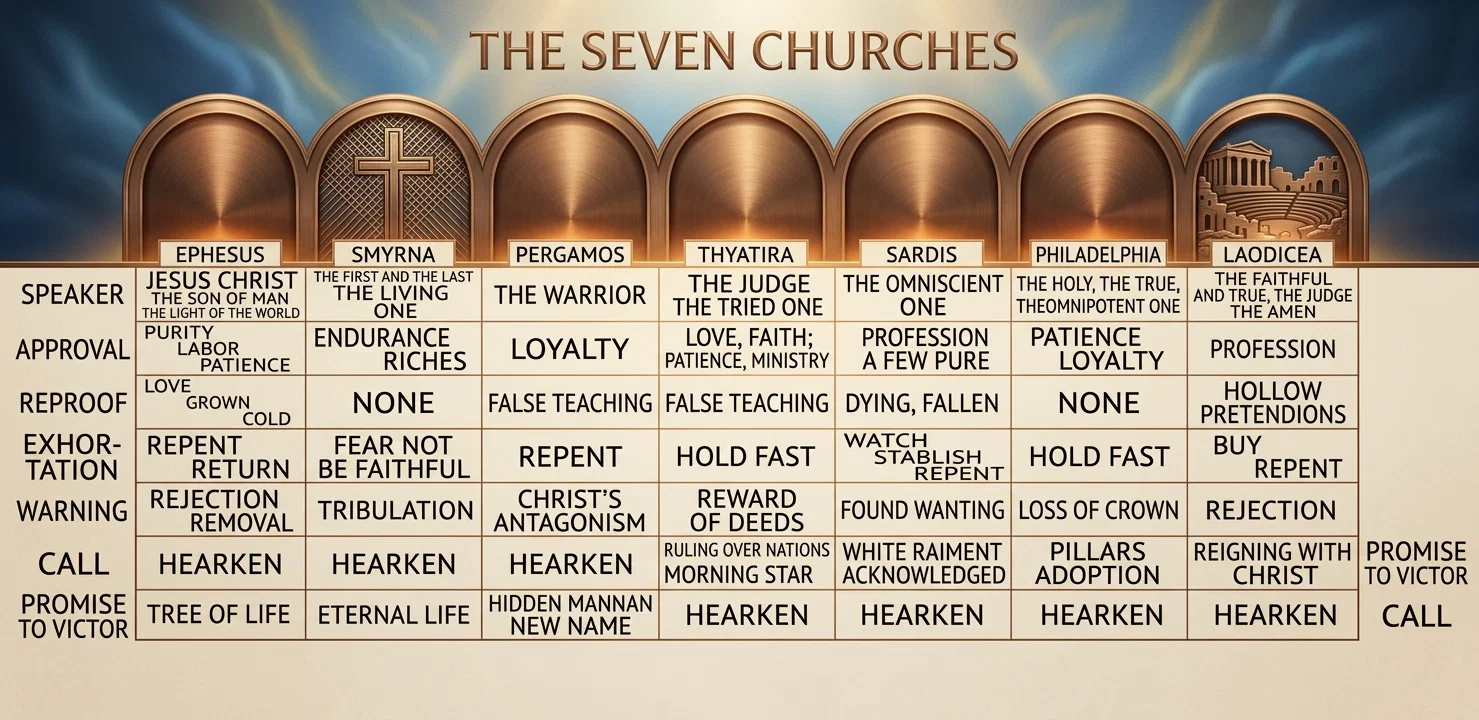
That the scope of the prophecy and the similarity and difference of the letters may be clearer, we present a diagram of the seven churches. Let the student note the following features:—
1. The diagram covers the Christian dispensation from John’s day to the second coming of Christ.
2. It is impossible to mark the definite beginning and ending of each division or church. They blended into each other, telescoped each other, so to speak, and the characteristics of each and all continue in some measure to the end. In general, it may be said that Ephesus included the closing part of the apostolic age; Smyrna, the time of the pagan persecutions; Pergamos, from the days of Constantine to the sixth century; Thyatira, the greater part of the long period of the Dark Ages; Sardis (beginning with Reformation times), Philadelphia (with Advent-message days, about 1840), Laodicea (especially after 1844), all represent last-day conditions, manifest even unto the very end.
3. The general plan, the sevenfold division, of our Lord’s letters to the church in each condition is the same throughout, with the exception of a few striking features. We have, (1) the speaker or writer, our Lord Himself under different titles; (2) approval if there was aught to approve; (3) the reproof, if the Master saw aught to reprove; (4) the earnest exhortation; (5) the faithful warning and admonition; (6) the call to hear, coming sixth in the first three, and seventh in the last four; so that before and after the promises comes God’s blessed invitation; (7) the promise to the overcomer, coming seventh in the first three and sixth in the last four.
4. It will be noticed that these conditions naturally fall into three irregular pairs, with a seventh which stands alone; Ephesus and Philadelphia, Smyrna and Thyatira, Pergamos and Sardis, and Laodicea.
5. Ephesus (“desirable”) represents a pure condition of the church, in which there was much to approve. Yet even here the love had grown cold under the influence of error, worldliness, and apostasy. But this condition is duplicated in fuller measure in Philadelphia (“brotherly love”), against which the Infinite has no reproof. Surely brotherly love is a desirable condition, and dwelling in it the church will have to be when she welcomes the return of the Lord.
6. Smyrna, persecuted under Pagan Rome, is duplicated on a larger scale in Thyatira, persecuted under Pagan Rome. Christ has no reproof for Smyrna; the sufferings are sufficient. Persecution purifies the church. The church driven into the strongholds of earth for protection in the Middle Ages, loving God, believing in Christ Jesus, enduring, ministering to all, even their persecutors, is fittingly represented by Thyatira, which had also imbibed false teaching, and in the darkness of the wilderness lost much of the light of truth in the night of error. Yet the Master tenderly loves the church in Thyatira.
7. Pergamos, lifted up with worldliness and pride and the favor of the State, is duplicated in the post-reformation churches, under Sardis. Sardis is the darker picture. Notwithstanding the place given to false teaching in Pergamos, the church was in a measure loyal. But in Sardis, connected with the world, bound in creed and form, there are but few, comparatively, who know more of Christianity than mere profession. There is the name to live, but the church is dead. How fitting the description to many in the churches in the present! Union with the world has crowded Jesus Christ from the heart. Yet God regards the comparatively few and pure; and these He will call out of Babylon before its destruction.
8. Laodicea represents the last phase of apostasy in the church. It is the waxing cold of a part of the remnant church, because of abounding iniquity. Matt. 24:12; 2 Tim. 3:1–5. It represents a large holding of theory and fact, but without the living truth. God has not one good thing to say of those in Laodicea. Their case is wretched indeed.

Here is the Lesson.

We, Christian reader, are in one of these three conditions. Are we in a church united with the world, seeking a closer union with the State, with a name to live, yet dead? “Protestants” we may be called, but with no power to protest against the principles of the Papacy in Church or State, in our own fold, or in the State. Is this our condition?
Or are we in Laodicea, counting ourselves possessed of spiritual riches because we have a working theory of the Gospel, at ease, having need of nothing, indifferent, wishing to be let alone? Is this our condition?
Or are we living in that condition where our heart condemns us not, where we have confidence toward God? Are we patiently enduring? Are we loyal to God? Have we entered the door which the Holy One has opened before us, and which no man can shut? Have we by faith followed Him into the Most Holy place, where He ministers before the ark of God containing the eternal, holy law, unchanged and unchangeable in a single jot or tittle? Are we bringing the sins which that law reveals to Jesus, putting them away forever, walking in His footsteps, obedient to all His law? If we are not, we are yet in Sardis or in Laodicea.
God calls to us, indifferent and lukewarm tho we may be, to be zealous and repent. For tho the Infinite One may have no good thing to say of us, He has wonderful things of blessedness to say to us, and which we may by faith make ours, so that they shall be of us.
The church which will greet with gladness Jesus Christ when He comes, is the heir of all the ages. Every warning of the past is hers. All the instruction to all the ages shines upon her pathway. Every promise to the overcomer is hers, one great sevenfold promise of the fulness of His bestowal of grace and glory. Access to the Tree of Life, life eternal, the hidden manna, the new name, power over the nations, the white raiment, public acknowledgment of faithfulness by the King of the universe, adoption as sons, pillars in God’s temple, reigning with Christ,—all are awaiting those who are now in Laodicea, but who heed the call of the faithful and true Witness.
Great is the task set before those who now live, great are their temptations, weak are wills and faint and uncertain are purposes, but His grace is sufficient. It is easier to live for God amid the fiercest persecutions than to arouse from the lethargy of Laodicea. Yet it is possibleThe drunken with self-conceit and self-complacency may recover from his death stupor, admit the Lord Jesus into his heart, and reign with Him forever. The Spirit calls, and the soul in its lukewarmness listens listlessly, but moves not. Christ, in His love chastens that He may arouse us. O soul, do not rebel. “Be zealous and repent,” and you may be among those in Philadelphia, kept by the power of God unto eternal life and immortality at His coming.
Continue reading: CHRISTIAN SCIENCE