Your ShelfYour Projects

Signs of the Times, Vol. 27, No. 15.

THE RESURRECTION AND THE LIFE

Signs of the Times

Apr 10, 1901

Pacific Press Publishing Company · Oakland, California · Apr 10, 1901

“THE RESURRECTION AND THE LIFE.”
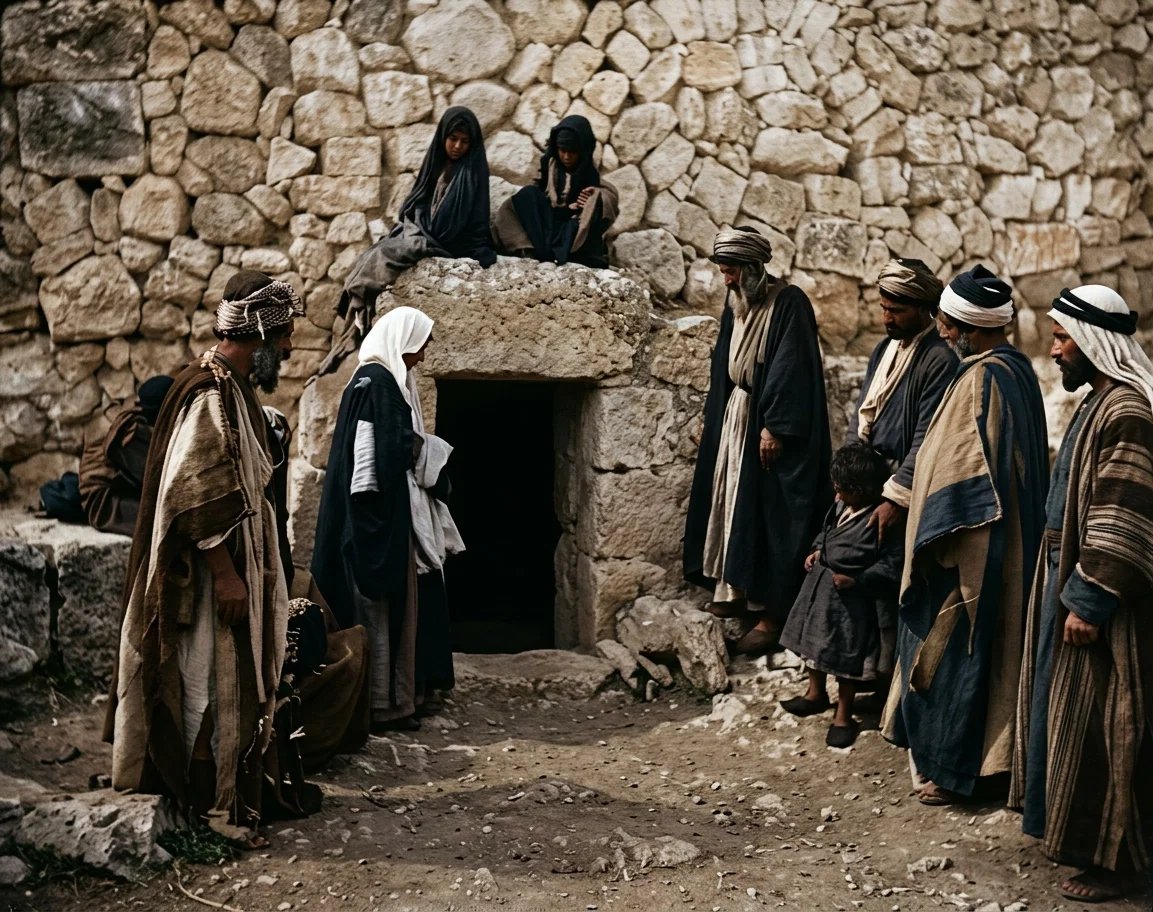
THE tombs of our loved ones speak to us in no consoling voice. They are places of sadness, mourning, and weeping. To many of earth the grave closes over their brightest hopes and fondest aspirations. In it is locked to them forever an only child, a noble son, a talented daughter, and the light of their home has been put out.
THE TOMB OF LAZARUS.
It is to such ones that Satan comes with the old Edenic lie, “Ye shall not surely die;” your loved one is not dead; he has entered on a higher sphere. But this does not comfort the mourner. Death seems just what God’s Word calls him, an “enemy.” He struck elasticity from the step, strength from the arm, brilliance from the eye, the roses from the cheek, and finally crushed out the life of our loved one, and locked him forever from us in the tomb.
TO SUCH comes the old question asked by the Idumean emir so many thousand years ago, doubtless old to him also, “If a man die, shall he live again?” Job 14:14. Will the grave give up its dead? Will we again clasp the hands of those who sleep? Will we again look into the eyes of those we love? Science says, “No.” Unbelief says, “No.” God’s Word alone gives us answer. Jesus Christ is “the resurrection and the life.”
DEATH came in consequence of sin; it is sin’s finished fruit. Only by conquering and removing the cause can the effect be banished. Jesus Christ removed the cause. He came into the stronghold of sin, the human flesh; He there fought the conflict against all the powers of spiritual darkness; “was in all points tempted like as we are,” and conquered gloriously. He died for us, the sinners; but He Himself was righteous. He had won the battle thru faith, and the grave could not hold Him. Acts 2:24. He came as the Son of man, bearing all the weaknesses of humanity. He conquered, and demonstrated Himself in character to be the Son of God. Rom. 1:4. He bestows that same character of righteousness upon all who will receive Him. “As many as received Him, to them gave He the right to become children of God, even to them that believe on His name; which were born, not of blood, nor of the will of the flesh, nor of the will of man, but of God.” John 1:12, 13, R.V.
TO SUCH sorrowing ones the grave has lost its terrors; its power has been triumphantly overthrown. This overthrow was manifest in the resurrection of Jesus; but it was accomplished in His own triumphant victory over all sin in His perfect life in the flesh. It was wrought out in the wilderness of temptation, in the “prayers and supplications with strong crying and tears,” in “the things which He suffered” on the mountain heights alone, or in Gethsemane’s Garden. There Jesus, the sinless One, conquered sin, and vindicated His right to the name of the Son of God. Rom. 1:4.
A MANIFESTATION of this same power was seen at the grave of Lazarus, the friend of Jesus, at whose home the Master found a sweet, refreshing resting-place. Lazarus lived at Bethany, about two miles east of Jerusalem, with his sisters, Martha and Mary. The village is now called by his name, el-Aziriyah.
THE story is found in John 11. It is this in brief: Toward the close of Christ’s ministry, Lazarus was taken sick. The sisters sent to Jesus a messenger bearing the news, “Lord, he whom Thou lovest is sick. . . . When Jesus heard that, He said, This sickness is not unto death, but for the glory of God, that the Son of God might be glorified thereby. . . . When He had heard therefore that he was sick, He abode two days still in the same place where He was. . . . After that He saith unto them, Our friend Lazarus sleepeth; but I go, that I may awake him out of sleep. Then said His disciples, Lord, if he sleep, he shall do well. . . . Then said Jesus unto them plainly, Lazarus is dead. And I am glad for your sake; that I was not there, to the intent ye may believe; nevertheless let us go unto him.”
SHORTLY after the messenger was despatched, Lazarus died; and when Jesus arrived in the little village, he had been dead four days. The beautiful narrative tells us of the weeping sisters, the comforting friends, and the arrival of Jesus. When Martha met Him she (and Mary also) said to Christ, what doubtless they had often said to each other, “Lord, if Thou hadst been here, my brother had not died.” And then she continued, hope awaking in His bodily presence: “But I know that even now, whatsoever Thou wilt ask of God, God will give it Thee. Jesus saith unto her, Thy brother shall rise again. Martha saith unto Him, I know that he shall rise again in the resurrection at the last day. Jesus said unto her, I am the resurrection and the life; he that believeth in Me, tho he were dead, yet shall he live; and whosoever liveth and believeth in Me [at the last day] shall never die. Believest thou this? She saith unto Him, Yea, Lord, I believe that Thou art the Christ, the Son of God, which should come into the world.”
THE sisters, who had sat under the direct teaching of Jesus, while they did not grasp His omnipresent power, knew that death was not His presence, but rather that His presence meant life. Had He been there, He could have healed the sick, but now it is too late. So Mary feels. So some of the sympathizing friends felt. So thousands feel to-day. “If Jesus were here, we would go to Him.” But as He was when bodily present, so is He when spiritually present to the child of faith.
THEY bring the “Man of Sorrows” to the tomb. “Jesus wept.” Some said, “Behold, how He loved him.” But it was not because of sorrow for Lazarus that Jesus wept. He knew that in a few minutes God would speak power to the lifeless clay; even as He had spoken power to Him in His own life. “Jesus wept” because He saw in the death of Lazarus and the weeping sisters the deaths of the future, and the mourning multitudes beside closed graves. His sorrow was over the desolation, and sadness, and destruction, and misery sin had accomplished and would accomplish before all men would have the privilege of learning the better way, and sin would be destroyed.
“Jesus therefore, again groaning in Himself, cometh to the grave. It was a cave, and a stone lay upon it. Jesus said, Take ye away the stone. Martha, the sister of him that was dead, saith unto Him, Lord, by this time he stinketh; for he hath been dead four days. Jesus saith unto her, Said I not unto thee, that, if thou wouldst believe, thou shouldst see the glory of God? Then they took away the stone from the place where the dead was laid. And Jesus lifted up His eyes, and said, Father, I thank Thee that Thou hast heard Me. And I knew that Thou hearest Me always; but because of the people which stand by I said it, that they may believe that Thou hast sent Me. And when He thus had spoken, He cried with a loud voice, Lazarus, come forth. And he that was dead came forth, bound hand and foot with grave-clothes; and his face was bound about with a napkin. Jesus saith unto them, Loose him and let him go.”
THESE are the lessons taught us in this wonderful miracle: (1) That Jesus wishes to perform this miracle in the life of every sinner, in raising him from a death in trespasses and sins to a new life in Christ Jesus; for the power of God in the resurrection is power over sin; and that power must first be manifest in the life and character. Of every bound sinner who believes, He says, “Loose him and let him go.” (2) It brings comfort to all Christian sorrowing souls who have laid in the dark, cold grave their loved of earth. Faith hears triumphant over the closed tomb, “I am the Resurrection and the Life.” The dead shall rise again. Christ has conquered. In Him all may conquer. “This is the victory that overcometh the world, even our faith.”

OUR LORD'S POSITION AS HIGH PRIEST.

IN His preparation for the high-priesthood, the Lord Jesus took on Himself the form of man, so that He might truly be a servant of men in behalf of their eternal salvation from sin. To do this He laid off entirely the nature of angels, and took on the condition of the seed of Abraham (Heb. 2:16), so that with that seed He might descend to the depths of human suffering, even the agonies of death in its most cruel form. But this submissiveness to the results of sin was not always to last; for the very self-abnegation exercised in behalf of a ruined race brought to Jesus the highest exaltation, and a name which is above every other name. Phil. 2:7-9.
This exaltation was an elevation to the Father's right hand, as joint-occupant of the throne of the universe. Col. 3:1; Rev. 3:21. Tho holding the title of High Priest, the additional name of God was bestowed upon Him, which was even higher than the name Michael,—“who is like God.” In His hand was placed a kingly scepter,—that of righteousness,—to be held out toward every debased and down-trodden soul who would be His follower. Heb. 1:8, 9. Thus equipped as a kingly priest, our Lord was fitted to hold a continued “counsel of peace” with the Father concerning lost souls, and thru their recovery constitute them the “temple of God.” 1 Cor. 3:16. As these are fitted, one by one, each into his place as a stone in the immortal structure, the temple of the Lord is being built for its eternal occupancy. Zech. 6:12, 13.
Such a position must necessarily be held by our High Priest until the temple of God has been completed, and those who refuse to become factors in its building have been put under the feet of Him whom they scorn to serve. 1 Cor. 15:24-27; Luke. 19:27. This is the logical effect of wielding the scepter of righteousness. When this is held out to the repentant sinner, tho he knows that he deserves only death for his rebellion against the rule of Heaven, he sees in it the signal of peace. Coming under its mild sway, and constantly beholding the gentleness of Him who wields it, rebellion and iniquity give place in the heart to the divine image of Jehovah. 2 Cor. 3:18. But he who refuses to let this reformation take place, must know that he remains unfitted to become a part of the uprising temple made without hands, and so he can not hope to continue in life with it.
This relation of the hopefully repentant soul to our great High Priest, makes it plain that He is the one directing head of all His earthly adherents, called the church. Eph. 1:22, 23. The only course, therefore, for loyal ones is to “follow where He leads.” To do this, one must renounce all allegiance to earthly leanings, and “seek those things which are above, where Christ sitteth on the right hand of God.” Col. 3:1. In other words, he must be dead to the charms of the world, while his “life is hid with Christ in God.” Verse 3. This is the only possible way to enjoy being raised up to sit together in heavenly places in Christ Jesus. Eph. 2:4-6.
The reason for this is evident. Whosoever loves the world can not love God, because all that is of the world,—the lust of the flesh and eyes, and the pride of life,—are not of God, but opposed to Him. To love these is to adhere to ephemeral things which must soon pass away with the world itself. 1 John 2:16, 17. Having loved them to the end, one becomes like them, and so meets with the same end as they do. But to separate from them entirely, gives one a claim upon the protection of Him who is infinitely merciful and long-suffering. James 4:1-10.
The truth is that the very life which is the basis of all our actions is a gift from God. It was given to man in the beginning to complete the image of God in him. Gen. 1:26; 2:7. It was using that life which belongs to God in the service of heaven's arch-enemy which first brought alienation between God and man. Instead of letting that life perform deeds which would glorify its Owner, it wasused to dishonor Him. The life of God given to our first parents represented His power in humanity, and so their act of disobedience was really using the power of God to bring reproach upon His name. It is the same now; whoever uses God's entrusted life with which to do iniquity, forces Him to serve with the sins of their lustful hearts. Isa. 43:24.
Man having defiled and weakened the very life of God confided to his care, God arranged a plan by which that life may be renewed by a second birth thru the everlasting Fatherhood conferred upon His only-begotten Son. Isa. 9:6. This was so that man might recover from the weakness brought upon him by entertaining sin in the heart, and thus be able to overcome the world, so strongly opposed to God. 1 John 5:4. Therefore to return to God, and to rest confidingly in Him, is salvation. Isa. 30:15. Closing thus with the offer of God thru Christ, nothing can separate one from His love and power. He may have tribulation, distress, persecution, famine, nakedness, and even death, yet these can not shut him away from the rescuing power of infinite love. Rom. 8:35-37. Tho one goes into the embrace of the tomb, He will there be found, and death will surely be swallowed up in victory, so that in all things and at all times one may confidently say, “Thanks be to God, which giveth us the victory thru our Lord Jesus Christ.” 1 Cor. 15:54-57.
J. O. CORLISS.

“THERE WAS NO KING IN ISRAEL.”

GOD'S promise to Israel was: “Ye have seen what I did unto the Egyptians, and how I bare you on eagles’ wings, and brought you unto Myself. Now therefore, if ye will obey My voice indeed, and keep My covenant, then ye shall be a peculiar treasure unto Me above all people; for all the earth is Mine. And ye shall be unto Me a kingdom of priests, and an holy nation.” Ex. 19:4-6. This promise was more than fulfilled to Israel, for tho the people never kept their part of the agreement, the Lord wrought most marvelously for them. When sent for in haste by Balak, king of Moab, to curse Israel, Balaam, the mercenary prophet, while desirous of securing the reward offered by Balak, said in the presence of all the royal princes:—
“Balak the king of Moab hath brought me from Aram, out of the mountains of the east, saying, Come, curse me Jacob, and come, defy Israel. How shall I curse, whom God hath not cursed? or how shall I defy, whom the Lord hath not defied? For from the top of the rocks I see him, and from the hills I behold him; lo, the people shall dwell alone, and shall not be reckoned among the nations. Who can count the dust of Jacob, and the number of the fourth part of Israel? Let me die the death of the righteous, and let my last end be like his!” Num. 23:7-10.
This was not what Balak wanted, and he took the prophet to another place, that from a different standpoint he might view the camp of Israel, and might, peradventure, curse God’s chosen people instead of blessing them. But again was the king of Moab disappointed; for Balaam took up his parable and said:—
“God is not a man, that He should lie; neither the son of man, that He should repent; hath he said, and shall he not do it? or hath he spoken, and shall He not make it good? Behold, I have received commandment to bless; and He hath blessed; and I can not reverse it. He hath not beheld iniquity in Jacob, neither hath He seen perverseness in Israel; the Lord his God is with him, and the shout of a king is among them. God brought them out of Egypt; He hath as it were the strength of an unicorn. Surely there is no enchantment against Jacob, neither is there any divination against Israel; according to this time it shall be said of Jacob and of Israel, What hath God wrought!” Verses 19-23.
And again, looking upon the camp of Israel from still another view-point, and still speaking under inspiration of God, Balaam said:—
“How goodly are thy tents, O Jacob, and thy tabernacles, O Israel! As the valleys are they spread forth, as gardens by the river’s side, as the trees of lign aloes which the Lord hath planted, and as cedar trees beside the waters.” Num. 24:5, 6.
All this was spoken and was true of God’s chosen people when “there was no king in Israel,” but “the shout of a king” was “among them,” “the Lord of hosts is His name.”
Not that the nation was perfect, nor that its history was an unbroken record of prosperity. The children of Israel were only human. In their veins flowed the blood of Reuben, of Simeon, and of Levi, as well as that of Judah, of Joseph, and of Benjamin. Moreover, Israel was at this time less than one generation removed from Egyptian bondage with all its degrading influences and memories. But under divine leadership a race of slaves had become a self-governing people.
Again, Israel should be judged not from the standpoint of the present, but in contrast with other people at that time. Viewed in this light, Israel is seen to be inestimably superior to all other peoples of that age. Nor was this because better blood flowed in their veins. It was because they had better laws and better government. “Behold,” said Moses, “I have taught you statutes and judgments, even as the Lord my God commanded me, that ye should do so in the land whither ye go to possess it. Keep therefore and do them; for this is your wisdom and your understanding in the sight of the nations, which shall hear all these statutes, and say, Surely this great nation is a wise and understanding people. For what nation is there so great, who hath God so nigh unto them, as the Lord our God is in all things that we call upon Him for? And what nation is there so great, that hath statutes and judgments so righteous as all this law, which I set before you this day?” Deut. 4:5-8.
God’s Word is a living Word. Where it truly dwells, there God is. There was no visible king in Israel—no mortal man who assumed the right to rule over his fellows; but “the shout of a king [was] among them;” for “the Angel of His presence saved them” in Canaan even as He did at the Red Sea and in the wilderness. Tho many times they sinned against Him, His judgments did not destroy but only corrected them; and when they turned again, He forgave their iniquity and delivered them from their enemies. “In His love and in His pity He redeemed them.” “He regarded their affliction, when He heard their cry; and He remembered for them His covenant, and repented according to the multitude of His mercies.” Isa. 63:9; Ps. 106:44, 45.
It was because Israel was His peculiar treasure that God was unwilling that His people should pattern after the tribes of Canaan. It was for this reason that Israel was not to be “reckoned among the nations” in the sense of being a part of the world’s political system, not in the sense of not being great and powerful.
Tho so far as the world could see, “there was no king in Israel”—none whom the world called a king—every true-hearted Israelite felt the invisible presence of their divine Leader, and “the shout of a King [was] among them;” for God Himself was their King; for He dwelleth not only “in the high and holy place,” but “with him also that is of a contrite and humble spirit, to revive the spirit of the humble, and to revive the heart of the contrite ones.” Isa. 57:15. “Happy is that people that is in such a case; yea, happy is that people whose God is the Lord.” C. P. BOLLMAN.

The Days of Noah.

As the days of Noah were, so shall also the coming of the Son of man be. For as in the days that were before the flood they were eating and drinking, marrying and giving in marriage, until the day that Noah entered into the ark, and knew not until the flood came, and took them all away; so shall also the coming of the Son of man be.”
Instead of showing gratitude to God for His blessings, the antediluvians used His blessings as a means of separation from Him. They did not seek to honor and glorify their Creator. The gold and silver which He entrusted to them they used for self-gratification. Violence filled the land. Appetite and passion bore sway. Men spent their time in dissipation and amusement and in enriching themselves. The earth was polluted under the inhabitants thereof, and God said, “The end of all flesh is come before Me; for the earth is filled with violence thru them; and, behold, I will destroy them with the earth.” He declared that by a flood He would cleanse the earth from its pollution.
To Noah was given the work of warning the people of the coming flood. For one hundred and twenty years the faithful preacher of righteousness sounded the warning. In obedience to God’s command he built an ark, that in the day of destruction those who believed his message might find a refuge. By his works as well as by his words, he warned the world. Every blow struck on the ark was a note of warning.
At that time the world showed scarcely the first signs of decay. Everything in nature was beautiful and lovely. The lofty trees, the towering mountains, the signs that God had hung in the heavens, appeared so great and grand to the people that they refused to believe that the earth was to be destroyed.
The antediluvians had abundant opportunity to learn in regard to the flood, but they would not learn. The warning was given; but they closed their eyes that they should not see, and their ears that they should not hear, the evidence of coming doom. Deception, violence, pride, and iniquity prevailed. The people went on asbefore, eating and drinking, marrying and giving in marriage. These things are not in themselves unlawful, but they were carried to excess. The minds of the people were so engrossed by them that they forgot their God.
Does not a similar state of things exist to-day? Are not our daily papers filled with records of crime, murder, and iniquity of every kind? Do they not testify that as it was in the days of Noah, so it is to-day?
The antediluvians were warned, but the record states that they knew not until the flood came and took them all away. “We can not believe your message,” they said to Noah. “Everything about us is so firm, so enduring. Look at the beautiful earth. It knows nothing of decay, neither will it for thousands of years.”
To the people Noah’s course seemed inconsistent. Together they talked about the foolishness of building an ark on dry ground, and the unbelief of one was strengthened by the unbelief of another.
But Noah believed that God would do as He had said, and he acted in accordance with his belief. While the people laughed and mocked and jeered, he kept steadily on with his work, teaching and building. He did not stop to listen to the false reports, to contradict the slander thrown at him. To him had been committed the work of warning the world and preparing a refuge for those who would receive his word, and he allowed nothing to turn him from this work.
The time came for the Word of God to be fulfilled. Still the people went on in their own way, irrespective of the warning. Still they allowed their minds to be engrossed by the things of the world.
The ark is finished, and the people see animals coming from the forest, and of their own accord entering the ark. Soon they see that the heavens are black with birds, and the inquiry is made, “Where can they be going?” Lo, they are flying toward the ark, and two by two they pass into it. With curious interest the people watch the strange sight. They can not understand what it means. They are alarmed; but they try to find some reason for the occurrence, and soon make light of it.
Could not the people see from this that the building of the ark was the work of God? Did they not know that animals and birds would not enter the ark in perfect order and of their own accord without the guidance of a divine hand? They might have known; but for a hundred and twenty years they had been hardening their hearts. For a hundred and twenty years they had been training themselves to reject the message of truth. Now, when unmistakable evidence was given them, their hearts were so hard that they laughed it away.
Presently they saw Noah and his wife and their sons and their wives passing into the ark; and the door was closed upon them. Only eight persons entered that refuge from the storm, and for a week they waited for the rain to come. Can we imagine the trial that this waiting brought to Noah’s faith? During this time the enemy suggested doubts, while outside the people laughed at the crazy old man who with his family had shut himself in an ark. Daily the sun rose and set in a clear sky, and daily there came to Noah the temptation to doubt. But the Lord had said that the flood was coming, and Noah rested in this word.
At the end of seven days clouds began to gather. This was a new sight; for the people had never seen clouds. Previous to this time no rain had fallen; the earth had been watered by a mist. Thicker and thicker gathered the clouds, and soon rain began to fall. Still the people tried to think that this was nothing very alarming. But soon it seemed as if the windows of heaven had been opened; for the rain poured down in torrents. For a time the ground drank up the rain; but soon the water began to rise, and day by day it rose higher and higher. Each morning as the people found the rain still falling they looked at one another in despair, and each night they repeated the words, “Raining still!” Thus it was, morning and evening.
For forty days and forty nights the rain poured down. The water entered the houses and drove the people to the temples which they had erected for their idolatrous worship. But the temples were swept away. The crust of the earth was broken, and the water that had been concealed in its bowels burst forth. Large stones were thrown into the air.
Everywhere could be seen human beings fleeing in search of a refuge. The time had come when they would have been only too glad to accept an invitation to enter the ark. Filled with anguish they cried, “O for a place of safety!” Some shrieked to Noah, pleading for admission into the ark. But amid the furious blast of the tempest their voices were unheard. Some clung to the ark till they were washed away by the dashing waves. God had shut in those who believed His word, and no others could enter.
Parents with their children sought the highest branches of the trees yet standing; but no sooner had they reached this refuge than the wind flung tree and people into the foaming, seething water. Terrified animals and terrified human beings climbed the highest mountains, only to be swept together into the angry flood.
Where was now the ark and those at whom the people had jeered and mocked?—Preserved by the power of God, the immense boat was riding safely upon the waters, and Noah and his family were safe inside.
MRS. E. G. WHITE.

THE GRACE OF GOD AND ITS MISSION.

An Exposition of Titus 2:11-14.

[By Lucius Hawkins, in the Gospel Message.]
“For the grace of God that bringeth salvation to all men, hath appeared, teaching us that, denying ungodliness and worldly lusts, we should live soberly, righteously, and godly, in this present world, looking for that blessed hope, and the glorious appearing of the great God and our Saviour Jesus Christ.” Titus 2:11–13, margin.
IN the text the grace of God is personified as a messenger bringing salvation; and it is brought as a gift, and no favoritism is shown; for the gift is brought to all men. And no greater gift was ever brought to any man; it is the gift of God Himself. Altho it is a gift, costing no money, and its value above estimate, and offered to all men, yet how few there are who accept it! . . . This messenger’s coming is not looked for. He is not wanted nor welcomed, and his priceless gift of salvation is refused with contempt and scorn.
But the grace and love of God in bringing salvation have appeared, or been manifested. How?—By giving His only-begotten Son to provide the salvation; by providing it for all men; by making it free; by making it conditional on simply believing and receiving. All this is of grace.
But the grace or love of God is further manifested in the effect or influence this salvation has upon the hearts and lives of those who embrace it. It transforms men into new creatures. The old things of sin all pass away, and the new things of love appear.
The grace of God is personified as a teacher; and he comes teaching two lessons—a negative and a positive. The negative lesson is the denial of ungodliness and worldly lusts. This settles the question of sin, and settles in favor of its entire prohibition. Whoever enters this school of salvation, taught by the grace of God, will be compelled to learn as the first lesson, denial, or abandonment of all sin, and not only gross or actual sin, as defined by the term “ungodliness,” but all sinful desires and motives and purposes, as expressed in the phrase “worldly lusts.”
Nor will a scholar in this school be promoted to the next grade till his lessons have been well learned and practised. The sin question must be settled, and settled right, at the very outset of a religious career. Thousands of professed Christian lives are failures because the question of sin is not properly settled. There can be no compromise or dallying with sin. The prohibition must be absolute; the denial must be complete, even if it cuts off a right hand or foot or plucks out a right eye. No pupil can graduate in this school and receive a diploma till this primary lesson—the utter denial of every phase of sin—has been thoroly mastered.

The Positive Side.

When this has been done, then the pupil is ready to be promoted to the higher grade, where the positive lesson of living soberly, righteously, and godly will be learned. Instead of one there are really three lessons to be learned in this grade in the school of salvation.
To learn to live soberly is a lesson we have to learn for ourselves. Man possesses a three-fold nature,—spirit, soul, and body. To live soberly is to so live that the highest interests of every department of our nature are promoted. . . . No habits or practises are to be indulged in that in the least degree militate against the health and strength and purity of the body. To live soberly is ever to remember that the body is the temple of the Holy Ghost, and nothing is to be done that would in any measure grieve or offend Him, or render our bodies unfit for His dwelling-place. Of course we can not live soberly without making a clean sweep of all intoxicating drinks, and also of the filthy tobacco habit.
In the second place, to live soberly is to attend to the interests of our souls, or intellectual natures; and that does not admit of our living in ignorance.
In the third place, to live soberly is to live for the best welfare of our highest nature, and constantly to work in His light, and keep all His commandments.
The second positive lesson the grace of God teaches us is that we are to live righteously. And this has reference to all our relations to our fellow-creatures, and to all the duties and obligations growing out of these relations. To live righteously is to live right, and to live right in all these varied relations is to live according to Christ’s rule of righteousness which He enunciated in His Sermon on the Mount: “Therefore all things whatsoever ye would that men should do to you, do ye even so to them; for this is the law and the prophets;” and he might have added, the Gospel also.
This is the rule by which all our conduct, in all our relations to all our fellow-creatures, is to be measured and controlled. In our family relations this is to be the rule; and if it was, how much of selfishness and all kinds of ugliness would be driven from the home!
In our neighborhood relations this is to be the rule. And if it was, how little bickering and strife and unpleasantness there would be in the community!
In our church relations this is to be the rule. If it were, there would be no envies, or jealousies, or animosities, or heart-burnings, or divisions among God’s professed children. . . .
In all our business relations, this is to be the rule, to do to others just as we would have them do to us, were our relations exchanged. Or, as the psalmist expresses it, if we swear to our own hurt, we are not to change. The strictest integrity is to characterize all our dealings with our fellow-men.
The third positive lesson that the grace of God teaches us is that we are to live godly. This takes us into a higher sphere of living. This takes us into our relations to God, and defines the character of those relations, and the character of the duties and obligations involved in those relations.
In order to live a godly life we must be godly. Our life is the expression, or manifestation, of what we are. God’s claim upon us admits of nothing less than a godly life; and this is a holy life. God does not allow us to live below that. This is His standard, and to this we must measure up. But we can not live a holy life without a holy heart. The heart is the fountain, the life is the stream, and the stream never rises above the fountain. God’s claim upon our heart is, “Thou shalt love the Lord thy God with all thy heart, and with all thy soul, and with all thy mind, and with all thy strength.” This requirement is all-inclusive. When we give to God this measure of love, we have no love for the world, neither for the things of the world. And we can not live a godly life without this godliness of heart.
Godliness is godlikeness, and to live a godly life we are to live a godlike life, and what this life is we see in the life of Jesus when on earth; for he was God manifest in the flesh, and Peter tells what kind of life he lived: “How God anointed Jesus of Nazareth with the Holy Ghost and with power; who went about doing good, and healing all that were oppressed of the devil; for God was with Him.” Acts 10:38. Jesus is our example; and the apostle John tells us that we are to be pure even as He is pure; that we are to be righteous even as He is righteous; and that we are to walk even as He walked. And when we do this we shall live godly, and measure up to the divine requirements. And the grace of God that teaches us this lesson will give us the strength thus to live.
When and where are we to live this sober, righteous, godly life?—Right here and now, “in this present world.” Some people teach that we can not live holy lives here; that we must carry our sins with us till death. But such is not the teaching of the Scripture. This present life is the sphere for the practise of godliness.

His Coming Again.

When we are thus living righteously, soberly, godly, we are then in the right attitude to be “looking for that blessed hope and the glorious appearing of our great God and Saviour, Jesus Christ.”
This is one of the multitude of passages in the Bible where the second coming of Christ is clearly taught, and to those who are living soberly, righteously, godly, the hope of His coming is a “blessed hope;” and when He shall appear, to all such His appearing will be a “glorious appearing;” because that event will be the consummation of the dearest and cherished expectations of the godly. It was the “blessed hope” of the personal coming of the Lord that animated Paul in all his arduous labors, and strengthened him to endure his untold afflictions. We hear him saying but little, if anything, of his hope of dying and going to heaven; but we do hear him exulting in the hope of meeting Christ when He comes, of having a share in the first resurrection, and of reigning with Him when He shall set up His kingdom upon the earth.
“Who gave Himself for us, that He might redeem us from all iniquity, and purify unto Himself a peculiar people, zealous of good works.”
Here Paul sweeps back to Christ’s first advent, stating the principle that prompted Him to come to the world, and the object of His coming.
“Who gave Himself for us.” Here we have the doctrine of the atonement, and the principle on which it was made,—a gift of Himself, prompted by pure love. Christ is a gift, and all that is included in the salvation He purchased for us is a gift—all of grace.
The object of this gift of Himself to us?—It is twofold. First, to redeem us from all iniquity. This He did on the cross, and the redemption was universal: He died for all men; no member of the human family was left out. And the redemption was not only universal, including all men, but it was complete, redeeming from all iniquity.
And He not only gave Himself unto us to be our Redeemer from all iniquity, but also to purify unto Himself a peculiar people. It is one thing to be redeemed and another thing to be purified. Redemption is unconditional, and includes all men. Purification has been made possible by redemption, but is conditional, and is received and enjoyed only by those who meet the conditions of repentance and faith. The fact must also be recognized that Christ purifies us for Himself. He gave Himself to us to redeem and purify us; and having done this, we are to give ourselves back to Him in an entire, irrevocable, and eternal consecration.
And we are to become a “peculiar people.” In what sense peculiar?—Peculiar by an entire separation from the world, and to live unlike the world. There is very little distinction to-day between those who profess godliness and those who do not. But Christ intends that the people He purifies unto Himself shall be a peculiar people, unlike the world in every respect.
But the peculiar peculiarity that is to characterize this redeemed and purified people is zeal in good works. Zeal may be laudable in many other directions, but that which distinguishes the purified people belonging to Christ is zeal in good works. And when the heart is purified from all iniquity, and filled with the love of Christ, then it is a joy and delight to do good works. Christ said in His Sermon on the Mount, “Let your light so shine before men, that they may see your good works, and glorify your Father which is in heaven.” That which convinces the world of the genuineness and value of the religion of Jesus Christ is not so much the profession of the lips as a life consecrated to the uplifting and betterment of humanity. This is the test of a purified heart and life.
Continue reading: LET YOUR LIGHT SO SHINE BEFORE MEN