Your ShelfYour Projects

Signs of the Times, Vol. 38, No. 28.

Psalm 67

Signs of the Times

Jul 18, 1911

Pacific Press Publishing Association · Mountain View, California · Jul 18, 1911

God be merciful unto us, and bless us; And cause His face to shine upon us; That Thy way may be known upon earth, Thy saving health among all nations. Let the people praise Thee, O God; Let all the people praise Thee. O let the nations be glad and sing for joy: For Thou shalt judge the people righteously, And govern the nations upon earth. Let the people praise Thee, O God; Let all the people praise Thee. Then shall the earth yield her increase; And God, even our own God, shall bless us. God shall bless us; And all the ends of the earth shall fear Him.

"IF YE WILL INQUIRE, INQUIRE YE."

This Inquirer's Department is conducted for the purpose of helping those who are studying the Bible. The answers are oftentimes only suggestive. They are never to be considered infallible, only as they agree with the infallible Word. The writer who may answer them does not consider that his opinion is infallible. He will simply give the best that he has, and plead with the inquirer to search the Word. Such questions only will be answered as, to the editors, seem to minister to the good of the readers and to the mission of the paper. We can not answer repeatedly in the same volume questions upon the same scripture. The name and address must accompany question, not for publication, but as an evidence of good faith, and that answer may be made by letter if deemed advisable. No letters are answered which do not contain the name of the writer. It is well always to enclose stamp for reply.

3509 — Binding and Loosing. Matt. 16:19

What is the meaning of "Whatsoever thou shalt bind on earth shall be bound in heaven: and whatsoever thou shalt loose on earth shall be loosed in heaven"?
T. E. W.
This is not only God's commission and statement of fact as regards Peter, but the same words are also spoken to the other disciples. John 20:23: "Whose soever sins ye remit, they are remitted unto them; and whose soever sins ye retain, they are retained." See also Mark 16:15, 16, which last text is also a key to the understanding of the thing. The real power to acquit or condemn, to accept or reject, is found in the word which the message bears. Peter was an approved messenger of God; so were the other disciples; so is every true minister of Jesus Christ. That minister is responsible for the word he speaks. He will have to give an account to God of the way in which he has presented it; and as he must give an account to God of the message he bears, so must every soul who hears that message give an account to God of the message he hears. That messenger may declare with the fullest authority
that the acceptance of the Gospel means justification, forgiveness of sins, salvation. He may declare with the fullest authority that the rejection of that message means condemnation and loss of eternal life. And so by the very message he bears he becomes a binder or a looser of souls.
The same truth is expressed in the commission which God gave Jeremiah: "Behold, I have put My words in thy mouth. See, I have this day set thee over the nations and over the kingdoms, to root out, and to pull down, and to destroy, and to throw down, to build, and to plant." Jer. 1:9, 10. How did he do this? By the message which he bore, as he declares in chapter 18:7-10: "At what instant I shall speak concerning a nation, and concerning a kingdom, to pluck up, and to pull down, and to destroy it; if that nation, against whom I have pronounced, turn from their evil, I will repent of the evil that I thought to do unto them. And at what instant I shall speak concerning a nation, and concerning a kingdom, to build and to plant it; if it do evil in My sight, that it obey not My voice, then I will repent of the good, wherewith I said I would benefit them." Jeremiah established or pulled down nations, not by any power given to him as an individual, but by the message which he bore; and so God's servants, whoever they are, have power to bind or loose souls by the message which God gives them.

3511 — The Picture of the Cross

I see in your paper pictures of the cross. Is there anything in this cross that the enemy can make use of? The Catholic Church uses this as their badge.
There is nothing in the Bible prohibiting the use of any figure, any cross, or square, or circle, or rectangle, or triangle, or any other geometrical figure. The mark of apostasy does not lie in any figure of that kind. It lies in that which pertains to conduct. The cross is not used in the "Signs of the Times," nor pictured there, as a badge. It is simply shown in the way in which the Bible has given it, as an emblem of crucifixion to the world, and of the sufferings of our Lord. The Bible uses it frequently in that way. Christ died upon the cross. Paul says, "God forbid that I should glory, save in the cross of our Lord Jesus Christ, by whom the world is crucified unto me, and I unto the world." Gal. 6:14. Now the apostle did not mean by this the cross as a mere sign was of value, but he meant the death of the Lord Jesus Christ upon that cross; and the "Signs of the Times," in the pictures which it uses, means the same thing, pointing to the death of Jesus upon the cross, and the fact that we should be crucified with Him.

3507 — Faith and Works

Will you please compare and explain the seeming difference between Heb. 11:33 and James 2:14 and 21-26? R. I. F.
Our inquirer is correct, the difference is only seeming. There are no works without faith, but the faith which works is the only faith that is worth anything. What James is showing is this: that if a man has faith, he will have works. The faith will demonstrate itself in doing just what God asks us to do, and acting on God's promises. The expression in Hebrews simply refers to faith, but through faith they did things. In fact, it is a good illustration of what James means,—who through faith wrought victories, obtained promises, and did a great many things. That is, their faith worked. So with all of the characters mentioned in Hebrews 11. This is well expressed by the apostle Paul in Gal. 5:6: "For in Jesus Christ neither circumcision availeth anything, nor uncircumcision; but faith which worketh by love." Those who try to set Paul against James are certainly doing violence to both. Preeminently, the apostle to the Galatians exalts justification by faith in Christ; but in the same epistle Paul the apostle tells us that the only faith that is worth anything, that avails, is the faith which works by love. James also refers to the faith of our Lord Jesus Christ in chapter 2:1, but it is the faith which works.
The question relative to our Lord's prayer has been recently answered.

3508 — A Tithe. Deut. 14:23

Please explain Deut. 14:23, regarding the tithing of the produce. Verse 26 looks as tho you could use it for yourself for anything that one would lust after, even to strong drink. C. C.
The tithe here spoken of was a second tithe, not the first. From the second tithe the people were to use that which was necessary in their great feast offerings. See also Deut. 12:17, 18. The first tithe, the tithe that was for the Levites, was to be paid yearly. If the people were standing where they ought before God, they would not long for anything that was wrong. The term "lust" in our common version is too strong a term as we use it now. The Revised Version gives the better thought: "And thou shalt bestow the money for whatsoever thy soul desireth, for oxen, or for sheep, or for wine, or for strong drink, or for whatsoever thy soul asketh of thee; and thou shalt eat there before Jehovah thy God, and thou shalt rejoice, thou and thy household." With all these things should be taken into consideration the one principle which runs through all the Lord's instruction to His people,—that they should eat and drink to God's glory. We must not take a text of this kind as covering absolutely everything, altho it is broad in its application. We could not understand it as including unclean animals. The first part of the 14th chapter prohibits certain kinds of food. We could not for a moment believe that "whatsoever thy soul asketh of thee" would include any of these prohibited foods. So the wine and the strong drink would be that which would not intoxicate, or lead them to commit sin. The strongest kind of drinks that the children of Israel were acquainted with were remarkably mild as compared with the poison liquids that are sold at the present time.

3510 — Deut. 13:6-10 and the Sermon on the Mount

Will you please harmonize Deut. 13:6-10 with the Sermon on the Mount, or give me some suggestions which will help me, especially the 9th verse? C. C.
First, it is well to remember that Israel was a nation, a separated nation, a nation surrounded by idolatrous nations of every sort. Secondly, the head of that nation was God; it was a Theocracy. The laws of that nation came direct from Him. He who was a member of that nation and yet enticed others to serve other gods, was a traitor to God, the King, and to the people of the nation. He would be an agency for destroying souls. Consequently it was but just that he should be slain; and he who was loyal to God and loyal to the souls of his brethren, certainly would not withhold the evidence of the traitors who were among them. There is a sort of loyal disloyalty to the world at the present time that is contrary to this. It is more often manifest, perhaps, in schools than anywhere else. Here will be a class of young men, for instance. One of their number will plot things that do a great deal of damage and cause trouble. His fellows will know of it. Not one of them would do any such thing as that. They could speak a word which would prevent it; but their "class loyalty," as they would term it, would not permit them to inform upon the one who is doing the wrong. They ought to have an honor and a loyalty that are above any such association. They ought to have sufficient to say to that one, "You must not do that; and if you do do that, my honor and my relationship to this school [or whatever it might be] demand that I should inform those who are in charge of it, in order that the thing you are thinking of doing may be prevented." So every one of the children of Israel ought to have been loyal to God, so loyal to God that under His directions they would be willing to punish the one who was a traitor to His government, and who, by that treachery, would be the means of destroying souls. The Sermon on the Mount is given to individuals in the Christian dispensation, individuals who are not under a Theocracy, who have no control over the consciences of their fellows, or of their relationship to God. Bearing these principles and conditions in mind, there is no contradiction in terms or in principles.

3512 — Regarding the Bible

Would it not be well to place in tract form a history of the Bible, and how it was brought together, how written, manuscript, etc., one which we could carry in our Bible?
We would say that there was prepared at the beginning of the year a little booklet of this kind, entitled "Our Bible Band," for the Bible Band readers of the "Signs of the Times." It tells us the meaning of the word "Bible," of the word "canon," what books are canonical, the division of the Scriptures,—Old Testament and New,—Bible writers, the languages in which the Bible was first written, how compiled, etc., etc. It is not a full setting forth of these facts; that would be impossible in one small tract. There are excellent books upon this subject, costing all the way from 50 cents to $5.00. If you have an Oxford Bible containing Oxford helps, this will give you a great deal of information—more information than could be compressed in a little tract; but for a small publication we know of none any better than our Bible Band booklet, the price of which is 10 cents.

3513 — Shall Pass Away

Will you kindly advise me what is your interpretation of the following passage in Scripture? "Heaven and earth shall pass away, but My words shall not pass away." Matt. 24:35. Is the first half of this verse to be taken literally, meaning that heaven and earth shall pass away — disappear? B.
Simply this, that it is easier for heaven and earth to pass than one word of God to fail. Compare with Luke 16:17. As a matter of fact this earthly, sin-marred atmospheric heaven and the world in its present form will pass away before the presence of God. Rev. 6:14. But in the shaking and removing and consuming God's word will abide. Isa. 51:6-8. The words of Jesus are the strongest kind of affirmation that His words will not fail.

The Sign of the Son of Man

3514 — G. N. — Matt. 24: 30 — The sign of the Son of Man is in all probability the cloud of angels that will encircle Him as He comes. When He ascended, a cloud received Him. "Behold, He cometh with clouds." This mighty host of angels will for a time seem to be a cloud. Compare Acts 1:9; Luke 21:27; Rev. 1:7; Matt. 16:27; 25:31.
Schedule for Week Ending July 29, 1911

Schedule for Week Ending July 29, 1911

Schedule for Week Ending July 29, 1911 Sunday July 23 Jeremiah 31, 32 Monday " 24 " 33-35 Tuesday " 25 " 36-38 Wednesday " 26 " 39-43 Thursday " 27 " 44-47 Friday " 28 " 48, 49 Sabbath " 29 " 50, 51
This week's reading, as last, falls entirely within the book of Jeremiah. Toward the latter part of his prophecies, he reaches out to the days and times of the restoration under Christ, in which the remnant of literal Israel who were faithful then were used as the type of Israel under the new covenant. In chapter 31 he predicts the new covenant. And those who are in that new covenant are not mere formal worshipers; they have God's law written in the heart and spirit. Over and over he tells us in different figures of the coming of Christ. From chapter 46 onward the prophecies deal with the kingdoms surrounding Israel. Egypt, Philistia, Moab, Ammon, Edom, Syria, Babylon, all come before the prophet's vision, and the doom of all is pronounced. In his prophecies concerning Babylon we can read the fate of Babylon the great prophesied in the book of the Revelation; for that Babylon of Jeremiah's day was a type of the great, mystical Babylon in our day.

Coöperation of the Divine and the Human

By Mrs. E. G. White
"If any man be in Christ, he is a new creature: old things are passed away; behold, all things are become new." Nothing but divine power can regenerate the human heart and imbue souls with the love of Christ, which will ever manifest itself in love for those for whom He died. The fruit of the Spirit is love, joy, peace, long-suffering, gentleness, goodness, faith, meekness, temperance. When a man is converted to God, a new moral taste is supplied, a new motive power is given, and he loves the things that God loves; for his life is bound up, by the golden chain of the immutable promises, to the life of Jesus. Love, joy, peace, and inexpressible gratitude will pervade the soul, and the language of him who is blessed will be, "Thy gentleness hath made me great."
But those who are waiting to behold a magical change in their characters without determined effort on their part to overcome sin, will be disappointed: We have no reason to fear while looking to Jesus, no reason to doubt that He is able to save to the uttermost all that come to Him; but we may constantly fear lest our old nature will again obtain the supremacy, that the enemy shall devise some snare whereby we shall again become his captives. We are to work out our own salvation with fear and trembling, for it is God that worketh in you to will and to do of His good pleasure. With our limited powers we are to be as holy in our sphere as God is holy in His sphere. To the extent of our ability, we are to make manifest the truth and love and excellence of the divine character. As wax takes the impression of the seal, so the soul is to take the impression of the Spirit of God and retain the image of Christ.

A Daily Growth

We are to grow daily in spiritual loveliness. We shall fail often in our efforts to copy the divine pattern. We shall often have to bow down to weep at the feet of Jesus, because of our shortcomings and mistakes; but we are not to be discouraged; we are to pray more fervently, believe more fully, and try again with more steadfastness to grow into the likeness of our Lord. As we distrust our own power, we shall trust the power of our Redeemer, and render praise to Him who is the health of our countenance and our God.
Wherever there is union with Christ there is love. Whatever other fruits we may bear, if love be missing, they profit nothing. Love to God and our neighbor is the very essence of our religion. No one can love Christ and not love His children. When we are united with Christ, we have the mind of Christ. Purity and love shine forth in the character; meekness and truth control the life. The very expression of the countenance is changed. Christ abiding in the soul exerts a transforming power, and the outward aspect bears witness to the peace and joy that reign within. We drink in the love of Christ, as the branch draws nourishment from the vine. If we are grafted in Christ, if fiber by fiber we have been united with the Living Vine, we shall give evidence of the fact by bearing rich clusters of living fruit. If we are connected with the Light, we shall be channels of light, and in our words and works we shall reflect light to the world. Those who are truly Christians, are bound with the chain of love which links earth to heaven, which binds finite man to the infinite God. The light that shines in the face of Jesus Christ, shines in the hearts of His followers, to the glory of God.

By Beholding We Are Changed

And as we meditate upon the perfections of the divine Model, we shall desire to become wholly transformed, and renewed in the image of His purity. It is by faith in the Son of God that transformation takes place in the character, and the child of wrath becomes the child of God. He passes from death unto life; he becomes spiritual, and discerns spiritual things. The wisdom of God enlightens his mind, and he beholds wondrous things out of His law. As a man is converted by the truth, the work of transformation of character goes on. He has an increased measure of understanding. In becoming a man of obedience to God, he has the mind of Christ, and the will of God becomes his will.
He who places himself unreservedly under the guidance of the Spirit of God, will find that his mind expands and develops. He obtains an education in the service of God which is not one-sided and deficient, developing a one-sided character, but one which results in symmetry and completeness. Weaknesses that have been manifested in a vacillating will and powerless character, are overcome, for continual devotion and piety bring the man in such close relation to Christ that he has the mind of Christ. He is one with Christ, having soundness and strength of principle. His perception is clear, and he manifests that wisdom which comes from God. Says James, "Who is a wise man and endued with knowledge among you? let him show out of a good conversation his works with meekness of wisdom." "The wisdom that is from above is first pure, then peaceable, gentle, and easy to be entreated, full of mercy and good fruits, without partiality, and without hypocrisy. And the fruit of righteousness is sown in peace of them that make peace." This will be the wisdom manifested by him who takes the cup of salvation and calls upon the name of the Lord. This salvation, which offers pardon to the transgressor, presents to him the righteousness that will bear the scrutiny of the omniscient One, gives victory over the powerful enemy of God and man, provides eternal life and joy for its receiver, and may well be a theme of rejoicing to the humble, who hear thereof and are glad.

The Shepherd and Sheep

The beautiful parable that Christ gave of the one lost sheep, of the shepherd that left the ninety and nine to go in search of that which was lost, illustrates the work of Christ, the sinner's condition, and the rejoicing of the universe over the salvation of the soul. The shepherd did not look carelessly over the sheep, and say: "I have ninety and nine, and it will cost me too much trouble to go in search of the straying one. Let him come back, and I will open the door of the sheepfold that he may come in; but I can not go after him." No; no sooner does the sheep go astray than the countenance of the shepherd is filled with grief and anxiety. He counts and recounts the flock, and when he is certain that one sheep is lost, he slumbers not. He leaves the ninety and nine within the fold, and, however dark and tempestuous the night, however perilous and unpleasant the way, however long and tedious the service, he does not weary; he does not falter, until the lost is found. And when it is found, he lays the weary, exhausted sheep on his shoulder, and with cheerful gratitude that his search has not been in vain, he bears back the wanderer to the fold. His gratitude finds expression in the melodious songs of rejoicing, and he calls upon his friends and neighbors, saying to them, "Rejoice with me; for I have found my sheep which was lost." So when a wanderer is found by the great Shepherd of the sheep, heavenly angels respond to the Shepherd's note of joy. When the lost is found, heaven and earth unite in thanksgiving and rejoicing. "Joy shall be in heaven over one sinner that repenteth, more than over ninety and nine just persons, which need no repentance."

The Gospel in Type and Antitype

(Concluded)

VI. The Times of the Closing or Cleansing Work of the Gospel

And he said unto me, Unto two thousand and three hundred days; then shall the sanctuary be cleansed. Dan. 8:14.
We have already seen that the cleansing of the sanctuary includes the cleansing of God's people. In other words, it is the closing work of the Gospel in the earth.
Would God leave His chosen ones in the dark in regard to the time when the greatest of all events in the history of our world is about to take place? Did He leave Noah in the dark as to when the Flood was coming? Did He leave Lot unwarned when Sodom was about to be destroyed? "Surely the Lord God will do nothing, but He revealeth His secret unto His servants the prophets." Amos 3:7.
The words of our text are connected with a vision given to Daniel near the close of the seventy years of Jewish captivity in Babylon. It therefore becomes necessary for us to study the whole vision in order to get the connection.

A Prophetic Vision

Beginning with the second verse of chapter 8, four objects presented themselves to the prophet in succession: First, a ram, standing by a river, having two horns, one higher than the other. Second, a rough goat with a notable horn between his eyes. He dashed into the ram, broke his horns, and cast him to the ground. But suddenly the great horn was broken, and in its place four other horns sprang up. Third, out of one of those four horns a little horn appeared, which waxed exceeding great, and magnified itself even to the Prince of the host. Fourth, the prophet then heard two angels conversing. One asked the other, How long shall the sanctuary and the host be trodden underfoot? Then, addressing Daniel, the other angel made answer, "Unto two thousand and three hundred days; then shall the sanctuary be cleansed."

The Meaning of the Symbols

Daniel sought for the meaning. Soon he heard a voice saying, "Gabriel, make this man to understand the vision." Gabriel proceeded at once to give the explanation: "The ram which thou sawest having two horns are the kings of Media and Persia." Verse 20. "The rough goat is the king of Grecia: and the great horn that is between his eyes is the first king. Now that being broken, whereas four stood up for it, four kingdoms shall stand up out of the nation." Verses 21, 22.
The first king of Grecia was Alexander the Great, who overthrew the Medo-Persian kingdom in 331 B.C. Eight years after Alexander died in a drunken debauch, his kingdom was divided among his four leading generals. Gabriel did not give the name of the kingdom represented by the third symbol, but gave specifications by which the student of history could readily see its application.
It was to stand up in the latter time of the Grecian kingdom. That was the very time that Rome appeared. "He shall destroy wonderfully." All opposing powers were rudely overthrown by Rome. "And shall destroy the mighty and the holy people." The blood of more than fifty millions of martyrs testify that Rome (in its papal form) is here spoken of. "He shall also stand up against the Prince of Princes [Christ]." "The kings of the earth stood up, and the rulers were gathered together against the Lord, and against His Christ. For of a truth against Thy holy Child Jesus, whom Thou hast anointed, both Herod, and Pontius Pilate [Roman rulers], with the Gentiles, and the people of Israel, were gathered together." Acts 4:26, 27. No further proof is needed to show that Rome is the power in question.

The Time Period

The angel Gabriel has now explained three of the symbols and begins on the fourth: "And the vision of the evening and the morning which was told is true." Dan. 8:26. In verse 14, where the 2,300 days are spoken of, the margin reads "evening morning;" also the A.R.V. renders this verse as follows: "Unto two thousand and three hundred evenings and mornings; then shall the sanctuary be cleansed."
When God made the day in the beginning, He said, "The evening and the morning were the first day." Gen. 1:5. This, then, was a common way of referring to a day. Hence when the angel speaks of "the vision of the evening and the morning," he refers to the 2,300 days.
The 2,300 days, being in the midst of a symbolic prophecy, where short-lived beasts symbolize kingdoms, some of which continued for hundreds of years, must be symbolic also; and where symbols are used, God does not leave us to guess at their meaning. In Eze. 4:6, where the prophet himself was acting a symbolic part, the Lord said, "Thou shalt bear the iniquity of the house of Judah forty days: I have appointed thee each day for a year." Again, in Num. 14:34, Israel was to wander in the wilderness forty years, according to the number of days they had searched the land, "each day for a year." Let us then bear in mind that the 2,300 days represent 2,300 years.
Why did the angel tell Daniel that the vision of the 2,300 days "is true"? Was not all the vision true? Surely; but when these nations should arise and overthrow one another, all could see that that part of the vision was true; but not so when the 2,300 days should terminate. No human eye could behold the change in the ministration of Christ in the heavenly sanctuary. No one could view the scene as presented by Daniel when "the thrones were placed," "the judgment was set, and the books were opened;" but the angel assures us that if we are living at the close of the 2,300 days, and are among God's people, we shall be cleansed, never to sin again. Blessed assurance!
Gabriel was unable to proceed further with his explanation, for "Daniel fainted, and was sick certain days." Verse 27 says, "I was astonished at the vision, but none understood it." He could not have inferred that he did not understand about the ram, the he goat, and the little horn; for had not Gabriel fulfilled his commission thus far to make him understand the vision?
He must refer to that part which was left unexplained; namely, the 2,300 days.

The Explanation of the Time

Will Daniel rest satisfied over that portion of the vision which so astonished him? Will Gabriel be so unfaithful as to leave the most important part unexplained? If not, then we may expect a further revelation. Less than a year passes, and the record of chapter 9 opens. We find Daniel studying the books of Jeremiah for light. He discovers that Jerusalem should lie desolate for seventy years. He knows that the time has about expired, and sets his heart to seek God, by prayer and fasting, for the fulfilment of His Word. Then follows the account of his wonderful prayer. In verse 17, he asks God to cause His face to shine upon His sanctuary which is desolate. He somehow seems to connect the cleansing of the sanctuary referred to in the vision, with the desolation of Jerusalem. He must now be set right; therefore while he was praying, the angel Gabriel, the one, says Daniel, "whom I had seen in the vision at the beginning," "touched me about the time of the evening oblation," and said: "I am now come forth to give thee skill and understanding. . . . Therefore understand the matter, and consider the vision." Did Daniel say, What vision? Ah, no. There were no preliminaries. Gabriel knew the thoughts of the prophet; and beginning with the twenty-fourth verse, he explained the 2,300 days of chapter 8:14.
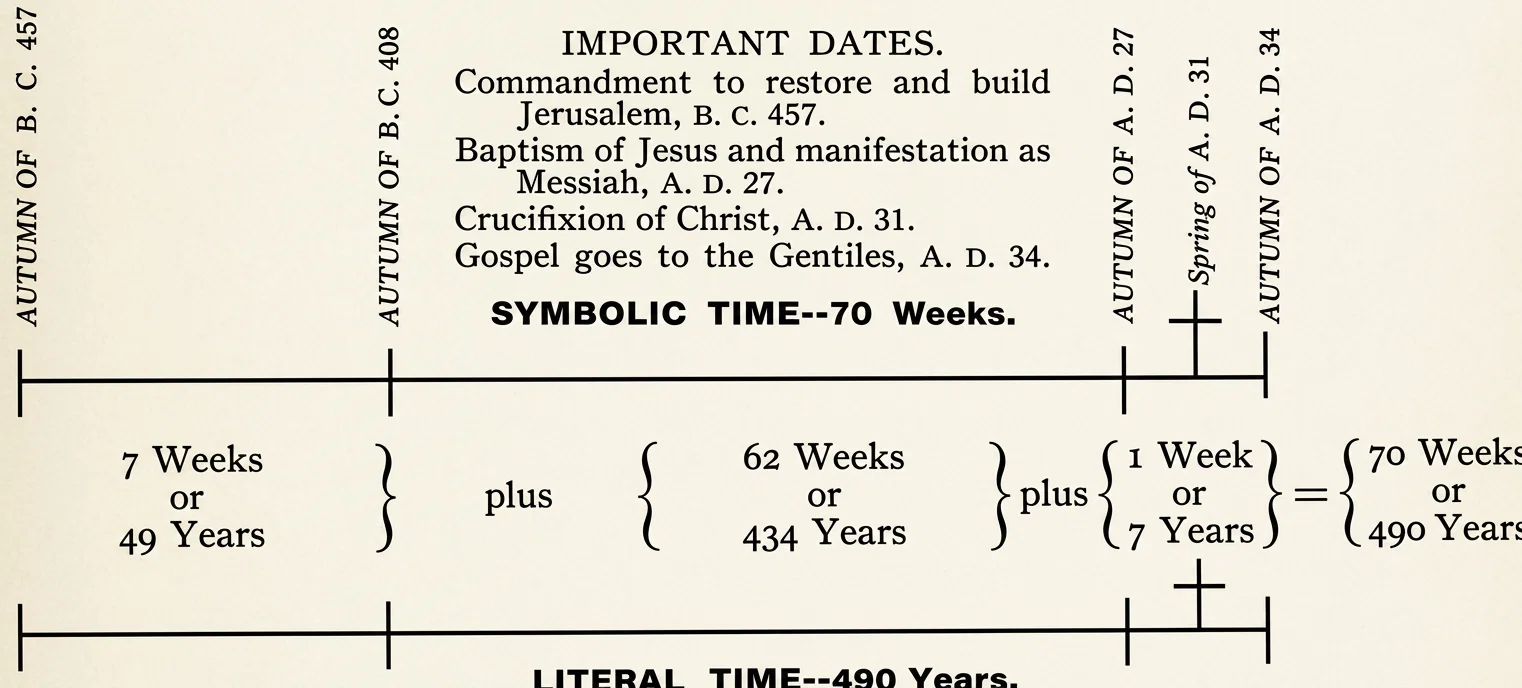
"Seventy weeks," he said, "are determined," or "cut off" (Whiting's translation, and many others), "upon thy people and upon thy holy city." If seventy weeks are cut off, they must be cut off from the first part of the 2,300 days, as no other period of time has been mentioned; hence if we can find when the seventy weeks begin, we have found when the 2,300 days begin.

The Commandment to Restore and Build

The angel proceeds at once to give the events that mark the beginning and close of that period. "Know therefore and understand, that from the going forth of the commandment to restore and to build Jerusalem unto the Messiah the Prince shall be seven weeks, and threescore and two weeks. . . . And after threescore and two weeks shall Messiah be cut off. . . . And He shall confirm the covenant with many for one week: and in the midst of the week He shall cause the sacrifice and the oblation to cease." Dan. 9:25-27.
From this testimony we learn that the going forth of the commandment to restore and build Jerusalem marks the beginning of the seventy weeks.
There were three decrees given in connection with the restoration of Jerusalem: one by Cyrus, for the rebuilding of the house of God, B.C. 536 (Ezra 1:1-4); the decree of Darius, for carrying forward the work, which had been hindered, B.C. 519 (Ezra 6:6-12); and the decree of Artaxerxes to Ezra, B.C. 457 (Ezra 7).
That it required the three decrees to constitute the commandment to restore and build Jerusalem, is evident from the words found in Ezra 6:14, "And they builded, and finished it, . . . according to the commandment [singular number] of Cyrus, and Darius, and Artaxerxes." The decree, then, was not complete until the last one had been issued. This was in the year 457 B.C., and is the time from which the seventy weeks should be reckoned. Ezra 7:12, 13, margin. Christ was anointed with the Holy Spirit (Acts 10:38 and Luke 4:18) at His baptism, which occurred in the autumn of A.D. 27. Mark 1:10, margin; Luke 3:21-23, margin.
Sixty-nine weeks, 483 years, must span the time between the going forth of the commandment and the baptism of Christ. We find that Ezra, with the children of Israel, reached Jerusalem the fifth month of 457 B.C. As part of the decree applied to the treasurers living in the vicinity of Jerusalem (Ezra 7:21, 22), and as no law or decree can go into effect until all the parties concerned are notified, and these treasurers were not informed of the decree until after Ezra reached there, therefore the decree could not be said to go forth until the fifth month. And as the Jewish year began in March or April, the fifth month would bring the going forth of the decree as late as September or October; thus more than half of the year 457 had passed, which would leave only 456½ years before A.D. 1. Christ was baptized soon after the middle of the year A.D. 27; thus only 26½ years had passed before that event. 456½ years before Christ, added to 26½ after Christ, equals 483 years, or 69 prophetic weeks, which exactly fulfils the prophecy.

The Closing Week

Of the seventy weeks, one is still left, in the midst of which Messiah was to be cut off. Christ attended four Passovers, as recorded in John 2:13; 5:1; 6:4; and 13:1. At the last of these He was crucified. This makes the duration of His ministry three years and a half, bringing us to the year 31 A.D., which was the middle of the seventeenth week. He caused the Jewish sacrifices to cease by the offering up of Himself as the great antitype of them all.
He was to confirm the new covenant with the Jews for one week, which he did personally the first half of the week, and through His disciples the remaining half. Heb. 2:3. Thus end the seventy weeks. This brings us to A.D. 34. At this time Stephen was put to death; and through the great persecution that arose, the church was scattered abroad, and went everywhere preaching the Word. Acts 8:1-5. See date in the margin, A.D. 34. Soon after, Paul, the great apostle to the Gentiles, was converted; and we hear him saying to the Jews, "It was necessary that the Word of God should first have been spoken to you: but seeing ye put it from you, and judge yourselves unworthy of everlasting life, lo, we turn to the Gentiles." Acts 13:46.
Having now reached the termination of the seventy weeks, or 490 years, 1,810 years remain. (2,300 less 490 equals 1,810.) In other words, when we reach A.D. 34, we have 1,810 years left of the 2,300, which added to 34 A.D. brings us to the autumn of 1844.

The Great Day of Atonement

As in the type the tenth day of the seventh month was called the Day of Atonement, when the earthly sanctuary was cleansed, must we not believe that on that very day, October 22, 1844 (the tenth day of the seventh month, Jewish reckoning), our great High Priest went into the most holy place of the heavenly sanctuary and began the work of judgment? Paul says that God "hath appointed a day, in the which He will judge the world." Acts 17:31. Beloved, that appointment was reached in 1844.
While the sanctuary is cleansed in heaven, there must be a corresponding work going on among God's people on earth.
A few years prior to 1844, a movement such as the world had never before witnessed took place. A warning message, based upon Rev. 14:6, 7, and many similar scriptures, was proclaimed with mighty power.
Voices everywhere were heard saying, "Fear God, and give glory to Him; for the hour of His judgment is come."
The message went to every missionary station on the globe. Treasure was poured out like water in its promulgation. Revivals followed its proclamation. God was in the movement; and Christendom was shaken from center to circumference.
It is true that a mistake was made by those giving the message, in that they thought that the earth was the sanctuary, and that its cleansing must take place by fire at the coming of Christ, and hence looked for that event in connection with the judgment; but the prophet Malachi had foreseen this, and said: "The Lord, whom ye seek, shall suddenly come to His temple. . . . And He shall sit as a refiner and purifier of silver; and He shall purify the sons of Levi, and purge them as gold and silver. . . . And I will come near to you in judgment." Mal. 3:1-6. This shows the nature of that coming, that it is to "purify" His people from sin.
Before sin can be put away, it must be discovered. And there is no sin detector other than the law of God; for, says Paul, "I had not known sin, but by the law." Rom. 7:7. God’s law is to be the standard in the judgment. James 2:12. For this reason, when the temple of God was opened in heaven, there was seen the ark of His testament. Rev. 11:19. The ark contains the law of God. How was it seen? Through faith, by the church on earth. What further evidence can be shown that this has been fulfilled? We answer, The great movement in behalf of the law of God and the true Sabbath, now going forward all over our world. Many people have received the light on the sanctuary. They see the temple opened in heaven. They behold there the ark, and our Lord making His last offering on the mercy-seat. They see that the requirements of the law are neither relaxed nor altered. And they are going forth to vindicate its claims, and lead others to make such a preparation as will be necessary to enable them to stand with that people of whom the Lord says in His closing message to this world, "Here is the patience of the saints: here are they that keep the commandments of God, and the faith of Jesus." Rev. 14:9-12.
Every soul has now a case pending in the court of heaven. Dear reader, have you secured your Advocate?
Continue reading: XXXIV. The Vision of Chapter XVII