Your ShelfYour Projects

Signs of the Times, Vol. 30, No. 8.

BABYLON IS FALLEN

Signs of the Times

Feb 24, 1904

Pacific Press Publishing Company · Oakland, California · Feb 24, 1904

"BABYLON IS FALLEN."
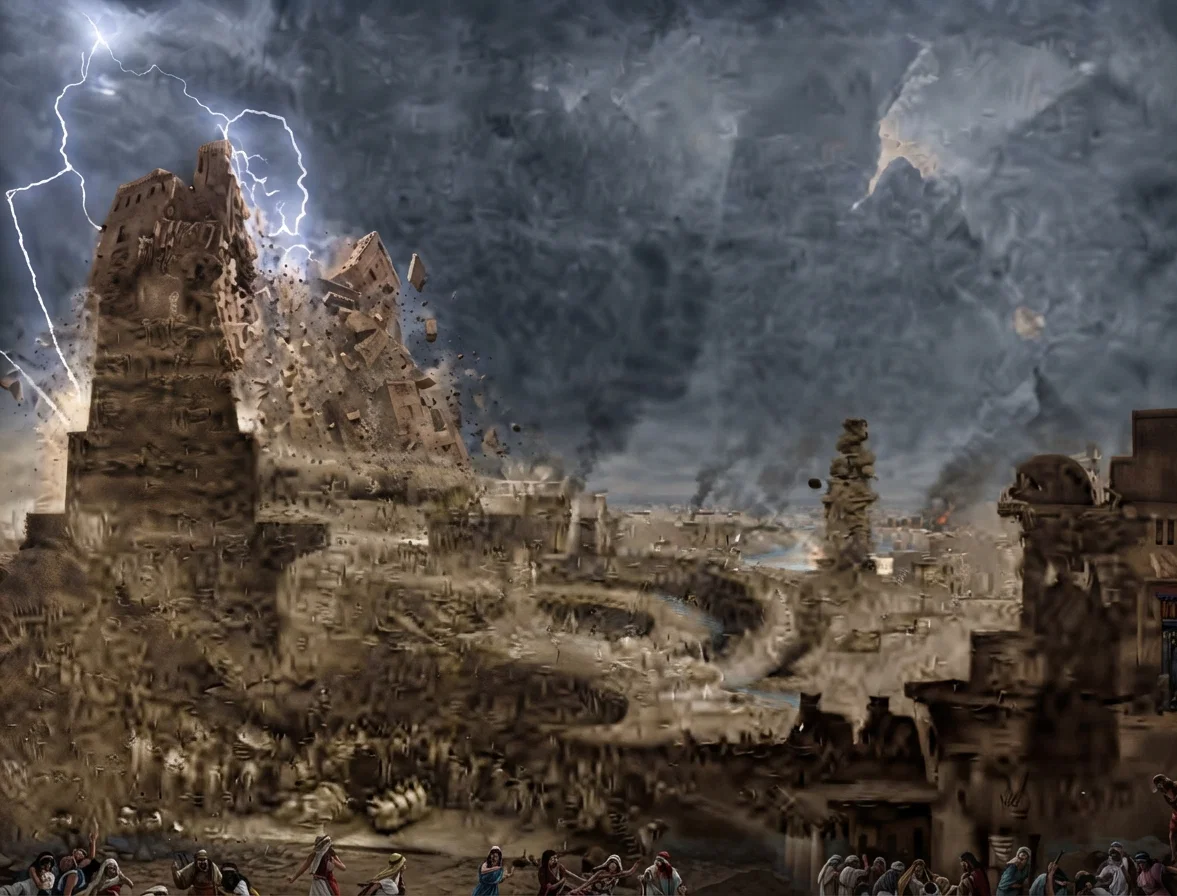
THE fall of the tower of Babel, so graphically and vividly portrayed in our illustration, was a prediction in object-lesson of the fall of the city and empire of Babylon, builded centuries later by Nabopolassar and his greater and more renowned son, Nebuchadnezzar. The doom of the one forefigured the doom of the other.
THE fall of Babylon the great before the conqueror Cyrus is an object-lesson in prophecy of the fate that shall befall mystical Babylon of the age in which we live. The fall of the second Babylon was as much greater than the first as the city exceeded the tower. The ruin of mystical Babylon will be as much greater than the fall of ancient Babylon by the Euphrates as the world exceeds the city and the empire. In the career of the one may be read the career of the others.
The folly and fall of Babel are lessons for the ages.
WHAT do I mean?—Just this: The building of that ancient tower, the spirit that conceived it, the mad ambition which fostered it, the purpose of its building, the principles involved, and its utter overthrow, are types of human ambition and folly from that day to this.
GOD is one, the Creator of the heavens and the earth. There is one only Saviour, Christ Jesus the Lord. There is one moral standard, the holy law of God, proclaimed by His own voice amid the burning glories of Sinai, and manifested in still greater glory in the teaching, the life, the character of Jesus Christ. There is only the one life that saves; not that which comes by generation, but by regeneration, given by the mighty Spirit of God through His Word. Such has always been God's standard of conduct, God's means of salvation. Such was the case when God created man, gave him the earth for his home, and told him to multiply, scatter abroad, and make the whole earth like the Garden of the Lord. Such was God's standard of conduct and means of salvation when, after the Flood, God gave the same command. But man's rebellion brought Babylon; and this is the record of the response of unbelief:—
The Fall of Babel.
The Fall of Babel.
"And they said one to another, Come, let us make brick, and burn them thoroughly. And they had brick for stone, and bitumen had they for mortar. And they said, Come, let us build us a city, and a tower, whose top may reach unto heaven, and let us make us a name; lest we be scattered abroad upon the face of the whole earth." Gen. 11:3, 4.
AND so they builded, and, according to their brick records, called the mighty structure they were rearing for themselves, for their own glory, Bab-il, the "Gate of God." It was their perverted plan of salvation. God, in His goodness, frustrated their efforts, broke down their tower, confounded their language, and called their effort, what all such efforts have ever proved to be, "Babel,"—confusion.
BABYLON of old stood for the same self-glorification, the same perversion of God's plans. She erected in the world a false system of government, a false system of education, which perverted the whole world, and which persists to the present time. She has made all the world drunken.
THE principle is as true now as then. God's standard is still the same. His Gospel is still "the power of God unto salvation." His Book is the guide, the standard, the creed, the ensign of His people. It is the one gathering, life-giving source of inspiration and soul-saving work in aggressive Christianity. Dowling's cry needs often to be repeated: "The Bible, I say, the Bible only, is the religion of Protestants. Nor is it of any account in the estimation of the genuine Protestant, how early a doctrine originated, if it is not found in the Bible." Tho you are a professed Christian, if, on the banner you are carrying or following, God alone is not glorified, you are bringing confusion among men. If you have, as a standard of conduct, erected a human creed which stands only for the Bible, the creed is not needed. If it varies in one essential from that Book, it is a standard of Babylon; it is exalting the human to the throne of the divine. If you have another means of salvation other than the unmerited grace in Christ Jesus our Lord, you are exalting a fraudulent saviour, and are bringing confusion to men."GATHER together" is God's call to His children, not to some country or city, but to Him, to His truth, His Word, His Gospel. He would heal His people of the wounds that have been gotten in Babylon. He would restore the primitive unity. He would sweep away the "refuge of lies," whether in human creed or scheme or plan; He would bring men again to the one God, the one Saviour, the one Gospel, the one Book, the one Life.
HE pities His people in Babylon. Many, nay, most of them, are there in ignorance. God knows it. He has saved them, and kept them, in spite of Babylon. But now He calls them. He tells them over and over again that "Babylon is fallen," and that certain destruction awaits, even tho she embrace the whole world. He calls men back from her creeds, her worship of the human. "Come forth, My people, out of her, that ye have no fellowship with her sins, and that ye receive not of her plagues: for her sins have reached even unto heaven, and God hath remembered her iniquities." See Rev. 18:1–5. But God not only calls us out of Babylon and away from her errors; He also calls us to the glorious salvation of "the everlasting Gospel." "Fear God, and give Him glory; for the hour of His judgment is come: and worship Him that made the heaven and the earth and sea and fountains of waters." Rev. 14:6, 7. Our God is worthy of all reverence and worship.

THE NARROW WAY.

BY MRS. E. G. WHITE.
CHRIST gives to all the invitation, "Follow Me." "He that followeth Me shall not walk in darkness, but shall have the light of life."
"Enter ye in at the strait gate; for wide is the gate, and broad is the way, that leadeth to destruction, and many there be which go in thereat; because strait is the gate, and narrow is the way, which leadeth unto life, and few there be that find it."
The path cast up for the ransomed of the Lord is far above all worldly schemes and practises. Those who walk in it are to show by their works the purity of their principles. They have a heaven to win, and by a well-ordered life and a godly conversation they are to show the genuineness of their profession. They are to work out their own salvation with fear and trembling, lest they shall not perfect a Christian character, striving to walk in the footsteps of Christ, keeping His life and His teaching ever before them. As they do this, God works in them to will and to do of His good pleasure.
Those who walk in the narrow way must follow the directions of the Guide-book. Thus only can they reach the gates of the city of God. They are to follow the example of Christ, working as He worked. Then at last they will hear the commendation, "Well done, thou good and faithful servant; . . . enter thou into the joy of thy Lord."

Our Gifts.

God has put men and women in possession of precious gifts. To different ones He gives different gifts. Not all have the same strength of character or the same depth of knowledge. But each one is to use his gifts in the Master’s service, however small this gift may seem to be. The faithful steward trades wisely on the goods entrusted to him.
The endowments of mind and body are to be carefully guarded. Our gifts are not to be weakened by self-indulgence. Every power is to be carefully preserved, that it may be always ready for instant use. No part of the physical organism is to be weakened by misuse. Each part, however small, has an influence on the whole. The abuse of one nerve or muscle lessens the usefulness of the whole body. Those for whom Christ has given His life should bring their habits and practises into conformity to His will.

"Freely Ye Have Received, Freely Give."

God’s Word declares, "The soul that sinneth, it shall die." But God does not desire the death of any one. When Adam’s sin had forfeited eternal life, at infinite cost God provided for the race a second probation. He "so loved the world, that He gave His only-begotten Son, that whosoever believeth in Him should not perish, but have everlasting life." Should not those to whom the light of truth for this time has come, place themselves in close connection with God, using their capabilities to advance the work of soul-saving? Should not the one who possesses an understanding of the Scriptures impart the knowledge given him to those who know not the truth? Upon every believer in present truth rests the responsibility of working for sinners. God points them to their special work,—the proclamation of the Third Angel’s Message. They are to show their appreciation of God’s great gift by consecrating themselves to the work for which Christ gave His life. They are to be stewards of the grace of God, dispensing to others the blessings bestowed on them. He who has found comfort in the Word of God is to share this comfort with others. Thus only can he continue to receive comfort.
The sincere child of God does not make light of any of His requirements. Should he do this, he would soon make for himself laws that would not be in harmony with God’s requirements. Another, having great confidence in him, would do the same, and thus God would be greatly dishonored. Infidels look at the defective lives of professing Christians, and say, "If I believed what those men and women profess to believe, I could never do the things they do."
Let us make steady advancement. Let us lay aside every weight, and the sin that so easily besets, and run with patience the race set before us. Let us hold the truth in righteousness. Then when adversity comes, we shall be able to trust in God, knowing that we have done our best. Trust in God is one of the signs that distinguish the righteous from the wicked. God never forgets His faithful children in their suffering and affliction. With confidence they may say:—
"The Lord is my Shepherd; I shall not want. He maketh me to lie down in green pastures; He leadeth me beside the still waters. He restoreth my soul; He leadeth me in the paths of righteousness for His name’s sake. Yea, tho I walk through the valley of the shadow of death, I will fear no evil; for Thou art with me; Thy rod and Thy staff they comfort me. Thou preparest a table before me in the presence of mine enemies; Thou anointest my head with oil; my cup runneth over. Surely goodness and mercy shall follow me all the days of my life; and I will dwell in the house of the Lord forever."

THE DAY OF SPECIAL BLESSING.

BY S. H. CARNAHAN.
By many superstitious persons Friday is considered an unlucky day. They are averse to beginning a new job of work or starting on a journey upon that day. Another class of people will eat no flesh meats, except fish, on Friday. It is worthy of note, too, that most people who do not hold any superstitious ideas in regard to the day have lost sight of its special significance. This occurs just as others, in reading the old myths or traditions of heathen nations regarding the peopling of the earth, the Flood, etc., have, in a measure, lost sight of the true objects of the creation, of the Deluge, and of other events.
The sixth day of the week (a portion of which is now called Friday) was the day which God designed particularly to be used in closing up our work and making preparation for the Sabbath. On this day the people were to gather and cook their food for the Sabbath, so that no boiling or baking should be done on God’s holy day. Ex. 16:22-27. And, of course, they were not to start any secular work that would have to be finished on the Sabbath.
The time was definitely fixed for the beginning and ending of the day, so that they might know when it came, even if they had no watches or clocks.
The day was reckoned from sunset to sunset, the evening and morning composing the day. Compare Lev. 23:32; Deut. 16:6; Gen. 1:5, 8, 13, 19, 23, 31.
At the time of the death of Christ those who were nearest Him and following His footsteps observed the days from sundown to sundown, and recognized the sixth day as preparation day. Matt. 27:62; Luke 23:54. They also recognized the seventh day as the Sabbath (Luke 23:56) and the first day of the week (counted from Saturday sunset until Sunday sunset) as a working day. See Mark 16:1, 2; John 20:1; Luke 24:1.
Ought not we to be as careful in the observance of the preparation day, the Sabbath, and all the days, for the purpose for which they were ordained (Ex. 20:9, 10), not using the six days in idleness, nor the seventh day in doing our own pleasure (Isa. 58:13)?
In so doing because we love God and truth, we shall be blessed here and hereafter. Isa. 56:2; 58:14; Rev. 22:14.

RESTITUTION.

BY L. D. SANTEE.
“Behold, I make all things new.” Rev. 21:5.
THERE is a promise of a future gladness, That slumbers in the bosom of the flowers, That softens all time’s weary years of sadness, And lightens all grief’s dark and bitter hours. That promise broodeth over all creation,— O’er sweet green pastures strewn with pearly dew,— That Christ shall come, and in the restoration, Clothe all with glory, and “make all things new.”
In evening sunsets, with their purple shadows, Is felt a language uttered not in speech, In solemn forests, and in grand old meadows, And where the mountains high their crests upreach; And mighty oceans, in their waters swelling, Breathe the glad prophecy, believed by few, The promise that through nature’s heart is welling,— The Saviour cometh, to “make all things new.”
Seas, with uplifted hands repeat the story, And plead the hastening of that longed-for day, Voicing her prayer, with sound of billows hoary, Come, Thou long-loved, resume Thy royal sway; Come to the earth that groans in sin and sorrow, Come with Thine angels, in the skies of blue, Come, usher in the wondrous glad to-morrow, Come, O Deliverer, and “make all things new.”

A Blessing Must Be Shared

"A BLESSING must be shared before it will be repeated."
THE BUILDERS
THE BUILDERS

THE BUILDERS

BY RODERICK S. OWEN.
THERE was a certain King, who ruled over an extensive domain. He had a Son, God noble and true, whom He had exalted (John 1:1-3) to a place of equality with Himself. In fact they reigned conjointly, sitting upon the same throne. This Satan King had an enemy who had once been a loyal subject, holding a high position in the kingdom, but who had rebelled (Isa. 14:12; Eze. 28:14, 15) against the authority of the King and had incited to rebellion a number of the King's subjects (Rev. 12:3, 9).
There was a portion of the territory of this kingdom over which the King had placed a certain one to reign as a prince. Gen. 1:26-28. This one Adam sold himself, his territory, and all his subjects to that enemy, who immediately took possession and thus brought this piece of territory into open rebellion. Luke 4:5, 6; John 14:30.
This King was greatly grieved, not at the loss of territory, for by His power He could easily recover that, but, being of a kind and loving disposition, He could not bear the thought of destroying His former subjects, who had been deceived into accepting the authority of the seducer.
Plan of Salvation A plan was proposed whereby these rebels might be forgiven and reinstated; but to insure against the possibility of a future revolt certain things were required of those to whom this new citizenship should be given.
The Gospel A proclamation was prepared and announced throughout the rebellious land to the effect that the King proposed to recover that territory and to make of it a special kingdom where His Son, noble and true, should reign most gloriously, having for His subjects (Matt. 5:5) all who would accept of pardon at His hands, and who would build a house in the rebellious land.
The subjects generally were greatly pleased at the prospect, for they had already become dissatisfied with the dominion of the usurper, who had proven to be a dreadful tyrant, and had filled the land with woe.
Many, therefore, were glad of this chance, and wished to undertake the work at once. They were then informed that each building must be a perfect one; and to insure this result the King proposed to furnish a The Bible Book of plans and specifications to be carefully followed by each one. When the Book was given, and they began to read, they soon found that the Traits of Character building was to be made entirely of gold, silver, and precious stones. This they could not furnish, as these substances were very rare in the rebellious territory, and could only be purchased at a price which it was not possible for them to pay. The Holy Spirit messenger then told them that the King expected to furnish all the material, His Son, their future King, paying the price for them.
The Book of Plans and Specifications.
With this information they were greatly pleased, and since they Self-righteousness had, as they supposed, a little of the right material on hand they began at once to lay the foundations for their houses.
The messenger then cried out, Hold! Hold! The material you are using (Isa. 64:6) is not genuine. None must be used save that furnished by the King; and besides, you are not laying your foundation aright. The Self specifications call for the removal of all sand until a certain bedrock is reached, and all foundation walls must rest throughout their length and breadth upon this Jesus rock (1 Cor. 3:11), because there is a terrible storm coming which will try every building, and in that storm (1 Cor. 3:13)

Judgment

every building not resting upon this rock, and not perfectly built, will fall, and great will be the fall of it. Matt. 7:24-27.
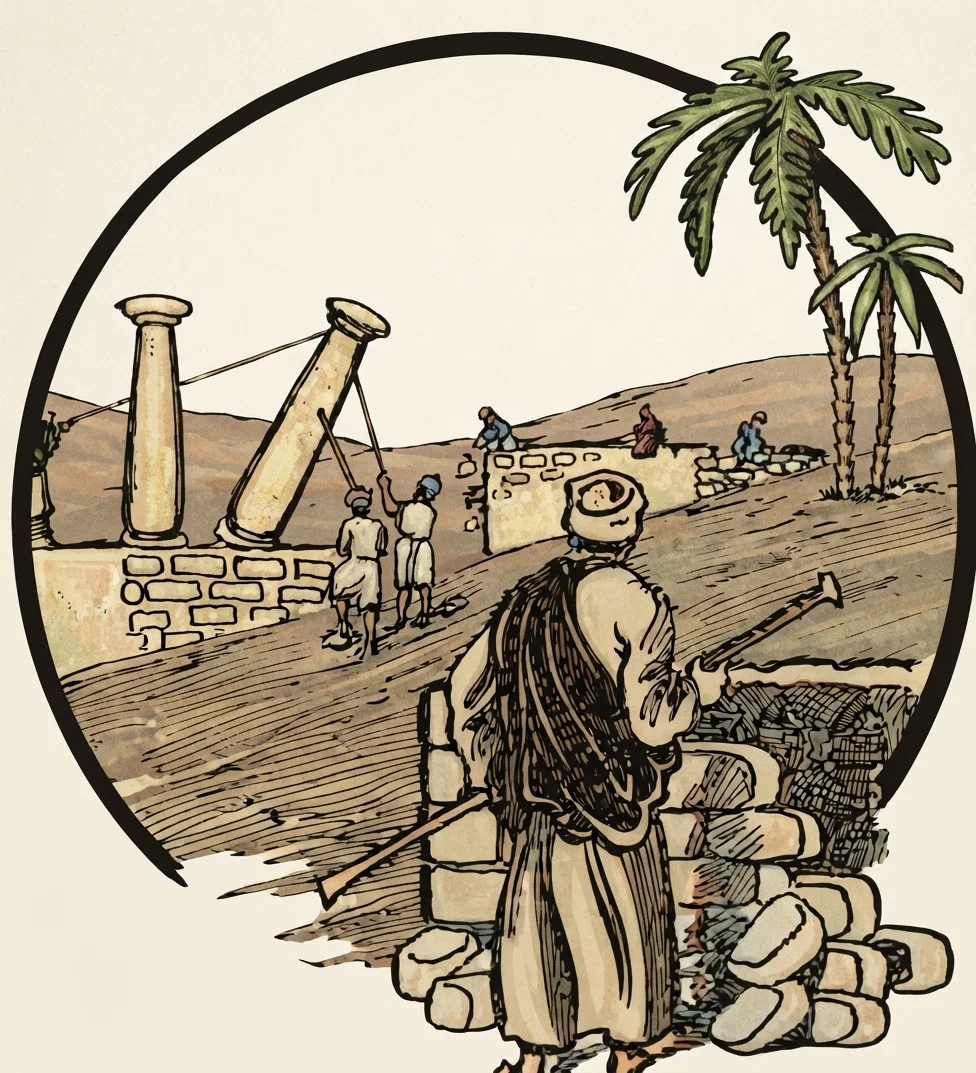
"Then began the builders, to tear down the walls"
Then began the builders, with some chagrin and disappointment, to tear down the walls already laid, and to cast aside the material, which some, however, laid away in a heap near by, thinking that it might yet be useful to them.
This done, all began to dig for the foundation stone; but this proved to be no light task, for the sand was loose and shifting, so that after digging down a few feet it began to roll in upon them. And in some cases the material of the old walls which they had torn down, but which they had left too near by, also tumbled into the trenches and had to be lifted out again and again. Some soon said, "We never can reach the rock." Others began to doubt its existence beneath such a mass of sand, while others concluded their trenches were deep enough, since no one could ever see that their foundations were not settled upon the stone; and besides they did not believe that a storm ever could come violent enough to wash away the earth to such a depth.
Variety of Architecture
As the King had supplied abundant material, these began at once to construct their walls. The work went rapidly forward. The walls arose above the surface. The sand and loose material was shoveled in and leveled up, and then all looked neat and indeed quite substantial. Others now began to think it useless to dig deeper for the true foundation, and they followed the example of their neighbors.
Thus many were led away from the Guide-book.
At length some of the faithful ones discovered the rock.
But they found it only in places, for the depth of the sand varied. There were deep cuts and holes here and there, and of course these were filled with the sand.
Their Own Plans and Specifications.
Here also was discovered more fully the nature of the sand, for, while in a general way there was a common resemblance, yet each hole and cut contained a kind peculiar to itself. For illustration, in one which was very deep were the sands of self, to wit, self-esteem, self-reliance, selfishness, etc. In another was the sand of pride; in another, of worldly ambition; in another, of the love of money, etc.
Just here is where many failed, for having found the stone in places, they did not persist in removing all the sand from these depressions. In fact there were few, very few indeed, who removed every grain of the sands of self. But some did, and when their walls began to rise they were resting throughout their entire length and breadth upon the true foundation.
Having once departed from the plans, those doing so felt free to introduce various other changes from time to time, so that soon there was seen a great variety of architecture. At length those whose ideas most nearly coincided Churches together, and in this way a number of bands were formed. It was not long before each of these associations drew up a book of plans and specifications Creeds for themselves; and while it was expected that all would follow in a general way the Book of the great King, yet each one was required to follow quite closely the book furnished by his association.
(To be continued.)

TEMPERANCE IN SPEECH.

WE talk much of freedom of speech. As in the matter of action, so in the matter of speech, too many have mistaken liberty for license, and go with tongue whetted or pen sharpened ready to thrust mercilessly everything in sight. When will men learn that there is the assault of speech, and that speech is a deadly weapon? that mental anguish is not a creature of the imagination—a something to be laughed at—but a reality, the tragedy of which can only be known by one who suffers, often in silence, the awful invective of a merciless persecutor?
St. James gives a very accurate description of the tongue turned loose in its riot of ruin: "The tongue is a fire, a world of iniquity. . . . It is set on fire of hell. . . . It is an unruly evil, full of deadly poison." Knowing the power of the tongue as an instrument of death, and having seen the awful results of the unbridled riot of speech, one can well appreciate the apostle's conclusion, "If any man offend not in word, the same is a perfect man, and able also to bridle the whole body."
Let him who aspires to any place of permanent usefulness or leadership, look well to the regulation of this member, whether it be in the matter of verbal or written utterance. Moreover, let no one delude himself by clamoring for freedom of speech who is known to riot in the license of hasty and inflammatory utterance. —Selected.
Continue reading: VIII. THE DECLINE OF SELF-GOVERNMENT IN ROME