Your ShelfYour Projects

Signs of the Times, Vol. 31, No. 30.

O, THE BLESSEDNESS!

Signs of the Times

Jul 26, 1905

Pacific Press Publishing Company · Mountain View, Cal. · Jul 26, 1905

O, THE BLESSEDNESS!

"Blessed are the poor in spirit; for their's is the kingdom of heaven. Blessed are they that mourn; for they shall be comforted. Blessed are the meek; for they shall inherit the earth. Blessed are they which do hunger and thirst after righteousness; for they shall be filled. Blessed are the merciful; for they shall obtain mercy. Blessed are the pure in heart; for they shall see God. Blessed are the peacemakers; for they shall be called the children of God. Blessed are they which are persecuted for righteousness' sake; for their's is the kingdom of heaven. Blessed are ye, when men shall revile you, and persecute you, and shall say all manner of evil against you falsely, for my sake. Rejoice, and be exceeding glad; for great is your reward in heaven; for so persecuted they the prophets which were before you. . . . Ye are the light of the world. A city that is set on a hill can not be hid. . . . Let your light so shine before men, that they may see your good works, and glorify your Father which is in heaven." Matt. 5:3-16.
"God is light, and in Him is no darkness at all." 1 John 1:5.

BOOKS ON SCIENCE

Modern Science and Modern Christianity
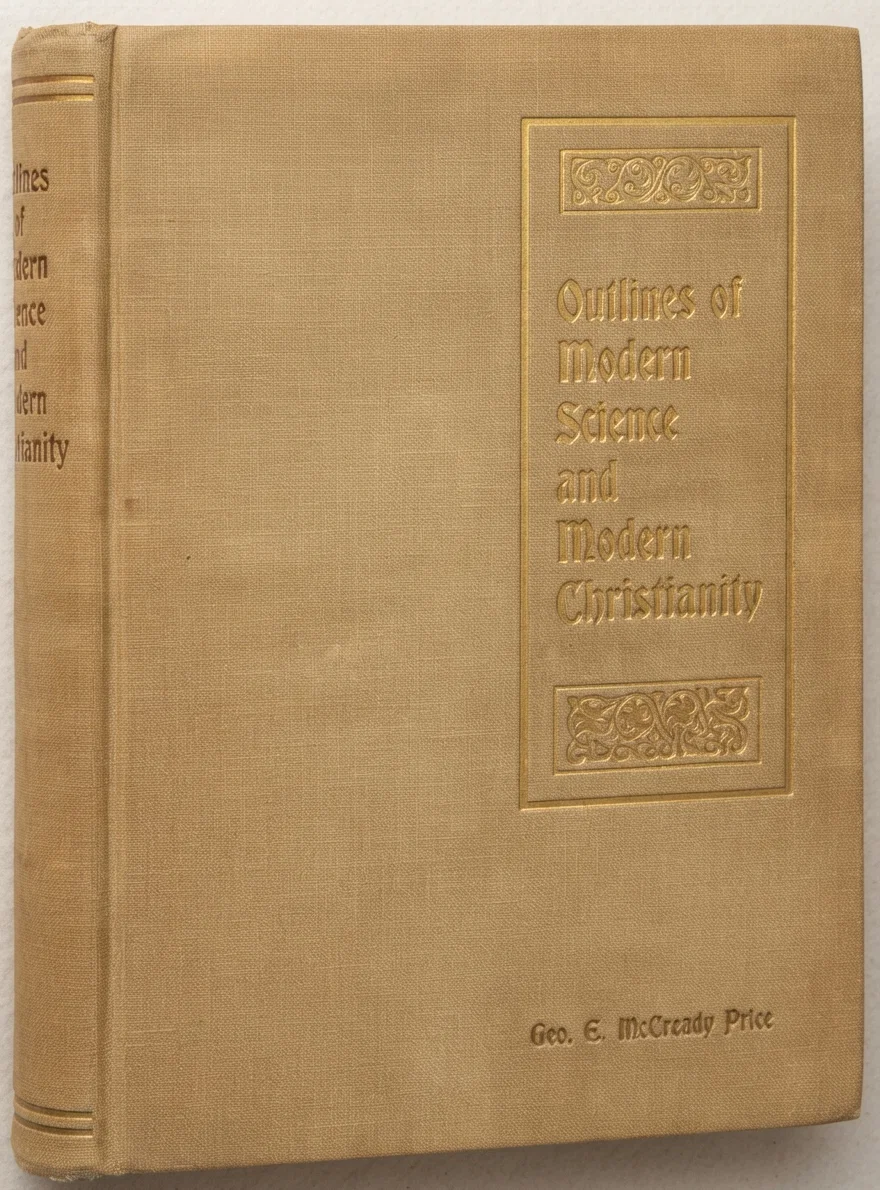
Is your foundation sure? Are you safely anchored? The flood-gates of error and deception are wide open, and the tides of evolutionary science are sweeping many away from their moorings. The reasonings of infidelic science are fast taking the place of Bible truth, especially in regard to creation, and this, too, in many of the pulpits of the land.
Our book, with the above title, by Prof. Geo. McCready Price, meets the great need of the hour by showing the absurdity of many of the deductions of worldly science, and the conflicting and ever changing opinions of scientists. On the other hand it shows the perfect agreement of the Bible and true science; and by its logical reasoning not only successfully refutes false-science theories, but is a strong appeal to stand by the old Guide-book which has stood the test of the ages.
If you are firmly established, your friend or neighbor may not be. Secure one for him.
271 pages, bound in cloth, price 75c.

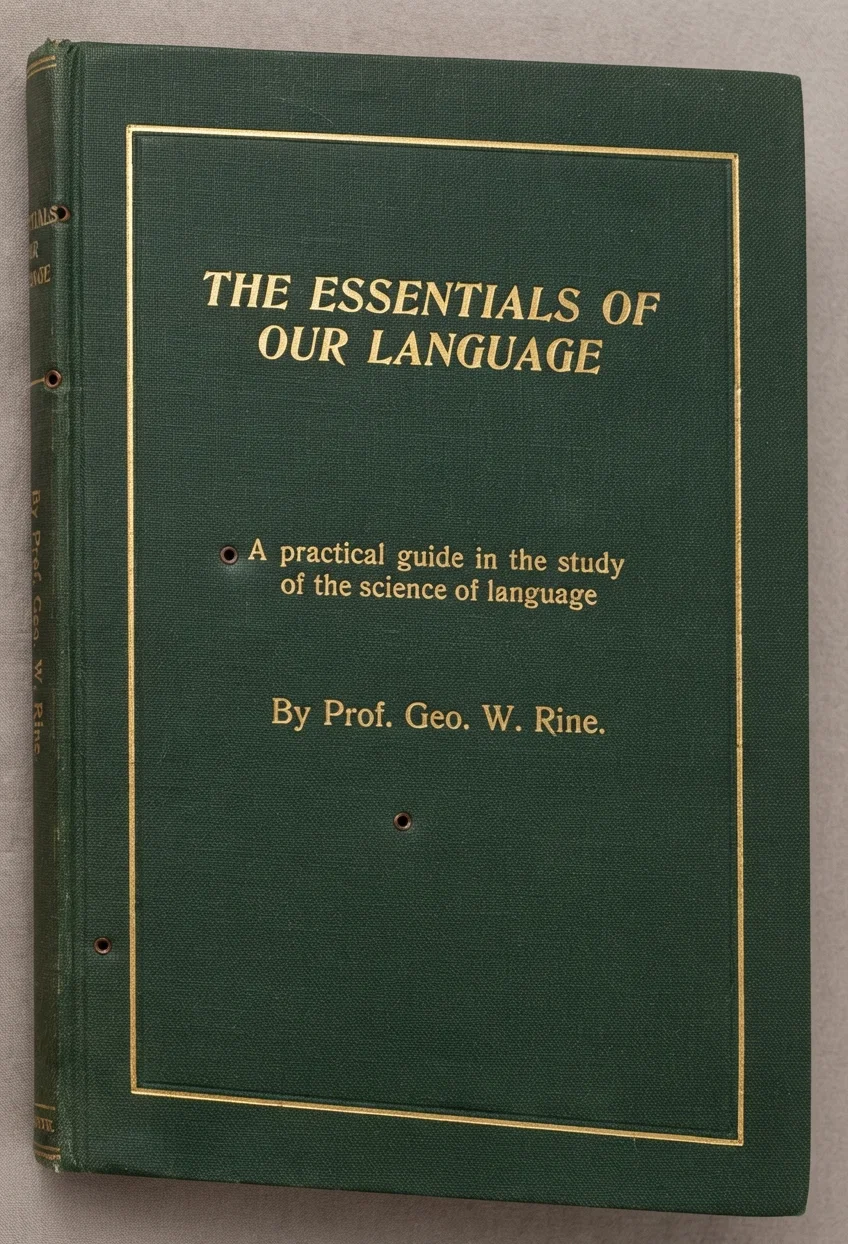
The Essentials of Our Language

A practical guide in the study of the science of language by Prof. Geo. W. Rine. The book has been written with a special view to the needs of many young and middle-aged persons, who, unable to attend school, are desirous of a better use of the English language, and are willing to teach themselves. Such will not find themselves embarrassed with needless rules, but will find abundant practical examples and helpful suggestions to aid them. The book is also well adapted to serve as a natural transition from the study of grammar to rhetoric in the schools, and will be found a convenient side help to teachers.
Note the following sectional headings: Accuracy in the Use of Words, Slips in Syntax, Punctuation, and Capitals, The Art of Correspondence, The Art of Sentence Building, Practical Synonyms Discriminated, Learning by Doing.
281 pages, bound in cloth, price 75c.

The Boy Puzzle

The science of child training, treated by a master in experience. A thoroughly practical work by Joseph F. Flint, being the direct outgrowth of his personal work with and for boys. His daily intimate contact with them for a long period of time, and under varied conditions and circumstances, has afforded him an excellent opportunity to note their weak and strong points of character, and to study the relative development of mental, moral, and spiritual qualities in connection with what he could learn of their earlier home surroundings.
The frequent confession of parents of their inability to control and train their children, has led the writer to place some of the most practical suggestions and helpful information in book form.
To parents who prize the old fashioned, Christian family life, while believing in progress, is the little work cordially dedicated.
Illustrated throughout, 217 pages, price 75c.

Health—How to Find It—How to Keep It

A practical work on the science of health, by B. Franklin Richards, M. D. From a wide experience the author has reached the conclusion that almost every one is suffering from some ailment—largely some form of stomach disorder. Based on this fact the writer treats at length on the various diseases of the stomach, errors in diet, right food combinations, the way to eat, and the care of the body in general. There are numerous useful tables, giving the chemical analysis of foods, their nutritive value, time for digestion, etc.
Among the many interesting things the book contains are the following: The Lost Treasure, Man's Present Condition, Errors in Diet, The Enemies of Man, The Digestive Agents, Timely Suggestions, What to Eat and Why, Home Remedies For Common Diseases, Seasonable Recipes.
220 pages of interesting, wholesome advice and information. Bound in cloth, $1.00.

The Vegetarian Cook Book

A book on the science of good cooking, wholesome foods, and correct combinations, by E. G. Fulton. The subject is treated from the generally accepted definition of the term vegetarianism, which means to discard flesh foods, but allows of the use of eggs, milk and its products.
From the inexhaustible resources of the vegetable world the author produces for us a large variety of thoroughly demonstrated, hygienic recipes that will prove both appetizing and healthful.
268 pages, bound in cloth, price 75c.

Pacific Press Publishing Company

Mountain View, California.
285 Salmon St., Portland, Ore. 1109 E. 12th. St., Kansas City, Mo.

PUBLISHED WEEKLY

(Entered September 15, 1904, as second-class matter at the Mountain View, Cal., post-office, under act of Congress of March 3, 1879.)
H. H. HALL, - - - - BUSINESS MANAGER.

Terms of Subscription.

Per Year, post-paid . . . . . . . . . . . . . . . . . . . . . $1.50 Six Months, 75 cts. Three Months, 40 cts. To Foreign Countries, per year, $1.75.

SPECIAL TERMS.

1. One new yearly subscription and one renewal, or two new yearly subscriptions, sent at one time, $2.50.
2. Two new yearly subscriptions and one renewal, or three new yearly subscriptions, sent at one time, $3.25.
3. Three new yearly subscriptions and one renewal, or four new yearly subscriptions, sent at one time, $4.00.
Sample copies sent on application.

SLIGHTLY DAMAGED BOOK SALE.

Below is a list of books that have been damaged in shipping, or by dampness. The damage to most of these books is so slight they can scarcely be distinguished from new ones.
Post-paid.
Bible Readings, Marble $1.25
“ “ Gilt 1.50
“ “ Full Morocco 2.20
Daniel and Revelation, Marble 1.40
“ “ Gilt 1.60
“ “ Library 1.75
Great Controversy, Gilt 1.60
“ “ Library 1.75
Home Hand Book, Cloth 2.65
“ “ Library 3.15
Ladies' Guide, Cloth 1.75
Prophecies of Jesus, Cloth 1.15
“ “ Gilt 1.40
Heralds of the Morning, Marble .90
“ “ Gilt 1.00
Eden to Eden, Gilt .75
INTERNATIONAL BIBLES.
Regular prices. Reduced prices post-paid.
No. 2491—Minion, leather-lined, reference $2.25 $1.65
No. 2593x—Minion, leather-lined, reference 4.50 3.10
No. 2693—Bourgeois, leather-lined, reference 3.75 2.65
No. 2791—Small Pica, leather-lined, reference 4.50 3.10
No. 3390—Ruby, paper-lined, concordance, etc., 2.00 1.00
Address—Pacific Press Pub. Co., 1109 E. 12th St., Kansas City, Mo.

Sample Copy Request

Editor SIGNS OF THE TIMES, Mountain View, Cal.
Sometime ago I saw a fragment of a torn paper, called, if I remember correctly, SIGNS OF THE TIMES. What little I saw of it I liked so much, I think I would like to subscribe for it. Please be so kind as to send me a sample copy.
By complying with the above request you will very much oblige,

XIII. THE GREAT PROVIDER.

Jehovah-jireh.
ABRAHAM, the father of those that believe, did not at once come to full growth in his stalwart faith. He believed God, but through years which followed his faith was weak and lame. By miraculous power, questioned of Abraham, God gave him a son in his old age. When the child became a comely youth, the pride of the father's heart, the supreme test of faith came to the father in the command to offer that son as a sacrifice. Abraham met the test without question; the hand raised to slay was restrained to strengthen and soothe, and a sacrifice was furnished in place of the son which he loved. There God revealed Himself in a new light to Abraham; under a new name—Jehovah-jireh, "Jehovah will provide."
How GOD has thus demonstrated His love through all the ages in all the common blessings of life, in common light and common air, in common water and common bread! God manifests His goodness in preserving the lives of His children. So needed are these common blessings, so unappreciative are we of them all, till deprived of them or of the power to use them!
BUT more than all these common blessings is the great uncommon, unique gift in which all these blessings are bound up, Heaven's best Gift, the sacrifice, the life of the Son of God's love. And these common blessings are ours to-day, because this world is redeemed—under the bond of the blood of Jesus Christ. In the light of the cross—the climax of the sacrifice—all the common and uncommon blessings of life are blood-bought, whether we believe it or not. All that we use and consume to perpetuate our lives is a gift from His hand.
FOR forty years in the wilderness God fed His people with "the corn of heaven." Morning by morning it fell; and He did it that His children then and at all times might know "that man doth not live by bread only, but by everything that proceedeth out of the mouth of Jehovah doth man live." Deut. 8:3. The fall of man's "daily bread" from heaven was to be, for all ages, the assurance that God is the great Provider; that, doing His will, we might trust the future with Him.
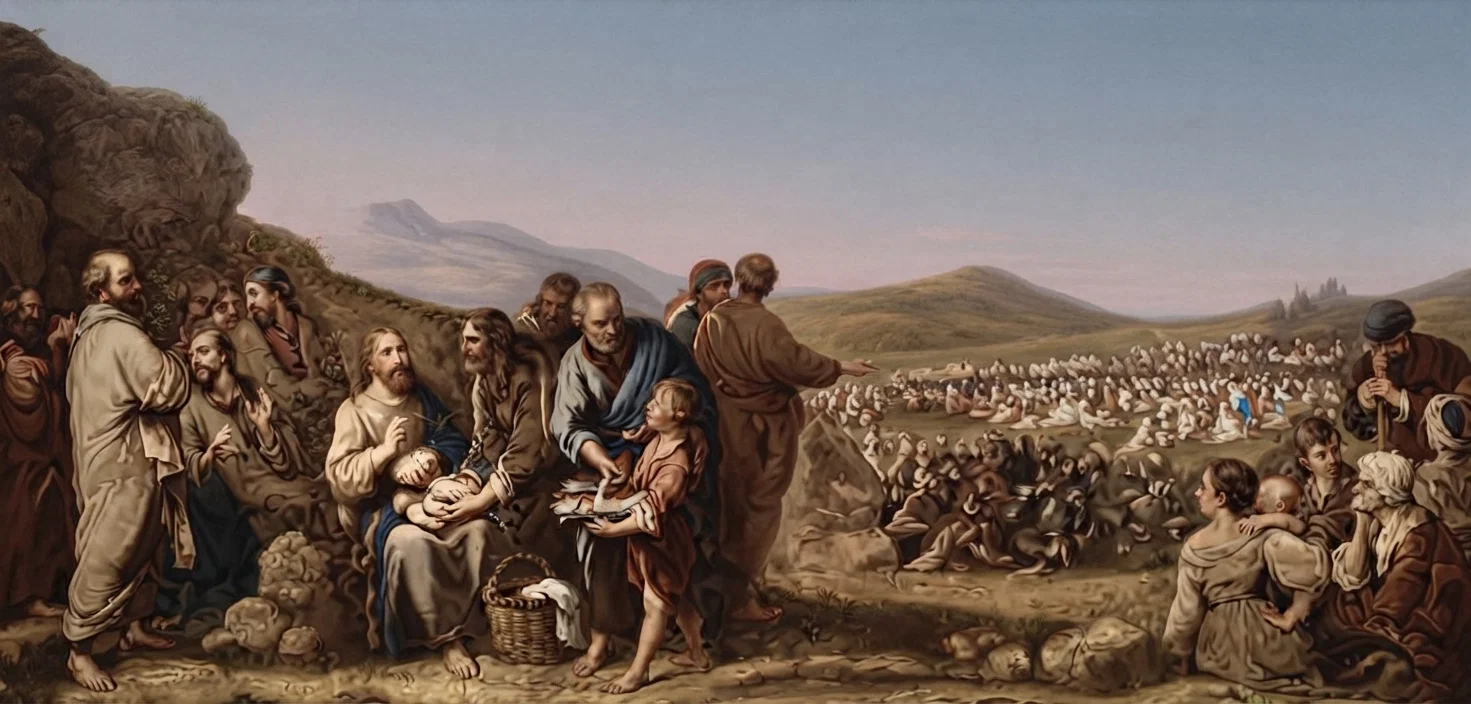
"HE DIVIDED THE LOAVES AND FISHES AMONG HIS DISCIPLES."
WHEN Jesus came to this world, He was God manifest in the flesh, and hence Jehovah-jireh. He came to provide them the bread of life. But the gross hearts could not appreciate the spiritual life, and the Master must so work that even the gross materialist could see that Jesus could supply the deeper needs of the spiritual side of man, as well as the physical need. And therefore He fed them.
YEA, as of old, He fed them in the wilderness. Read the account in Mark 6:35-44. See, also, in Matthew 14, Luke 9, and John 6. The weary Master had called His disciples apart from the crowds and cities and busy haunts of men to rest awhile. But it was useless. The people, knowing of the wonder-working power which went with Jesus, followed Him on foot a great multitude. Jesus looked upon them as sheep without a shepherd, scattered upon the dark mountains, and His heart was touched. They were in need, and there the heavenly manna fell from His lips during the day in words of life.
AS THE day declines, the disciples grow anxious. There was a great multitude of people, far from any supply house, with no provision for their needs. The disciples go to the Teacher, and ask Him to send the multitude away, that they may go into the villages round about, and get food. But Jesus calmly replies: "They have no need to go away; give ye them to eat." The reply seemed so preposterous to them, and they answered: "Shall we go and buy two hundred shillings' worth of bread, and give them to eat, that every one may take a little?" That sum of money, about thirty-three dollars, probably constituted the cash assets in the Christian treasury. But all that expended in bread would give each one but a meager morsel. What could the Master mean?
AND then He asked, "How many loaves have ye?" They investigate, and reply, "Five, and two little fishes; but what are these among so many?" His only response was, "Bring them hither to Me." His next command was that the people should be made to sit down upon the green grass, disposed inrows, by hundreds and by fifties, and it was done. And then He took the little quantity of food that a dozen men could have eaten, and looked up to heaven and blessed it, and broke the loaves. Strange indeed it must have seemed to the people that any one should even attempt to feed a multitude of perhaps ten thousand with such a miserable dole. Surely, He must be insane or divine.
HE divided the loaves and fishes among His disciples. As they passed from one to another the food multiplied in their hand, and, as the people partook of the blessed bread, it was again multiplied, till all had eaten, and all were filled, and there was left twelve basketfuls, besides pieces of the fishes. The fulness of the Godhead was in the food blessed of Him. The people knew the deed for what it was, a mighty miracle of God; and they said, “This is of a truth the prophet that cometh into the world.”
JESUS CHRIST is still the great Provider; and Jehovah-jireh is His name. We may go on our way of unbelief, refuse to obey His commands, and may eat our unblessed food alone. It will do us little good and others none. Or we can trust God, obey His commands, give our all into His hands, co-operate with Him in its distribution among the needy, and have the satisfaction of seeing them blessed and filled, and we ourselves left with more than when we began. “The liberal soul shall be made fat; and he that watereth shall be watered also himself.” “And he that supplieth seed to the sower and bread for food, shall supply and multiply your seed for sowing, and increase the fruits of your righteousness.” Truly, we can say with an apostle: “And my God shall supply every need of yours according to His riches in glory in Christ Jesus.”

CHRIST’S SELF-DENIAL.

THE perfect Man was so unlike other men. Because men were remarking His success to the disparagement of a supposed rival, He took Himself out of the way. A selfish man would have stayed under like conditions, and taken advantage of his popularity. The record says, “When therefore the Lord knew that the Pharisees had heard that Jesus was making and baptizing more disciples than John, . . . He left Judea, and departed again into Galilee.” John 4:1-3.
It was not popularity in the ordinary sense that Jesus was seeking. He came to seek and to save that which was lost—to save sinners. To this end He “made Himself of no reputation.” John had a mission to carry out, and altho his mission was to preach Jesus and promote His work, there were some who felt jealous because John’s prestige seemed to be waning.
If the people had really understood John and his mission they would have better understood Jesus and His work. Then they all would have expected John to decrease and Jesus to increase. There was no rivalry between Jesus and John, and they could have worked harmoniously together, and no doubt to better advantage. But when it began to be noted that Jesus was making more impression than John, and that fact was likely to hinder John’s work, Jesus was the one to go away rather than to injure John’s influence.
The natural man would have occupied the ground, and left John’s work to suffer by comparison. But the plan of salvation was not laid out on lines of selfish ambition. It is altogether a covenant of sacrifice, and the way to true exaltation is along the rugged path of self-denial.

GOD’S TEST OF OUR LOVE.

THE disobedience of God’s professed people has been the burden of every prophet’s cry. From Moses down to John the Revelator the story has been the same. “Precept upon precept, line upon line, . . . here a little, and there a little”—this has been the unvarying rule of God’s dealings with His people.
God’s promise to one and all is this: “If ye be willing and obedient, ye shall eat the good of the land” (Isa. 1:19); and there are no promises in the Bible to any but the “willing and obedient.” God has told us plainly enough what is the test of our love and loyalty to Him—it is obedience; not obedience to our own desires, to the traditions or commandments of men—but obedience to the law of God. That is His own appointed test of our love and loyalty. Jesus says, “Why call ye Me, Lord, Lord, and do not the things which I say?” He did not recognize them as His while they refused to follow His commands. As He is “the same yesterday, and to-day, and forever,” we may know, likewise, that He will never recognize us as His while we refuse obedience to His law.
In every age men have professed themselves lovers of God while walking at variance with the precepts of His law; but John, writing with the pen of Inspiration, declares:
“This is the love of God, that we keep His commandments.”
Then, as if foreseeing that men would accuse God of having given men a law to keep which was a “yoke of bondage,” he says:
“And His commandments are not grievous.” 1 John 5:3.
There is the test—a divinely-appointed test—and every man and every woman can apply it for themselves to themselves. Do we love God? Look at the law of God and see if we are following out its precepts—not four, or six, or even nine, but all of them. If we have found ourselves declaring that “the law is no longer binding upon men;” that “the law was abolished;” and so have found delight in what the law forbade; then we may know that it is not “the love of God” in our hearts that has been prompting our course. We may know, rather, that it is a spirit at enmity with God that has been directing; for He says:
“The carnal mind is enmity against God; for it is not subject to the law of God, neither indeed can be.” Rom. 8:7.
We can not be God’s children—we can not be inhabitants of His kingdom—if we have a mind at enmity with Him. That would bring rebellion the second time into the universe, and that God will not permit. So we can not be His, and Heaven can not be ours, if it can be said of us that we are “not subject to the law of God.” It is an exceedingly serious matter for any professed Christian to declare against God’s law, or to declare himself out from under its obligations in any single precept. It means rebellion, disloyalty to the One we profess to love and serve. It is the very antithesis of the example of Christ. His attitude toward the law is thus expressed:
“Lo, I come; in the volume of the book it is written of Me, I delight to do Thy will, O My God; yea, Thy law is within My heart.” Ps. 40:7, 8.
One proof that this refers to Christ is in His fulfilment of it in His attitude toward the Law. Concerning this He says:
“If ye keep My commandments, ye shall abide in My love; even as I have kept My Father’s commandments, and abide in His love.” John 15:10.
In that perfect submission of Christ to the will of God is our example. He could not have been our Saviour had He assumed any different attitude. It was man’s transgression of God’s law that brought death; it is Christ’s obedience to that law which has purchased back the life man had forfeited. He lived upon this earth, “leaving us an example, that ye should follow His steps.” 1 Peter 2:21. “This is the love of God,” says John, “that we keep His commandments.” And Christ says to His followers: “If ye love Me, keep My commandments.” John 14:15.
Thus over and over is it declared to us that the test of our loyalty and love to God is in our attitude toward the law of God. It is a test to which our Saviour, our great Exemplar, willingly submitted; it is a test which will be brought to bear upon us, each and all, and our eternal destiny hangs upon how we stand the test.
Of His remnant, redeemed people the Lord declares: “Here are they that keep the commandments of God, and the faith of Jesus.” Rev. 14:12. That can not be said of those who are fighting against God’s law; and they who continue so to do can not be among that number. The only safe course is to come to Christ and ask Him to take out of our heart every vestige of the hate we have entertained toward His holy law, and put its principles into our heart, so that we can say with the psalmist: “O how love I thy law.” Then in His strength we will keep it, and be recognized as His.
S.

A PROPHETIC WARNING.

THE result of church and state union is most vividly portrayed in Revelation 17. There is presented a woman (church)—a harlot, therefore an apostate church—and she “sitteth upon many waters” (peoples, verse 15). And the kings (or governments) of the earth commit fornication (have illicit connection) with her. She is carried by a scarlet-colored beast with seven heads and ten horns. Upon all the seven forms—seven principal jurisdictions in the history of this beast principle, represented by the heads—the woman sitteth, and controls them. But at last there comes a time when all the various governments composing this “beast” in its last phase, represented by the horns, are stirred up against her, and combine to destroy her.
It is not necessary here to designate what church especially fills the specification of controlling and corrupting the governments ofearth could have any union with her at all. And all action by the state tending to enforce the doctrines of any church is an adulterous connection with her.
Any church that assumes to control the secular government, that resorts to the power of such government for the furtherance of her work, will eventually find that power acting as a boomerang against her. God has provided that His Spirit through His Word, shall endow the church with all the power she needs, and whenever she becomes dissatisfied with that power, and seeks instead the power of human government, she courts alliance with that which will sometime destroy her. God has so ordained (verse 17) that the power which the harlot corrupts to the extent of illicit connection shall be the instrument of her utter destruction.
This prophecy ought to be a warning to any church, or to any people assuming to act in the name of the church, that any demand upon the state for power to carry on the work which God has given to the church, is a virtual rejection of the power of the Spirit, the consequence of which means ruin at the hands of the power that is sought in its stead. Will the professed Christian people who are now so prone to seek the assistance of the secular power in this, that, or the other project for so-called reform, pause and reflect, and heed the divine warning? G.

MEN VERSUS INSTITUTIONS.

THE one thing prominent in God's work through all the past of this world is man, man generically, mankind; and mankind as individuals.
The one thing above all other things which God has used is the individual man who was willing to be used by Him.
Ever subordinate to that man and his associates has been the institution, the building, the system, not of truth, but of labor. The system of truth is divine; the system of method, of labor, is subject to field, to environment, to soul-needs, to God's men for the hour.
Yet it is a sad fact that as God's children have departed from Him, they have exalted institutions above men.
When God led Israel out of Egypt, it was "Moses, the man of God" whom the Lord used and honored, and he led them, when they followed, to victory. When they were backslidden, they exalted the ark of the testament, and the ark was captured, and they went down to defeat. When Solomon humbled himself, God honored him, and made him a world-center of wisdom; but later when God was forgotten, the temple and the city which Solomon builded and beautified became the nation's idols, and the idolatry preluded their complete overthrow.
A few centuries pass and the Man Christ Jesus appears, the central lodestone of righteousness of all subsequent ages; but when backsliding came in, the church worshipped His sepulcher, and turned their back upon the Man.
We are in the last great crisis of the world, and God's work in the world to-day needs both institutions and men; but, O, it needs men above everything else.
More than the shining metal gold it needs men with the gold of character. More than great buildings it needs men who under God can mine and quarry and carve and polish living stones for the eternal temple of God.
"God, give us men! a time like this demands Strong minds, great hearts, true faith, and ready hands;
Men whom the lust of lucre can not kill, Men whom the spoils of office can not buy;
Men who possess opinions and a will; Men who have honor; men who will not lie;
Men who can stand before a demagog, And spurn his treacherous flatteries without winking;
Tall men, sun-crowned, who live above the fog In public duty and in private thinking.
For while the rabble with their thumb-worn creeds, Their large profession, and their little deeds Mingle in selfish strife; lo, Freedom weeps; Wrong rules the land, and waiting Justice sleeps."
God wants men; wants you, young man, that He may make you more precious than the gold of Ophir, a MAN that shall stand for truth, for righteousness, for loyalty to God and love of humanity.
Now is the hour of need. Now is God's time to use men. Now is your opportunity.

ZEAL.

ACCORDING to the Standard Dictionary, "zeal" signifies "ardor for a cause; . . . eagerness, especially disinterested eagerness, in promoting some end; enthusiastic devotion; fervor." Zeal, of itself, is no evidence of virtue. It is nothing to one's credit to be zealous—terribly in earnest—unless the end to be promoted be a righteous one. The most intense zeal may be exercised in behalf of an unholy cause.
The apostle Paul, in describing his personal position and characteristics before conversion, says: "If any other man thinketh to have confidence in the flesh, I yet more; circumcised the eighth day, of the stock of Israel, of the tribe of Benjamin, a Hebrew of Hebrews; as touching the law, a Pharisee; as touching zeal, persecuting the church."
Here was an exceedingly zealous man, a religiously zealous man, yet whose zeal, in the highest degree, was manifested in persecuting the church of Christ. He also represents the Jews, who were actuated by the same spirit of hatred toward Christ, as having "a zeal for God;" but because it was directed against Christians, he says their zeal was "not according to knowledge." They did not know the righteousness of God. This ignorance was manifested in their aim to establish their own righteousness, refusing to submit themselves to the righteousness of God, of which Christ was the supreme exponent.
Persecution, then, may be a manifestation of zeal, and usually is; it may indicate an intense zeal; as in the case of Paul, the very acme of zeal. This is especially the case in the matter of religious zeal, where men are aiming to enforce their own type of righteousness instead of the righteousness of God.
The law of God is His righteousness (Ps. 119:172), and the laws of men are the expression of their righteousness. The righteousness which the Jews of Paul's day were seeking to establish was expressed in their traditions. So the righteousness which so many religious people of to-day are zealously striving to establish is expressed in Sunday laws and kindred legislation. But, like the zeal of the Jews, professedly toward God, their zeal is "not according to knowledge." The zeal that is according to knowledge is for "the commandments of God, and the faith of Jesus."
The purpose of Christ in this world was to exemplify the law of God in human life. Ps. 40:7, 8. So it is said that He "gave Himself for us, that He might redeem us from all iniquity, and purify unto Himself a peculiar people, zealous of good works." When men are redeemed from all iniquity they are in harmony with the law of God (1 John 3:4), a condition possible only through the faith of Christ. G.

Question Corner

1692.—What Is the Comforter?

Jesus said, "If I go not away, the Comforter will not come unto you." What is the Comforter?
The Comforter is the Holy Spirit. John 14: 16, 17, 26.

1693.—Blindness to Israel. Rom. 11:25, 26.

Please explain Rom. 11:25, 26—"Blindness in part is happened to Israel, until the fulness of the Gentiles be come in; and so all Israel shall be saved." M. B. H.
The blindness, or hardness, of Israel came because of their backsliding and sin. Because of it they rejected Christ as a nation. But this did not change the nature of God. Their unfaithfulness could not make of "none effect the faithfulness of God." Rom. 3:3. The nation missed the blessing, but God's people did not fail. He offered it to all the world, not through national Israel, but through His church of whatsoever nation. The fulness of both Jew and Gentile is found in Christ Jesus. Col. 1:19; 2:9, 10; John 1:16. Through Him all shall be saved; and all who by faith are saved through Him are members of the commonwealth of Israel. Eph. 2:11-20; 3:6. The "so" refers back to verses 19, 23, the way the Gentiles came in—by faith. "So," that is in the same manner, by faith, "all Israel shall be saved." See Bible Student's Library, No. 165. Sent singly by mail for two cents.

1694.—"Serve with Thy Sins." Isa. 43:24.

Please explain the meaning of the text, "Thou hast made Me to serve with thy sins." Isa. 43:24. I have heard it quoted to prove that we have God's blessing in our sins. L.
The text is a mistranslated and fearfully misused one. The "thou" applies to those who never knew God, who never professed to know Him. Read the context and it will be seen that the Lord is addressing His people who have departed from Him. And then read the text as given by the best translation in the English from the American Standard Revised Version: "Thou hast bought Me no sweet cane with money, neither hast thou filled me with the fat of thy sacrifices; but thou hast burdened Me with thy sins, thou hast wearied Me with thine iniquities." The endeavor to prove God in every man by this text is evil and perverse. See Rom. 2:23, 24.

1695.—"Keep Alive for Yourselves." Num. 31:18.

What is the meaning of the last clause of Num. 31:18? J. R. C.
It meant simply that the uncorrupted female children could be kept alive for servants by the Israelites, where they would be reared in virtue, and lead a life many times better than in their own nation. They were not for an immoral use; for because of this they were punished. How female captives should be treated is told in Deut. 21:10-14. This was the best God could do with this nation; and their regard for women far transcended that of all foreign nations.
Continue reading: HOW ROME REGARDS IT