Four young men, clerks and students, while on a summer vacation tramp through northern New England, engaged as guide to a certain romantic waterfall, a boy named Forrest Leo Graves.
Forrest was a fine, athletic fellow, and could outwalk and outclimb any amateur in the mountains; and his moral courage was quite equal to his physical health and strength.
After he had guided the young men to the waterfall, and they had satisfied themselves with sightseeing, they invited him to lunch with them.
“Thank you, I have my own lunch,” and the boy went away by himself. Later, when full justice had been done to their repast, and a flask of brandy had furnished each of the young men with a stimulating draft, Graves was called.
“You must drink with us, if you will not eat with us,” now said the owner of the flask, and the most reckless of the party.
“No, sir; thank you,” was the boy’s courteous response.
“But I insist upon it,” said the young man.
“You can do as you please about drinking; but I can not drink,” replied Graves.
The young man sprang to his feet and with a bound stood beside the boy, too much absorbed in his own purpose to heed the quivering lips and flashing eyes of the other. “Now you are bound to try my brandy. I always rule,” he exclaimed.
“You can’t rule me,” was the brave reply.
These words were scarcely uttered when the flask was seized and hurled into the stream. Then a clear, defiant tone rang out:—
“I did it in self-defense! You had no right to tempt me. My father was once a rich and honorable man, but he died a miserable drunkard, and my mother came here to live to keep me away from liquor till I should be old enough to take care of myself. I have promised her a hundred times I wouldn’t taste it, and I’d die before I’d break my promise!”
“Bravely said! Forgive me, and let us shake hands. My mother would be a happy woman if I were as brave as you. I wouldn’t tempt you to do wrong. I shall never forget you, nor the lesson you have taught me.”
The most reckless was the most generous, and, seeing his error, apologized frankly.
How many boys need to be kept from strong drink, and, alas, how many men and women! Who dare tempt them?—Selected.
“A Live Wire”
By G. L. Morrill
LITTLE Arthur lay with his eyes closed in dreamless slumber, and his busy hands folded in rest. His pet dog stood near the coffin, and wondered why his master did not speak. Eight playmates sat still, with faces as white as the flowers in their hands. Sad friends and neighbours filled the house where laughter had held sway. The broken-hearted family were alone in their grief, which none but He of Gethsemane could comfort. Only a few hours before, while playing, the little fellow had picked up a wire which was in his way. It looked harmless, but it was a live wire, and a live wire had made a dead boy.
Sadder than this picture was the one I saw on the street that night—a picture of young men and women stricken with a living death. They were born of a mother's pain and baptized with a father's tears; yet it seemed it had been better had they never lived, or had died in infancy. City life is full of wires of dissipation. The strange companion, the glass of wine, or the game of cards look innocent enough, but they are in contact with a heavily charged wire connected with the devil's dynamo.
“There is a way which seemeth right unto a man, but the end thereof are the ways of death.”—G. L. Morrill.
Opened His Eyes
A YOUNG man entered the barroom of a village tavern and called for a drink. “No,” said the landlord, “you have had too much already. You have had the delirium tremens once, and I can not sell you any more.”
He stepped aside for two young men who entered, and the landlord waited upon them very politely. The other stood by, silent and sullen, and when they had finished, he walked up to the landlord and addressed him as follows:—
“Six years ago, at their age, I stood where these young men are. I was a man with fair prospects. Now, at the age of twenty-eight, I am a wreck, body and mind. You led me to drink. In this room I formed the habit that has been my ruin.
“Now, sell me a few glasses, and your work will be done.
“I shall soon be out of the way; there is no hope for me.
“They can be saved; they may be men again. Don’t sell it to them. Sell it to me and let me die, and the world will be rid of me; but for heaven’s sake sell no more to them.”
The landlord listened, pale and trembling. Setting down his decanter, he exclaimed, “God helping me, that is the last drop I will sell to any one.” And he kept his word.—Ram’s Horn.
What Beer Drinking Does
THERE is a quite general impression that the drinking of beer, especially in reasonable quantities, is a comparatively harmless thing; in fact, that it may even be physically helpful. But the testimony of medical men seems to be getting more and more conclusive against such a doctrine. Here is the testimony given by Dr. S. H. Burgen, a physician of thirty-five years’ standing, twenty-eight of which were spent in the city of Toledo, Ohio. And he has had exceptional opportunities of study along this line, for, unfortunately, there is almost as much beer drunk, according to population, in some of the large cities of the United States as anywhere else in the world. Dr. Burgen says: “I think beer kills quicker than any other liquor. My attention was first called to its insidious effects when I began examining for life insurance. I passed as unusually good risks five Germans—young business men—who seemed to be in the best of health, and to have superb constitutions. In a few years I was amazed to see the whole five drop off, one after another, with what ought to have been mild and easily curable diseases. On comparing my experience with that of other physicians, I found they were all having similar luck with confirmed beer drinkers, and my practise since has heaped confirmation on confirmation.”
Drink, the Cause of Social Crime
The great cause of social crime is drink. The great cause of poverty is drink. When I hear of a family broken up, I ask the cause—drink. If I go to the gallows and ask the victim the cause, the answer — drink.—Ireland.
In Asia Minor and Constantinople
By L. R. Conradi
L. R. CONRADI
I LEFT Rome, May 8, via Ancona, where I took the night steamer for Fiume, the Adriatic seaport of Hungaria, which I safely reached next morning. Fourteen hours’ ride from here through Croatia, on the fast train, brought me to the Servian border. Throughout this whole trip, from Fiume, through Croatia and Servia, to Philippopel, Bulgaria, there is not a single Sabbath-keeper to be visited,—a distance of about seven hundred miles. This is a large, inviting field, where we could easily keep a score of workers employed; it is ripe for the harvest.
While passing through Hungaria I improved the opportunity to get rid of all books, letters, and other matters of that nature that I could, knowing that the Turks were quite particular about such things. When I reached Constantinople, the morning of the eleventh, after a ride of sixty-seven hours by boat and train, I was pleased indeed to meet Dr. George and his wife at the station.
The customs officers were easily satisfied with my passport, but they carefully searched my luggage, and, not satisfied with what was found there, an officer began to look at my pockets, to see what I had there. So I pulled out my Bible, and some signatures of “Ministry of Healing” I had with me; but that would not answer, I must also show the letters I had with me; and even after that, he felt all my pockets to be sure I had nothing in them. I told him that while I had showed my letters that he might see there was no dutiable things with me, yet I desired my mail to be given back to me. I went so far as to appeal to the police officer, who said I should come later to secure my letters. I went home with the doctor, who lives in Stamboul, where we have a three-story building that has been fitted up as a health home. When I told the American consul what had happened about my papers, he at once sent a messenger to the customs office, and the letters were delivered up, and brought to me, the excuse for detaining them being that the officer thought I had some forbidden manuscript with me. On that day I secured my Turkish pass for Asia Minor.
The narrow building we occupy for our health institution overlooks the Marmora Sea. It is located in the Greek quarters of Stamboul. In the basement are the bath-rooms, in the first story is room for the offices, and in the upper story Dr. George lives, and also has two rooms for patients. He has for helpers a Greek sister as nurse, and a Greek brother who assists in giving treatment, and a young Armenian boy who assists in his correspondence.
In view of the suspicion which the government had against Elder Baharian, there had been very few meetings in Constantinople for five years. Naturally, the work in the city has been at a standstill. We improved the time to have a number of meetings with the believers, and were able to choose the necessary church officers, and ordain an elder and a deacon, and have the ordinances; all seemed to be refreshed by the meetings.
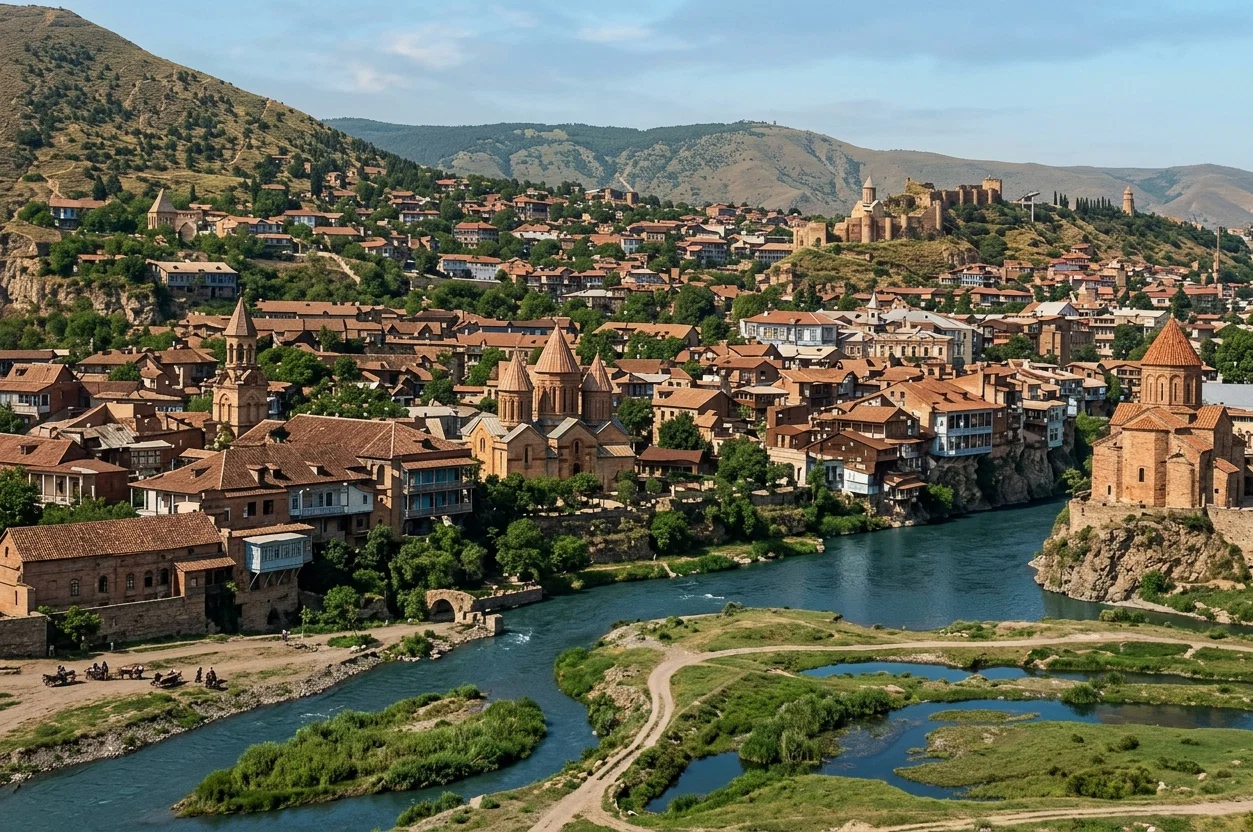
A VIEW OF TIFLIS
While I had questioned going to Turkey at the time, on account of the threatened trouble between England and Turkey key about the Egyptian border question, yet the papers in Constantinople did not contain a word about this, as the censor undoubtedly forbade mentioning the affair. I suppose that if anything had occurred, the first we should have known about it would have been the appearance of the English battle-ships before the city of Constantinople, so far as the papers were concerned: it might of course have been announced by letter from outside. The Turks are so suspicious of everything that no newspapers or letters would get into the hands of the Europeans there containing any such news, were it not for the fact that the great powers have insisted on establishing their own post-offices in Constantinople and other leading cities of the empire. If anything shows the weakness of this government, it is that while even the smaller States would not submit to the establishment of a post-office by a foreign power within their borders, such post-offices have been established in Turkey. But even in Turkey, one must be careful that he goes to the post-office himself, for it has happened that when natives were sent, they have obtained the mail, and have had it taken from them by the officials after they had started off with it.
The morning of the fourteenth, I left with one of our Armenian nurses as interpreter, for Adabazar, a town of twenty thousand inhabitants, about one hundred miles into Asia Minor. This is the first time I ever visited the place. Although Paul was not permitted to visit Bithynia (Acts 16:7), I was more fortunate, for this privilege was granted to me. I was glad to meet a number of our brethren at the station. We have about twelve Sabbath-keepers in the city, and another company some miles in the country, a company of about twelve Greeks, whom I was much pleased to meet. We remember how Christ was impressed as he heard of the Greeks who desired to see him (John 12:20-24); in their coming he saw a type of the ingathering of the Gentiles, through the sacrifice he was about to make. And we hope that through these Greeks who have now accepted the message, many others of that nationality may be brought to the truth. Although it was in the midst of their silkworm season, they took time to attend the meetings from early morning until late at night. Everything went on nicely, and we were able to celebrate the ordinances, and select officers for the church. We would have had baptism, but our time was so limited that we had to leave that until later on.
From here we went to Ismid, Nicomedia, a town of about twenty thousand, and from there one of our brethren took us across the bay to Bardizag; here and in Ovajuk we have about sixty Sabbath-keepers. In Bardizag there are about ten thousand people; it is an Armenian town, well known for its schools. Here are the American high school with about two hundred students (Armenians), a Catholic school, a German orphanage, and two large silk factories. The town is on the mountains about three miles above the bay; thus one has a splendid view14of Ismid, the ancient Nicomedia, from which Pliny wrote his noted epistle to the Emperor Trajan about the Christians, as early as 104 A. D. The doctor was out to this place, also, and found his hands full of work. We had most excellent meetings in different houses, as many as one hundred being present at a time. Through his medical work, the doctor became acquainted with some of the Armenian professors in the school, and this gave me opportunity to call upon them. When I began to talk about our mission work in Africa, the professor became so interested that he excused himself from his class, asking if I would not continue the conversation longer; and, in the end, he requested me to speak to the students about Africa. This I consented to do. Formerly there had been considerable prejudice against us as a people in this neighborhood.
During the few days of my sojourn in this place, there was quite an interest awakened among our young people through the youth’s meetings I held, and a number of them offered themselves for baptism; so on Friday evening I told them to go home and talk the matter over with their parents, and then early Sabbath morning we would go up into the mountains for baptism.
Early Sabbath morning, about five o’clock, as I was getting ready to go to the place of baptism, the father of one of the boys who desired to be baptized, called on me. When I visited the place about five years before, he was quite an active member of the church, but he was at that time somewhat against the baptism of young people. Somehow he gradually lost his first love; and while he attended every one of my meetings, yet I learned that he had opened a store, and was living in constant violation of the Sabbath, and had been disfellowshipped. To my surprise the man, instead of opposing his son’s baptism, broke down, as he related how his boy had come to him the evening before, stating his desire to be baptized. His first impulse had been to refuse the permission; but as the lad had asked the father’s pardon for his former mistakes, and had prayed that the father, too, would again follow the Master, there was such power in the youth’s testimony that the father could not resist; and in praying with him, his own heart had been broken, and the father therefore had come to ask the pardon of the church elder for the manner in which he had treated him, and he desired to be rebaptized, and re-enter the church with his boy. Thus God is turning the hearts of fathers to their children, and causing the children to long for the salvation of their fathers, as Malachi said should be in the last days.
So we walked up the mountains, finally following the bed of the small stream when the way became so narrow that there was no other place for us to go, until we reached a place where there was sufficient water, and baptized eight. This is the same place where I had baptism five years ago.
During the Sabbath we celebrated the ordinances of the Lord’s house, and had most excellent meetings; and another brother who had been away from the company of believers for some years, was reclaimed, and more young people offered themselves for baptism. As I saw how willing these souls were to receive the truth, even when spoken in weakness through an interpreter, my heart was pained at the thought that for years they had been deprived of the labors of a minister. What good could be done with these bright youth, if we had the proper ministerial help to train them for the cause, and to teach them how to labor! We ordained a new elder and a deacon here, all being united in the selection made.
In the evening I went over to the school, where I had promised to speak about the work in Africa. I was surprised to find their chapel crowded, professors and pupils being present. They received me in Turkish fashion—standing up and clapping their hands on my arrival, to assure me of a hearty welcome. I was then introduced, and the professor interpreted for me. All seemed to enjoy the words spoken. The teachers thanked me very much, and were surprised to find that we had such an encouraging work in Africa, among the heathen. They never had dreamed of our efforts in this direction. The students crowded around me to get a glimpse of some of my photographs representing African scenes and peoples.
This school was started as other institutions of its nature must be in Turkish countries—without any special permission from the government authorities; they simply erected one building, and then another, and now the school is an established fact, with which the government has to reckon, and which it can not very well obliterate.
Early Sunday morning we again had baptism, four being buried with their Lord at this time. And our meetings that day were well attended.
An interesting visit to another school was brought about in this way: One day while sitting in an Armenian brother’s house, I heard below some one singing a familiar German tune. I listened attentively, for I could hardly believe my ears; and I discovered that the child was not only singing a German tune, but German words also. Upon inquiry, I found there was a German orphanage here. In conversation with the teacher, the girl told her of my presence in the place; and so I was invited to visit the school. I found about a score of orphans present, and learned from the teacher that a few noted persons in Germany had become godparents for the children, two persons generally combining to sustain one child, at a cost I think of about thirty dollars a year. The children sang a number of German hymns, and spoke several German pieces. Thus the messenger of God finds opportunities to the right and to the left to make known the truths of the message.
A group of our brethren were so taken up with the study of the Word that they followed us down to the seashore three miles distant, and then hired a large sailboat, so that during the hour we were crossing the sea, I could continue the Bible study; and it seemed to come so easy as I could look out upon the hillsides and the towns, and repeat the precious teaching given the disciples of our Lord under similar circumstances.
When we returned to Constantinople, we learned that the government had sent spies around to get some details about our whereabouts, but as usual, they had been several days too late. We had several other meetings. We now have in this important field, with probably four or five million people, about one hundred and twenty-five Sabbath-keepers, and no ordained minister, the only help thus far rendered being that of the doctor, who is busy with the treatment rooms. Constantinople itself is a city of over a million, and it is one of the great international centers of the world, and the great city of the Mohammedans, and yet it is without any ministerial help. They need not simply some one who can preach the gospel to them, but some one who can take the many bright young people we have there, and educate them for laborers. That our brethren feel the great need of this is evidenced by their raising a subscription of nearly three hundred dollars in a short time, to serve as an educational fund.
When we glance at the Oriental field to-day, we see that there is, first, Egypt and the Sudan, with about twenty-five million people and a few native workers and no outside ordained minister. Here we have all the liberty we desire, and every facility of traveling by water and by rail, and Egypt is waiting for the message. There are about thirty Sabbath-keepers in Alexandria, Cairo, and Luxor, Upper Egypt. Where is the ordained worker who can go to this field, master the Arabic, and do the work that is to be done?
In Syria there are about ten millions, if we include Arabia and Mesopotamia. We have about twenty members at Jerusalem, Jaffa, and around Beirut. No ordained help of any kind is engaged in gospel work in this field.
In Turkey and Asia Minor we have probably two hundred and twenty-five Sabbath-keepers. There are two native ordained ministers, but they are not able to visit freely among the people. We must have outside ministers, for they can travel much more freely. In the Orient we have about sixty million people, all told, who must hear the message, and there are many languages represented. Other missionary societies have schools and other institutions here; but thus far we have not been able to furnish even the necessary help to organize and superintend the work thoroughly. This is truly a Macedonian field and a Macedonian call, for Macedonia is located within its territory. Where is the money, and where are the men God calls to develop this field?
Hamburg, July 2, 1906.
Among the Santals
By W. A. Barlow
W. A. BARLOW
SINCE writing to the REVIEW AND HERALD last, we have seen God's hand working in our midst, and causing souls to come to us for the bread of life. We now hold Bible readings twice daily, besides our morning and evening services with praise, prayer, and Scripture. About nine are attending the daily Bible studies on present truth, which I conduct from “Bible Readings,” a book which all our dear native workers should have as soon as they can read and understand English. They often ask me the price of this book, so I am trying to secure a few copies from our Calcutta depot. We also need some prophetic charts for each member of our candidates' class, while they are studying and preparing for baptism, which rite I hope to administer during the next cool season. That is the best time to get teachers and preachers and others together for Bible classes, as the rainy season is on. Nearly all the farmers are busy plowing and sowing Indian corn, rice, etc., and the country is generally flooded. Most of the large boys in our boarding-school ask leave to go home to help their parents on the farm. I encourage this spirit, because, as a rule, all the members of each family help at this time of the year. We have sown some cotton, and are now busy hoeing (or “poeing,” as the Santals say). They use an Indian spade, called a kudali. The boys who are too small to use the plow care for the cattle.
At present we have two families at Simultala studying the Bible truths. Part of the day they work in the garden, among the young fruit-trees, etc., and part of the time they go to the heathen villages, to preach and sing the everlasting gospel, in Santali and Hindi, and sometimes in Bengali. They also circulate gospel tracts in the vernacular, as well as the London Good Health and Oriental Watchman, at the railway station, about a mile from our mission compound.
We have one dear little Santali orphan boy, named Libu, who has been with us a long time in school, and now is able to attend our Bible class and read his own Santali-Roman Testament. He feels quite happy, and reads fairly well, considering his age. He is the smallest boy we have had in the school, but I think one of the best. My son Rudie is very fond of him, and between school hours they work and play together like two little Santali boys.
Another of our schoolboys has desired to study with us, as does also his young wife. It may seem strange that nearly all our students are married. They marry young, though not so early as the Hindus. Most of the latter are married when babies. The Santals marry between the ages of fifteen and twenty-five, or later, and are allowed to choose their wives and husbands, contrary to Hindu custom. From my experience of about sixteen years among them, I find them one of the most moral, peace-loving people I know in India. I have heard of only one or two murders in the Santal country. One occurred a few days ago, not far from Babolmohal. It was caused, I hear, through a land dispute with some Hindus. The Santal is, as a rule, very straightforward and honest, unless he wanders away from his hill and forest home, and settles near a city or bazaar, and mixes with the keen shopkeepers, money lenders, and others.
We are hoping to make a good start in the hand-loom weaving industry, after the rainy season is over. It takes well among the Santals, because most of them are accustomed to weaving. They use a very simple hand-loom. It costs about half a dollar. I have two here for beginners; and as soon as the student can operate this loom, he will begin work on the fly-shuttle loom, which is a little more difficult, runs faster, and turns out better work. We shall need a better place for a weaving school. Our present place is only one small room, about ten by twelve feet, and will accommodate only two looms. So in the rainy season it will be difficult to prepare the cotton for the looms, unless we have a good, large shed, or veranda. We shall also need a better kind of loom. I saw one of these automatic machines at work while visiting the School of Industry, in Calcutta, during my visit to our new Bengal mission at Gopalganj, east Bengal, conducted by Brother and Sister Mookerjee.
I was much encouraged to see the progress of the work in east Bengal. After a hard struggle and much prayer and perseverance, our laborers there have, by God's help, been enabled to erect a number of bamboo and sal-tree buildings, with well-thatched roofs, near a river, and right among the poor villagers, who earn their living by fishing, farming, carpentering, shopkeeping, etc. The most encouraging feature of this work in connection with the present truth is the multiplication of earnest inquirers, through the mediums of the preacher and the printed page. I believe that the spiritual work begun by the free circulation of our Seventh-day Adventist Spirit-filled tracts will accomplish much. We need a greater supply of tracts in Hindi, Burmese, Tamil, Bengali, Urdu, Singalese, and Santali. We need more translators, typesetters, and funds for this important and urgent work. I am glad the Watchman Press has just given us a few thousand Hindi and Bengali tracts; but what are these among so many?
Brother and Sister Burgess have worked well in this line since their return to India, among the Hindi- and Urdu-speaking people. They have already sent me a number of tracts in these two dialects, on “The First Angel’s Message,” “The Ten Commandments,” and “Tobacco Poison,” and now they write that they hope to have a neat little Hindi pamphlet, or booklet, on present truth. I am sure this will be one of the best little works we have yet had printed in these dialects on this subject. We need to pray for these dear laborers, who are at present, I hear, studying Hindi and Urdu, as well as translating and publishing these tracts for India’s millions. May God bless them, and lead in opening their new mission station.
It is hoped that we shall have two preachers in each of our Santal stations and out-stations—in Simultala, Babolmohal, and Baswata, where we have a village school, conducted by Malta, one of the first Santali converts, whose parents live in this village. We hope that one or two students will take their stand for Christ in the near future, as well as others who, with their wives, are now under instruction for baptism.
May God bless our coming general meeting. We shall be glad to welcome Elder and Mrs. Shaw, and other workers who are expected in India at that time, also Elder Hansen, and the medical staff from Bombay who have lately arrived. May this be another pentecostal season of prayer, praise, testimony with power, and soul winning.
“From Greenland’s icy mountains,
From India’s coral strand,
Where Afric’s sunny fountains
Roll down their golden sand,
From many an ancient river,
From many a palmy plain,
They call us to deliver
Their land from error’s chain.
“What though the spicy breezes
Blow soft o’er Ceylon’s isle;
Though every prospect pleases,
And only man is vile;
In vain with lavish kindness
The gifts of God are strown;
The heathen, in his blindness,
Bows down to wood and stone.”
Simultala, India.
Mission Notes
Who, with the prophet Isaiah, can say, “Here am I; send me”?
SINCE its foundation, the British Bible Society has issued 198,515,199 copies of the Scriptures, complete or in part.
A GREAT change has come in the island of Sicily. Where formerly Protestant services had to be held in secret, and Protestants were stoned, now public services are well attended, and mission services are held in public squares.
A SWEDISH missionary, the first who has been permitted to establish a permanent station in Abyssinia, has sold out the first shipment of Bibles and New Testaments in Amharic, sent him by the Bible Society. Abyssinia is slowly opening to missions.
THERE are said to be over eight million Chinese students attending schools in Japan. They come from seventeen of the eighteen Chinese provinces. No such movement of students from one land to another has ever been seen before. It is one of the signs of the Chinese awakening.
West Africa
By D. C. Babcock
FREETOWN, SIERRA LEONE.—We must have help soon. We are so far advanced with our new home that we are ready to receive new workers. And I am sure that if we can get laborers from a tropical country, such as the West Indies, they can get along here all right, and in the new home can soon become acclimated. It will be a great encouragement, at least, that, if they should get down with the fever, they would have somewhere to go to recuperate.
There are some things which encourage us here, but the conflict has been severe. Some opposition is giving way. Above everything, we are thankful to the dear Lord for the good health we are enjoying since we moved into our new home.
There is plenty to say of the needs in this dark land, and as soon as it is consistent, I want to make a tour of the hinterland. But I do not think it advisable to go until the war among the Gejes in the interior is over, when I shall be better protected from the danger of disease, especially fever.
I have two Mendi boys with me yet. When I asked them if they expected to go into the war, they said no, they wanted to remain with us. I was so glad for this. One of them is the son of a king who lost his life in the last Mendi outbreak, and I feared that he might want to go and take revenge. He is a very bright young man, and Mrs. Babcock is giving him lessons, and he is learning very fast.
When I was putting up the walls of the building, some days I would have thirty or forty working at one time. The masons were creoles, who had had their relatives killed by the Mendies, and sometimes it seemed almost impossible for me to keep them from war while they were at work. The Lord gave me good control of the Mendies, or there would have been trouble. I called them all together one day, and told the creoles plainly that unless they did differently, I would have to dispense with their services entirely. I am sure if you were here some nights, and heard the drums, and the throng of people in the streets, you would declare that there was but little hope of seeing the next morning.
I believe the Lord will raise up help among these Mendi boys, to assist us in our work. Most of these tribes are strongly opposed to education, and if one begins to learn to read, he is marked as an enemy to his people.
Mrs. Babcock asked Fambuoi the other day what he would do if he visited his people, and they heard him speak English. He said that he would not let any one hear him speak it. There are some bright men among them, who in past years went to England, and were graduated in some of the best schools, who have interpreters, pretending that they can not understand.
An interesting case has just been tried in the courts, of a native who was taken from this colony when but a boy, and educated in Dayton, Ohio. When he reached manhood, he returned to this colony, and entered the ministry, under the supervision of the United Brethren. A few years ago he left the church, joined his original tribe, and became a king among them. Last year he was arrested by the civil authorities for joining the Leopard Society, a crime for which death is the penalty. After a long trial, by claiming to be a citizen of the United States, he got off. The next day he went back, and preached for the Brethren.
We are of good courage, and hope soon to see some good results from our efforts in this dark land.