Your ShelfYour Projects

Review and Herald, Vol. 83, No. 38.

Our Publishing Work

Review and Herald

Sep 20, 1906

Review and Herald Publishing Association · Takoma Park Station, Washington, D. C. · Sep 20, 1906

Our Publishing Work

The Lord gave the word: great was the company of those that published it. Psalm 68:11.
See last paragraph on this page for instructions where to order.
MR. PEARCE has presented to the public, in “The Master's Greatest Monosyllables,” an intensely interesting and highly instructive little work on the Master's use of the common monosyllables, “Go,” “Do,” “Lo,” etc. The work is inspiring, and well calculated to turn the thoughts of the reader heavenward, to rebuild his faith, and to win his heart. Beautifully bound, 75 cents.
ONE of the most popular books among children is “Best Stories from the Best Book.” This little work was designed with special reference to its adaptability to the needs of the children. It is profusely illustrated, and the stories have been prepared with special reference to teaching the truth. Many features of present truth are considered in a manner to cause a deeper investigation from the Bible. This book is also published in the German, Danish, and Swedish languages. Two hundred large pages. Board covers, 50 cents. Fine presentation cover, heavy paper, 75 cents. Paper covers, 25 cents.
IT will do all the children good to read “How a Little Girl Went to Africa.” Besides being educational, it will inspire a missionary spirit in those who read it. Some simple work like this may be the means of turning the whole course of a child's life, causing him to set his heart upon work for the Master in foreign fields. Bound in cloth, $1. The book is given free for three new yearly subscriptions for the Instructor at 75 cents each. Sample copies of the Instructor will be furnished to all who want to solicit for Instructor subscriptions. Address Youth's Instructor, Takoma Park Station, Washington, D. C.
FROM far-away Africa comes the following, expressing an appreciation of the Youth's Instructor: “DEAR EDITOR: I want to tell you in some way how pleased I am with the last Instructor we had,—the Scotch number. It was fine, every bit of it. I have many Scotch friends who will be pleased with this number of the Instructor. I have an English friend who is also much interested in the Instructor, and keeps her copies of it sewed together for her little girl to read when she is ‘older grown.’” From all parts of the world come voluntary testimonials for the Instructor. This good youth's paper has been published for over fifty-three years, and it has constantly brought to the young people the information well calculated to strengthen their understanding, supply their minds with proper information, invigorate their moral nature, and increase their reverence, devotion, and love for God and humanity. The Instructor is not filled with advertisements, but each issue is replete with much helpful matter that will prepare the youth for future noble service. All parents who are interested in the development of their children should provide the Instructor for them. Yearly subscription price, 75 cents. Foreign countries, $1.25.
ONE of the most convenient books for ready reference is the pocket size of “The Bible Text-Book,” which contains forty-nine complete Bible readings on principal points of Bible truth. It contains several charts, a table of contents, and an index of subjects, making it a most valuable compendium of Scripture topics for ready reference. Flexible cloth, 30 cents; leather, round corners, 50 cents.
WHAT a difference there would be in the order and dignity of all our business meetings if the members of our church would secure and study “Smith's Diagram of Parliamentary Practise.” All matters pertaining to the order of business is simply, yet minutely given in this diagram. It can be readily understood by all, and should be followed more closely in the proceedings of all our business meetings. Pocket size, price, 50 cents.
WHEN one feels spiritually cold, and doubts of God's personal care force themselves upon the mind, a few moments with “The Lover's Love: or, John Three-Sixteen” will result in a decided victory over doubts and discouragements. It helps one to possess a fuller conception of the meaning of, Love that Counteth Not the Cost; The Lover—God; The Lover's Intensity of Love; His Great Object; His Proviso—“Whosoever Believeth.” It sparkles with divine truth, and ought to be studied by every man and woman who is striving to be a follower of Him who was given to the world as an evidence of divine love. Price, 75 cents.
THE author of “Paradise Home,” Elder S. H. Lane, has left this little work to continue his ministry in the promulgation of the gospel of the kingdom by helping truth seekers to understand the Lord's design in creation, why sin was permitted, the fall of Satan, the promise made to Abraham through Christ, the three worlds and three heavens, the rest that remaineth, the two Jerusalems, the transfiguration, the judgment, the binding of Satan, the millennium, the two resurrections, the description of the world to come, the New Jerusalem, etc. Though the author is no more, the results of his work will follow and produce many-fold. About 60,000 copies of “Paradise Home” have been sold, and many are those who have assured the publishers that they have been helped and strengthened through reading this work. Nicely illustrated with new and original illustrations prepared especially for the book; in board binding, 25 cents; cloth, 50 cents; special edition, gilt edges, 75 cents.
Orders for any publication mentioned on this page may be sent to any conference tract society or to Review and Herald Publishing Association, Takoma Park Station, Washington, D. C., or Battle Creek, Mich.
Also Pacific Press Publishing Company, Mountain View, Cal.; Portland, Ore.; Kansas City, Mo.; Southern Publishing Association, Nashville, Tenn., and Fort Worth, Tex.

Editorial

THERE is no kind of preaching which will renew the courage and revive the hope of believers like a spiritual presentation of the fundamental truths of the third angel's message. This message is not a dry theory which loses its interest as soon as the novelty is worn off, but is a living experience which grows more and more real as we know it better. The plain truths of the third angel's message are always meat in due season.
EVERYTHING indicates that the time has come for rapid advancement in this advent movement. Hindrances have been removed. The way has been prepared. The doors are open on every hand. The spirit of giving and of working is taking possession of the people. And above all, there are manifest tokens that God is bearing witness to his message “both with signs and wonders, and with divers miracles, and gifts of the Holy Ghost, according to his own will.” The time to favor Zion is come, and we should recognize the day of our visitation.
WONDERFUL is the provision which the Father has made for his children. “He will abundantly pardon.” We are made accepted in the Beloved. Grace is promised for every trial. We are invited to come boldly to the throne of grace, where mercy and grace are freely dispensed. No good thing will he withhold from them that walk uprightly. Certain it is that the Lord has planned for believers to live a life of victory over every opposing influence, and daily to show forth the praises of him who has called them out of darkness into his marvelous light. “O that men would praise the Lord for his goodness, and for his wonderful works to the children of men!”

“The Double Doctrine of the Church of Rome”

There has appeared a book with this title written by the Baroness Von Zedtwitz, better known as Miss Mary Caldwell, a former communicant of the Roman Catholic Church who donated liberally to the founding of the Catholic University of America at Washington. The reasons for the author's repudiation of Roman Catholicism are given in this book.
The baroness claims to have been admitted to the inner circles of the church, and as the result of this intimate acquaintance with its teaching and practise, she declares that there are two kinds of doctrine advocated by the adherents of the papacy. She analyzes them thus:—
First, those for the uninitiated, or the sheep; second, those for the initiated, or the shepherds; in other words, there is exoteric and esoteric Catholicism. With the exoteric doctrines it finds means to defend itself against attack, and retreats always behind the bulwarks of Christian ethics. It proclaims charity, sincerity, justice, altruism, professes from the pulpits the gospel of Jesus Christ, and thus deludes its adversaries, who fall back disheartened, and abandon a systematic attack. . . .
Jesuitism is but esoteric Catholicism made tangible. It is the heart and spirit of the whole system; and whether or not there have been, and still be, popes and prelates who are covertly hostile to its necessary hegemony [leadership], they are aware that if Catholicism and papacy are to last, Jesuitism is absolutely indispensable for their justification; were it otherwise, Rome, following the course she has always pursued in denouncing unsound doctrines of a theological nature, would have been forced to call upon the Jesuits in Vatican Council to disown and repudiate the unsound moral teachings of a whole host of Jesuit authors, or failing to obey this order, banish the Jesuits from the church. Rome has never attempted either. The Jesuits are the bold cynics who meet with a sneer the faltering Christian doubtful of his power to reach salvation; they are the mockers of those seeking more light on intellectual doubts. They, the modern Pyrrhonists [skeptics], emboldened by their Greek prototype, reply now to the seeker of truth, as Pilate once replied to Christ, “What is truth?”
This testimony, coming not from an official of the church who has some grievance, but from an intelligent lay member who has shown a sincere devotion to the advancement of Catholicism, is a forcible confirmation of the conclusion to which any unprejudiced investigator must arrive. The political intrigues of the papacy, covering many centuries, the methods of ecclesiastical administration, and the irregularities of conduct even among her clergy, are so much at variance with the Biblical standard of morals as to force the student of Roman Catholic history to conclude that among the initiated who shape the policy and plans of the papacy as an organization, the principle that the end justifies the means has more weight than the principles taught and practised by Jesus Christ. We know that there are sincere and devout Catholics who are following all the light which they have, and who, for this very reason, will be led into clearer light; but viewed as a system of doctrine and as an outward organization, popery and the papacy represent the kingdom of darkness under the forms and names of Christianity. Underneath the mask will be found “the man of sin.”
The gospel message which is designed to bring deliverance to those who are in the bondage of this false system of religion must, it is perfectly plain, be more than the proclamation of the theories of “charity, sincerity, justice, altruism;” there must be the exemplification of the life of Christ, not simply in the “uninitiated,” but also in the “initiated.” There should be no appearance of a foundation for the charge that there is exoteric and esoteric Adventism. “Organizations, institutions, unless kept by the power of God, will work under Satan’s dictation to bring men under the control of men; and fraud and guile will bear the semblance of zeal for truth and for the advancement of the kingdom of God. Whatever in our practise is not as open as day, belongs to the methods of the prince of evil.” Pretense and underhand dealing can have no place in those who are really giving the third angel's message.

A Bohemian Witness

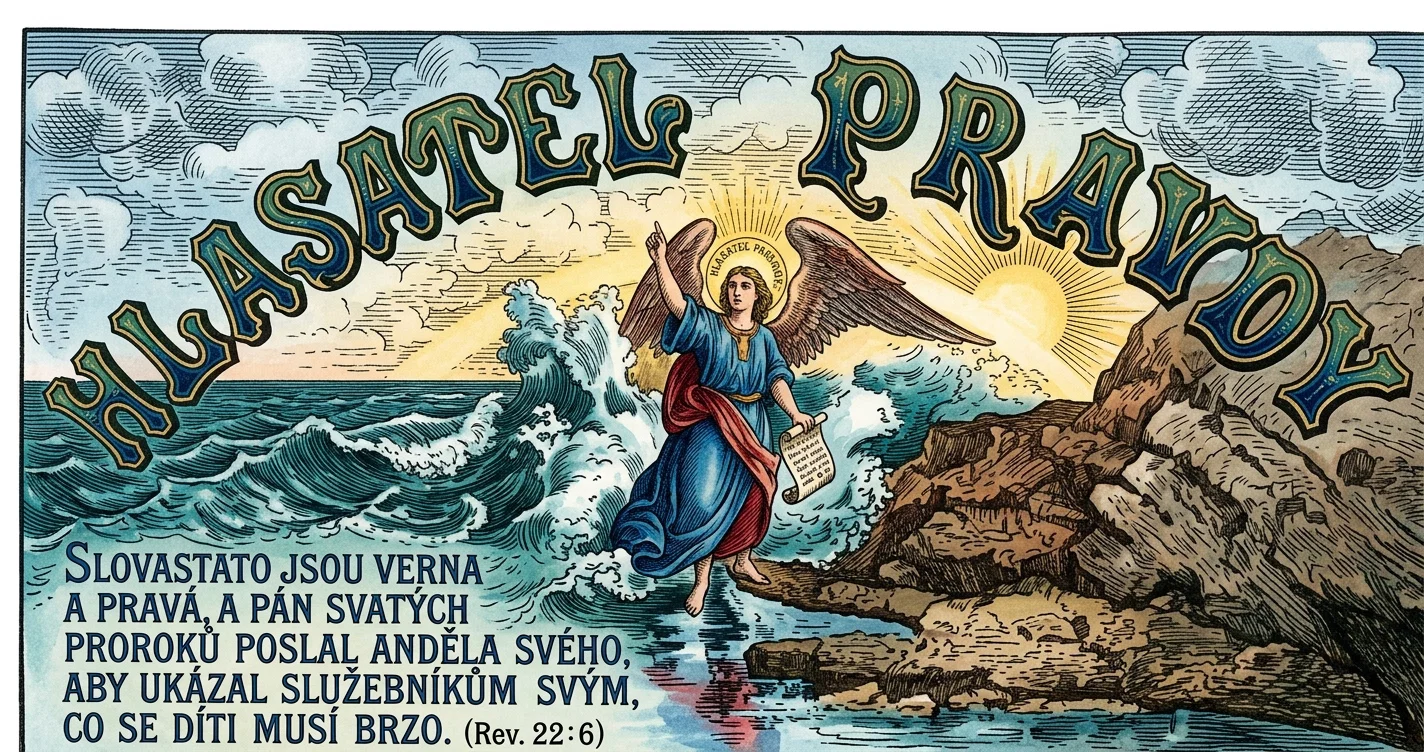
There is a new witness to the third angel’s message in Bohemia, the land of Huss and Jerome. It is a monthly illustrated paper, bright and cleanly looking, full of truth for the time. It is printed in Hamburg, but edited and issued from Nymburk, near Prague.
TITLE HEAD OF BOHEMIAN PAPER “HERALD OF TRUTH.”
When the first copies came to the camp-ground at Friedensau, there was a little praise service to welcome the new witness. Brethren from Hungary, and Russia, and other parts, thanked God in behalf of many in their fields, outside of Bohemia, who may now hear this truth through the new witness. And the hope was expressed that our brethren in America would use this paper among the many Bohemians in the States.
The paper is called Hlasatel Pravdy (Herald of Truth). The title-heading, shown in the accompanying cut, was designed by the editor, an artist, who has been giving his time to evangelistic work for a year. Somewhat over a year ago, he told me, he heard his mother saying, “No, no,” to some one at the door, who was patiently and persistently urging something upon her attention. He went to the door and found a colporteur, with tracts, one of our brethren. Thus was the truth brought to his home in Nymburk.
The message is making progress in Bohemia. In ancient Prague we have a company of about twenty-five Sabbath-keepers.
The price of this paper to America is fifty cents a year. Orders may be sent to the General Conference in Washington. Surely many brethren must have Bohemians in their neighborhood, to whom this paper from the Bohemian home land would be a blessed herald indeed. W. A. S.

The “Christian Nation” Claim Denied

THERE is a certain class of reformers who are constantly repeating the dictum of the Supreme Court that “this is a Christian nation,” and who are demanding the enactment of laws which shall enforce some of their ideas concerning Christianity. In marked contrast with this view, and much more in harmony with the facts in the case, is the assertion of Dr. Philip S. Moxom, that, when tried by the proper test, “the attitude which a nation assumes toward other nations, and the kind of social order which it maintains within itself,” the so-called Christian civilization, is, in many respects, decidedly unchristian. “The dominating forces in it,” he declares, “are individualism, self-assertion, injustice, selfishness, pride, and greed for riches. . . . Almost invariably rights take precedence over duties, and self-interest abridges or obstructs exact justice.” A quotation from Dr. Moxom’s article in The North American Review will make his position clear. He says:—
Conceivably, one may contend that our present social life is the result of a long evolution, and is economically wise and beneficent; but one can not truthfully call it Christian. Now, if Shintoist and Buddhist Japan can produce a higher, saner, more just, more self-controlled, more unselfish individual and social life than Christian England or America, by that fact Christianity, as these peoples have interpreted and exemplified it, is proved inferior to Shintoism and Buddhism. But what really suffers by the comparison is not the Christianity of Jesus, but the Christianity of the church, the Christianity which we have made. In other words, Christianity can maintain its pre-eminence only by the vital and effective incorporation of the spirit and teaching of Jesus in individual and social life and character. Nothing can invalidate this proposition. The trial which the Christian nations are facing to-day is obvious and inescapable. Let us, at least, be honest with ourselves. If we will not practise what Jesus taught, let us cease to call ourselves Christian.
Dr. Moxom further declares that the missionary work of the church “is imperiled, or seriously hindered from achieving the largest results,” by two causes, one of which is “the inconsistency of our life with the Christian faith and principles which we inculcate.” And he tells some very plain, even if it be unpalpable, truth in these words:—
But the question is up and will not down: Are we genuinely Christian? The question is, first of all, one for the individual man and woman. It is, second, one for society. If individuals are persistently Christian, they will make society Christian. Where is the difficulty? We have not taken Jesus frankly at his own word and on his own terms. With perfect propriety, with absolute justice, he might say to us, as he said to some professed disciples in his time, “Why call ye me Lord, Lord, and do not the things that I say?” We read these words in the New Testament, but, with curious fatuity, we never suspect that they are addressed to us. It may be that the church and the Christendom which is identified with the church, are to hear the doomful words which were spoken to the ancient “elect” people of God: “The kingdom of God shall be taken away from you, and given to a nation bringing forth the fruits thereof.”
This description of the present condition of things is exactly in accord with the prophecies concerning the last days. The form of godliness is present, but the power of it is lacking. Those who are willing to weigh evidence calmly must come to the same conclusion which has been reached by Dr. Moxom. And the remedy will not be found in seeking to enforce religious observances by law, but in proclaiming the gospel message for this generation “in the power of the Spirit.” Only in the light of the third angel’s message can the present situation be understood and explained; only by the third angel’s message can the demands of the present situation be met.

France and the Vatican

FOR several weeks the periodicals of the world have been giving a great amount of space to the discussion of the papacy’s attitude toward the French government. The publication of the recent encyclical of Pope Pius X seems to have set the machinery of the Catholic Church against the French law governing the holding of church property. The encyclical has greatly intensified the feeling stirred up by the law of July 1, 1901, known as the law of associations, which required all religious establishments to be authorized by the state. Rather than comply with that law, more than three hundred monastic associations dissolved, and in July and August, 1902, alone, 2,737 establishments were closed by the government. There was an extensive migration of members of these orders to other countries. The storm stirred up by this law had not died down when, on Dec. 9, 1905, the law was enacted against which the encyclical of August 14 is aimed. By that law the churches are separated from the state, and all religious bodies are authorized to form associations for public worship. It is the design of the law makers that these associations shall hold all church properties in the country. As the associations must be composed of lay members instead of priests and bishops, the officials of the Roman hierarchy took exception to the law as soon as it was advocated. It was enacted by a majority sufficiently large to indicate that the government’s support in the matter was beyond question. This surprised not only the Catholic Church in France, but Christendom generally. It seemed that France, the oldest daughter as well as the pampered child of the Church of Rome, was bent on severing the closest ties that bound her to her spiritual sponsor on the Tiber.
The pope says nothing causes him greater agony than this rapidly developing unfriendly attitude of the French government toward the church, and his encyclical has greatly intensified the bitterness of both parties. Some have evenpredicted civil war as the outgrowth of the apparently unyielding attitude of the two powers. The pope denies the right of the state—of any state—to say in what manner the “sacred edifices” shall be held; but in view of the fact that these edifices were erected largely from public funds, and the ecclesiastics who officiated therein were paid from the public treasury, it should not surprise the church that the state now assumes the right to dictate in the matter of ownership, and carry out its will by physical force.
The attitude of the encyclical may be judged from the following excerpt:—
We deferred our decision owing to the importance of this grave question, and particularly through a charitable feeling for the great services your nation has rendered to the church. Having heretofore condemned this iniquitous law, we examined with the greatest care its articles to see if they permitted the organization of religious life in France without jeopardizing the sacred principles of the church. . . .
Therefore, concerning cultural associations such as the law prescribes, we decree absolutely that they can not be formed without a violation of the sacred rights which are the life itself of the church. Putting aside, therefore, these associations which our conscience forbids us to approve, it is opportune to examine if some other kind of organization, both legal and canonical, can avert the threatened dangers to the church. . . .
We declare it not permissible to try this other kind of associations so long as they do not establish in the most legal and most positive way that the divine constitution of the church, the immutable rights of the Roman pontiff and the bishops, and their authority over the temporal affairs of the church, particularly the sacred edifices, will be irrevocably protected by such associations. We can not wish otherwise without betraying our sacred charge, and producing the ruin of the church in France.
Many feel that this apparently uncompromising attitude of the two powers will not prevent a settlement of the difficulty; but how the matter will be adjusted none are able to forecast. So far the government has shown no signs of yielding; and whether the Vatican will submit after characterizing the law as an “iniquitous” measure, “jeopardizing the sacred principles of the church,” is a serious question. The Roman Church holds that the pontiff and the bishops have the divine and immutable right to exercise authority over the temporal affairs of the church, and these it can not relinquish without betraying its sacred trust. He even goes so far as to declare that oppression, and not separation, is the object of the French law, and that atrocious war is being made against religion. He counsels against seditious action by Catholics against the French government, but nevertheless urges them to unite and stand firmly against the law. Next December the law is to go into effect. If the church officials are obdurate, and the government maintains its present unyielding attitude, we may expect to see more riotous scenes in France than those which accompanied the taking of church inventories during the past year.
A movement very similar to that in France is developing in Spain, both founded on clerical influence in politics and the growth of “liberalism.” One writer, favorable to the Catholic Church, declares that out of all these changes in the European field “the Roman Catholic Church as a religious institution will lose absolutely nothing, but on the contrary will gain in influence and service.”
He who is unfamiliar with the Revelator’s setting forth of Rome’s career might look upon the present agitation as a sure indication of a decaying power, as he sees privilege after privilege stripped from her. He might declare that the consummation of her widowhood and overthrow was fast approaching. But that we may not be deceived by the events we see, the Word points out a time when she will declare, “I sit a queen, and am no widow, and shall see no sorrow.” That time is near; and out of these adverse circumstances which we see to-day Rome will yet work out those conditions which will inspire that declaration. When Nebuchadnezzar declared, “Is not this great Babylon, that I have builded?” in that moment heaven’s judgments fell upon him. So when spiritual Babylon makes that predicted declaration extolling her greatness and denying her widowhood, that is the signal for her judgments to fall upon her. Rev. 18:7, 8. That time is approaching; that judgment hour is drawing near. C. M. S.

Things That Can Not Block the Way

The laborers in Europe learn the lesson of “doing the next thing.” When one way is made impossible, they work another way. If they can not sing or pray in a public meeting, they read a psalm or prayer from the Bible, and preach the message. If preaching is forbidden, they hold a prayer-meeting. If a public meeting is prohibited, they hold a private meeting.
Where public baptisms are impossible, the service is attended to in the darkness of night. One sister told me that where it was forbidden the older ones to sell papers, they sent the little children out with them, and so they raised, with the help of the children, a nice little sum for the East African Mission.
It gives the laborer in Nuremberg, Bavaria, for instance, a strange sensation to have people start at every knock at the door, wondering if a policeman is waiting to enter.
In Rome, priests stir up employers to set a watch at the door of our meeting hall, to see that none of their men attend meetings. On the German border of Holland, the workers were shadowed everywhere they went. The shadow—some person sent by priest or Lutheran pastor—followed the worker’s steps, stopped by door or window while the worker made a call, and followed him the whole round of his work till he reached his home at night.
In Flemish Belgium, workers were assailed with water pitchers or flower-pots, or perhaps the priest would set thirty or forty children clattering down the street after the worker, crying, “Heretic!” In eastern Prussia a pastor may take his stand at the door of a village meeting place, and order away those who come to hear. Brethren from north, south, or central Russia tell of revolution raging, with death abroad in the streets.
But all the time, and everywhere, these fellow laborers of ours are working away, sowing the seed of the word in honest and good hearts; and companies and churches are springing up, and governors and judges, and even royal courts, are hearing of the progress of this truth.
W. A. S.

Note and Comment

SAYS the psalmist: “Put not your trust in princes, nor in the son of man, in whom there is no help.” America and Europe are being filled with the doctrine of socialism; and if we understand the aim of its expounders, most if not all the national, political, and social ills of the world are to be eradicated by the application of the principles of socialism to the affairs of men and nations. Political corruption, bank wrecking, graft, and financial inequality are to be banished from the world when socialism sits in the seats of the rulers. In view of what socialism expects to see accomplished through the instrumentality of human power, the following extract from the socialist paper Appeal to Reason is interesting reading:—
If we could only employ dogs instead of men in places of public trust! Dogs are honest, faithful, even unto death. They never turn traitor to their benefactors. But man! Look at him in all his glory, and find one you can trust with your life! Look at the tens of thousands who rob those who trust them, even when they have plenty without robbing.
Men rob and betray trust because they are wrong inside. Their hearts are corrupted, and in their hearts they break the law of God before they put forth the hand to take that which is not theirs or turn their backs upon their trusting friends. What remedy has socialism to change the hearts of men? What menhave socialism or any other human organization to put in places of public trust but those who are in the world now, the very men so scathingly denounced in the above extract? What those men need, what all unconverted men need, is a change of heart; and that need can be supplied by nothing but the gospel of Jesus Christ. To denounce a man is not the same as putting a new heart in him. To denounce one set of men will never make angels of another set. As socialism has no power to touch and convert and transform the hearts of men, it will never be able to accomplish the purpose at which it aims. There is only one converting, conscience-building power in the world, and that is the power sent hither by God himself. Jesus said: “I, if I be lifted up from the earth, will draw all men unto myself.” There is power enough in that drawing to transform hearts and save men and enable them to lead clean lives. There is no other power on earth that can do it; and if we build our hopes for better things here upon what we can induce unconverted men to do for us, we are planning for ourselves the most bitter of disappointments.

A Cardinal’s Warning

THAT was a significant statement made by Monsignor Lecot, the cardinal archbishop of Bordeaux, in a pastoral letter before departing from Bordeaux to attend the meeting of bishops in Paris. In uttering his condemnation of the law for the separation of church and state, he stated that “the church would never use violent means to secure the triumph of its sacred cause;” “but,” said he, “let us never forget that there is nothing so inflammable as the religious sentiments of a nation. Although with nothing to excite them the masses will remain indifferent, it will take but a trifle to cause them, like a raging torrent, to sweep all before them.” Evidently the cardinal bishop does not expect his religious flock to follow the example of the early Christians who “took joyfully the spoiling of their goods.” It is very probable that the cardinal bishop knows the temper of his people; and this makes one question the organizing or converting power of the religion that has been taught them. If the cardinal does not misrepresent them, and they are likely to rise and “sweep all before them,” they are hardly close followers of the teachings of Jesus Christ.

The Dangers of Excessive Athletic Training

SINCE the colleges and academies of the world are giving so much attention to athletics, and providing so elaborately for the muscular development of the students, and since in all the Y. M. C. A.'s of the country similar provision is made, it may be well to place before the readers of the REVIEW some plain, straightforward statements upon the subject by one who has had long experience with athletes, and has collected a large amount of statistics in reference to the health, manhood, and longevity of men of that class. Dr. Robert E. Coglin, of Brooklyn, N. Y., is the authority quoted below. He examined the contestants in amateur boxing matches, and the abnormal development of the best of them attracted his attention. Magnificently developed as to their muscles, they were far from being men of normal health and strength. Beyond a certain point the muscular training was at the expense of their vitality. It took away from the disease-resisting powers of both heart and lungs. There was scarcely an organ of the system not affected and made less efficient. The doctor says:—
It will be found that comparatively few athletes marry. Of those that do marry a small percentage have children. A large percentage are divorced by their wives. There is no evidence to prove that athletics and muscle building improve the constitution. Hypertrophied muscle has a tendency to degenerate. The heart, being a muscular organ, shares in this tendency. Severe athletic training and muscle building are at the expense of the nervous and glandular systems. When the muscular fatigue is carried to excess, the health nutrition of the other organs and tissues can no longer be maintained. This condition has a special effect on the nerve-centers. With his nerves on edge, his physical vitality impaired, his body seriously developed in one direction or another, there is little wonder that the athlete makes a poor husband and father.
The world has nervous wrecks a plenty. The nervous, strenuous life that is being led by so many to-day is taking the attention entirely away from the things of God. It is natural for a young man to desire strength; and given the encouragement of a college faculty, a very strong temptation is thrown in his way, and as he yields and becomes enamored of his growing physical powers, he almost invariably loses interest in his spiritual growth. A certain amount of physical exercise is good; but the business of muscle building can not be recommended either for health or for spiritual growth.

Church Sociable Raffles and the Mails

A WESTERN religious paper has given notice that it can not print any more notices of raffles at church sociables, as it has been warned by the postal authorities that papers containing such notices will not be received in the mails. In every church which conducts raffles this text of Scripture, printed in bold characters and suitably framed, ought to be hung in a conspicuous place: “My house shall be called the house of prayer; but ye have made it a den of thieves.”

Spiritualism

SPIRITUALISM is to-day in the courts of kings, and its advice comes high. Papus, a Spiritualist, has given fifty seances to the czar of Russia, receiving twenty-five thousand dollars as compensation therefor. The press has taken the matter up, and Papus has gone abroad. A contemporary remarks:—
The czar must be on the intellectual and moral grade of Saul when he went down to see the witch of Endor. It is a case of the blind leading the blind.
It seems to us more like the blind being led by the very power of darkness itself, and led thus for a purpose. The Russian ruler is not the only ruler who takes his counsel from that source. And this incident brings to mind this Scripture: “And I saw coming out of the mouth of the dragon, and out of the mouth of the beast, and out of the mouth of the false prophet, three unclean spirits, as it were frogs: for they are spirits of demons, working signs; which go forth unto the kings of the whole world, to gather them together unto the war of the great day of God, the Almighty. Behold, I come as a thief.” Rev. 16:13-15. There is nothing equivocal about the Bible definition of that kind of counsel. Neither does it hesitate to state that when that thing is prevalent, the coming of the Son of God is near.

Baptist Bible Authority and the Sabbath

FROM an editorial in a recent issue of The Western Recorder (Baptist), we take the following paragraph:—
Since the Roman Catholics do not depend on the Bible, but on their “church,” which they hold is directly inspired of God, the integrity of the Bible is not a matter of vital concern to them. Much that they hold and do is contradicted by the Bible, and when faced by the contradictions, they say the “church” is superior to the Bible. With Baptists, however, the case is different. We depend wholly on the Bible, admitting no other authority. Hence Baptists can not afford to have the authority of the Bible in any way weakened. Of all people, it behooves Baptists to make no compromise with “higher criticism.”
The Baptist position is sound; but if “no other authority” is admitted, what will become of Sunday observance? Will the Recorder say that “we depend wholly on the Bible” for the authority for Sunday-keeping? The logical result of the Baptist principle would be the observance of the seventh-day Sabbath.

Cigarette Smoking Causes Physical Decline

LIEUTENANT BENNETT, of the New Orleans recruiting office, reports that out of one hundred and six applicants for enlistment during July only twenty-nine men were accepted as physically fit. Cigarette smoking is given as the chief cause for this physical retrogression.

Waiting at the Door

OPEN the door, O, open the door! I know you closed it to one before, But I faint with hunger and cold; The one that knocked and prayed your grace— The man with agony writ on his face— You refused, but I am bold.
I own I have sinned in the bitter past, My birthright squandered with living fast, But you—have you no sin? As you carefully earned and meted your gold, Did you ever wander from the fold, Whence you were gathered in?
I'm a starving man, open the door; I have wandered far and returned footsore; “Starving for bread?”—Nay, nay; I am hungry for faith, for the bread of life, I am weary of evil's bitter strife; Show me a better way.
You say you walk in the steps of a Lord Who lived and died for the common horde, And all their misery bore; Who turned not one man hungry away; O Christian brother of Christ, I pray, I hunger, open the door!
I have begged of the wise, they gave me a stone; I have followed the world, but it left me alone, A scorpion sting in my breast. But you should have pity, the child of grace; Alas, you turn away your face: Where, where shall I find rest?
Is there no one who may guide my feet To a home of plenty, and waters sweet— Who will open the door to me? O God, if there be a God above, If thy Saviour Son hath a pitying love, His face then let me see.
It is late—but what is that light Shining from out the darkness, so bright? Ah, a Friend with a welcome face!
“I have come to seek that which was lost; To offer you bread that my life-blood cost; Wide stands the door of my grace.
“From door to door you long have strayed; At feet of wise and worldling laid Your need, that all might see. Can souls of men on learning live? The worldling, what has he to give The famishing to feed?
“And he, called falsely by my name, Had naught to give thee, ah, the shame Of such a gilded life: His long robes and phylacteries Hide leaner souls than worldlings wise, With all their evil rife.
“But thou, take all and fill thy soul With bread of life, and from the whole Feed thou my wandering sheep; Go up the mountain, down the dale; Where'er thou hearest a hunger wail, Go seeking, find and keep.
“Then you shall know that as you break This bread to others for my name's sake, Need you shall never know. Often as you shall ope the door To souls grown weary, sad, and poor, Your joy shall overflow.”
—Margaret R. Radcliffe.
Continue reading: Love Toward God and Man