41 “And Esau hated Jacob because of the blessing wherewith his father blessed him; and Esau said in his heart, The days of mourning for my father are at hand; then will I slay my brother Jacob. 42 And the words of Esau her elder son were told to Rebekah; and she sent and called Jacob her younger son, and said unto him, Behold, thy brother Esau, as touching thee, doth comfort himself, purposing to kill thee. 43 Now therefore, my son, obey my voice; and arise, flee thou to Haran to my brother; and tarry with him a few days, 44 until thy brother’s fury turn away; until thy brother’s anger turn away from thee, and he forget that which thou hast done to him; 45 then I will send, and fetch thee from thence; why should I be bereaved of you both in one day?”
46 “And Rebekah said to Isaac, I am weary of my life because of the daughters of Heth; if Jacob take a wife of the daughters of Heth, such as these, of the daughters of the land, what good shall my life do me?”
1 “And Isaac called Jacob, and blessed him, and charged him, and said unto him, Thou shalt not take a wife of the daughters of Canaan. 2 Arise, go to Paddan-aram, to the house of Bethuel thy mother’s father; and take thee a wife from thence of the daughters of Laban thy mother’s brother. 3 And God Almighty bless thee, and make thee fruitful, and multiply thee, that thou mayest be a company of peoples; 4 and give thee the blessing of Abraham, to thee, and to thy seed with thee; that thou mayest inherit the land of thy sojournings, which God gave unto Abraham. 5 And Isaac sent away Jacob; and he went to Paddan-aram unto Laban, son of Bethuel the Syrian, the brother of Rebekah, Jacob’s and Esau’s mother.”
10 “And Jacob went out from Beer-sheba, and went toward Haran. 11 And he lighted upon a certain place, and tarried there all night, because the sun was set; and he took one of the stones of the place, and put it under his head, and lay down in that place to sleep. 12 And he dreamed, and behold a ladder set up on the earth, and the top of it reached to heaven; and behold the angels of God ascending and descending on it. 13 And, behold, the Lord stood above it, and said, I am the Lord, the God of Abraham thy father, and the God of Isaac; the land whereon thou liest, to thee will I give it, and to thy seed; 14 and thy seed shall be as the dust of the earth, and thou shalt spread abroad to the west, and to the east, and to the north, and to the south; and in thee and in thy seed shall all the families of the earth be blessed. 15 And, behold, I am with thee, and will keep thee whithersoever thou goest, and will bring thee again into this land; for I will not leave thee, until I have done that which I have spoken to thee of.”
16 And Jacob awaked out of his sleep, and he said, Surely the Lord is in this place; and I knew it not. 17 And he was afraid, and said, How dreadful is this place! this is none other but the house of God, 18 and this is the gate of heaven. 19 And he called the name of that place Beth-el; but the name of the city was Luz at the first. 20 And Jacob vowed a vow, saying, If God will be with me, and will keep me in this way that I go, 21 and will give me bread to eat, and raiment to put on, so that I come again to my father’s house in peace, then shall the Lord be my God, 22 and this stone, which I have set up for a pillar, shall be God’s house; and of all that Thou shalt give me I will surely give the tenth unto Thee.”
2. In the night. Dream. (a) The ladder. (b) The angels. (c) God. Verse 12. Note 1. (d) The promise. Repeat verses 13-15. (e) The effect upon Jacob. Verses 16, 17. Note 2.
3. In the morning. (a) Stone. Verses 18, 22. (b) The place. Verse 19. (c) The vow. Verses 20-22.
Suggestive Readings.—“Patriarchs and Prophets,” pp. 183-188; Review and Herald, November 11, 1890; “Great Controversy,” page 19; “Christian Education,” pages 155, 156.
Notes
1. This is the only way back to God. “Here the Redeemer identifies Himself as the mystic ladder that makes communication possible between heaven and earth.” “In assuming humanity Christ planted the ladder firmly upon the earth. The ladder reaches unto the highest heaven, and God’s glory shines from its summit, and illuminates its whole length, while the angels pass to and fro with messages from God to man, with petition and praise from man to God. Through the divine nature, Christ was one with the Father; and by assuming humanity, He identified Himself with man. He ‘being in the form of God, thought it not robbery to be equal with God; but made Himself of no reputation, and took upon Him the form of a servant, and was made in the likeness of men.’ In the vision of Jacob was represented the union of the human and the divine in Christ. As the angels pass to and fro on the ladder, God is represented as looking down with favor upon the children of men, because of the merit of His Son.” “The sinner can not take one step unless the Spirit draws him; he must cling to Christ if he would be saved. If he ascends to heaven, it must be by mounting up step by step the whole height of Christ’s work, so that Christ shall be his wisdom, righteousness, sanctification, and redemption. The gaining of eternal life is no easy thing. By living faith we are to keep on reaching forward, ascending the ladder round by round, seeing and taking the necessary steps; and yet we must understand that not one holy thought, not one unselfish act, can be originated in self. It is only through Christ that there can be any virtue in humanity. Without Christ we can do no good thing, but with Him we may do all things.”—Review, 1890, No. 44.
2. Note the number and the order of the promises made to Jacob in verses 13-15, and the fitness of each to comfort and encourage him ever after that memorable night. What must have been his state of mind and heart on the night previous in order to receive so glorious a revelation concerning the future of himself and his posterity! (a) He felt lonely; but God said, “I am with thee.” (b) He was fearful; but God said, “I will keep thee.” (c) He felt forsaken; but God said, “I will not leave thee.” (d) He had no property with him; and his father’s blessing seemed lost forever; but God said, “I will do that which I have spoken to thee of.” (e) He thought that he might be slain; but God said, “In thy seed shall all the families of the earth be blessed.” How terrible must Jacob’s misdeeds have seemed to him after that angel vision! but how precious the plan of salvation!
Additional Study
(1) Trace carefully the causes of Jacob’s exile. Are we in banishment? If so, why? (2) From the human standpoint, who was most prosperous then, Jacob or Esau? (3) Note that Jacob was forced from lack of faith to do what Isaac was forbidden to do,—go to Haran, thus risking his spiritual to save his natural life. (4) What did Jacob take with him when he left home, (a) of the earthly inheritance? (b) of the heavenly birthright? Gen. 28: 18; 32: 10. (5) Note the order of the causes and effects of sin in the human soul,—lack of faith, lack of love, distrustful of man, human planning, human working, bitter hatred on the part of his brother, distrustful of God’s protecting care, fearful, fleeing for life. (6) Note the order of return to God,—distress, humility, loneliness, repentance, prayer, visions of glory. (7) In what special promise did Adam and Eve see Christ? Did Abel? Enoch? Noah? Abraham? Isaac? Jacob? We? (8) What does every one behold who really sees Christ? See John 1: 51. There are two ways of seeing Him—by fear and by love. “This is the finger of God,” said the tremblingly opposing Egyptian astrologers; and the heart of Pharaoh was hardened. Ex. 8: 19. Love discerns Him. “It is the Lord,” said the loving and beloved disciple; and the hearts of the disciples were melted with joy. John 21: 7, 8. Behold the ladder; study the ladder; walk upon the ladder; see the angels with you on the ladder; behold God above the ladder.
THE TEMPLE REPAIRED
Lesson III.—Sunday, October 16, 1898.
THE TEMPLE REPAIRED.
NOTE.—In our last lesson we learned of the good reign of Jehoshaphat. Notwithstanding this, however, he made one great mistake—that of marrying his son Jehoram to the daughter of Ahab, king of Israel. This woman, Athaliah, was of the character of her mother Jezebel, and when Jehoram came to the throne on the death of his father, she ruled him as her mother had ruled Ahab. Under such an influence it was not long until Baal-worship, with all its wicked associations and abominations, was established in Jerusalem. Jehoram reigned eight years; his son Ahaziah reigned one year, and was also governed by his mother Athaliah. On his death, his mother seized the throne and put to death all who might be considered heirs to it. But a babe, the child of Ahaziah, was hid in the temple by his aunt, who was the wife of Jehoiada, the high priest. He was kept in the temple six years, until Athaliah became so corrupt that the people revolted. She was put to death, and the boy Joash at the age of seven years was made king. He did right all the days of Jehoiada the high priest, for Jehoiada was his counselor.
4 “And it came to pass after this, that Joash was minded to 5 restore the house of the Lord. And he gathered together the priests and the Levites, and said to them, Go out unto the cities of Judah, and gather of all Israel money to repair the house of your God from year to year, and see that ye hasten 6 the matter. Howbeit the Levites hastened it not. And the king called for Jehoiada the chief, and said unto him, Why hast thou not required of the Levites to bring in out of Judah and out of Jerusalem the tax of Moses the servant of the Lord, and of the congregation of Israel, for the tent of the testimony? 7 For the sons of Athaliah, that wicked woman, had broken up the house of God; and also all the dedicated things of the 8 house of the Lord did they bestow upon the Baalim. So the king commanded, and they made a chest, and set it without at 9 the gate of the house of the Lord. And they made a proclamation through Judah and Jerusalem, to bring in for the Lord the tax that Moses the servant of God laid upon Israel in the wilderness. 10 And all the princes and all the people rejoiced, and brought in, and cast into the chest, until they had made 11 an end. And it was so, that at what time the chest was brought unto the king’s office by the hand of the Levites, and when they saw that there was much money, the king’s scribe and the chief priest’s officer came and emptied the chest, and took it, and carried it to its place again. Thus they did day 12 by day, and gathered money in abundance. And the king and Jehoiada gave it to such as did the work of the service of the house of the Lord; and they hired masons and carpenters to restore the house of the Lord, and also such as wrought iron 13 and brass to repair the house of the Lord. So the workmen wrought, and the work was perfected by them, and they set up the house of God in its state, and strengthened it.”
Golden Text: “And the men did the work faithfully.”2 Chron. 24: 12.
SUGGESTIVE QUESTIONS.
(1) Of what important work was King Joash reminded? V. 4. Note 1. (2) How did he go about the work? With what words did he urge them to duty? With what spirit did the Levites respond to the king’s directions? V. 5. Note 2. (3) Then for whom did the king especially call? What did he say to the high priest? V. 6. Note 3. (4) How had the temple become so dilapidated? What had been done with the holy things? V. 7. (5) What arrangement was made for receiving the collection? V. 8. (6) What proclamation was made? V. 9. (7) What was the effect upon the people? V. 10. Note 4. (8) How was the money cared for? What was the result of the collection? V. 11. (9) How was the money disbursed? V. 12. (10) In what manner did the workmen perform their work? V. 13. (11) What was done with the rest of the money? After the house was thoroughly put in order, for what purpose was it used? V. 14.
NOTES.
1. “After this.”—After he had grown to manhood in the king’s office. It was the twenty-third year of his reign.
2. Jehoiada’s negligence may be accounted for by the fact that he was now an old man, and depended upon his assistants for the performance of the duties of the priesthood. Read 2 Kings 12: 4-16.
3. The collection referred to was the half shekel which the Lord had commanded through Moses to be collected annually from every man twenty years old and upward. It was for the service of the tabernacle, and later for the temple. The collection of this tax had been neglected until, because of the backslidden condition of the people, it was no doubt a difficult and disagreeable task to get them to pay it. Tent of the testimony.—The tabernacle in Moses’ time, and later the temple, containing God’s holy law, bore constant testimony, or witness, of Jehovah’s presence and His covenant with Israel.
4. How to enliven the church.—It will be noticed that when the priests set about their duty in earnest, there was a great revival of interest among the people. There was soon enough money on hand to repair the house of God and to carry on other necessary work. The same principle holds good to-day. Where pastors and other church officers are faithful in all their own duties, and keep before the people the requirements which the Lord has laid upon the flock, there will be found a working church, and the house of worship in creditable condition. But much depends upon the faithfulness of the “priests and Levites,” “the ministers of the Lord.”
YOSEMITE VALLEY And Big Trees of California
Read All About Them in the Book:
IN THE HEART OF THE SIERRAS
Nearly 500 Pages, with Many Illustrations. Limp Binding.
Price, 75 Cents.
Address . . .
PACIFIC PRESS PUB. CO., Oakland, Cal.
Or 43 Bond St., N. Y. City.
THE GREAT DAY OF THE LORD.
By M. C. Wilcox
By M. C. Wilcox. This tract of 40 pages sets forth in brief some of the more important events of the Great Day of God Almighty. It discusses the character of that day, shows when it begins, the coming of the Lord, the events in connection with that coming, the Millennium, the Saints in Judgment, when the Day of the Lord Ends, and the Eternal Home of the Redeemed. Bible Students’ Library No. 65. Price, 5 cents.
NATURE'S MEANING.
By Frances E. Bolton
Have you heard a bird sing in the wood,
And felt that it did you good?
Have you seen a flower bloom by the way,
And blest God for a happier day?
Nature is meant for divine ministration, for spiritual enlightenment. The morning that breaks so gently, sending a beam of light to our eyelids, is a revelation of God's nature.
CALIFORNIA SCENERY, No. 27.—An Irrigating Ditch. It was formerly thought that a greater part of California was sterile. People thought back about 1850 that, as no trees grew in the valleys of the Sacramento and San Joaquin Rivers, nothing else would grow. But some of that same soil has since produced fifty to eighty bushels of wheat to the acre. Irrigation has done wonderful things for many parts of the State. Ditches and sluices bring the water from the mountain streams, lakes, and reservoirs, to the lower levels, where it is gradually distributed over the land. Many thousands of acres utterly barren of themselves have thus been made to blossom as the rose.
How gently God does all things!
How soft the morn spreads out her healing wings,
Not with a sudden burst of light, but slow,
As if God sent the day, and said, “Speak low,
And wake my sleeping children gently, lest
The light I send seem to disturb their rest”!
Of the morning the prophet says, “Then shall we know, if we follow on to know the Lord; His going forth is prepared as the morning.” This should lead us to a reverent study of the dawning as a revelation of God to our souls. Would not the children take a delight in watching the miracle of morn if directed by father or mother or friend? These mornings are new poems, new pictures day by day.
See the dew like million gems on the grass. Jesus said, “I will be as dew unto Israel.” See the lily beginning to bud and bloom. Jesus says through His prophet, “He shall grow as the lily.” See the trees throwing out roots and branches. The Christian is to cast forth his roots as Lebanon. The crocus, the daffodil, the snowdrop, the early flowers, bursting into bloom almost before the earth has broken away from the grasp of winter, tell their story of faith and courage to the soul. The rose with its thorn symbolizes the love and pang of the cross. The passion flower tells the story of the conquering sorrow. And so nature tells of revelation.
How gently God does all things!
See how the delicate buds break in the spring,
After their long, curled sleep, fold after fold,
Touched with the dew and with the sunshine’s gold.
He who does this work for nature, will do the same for our souls, and this is the meaning of nature. “For as the earth bringeth forth her bud, and the garden causeth the things that are sown in it to spring forth; so the Lord God will cause righteousness and praise to spring forth.” FRANCES E. BOLTON.
“PLAY I WAS DEAD.”
By Mrs. McVean Adams
Mrs. Bond sat beside her bedroom window, running her sewing machine with nervous haste. Two little children were playing in the yard.
She could hear their voices as she sewed. “Now, Teddie, you old sweetness, sit right still while I run in and ask ‘mover’ if we can go over to Gracie’s;” and two kisses were given to baby Teddie by the motherly little sister Susie. Then the little girl came dancing into the room, and said, “O mama! can I take baby over to Gracie’s? She’s got a new swing, and she’s been calling over for us to come.” A little coaxing arm was stealing around the mother’s neck. “O dear!” said the busy mother, “see how you’ve made me break my thread! No, you stay right here in our own yard. How many times must I tell you before you will mind! I should think you might help me by playing pretty with brother, so that I could get this dress done for you to wear tomorrow. All the rest of the girls will have on white dresses, and here it is almost 5 o’clock, and you know your father always wants to find supper ready, and I have one more ruffle to put on the skirt yet.”
Little Susie went slowly out, away from the flood of petulant words, and presently her mother heard her voice again under the window: “Never mind, Teddie; we’ll go sometime when ‘moverdy’ isn’t nervous. I’ll tell you a new play. Let’s play I was dead. I’ll lie here, and you cover me up with leaves, like ‘the babes in the wood,’ you know.” “Let’s play I was dead!” The words sent a strange chill through the heart of the hurrying mother.
Her thoughts had been running on along the same line of complaining that she had expressed to the child: “If John had only let me get that embroidery for the skirt of Susie’s dress, I wouldn’t need to hem all these ruffles; but there is never any money to spare when I want anything. I’m sure I go without for myself willingly in order to have the children look nice; and if there is another woman that works and saves more than I do, I wish John had her—that’s all!”
So far her complaining thoughts had carried her when the sweet little voice broke in, “Play I was dead.” Dead! To think of it, even in play! And yet her neighbor’s little daughter was buried only last week! What if her treasure, her patient, sunny little Susie, should die! Would she think then that all she owed the child was to overwork for her sake? Or would she wish she had been less hurried, and made the little heart happy in a serene and joyous home? How many times had she pushed that loving little arm off her neck because she was hurried! How many times laid her own burdens of care, worry, and fretfulness upon that tender little spirit that should be care-free as a bird! Conscience began to struggle as Mrs. Bond sewed yet faster. Suppose Susie were, indeed, to die! What would baby do? No one could amuse him like sweet and patient Susie. And she was the sunlight of her father’s life. What would home be to him without her? Suddenly Mrs. Bond’s brow crimsoned as she had to own to herself that she had, unconsciously, determined that her husband should have a cloudy supper hour; for was it not hard for her that he should refuse even a little embroidery for her child’s dress? Now she thought: “Poor John! He is so proud of Susie! Perhaps he could not get the money, and felt bad about it.”
“Now I’m all dead,” came the voice from outside. Mrs. Bond rose from the machine and looked out. Under the apple tree, with eyes shut very tightly, and chubby hands (not over-clean) folded primly across her breast, lay Susie, while little Teddie was busily piling a heap of lilac leaves over her sunny curls as they lay widespread on the grass. A smile and a sigh met together on the mother’s lips. “I will go and stir up some of those griddle-cakes John is so fond of for supper,” she soliloquized; “then he’ll know I’m sorry I was cross about the dress.” Strange how hard husbands and wives find it to say little easy sentences, such as, “I was wrong,” “I am sorry,” “I love you,” “Forgive me”! Mrs. Bond hurried to the kitchen (which she always13left shining with cleanliness before she began her afternoon sewing, no matter how weary she was). She had scarcely time to prepare the appetizing meal which she had planned, and was hurrying, as usual, when she heard a loud scream, and Susie ran in carrying Teddie, from whose fingers the blood dropped on the white floor as he reached out his arms for “mover.” It was too provoking, just as she was going to have everything so pleasant for her husband. “O you naughty child!” she began; “had to let him get hurt, just as I was in”—The sentence died on her lips as she met Susie’s sorrowful gaze, noted the pale face, the quivering lip, and the trembling form of her precious little daughter. “Play she was dead,” whispered a voice in her fretful heart. “Never mind, darling; mother knows you did the best you could,” and she gave the astonished Susie a hurried kiss as she carried baby to the sink. “Now help mother, for father will be here right away. You can bring the roll of white pieces from the pantry drawer to wrap up these poor little fingers, and then wash up the blood from the floor before it dries.” Susie hurried to obey.
“Now, Teddie, mans don’t cry. You can play you are a wounded soldier, and sit in the high-chair by the window and watch for papa, while I get his supper.”
Susie was eager to help, and seemed so grateful to escape sharp words that Mrs. Bond experienced a queer, guilty feeling. Had she, then, been so unkind to the child she loved so tenderly that a little forbearance caused surprise and gratitude?
In spite of hurry, the supper was not ready when Mr. Bond came slowly up the walk. His brow was clouded, and his wife noted that his shoulders were stooping and his walk was listless. Plainly John was overworked, and he advanced as if uncertain of the state of the home atmosphere.
“Poor John!” she thought. “Play he was dead!” She must make home a more restful place for him. What would home be should he never come into it any more? So she smiled bravely at him, and waved the pancake turner gaily, in token that a dish he liked was in preparation.
His brow cleared instantly, and, turning to take and toss little Teddie, he was soon deep in the discussion of how the knife shut up on the chubby, hurt fingers. A whispered word to Susie, and there lay beside papa’s plate a spray of the pink bleeding-heart that had been transplanted from his own mother’s dooryard.
“Is it a birthday, or what?” he asked, lifting the flowers, as he took another golden brown griddle-cake. “I thought you would be too hurried and worried over that dress to get any supper.”
Mrs. Bond blushed a little. Was kindness, then, so strange in the home over which she presided that a little gift of love, that cost nothing, should occasion surprise? Yet what had she planned for the supper hour before Susie’s new play?—If not absolute unkindness, yet a resentment of his refusal of the embroidery for the dress.
“It was time I had the lesson,” she thought. “I will do as I would wish I had if he should die.”
After the supper work was all done, the sponge set for light rolls for breakfast, and the children, rosy from the bath, in bed, she hoped to finish Susie’s dress; for the next day was Sunday. But Teddie was restless, kept wanting a drink, and would let no one tend him but his “mover.” With an impatient gesture she left her work, and bent over the crib. “Go to sleep this minute, you naughty baby!” she said. But the red lip was “put up” pitifully, and the little pleading hand that touched her cheek was too hot. “Play he was dead,” said the voice in her heart. “Would you value a dress above your loving baby, who needs your care, and can never be a baby but once?” She took the baby into her arms, and gently sang, while she softly laved the hot hands and face with warm water. By and by the white lids drooped over the blue eyes, and baby slept. But it was long before the mother sought her pillow.
Sitting there in the silence, slowly rocking her child, her thoughts took unaccustomed courses. What was she doing with her life, and the lives of those dearest to her? Had she set up a false standard of values? “Is not the life more than meat, and the body than raiment?” Was the demon of hurry spoiling her home? Was she so overworked that she was habitually fretful? Suppose she should die! Would her children remember only a fretful voice and a face clouded with worry? Would they be happier in the care of some one more serene and gentle? Would they remember, not the work mother did for them, but the unjust scolding and nervous worry? What did it matter how they were clothed as babies? They would not remember nor care. But if she could give them a childhood bright enough to light all after-life, happy, serene, with no tempests of fright and anger, with the memory of mother as the one who never failed them, but was the constant source of love, sympathy, forgiveness, and comfort, no matter what they had done—ah! that was what she would strive for. John should see. She would be different.
And that is why Susie wore on Easter Sunday her old blue gingham dress (and looked as sweet as a pink rose in it, too), while the other girls had new white dresses.
And Susie never knew how her new play, invented for Teddie that afternoon, brought sunshine into that home, so that her mother no longer was a slave to worry, and her father took fresh courage, and the little ones grew, like roses, in a tranquil atmosphere. Verily, “a little child shall lead them.”—Mrs. McVean Adams, in S. S. Times.
WHO SERVES BEST.
By Susan Coolidge
He serves his country best
Who lives a pure life and doeth righteous deed,
And walks straight paths, however others stray,
And leaves his sons, as uttermost bequest,
A stainless record, which all men may read;
This is the better way.
—Susan Coolidge.
A CIGARET SLAVE.
A YOUNG man in New Jersey induced the police to lock him in jail, so he could not get cigarettes. He had begun smoking at the early age of ten years, and at twenty-six was a nervous wreck, with a will power so weakened that he was utterly unable to resist the clamorings of his appetite for cigarettes when it was possible to get them. Within the last three years their terrible effect has been painfully apparent—his constitution is now ruined, his once robust body is reduced to a skeleton, he is so nervous he can scarcely hold a glass of water, and his head aches incessantly. Again and again he had determined to drop the habit, but found to his dismay that he could not do it, as he no longer had the will power to obey the dictates of his conscience.
And still boys and men will trifle and fool with these infernal devices until they find themselves in the grasp of the destroyer, and are lost beyond the hope of redemption. Keep clear of the devil's death traps.—World's Crisis.
Being Slow to Take and Give Offense
THERE are two things in which we should thoroughly train ourselves—to be slow in taking offense and slower in giving it.—Lutheran.
The Fairbanks-Morse Gas and Gasoline Engines
Fairbanks Galvanized Steel Windmills
Fairbanks Standard Scales
Send for Illustrated Catalogues to
Fairbanks, Morse & Co.
310 MARKET STREET
San Francisco, Cal.
When you write, please mention the SIGNS OF THE TIMES.
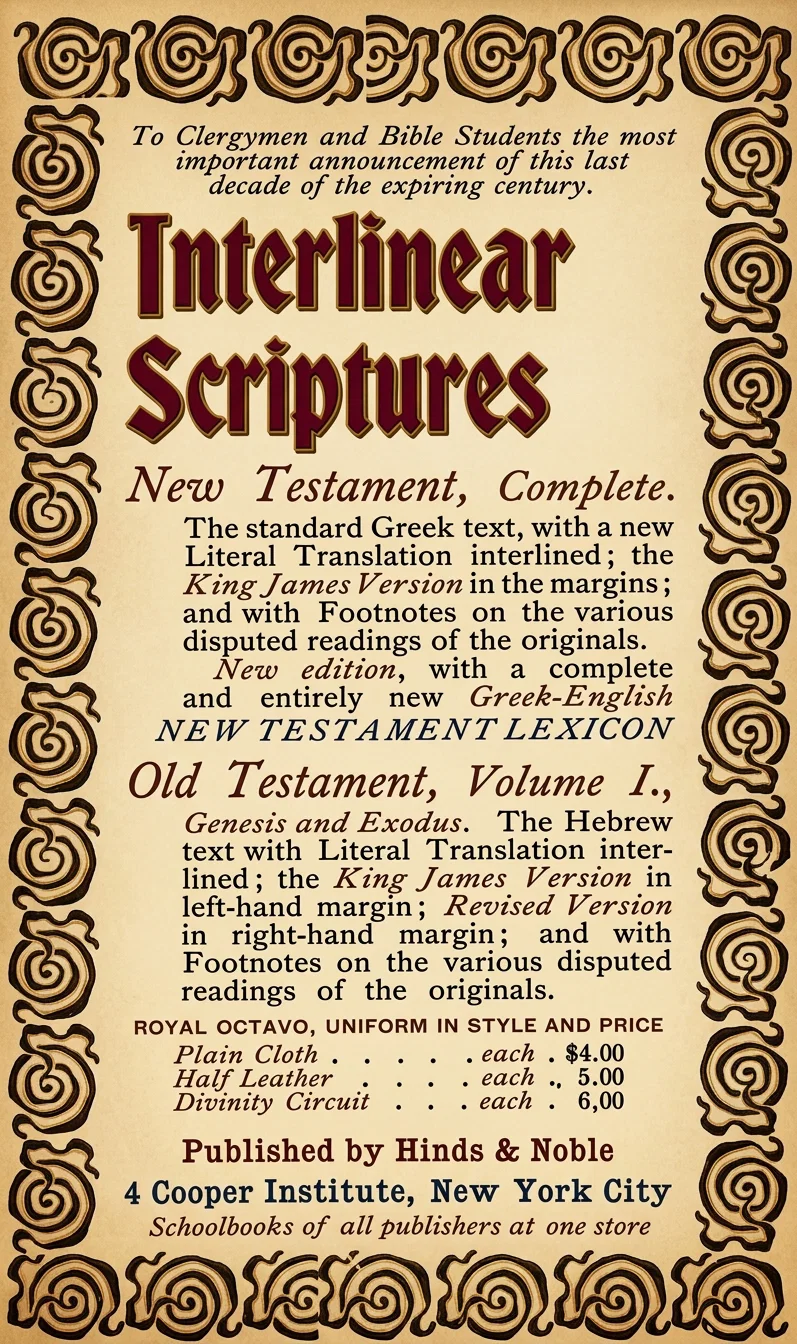
Interlinear Scriptures
To Clergymen and Bible Students the most important announcement of this last decade of the expiring century.
Interlinear Scriptures
New Testament, Complete.
The standard Greek text, with a new Literal Translation interlined; the King James Version in the margins; and with Footnotes on the various disputed readings of the originals.
New edition, with a complete and entirely new Greek-English NEW TESTAMENT LEXICON
Old Testament, Volume I.,
Genesis and Exodus. The Hebrew text with Literal Translation interlined; the King James Version in left-hand margin; Revised Version in right-hand margin; and with Footnotes on the various disputed readings of the originals.
ROYAL OCTAVO, UNIFORM IN STYLE AND PRICE
Plain Cloth . . . each . $4.00
Half Leather . . . each . 5.00
Divinity Circuit . . . each . 6.00
Published by Hinds & Noble
4 Cooper Institute, New York City
Schoolbooks of all publishers at one store
When you write, please mention the SIGNS OF THE TIMES.