Signs of the Times, Vol. 42, No. 17.

Will Sinners Have Another Chance?

Signs of the Times

Apr 27, 1915

Pacific Press Publishing Association · Mountain View, California · Apr 27, 1915

Will Sinners Have Another Chance?

Shall Men Be Encouraged to Sin by a False Hope?—The “Second Death,” but No “Second Chance”
By George B. Thompson
The “age to come” or “second chance” doctrine is a very convenient religion, and pleasing to the natural heart. As all are told that they will have “another chance,” it practically says to the ungodly: “Live as you desire. Take your fill of sin. Gratify all your carnal propensities. Get all you can out of this world. And in the age to come, for a thousand years you can repent, and make your calling and election sure for the life to come.” We know of no doctrine calculated to detain souls more than this.
One verse in the word of God disposes of this damnable heresy most effectively: “But the rest of the dead lived not again until the thousand years were finished.” Rev. 20:5.

The Binding of Satan

This scripture stands in connection with the record of the binding of Satan during the thousand years, the millennium, and seems to have been written expressly to guard against the heresy of a future probation. It completely overthrows the whole system of Millennial Dawn theology concerning the so-called “second chance” in the millennial age.

Two Resurrections

Two resurrections are brought to view, as a first implies a second. The period that intervenes between these two resurrections is clearly stated to be a thousand years. Some live, but “the rest” remain in the embrace of death until the thousand years are finished. Those who live in the first resurrection are the righteous. “Blessed and holy is he that hath part in the first resurrection.” Rev. 20:6.
This resurrection of the overcomers takes place at the second coming of Christ, when He appears attended by all the angels in heaven, to reap the harvest of the earth, and gather into His garner the sheaves separated forever from the tares of sin. “For the Lord Himself shall descend from heaven with a shout, with the voice of the Archangel, and with the trump of God: and the dead in Christ shall rise first.” 1 Thess. 4:16.
As “the dead in Christ,” the righteous, all live in “the first resurrection,” which takes place when Jesus comes, “the rest of the dead” can refer only to the wicked. This is the only millennial period marked off in the Bible, and is the very period the Millennial Dawn teaching has in mind when it talks of that “golden age” in which the lost will have “a second probation,” or “another chance,” under more “favorable circumstances”; when the heathen will hear the gospel, and be converted. But we are told in this scripture, in language so plain that the meaning cannot possibly be misunderstood, that the heathen, the Sodomites, the Amalekites, and others who are especially mentioned as having a “second chance,” are all dead.

No Chance for Converts There

During this entire millennial period, in this so-called “golden age,” instead of being alive and listening to the gospel, they are sleeping in the tomb. The one thousand years are bounded at either end by a resurrection, making mistake impossible asto when they begin or end. They are ushered in by the resurrection of the righteous, and close with a resurrection of the wicked, who “live not” until this millennial period has passed.
How, then, are these unnumbered millions of the incorrigible to hear the gospel? Can these corpses believe and repent? If the work of the church is the proclamation of the gospel to the lost during the one thousand years, it will be a gloomy task indeed. As well go out now into the cemetery and conduct evangelistic services, and expect converts.
And this is the “second chance” to which the rebels against the government of heaven are bidden to look forward. Surely it is a vain hope. So long as this text stands in God’s word, there cannot be held out to sinners the faintest promise of a “golden age” in which all will have “another opportunity” to forsake their ungodly ways and serve the Lord.

Try to Mutilate the Bible

The advocates of the Millennial Dawn see this. Nobody, it would seem, could help seeing it. Something must be done to save their entire system of faith from being wrecked by this plain statement of the Word. In some way the troublesome scripture must be disposed of. And this is the way they do it:
“In this verse (Rev. 20:5) the words, ‘But the rest of the dead lived not again until the thousand years were finished,’ are spurious. They are not found in the oldest and most reliable Greek manuscripts, the Sinaitic, Vatican Nos. 1209 and 1160, nor the Syriac manuscript. We must remember that many passages found in the modern copies are additions which do not properly belong to the Bible. Since commanded not to add to the word of God, it is our duty to repudiate such additions as soon as their spurious character is established. The words indicated probably crept into the text by accident, in the fifth century; for no manuscript of earlier date (either Greek or Syriac) contains this clause. It was probably at first merely a marginal comment made by a reader, expressive of his thought upon the text, and copied into the body of the text by some subsequent transcriber who failed to distinguish between the text and the comment.”—“Plan of the Ages,” volume 1, pages 288, 289, note.
The statement that there are “many passages” in “modern copies” of the Bible “which do not properly belong” in the inspired record, is a claim similar to that put forth by that modern phase of infidelity known as “higher criticism.” The tendency of all such statements is to cast suspicion upon the Word, and weaken faith in the Bible as an unerring guide.

The Text According to Unimpeachable Authority

It is necessary for them to impeach this witness, else the fable of a future probation is revealed. But there is no authority for discrediting the inspiration of the text, unless it be the statement of the author of the book from which the preceding extract is taken; and this is hardly sufficient.
The English edition of the Revised Version makes no reference to this text as being “not found” in ancient Greek manuscripts.
The American Revised Version, which is admitted by the ripest scholars in the land to be the best translation of the Holy Scriptures extant, does not give the slightest hint that a part of the text is omitted in “the most reliable Greek manuscripts.”
Rotherham’s translation, another excellent work, though noting elsewhere “doubtful” renderings, says nothing about this text’s being spurious.
The Interlinear translation also puts this text on the same basis as other portions of the Holy Scriptures.
It is found in Young’s translation also, without any hint of its being some “marginal comment.”
Sawyer’s translation contains it, also the Twentieth Century New Testament.
In the translation from the Greek text of Von Tischendorf it is found unquestioned.
The Emphatic Diaglott, based on Griesbach’s text, gives this verse, and in a footnote says: “These words [‘the rest of the dead lived not again till the thousand years were finished’] were probably omitted by oversight in Vatican manuscript (No. 1160), as they are found in A, B, C, though not in the Syriac.” By “A” is meant Codex Alexandrinus; by “B,” Codex Vaticanus, No. 206, of the seventh or eighth century; by “C,” Codex Ephraemi Rescriptus.
Finally, the best Greek text, that of Westcott and Hort, contains the passage; and neither have the Revised Versions or any of the critics, so far as we know, even questionedit.
Neither Dr. Adam Clarke nor Dr. Bliss, in their comments on this scripture, offers any objection to its genuineness. They had access to these Greek manuscripts, and had some opportunity to know if these words were only a “marginal comment” which was mixed in accidentally. All these, and scores of other good scholars, who have had opportunity for the most extended research, pronounce the text genuine. The clause in question is considered spurious only by those who have a doctrine to prove which the text condemns.

How Satan Is Let Loose

Satan is bound by circumstances in the earth, made desolate at the coming of Christ. At that time, the saints are all taken to heaven, and the wicked are slain. Then, confined in the earth, compelled to wander amid the ruin his own hands have wrought, with none to tempt or annoy, he will indeed be “bound.”
At the end of this millennium of darkness and chaos, he is loosed through a reversal of the events which bound him. The city of God, with all the saints, descends from heaven on the earth (Rev. 21:1–3; Zech. 14:4, 5), and the wicked dead are raised. Satan again has access to his deluded children, and begins his work of deception. He marshals his legions in battle array, and surrounds the camp of the saints. This is the first and only time the entire family of Adam stand on the earth together. Then the wicked will see Abraham, Isaac, and Jacob, and all the saved, in the kingdom of heaven, and they themselves be cast out.

The Second Death Instead of a Second Chance

But does the church, the “royal priesthood,” begin the work of preaching to them the gospel? Does a power which they “will strive in vain to resist” seize hold of them? Is a “second chance” held out to them?—Not by any means. “And they [the wicked] went up on the breadth of the earth, and compassed the camp of the saints about, and the beloved city: and fire came down from God out of heaven, and devoured them.” Rev. 20:9.
Instead of the “second chance” will be “the second death.” Verse 14. They will be consumed, root and branch. Mal. 4:1. Sin and sinner will thereafter be no more. The entire universe will be clean, and the great controversy forever ended.
“To-day is the day of salvation.” Christ lightens every man who comes into the world. If any fail to accept the light in this life, they have no further chance beyond the resurrection.

Divine Blessing to This Mourner

The Sorrow That May Be Healed—The Most Precious Boon to Mankind
By Rufus A. Underwood
This is the second of several short articles by Elder Underwood on the fundamentals of the gospel. In a time when there is so much confusion on the subject, the matter is very timely. Editor.
“Blessed are they that mourn: for they shall be comforted.” Matt. 5:4. The grief and anguish of this world, that come as the heritage of disappointment, disease, and death, which every man in a sinful world must meet more or less, is not primarily the sorrow that Christ refers to. The mourning He is considering is the second step in order that must be taken by the one who has felt his great need of salvation; namely, to have a heartfelt sorrow for sin, which leads him to confess and forsake his wrongdoing. It is the godly sorrow that works repentance, expressed by the apostle Paul in 2 Cor. 7:10: “For godly sorrow worketh repentance to salvation not to be repented of: but the sorrow of the world worketh death.”

The Comforter First Reproves

No man will ever receive pardon until he is ashamed of his sin, and is ready to confess and forsake the same. The Comforter, Christ’s representative, comes first as a reprover of sin. Christ said: “It is expedient for you that I go away: for if I go not away, the Comforter will not come unto you; but if I depart, I will send Him unto you. And when He is come, He will reprove the world of sin.” John 16:7, 8.

He Shall Have Mercy

All those who accept the reproof and have godly sorrow for sin have the assurance, “He that covereth his sins shall not prosper: but whoso confesseth and forsaketh them shall have mercy.” Prov. 28:13. This is the explicit condition upon which pardon is promised. “Blessed is he whose transgression is forgiven, whose sin is covered.” Ps. 32:1. “If we say that we have no sin, we deceive ourselves, and the truth is not in us. If we confess our sins, He is faithful and just to forgive us our sins, and to cleanse us from all unrighteousness.” 1 John 1:8, 9.
David has said it is the glory of God to conceal or cover our sin, and to this end Christ has died for us, as expressed in 1 John 3:5: “And ye know that He was manifested to take away our sins; and in Him is no sin.”

His Sins to Be Covered

The precious promise that God will hide our sins from view, and cover us with His own robe of perfect righteousness, is Heaven’s plan of putting away sin from the individual character, and is beautifully expressed by the prophet Ezekiel in these words: “I decked thee also with ornaments, . . . and a beautiful crown upon thine head. . . . And thy renown went forth among the heathen for thy beauty: for it was perfect through My comeliness, which I had put upon thee, saith the Lord God.” Eze. 16:11-14.
Before the individual can be decked with the light of heaven, and be robed in the character of Christ, he must manifest a godly sorrow and repentance for his guilt. This assures the individual of the comfort of God’s grace and pardon. What can be more comforting than to know that your sin is pardoned and covered?

“The Most Precious Promise to Me”

Some time ago, in our family worship, after we had read some of the precious promises of God, I asked members of the family what promises came to mind that seemed most precious. After my wife had quoted several very precious promises, I asked my son Robert what was the most precious promise to him that he could call to mind in all the Bible. With tearful eyes, he replied, “Father, the promise Jesus has made that He will forgive is the most precious to me.” Surely all the other promises would be in vain if we did not know that Jesus forgives.
The prophet Isaiah had this same thought in mind when he exclaimed: “Comfort ye, comfort ye My people, saith your God. Speak ye comfortably to Jerusalem, and cry unto her, that her warfare is accomplished, that her iniquity is pardoned.” Isa. 40:1, 2. The Master uttered the sweetest message that ever fell from His lips when He said to a poor, afflicted soul, “Son, be of good cheer [or comfort]; thy sins be forgiven thee.” Matt. 9:2. “Blessed are they that mourn: for they shall be comforted.”

SPARE IT YET THIS YEAR

The Fruitless Tree Was Doomed—Its Opportunity Was Prolonged—How the Master Yearned and Labored over His Stubborn People
By Mrs. E. G. White
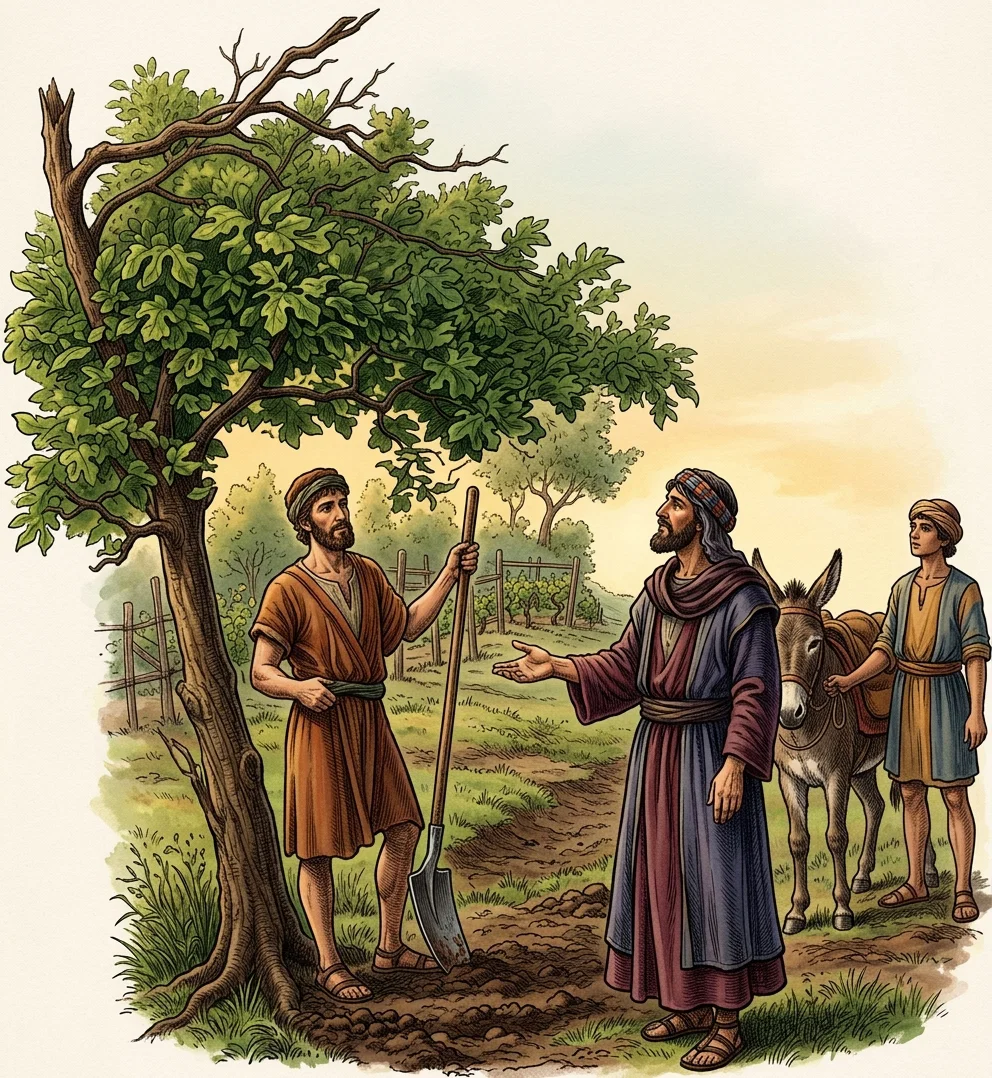
CHRIST, in His teaching, linked with the warning of judgment the invitation of mercy. “The Son of man is not come,” He said, “to destroy men’s lives, but to save them.” “God sent not His Son into the world to condemn the world; but that the world through Him might be saved.” Luke 9:56; John 3:17. His mission of mercy, in its relation to God’s justice and judgment, is illustrated in the parable of the barren fig tree. “A certain man had a fig tree planted in his vineyard; and he came and sought fruit thereon, and found none. Then said he to the dresser of his vineyard, Behold, these three years I come seeking fruit on this fig tree, and find none: cut it down; why cumbereth it the ground?” Luke 13:6, 7.

Had Received His Special Care

Christ’s hearers could not misunderstand the application of His words. David had sung of Israel as the vine brought out of Egypt. Isaiah had written, “The vineyard of the Lord of hosts is the house of Israel, and the men of Judah His pleasant plant.” Isa. 5:7. The generation to whom the Saviour had come were represented by the fig tree in the Lord’s vineyard within the circle of His special care and blessing.
“Let it alone this year also, till I shall dig about it, and dress it: and if it bear fruit, well.”
God’s purpose toward His people, and the glorious possibilities before them, had been set forth in the beautiful words, “That they might be called trees of righteousness, the planting of the Lord, that He might be glorified.” Isa. 61:3. The dying Jacob, under the Spirit of inspiration, had said of his best-loved son, “Joseph is a fruitful bough, even a fruitful bough by a well; whose branches run over the wall.” And he said, “The God of thy father” “shall help thee,” the Almighty “shall bless thee with blessings of heaven above, blessings of the deep that lieth under.” Gen. 49:22, 25. So God had planted Israel as a goodly vine by the wells of life. He had made His vineyard “in a very fruitful hill.” He had fenced it, and gathered out the stones thereof, and planted it with the choicest vine. Isa. 5:1, 2.

“It Brought Forth Wild Grapes”

“And He looked that it should bring forth grapes, and it brought forth wild grapes.” Verse 2. The Jews of Christ’s day made a greater show of piety than did the Jews of earlier ages, but they were even more destitute of the sweet graces of the Spirit of God. The precious fruits of character that made the life of Joseph so fragrant and beautiful, were not manifest in the Jewish nation.
God in His Son had been seeking fruit, and had found none. Israel was a cumberer of the ground. Its very existence was a curse; for it filled the place in the vineyard that a fruitful tree might fill. It robbed the world of the blessings that God designed to give. The Israelites had misrepresented God among the nations. They were not merely useless, but a decided hindrance. To a great degree their religion was misleading, and brought ruin instead of salvation.

Give It One More Year

In the parable, the dresser of the vineyard does not question the sentence that the tree, if it remained fruitless, should be cut down; but he knows and shares the owner’s interest in that barren tree. Nothing could give him greater joy than to see its growth and fruitfulness. He responds to the desire of the owner, saying, “Let it alone this year also, till I shall dig about it, and dung it; and if it bear fruit, well.” Luke 13:8, 9. The gardener does not refuse to minister to so unpromising a plant. He stands ready to give it still greater care. He will make its surroundings most favorable, and will lavish upon it every attention.
Jesus did not in the parable tell the result of the gardener’s work. At that point His story was cut short. Its conclusion rested with the generation that heard His words. To them the solemn warning was given, “If not, then after that thou shalt cut it down.” Verse 9. Upon them it depended whether the irrevocable words should be spoken. The day of wrath was near. In the calamities that had already befallen Israel, the Owner of the vineyard was mercifully forewarning them of the destruction of the unfruitful tree.

The Warning to Us Also

The warning sounds down along the line to us in this generation. Are you, O careless heart, a fruitless tree in the Lord’s vineyard? Shall the words of doom erelong be spoken of you? How long have you received His gifts? How long has He watched and waited for a return of love? Planted in His vineyard, under the watchful care of the gardener, what privileges are yours! How often has the tender gospel message thrilled your heart! You have taken the name of Christ, you are outwardly a member of the church which is His body, and yet you are conscious of no living connection with the great heart of love. The tide of His life does not flow through you. The sweet graces of His character, “the fruits of the Spirit,” are not seen in your life.
The barren tree receives the rain and the sunshine and the gardener’s care. It draws nourishment from the soil. But its unproductive boughs only darken the ground, so that fruit-bearing plants cannot flourish in its shadow. So God’s gifts, lavished upon you, convey no blessing to the world. You are robbing others of privileges that, but for you, might be theirs.

His Mercy Has Spared You

You realize, though it may be but dimly, that you are a cumberer of the ground. Yet in His great mercy God has not cut you down. He does not look coldly upon you. He does not turn away with indifference, or leave you to destruction. Looking upon you He cries, as He cried so many centuries ago concerning Israel: “How shall I give thee up, Ephraim? how shall I deliver thee, Israel? . . . I will not execute the fierceness of Mine anger, I will not return to destroy Ephraim: for I am God, and not man.” Hosea 11:8, 9. The pitying Saviour is saying concerning you, Spare it this year also, till I shall dig about it and dress it.

All That Heaven Could Give

With what unwearied love did Christ minister to Israel during the period of added probation! Upon the cross He prayed, “Father, forgive them; for they know not what they do.” Luke 23:34. After His ascension, the gospel was preached first at Jerusalem. There the Holy Spirit was poured out. There the first gospel church revealed the power of the risen Saviour. There Stephen—“his face as it had been the face of an angel”—bore his testimony and laid down his life. Acts 6:15. All that heaven itself could give was bestowed. “What could have been done more to My vineyard,” Christ said, “that I have not done in it?” Isa. 5:4. So His care and labor for you are not lessened, but increased. Still He says: “I the Lord do keep it; I will water it every moment: lest any hurt it, I will keep it night and day.” Isa. 27:3.
“If it bear fruit, well: and if not, then after that”—The heart that does not respond to divine agencies becomeshardened until it is no longer susceptible to the influence of the Holy Spirit. Then it is that the word is spoken, “Cut it down.”
To-day He invites you: “O Israel, return unto the Lord thy God. . . . I will heal their backsliding, I will love them freely. . . . I will be as the dew unto Israel: he shall grow as the lily, and cast forth his roots as Lebanon. . . . They that dwell under his shadow shall return; they shall revive as the corn, and grow as the vine. . . . From Me is thy fruit found.” Hosea 14:1-8.
And the stars of heaven fell unto the earth, even as a fig tree casteth her untimely figs, when she is shaken of a mighty wind.

Celestial Fireworks

Significant Display of Shooting Stars—Had Been Predicted for Centuries—What Is the Significance?
By Calvin P. Bollman
In our Lord’s great prophecy of the signs that should precede His coming, He foretold, among other things, the greatest display of celestial fireworks ever witnessed since the Creator first spread out the richly bejeweled heavens before the admiring gaze of the universe, “when the morning stars sang together, and all the sons of God shouted for joy.”

The Stars Shall Fall

“The stars shall fall from heaven,” said our Saviour, “and the powers of the heavens shall be shaken.” Matt. 24: 29. Commenting upon this scripture in 1697, Bishop Burnett said: “From the very nature of things, this cannot be understood either of fixed stars or planets. . . . It is necessary, therefore, by these stars, to understand either fiery meteors falling from the middle regions of the air, or blazing comets and stars. No doubt there will be all sorts of fiery meteors at that time; and among others, those that are called falling stars.”—Burnett’s “Sacred Theory of the Earth,” page 486.
November 13, 1833, our Saviour’s words, so clearly explained by the good bishop 136 years before the event, were most strikingly fulfilled. We take the following account of this wonderful phenomenon from “Burritt’s Geography of the Heavens,” a work on astronomy published in 1854, page 163:

Fireballs Cover the Vault of Heaven

“But the most sublime phenomenon of shooting stars of which the world has furnished any record, was witnessed throughout the United States on the morning of the thirteenth of November, 1833. The entire extent of this astonishing exhibition has not been precisely ascertained; but it covered no inconsiderable portion of the earth’s surface. . . . The first appearance was that of fireworks of the most imposing grandeur, covering the entire vault of heaven with myriad of fireballs, resembling skyrockets. Their coruscations were bright, gleaming, and incessant, and they fell thick as the flakes in the early snows of December. To the splendors of this celestial exhibition the most brilliant skyrockets and fireworks of art bear less relation than the twinkling of the most tiny star to the broad glare of the sun. The whole heavens seemed in motion, and suggested to some the awful grandeur of the image employed in the Apocalypse, upon the opening of the sixth seal, when ‘the stars of heaven fell unto the earth, even as a fig tree casteth her untimely figs, when she is shaken of a mighty wind.’”

No Language Can Meet It

The Christian Advocate and Journal, of New York, in its issue of December 13, 1833, said: “The meteoric phenomenon which occurred on the morning of the thirteenth of November last, was of so extraordinary and interesting a character as to be entitled to more than a mere passing notice. . . . The lively and graphic descriptions which have appeared in various public journals do not exceed the reality. No language, indeed, can come up to the splendor of that magnificent display; and I hesitate not to say that no one who did not witness it, can form an adequate conception of its glory. It seemed as if the whole starry heavens had congregated at one point near the zenith, and were simultaneously shooting forth with the velocity of lightning, to every part of the horizon; and yet they were not exhausted—thousands swiftly followed in the track of thousands, as if created for the occasion.”

Shaken by a Mighty Wind

The same occurrence was foretold not only by our Lord when He was on earth, but in Rev. 6: 13 the prophet says, “And the stars of heaven fell unto the earth, even as a fig tree casteth her untimely figs, when she is shaken of a mighty wind.”
All observers of the great meteoric shower of November 13, 1833, seemed to be impressed with the fact that while all shooting stars or meteors seen upon that occasion appeared to come from a single point in the heavens, they fell in different directions, much as unripe fruit would fall or be thrown from a tree by a violent wind. Some of the figs or other fruit would be taken off by the violence of the wind, and would be carried in the direction of the gale, while others would be thrown from the twigs by the rebound of the limbs, and would be thrown against the storm. No one who has picked up fruit under a tree after a violent storm, can fail to have noted this fact.

The Impression That Was Made

Almost every one who described the remarkable phenomenon, seems to have been impressed, at least while witnessing it, that it was a sign of the speedy approach of the day of God, if indeed it was not directly to usher in that terrible event. Horace Greeley, writing in the New York Tribune of June 4, 1859, said: “While a mere lad, I was waked in the night to see a pale, frightened face bending over me, and to hear: ‘Get up! Get up! the day of Judgment has come, I believe, for the stars are all falling!’”
“Old Countryman,” writing to the Connecticut Observer of November 25, 1833, said: “The time is just at hand, described not only in the New Testament but in the Old. A more correct picture of a fig tree casting its leaves [unripe figs] when blown by a mighty wind, it is not possible to behold.”

Not Invalidated by Lapse of Time

It is true this sign is now many years in the past. There are now few living who witnessed that grand and awe-inspiring display of celestial fireworks. But so did many years elapse between the time when Noah began to announce his message, and the beginning of the Flood. “Because sentence against an evil work is not executed speedily, therefore the heart of the sons of men is fully set in them to do evil.” Eccl. 8: 11.
But the flight of time makes no difference with either the promises or the threatenings of the Lord. In respect of ability to bring to pass that which He has spoken, “one day is with the Lord as a thousand years, and a thousand years as one day.” He who inhabits eternity, lives to fulfill His word; and He will fulfill it to the letter, as He has done in the past, when His great clock of time strikes the eventful hour. The end draws on apace. “Prepare to meet thy God.”

“Amen”

“AMEN,” or “So let it be,” is a responsive utterance to confirm what has been said. It is of ancient origin. Deut. 27: 15-26. “And all the people said, Amen, and praised the Lord.” 1 Chron. 16: 36. The response is seldom heard in the churches of to-day, except from the pulpit. A reverential “Amen” from the heart of the sincere worshiper in the congregation is acceptable to God, and adds to the impressiveness of His worship. ELIZA H. MORTON.

Stumbling Over the Moral Law

“A MAN does not stumble over the moral law until he tries to cross it.”

The Law and the Gospel

How Sin Is Revealed—How It Is Taken Away—The Happy Condition That Follows
By A. C. Gilbert
Man’s character was perfect by creation. His attitude toward his Creator was one of confidence, loyalty, and integrity. He served God in a perfectly natural manner. Every manifestation of interest in the character and work of the Lord was an absolutely natural act.

Was “Perfectly Natural”

Man, in this sinless state, exercised his functions in fullest harmony with the perfect law that was ordained to govern in the sphere of perfect moral nature. Indeed, it was the complete, perfect recognition of and obedience to God’s holy, perfect moral law which enabled man, before sin entered the world, always to please to the highest degree his Maker. He acted, as we often say, “perfectly natural.”

A Change in This Nature

But a regrettable change has come. Upon the face of nature in general, and moral nature in particular, is seen the stain of sin. Man to-day possesses a nature that is diametrically opposed to the nature with which God endowed him in the beginning by the direct act of creative power.
It is vividly described by the apostle Paul in the following words: “There is none righteous, no, not one: there is none that understandeth, there is none that seeketh after God. They are all gone out of the way, they are together become unprofitable; there is none that doeth good, no, not one. Their throat is an open sepulcher; with their tongues they have used deceit; the poison of asps is under their lips: whose mouth is full of cursing and bitterness: their feet are swift to shed blood: destruction and misery are in their ways: and the way of peace have they not known: there is no fear of God before their eyes.” Rom. 3:10-18. They are enemies of God. Rom. 8:7; James 4:4. This is the darksome picture of man as he “acts perfectly natural” to-day.
Though man sinned—changed his character—this does not affect the nature and authority of the perfect moral standard that was his guide in the days of his perfection. Since man is invited by the Saviour to give up his sinful character for the perfect character he had in the beginning, it logically follows that the very same perfect law which regulated that sinless life in the beginning must exist to-day as the moral standard, in order to bring man back into harmony with the perfect will of God.

The Carnal Mind Is Enmity

The sinful nature of man is opposed to the plans and purposes of God. “Because the carnal mind is enmity against God: for it is not subject to the law of God, neither indeed can be.” Rom. 8:7. The law that governs the character of sin is in direct opposition to the law that governs the character of righteousness. Rom. 7:12 to 8:3. The purposes of the law are: (1) To define sin. 1 John 3:4. (2) To detect sin. Rom. 3:20; 7:7. As it enters the inmost recesses of heart and mind, searching for sins that lie in wait to deceive, the law becomes (3) a mirror reflecting the imperfections and stains revealed in the face of sinful character. James 1:22-25. (4) As the law manifests the inconsistencies and contradictions in the life because of sin, it becomes a reprover of wrong. Rom. 3:19; 7:7-13. (5) In fulfilling these purposes, the law becomes a standard of righteousness. It is itself a holy and righteous instrument. Rom. 7:12; James 1:25; Ps. 19:7; 111:7, 8.

Pointing to the Way Out

Though the law is righteous and perfect, yet it can impart no righteousness to the individual who stands before it condemned to the death penalty. 1 John 3:4; Rom. 6:23; 5:12; James 1:15. In the light of the purposes of the law, as stated above, man, as a sinner, stands hopeless and helpless until he discovers that the law is not only a revealer of sin, but is, as it were, a finger board directing him to Jesus, whose sinless life met the fullest just demands of the broken law, and whose precious blood can cleanse from every sin. Gal. 4:4, 5; 3:23, 24; 1 Peter 2:22; 2 Cor. 5:21; Gal. 3:13; 1 John 1:7, 9; 1 Peter 1:18, 19.
This righteousness which is imputed to us, or placed to our account, is “the righteousness of God” provided apart from that contained in the law. Seeing that the law cannot give of its righteousness to the sinner, therefore “apart from the law a righteousness of God hath been manifested,” which is the superabundant righteousness of Jesus Christ. Rom. 3:21, 22, R.V.

Power unto Salvation

We see the helplessness of man in the eyes of the justice of the law, and how through Jesus provision has been made to save him fully from the extreme penalty of the transgressed holy law of heaven. Heb. 7:25. The gospel is the revelation of this condescension, and contains within itself “the power of God unto salvation.” Rom. 1:16. The gospel, the plan of the ages, provides the pool into which all may plunge and find complete, perfect cleansing from the filth of sin.
Following the instruction given by the law, the willing heart has gone to the gospel fountain (Zech. 13:1), the Saviour, and found rescue from “the miry clay,” and has been taught to sing “a new song.” Ps. 40:1-3. Now he returns to the mirror, the law. James 1:25. And what does it say? It approves his conduct. It testifies to the fact that the person who stood before it previously as a sinner is not unrighteous now, but is righteous, has been converted, and is in harmony with the perfect purpose of the mirror, the law, because he has been justified by “the righteousness which is of God by faith” in Jesus Christ. See especially Phil. 3:9; Rom. 3:21-26, R.V.; Gal. 3:22-24.

The Law and the Man in Harmony

There is perfect agreement now between the law and the man who is justified by faith. It no longer stands to condemn. Gal. 3:25, 26. That agreement, and that approbation of the law in behalf of the man justified by the blood of Christ, will remain as long as the man maintains his loyalty to the banner of Prince Immanuel. But the moment he neglects one spiritual duty, and is made conscious of that neglect by the Holy Spirit, that very moment the righteous law arises to reprove and condemn. Either one or both of the principles upon which hangs all the law—love to God and love to man (Matt. 22:36-40)—has been violated, and the conscience feels condemned.
It is thus made clear that the law is not done away, or abolished, after one has become converted—justified by faith in Christ.Paul says: “Do we then make void the law through faith? God forbid: yea, we establish the law.” Rom. 3:31. Through the righteousness of Jesus Christ we are freed from the condemnation of the law, but not from its authority.

“Beware of Antinomianism”

The “Baptist Church Manual” has this to say in reference to the law: “We believe that the law of God is the eternal and unchangeable rule of His moral government; that it is holy, just, and good.”
Martin Luther emphatically avers: “I wonder exceedingly how it came to be imputed to me that I should reject the law of Ten Commandments. . . . Can it be imagined that there should be any sin where there is no law? Whosoever abrogates the law must of necessity abrogate sin also.”—“Spiritual Antichrist.”
John Wesley says, “Beware of antinomianism, making void the law, or any part of it, through faith.”—“Christian Perfection.”

The Great Peace That Comes

The attitude that every Christian should assume toward the law of God, the Ten Commandments, is beautifully expressed by the psalmist: “O how love I Thy law! it is my meditation all the day.” “I understand more than the ancients, because I keep Thy precepts.” “Through Thy precepts I get understanding: therefore I hate every false way.” “Great peace have they which love Thy law: and nothing shall offend them.” Ps. 119:97, 100, 104, 105.
The heart that is liberated from the power of sin, and maintains its loyalty to the gospel of Christ, is free, during that blessed experience, from the condemnation of the law, and has “confidence toward God. And whatsoever we ask, we receive of Him, because we keep His commandments, and do those things that are pleasing in His sight.” 1 John 3:21, 22. “For this is the love of God, that we keep His commandments; and His commandments are not grievous.” 1 John 5:3.
Continue reading: THE RESPECTABLE SIN