Your ShelfYour Projects

Signs of the Times, Vol. 23, No. 21.

Editorial

Signs of the Times

May 27, 1897

Pacific Press Publishing Company · Oakland, California · May 27, 1897

Editorial

The Good Shepherd.—Jesus Christ is "the good Shepherd;" he is the one who laid down his life for the sheep. He left his own home of comfort and glory, and came to this world's lone, barren mountains of sin to seek and save the lost ones.
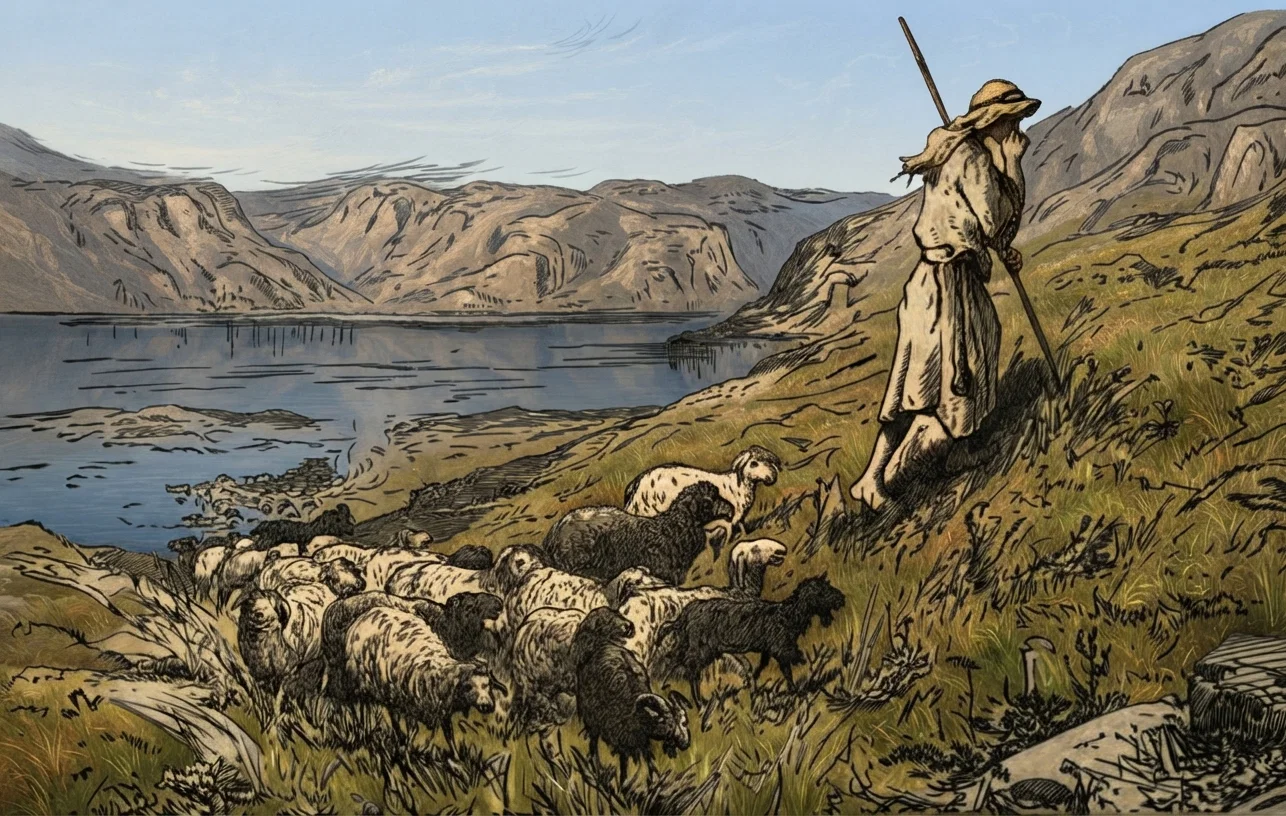
"Home of comfort," did we say? No, it was not, is not, comfort while the sheep were lost. He is infinite love, and love is pained with the pain of others. "In all their afflictions"—the afflictions of Israel—his flock—"he was afflicted;" and this is an eternal truth; for He is "the same yesterday, to-day, and forever." And as a good shepherd of earth could not rest content in sheltered home while members of his flock were astray on the wild, bleak moor or in the desolate, prey-seeking mountains, so the heart of the Good Shepherd could not rest in comfort while poor, sin-sick souls were wandering in the wilds of earth, subject to the fierce wolves of sin and the bleak, cold moors of eternal death.
He calleth His own sheep by name, and leadeth them out. And when He putteth forth His own sheep, He goeth before them, and the sheep follow Him; for they know His voice. John 10:3, 4.
He does not wait to find others to go. Out into the cold, starless night he plunges alone, willing to meet all that awaits him, only so that he saves the lost. He does not count the danger. Neither does he seek to arouse the lion in his den, nor the tiger in his lair. But he does not fear them; his mission is to save. And so he comes, and seeks, and suffers, and meets lion, and bear, and cold, and heat, and want, and strife, till at last he lays down his life, that he may save the lost one. Infinite love finds more comfort in the sacrifice that wins one soul than in the selfish comfort which is indifferent to the wants of others.

The Lesson which the Lord would teach to every lost soul is that there is hope. He thus brings salvation full and free. Sinner, you are the lost sheep; and that means every soul of man by nature. You are in the wild mountains, surrounded by beasts of prey, footsore, weary, disheartened, worthless, ready to die; yet the Good Shepherd sees you, and over the rough, hard way you went, he seeks you. In his great sacrifice he took upon himself your nature, bore your sins, suffered your woes and pains, endured your temptations, and all to save you.

Will You Not Be His Sheep?—It only means that you will follow him—no more than this, no less. When he lived a man, he submitted to the Father's will. "My meat is to do the will of Him that sent me." John 4:34. He said this by the shepherd king of Israel before he came: "Lo, I come; . . . I delight to do thy will, O my God; yea, thy law is within my heart." Ps. 40:7, 8. God's will is therefore his holy law, and in this law Jesus Christ, the Good Shepherd, delighted, because it was in his heart. His heart was in harmony with the law; he was submitted to its every precept. All who in Christ submit to that same law are members of Christ's flock. He counts them as his very own.

"He Goeth before Them."—Mark his loving care. Altho they are in the world, meeting its temptations, altho seemingly thrust out from home and friends, they are not alone; he goeth before them. How unlike many of the false shepherds of earth who endeavor to drive the flock of God! They seem to have obtained their conception of a shepherd from the west, where sheep are driven, oftentimes by dogs. But the true, oriental shepherd, from whom our Lord draws his illustration, does not drive his flock; he leads, he goes before, he goes with. He does not even send us alone; he says, "Follow me."

"He leadeth me, O blessed thought!" Every step of the way is marked by his footprints. He has met every trial, conquered in every temptation. He takes us over no strange ground to him. "He knoweth the way that I take." He walks with us in the way.

"My Sheep Hear My Voice."—His sheep are those who follow him in submitting with entire and willing surrender to "the will," "the law," "the commandments," the "good-pleasure" of the all-wise God. That law was spoken from heaven by the voice of God (Deut. 5:22); by Christ, the Sent of God; for he is the Word "by whom are all things" (1 Cor. 8:6). While therefore the voice which spoke God's unchangeable law was the voice of God the Father, it was also the voice of God the Son. The law of God is preëminently the voice of the great Shepherd of the sheep, the one unchangeable voice. He who knows that voice knows that by which all other voices may be tested. When the heart is submitted to God's law, the whole being is attuned to his nature. His Son speaks in harmony with that law; and his apostles and messengers bear a message in harmony with that law; so that if one hears Christ, they will hear his servant. John 15:20. His Spirit will lead and teach in harmony with that, for that law is "the law of the Spirit of life." Rom. 8:2.

What a Babel of voices there now is! "Lo, heres," and "Lo, theres," are heard on every side, and multitudes are deceived. Many are led by men. Others suppose they are led by the Spirit of Christ when it is the spirit ofantichrist, because it leads away from God's law and Christ's life. Still others walk in the imagination of their own heart, and think they are following God. They are deceived. Would we test them?—'To the law and to the testimony: if they speak not according to this word, it is because there is no light in them.' Isa. 8:20. Our Lord teaches the same truth: 'Not every one that saith unto me Lord, Lord, shall enter into the kingdom of heaven; but he that doeth the will of my Father which is in heaven.' Matt. 7:21. God would have us so know his voice that we neither shall be deceived by others or in ourselves.

The Good Shepherd.—Follow him. He will never forget us, and until we reject him forever, he will not leave us. Even in his rod of discipline, there is comfort. In the valley of the shadow of death there is no cause to fear. He will lead us all the way, and bring us to Zion. He is the Author and Finisher of our faith. He says: 'Fear thou not; for I am with thee; be not dismayed; for I am thy God. I will strengthen thee, yea, I will help thee, yea, I will uphold thee with the right hand of my righteousness.' 'When thou passest through the waters, I will be with thee; and through the rivers, they shall not overflow thee; when thou walkest through the fire, thou shalt not be burned; neither shall the flame kindle upon thee.' 'And even to your old age I am he; and even to hoar hairs will I carry you: I have made, and I will bear; even I will carry, and will deliver you.' 'I am the Good Shepherd; and I know mine own, and mine own know me, even as the Father knoweth me, and I know the Father.' Blessed Shepherd, indeed! Who would not follow him?

Publishers and Terms

(Entered at the Post-office in Oakland.)
For Publishers and Terms, see page 15.

Mother Love.

A leaflet sent out by the Woman Suffrage movement tells us that when Miss Willard, years ago, was seeking and praying for a remedy to "be set over against the appetite of the drinker and the avarice of the saloon-keeper," this answer was whispered to her:—
Set over against the appetite of the drinker and the avarice of the saloon-keeper the undying mother love of the home.
A blessed answer indeed; but it has been perverted to be made the foundation of a woman suffrage movement. Now we are not going to discuss the question of woman suffrage, but we do say that "undying mother love of the home" has no necessary connection with it. Suffrage is demanded for political purposes, for compulsory measures, to compel saloon-keepers, and to restrain liquor-drinkers. But mother love is divine. It can not be compelled; it can not compel by political or civil force; it wins by a power stronger than all compulsion. It is that which binds the son to home and mother and God from the earliest infancy, and so furnishes a mighty bond of Christian manhood by which other men may be rescued and bound. It is a force which, to a limited extent, has been potent of good from the time of Eve, "the mother of all living," down to the present time; and there is no way by which the world can be more greatly helped to-day than by converting the mothers, not to political means, measures, or methods, but to "the undying mother love of the home," having its center and circumference in the love of God, through faith in the power of Christ Jesus. Woman suffrage may give women the "equal rights" they are clamoring for, but it will not give them more abundant grace or power for good.

THE EVERLASTING KINGDOM.

IN our last issue was presented in brief the great alphabetical symbolic prophecy of the Scriptures, the dream of Nebuchadnezzar. Under the symbol of a great metallic image was shown in epitome the rise and fall of the four great universal empires of the Bible, the head of gold representing Babylon, the original apostate kingdom; the breast and arms symbolizing Medo-Persia; the belly and thighs of brass standing for Grecia; and the legs of iron and feet of iron and clay symbolizing Rome in its united and divided states. The whole sweep of earthly empire is comprised in this brief prophecy. It begins at that kingdom which had its origin just this side of the Deluge, and carries us forward to the last of all earthly empires. But the vision does not pause here. After describing the image, the prophet proceeds:—
"Thou sawest till that a stone was cut out without hands, which smote the image upon his feet that were of iron and clay, and brake them to pieces. Then was the iron, the clay, the brass, the silver, and the gold, broken to pieces together, and became like the chaff of the summer threshing-floors; and the wind carried them away, that no place was found for them; and the stone that smote the image became a great mountain, and filled the whole earth." Dan. 2:34, 35.
This was the dream. What does this stone not of man symbolize? What does it mean? Here is the interpretation:—
"And in the days of these kings shall the God of heaven set up a kingdom, which shall never be destroyed; and the kingdom shall not be left to other people, but it shall break in pieces and consume all these kingdoms, and it shall stand forever. For as much as thou sawest that the stone was cut out of the mountain without hands, and that it brake in pieces the iron, the brass, the clay, the silver, and the gold; the great God hath made known to the king what shall come to pass hereafter; and the dream is certain, and the interpretation thereof sure." Verses 44, 45.
The stone which became a great mountain represents, therefore, a kingdom established of God. That stone primarily is Jesus Christ. "Behold, I lay in Zion for a foundation a stone, a tried stone, a precious corner-stone, a sure foundation." Isa. 28:16. The apostle Peter quotes this prophecy and applies it to the Lord Jesus Christ. 1 Peter 2:6-8. See also Ps. 118:22; Rom. 9:33, and others. But when is this kingdom of Christ set up? and how?
It is sometimes supposed that it was set up at the first advent of Christ, and from that time forward the kingdom of Christ was to progress, the stone to grow by accretion, till it embraced, or gathered to itself, all other kingdoms. Thus, it is said, the nations of earth are to become Christian; they will yield to Christ. One writer tells us that the kingdom of Christ will enter the world "through the gateway of politics," and then he will be "King of its camps, its courts, its cloisters." Congress and Legislatures are besieged to make this a "Christian nation" by law, or to acknowledge it as such. "National Reform" and "Christian Citizenship" are working on these political lines.
But all such views are erroneous, however honest may be those who cherish and promulgate them; and the greater the sincerity, the more potent for evil are such theories.
That these views are not scripturally correct may be seen from the following considerations:—
1. Jesus Christ did not come to establish his reign upon earth at his first advent. He expressly declared to Pilate, "My kingdom is not of this world;" it is not of the present order of kingdoms; it does not know the spirit and methods of the world; for "if my kingdom were of this world, then would my servants fight, that I should not be delivered to the Jews; but now is my kingdom not from hence." John 18:36. The nations that use worldly methods, that "war after the flesh" with "carnal weapons," are not Christian nations nor kingdoms of Christ. They are of the earth, earthy. As an avowed agnostical writer recently remarked, "it should be sufficient to say that if the modern Greek were a Christian, Christ was not." But the "Christian" Greek nation is of the same spirit and nature as the "Christian" English nation, the "Christian" Russian nation, the "Christian" American nation, or the "Christian" Austrian nation. Jesus said, "My kingdom is not of this world." Is not that sufficient?
2. When our Lord was here upon earth, the people wanted to make him a king. They would then have elected him, and the kingdom of Christ would have come "through the gateway of politics." But no, he refused, and "departed" from those who would thus honor him. John 6:15. When on the Mount of Temptation, the devil offered him the kingdoms of the world on certain conditions. Luke 4:5-8. But Jesus refused what now many of his followers seem too ready to accept. On the other hand, he taught by a striking parable that he must go away into "a far country [implying long absence] to receive for himself a kingdom, and to return." Luke 19:12. He is absent yet. His true servants are carrying out his instruction, "Occupy till I come." From hearts sick and weary of the world's wo, and sin, and folly, rises the oft-repeated petition, "Thy kingdom come." It is yet future.
3. The iron legs represent Rome in her united state; the intermixture of the clay, her division. If the kingdom of Christ were set up at his first advent, the stone should have smitten the image on the legs; but such was not the case. The stone smote the image on the feet, showing that the kingdom of Christ would not be established until the close of earthly rule.
4. Neither is our blessed Lord reigning a king upon the throne of his kingdom now. He sits a high priest "on the right hand of the throne of the Majesty in the heavens." Heb. 8:1; Ps. 110:1. While there, by his mediation and intercession he gathers out of all nations of earth his people, converts them, writes his law and the principles of his kingdom in the heart, and by his Spirit makes his abode there, till that time shall come when he shall gather all such home to his own glorious kingdom of light. To such he says: "To him that overcometh will I grant to sit with me in my throne, even as I also overcame, and am set down with my Father in his throne." Rev. 3:21.
5. The kingdom of Christ upon this earth will not be established "till he come." "When the Son of man shall come in his glory, and all the holy angels with him, then shall he sit upon the throne of his glory. . . . Then shall the King say unto them on his right hand, Come, ye blessed of my Father, inherit the kingdom prepared for you from the foundation of the world." Matt. 25:31-34. "At his appearing and his kingdom." 2 Tim. 4:1. Now he is on the Father's throne of grace, gathering out subjects, inhabitants, for his everlasting kingdom (Zech. 6:12, 13), but then, in the end of this age, the children will be gathered home, and the righteous shall "shine forth as the sun in the kingdom of their Father."
6. The everlasting kingdom of Christ will not be established in this world by gathering to itself all earthly kingdoms, or by converting the various governments. Not so does the stone kingdom succeed the Roman Empire. The figure used is the very opposite of conversion. The stone "smote the image upon his feet that were of iron and clay, and brake them to pieces. Then was the iron, the clay, the brass, the silver, and the gold, broken to pieces together, and became like the chaff of the summer threshing-floors; and the wind carried them away, that no place was found for them." Verses 34, 35. Nothing could more forcibly illustrate the utter destruction of all earthly rule than the vision of the dream. And this is the interpretation: "The kingdom [represented by the stone] shall not be left to other people, but it shall break in pieces and consume all these kingdoms, and it shall stand forever." Verse 44. Breaking in pieces and consuming is not conversion, but destruction. The same truth is taught in Ps. 2:8, 9. The Father says to the Son: "Ask of me, and I shall give thee the heathen for thine inheritance, and the uttermost parts of the earth for thy possession. Thou shalt break them with a rod of iron; thou shalt dash them in pieces like a potter's vessel."
Many more proofs might be given to show that the kingdom of Jesus Christ succeeds on the same territory the empires of earth; but before its establishment here, it destroys all sin, and all that is identified with sin, "all rule and all authority and power" which is opposed to the blessed rule of Christ. It is not established by human politics or invention or effort; "the zeal of the Lord of hosts will perform this." Read Isa. 9:6, 7.
We are in the divided state of the Roman Empire, and rapidly nearing its closing days. Soon it will be said, "In the days of these kings shall the God of heaven set up a kingdom." Earthly dominion will pass away. Earthly glory will perish. Those whose hopes are centered in earthly things, whose hearts are twined about the kingdoms of earth, who identify themselves with and of and for these kingdoms or governments of earth, will perish with them. Those who take the sword, who depend upon what the sword stands for—civil power—"will perish with the sword."
The kingdom of God will have its subjects. Jesus Christ is now, and has been during all the days of sin, gathering "out a people for his name." His reign over man must be by man's choice. His law must be received into the heart; Christ must be his Saviour, his Leader, his Teacher, his King, even now, while he wanders in earth a pilgrim and stranger. When Christ comes, he gathers his subjects, his children, his co-heirs, home to the redeemed earth, to the first dominion restored. It is theirs forever. It will not succeed to coming powers. It will "not be left to other people." It will know no wars, no strife of battle, no captives' chains, no moans of suffering and want, no wholesale murder of battle, no death, because in all that glorious domain, there is no sin. Jesus Christ invites all to share in that kingdom by giving all to him now.

General Articles

“Christ Jesus, who of God is made unto us wisdom, and righteousness, and sanctification, and redemption.”

THE NECESSITY OF FAITH.

IT is said of Jesus at one place during his ministry that “he could there do no mighty work, save that he laid his hands upon a few sick folk, and healed them. And he marveled because of their unbelief.” Mark 6:5, 6.
It will be seen by this that the work of Jesus when he was personally here on the earth was, to some extent at least, affected by the condition and the attitude of those who heard him. God was as ready to work through Christ in one place and at one time as at another. It was not God’s intention to shower blessings upon the people of Galilee and refuse to do the same for those of Nazareth and Capernaum. His tender mercies are over all his works. Jesus came with blessings to all.
But since there is only one avenue by which these blessings may be received by us,—the avenue of faith,—it sometimes happens that one people were blessed and another people were passed by. After a large multitude had received the spiritual bread which he broke for them, it was easy for him so to increase a few loaves and fishes that their physical wants also might be satisfied. Faith to be healed was the first requisite to the miracle of healing. “And, behold, there came a leper and worshiped him, saying, Lord, if thou wilt, thou canst make me clean. And Jesus put forth his hand, and touched him, saying, I will; be thou clean. And immediately his leprosy was cleansed.” Matt. 8:2, 3. It was easy for Jesus to do mighty works when there was, on the part of those who listened to his words, a certainty of faith that he could and would do the works. The “few sick folk” which he healed in Nazareth were healed because their faith grasped the promise of God. No doubt there were many others there who needed the divine healing, both in body and soul, but looking upon Jesus’ apparent origin, his humble life, and the poverty and obscurity of his family, they would not believe, and so they actually hedged up the way of the Lord in that place. The Lord marveled at their unbelief.
Since unbelief is the same in all ages, it is reasonable to conclude that the Lord has marveled many times at the perverseness of mankind in refusing to believe the evidences that he places before them. The letter to the Hebrews cites the example of the children of Israel, who, because of their unbelief, fell in the wilderness, and then gives this word of admonition: “Take heed, brethren, lest there be in any of you an evil heart of unbelief, in departing from the living God. But exhort one another daily, while it is called To-day; lest any of you be hardened through the deceitfulness of sin.” Heb. 3:12, 13.
The danger of unbelief, and the result,—being hardened through the deceitfulness of sin,—never was greater than at the present time. The careless people of the world unite in saying, “Where is the promise of his coming.” The danger that the people of God,—those who profess to believe that Christ’s coming is near, will partake of this careless, worldly spirit and lose sight of the solemn nature of the work of God in the closing days of time, is so great that to them a special exhortation is given: “And take heed to yourselves, lest at any time your hearts be overcharged with surfeiting, and drunkenness, and cares of this life,and so that day come upon you unawares.” Luke 21:34.
If the day of God comes upon the world and finds them unprepared, it will be because they have not heeded the warning given them. They have not believed. Evidences were presented to them, but in their blindness of unbelief they understood them not. Take those whom Lot tried to warn; the warning seemed to them but mockery. The warning was heard. In it was the voice of Jesus pleading as in days of old, but unbelief barred every avenue to their hearts. Thus the majority of the professed followers of Christ do not know that the coming of the Lord is near. Their unbelief prevents them from seeing fulfilments of prophecy of the most startling character. No doubt the Lord marvels at this unbelief. But there is another exhibition of unbelief that is quite common among those who claim to be looking for the Lord.
It is the unbelief that denies the power of Christ to save from all sin, an unbelief that tries to hold to something else than the righteousness of Jesus Christ to prepare a people to stand when he shall appear, a looking to self rather than to “Jesus the author and finisher of our faith,” and thus while not in words denying the Master, and his power to save, does so in fact, by denying that which alone will prepare them to stand approved by him at his coming. Jesus wants to do mighty works among the remnant who are heralding to the nations of the earth the news of his speedy return. He will do it for those who believe and trust him fully. They will receive the “spirit of adoption,” whereby they will be enabled to cry, “Abba, Father.” His glory will be seen upon them. These words of Paul will be fulfilled in them: “For whom he did foreknow, he also did predestinate to be conformed to the image of his Son, that he might be the first-born among many brethren. Moreover whom he did predestinate, them he also called; and whom he called, them he also justified; and whom he justified, them he also glorified.” The power of God will be revealed from faith to faith. Faith starts us in the Christian course, and nothing but the same faith will keep us in the way unto the end.
Faith is the life of the Christian; they live by faith. “Man shall not live by bread alone, but by every word that proceedeth out of the mouth of God.” Matt. 4:4. We must take his words in simple faith as the words of God to us. That word, fully received, changes sinful human nature into the likeness of the Son of God. So the apostle expressed this wish: “That Christ may dwell in your hearts by faith; that ye, being rooted and grounded in love, may be able to comprehend with all saints what is the breadth, and length, and depth, and height; and to know the love of Christ, which passeth knowledge, that ye might be filled with all the fulness of God.” Eph. 3:17-19.
This is the fulness that we need, that Jesus, at his coming, may see in us a reflection of his own blessed image. Only by faith can this experience be ours. Unbelief now, as in former days, prevents this work from being accomplished in many hearts, and it is being recorded on the pages of the record books of heaven that the mighty work which Jesus desired to do for them to fit them for a place in his kingdom, can not be done for them “because of their unbelief.” O, that all those that claim to believe the great truths for this time might give themselves to the Lord, with unwavering faith, believing all he has done and all he promises to do for them. Then would their faith place them in such close connection with God that the fruits of the Spirit would be seen, and God’s Word and works be manifested in their lives.
M. E. K.

Fallen Man

Fallen Man.—It is unreasonable to suppose that man, the highest of all God’s creatures on this earth, was created lower in any respect than any of the animate creation. In the use and acuteness of his senses he was doubtless superior to all the lower orders of creation. He was the prince of this world in every respect. But it was man that sinned, it was man that fell, and upon man has rested the heavier curse. In many respects now man is below many of the brute creation, especially in respect to the senses and instinct. The instinct of the brute is truer than man’s boasted wisdom. The senses of the temperate and sinned-against brute are keener than those of intemperate and degenerate man. It is a well-known fact, the St. Louis Republic tells us, that “horses can hear sounds that are not perceptible to human ears. For days previous to the great earthquake in the Riviera, the horses of that locality showed every symptom of abject fear, which continued without change of character (unless it was in the direction of greater frenzy) till the fury of the great convulsion broke forth. Not until a few seconds, however, before the earth began to tremble, did human beings hear the subterranean rumblings. One writer from the scene says that in his opinion the horses knew that the great quake was on the way from seventy-two to one hundred hours before their masters heard or felt the first jar.” In the day of Christ all those who receive him will be restored to man’s first estate, yea, and beyond; they will be like Christ. Every faculty of mind, body, and soul will be renewed.

Only a Shadow.

Every shadow of darkness, every cloud of gloom, every fear of whatever kind, is simply the shadow of death and of the devil. He has cast his hellish shadow over the world. Now, as Zacharias prophesied by the Holy Ghost at the birth of his son, the Lord has visited us and delivered us out of the hand of our enemies, that we “might serve him without fear.”
He has delivered us from every tremor of fear, and hath sent the Dayspring from on high “to give light to them that sit in darkness and in the shadow of death.” If you have his life, you have his light. What is there to be afraid of? To the one in Christ, death itself is only a shadow. The sting is gone. Satan can cast the shadow over him, but there is nothing in a shadow to be afraid of. He is delivered from the power of darkness. He is going through an enemy’s land, whose weapons are all broken. He is going into a nest of scorpions, whose stings have been removed. He is going into a prison-house, the key of which is held by One who loves him. E. J. W.

THE OFFICE OF THE SPIRIT OF GOD.

Its Sympathy.

WE are subject to many infirmities, and these infirmities have so far weakened us that we can not know what we most need. And not knowing what we need, we do not know what to pray for as we ought. And so we read: "Likewise the Spirit also helpeth our infirmities; for we know not what we should pray for as we ought; but the Spirit itself maketh intercession for us with groanings which can not be uttered. And he that searcheth the hearts knoweth what is the mind of the Spirit, because he maketh intercession for the saints according to the will of God." Rom. 8:26, 27. May the Lord help each, reader and writer, to be thus in earnest in our own behalf.

Reproves of Sin, of Righteousness, and of Judgment.

From the earliest period of the history of the race the Holy Spirit has striven with men because of sin. "My Spirit shall not always strive with man," were the words written against the ungodly antediluvians. It was the Spirit of Christ in righteous Noah warning that race of a judgment, preaching righteousness; Christ in Noah preaching to those who are now in the prison-house of Satan, the grave. 1 Peter 3:18, 20.
In place of his own bodily presence Christ made promise of the Spirit in the hearts of his disciples, and said: "And when he is come, he will reprove the world of sin, and of righteousness, and of judgment; of sin, because they believe not on me; of righteousness, because I go to my Father, and ye see me no more; of judgment, because the prince of this world is judged." John 16:8-11. During these ages the Holy Spirit has been the active agent in working upon the hearts of men, striving to lead them to see God and recognize him in all things. But in the days of Noah men put off the day of repentance, plunged deeper and deeper in sin, and defied the Spirit of God till that Spirit forsook them, to be filled with their own ways, and they drank of the waters of the flood. There have even been times when whole cities and nations cut themselves off from its influences, and were left to drink the cup of their own choosing to the very dregs.
When Christ wept over the city of Jerusalem and pronounced the sad words, "Behold, your house is left unto you desolate" (Luke 13:35), the angel of mercy was in the very act of folding her wings to depart forever from that city. And when that people cried, "His blood be on us, and on our children," and filled up the cup of their iniquity by the crucifixion of the Son of God, then it was that, as a nation, they forever separated themselves from the brooding, wooing influences of the Holy Spirit, and have been left to drink of the cup of their own choosing. No more as a nation, but only as individuals, will they seek God.

History Repeating Itself.

"For as it was in the days of Noah," "as it was in the days of Lot," "they ate, they drank, they planted, they builded," and "they knew not till the flood came and took them all away." Why did they not know?—The Spirit of God through righteous Noah told them, but they did not believe. Unbelief was the cause of their not knowing. No man can fail to recognize the fact that the history of the terrible record of sin and crime of to-day is but a repetition of former days. Men are intent upon the gratification of self at the expense of things eternal. Soon they will drink the cup of their own choice.
It is just as clearly to be seen that as the church in former days formed an adulterous union with the world and put the Son of God to death in the person of his saints, so now the church is again uniting with the world and crucifying Christ afresh in the persecution of his people. But all this time the Spirit of God is doing its work of brooding, wooing, inviting, pleading, with men to yield to God. Yet, even as it was in the days of Christ, the angel of mercy was folding her wings to depart from that city, so to-day is the angel of mercy folding her wings to depart—not from one city, nor from one nation, but from all the earth; not to continue her work with individuals, but to leave every one to drink of the cup of their own choosing, and to be filled with their own devices, which will leave them in their everlasting ruin. Still the Spirit of God lingers a little longer, loath to depart as long as there is one soul to save. But soon it will bid an everlasting adieu to this generation. Yet it lingers; it pleads; it is yet brooding over the souls of men. Reader, does it still plead with you? Is it yet inviting you to come now? Then yield to-day. Give your heart to God before it is forever too late. Now is the accepted time.

In Yielding There Is Comfort.

In submission there is peace, peace with God, and comfort in the Spirit, for the Spirit is a "Comforter." That men need some comforter in this world of sin, in the midst of all their trials and sufferings in this life, is evident to all men. But as surely as they need a comforter, so surely do men go in every direction seeking comfort, except in the right way. But as surely as they go in the wrong direction, so surely there is a right one, and the comfort needed is provided in the comfort of the Spirit of God; and that Spirit is nigh unto every one of us, even in our hearts and minds; for God has placed it there. It is a continual reprover of sin. Receive it and it will be the Comforter. When the Saviour told the disciples that he was going away, sorrow filled their hearts. But he said: "I will not leave you comfortless;" "I will pray the Father, and he shall give you another Comforter, that he may abide with you forever; even the Spirit of truth; whom the world can not receive, because it seeth him not, neither knoweth him; but ye know him; for he dwelleth with you, and shall be in you." John 14:16-18.

GOING BEFORE.

It is God's plan to anticipate our coming experiences. "He knoweth the way I take." To Moses and others God said, "I will go before thee." He went before Adam and Eve and prepared a garden for them. He went to the place of sacrifice before Abraham reached it, and had a victim ready for the altar. He went to Nineveh before Jonah, and prepared the people to receive the message.
The Bible is full of illustrations of this beautiful thought. Our Saviour has gone on before to prepare a place for us. Before we reach any spot in our earthly experience, God has preceded us in his providence, and has arranged for us all the strength and light and comfort we may need.—Selected.

Holding a Grudge

A GRUDGE is like a coal of fire; the longer you hold it the deeper it burns, and it burns nobody but you.—Washington Star.
Continue reading: TEMPTATION—WHAT IS IT?