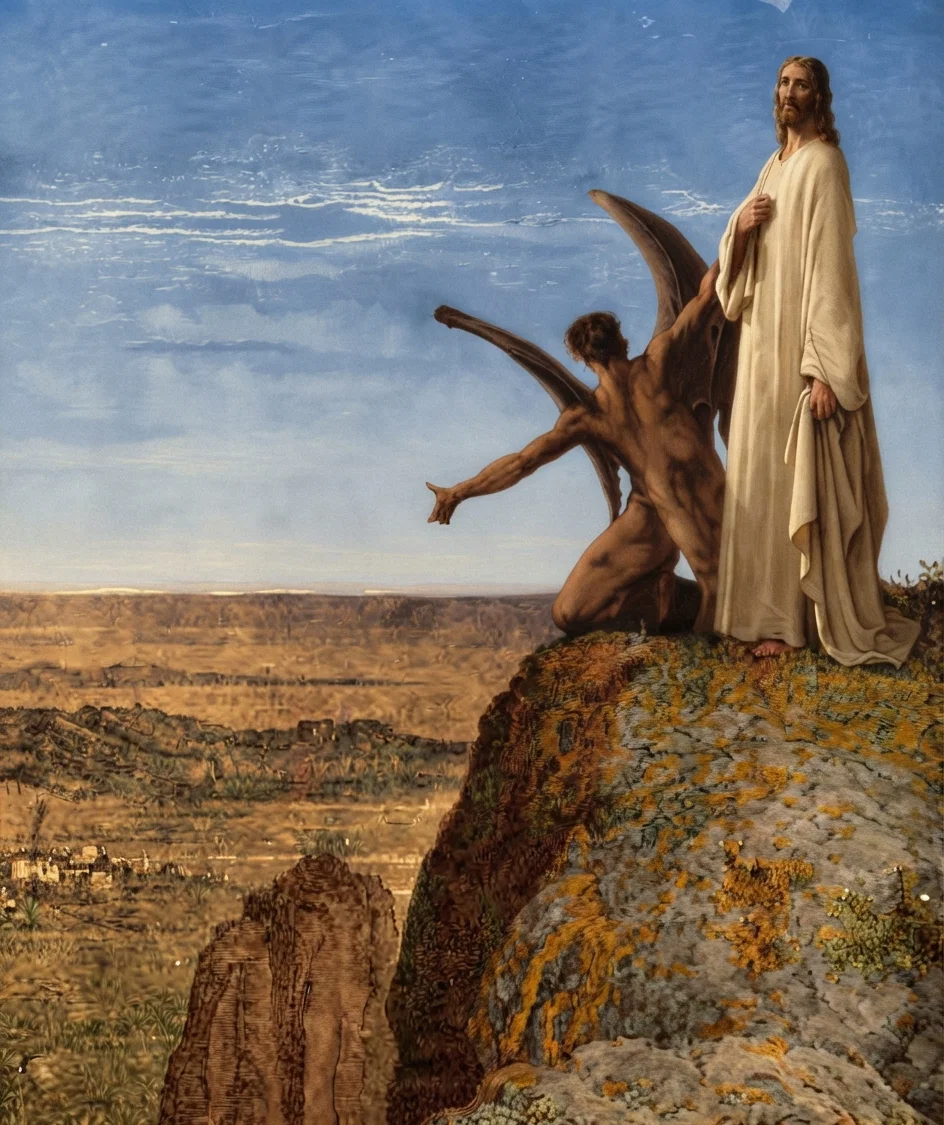
For we have not an High Priest which can not be touched with the feeling of our infirmities; but was in all points tempted like as we are, yet without sin. Heb. 4:15. For in that he himself hath suffered being tempted, he is able to succor them that are tempted. Heb. 2:18.
TEMPTATION—WHAT IS IT?
By Mrs. E. G. White
WHAT is temptation?—It is the means by which those who claim to be the children of God are tested and tried. We read that God tempted Abraham, that he tempted the children of Israel. This means that he permitted circumstances to occur to test their faith, and lead them to look to him for help. God permits temptation to come to his people to-day, that they may realize that he is their helper. If they draw nigh to him when they are tempted, he strengthens them to meet the temptation. But if they yield to the enemy, neglecting to place themselves close to their Almighty Helper, they are overcome. They separate themselves from God. They do not give evidence that they walk in God's way.
Thus the Lord determines character. Thus he decides whether we are obedient or disobedient. He does not do this for his own enlightenment; for he reads all things as an open book. He does it that the secret motives of men's hearts may be manifest, that his true witnesses may be strengthened, that others may become intelligent in regard to the ways and works of God as contrasted with the ways and works of the enemy.
Temptations will pour in upon us; for by them we are to be tried during our probation. This is the proving of God, the revelation of our own hearts. There is no sin in having temptation; but sin comes in when temptation is yielded to.
When Jesus was led into the wilderness to be tempted, he was led by the Spirit of God. By going into the wilderness, he did not invite temptation. But Satan knew that the Saviour had gone there, and he thought it the best time to approach him.
Christ went to the wilderness to be alone, to contemplate his mission and work. He had taken the steps which every sinner must take, in conversion, repentance, and baptism. He himself had no sins of which to repent, and therefore he had no sins to wash away. But he was our example in all things, and therefore he must do that which he would have us do. Christ fasted and prayed, bracing himself for the blood-stained path which he must travel. He was the Son of the eternal God, but as man's surety, he must meet and resist every temptation with which man is assailed.
When Christ had fasted for forty days and forty nights, the enemy came, tempting him to make bread of the stones. Christ knew that he would be assailed upon appetite, for it was upon this point that Adam and Eve had failed. And with the terrible weight of the sins of the world upon him, he withstood the fearful test upon appetite, upon the love of the world, and upon that love of display that leads to presumption. He endured these temptations, and overcame in man's behalf, working out for him a righteous character, because he knew that man could not do this of himself.
The world's Redeemer, the second Adam, by his suffering and death worked out a redemption for the human race. He was tempted in all points like as we are. He knew that the enemy would come to every human being, to take advantage of hereditary weakness, and to ensnare, by his false insinuations, all whose hope and trust is not in Christ. And by passing over the ground which man must travel, by showing that, through the divine power granted him, man can overcome every form of temptation, Christ prepared the way for us to gain the victory.
If Satan can persuade people to follow a course that is contrary to the principles underlying and running through every enactment of God's law, he has a chance to work upon their minds. One venturesome step in deceptive practises, under the specious direction of Satan, leads to a second such step. Those who follow this course depart from God. The poisonous malaria of worldly principles is so disguised by the enemy that the actors become willing to work in lines which are contrary to the will of God. They make use of the world's artifices in order to gain an advantage over their neighbors. This creates a train of thought which separates the soul from the Spirit of God. The mind becomes more and more infatuated, and the power to overcome temptation is destroyed. The tendencies thus cultivated are transmitted to the offspring, as Adam's disobedience was transmitted to the human family.
Christ came to our world as man's surety, preparing the way for him to gain the victory by giving him moral power. It is not his will that man shall be placed at a disadvantage. He would not have those who are striving to overcome, intimidated and discouraged by the crafty assaults of the serpent. "Be of good cheer," he says, "I have overcome the world."
With such a general to lead us on to victory, we may indeed have joy and courage. He came as our champion. He takes cognizance of the battle that all who are at enmity with Satan must fight. He lays before his followers a plan of the battle, pointing out its peculiarities and severity, and warning them not to join his army without first counting the cost. He tells them that the vast confederacy of evil is arrayed against them, and shows them that they are fighting for an invisible world, and that his army is not composed merely of human agencies. His soldiers are coworkers with heavenly intelligences, and One higher than angels is in the ranks; for the Holy Spirit, Christ's representative, is there.
Then Christ summons every decided follower, every true soldier, to fight for him, assuring them that there is deliverance for all who will obey his orders. If Christ's soldiers look faithfully to their Captain for their orders, success will attend their warfare against the enemy. No matter how they may be beset, in the end they will be triumphant. Their infirmities may be many, their sins great, their ignorance seemingly insurmountable; but if they realize their weakness, and look to Christ for aid, he will be their efficiency. He is ever ready to enlighten their dullness and overcome their sinfulness. If they avail themselves of his power, their characters will be transformed; they will be surrounded with an atmosphere of light and holiness. Through his merits and imparted power they will be “more than conquerors.” Supernatural help will be given them, enabling them in their weakness to do the deeds of omnipotence.6
Those who fight for Christ are fighting in the sight of the heavenly universe, and they should be soldiers, not cowards. Those who truly desire to serve God will not follow their own wisdom, or the wisdom of the arch-deceiver, who is playing the game of life for their souls. By faith they are to look calmly upon every foe, exclaiming: “We fight the good fight of faith, under the command of an omnipotent Power. Because he lives, we shall live also. Through Jesus, who is the author and finisher of our faith, we may withstand all the fiery darts of the enemy.”
Abraham certified his obedience to God when, with Isaac by his side, he journeyed on his way, in response to the command, “Take now thy son, thine only son Isaac, whom thou lovest, and get thee into the land of Moriah; and offer him there for a burnt-offering upon one of the mountains which I will tell thee of.” Job was permitted to suffer; he was severely tempted; but he would not speak one word against God. During Christ’s life on earth the scribes and Pharisees, instigated by Satan, tempted him in every possible way. But he never allowed these temptations to lead him from the path of obedience. When God speaks, let us obey, no matter how the enemy may tempt us to disobey; for the path of obedience is the only safe path.
Christ’s example shows us that our only hope of victory is in continual resistance of Satan’s attacks. He who triumphed over the adversary of souls in the conflict with temptation understands Satan’s power over the race, and has conquered in our behalf. As an overcomer, he has given us the advantage of his victory, that in our efforts to resist the temptations of Satan, we may unite our weakness to his strength, our worthlessness to his merits. And, sustained by his enduring might, under strong temptation, we may resist in his all-powerful name, and overcome as he overcame.
MRS. E. G. WHITE.
THE WREATH OF LAUREL AND THE CROWN OF GOLD.
By Clyde Scott Chase
"He that striveth for the mastery is temperate in all things."
THE Father, to His children of the earth, has said:
"Be temperate while in the flesh ye dwell;
Your happiness words then can scarce portray;
But if slaves thou to appetite be led,
The misery of thy wasted, fleeting day,
The united tongues of nations can not tell.
"Across the highways and the paths of life
Are strung the meshes of the tempter bold;
But he whose progress naught can swerve or stay,
Who girds his armor for a noble strife,
And conquers all that barricades his way,
Shall wear a laurel with a crown of gold!"
But, ah! unheeded is the guiding Voice
From out the realms of happiness on high,
And scorned are all the offerings of love—
Sweet gifts to make the hearts of men rejoice—
And from the shining star of hope above,
The tempter's glitter draws affection's eye.
And men there are along life's storm-lashed shore—
Wrecked ones whose story in their hearts are told—
With sunken eyes and sorrow-silvered hair,
Whose weary souls cry out in accents sore:
"O God, that I had chosen but to wear
"Thy gift of laurel with its crown of gold!"
But there are men whose hearts are true and strong,
Whose footsteps firm the ways of peace pursue,
Whose shield the foe's keen weapons can not rend;
And bursts the music of a nation's song
As in their coronets are seen to blend
A tint of laurel and a golden hue.
And their bright works about the world are strewn,
For all upon life's journey to behold,
And bright their beacons on the headlands gleam,
While flees the darkness as at brilliant noon,
That all may shun the swift and treacherous stream,
And seek the laurel with its crown of gold.
CLYDE SCOTT CHASE.
STANDARD OF RIGHT.
By O. E. Jones
“SIN is the transgression of the law.” 1 John 3:4. “All unrighteousness is sin.” 1 John 5:17. Christ’s life of perfect obedience to the law (“who did no sin, neither was guile found in his mouth,” 1 Peter 2:22) won for him the title “THE LORD OUR RIGHTEOUSNESS;” and all claims that God’s rule was arbitrary and his law unjust were proven to be groundless. And when Satan took the life of the innocent Son of God, it was then manifest to the intelligences of the universe that Satan was in the wrong, and he is now an outcast in the sight of all the holy and the good.
The exceeding sinfulness of sin may be seen by its fruits. “Sin, when it is finished, bringeth forth death.” James 1:15. The sin may appear otherwise, but in every sin are the seeds of death.
In disregarding God’s word and hearkening to the voice of a stranger, Adam and Eve transgressed the first commandment, which says, “Thou shalt have no other gods before me.”
And in partaking of the forbidden fruit, that which was not given to them, they violated the commandment which says, “Thou shalt not steal.” In yielding to a desire for the supremacy, they violated the commandment which says, “Thou shalt not covet.”
Our first parents were not ignorant of their sin. The record says, “And when the woman saw that the tree was good for food, and that it was pleasant to the eyes, and a tree to be desired to make one wise, she took of the fruit thereof, and did eat, and gave also unto her husband with her; and he did eat.” Gen. 3:6. Adam and Eve did not plead innocent, but sought an excuse for their disobedience. “And the man said, The woman whom thou gavest to be with me, she gave me of the tree, and I did eat. And the Lord God said unto the woman, What is this that thou hast done? And the woman said, The serpent beguiled me, and I did eat.” Gen. 3:12, 13. Adam, in excusing himself by placing the blame upon God, or more directly upon the woman whom God had given to be with him, shows clearly that he was not ignorant of the sin which he had committed. The same was true of Eve. Now Paul says, “By the law is the knowledge of sin.” Rom. 3:20. And again, “I had not known sin, but by the law; for I had not known lust, except the law had said, Thou shalt not covet.” Rom. 7:7.
In the above text the apostle shows clearly that the Decalogue, that law which says, “Thou shalt not covet,” is the standard of right, and that to transgress that law is sin.
The apostle James teaches the same thing, for he says: “If ye have respect to persons, ye commit sin, and are convinced of the law as transgressors. For whosoever shall keep the whole law, and yet offend in one point, he is guilty of all. For he [margin, “that law”] that said, Do not commit adultery, said also, Do not kill. Now if thou commit no adultery, yet if thou kill, thou art become a transgressor of the law.” James 2:9-11. The reasoning which James applies to the sixth and seventh commandments may, with equal propriety, be applied to all the commandments.
That perfect obedience to God’s law is perfect righteousness or right-doing, and that disobeying it is sin is seen by the following: “Know ye not, that to whom ye yield yourselves servants to obey, his servants ye are to whom ye obey; whether of sin unto death, or of obedience unto righteousness?” Rom. 6:16. “That the righteousness of the law might be fulfilled in us, who walk not after the flesh, but after the Spirit.” Rom. 8:4.
But perfect obedience is accomplished only as we have the mind of Christ. “Because the carnal mind is enmity against God; for it is not subject to the law of God, neither indeed can be.” Rom. 8:7. “Let this mind be in you, which was also in Christ Jesus.” Phil. 2:5. He kept his “Father’s commandments.” John 15:10. O. E. JONES.
JEWISH CUSTOMS AND TRADITIONS.
By F. C. Gilbert
(By an Israelite.)
The Sanctuary and Its Services.—Continued.
The Day of Atonement.
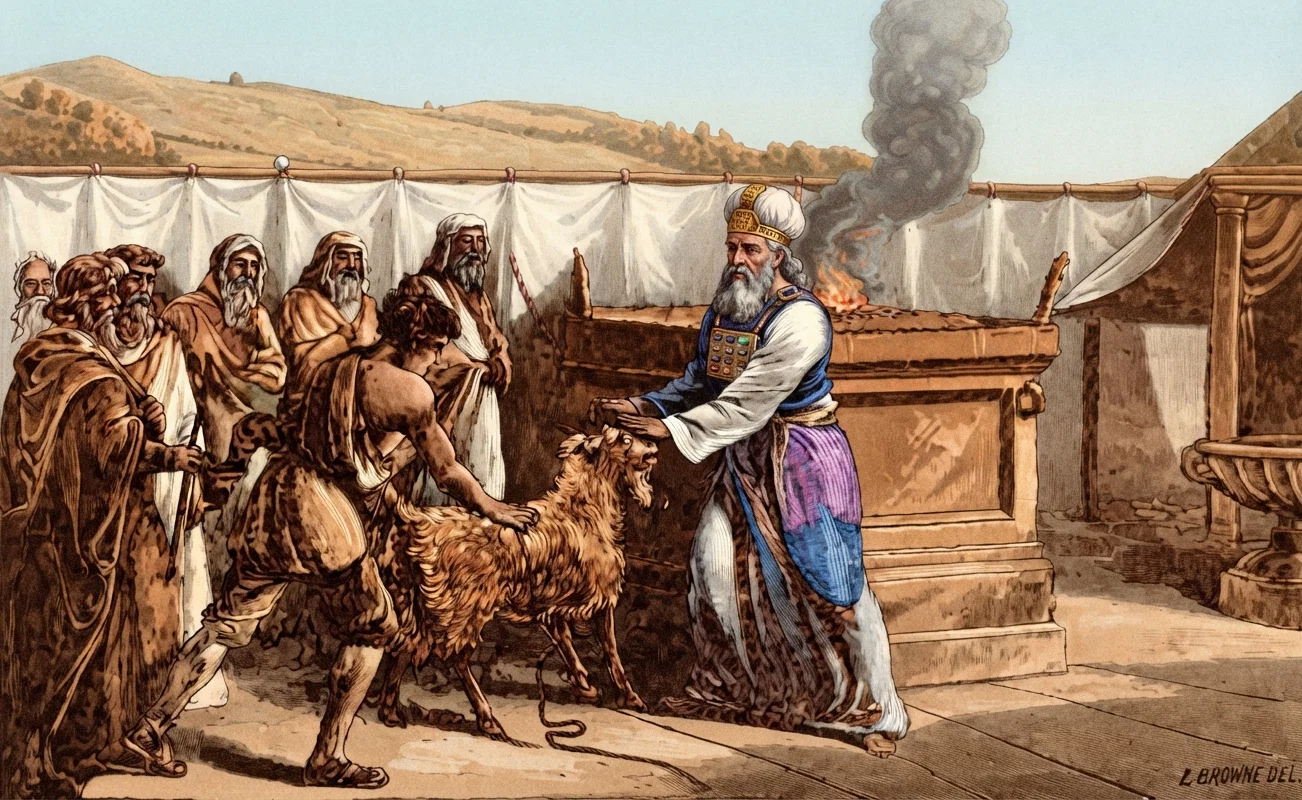
Of all the sacred days for devotions and meditations which God commanded Israel to observe, the day of atonement was the most important. The institution itself, with the manner of its observance, is recorded in Lev. 16, the substance of which is as follows: On the tenth day of the seventh month of the Jewish year, Tishri, all the congregation of the children of Israel were to refrain from their labor. The high priest was to take a young bullock for a sin-offering, and a ram for a burnt-offering, which he was to offer for himself before the Lord in the most holy place as an atonement for his sins. He was also to take of the congregation two kids of the goats for a sin-offering, and one ram for a burnt-offering. These two goats he was to bring to the door of the tabernacle of the congregation, and present them for acceptance to God. Then lots were cast upon the animals, one to be God’s lot, the other Azazel’s lot. Or, rather, one was to represent God, the other Azazel. Of this latter term more will be said later. When this was accomplished, the Lord’s goat was to be offered up for sins, or, as we generally express it, for a sin-offering. But the goat which was selected for Azazel, or the scapegoat, was to be presented alive to make an atonement upon, instead of with him, and let him go to Azazel in the wilderness.
The high priest was also to take a censer full of the hot coals from the altar, his hands filled with the sweet incense, and bring these into the most holy place. The incense was then placed upon the fire, and the clouded perfume laid upon the mercy-seat. He was then to take of the blood of the bullock for himself, and sprinkle the mercy-seat, and in front of the mercy-seat, seven times. After the Lord’s goat was killed, he was to take of its blood within the vail, and do with it to the mercy-seat as he did with the blood of the bullock. And in the doing of these things, he was making an atonement for himself, for all the congregation of the children of Israel, as well as for the sanctuary itself. Of course it was necessary that all the things in the sanctuary should be sprinkled with blood; for almost all things by the law were purged with blood; and without the shedding of blood there was no remission. Heb. 9:22.
When this work of cleansing the priest, people, and the holy places was accomplished, the scapegoat was brought alive, and the high priest then confessed all the sins of all the people of Israel, which were atoned for in the most holy place by the sprinkling of the blood taken from the Lord’s goat, and by an appointed man sent to the Azazel in a barren place. Verses 10, 21.
These sins of the people were confessed upon the head of this scapegoat, and it was to bear all these iniquities, in a separated land, not inhabited.
During this day all the people were to afflict their souls before the Lord; no work of any kind was done, neither were they allowed to partake of any food. Not only was this true of the Israelites, but any sojourner who dwelt among them was to observe the day in the same manner. And the soul who did not carry out the commands of God on this day as he had appointed was punished with death; for it was the day in which all their sins were blotted out before God, and they were cleansed and justified. Lev. 23:26-32; Num. 29:7. This was the institution ordered by the Lord,7and also the manner of its observance; the reasons for the ordinances therein are also described. Only such a day kept in such a manner could the Lord accept. But since the destruction of the temple at Jerusalem, under Titus, there has never been any place where Israel could offer her offerings before the Lord, nor have any high priest to perform the work. Yet the day has ever been observed, even to the present time. In fact, the day upon which this article was written was the day of atonement for the Jews this year. Of course, as Christians, we know by the Bible, since the Crucifixion, and the rending of the temple's vail between the holy places, Christ has become the High Priest, and earthly sacrifices are of no service. But the Jew says it was to be an everlasting statute, to be observed by all their generations. Therefore, as it can not be observed in the exact manner the Lord commanded, means have been substituted which are regarded as equally acceptable to the Lord.
In the Talmudic work Hilchoth T'shuva, or 'Laws of Repentance,' we find the following:—
At this time, when there is no temple, and we have no altar, there is no atonement but repentance.
Repentance atones for all transgressions; yea, tho a man be wicked all his days and repent at last, none of his wickedness is mentioned to him, for it is said, 'As for the wickedness of the wicked, he shall not fall thereby in the day that he turneth from his wickedness.' Eze. 33:12. The day of atonement itself also atones for them that repent, for it is said, 'For on that day he shall make an atonement for you.' Lev. 16:30.
It will here be noticed that repentance is substituted for the offering, and that repentance of course is by the good works of the individual. But right here we find a great inconsistency in the present manner of its observance. It says first that repentance alone is sufficient for atonement, independent of any day. If a person can only perform good works enough, the Lord will make it as acceptable as the offering. And the very next sentence says, 'The day of atonement itself atones for them that repent.' Now, if repentance alone is sufficient, why need the day? And if the day itself, by virtue of its name, be sufficient, then why need to repent?
But with this they were not satisfied, as they were well aware that some might sometime say that it was necessary to be provided with an offering. Hence the following was provided:—
Order of the atonements: On the eve of the day of atonement, the custom is to make atonements. A fowl (cock) is taken for a man, and a hen for a woman. . . . The father of the family first makes atonement for himself, for the high priest first atoned for himself, then for his family, afterwards for all Israel.
The order for these atonements is as follows: He takes the cock in his hand and says the following: 'The children of men that sit in darkness and the shadow of death, being bound in affliction and iron; he brought them out of darkness and the shadow of death, and brake their bands asunder. Fools because of their transgression and because of their iniquities are afflicted. Their soul abhorreth all manner of meat, and they draw near unto the gates of death. Then they cry unto the Lord in their trouble, and he saveth them from their distresses. He sendeth his word, and healeth them, and delivereth them from their destructions. O that men would praise the Lord for his goodness, and for his wonderful works to the children of men!' Ps. 107. 'If there be for him an angel, an intercessor, one among a thousand, to show unto man his uprightness, then he is gracious unto him, and saith, Deliver him from going down to the pit; I have found a ransom.' Job 33:23, 24. Whilst moving the atonement around his head he says: 'This is my substitute. This is my commutation. This cock goeth to death, but may I be gathered and enter into a long and happy life, and unto peace.'
This is performed three times in succession;
LAYING THE SINS ON THE HEAD OF THE SCAPEGOAT.
each time the prayers begin with the words, 'The children of men.'
As soon as one has performed the order of the atonement, he should lay his hands upon it as the hands used to be laid upon the sacrifices, and immediately after give it to be slaughtered.
These prayers will be found in any orthodox Jewish prayer-book on the day of atonement. Thus we see how God's plan is perverted, and man's ideas placed in its stead. The reason may be asked why the cock instead of any other. Because the Hebrew word for cock sometimes is used for man. If they could get a wholly righteous man, who never had sinned, to atone for them, they think he would be acceptable; but since that is impossible, they take the nearest thing bearing the name of a man, and believe it will answer.
How sad it is to see such blindness, when God has provided a Righteous Man, who has become the atonement for us all, and who is able to pardon all our sins. He was wounded for our transgressions, and was bruised for our iniquities; and the chastisement of our peace was upon him. He has healing for all those who will accept of his blood, even him whose name is 'Jehovah Our Righteousness.' Isaiah 53. Jer. 23:5. But to continue:—
Our God and the God of our ancestors; the burnt-offerings have ceased, and the sacrifices are discontinued. Wherewith shall we then approach him who dwelleth on high, for there is none amongst us that is fit to appease thee with supplications, to seek mercy for us that we may find grace. Did not our ancestors aforetime bring a certain sin and trespass-offering when they sinned, to make an atonement before thee? But now the sacrifices and meat-offerings are moved, and thy dwelling-place is destroyed. . . . Wherewith shall we wash away the filth of our shame, and make atonement for our transgression?
Then comes the reply:—
All those have failed, and we remain deprived of them. We fast this day to diminish our blood and fat, in lieu of the blood that was sprinkled on the altar; we bow ourselves with two supplications instead of the binding of the lamb morning and evening; we bow down the head and stretch out the neck, instead of the jugulation and wringing of the head, and the receiving of the blood in the bowels.—Prayers for the Day of Atonement.
Thus they fast, they pray, they afflict themselves and carry out their own ideas, and then think those traditions are accepted with the Lord. They serve him with their lips; but their hearts are far from him.
Much more might be adduced from their writings as to the manner of observance of this sacred day; but it is all man-made, and can only bring self-righteousness. If they only knew that there has a way been opened for them by which they can approach the Father, and there is One who is fit to make us accepted with the Lord, how different it would be with them! And how thankful we ought to be to the Lord that Jesus has shined into our hearts, to give unto us the light of himself! Let us then be light-bearers for him to those who are dead and buried beneath the rubbish of tradition.
F. C. GILBERT.
South Lancaster, Mass.
BETTER COME DOWN.
A MAN stood up in an experience meeting, and said, "I have been for five years on the Mount of Transfiguration."
"How many souls have you led to Christ in that time?" inquired the pastor.
"Well, I don't know," he replied.
"Have you brought a single one?"
"I don't know that I have."
"Well, then, you had better come down."
When a man gets too high for service, there is something wrong.—Selected.
HEROIC LIFE-SAVING.
THE Northwestern University, situated at Evanston, twelve miles north of Chicago, has organized among its students a volunteer life-saving crew, which has become famous for its services. Some years ago, in the early morning, there came the word that a steamer was in distress. The students hurried down to the shore. There they saw the Lady Elgin, not only in distress, but going to pieces, and men and women in imminent peril of being lost.
Among the students were two brothers from Iowa. One of these brothers stripped off all surplus trapping and swam out and brought one to the shore, and another, and another, and another, and another, until he had, what seems incredible, some eight or nine rescued on the shore of Lake Michigan.
They had built a fire of logs, and he was blue with cold. As he stood there trembling before the fire, and looked out over the lake again, he saw another man in peril. He said, "I must go again." They gathered around him and said, "It does not mean rescue for him for you to go; it means death to you." He broke from the crowd and plunged out, and brought a tenth, an eleventh, and twelfth, and again he stood, strength apparently all gone. And as they looked at him there, so blue and8chilled, they thought that death had put its finger upon him. He looked out and again he saw others in peril, and again he struck out through the storm, and he brought the thirteenth, and fourteenth, and fifteenth to the shore.
And now he stood there by the fire once more. Again he looked out and saw a beam drifting in, and clinging to that beam a man. And as he looked again he saw the man's wife, apparently, and the man was making almost superhuman efforts to save his wife, and as he looked he saw that beam was drifting around a point of land that meant death. He broke out from the crowd again. He plunged into the water, grasped hold of that beam. He swung it round the perilous corners of that lake, and brought man and wife safely to land. That afternoon as he stood in his room with his roommate, shivering, and white, and exhausted, he said: "Did I do my best? Did I do my very best? O, I am afraid I did not do my best!"
And that night they say he tossed in delirium all night, and they tried to calm him, and his brother sat beside his bed as he tossed through the night. The only thing he thought of was those that were lost. His brother said:—
"Why, you saved seventeen!"
"O," he said, "if I could only have saved just one more!"
Gentlemen, look out to-day. Don't you see the storm-tossed sea? Don't you see the people in your home? Don't you see the millions of heathen going down? O, in the strength of God, men, in the strength of God, to-day let us plunge in again, and again, and again, until every last ounce of strength is gone; and when at last, utterly exhausted in the service of Jesus Christ, we sink upon the sand, in the intensity of our longing to save some, let us cry, "O, if I could only have saved just one more!"—The Evangel.
THE Revised Version thus reads: "If ye died with Christ from the rudiments of the world, why, as tho living in the world, do ye subject yourselves to ordinances, Handle not, nor taste, nor touch (all which things are to perish with the using), after the precepts and doctrines of men?" Christ has set you free, and "as ye have therefore received Christ Jesus the Lord, so walk ye in him." Verse 6. Do not be carried away "through philosophy and vain deceit, after the tradition of men, after the rudiments of the world." Verse 8. Why, we are free in Christ, complete in his fulness. Verses 9, 10. Now if this be the case, if in Christ we die to the world, why do we act as tho we still lived in the world? why do we follow its ordinances, and expect men to say, "Touch not, taste not, handle not"? God desires his people to look to him, not to men or to the traditions and commandments of men. Man's commandments and prohibitions perish with use, as do men, but the Word of God and those who do it abide forever.
There is no marginal reading to either of these texts. The first reads: "I am in a strait betwixt two, having a desire to depart, and to be with Christ; which is far better." The second reads: "For I am now ready to be offered, and the time of my departure is at hand."
What the apostle means by "departure" and "to depart," is simply leaving this present state of existence. A man in St. Louis could speak of departing six times in a week, and yet have in mind the going to a different place each time. The departure refers not to where one goes, but to where one goes from. Paul referred in both cases to leaving this present state of existence. This may be done in two ways, by death, and by a change to immortality, and translation to heaven. In 2 Tim. 4:8 the apostle refers to his death. In Phil. 1:23, he stated that he desired another thing. Either life or death would magnify Christ, yet of the two he says, "What I shall choose I wot not." Verses 20-22. But while he did not know which to choose of the two—life and death—he desired a third thing, to leave the present life and be with Christ, which is far better than either of the two. Christ's people will be with him only by a resurrection of the dead or a change to immortality. See 1 Cor. 15:51-54; 1 Thess. 4:16, 17; Matt. 16:27. "So shall we ever be with the Lord." What Paul therefore desired was the coming of Christ and translation to heaven.
No. 578. Reporting Charity.
ARE we authorized by the Scriptures to make a report of charitableness?
Yes, and no. David told what they had been able to do for the house of God, but he gave all the credit to the Lord. 1 Chronicles 29. Paul and his coworkers "rehearsed all that God had done with them" (Acts 14:27; 15:4); he also gloried in behalf of the Corinthians, and his report of their zeal provoked (stirred up) many (2 Cor. 9:2). But in all these reports the Lord alone seemed to be magnified. Jesus says, "When thou doest alms, let not thy left hand know what thy right hand doeth; that thine alms may be in secret; and thy Father which seeth in secret himself shall reward thee openly." Matt. 6:3, 4. It is always proper on proper occasions to tell what great things the Lord has done for us. There is much, too much, vain self-confident boasting of what I have done, what we have done. How do we know but the very thing we "report" as great and good and praiseworthy may be of the least account in the eyes of God; and the things which seem to us to be unworthy of notice, may in his sight be both great and worthy? "That which is highly esteemed among men is abomination in the sight of God." Luke 16:15. Those mentioned by our Lord as worthy in Matt. 25:34-40 did not seem to know that they had done anything. "The labors of love given for Christ's sake if treasured by the giver as important end there; for he has all the reward he ever will have; but if he does the work for Christ's sake, thinking not of the matter afterward, angels of God gather up these incidents and cherish them as precious pearls."—E. G. W. Jesus Christ "is made unto us wisdom, and righteousness, and sanctification, and redemption; that, according as it is written, He that glorieth, let him glory in the Lord." 1 Cor. 1:30, 31.
Our common version has "broidered" hair and "plaiting" the hair, with a margin to the first text of "plaited." We would not understand them to refer to neat, modest braiding of the hair, but to extravagant, fanciful preparation of the hair to attract attention. Says Vincent on 1 Peter 3:3: "The Roman women of the day were addicted to ridiculous extravagance in the adornment of the hair. Juvenal ('Satire,' VI.) satirizes these customs. He says: 'The attendants will vote on the dressing of the hair as if a question of reputation or of life were at stake, so great is the trouble she takes in quest of beauty; with so many tiers does she load, with so many continuous stories does she build up on high her head. She is tall as Andromache in front, behind she is shorter. You would think her another person.' The hair was dyed, and secured with costly pins and with nets of gold thread. False hair and blonde wigs were worn." The world is living the life of Rome over again. The true rule for dressing the hair, and for all other things, is to "do all to the glory of God." 1 Cor. 10:31.
Yes; why not? Did not the plagues of Egypt have a literal fulfilment? They are the working out of the results of sin.
No. 581. The Day of the Crucifixion.
WILL you please explain Matt. 12:40 and 27:62, as compared with Good Friday? On what day of the week was the Crucifixion?
By some of those who contend that Jesus was crucified on Friday the three days are made to date from Thursday, when Jesus was betrayed and delivered into the hands of the powers of darkness. This includes the greater part of Friday, the whole of Sabbath, and a part of Sunday, parts of days being counted as a whole, as might have been the case with Jonah. See also Luke 24:21, where the disciples say, on the eve of that "first day," "To-day is the third day since these things were done." We have not space in this department to discuss the matter at length.
THE "Watch Tower Bible and Tract Society" says in a "quarterly": "In Rev. 20:5 the words, That the rest of the dead lived not again until the thousand years were finished, is spurious. They are not found in the oldest and most reliable Greek MS., the Sinaitic, Vatican Nos. 1209 and 1160, nor in the Syriac MS." I would like your view of the above.
(1) The Revisers do not even question them. (2) The Greek text of Tregelles, and Rotherham's Emphatic Translation, based on that text, admits the expression without question. So also Alford. As to the statement that the words are not found in Vatican MS. 1209, it is sufficient to say that the Book of the Revelation is not found in that MS. Vatican MS. 1160 is of the eleventh century. The Emphatic Diaglott says: "These words were probably omitted as an oversight in Vatican MS. [1160], as they are found in A B C—tho not in the Syriac." "A" is the Codex Alexandrinus, probably of the fifth century; it contains the entire New Testament. "B" is the Codex Vaticanus, probably of the fourth century; the latter part, after Heb. 9:14, was added at a later date. "C" is Codex Ephraemi, supposed to be written in the fifth century.
FORGIVES LIKE A FATHER.
A MINISTER had a deacon who was continually lamenting about his great sins. One day the minister said:—
"Deacon, you remember your son stoutly rebelled against your authority some time ago, but afterward felt sorry and repented of his sin, and humbly asked your forgiveness. Did you forgive him?"
"Of course I did."
"What did you forgive him for?"
"Because I could not help it when I saw how sorry he was."
"And does he still ask forgiveness?"
"No! no! Nothing is said about it. It is all settled forever."
"Now do you believe that you can be better to your son than God is to you? He forgives like a father."—Selected.
Removing Oxygen with a Mushroom
A SINGULAR way of removing oxygen from the air by the aid of a plant is described by Dr. T. L. Phipson in the Chemical News. Inside a glass bell jar, suspended over water, is placed a mushroom, and sunlight is allowed to fall upon the plant. The mushroom absorbs the oxygen from the air in the jar, and the carbonic acid formed during the process is absorbed by the water, which gradually rises in the jar to one-fifth of its height. The mushroom now dries up, but its animation is only suspended, as may be proved by introducing beside it a green plant, when it will recommence to vegetate, being nourished by the oxygen exhaled from the fresh plant.