Your ShelfYour Projects

Signs of the Times, Vol. 38, No. 29.

Waiting for My Lord

Signs of the Times

Jul 25, 1911

Pacific Press Publishing Association · Mountain View, California · Jul 25, 1911

Waiting for My Lord
BY W. S. CRUZAN
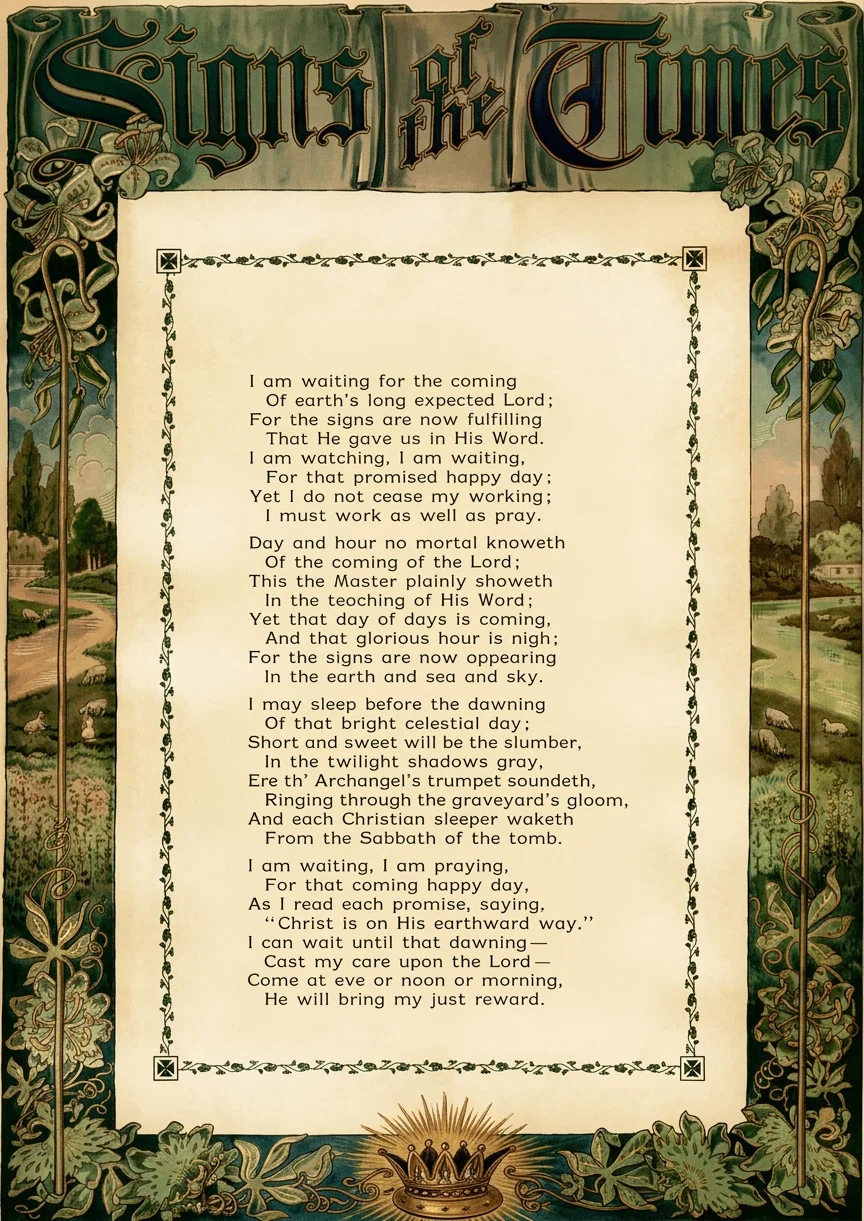
I am waiting for the coming Of earth's long expected Lord; For the signs are now fulfilling That He gave us in His Word. I am watching, I am waiting, For that promised happy day; Yet I do not cease my working; I must work as well as pray.
Day and hour no mortal knoweth Of the coming of the Lord; This the Master plainly showeth In the teaching of His Word; Yet that day of days is coming, And that glorious hour is nigh; For the signs are now appearing In the earth and sea and sky.
I may sleep before the dawning Of that bright celestial day; Short and sweet will be the slumber, In the twilight shadows gray, Ere th' Archangel's trumpet soundeth, Ringing through the graveyard's gloom, And each Christian sleeper waketh From the Sabbath of the tomb.
I am waiting, I am praying, For that coming happy day, As I read each promise, saying, "Christ is on His earthward way." I can wait until that dawning— Cast my care upon the Lord— Come at eve or noon or morning, He will bring my just reward.
Semmes, Alabama.

"IF YE WILL INQUIRE, INQUIRE YE."

This Inquirers' Department is conducted for the purpose of helping those who are studying the Bible. The answers are oftentimes only suggestive. They are never to be considered infallible, only as they agree with the infallible Word. The writer who may answer them does not consider that his opinion is infallible. He will simply give the best that he has, and plead with the inquirer to search the Word. Such questions only will be answered as, to the editors, seem to minister to the good of the readers and to the mission of the paper. We can not answer repeatedly in the same volume questions upon the same scripture. The name and address must accompany question, not for publication, but as an evidence of good faith, and that answer may be made by letter if deemed advisable. No letters are answered which do not contain the name of the writer. It is well always to enclose stamp for reply.

3516—To What Law?

To what law does Paul refer in Gal. 3:19, 24-26? Also in chapters 2:16-21; 3:2-5, 11-13; 4:4, 5? H. P. B.
It is impossible, in the space which we have and in justice to other querists, to attempt a detailed answer to all these questions, or a detailed explanation of all these texts. What will help our inquirers, we are sure, will be one or two preliminary considerations: First, what is the general subject of the epistle? We are sure that all will agree that it is justification by faith in Christ, with the emphasis on "in Christ," not justification by doing, not justification by any law whatsoever, but justification by faith in Christ Jesus our Lord. It is the enforcing of the same truth that is taught by Romans. If there could be any difference at all, Romans would simply be justification by faith. But there were conditions which led to an emphasis on "Christ," justification by faith in Christ, to the Galatians. Second, this point is also emphasized: that law can not justify; and in some cases it seems to us that the apostle is talking of law in general. No law can justify the sinner. It matters not what it is or what its nature is. Any law given by any authority which has been transgressed by any one subject to that authority, is by that law condemned. He can only be justified by the grace of the governor. But when the apostle brings it right down to the very sinner himself, the law which condemns must be the law which points out sin, and the only law which points out sin is the law of Ten Commandments.
In chapter 2:16, he could say to the Galatian brethren that they knew that a man is not justified by the works of the law but by the faith of Jesus Christ; and that if one should go back and say, "I will be justified by works that I can do," whatever those works were, he was building again the things which he destroyed, he was making Christ a minister of sin, and that he could not do. Righteousness could not come to the sinner by the law; it must come through Christ. In Gal. 3:19 the question is asked, "Wherefore then serveth the law?" In other words, "What was purposed in speaking the law?" The only trouble to our inquirers, we apprehend, is the term "added;" but that expression seems to be clearly parallel with Rom. 5:20: "Moreover the law entered, that the offense might abound," that sin might be exceeding sinful. The time had come when the consciences of men had become so perverted that they could not be trusted. The law which God wrote in man's very nature in the beginning had become so effaced by sin, that man's conscience must be brought to a standard which was unperverted and unpervertible. Consequently, when God brought His people out of Egypt He gave them the great moral standard, in order that they might know what sin was; and that moral standard was the Ten Commandments. It entered there in its written form, that the offense might abound, that sin might be seen to be exceeding sinful. It was to that people spoken. Heb. 12:19.
The Greek word rendered "added" in Gal. 3:19 is the same as the word rendered "spoken" in Heb. 12:19. It was spoken by God in order that sin might be more clearly seen. It was added because of transgressions; that is, that transgression might be known to be what it really is. It is the same Greek word in the Septuagint in Deut. 5:22, "He added no more," referring directly to the Ten Commandments. That Greek word is prostithemi. It is defined by Baxter: "To put to, or near to, lay with, or by the side of, to add, superadd, adjoin." What it refers to in these texts, is that God added it in its written form.
It was given in written form until a certain time, designated as "till the Seed should come to whom the promise was made." The promise is that of the inheritance, or the new earth. Rom. 4:13. That is the promise which was given to Abraham. In that new earth state there will be no prohibitive commandments, God's law will be written in the hearts of all His children. Every single precept will be an enabling act, in which they will find power, and grace, and pleasure to do God's will. But until sinners are no more, the law is needed, and needed in the form in which God has given it.
Christ has not come yet as the Seed bringing the promise. He came as our sacrifice, came to give Himself for us. He came as the way, He is coming again as the life, as the king, and then He will say, "Inherit the kingdom prepared for you from the foundation of the world." That coming is set forth in Eze. 21:25-27. Referring to Zedekiah, whose throne was just overturned by Babylon, the prophet says: "And thou, O deadly wounded wicked one, the prince of Israel, whose day is come, in the time of the iniquity of the end, thus saith the Lord Jehovah: Remove the miter, and take off the crown; this shall be no more the same; exalt that which is low, and abase that which is high. I will overturn, overturn, overturn it: this also shall be no more, until He come whose right it is; and I will give it Him."
After the overturning of the kingdom by Babylon came the overturning by Medo-Persia, by Grecia, by Rome; and succeeding Rome, in all the time before, I came to Lord Jesus Christ to take the kingdom and reign forever; and until that time come, God's law will still stand in its written, largely negative form, as a reproof to all sinners. Thus in Gal. 4:4 we read that God "sent forth His Son, . . . made under the law," condemned because a human, our Representative, and yet committing no sin, that He might redeem all others who are under the law. That law prescribes all duty, forbids all sin, and is in absolute harmony with His Holy Spirit. Consequently, in him in whom the fruits of the Spirit are manifest there is no condemnation; God's law is not against him. But if a man is doing that which is contrary to the Spirit, he is still under the law, condemned by it.

Matthew 12:40

3517 — Matt. 12:40

Will you please explain Matt. 12:40? How will you harmonize it with Luke 23:53-56; 24:1-4? Subscriber.
It is impossible for us to see anything out of harmony with those texts at all. We do not know what our subscriber wishes harmonized. We do not know that there is any particular need of quoting the texts, because they can be easily read. The first declares that Jonah was to be a sign of our Lord, and the second scripture refers to the death and resurrection of our Lord. Presumably the trouble is over the expression "three days and three nights." The term "day" is used with a great deal of latitude and meaning in the Scripture. Parts of three days and three nights, would be spoken of in a general way as three days and nights. Now in the first place there is absolutely nothing in the Bible that would warrant the construction that some put upon that passage, that the three days and three nights means seventy-two hours. They simply mean, in a general way of speaking, parts or the whole of three days, or a period of time in which some part of each of three days is included. There is absolutely nothing in the Scriptures which warrants us in saying that "the heart of the earth" means the grave. It is the only place in the Word where just such an expression occurs; and for us to say that that means the grave, is arbitrary interpretation. Why may it not mean just as well "in the power of the rulers of the earth," the very heart of which was Rome at that time, and include in that time the apprehension, trial, and sufferings of our Lord previous to His death? When He was arrested He said, "This is your hour, and the power of darkness." That occurred on what would be our Thursday night, or the first part of the day Friday. Later in that day He was crucified. He rested in the tomb on the Sabbath; and in the middle of the third day, which was the first day of the week, He arose from the dead. At the very close of that first day of the week we find the disciples saying to Jesus, "Today is the third day since these things were done." Very much more might be said. See the book entitled "Questions and Answers," pages 28 to 34, in which each text mentioning this period is examined.

3515—Who Is the Rock?

Matt. 16:18. What did the Saviour mean by "Upon this rock I will build My church; and the gates of hell shall not prevail against it"? T. E. W.
He meant, as taught by the universal testimony of the Bible, that He Himself was the Rock, the Foundation Stone. Nowhere in the Word of God is man called "the rock," or said to be the foundation of the faith of God's children. Take, for instance, Deuteronomy thirty-two—the wonderful song of Moses, his ascription of praise to God: "He is the Rock, His work is perfect: for all His ways are judgment: a God of truth and without iniquity, just and right is He." Verse 4. (See also verses 18, 30, and 31.) The same thought is echoed in Psalm 18; "The Lord is my Rock, and my Fortress, and my Deliverer; my God, my strength, in whom I will trust." Verse 2. Christ as a foundation is predicted in Isa. 28:16: "Behold, I lay in Zion for a foundation a Stone, a tried Stone, a precious Corner-stone, a sure Foundation." To this Paul refers in 1 Cor. 3:11: "For other foundation can no man lay than that is laid, which is Jesus Christ." To the same thing Peter refers in his first epistle, chapter 2, verse 6: "Behold, I lay in Zion a chief Corner-stone, elect, precious: and he that believeth on Him shall not be confounded." He is the Foundation of the whole house of God, as the apostle Paul states, speaking to the Christian church: "Ye . . . are built upon the foundation of the apostles and prophets, Jesus Christ Himself being the chief Corner-stone." Peter, and all others who believe in Christ, are living stones, built upon the Foundation Stone. See 1 Peter 2:4, 5.

3518—The Shape of the Earth

Please explain Rev. 7:1. Is the earth square or round? What does it mean about the four corners?
The four corners of the earth, the four winds of the earth, the four quarters of the earth, all common, every-day expressions, simply mean in all directions, embracing the whole thing. The Bible language is just simply the ordinary language of humanity. Just as we very commonly hear now, the four points of the compass — east, west, north, and south. Such expressions as these do not have any reference whatever to the shape of the earth. As to what that shape is, the evidence to us is overwhelming that it is round. We have not space to discuss that here. What is meant in Rev. 7:1 is this, that God has His own great messengers, who are in the four quarters of the earth, holding the winds of war, in order that the war shall not break out universally until His work is done.
3519 — G. N. Acts 10:1 and Mark 15:39.—There is nothing in the Bible to identify Cornelius with the centurion who stood by the cross, save the fact that both men were centurions. A centurion was an officer in the Roman army having the command of a hundred men. Rome had many centurions. It is not unreasonable to suppose that more than one of them were devout men, desiring to know what was truth.
3520 — A. K. Matt. 11:12. — Jesus seems to have been speaking of those tremendously in earnest, the eager, anxious ones that pressed in because of John's preaching. See Matt. 3:5.
Schedule for Week Ending August 5, 1911

Schedule for Week Ending August 5, 1911

Sunday July 30 Jeremiah 52;
Lamentations 1, 2
Monday " 31 " 3-5
Tuesday August 1 Ezekiel 1-4
Wednesday " 2 " 5-8
Thursday " 3 " 9-13
Friday " 4 " 14-17
Sabbath " 5 " 18-20

Jeremiah, Lamentations, and Ezekiel

We close Jeremiah with a narrative of the reign of Zedekiah, the conquest of Nebuchadnezzar, and the spoil which he carried to Babylon.
The Book of Lamentations is generally ascribed to Jeremiah, and must have been written by one who witnessed the awful sufferings of the people in the siege of Jerusalem. It consists of five poems. The first, second, and fourth are in the Hebrew acrostics, each verse begins with a letter of the Hebrew alphabet in order. The third is divided into twenty-two sets of three verses each, each set beginning with a different letter of the Hebrew alphabet. The fifth chapter is divided into twenty-two divisions, but it is not acrostic.
The first twenty chapters of the wonderful book of Ezekiel fall in this week's reading. Ezekiel was the mouthpiece of God among the captives in Babylonia by the river Chebar, while Jeremiah prophesied in Jerusalem. By wonderful visions of living creatures, or angels so arranged, typifying might, patience, wisdom, glory, God showed His overruling providence over the nations. The wheels within wheels were all in order to him. God was ruling. These four symbols were the same as the four standards under which the camp of Israel was pitched

Chosen in Christ

By Mrs. E. G. White

Faith Personal

MANY have confused ideas as to what constitutes faith, and they live altogether below their privileges. They confuse feeling and faith, and are continually distressed and perplexed in mind; for Satan takes all possible advantage of their ignorance and inexperience. Through manifold temptations, Satan often succeeds in making the experience of the Christian dark and bitter, according to his evil designs. We are to accept of Christ as our personal Saviour, or we shall fail in our attempt to be overcomers. It will not answer for us to hold ourselves aloof from Him, to believe that our friend or our neighbor may have Him for a personal Saviour, but that we may not experience His pardoning love. We are to believe that we are chosen of God, to be saved by the exercise of faith, through the grace of Christ and the work of the Holy Spirit; and we are to praise and glorify God for such a marvelous manifestation of His unmerited favor. It is the love of God that draws the soul to Christ, to be graciously received, and presented to the Father. Through the work of the Spirit the divine relationship between God and the sinner is renewed. The Father says, "I will be to them a God, and they shall be to Me a peculiar treasure; for this people whom I have formed for Myself shall show forth My praise."
CHRIST THE SACRIFICE OF THE AGES
The Father sets His love upon His elect people who live in the midst of men. These are the people whom Christ has redeemed by the price of His own blood; and because they respond to the drawing of Christ, through the sovereign mercy of God, they are elected to be saved as His obedient children. Upon them is manifested the free grace of God, the love wherewith He has loved them. Every one who will humble himself as a little child, who will receive and obey the Word of God with a child's simplicity, will be among the elect of God. Of the church at Ephesus, the apostle writes:
Grace be to you, and peace, from God our Father, and from the Lord Jesus Christ. Blessed be the God and Father of our Lord Jesus Christ, who hath blessed us with all spiritual blessings in heavenly places in Christ: according as He hath chosen us in Him before the foundation of the world, that we should be holy and without blame before Him in love: having predestinated us unto the adoption of children by Jesus Christ to Himself, according to the good pleasure of His will, to the praise of the glory of His grace, wherein He hath made us accepted in the Beloved. In whom we have redemption through His blood, the forgiveness of sins, according to the riches of His grace; wherein He hath abounded toward us in all wisdom and prudence; having made known unto us the mystery of His will, according to His good pleasure which He hath purposed in Himself: that in the dispensation of the fulness of times He might gather together in one all things in Christ, both which are in heaven, and which are on earth; even in Him: in whom also we have obtained an inheritance, being predestinated according to the purpose of Him who worketh all things after the counsel of His own will.

Only Through Christ

In the council of heaven, provision was made that men, tho transgressors, should not perish in their disobedience, but, through faith in Christ as their substitute and surety, might become the elect of God, predestinated to the adoption of children by Jesus Christ to Himself according to the good pleasure of His will. God wills that all men should be saved; for ample provision has been made, in giving His only-begotten Son to pay man's ransom. Those who perish will perish because they refuse to be adopted as children of God through Christ Jesus. The pride of man hinders him from accepting the provisions of salvation. But human merit will not admit a soul into the presence of God. That which will make a man acceptable to God, is the imparted grace of Christ through faith in His name. No dependence can be placed in works or in happy flights of feelings as evidence that men are chosen of God; for the elect are chosen through Christ.

SIGNS OF THE TIMES

"Even as we have been approved of God to be entrusted with the Gospel, so we speak; not as pleasing men, but God, who proveth our hearts."
For Terms, See Page 15
Volume 38, Number 29
Mountain View, California, July 25, 1911
Weekly, $1.75 per year
Single Copies, Five Cents

Not Turned Away

Jesus says, "Him that cometh unto Me I will in no wise cast out." When the repenting sinner comes to Christ, conscious of his guilt and unworthiness, realizing that he is deserving of punishment, but relying on the mercy and love of Christ, he will not be turned away. The pardoning love of God is appropriated, and joyful gratitude springs up in his heart for the infinite compassion and love of his Saviour. That provision was made for him in the councils of heaven before the foundation of the world, that Christ should take upon Himself the penalty of man's transgression and impute to him His righteousness, overwhelms him with amazement, and calls forth from his lips words of praise and songs of gratitude.
Christ was the Lamb slain from the foundation of the world. To many it has been a mystery why so many sacrificial offerings were required in the old dispensation, why so many bleeding victims were led to the altar. But the great truth that was to be kept before men, and imprinted upon mind and heart, was this: "Without shedding of blood is no remission." In every bleeding sacrifice was typified "the Lamb of God, which taketh away the sin of the world." Christ Himself was the originator of the Jewish system of worship, in which, by types and symbols, were shadowed forth spiritual and heavenly things. Many forgot the true significance of these offerings; and the great truth that through Christ alone there is forgiveness of sin, was lost to them. The multiplying of sacrificial offerings, the blood of bulls and goats, could not take away sin.
In the old dispensation many failed to see the force of the lesson presented to them in sacrifice and offering, and they were without excuse. But to-day we are living when type has met antitype in the offering of Christ for the sins of the world; we are living in the day of increased light, and yet how few are benefited by the grand and all-important truth that Christ has made an ample sacrifice for all! What justice required, Christ had rendered in the offering of Himself, and "how shall we escape, if we neglect so great salvation?" Those who reject the gift of life, will be without excuse; "for God so loved the world, that He gave His only-begotten Son, that whosoever believeth in Him should not perish, but have everlasting life."

The Creator and the Sabbath

In whom we have redemption through His blood, even the forgiveness of sins: who is the image of the invisible God, the first-born of every creature: for by Him were all things created, that are in heaven, and that are in earth, visible and invisible, whether they be thrones, or dominions, or principalities, or powers: all things were created by Him, and for Him. Col. 1:14-16.
HIS scripture asserts that the One who redeems us by His blood, is that One who called into existence the myriads of twinkling stars that bestud our sky; that One who spoke out of nothingness the unnumbered systems of worlds that sweep so majestically around these suns; that One who is the Author of the power that set them in motion, and supports them as they traverse their wide orbits; that One who established the laws that control all the planetary systems in all this vast universe; that One who formed, fashioned, and beautified the earth for the abode of the man, whom He made in His image; the One whose name forever is I AM. And this is His memorial through all generations; but we call His name JESUS, for He saves His people from their sins.
Turning to the first chapter of Genesis, let us notice the successive steps by which our earth was made.
"In the beginning God created." "For He spake, and it was; He commanded, and it stood fast."
"Without form and void." A plastic mass, with no fixed shape, submissive to be fashioned by the same voice that was responsible for its existence; like the soul that God creates anew, pliable and yielding as clay in the hands of the potter, to be formed and fashioned as He wills.
"Void"—empty, to be filled with the glory of God.
"Let there be light." Darkness was there; and God said, Let light be there; and light was there. He did not send the light into the darkness; for God commanded the light to shine out of the darkness, just as He in redemption speaks to the soul darkened with sin, and the entrance of His Word floods its innermost recesses with light, which streams forth with cheering radiance to all around.
"God divided the light from the darkness." Gathering the light to one side of the earth, and fixing its position, the Creator produced a succession of light and darkness, by giving the earth its motion upon its axis, thus originating the day composed of twelve hours of light and twelve hours of darkness, "and the evening and the morning were the first day."
"Let there be a firmament." Revolving, the earth assumed the form of a globe, its surface as clear as a crystal. Underneath this transparency of air, appeared another surface of water, on one side clear and sparkling, and on the other side clear but darkening in the shadow. And God said, "Let there be a firmament;" and immediately a volume of water was lifted up, forming a vast canopy above the air which passed between the waters, thus forming the firmament, called our heaven.
"Let the waters . . . be gathered together, . . . and let the dry land appear." O, what a moving was there! The land arose and came to view, while the waters fell away from sight, filling the vast reservoirs of earth's interior. At God's rebuke they fled; at the voice of His thunder they hastened away. When the commotion had ceased, O, what a picture was there—the earth, composed of broad, beautiful valleys, surrounded by lofty mountains that towered in graceful slopes; vales skirted by hills that arose in varied but pleasing forms; plains that stretched away to shores of seas beyond. The waters were gathered in seas, lakes, and ponds, in rivers, brooks, and rills, each gleaming like a sparkling jewel, or like a thread of silver, upon the surface of the earth.
"Let the earth bring forth grass." Over the face of nature there spread a carpet of living green of varied shades, bestudded here and there with clumps of shrubs in blending colors; while from the midst of it all, to grace the slopes of mountains and of hills, there arose the trees, from the lofty cedars exceeding those of Lebanon, and the spreading oaks, to the pale, trembling asps of the mountains, or the swaying willows by the brooks.
Let each bear seed in itself. Then, lo, upon the blades of the grasses, upon the sprigs of the bushes, and upon the twigs of the trees, there burst forth flowers of wondrous beauty, to sway to and fro in the breezes, to fill the air with their fragrance, and to bear seed in themselves.
"Let there be lights in the firmament, . . . to give light upon the earth." A vast body in the heavens, clothed with the glory of God, immediately began to pour its radiance upon the earth; while opposite it, but much nearer, was a smaller body, from which there began to stream a flood of silvery light upon the darker side of the earth. The first was the king of day, the second was the queen of night. Besprinkled throughout the canopy above, there appeared a great host of lesser lights, to grace the presence of the queen of night. O, the beautiful dome of heaven, with the sun to rule the day, and the moon to rule the night!
Let the waters bring forth, and let there be fowls. Immediately in all the waters appeared the finny tribes, in forms diversified, in colors beautiful; while in the sea swam great whales, and other denizens of the deep, leaving behind them a trail of sparkling foam. High in the heavens, with leveled wings cleaving the air, soared great birds; while flitting from tree to tree, happy songsters of brilliant plumage made the air vocal with joy.
"Let Us make man in Our image, after Our likeness: and let them have dominion." God made man in His own image, and gave him dominion over the fish of the sea, and over the fowl of the air, and over all cattle, and over every living thing that moves upon the earth, and over all the earth. "And the Lord God formed man of the dust of the ground, and breathed into his nostrils the breath of life; and man became a living soul."
Thus the earth came from the hand of Christ a thing of beauty, set in glory, to be inhabited by creatures controlled by love; while over it all stood man, made a little lower than the angels, crowned with glory and honor. And as the Creator viewed His finished work, He pronounced it all "very good." "Thus the heavens and the earth were finished, and all the host of them.
And on the seventh day God ended His work which He had made; and He rested on the seventh day from all His work which He had made. And God blessed the seventh day, and sanctified it: because that in it He had rested from all His work which God created and made."
Here we have the origin of the Sabbath, or rest of the Lord. He rested (sabbatized) on the seventh day, thus constituting that day His Sabbath, or rest day. Christ, the One who created, is the One who rested; and thus He became the Lord of the Sabbath, being its Author. Because of this fact, we find the seventh day called in the Bible "the Sabbath," "the Sabbath of the Lord thy God," "the rest of the holy Sabbath unto the Lord," "the Lord’s day;" and God speaks of it as "My holy day," "My Sabbath," etc. See Acts 16: 13; Ex. 20: 10; 16: 23; Rev. 1: 10; Eze. 20: 12; Isa. 58: 13.
On the seventh day, God rested—not a physical rest; for "hast thou not known? hast thou not heard, that the everlasting God, the Lord, the Creator of the ends of the earth, fainteth not, neither is weary?" But "He rested, and was refreshed." He viewed this new creation, and rejoiced in it—not alone, for "the morning stars sang together, and all the sons of God shouted for joy" as they beheld this new manifestation of the beneficence of God. Thus we see that the Creator’s rest was the joy and satisfaction of seeing and rejoicing in this finished new creation. Into the rest of Jehovah all His intelligent, loving creatures entered in that morning song of earth’s history.
Having rested on the seventh day, God blessed and sanctified it. The resting made it His rest day. The blessing and sanctifying established it as a memorial, and placed upon all His loyal subjects the obligation to recognize it as such, and thus brought its blessing to all who do so.
No other day has ever been treated in this manner. No other day has ever been blessed and sanctified. No other day has God ever recognized in its weekly recurrence as His Sabbath. Thus the seventh day stands before us as His Sabbath day, the sign of His creative power, the seal of His finished work, the memorial of His name as Creator. Wherefore the Son of Man is Lord even of that holy day which He made for man. Mark 2: 27, 28.
Continue reading: The Second Coming of Our Lord