Your ShelfYour Projects

Signs of the Times, Vol. 32, No. 17.

WAGES OF INTEMPERANCE

Signs of the Times

Apr 25, 1906

Pacific Press Publishing Company · Mountain View, California · Apr 25, 1906

WAGES OF INTEMPERANCE.

"Who hath wo? who hath sorrow? who hath contentions?
Who hath complaining? who hath wounds without cause? who hath redness of eyes?
They that tarry long at the wine;
They that go to seek out mixed wine.
Look not thou upon the wine when it is red,
When it sparkleth in the cup,
When it goeth down smoothly;
At the last it biteth like a serpent,
And stingeth like an adder.
Thine eyes shall behold strange things,
And thy heart shall utter perverse things.
Yea, thou shalt be as he that lieth down in the midst of the sea,
Or as he that lieth upon the top of a mast.
They have stricken me, shalt thou say, and I was not hurt;
They have beaten me, and I felt it not;
When shall I awake? I will seek it yet again."

John of Wycliffe

By Emma H. Adams. Every reader of the English Bible owes a debt of gratitude to this man who had so much to do with placing the Scriptures in the hands of the people. The writer has sketched in striking outlines the great controversies of the times and the part that was taken in them by Wycliffe.
160 pages, illustrated; paper covers, 25 cents; cloth, post-paid, $.50.

Left with a Trust

By Nellie Hellis. Is a story of the struggles of a family to help mother and each other during the absence of father, and pleasantly reveals the brighter side of youth where there is a worthy purpose and a will to be kind and affectionate.
160 pages, illustrated; paper covers, 25 cents; cloth, post-paid, $.50.

Life of Joseph Bates

By James White. The early life and later experience and labors of Elder Joseph Bates, one of the pioneer preachers among Seventh-day Adventists, including his seafaring experience and adventures, his conversion, and his public labors in the ministry.
With portrait, cloth, 320 pages, post-paid, $.35.

Terms of Subscription.

Per Year, post-paid . . . . . . . . . . . . . . . . . . . . . . . . . . . . . . . . . . . . . . . . . . . . . . . . . . . . . . . . . . . . . . . . . . . . . . . . . . . . . . . . . . $1.50 Six Months, 75 cts. Three Months, 40 cts. To Foreign Countries, per year, $1.75.

SPECIAL TERMS.

1. One new yearly subscription and one renewal, or two new yearly subscriptions, sent at one time, $2.50.
2. Two new yearly subscriptions and one renewal, or three new yearly subscriptions, sent at one time, $3.25.
3. Three new yearly subscriptions and one renewal, or four new yearly subscriptions, sent at one time, $4.00.
Sample copies sent on application.

THE GOSPEL SERIES STILL SELLS.

A brother from Ontario, Canada, writes:
"I took about 600 sets of your Special Signs last fall through our tract society here, and they are nearly all gone now. I wouldn't mind if I had a thousand or two more; they are good papers to do missionary work with."

OLD COPIES GOOD.

Here is a sentence from a card recently received from Georgia:
"I chanced to see an old copy, April 25, 1900, and I like it very much indeed. Will you oblige me by sending a copy or two to me?"
"Corpus Christi, Texas. "The SIGNS is stirring many of the stanch Catholics here. One woman said she didn't think I had any business going around selling these papers, the SIGNS. Well, I think I have. This is where we are different, you see. John K. Lane."

MUTINY OF THE BOUNTY.

And Story of Pitcairn Island. This very interesting book of 266 pages is now in its third edition, and is brightened by over 25 illustrations. It is bound in paper covers, and will be sent post-paid to any address for fifty cents. The book is written by a native lady teacher who has practically spent her whole life on the island. Remember the price, only 50 cents. Address Pacific Press, Mountain View, Cal.

CAPITAL AND LABOR.

The book entitled "The Conflict Between Capital and Labor" is a valuable, impartial, and interesting treatise upon one of the live issues of the day. No one can read the book without being instructed and made better acquainted with a question of growing importance. The book deserves, and will have, a large sale.
R. A. Underwood, Pres. Northern Union Conference.
The above-mentioned book of over one hundred and sixty pages, bound in substantial board covers, will be mailed post-paid upon receipt of 50 cents. Address Pacific Press Pub. Co., Mountain View, Cal., or 1109 East 12th Street, Kansas City, Mo.

Our Publications

This is the space to watch carefully each week, that you may not miss any of the good books that we are reviewing.

Jack the Conqueror, or Overcoming Difficulties,
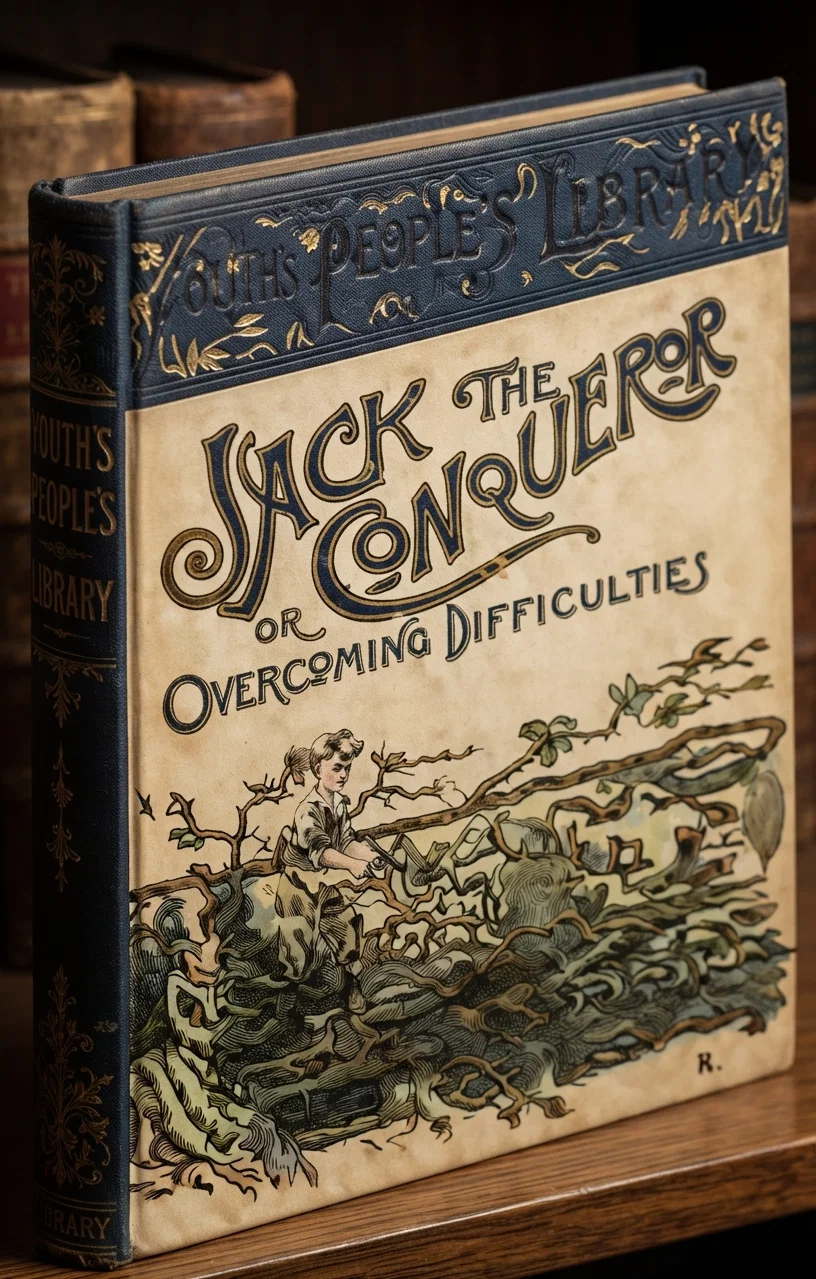
and other stories. These are not light, trashy, improbable tales, but they present some of the real difficulties which nearly all boys and girls are compelled to encounter, and point out the best way to meet them, so as to make the difficulties aids to higher attainments.
160 pages, illustrated; paper covers, 25 cents; cloth, post-paid, $.50.

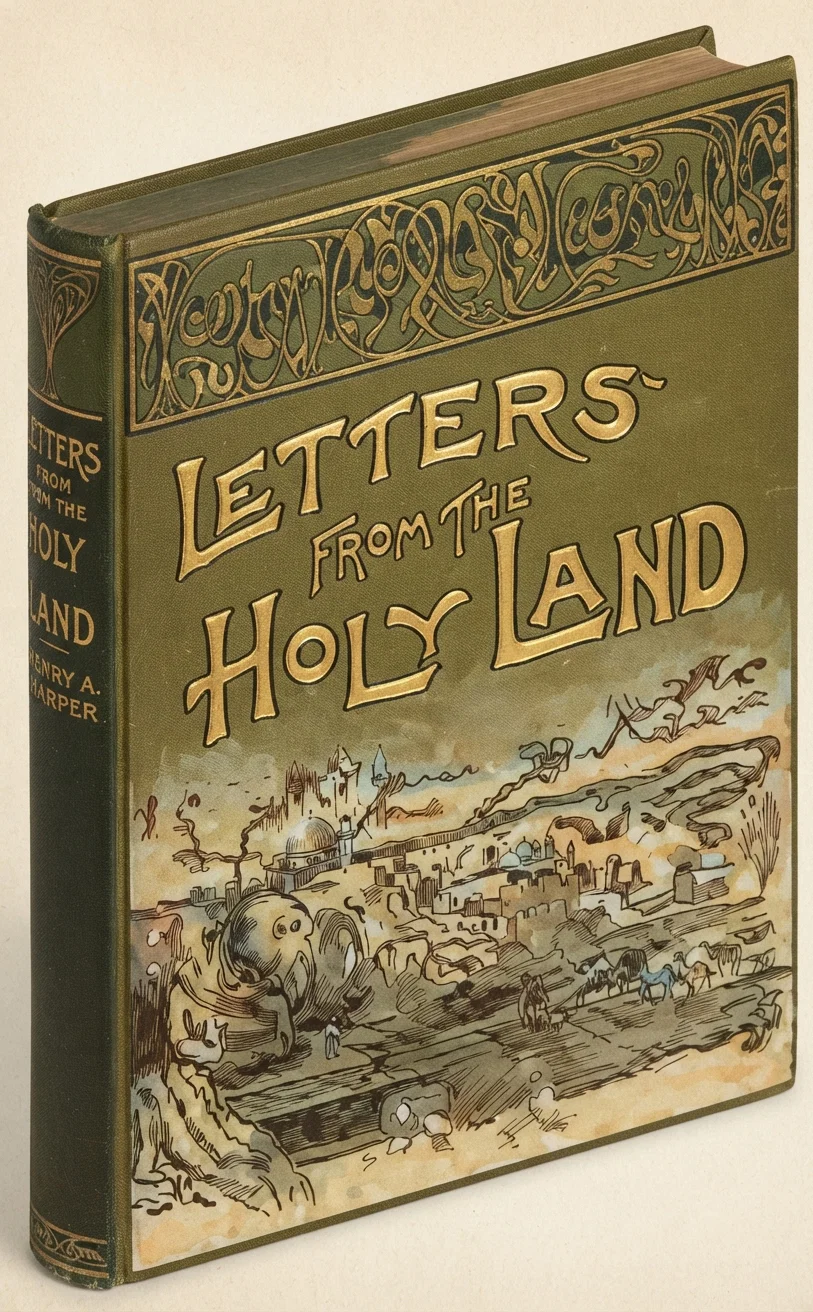
Letters from the Holy Land

By Henry A. Harper. Illustrates many customs and practices, people, and things, so different from those of our own land. The reading of the book will make more interesting the study and reading of the Word of God. It contains a large number of illustrated chapter headings and full-page cuts.
160 pages, illustrated; paper covers, 25 cents; cloth, post-paid, $.50.

Life on the Kongo

By Rev. W. Holman Bentley. This short, tho comprehensive, story of the new-old empire of the Kongo, in many respects the choicest portion of the "Dark Continent," can not fail to interest young and old. The information given has the merit of being the product of the personal observation of the author and other well-known parties who have traversed the country which is so graphically described. Young People's Library Series.
12mo, 160 pages, illustrated; paper covers, 25 cents; cloth, post-paid, $.50.

Life Sketches of Elder James White and Wife, Ellen G. White

Revised. Nearly the last labor of Elder James White was the production of the above-named work. It comprises a sketch of his life, and his public labors in connection with those of his wife, Mrs. E. G. White, and presents a comprehensive history of the Seventh-day Adventist denomination, which he, more than any other man, was instrumental in founding. It gives their ancestry, early life, Christian experience, and an interesting account of their extensive labors. It should be in the hands of all those who desire an acquaintance with the rise, early struggles, and progress of the Seventh-day Adventists.
With steel portraits, brown cloth, 453 pages, post-paid, $1.25.

Living Fountains or Broken Cisterns

An Educational Problem for Protestants. By Prof. E. A. Sutherland.
This book gives the history of the two systems of education, Christian and Pagan. "All thy children shall be taught of the Lord," Isa. 54:13. "Now as never before we need to understand the true system of education. If we fail to understand this, we shall never have a place in the kingdom of God."
"Living Fountains" tells us the cause of the failure and apostasy of Israel, of the early church, the Reformers, the modern Protestants; and also the weakness of the remnant church can be traced to no other source, and accounted for on no other grounds, than pagan methods and wrong principles of education instilled in the minds and hearts of the children and youth of the past and present generations. What kind of education are your children receiving? Would you know and understand the principles of Christian education for to-day? Secure a copy of "Living Fountains or Broken Cisterns;" read it, and ponder its teachings in your heart.
Bound in cloth, post-paid, $1.25.

Pacific Press Publishing Co.

Mountain View, Cal.
285 Salmon St., Portland, Ore. 1109 E. 12th St., Kansas City, Mo.

WALKING WITH JESUS.

HOW many times and in how many ways God manifests His love and presence to us, and we know it not, see it not! His blessings may come in seeming affliction, and we like Jacob mourn, "All these things are against me." We lie down in the desert night feeling utterly alone, and not until the night vision of the messengers of God and the shining stairway to heaven is in the past do we recognize that God was in the place and we knew it not. How much better it would have been to have builded our Beth-el in the evening. He sends His angel to deliver us, and we struggle with Him till the break of day as an enemy. We start like Joshua with an untrained force against a walled city with thousands of foes beyond, and do not recognize as a friend the Captain of God's host who comes to help us, and without whose aid our mightiest effort would spell failure.
How frequently we meet with such paradoxes in the life and experiences of our Lord and His disciples. How the people longed that He should be their King,—He whose right it was. But He sends them back to their every-day life, to the Roman yoke, and to bitter disappointment, and He retires to pray. Did they but know it, He was working out for them in His refusal a more glorious kingdom than earth ever knew. When He died upon the cross, so soon after His triumphal entry into Jerusalem with a multitude singing His praises, the last hope of the disciples seemed forever crushed; but by the means of His death He was destroying even him that had the power of death, the devil, and delivering all who desired deliverance from the devil's thraldom. His humility, His suffering, ever issued in exaltation and glory.
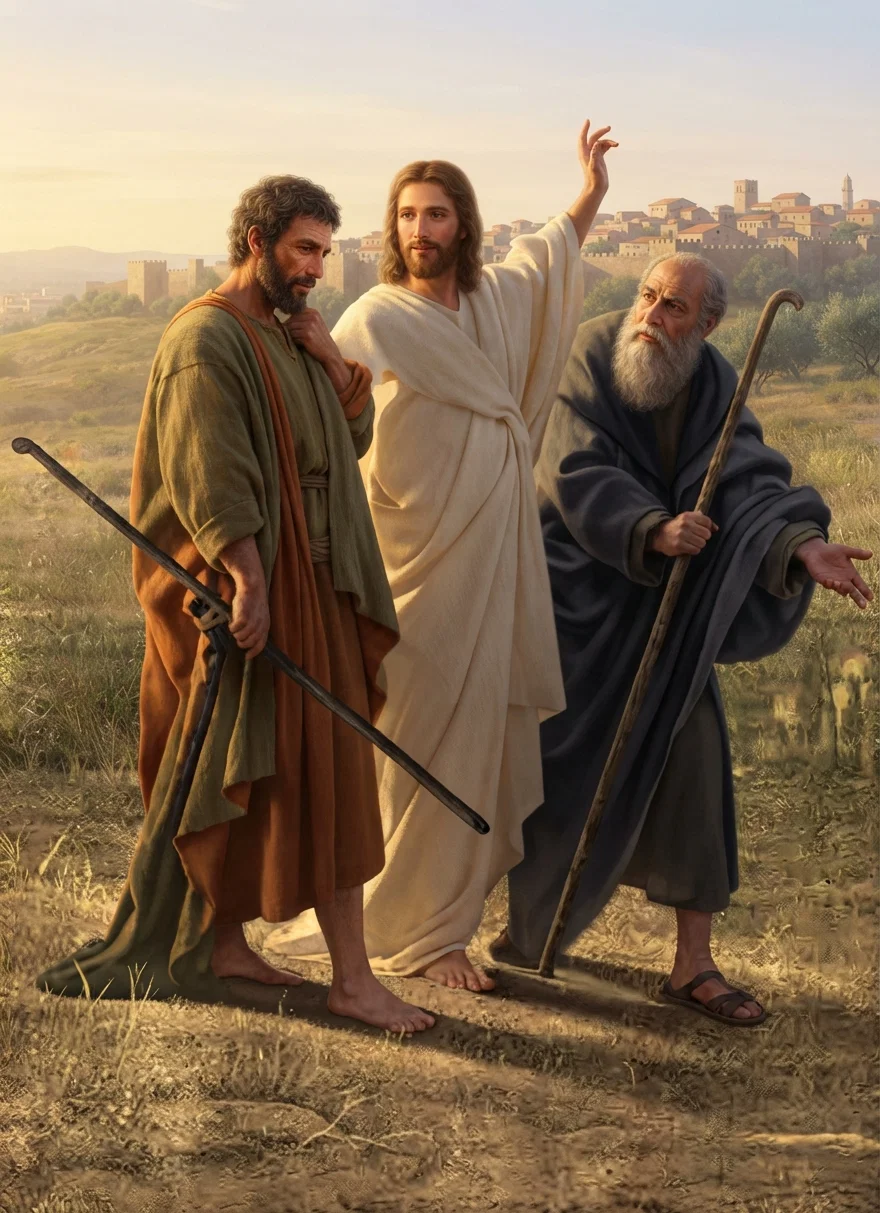
WALK TO EMMAUS.
WALK TO EMMAUS.
THAT first first-day after the resurrection of our Lord was a day of disappointments and surprises, darkest in the morning, but at evening time, light. According to the record, only the women saw Jesus that morning. Later in the day He appeared unto Peter. But when Mary told the disciples "that He was alive, and had been seen of her, [they] disbelieved."
Mark 16: 11. Luke tells us that the words of the women who told the apostles seemed to them "in their sight as idle talk; and they disbelieved them." Luke 24: 11. And after the first excitement of the day was over, the disciples went to their own home (Acts 1: 13), not understanding that Christ should rise from the dead (John 20: 9, 10).
STILL another experience met two humble disciples who went on that day to Emmaus, a little town between seven and eight miles from Jerusalem. Their hearts were full of the events of the past few days. They had been among His devoted followers. They loved Him and His teaching. Therefore their conversation was upon Him and His character and their disappointment. A stranger, as they suppose, joins them and inquires as to their thoughts, and they reply in half reproof as tho there could be any other subject to engross attention save that "concerning Jesus the Nazarene, who was a prophet mighty in deed and word before God and all the people." And they tell of His death and their blasted hopes; also of the empty tomb and the angel's story. And then the Master reveals to them how slow they were to believe the prophets and to see that all those things were necessary in the experience of the Messiah. And He opened their eyes to the Word of God; and still they knew Him not. That His words of reproof and instruction were acceptable to them was shown in their earnest invitation, "Abide with us." They spread before Him their frugal repast, and He blessed and brake the bread and gave to them; and they knew Him. The simplest deed of hospitality revealed to them the Master, and then their eyes were again holden, and they saw Him not.
O HOW full were their hearts now! How they recalled the pleasure by the way as they listened to His soul-stirring words. "Was not our heart burning within us, while He spake to us in the way, while He opened to us the Scriptures?" Their weariness is now gone. What matters it if the day is well nigh spent; they must return to Jerusalem and tell the glad news. After partaking of the bread blessed by the Master, they start the same hour, ending their journey in the light of the moon. They find the disciples at home, with doors closed for fear of the Jews; but they, too, are talking of Jesus' appearance to Simon. While they converse, their eyes are opened, and they see Jesus in their midst; but they are affrighted, thinking Him to be a phantom, till He eats before them. He is "the same Jesus," and His rich blessing, "Peace be unto you," settled down upon their storm-tossed soul as the soft lullaby of the mother soothes her weary child. Their Lord was risen indeed.
EVEN so does the Master long to walk with us in the way, and to open to us His Word. He will not do it, He can not do it, if our hearts are full of the light, the trifling, the foolish, the vain things of this world. He can not walk with us if our hearts are proud and self-sufficient. "Humble thyself to walk with thy God," is the unfailing rule. "For thus saith the High and Lofty One that inhabiteth eternity, whose name is Holy: I dwell in the high and holy place, with him also that is of a contrite and humble spirit, to revive the spirit of the humble, and to revive the heart of the contrite ones." Christ walking with us, Christ abiding in us, Christ opening to us the Scriptures—that is the privilege of every soul.

APOSTASY NOT A RELIABLE STANDARD.

THE apostle Paul mentions several laborers in the cause of Christ who afterward apostatized, and some of them became conspicuous opponents of the Gospel truth. Among these were Hymenæus and Alexander and Philetus and Demas. He says: "Alexander the coppersmith did me much evil; the Lord reward him according to his works; of whom be thou ware also; for he hath greatly withstood our words. At my first answer no man stood with me, but all men forsook me; I pray God that it may not be laid to their charge. Notwithstanding the Lord stood with me, and strengthened me." Because Alexander had once believed and proclaimed the Gospel, he was probably the more able to oppose it, when the spirit of the adversary so moved him. That is, people who did not want to believe the truth would be likely to listen to him, and to quote what he said against the faith. They would say, "This man was once a believer, and proclaimed that doctrine of Christianity for so many years, and of course his testimony is invincible. He and Demas and Hymenæus, and some others, were among the leading men, and if they have seen that the doctrines preached by Paul and his fellow workers are fallacious, that settles it for us." Many people held that Paul could not meet the arguments of these men, and that they completely overthrew their own previous arguments in behalf of the truth.
Now few, if any, professed Christians to-day would believe that to be good logic with reference to the positions of Alexander and other apostates of his time. But there are some who hold exactly the same ideas concerning men who once proclaimed the doctrines of Seventh-day Adventists, but afterwards turned against them. Some champions of these men seem to imagine that they are the acme of authority on the subjects they once advocated but now oppose. That is just what the people thought who stood with Alexander as against Paul and the Gospel. But the Lord deemed that kind of judgment to be all wrong. And this ruling of the Lord is good for all time.
"Ex-seventh-day preachers" have no better pretexts for denying the faith they once held than those opponents have who never accepted it. Their arguments are precisely the same, and are no stronger because repeated by men who once rejected them; they are not even strengthened by such as have several times gone back and forth between advocacy and opposition. All the positions espoused by the enemies of the Sabbath of the Lord and the Spirit of prophecy have been answered from the Word of God many times, and are being answered by it continually. If men will not believe this, they would not believe "tho one rose from the dead." One who deserts the cause of truth may greatly encourage other opponents by his action, but their arguments are in no sense rendered more truthful by the accession. G.

GOD'S PURPOSE FOR HIS REMNANT.

GOD'S purpose for His people is an unchanging one. Through all the ages that purpose has been working out, and that promise has been held out.
The pronouncement of the penalty for Adam's transgression was accompanied by the promise of the Messiah, with all that the Messiah's coming involved.
The promise to Abraham and his seed was a promise that involved the restoration of this earth to its sinless condition as a place fit for the habitation of God's righteous remnant.
Moab and Ammon, the enemies of God's people of old, are but types of the enemies of God's faithful people all through the ages. So God's promise that the residue, or remnant, of His people should possess their land (Zeph. 2:9) was also a prophecy of the time when the wicked would be utterly removed from the earth, and the habitations of sin give place to the habitations of righteousness. "Ye shall tread down the wicked," says Inspiration through Malachi; "for they shall be ashes under the soles of your feet in the day that I shall do this, saith the Lord of hosts." Mal. 4:3.
God's people are they that triumph over sin; and He says of them: "He that overcometh shall inherit all things; and I will be his God, and he shall be My son." Rev. 21:7. Again He says, "No good thing will He withhold from them that walk uprightly." Ps. 84:11. It is God's own, His remnant, His precious jewels, that do that.
So precious is His remnant in His sight, that He declares: "They shall be Mine, saith the Lord of hosts, in that day when I make up My jewels, and I will spare them, as a man spareth his own son that serveth him." Mal. 3:17. Inspiration could, seemingly, use no stronger comparison to show how precious in the sight of the Father are the lives and happiness of those who will stand loyally, unswervingly for Him in spite of the most bitter persecutions. He likens them also to perpetual pillars in His eternal temple.
He tells us through Isaiah that those who are His willing servants and are obedient (who keep His commandments) shall "eat the good of the land." Isa. 1:19. That does not have reference to the "good things" of this sin-cursed earth; but to those truly good things of that goodly land where sin and sorrow no more can come.
Again, it is said of those who are His, "The meek shall inherit the earth; and shall delight themselves in the abundance of peace." Ps. 37:11. Christ gave the most positive assurance to His faithful ones of the reward that awaited them. He said, "I go to prepare a place for you;" and just so surely as He was to go and prepare a place for them, He was to come again and take them to Himself to be with Him forever. That thought is further emphasized in these words of the Revelator: "I heard a great voice out of heaven saying, Behold, the tabernacle of God is with men, and He will dwell with them, and they shall be His people, and God Himself shall be with them, and be their God. And God shall wipe away all tears from their eyes; and there shall be no more death, neither sorrow nor crying, neither shall there be any more pain; for the former things are passed away." Rev. 21:3, 4.
His faithful ones, His remnant, He Himself declares, will be watching for His return; and one of the blessed experiences of that class is foretold in these words of Christ: "Blessed are those servants, whom the Lord when He cometh shall find watching; verily I say unto you, that He shall gird Himself, and make them to sit down to meat, and will come forth and serve them." Luke 12:37.
These are the overcomers: "These are they which follow the Lamb whithersoever He goeth. These were redeemed from among men, being the first-fruits unto God and to the Lamb." Rev. 14:4. This is the class to whom the Saviour refers in these words: "He that overcometh, the same shall be clothed in white raiment; and I will not blot out his name out of the book of life, but I will confess his name before My Father, and before His angels." The white raiment is the robe of Christ's righteousness, which He promises to place upon those who are His. The prophet Daniel in speaking of this class says that they shall shine "as the stars forever and ever." Dan. 12:3.
Out of great tribulation they come; out of the sorceries and philosophies and superstitions and false religions of modern Babylon they are called. "I heard another voice from heaven, saying, Come out of her, My people, that ye be not partakers of her sins, and that ye receive not of her plagues." See Rev. 18:1-4. But they that heed that call sit down at the grandest feast the universe will ever afford.
When "the marriage of the Lamb is come, and His wife hath made herself ready," then shall the overcomers experience the joy of the invitation, "Blessed are they which are called unto the marriage supper of the Lamb. And He saith unto me, These are the true sayings of God." See Rev. 19:7-9.
All these promises and these blessed experiences are for the remnant that prove faithful to God through the most trying experiences that can come to the people of this world. What matter persecutions and oppositions when faithfulness to God brings such rich rewards?

A BAPTIST AGAINST THE LAW OF GOD.

IN laboring to reply to our tract, "An Appeal to Baptists," and in striving to wrest the Scriptures into a support of Sunday observance, a writer in the Pacific Baptist gets wofully entangled. Here is his first deception:
We find in Gen. 2:1-4 that when God had in six days finished the creation, He rested on the seventh day, blessed and sanctified it. But for two thousand five hundred years He commanded no man to keep (hallow) it. Not until we get to Exodus, twentieth chapter, do we find such a command.
Here it is admitted that the Sabbath was made in the beginning, and Christ, the Maker, says it was "made for man." Hardly any one would have the temerity to assume that by this expression Christ meant that it was made for only one man; hardly any one would assume that in order to keep the sanctification alive it would be necessary to repeat it personally to every man who came into the world; hardly any one would assume that any law, human or divine, must needs be re-enacted for those who are born after its promulgation in order to make it binding upon them. Yet all this incongruous assumption is implied in the argument above quoted.
Law always holds until it is repealed, or expires by limitation, tho many generations be born and pass away in the meantime. It seems indeed strange that otherwise intelligent people should be apparently oblivious of that common principle. But the fact that it is so probably accounts for the oversight of Exodus 16 in the long leap from Genesis 2 to Exodus 20. In Exodus 16 we have the account of Moses' reminding the Israelites that the following day was the Sabbath; that the seventh day was the Sabbath, "the holy Sabbath unto the Lord." This was not a new commandment, but a reminder of an old commandment, which they had long been neglecting, and the occurrence was some weeks before the arrival at Sinai, where the whole law was repeated to the people with great solemnity and manifestation of divine majesty.
It is also of importance to note that in the giving of the manna, at the camp where the long-neglected Sabbath law was recalled to the attention of the people, there were instituted three weekly miracles to guard against further desecration of the day during their journey through the wilderness. Let it not be forgotten that this reference to the recognized Sabbath law, and provision against its further desecration by God's people, was before the arrival at Sinai. As there is no record of a repeal of the original Sabbath law, which "was made for man," but there is record that Abraham kept the commandments and laws of God (Gen. 26:5), the continuance of the Sabbath law from Eden to Sinai can not be refuted with any show of reason.
The inconsistency of the argument that for two thousand five hundred years God commanded no man to keep the Sabbath, is emphasized in that those who adduce that plea insist on the obligation of Sunday observance, for which the Scriptures do not show even an initial command of the Lord, much less any repetition in the nearly two thousand years that is claimed for its prerogative of observance.
But the very last argument that one would expect to find in a Baptist journal is this:
Man was left to his own conscience during that period of time, hence sin was not imputed to him. Rom. 5:13.
The period here referred to is the time between the sanctification of the Sabbath in Eden and the repeating of the law on Sinai. Men are always left to their own consciences; God compels no man's conscience; but His Word is given as a guide to conscience. When men depart from the Word it is because they have not a "good conscience toward God." Man being a free moral agent, his conscience, confronted by the testimony of the Spirit, must ever decide whether he will obey God or not. Conscience is ever either accusing or excusing the disobedience of God's law.
But, we would ask, If God did not impute sin to the people during that long period, why did death reign from Adam to Moses? Rom. 5:14. Death is the wages of sin. Rom. 6:23. If sin was not imputed to the people during that long period, why their general destruction by a deluge of water? The Word says it was because "God saw that the wickedness of man was great in the earth, and that every imagination of the thoughts of his heart was only evil continually." If sin was not imputed to the people before Israel came to Sinai, why were Sodom and the cities of the plain destroyed by fire and brimstone, "suffering the vengeance of eternal fire"? The Lord said it was "because the cry of Sodom and Gomorrha is great, and because their sin is very grievous." Gen. 18:20. And Jude testifies that it was because they had given "themselves over to fornication." Verse 7.
So we see that sin was imputed to the people back there; therefore the law was in force, for "sin is the transgression of the law." 1 John 3:4. And the particular law of which the transgression is sin, is designated to be the Ten-Commandment law. Paul says, "I had not known sin, but by the law; for I had not known lust, except the law had said, Thou shalt not covet." Rom. 7:7. And James tells us that to offend in one point is to be guilty of all. James 2:10.
Another great mistake made in the argument in the Baptist is in confounding the Sabbath of the Lord, instituted in Eden, with the ceremonial sabbaths of the Levitical economy. The weekly seventh-day Sabbath was set apart for man before sin entered, when as yet there were no typical institutions, nor any occasion for them. When the Lord gave commandment concerning the typical sabbaths (Leviticus 23), after enumerating various feasts and sabbaths, He said these were beside the "Sabbath of the Lord" (verses 3, 8, 38). Therefore it could not be classed with them.
The argument that sin was not imputed during the pre-Mosaic period is completely stultified by the assumption that the law was suspended at the Cross, and will be again in operation during the Millennium. Here is the claim in the author's own words:
Just as the game law is suspended during certain seasons of the year, God's law is not set aside forever, but is suspended during "this dispensation of grace" while Israel is scattered and the church, the heavenly "body of Christ," is being gathered out from among the nations. Acts 15:14.
Law will be in force again during the millennial kingdom with Israel restored as a nation. See Rom. 11:25-27.
A suspended law is as inoperative as a repealed law. Therefore, according to the logic of this Baptist, sin has not been imputed to the people since the Crucifixion. Then why preach the Gospel? If there is no law in force, there is no sin; then what need of the Gospel? According to this no-law theory, the "dispensation of grace" amounts merely to a period of license—sin is not imputed to anybody, because there is no law to violate. But if the working of God's "holy," "perfect," "just," and "good" law, which is established by faith (Rom. 3:31), was such a burden to the people that Christ gave His life to get it out of the way, wherein will lie the blessing of having it restored "during the millennium kingdom"?
This Baptist effort to make void the law of God is simply another testimony that all such effort is sheer perversion of the Word. It sets the Gospel of Christ against the immutable law which He sacrificed His life to vindicate—to which He was obedient, even unto death. "He that saith he abideth in Him ought himself also so to walk, even as He walked." 1 John 2:6. When the wrath of God is poured out on the earth, without mixture, there will be seen unscathed the company of them "that keep the commandments of God, and the faith of Jesus." Rev. 14:6-12.
Continue reading: Question Corner