THE war-clouds that have been threatening the new republic of China ever since it was established, suddenly broke with tremendous fury on July 15. The troops stationed at Kiukiang, an important city on the Yang-tse River, not far from Hankow, revolted, and opened an attack on a company of northern soldiers who had been sent down by Yuan Shih Kai, in anticipation of an outbreak.
The southern troops then declared martial law, took control of the city, and immediately the Kiangsi province declared its independence from the Peking government.
The next day found Nanking, the historical old southern capital and the scene of many a previous conflict, in the hands of the rebels. Three of the commanding officers stationed in the city, who avowed their allegiance to Yuan Shih Kai, and refused to join the rebels, were seized and beheaded. The rank and file of the soldiers were easily brought over, by the promise of a few extra dollars.
Having secured enough of the soldiery to make a formidable attack, the office of the governor-general was stormed, and the governor of the Kiangsu province, Mr. Chen, was forced, at the point of the bayonet, to turn over the seals of his office to the rebels. A proclamation was issued in his name, declaring Kiangsu province independent, appointing Huang Hsing as generalissimo of the southern army, with orders to proceed north at once on a punitive expedition to kill Yuan Shih Kai, who was declared to be a tyrannical monarch, and restore the republic to the control of the people. What troops could be spared from the northern expedition were despatched to Shanghai to capture the arsenal and take command of the Woosung forts.
Thus far the rebels seemed to have everything their way; and when seven of the southern provinces joined hands with them, and offered support of soldiers and money, it appeared that this rebellion was assuming large proportions, and threatened to bring about the long-dreaded division of China into the north and south, with the Yang-tse River as the dividing line.
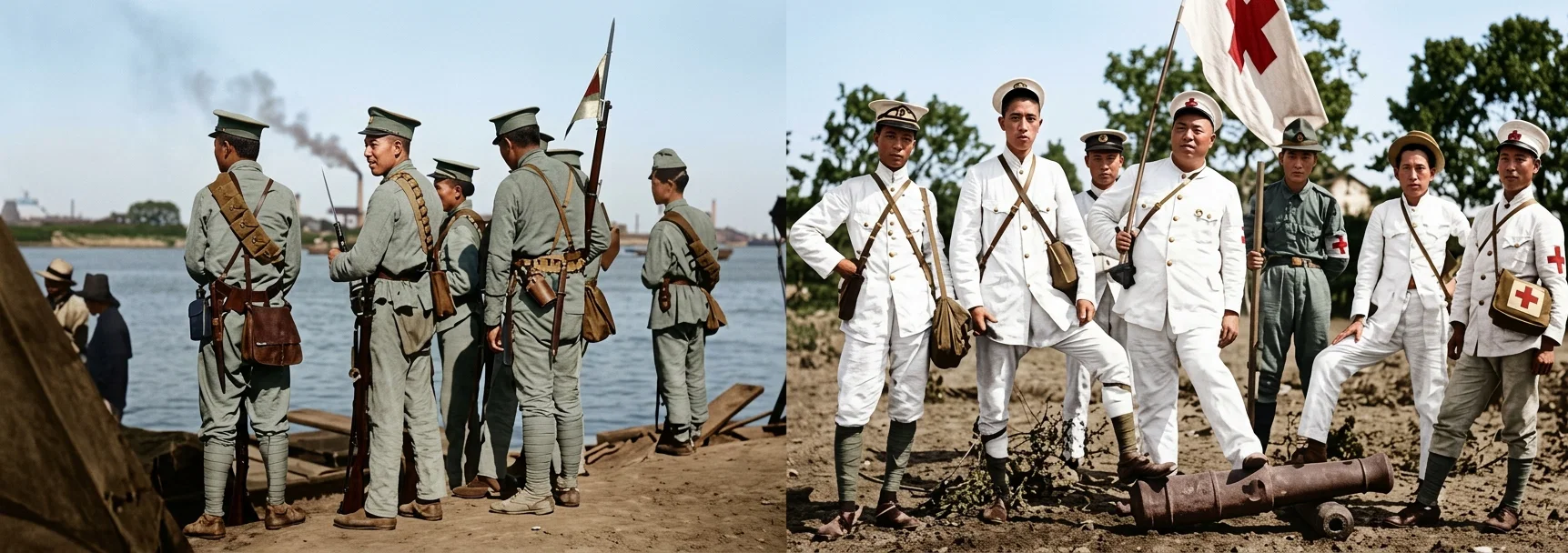
Peking soldiers guarding the Whangpoo River at Shanghai Representatives of the Chinese Red Cross Society in Shanghai
In order to be successful, however, there were two important points of vantage for them to gain. One was the control of the navy, which up to this time had remained neutral; and the other was the Shanghai arsenal, from which to draw their ammunition, it being impossible to carry on a war for any great length of time depending on ammunition that had to be smuggled in from foreign countries.
Right here the rebels lost, and here again was manifested another instance of the ability and foresight of President Yuan Shih Kai in making the needed preparation to prevent just such a calamity. About two weeks before the rebellion broke out, one thousand picked soldiers from Peking were sent to Shanghai, who took over the control of the arsenal, displacing the southern soldiers, whose loyalty was in doubt. The loyalty and good training of these soldiers proved to be the turning-point of the war and the downfall of the rebel army. For eight days they held out against an almost continual rain of shot and shell that was poured in upon them, both night and day, by something like ten thousand of the best of the southern soldiers, who surrounded the arsenal, and attacked from three sides at once. The fourth side is the Whangpoo River; and when the war-ships of the Chinese navy declared themselves for the Peking government, they poured out a scorching fire of big shells before which the rebels were forced to retreat.
Gathering reenforcements, they returned, more determined than ever to capture the arsenal, knowing full well that this was the decisive battle of the war. The arsenal is by no means an easy place to defend, as it is stretched out over several miles of territory, and only partly protected by walls. But the handful of loyal soldiers returned every attack with a hot fire from their rapid-firing guns, until, exhausted and disorganized, the rebels beat a hasty retreat, many of them throwing away their arms and uniforms, and escaping to the settlement in the hope of saving their lives.
This week of severe bombardment was a time of great danger to both the native and the foreign population of Shanghai. Barricades were hastily thrown up at the entrances to the foreign concessions, and soldiers and marines were landed from the war-ships of the various nations stationed at Shanghai. The local volunteers were called out, and patrolled all the important streets, and every precaution was taken to protect life and property. Still no place was safe, as the settlements were in direct line of the shelling from the war-ships, and hundreds of shells fell and exploded in the concessions, damaging property and injuring a number of persons. That there was not greater loss of life seems really remarkable.
The French concession, being nearest the arsenal, got the worst of it; but some shots came clear over the race-track into the Bubbling Well district, where Shanghai's fashionable foreigners live. Several of the consulate buildings were struck. Persons were forced to flee from their homes in the middle of the night, and seek a place of safety. Many had thrilling and narrow escapes from death.
Almost the whole population of the native city fled to the concessions for refuge, and a terrible congestion ensued. At places the streets were impassable, and at night the natives were simply piled up on the sidewalks and the steps of stores and office buildings.
Homeless, hungry, and restless, this mob became a menace to the safety of the residents of the settlement, and steps were immediately taken to care for them as well as possible. The Y. M. C. A., the Chamber of Commerce, and other prominent societies united in this effort. A representative committee of Chinese and foreigners was appointed to solicit funds and distribute relief. Nearly $50,000 was raised, and both food and lodging were provided for as many as 2,500 to 3,000 refugees each day until they were able to return to their homes in safety.
With the government in control of both ends of the Yang-tse, and hastening reenforcements to aid the Nanking attack, it is only a question of time now until this last stronghold of the rebels falls and the rebellion is crushed.
The leaders who plotted and made plans for the carrying out of this revolution have already fled for their lives, as there is a price of $100,000 offered for their arrest. It is rumored that they are in hiding in Japan, but no one knows positively just where they are.10
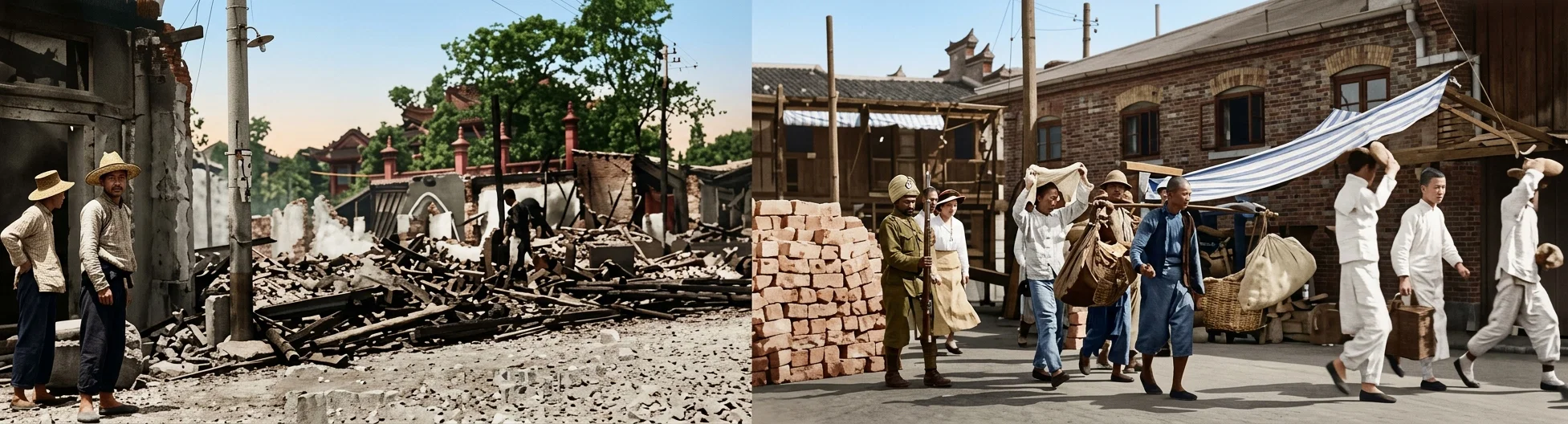
House destroyed in Shanghai by explosion of shell Refugees fleeing to the foreign concession, Shanghai
Contributory Causes
In its conception, it was simply a political war, started by prominent men who were identified with the revolution against the old Manchu government, and upon the division of the spoils these men did not get the share which they claimed was their due.
Gen. Li Yuan Hung, the loyal vice-president, who has faithfully supported the Peking government, tho repeated attempts have been made by the rebels to buy him over, says:
“The present rebellion is founded on nothing but the personal ambitions of certain men. . . . The principal persons responsible are Huang Hsing and Sun Yat Sen. . . . Hardly was the republic formed when they began to scheme to get Yuan Shih Kai out of office.”
Their scheming took the form of a political party called the people's party, through which they sought to control parliament so as to get a man of their own choosing elected as president, or if that was not possible, to make the president a mere figurehead subject to the control of a parliament controlled by their party.
The assassination of Sung Chao Jen, one of their leaders, formed an opportunity of which they took quick advantage; and accusing Yuan Shih Kai with this crime, and circulating inflammatory literature, they soon had a large following.
It only remained then to get the necessary money to buy ammunition, and the rebellion was fairly launched. One thing is certain,—the money and arms for this rebellion did not come from China, and what country furnished them will prove one of the interesting points which will be investigated as a result of this war.
Right here is plainly seen to be China's real danger to-day. In order to establish firmly her government, China is compelled, by her weak condition, to depend upon the powers for their financial and moral support. In fact she is pledged, mortgaged as it were, to five of the great powers now; and if these powers, while outwardly professing to be friendly, continue to work against the up-building of the nation, and lend their support to efforts to divide the country for gain, then China has very small hope of surviving at all.
It is a significant fact that none of these five powers have recognized the Chinese republic yet, and the opinion is fast gaining ground here that “they do not really want the republic to succeed.” (Quoted from Gen. Li Yuan Hung.)
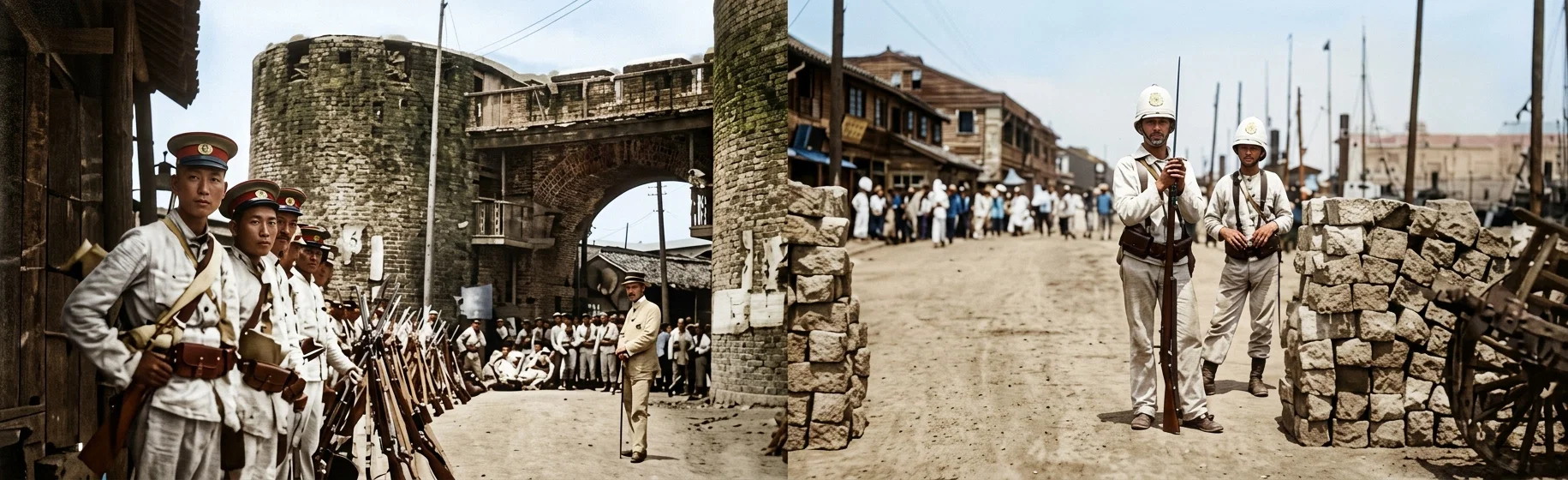
Peking soldiers guarding entrance to the arsenal, Shanghai French soldiers guarding entrance to the foreign settlement
Russia's impudent attitude in regard to Mongolia, and Japan's interest in this rebellion, have stamped these two countries as enemies of China. Great Britain's tacit refusal to help out with the struggle against opium, and the action of the municipal council of the British concession at Shanghai in trying to take forcible possession of the Chinese Chapel district during the rebellion, under cover of protecting foreign interests, have not been lost upon the Chinese; and that there is a marked feeling growing against the British is clearly manifested by the following incident of the late war:
The largest summer colony for missionaries in China is situated on Kuling Mountain, about ten miles from Kiukiang; and when the fighting commenced at that place, the missionaries assembled there for the summer, to the number of 1,200—quite a city in itself—were cut off from all supplies for several days, and a serious food famine threatened. A young Englishman named John Duff volunteered to try to break through the lines of fighting and get supplies from Kiukiang. In order to identify himself, he secured a note from the British consul, written on one of his cards. He also obtained a letter of introduction from the commanding officer of the U. S. S. Helena, who happened to be there at the time.
Young Duff made his way cautiously toward the camps of soldiers, and was soon intercepted by pickets, who escorted him to the general's tent. Producing the British consul's card, he stated the object of his visit, and was amazed to see the card snatched from him, torn up, and thrown on the ground, with the information that British would receive scant favors in their lines.
The young man, concealing the fact that he himself was a Briton, presented his American credentials, which were received with a cordial, “O, yes, we will be glad to extend favors to Americans;” whereupon the officer wrote a pass in Chinese, which said: “Pass the American, John Duff, with supplies from Kiukiang to Kuling. For this man only, and for no other purpose.”
Results of the War
The immediate results of the war will be confusion, stagnation of business, and robbery and looting by the disbanded soldiers; but given time, good crops, and no famine or plague, China can weather these conditions again, as she has done many times before.
The putting down of this rebellion means a united country, and an end to the north and south idea which has been so prominent ever since the setting up of the republic.
It should also form a striking object-lesson to anarchists and jealous politicians who, to further personal ambition, would plunge the country into strife and ruin.
It undoubtedly places the president, Yuan Shih Kai, in a stronger position than he has occupied in the past.
One result should be to teach the powers to keep their hands off and let China work out her own salvation unhampered; but whether this will be the case, we are not prepared to state.
This war should decide once for all that China is to be subjected to a strong central government, and not allow every province to be a law unto itself. It should decide that definite, strong methods are to be used in the regeneration of China, in place of the wild and impractical dreams of the Young China party.
Finally, it is to be hoped that some one man will possess strength and resolution enough to pull the republic together, instead of a dozen eager aspirants' fighting among themselves for power.
Yuan Shih Kai may have been rough in his handling of the provinces, he may have been indiscreet in his treatment of the Cantonese, he may have treated the south with too much disdain; but to unprejudiced onlookers here on the field, he still appears, for the present at least, to be the only man who11can prevent the Chinese republic from falling to pieces.
We have faith in the future of China. We believe in God's word, which declares that the gospel of the kingdom will be preached to every nation, kindred, tongue, and people before the end comes; so we know that an opportunity will be granted to present the gospel to all the Chinese people. Under just what conditions this work will be accomplished, no one can say; but we do know that now is an opportune time. Who will come and help us thrust in the sickle? The harvest is ripe. Let us work while it is day, for “the night cometh, when no man can work.”
F. E. STAFFORD.
Chefoo, China.
Prohibition in Kansas
The Galena Times gives the following figures, as reported by Attorney-General Dawson:
“Five hundred and sixteen thousand children in the public schools of Kansas never saw an open saloon in the state.
“More than one half the county jails are empty.
“Sixty-five of the 105 counties of the state have no inmates of the state penal institutions.
“Many counties have not had a jury try a case in ten years.
“Eighty-seven counties have no insane.
“Fifty-four counties have no feeble-minded.
“Ninety-six counties have no inebriates.
“Twenty-nine counties have not a single inmate on their poor-farms.
“Kansas is the richest state in the Union. Its average wealth per capita is $1,700.
“Less than ten of 786 newspapers in the state accept liquor advertisements, one of them being in Atchison.
“Is it any wonder, then, that, Kansas being the driest dry state, prohibition is stronger than at any time in her history?”
The foregoing figures are well worthy of study and reflection. They show the great advantages of prohibition and of the absence of liquor from any community or state. The fact that there may be drinking done in the large cities of Kansas, and that men insist upon “bootlegging” and running “blind tigers,” contrary to the law, does not invalidate the beneficial results of prohibitory law.
There are some who argue that prohibition does no particular good, because it does not stop the drinking altogether; but anything that can be done to lessen the use of strong drinks helps just that much, even if it can not stop it entirely. We have laws against murder, but those laws do not stop murdering. And yet we do not find ourselves repealing the laws; we seek to have them enforced as completely as possible. Any man who is not financially interested in the drink traffic, or who is not under some kind of hypnotic influence of those who are thus interested, will be able to see that the liquor business is destructive of every social good. The facts show that it is at the foundation of a large part of the crime and vice that cause so much concern and anxiety in the world at the present time. But there are millions upon millions of dollars invested in the liquor traffic; and with these dollars before the eyes of men, they can not see the misery and the suffering that are caused by the drink evil, and they can not see the facts very clearly that are brought out by the report of the conditions in Kansas.
Those who are acquiring these dollars by the sale of alcoholic drinks, of course will tell us that in the large cities in Kansas, and possibly elsewhere through the state, they can buy all the whisky they want. That may all be true, but it does not in the least degree overthrow the facts set forth by Attorney-General Dawson. It merely serves to show the determined lawlessness of those who insist upon making their money through the sale of that which degrades, debauches, and impoverishes multitudes.
The Capitalist and the Laborer
THE determined conflict between the capitalist and the laborer is shown in a new light through the lobby investigations that are being conducted in the United States Congress. Those investigations are showing without any question, that the capitalists have maintained a strong organization to influence legislation; they have agencies to color the matter that is put through the press; and in many other ways they seek to hold the business of the country under their power.
This means, of course, that they would keep wages down, and do many other like things that would be to their advantage. Labor organizations have been claiming this for years, and so they have been uniting all the more closely and working all the more vigorously to combat the work of the men of colossal wealth. A great many people spend their time in studying and discussing the right and the wrong that may be in each of these contending forces of capital and labor; but a better way is for us to recognize the great struggle that is on, to observe that it is world-wide, and then to know the meaning of it as it is disclosed through the prophets.
The world at the present time is very seldom free from outbreaks between these contending camps in the form of strikes and lockouts. These are becoming constantly more frequent; and if we knew the facts, we would doubtless find that what is in process in secret on each side would be much more alarming than what is out in the open.
We have no disposition to discuss who is right, or who is wrong, in these things. It should pass without saying that there is more or less of right and wrong upon both sides, and that the men of wealth, being in the possession of power, carry the greater responsibility for the conditions that are existing at the present time.
When the Master was here in person, He said that as it was in the days of Noah, so shall it be in the coming of the Son of Man; and the same Master, some two thousand years before, had inspired Moses to tell us that in the days of Noah every imagination of the heart of man was only evil continually. And furthermore, He said: “The earth also was corrupt before God, and the earth was filled with violence. And God looked upon the earth, and, behold, it was corrupt; for all flesh had corrupted his way upon the earth.” Gen. 6:11, 12.
We can not be held responsible for the statement that was made by the Master, nor for this other statement that He inspired Moses to write. If any one wishes to quarrel with these statements, he must see, if he stops to think, that he is not quarreling with men, but he is quarreling with the Author of the Bible. He told us that the days of violence and anarchy that existed in the times before the Flood, would be repeated just before His second coming. The conflict now on between capital and labor, not to speak of the other causes of violence and social discontent throughout the world, is assuming greater and greater intensity. Who can not see that these predictions that were made by the Lord of Glory are being most literally fulfilled?
Growing Sentiment in Favor of the Soon Coming of Christ
We are seeing more and more in print emphasizing the fact that Christ will soon return to this earth. There are many of the best men everywhere who have been grappling with the moral situation in the world, and who find that it is becoming hopeless, and believe that the only solution of these difficulties and problems will be the personal return of Christ Himself. The prophecies very clearly show that we are rapidly nearing the end of this world in its present condition of sin, and that the return of the Master is the next thing on the divine program. These matters are made very clear in the great book of prophecy, yet it is true that there are many fanciful and unscriptural ideas concerning the second coming of the Master. And we should expect these, because the arch-deceiver is determined that men shall not have a correct idea of the teaching of the Word concerning the great event. Satan would have some minimize the importance of it, and so practically ignore it altogether. Those who can not be inspired with this spirit of indifference, he will drive into some foolish or absurd vagaries that are just as destructive of truth and sound doctrine. And those who will imbibe these errors are not prepared for the great day of the Lord and the second coming of Christ, because they do not have an intelligent understanding of the teaching of the Word itself. We need to know the Bible in these times, and to know it for ourselves. If we earnestly study God's word, and truly seek Him for light, He will teach us of His way.
When the Master was asked by His disciples concerning the matter of His second coming, His first concern seemed to be directed to the thought of His people's not being deceived in regard to the great doctrine; for He said: “Take heed that no man deceive you. For many shall come in My name, saying, I am Christ; and shall deceive many.” “If any man shall say unto you, Lo, here is Christ, or there; believe it not. For there shall arise false Christs, and false prophets, and shall show great signs and wonders; insomuch that, if it were possible, they shall deceive the very elect. Behold, I have told you before.” Matt. 24:4, 5, 23-25.
The teaching of the Word itself is perfectly simple and plain; but our danger is in imbibing theories and doctrines, and insisting upon clinging to them regardless of what the Word says. Let us study the Word, and follow it closely. The only key to the Scriptures that we can safely trust is the exact wording of the Book itself, as impressed upon the mind by the divine Spirit that comes direct from God, without any human intermediary.
Did He Miss the Opportunity?
By M. C. W.
—One would naturally think, if our Catholic friends have the right of it in the honor and exaltation which they give to the mother of our Lord, that Jesus missed a great opportunity of stating her exalted position at the marriage in Cana of Galilee. The wine failed, and the mother of Jesus “saith unto Him, They have no wine. And Jesus saith unto her, Woman, what have I to do with thee? Mine hour is not yet come. His mother saith unto the servants, Whatsoever He saith unto you, do it.” John 2:3-5.
What a splendid opportunity it was for Jesus to exalt as divine His highly honored human mother,—honored by being the channel through which the Word was made flesh. But He does not do this. We do not understand that His language was disrespectful, but it clearly indicated that she was not to be the guide, or governess, or leader, or ruler, in any way, of His work. Nor did she herself feel that at all. She quietly submitted to His kindly reproof, if so we may call it, and simply said to the servants, “Whatsoever He saith unto you, do it.” He needed no solicitation from her; He needed no daysman to come between Him and humanity’s needs. It is He Himself who said to the poor and the needy, to the weary and the worn, to the sick and the sinful, “Come unto Me.” No cordon of saints or angels or prelates or priests is needed to give the needy soul a connection with the divine Lord. He Himself has opened the way, and He invites all to enter.
M. C. W.
Theosophy’s Coming Messiah Claim
In the twenty-seventh annual meeting of the Theosophists in Chicago, they declared that the Theosophists are breeding a new race of world masters, that they are doing it out here in the West, and that they have three young men now undergoing an exalted training, and that one may be designated as the representative of the coming Messiah. There will be many carried away by just such declarations as this. It might be well for them to look back and ask what Theosophy has done for India, where it has had such long experience. A religion that grasps no power outside of the individual is worthless.
Methodists Favor Church Steeple Crosses
The California Conference of the Methodist Episcopal Church, in its recent session at Pacific Grove, adopted resolutions favoring crosses upon the steeples of all their churches.
The Trail of the Serpent
By Clara Edna Rosecrans
By Clara Edna Rosecrans
ARE you going out to-night, Scott?” asked pretty Kathleen Lorimer, as her young husband rose from the supper table and began putting on his overcoat.
There was an anxious note in the young wife’s usually cheerful voice—a look of solicitude in her blue eyes that made the man wince as he answered with forced carelessness: “Why, yes, little girl; I promised Jim I’d be down at the store to-night. He wants me to look over the books with him.”
Kathleen shivered, the room was warm and bright. “It’s very lonesome here by myself, dear,” she said, looking wistfully into her husband’s handsome, boyish face, which reddened slightly under her gaze. Well he knew in his secret heart that it was not the loneliness that the poor wife dreaded. It was not the mere going away that made the tears start, but the terrible fear of how he might return that grieved her heart.
He stood a moment irresolute. “If it’s dreary here at home, let me take you over to your mother’s while I’m out,” he said.
Kathleen shook her head. “No,” she said; “it’s you, not mother, that I want for company to-night.”
“All right,” he answered lightly. “I’ll promise not to be out long.” So saying, he bent and kissed his wife, and went out.
She listened till the last footfall had died, then with a sigh that was almost a groan, went about her work.
Scarcely a year had passed since Kathleen Reed had stood at the altar, a happy, contented bride. She knew that Scott drank a little; but like many another fond girl, she was sure he would settle down and make a good husband.
Scott Lorimer’s father had died when the son was a mere boy—died in the prime of his manhood, slain, alas, by the terrible habit that was dragging his son down a swift incline to ruin. Not the least part of Scott’s inheritance was the corner drug store, a prosperous business ably managed by a distant relative of his father.
Sad indeed was the awakening of Kathleen, when, shortly after her marriage, she discovered that Scott was his own best customer, and that, more and more frequently, as the restraints imposed by the honeymoon wore off, he returned late at night in a state of beastly intoxication.
To-night, left alone in the cozy sitting-room, she mended the fire, drew an easy chair to the table, and tried to busy herself with her embroidery. The hours passed leaden-footed. The little clock on the mantel chimed eight, nine, and ten. When at last it struck eleven, Kathleen arose and wrapped a dark shawl around her, over her neat house dress. Taking a lantern from behind the kitchen door, she lighted it and went out into the darkness. What need to describe that fearsome journey through the dark, deserted streets of the country town; or the condition in which she found her husband; or the terrible humiliation of the proud, girlish heart, as she saw her loved one, his reason dethroned, his manhood debased, by the terrible fiend of drink? What need to tell it all, when it has been written over and over again in the heart’s blood of the best and noblest of our land?
That was not the last journey of a similar nature that the poor wife made. Night after night, as the midnight hour drew on, might she be seen stealing forth into the darkness to lead her erring husband home. Poverty she never knew. That last bitter drop in the cup of the drunkard’s wife was spared her. Tho she never complained, one could see that the heart was bleeding inwardly day by day. The light went out of her eyes, and the pretty flush from her cheek. She drooped like one overburdened.
Thus three years passed away—years of slow, heart-breaking sorrow to the once happy wife; of slow downward progress for the husband. Then suddenly the end came: Scott was smitten with typhoid fever, and lived only two weeks. There was no hope for him from the first. His constitution, tho naturally strong, had been ruined by drink; his stomach had been literally burned up, his physicians said.
Never have I witnessed with a sadder heart the passage of a funeral train, for I had known him as a prattling baby, as a handsome schoolboy, and as a young man.
Girls, this is a true story, which might be duplicated in many a village and city all over the land. Take warning, therefore, you who perchance are just entering upon the witching days of courtship. Beware lest you give your hearts where your reason and conscience may not follow. Be sure that the youth upon whom you bestow your heart’s best affections has given his heart to God, and is thus stayed against the terrible temptations that lie about his path. So shall you be happy in your love. So also shall you build a home that shall be a shadow of that blessed and everlasting home above.
Springfield, Missouri.
God Is Good
By M. C. Sellers
By Mrs M. C. Sellers
God is good. His mercies great,
Coming soon or coming late,
Give us faith to trust Him more
When the darkening storm-clouds lower.
Swing the pearly gates ajar!
Let us view the land afar!
Wide, swing wide the pearly gates!
An abundant entrance waits.
Weary pilgrim, sore oppressed,
Thou shalt soon find home, sweet rest.
Tho thou pass Gethsemane,
With thee He will surely be.
Grievous chastening ’neath the rod
Leadeth home to heaven and God.
Whatsoe’er the trial be,
He who stilled the Galilee,
Still is able, if His will,
All the stormy waves to still.
Courage now! The land is near!
Weary one, be of good cheer!
These poor bodies soon will be
Changed to immortality.
Ballard, Washington.
Winning and Bringing
By Anon.
A CHRISTIAN lady was pleading with a sinful girl, who had gone far away from her mother's God, to come to Jesus for pardon and peace. Suddenly the girl turned upon her.
“Have you been to Him?” she asked.
“Yes, indeed I have,” was the reply.
“And has He given you rest?”
“He has. O, thank God, He has! He is my Saviour and Friend.”
“Then put your arms about me, and try to take me with you to Him,” murmured the girl. “It would be easier to go with one who has been before.”
It was the secret of success. Many who will resent an attempt to draw them out of evil courses, will be won by that “touch of nature which makes the whole world kin.” Let it be rather, “Come thou with us, and we will do thee good.”—Anon.
The Making of Great Men
By John Temple Graves
It is not in superficial gifts, nor in natural talents, nor in brilliant beginnings, but in the resolute ambition, the steadfast purpose, and in the capacity to endure toil and to conquer disappointment, that the strong, great men of the world are made.—John Temple Graves.
IN THREE DAYS SAN FRANCISCO Overland Limited TAKES YOU To Chicago
ACROSS GREAT SALT LAKE AND HIGH SIERRA BY DAYLIGHT
Luxurious High-class Equipment Electric Lighted Throughout
Pullman Drawing-room Stateroom Vestibuled Sleeping-cars Careful and Attentive Dining Service Parlor Observation-car with Library and Cafe Ladies' Reading-room Gentlemen's Smoking-room Daily News Bulletins Latest Papers and Magazines