Your ShelfYour Projects

Signs of the Times, Vol. 40, No. 40.

Take heed—

Signs of the Times

Oct 14, 1913

Pacific Press Publishing Association · Mountain View, California · Oct 14, 1913

Take heed—

“And Jesus answered and said unto them, Take heed that no man deceive you. For many shall come in My name, saying, I am Christ; and shall deceive many.” Matt. 24: 4, 5.
“Then if any man shall say unto you, Lo, here is Christ, or there; believe it not. For there shall arise false Christs, and false prophets, and shall show great signs and wonders; insomuch that, if it were possible, they shall deceive the very elect. Behold, I have told you before. Wherefore if they shall say unto you, Behold, He is in the desert; go not forth: behold, He is in the secret chambers; believe it not. For as the lightning cometh out of the east, and shineth even unto the west; so shall also the coming of the Son of Man be.” Matt. 24: 23-27.
“Enter ye in at the strait gate: for wide is the gate, and broad is the way, that leadeth to destruction, and many there be which go in thereat: because strait is the gate, and narrow is the way, which leadeth unto life, and few there be that find it. Beware of false prophets, which come to you in sheep’s clothing, but inwardly they are ravening wolves.” Matt. 7: 13-15.
“Not every one that saith unto Me, Lord, Lord, shall enter into the kingdom of heaven; but he that doeth the will of My Father which is in heaven. Many will say to Me in that day, Lord, Lord, have we not prophesied in Thy name? and in Thy name have cast out devils? and in Thy name done many wonderful works? And then will I profess unto them, I never knew you: depart from Me, ye that work iniquity.” Matt. 7: 21-23.

Question Corner

“IF YE WILL INQUIRE, INQUIRE YE.”
This Inquirers' Department is conducted for the purpose of helping those who are studying the Bible. The answers are oftentimes only suggestive. They are never to be considered infallible, only as they agree with the infallible Word. The writer who may answer these questions does not consider that his opinion is infallible. He will simply give the best that he has, and plead with the inquirer to search the Word. Such questions only will be answered as, to the editors, seem to minister to the good of the readers and to the mission of the paper. We can not answer repeatedly in the same volume questions upon the same scripture. The name and address must accompany question, not for publication, but as an evidence of good faith, and that answer may be made by letter if deemed advisable. No letters are answered which do not contain the name of the writer. It is well always to enclose stamp for reply.

4199 — Thrones at Jerusalem, Jer. 1:15

Does this text mean that the north kingdoms really set their thrones there? or that in going there their kingdoms are at stake? G. W. S.
No! it simply means that the kingdoms from the north would gather around Jerusalem and take it. That is all. It was God's warning to Judah. They had thought that they would exist forever, because that was God's sanctuary and God's city, and that whatever they did, it would still stay. They did not know, nor appreciate, that their iniquities were working toward the destruction of Jerusalem; so God warns them that the nations from the north (of course when they came against Jerusalem they were under one head, that of Babylon) would gather around Jerusalem, and would there judge the people just as tho their thrones themselves were there. The prophecy may look forward to that time when there shall be a gathering in the last days in the war of Armageddon, when the thrones of all would indeed be at stake. But right here in this prophecy of Jeremiah it seems to have a local application.

4200 — The Judgment of the Wicked

If the wicked are already condemned, why their judgment?
The Bible says, “The wages of sin is death.” Rom. 6:23. But temporal death, or the natural death that we die, is not a punishment for the sins that we have personally committed, but is the result of Adam's transgression. When Adam sinned, he was deprived of partaking of the tree of life, and became subject to death, according to the divine decree; and since he was subject to death, all his posterity must be subject to the same thing. He could not transmit attributes that he did not possess. Hence we have this statement: “For as in Adam all die, even so in Christ shall all be made alive.” 1 Cor. 15:22. We all die in Adam, but Christ gives each one a resurrection. That is the plain statement of the text. And then in the resurrection we stand, not upon the record that Adam made, but upon our own individual acts. Everything that we lost in Adam we receive back through Christ; in the resurrection, the righteous stand in the strength of their own immortal life that they have received as a gift of God through Christ; and when the wicked are resurrected, they stand to receive their reward for the deeds that they did, and that reward is everlasting death. God's plan provides for justice, and does not leave the individual under the necessity of believing that he is called upon to suffer for the transgression of his father Adam. Through Christ both saint and sinner stand upon the record of their own personal lives.

4201 — The Millennial Reign of the Saints

In the thousand-year reign of the saints with Christ, over whom will they reign?
Rev. 20:4, speaking of the redeemed, says, “And they lived and reigned with Christ a thousand years.” This thousand-year reign, as will be seen by the rest of the chapter, is the period between the first and the second resurrection, the righteous being raised in the first resurrection, and the wicked raised in the second. The text says that they reign with Christ. Then since they reign with Christ, they would reign over whatever Christ reigns over. Rev. 5:10 represents the redeemed as saying to Christ, Thou “hast made us unto our God kings and priests; and we shall reign on the earth.” The same thought is also expressed in the sixth verse of the first chapter. When Christ undertook the redemption of the human race, He arranged the plan to be forever identified with the human family. He is our elder Brother, and we are adopted into the divine Father's family. “For both He that sanctifieth and they who are sanctified are all of one: for which cause He is not ashamed to call them brethren, saying, I will declare Thy name unto My brethren, in the midst of the church will I sing praise unto Thee.” Heb. 2:11, 12. And again: “As many as are led by the Spirit of God, they are the sons of God. For ye have not received the spirit of bondage again to fear; but ye have received the Spirit of adoption, whereby we cry, Abba, Father. The Spirit itself beareth witness with our spirit, that we are the children of God; and if children, then heirs; heirs of God, and joint heirs with Christ; if so be that we suffer with Him, that we may be also glorified together.” Rom. 8:14-17.
Are we as Christians awake to the wonderful gift that is conferred upon us in the plan of salvation? We are made heirs of God and joint heirs with Christ. Christ is the only-begotten Son; and when the Father adopts us into His family, we are not stepchildren, but we stand in a joint relation with His own beloved Son. And then, when the great consummation is finally reached, the record tells us: “I John saw the holy city, New Jerusalem, coming down from God out of heaven, prepared as a bride adorned for her husband. And I heard a great voice out of heaven saying, Behold, the tabernacle of God is with men, and He will dwell with them, and they shall be His people, and God Himself shall be with them, and be their God.” Rev. 21:2, 3. The redemption of mankind is costing Heaven an indescribable price; and when He shall bring His redeemed sons and daughters into their eternal home, they are to reign with their Redeemer. “And it doth not yet appear what we shall be: but we know that, when He shall appear, we shall be like Him; for we shall see Him as He is.” 1 John 3:2.
In the redeemed state, we will not reign over subjects in the sense in which kings reign or tyrannize over their subjects in this world. “The kings of the Gentiles exercise lordship over them, and they that exercise authority upon them are called benefactors. But ye shall not be so; but he that is greatest among you, let him be as the younger; and he that is chief, as he that doth serve. For whether is greater, he that sitteth at meat, or he that serveth? is not he that sitteth at meat? but I am among you as he that serveth. Ye are they which have continued with Me in My temptations. And I appoint unto you a kingdom, as My Father hath appointed unto Me; that ye may eat and drink at My table in My kingdom, and sit on thrones judging the twelve tribes of Israel.” Luke 22:25-30. The principles of the kingdom of Satan which he has transmitted to the kings of the Gentiles cause lordship and tyranny, and require that the subject shall enslave himself, if necessary, for the king. But the principles of the kingdom of the Prince of Peace exalt and establish that higher and more delightful form of government where each one seeks to serve the other, and to make the other happy. The reigning with Christ is a work of joyful ministry.

4202 — Will Men Be Lost for Not Keeping the Sabbath?

Do you not think it presumptuous to say that those rejecting the Bible Sabbath day as a non-essential are doomed to destruction? It seems to me incompatible with God's mercy that so many hundreds who have rejected the literal teaching of the Sabbath law, yet who live upright, moral lives and seem to enjoy their spiritual experience, are forever lost unless they obey the fourth commandment to the very letter. H. T.
No question involving Bible truth can be properly answered except in the words of Scripture, for it is upon the Scripture itself that we must stand. The Word declares, “So speak ye, and so do, as they that shall be judged by the law of liberty.” James 2:12. It further says: “For there is no respect of persons with God. For as many as have sinned without law shall also perish without law: and as many as have sinned in the law shall be judged by the law; for not the hearers of the law are just before God, but the doers of the law shall be justified.” Rom. 2:11-13. Then the verdict of the Word in regard to judging is, “But why dost thou judge thy brother? or why dost thou set at naught thy brother? for we shall all stand before the judgment-seat of Christ.” Because a man rejects a doctrine that we have presented, we do not necessarily infer that he has rejected God also; for the way in which we presented it may have been so bungling as to close the mind of the individual completely to a truth that is perfectly plain in the word of God. And hence we are not to judge, for all these persons will stand before the judgment-seat of Christ. But when one does see plain truth in God's word, and rejects it, he must suffer the consequences. The Scriptures are plain upon this point. Speaking of those who had rejected truth when He was here upon earth, Christ says, “If I had not come and spoken unto them, they had not had sin: but now they have no cloak for their sin.” Christ could read the thoughts and the motives of men, and He was able to tell when they had rejected truth that meant their condemnation; but He has not left that work, or that kind of ability, with us. We are to live His truth as we understand it in His word. We are to seek to have our consciences educated to divine truth, and to keep our consciences inviolate. We are to teach that truth as far as we have opportunities; but the question of how that truth shall be received, and how individuals will stand in the judgment, is not our part of the work.

4203 — The Sacrifices of Israel

Where in the Scriptures have we any evidence that the Israelites might understand that their sacrifices were typical, and not real? I can not find a hint anywhere that even Moses knew they were typical. S. H.
We would suggest to our inquirer that he study such texts as the following: “Blotting out the handwriting of ordinances that was against us, which was contrary to us, and took it out of the way, nailing it to His cross; and having spoiled principalities and powers, He made a show of them openly, triumphing over them in it. Let no man therefore judge you in meat, or in drink, or in respect of an holy day, or of the new moon, or of the sabbath days: which are a shadow of things to come; but the body is of Christ.” Col. 2:14-17. Then if he will study the book of Hebrews, which is a divine commentary on the sanctuary service and its sacrifices of the old dispensation, he will get a great deal of added light showing that the Hebrew nation distinctly understood what they were doing in offering their sacrifices. For instance, the first part of the ninth chapter of Hebrews talks particularly of the sanctuary, mentioning its various parts, and telling of its services. Then we have these statements in verses 18-19: “Which stood only in meats and drinks, and divers washings, and carnal ordinances, imposed on them until the time of reformation. But Christ being come an high priest of good things to come, by a greater and more perfect tabernacle, not made with hands, that is to say, not of this building; neither by the blood of goats and calves, but by His own blood He entered in once into the holy place, having obtained eternal redemption for us. For if the blood of bulls and of goats, and the ashes of an heifer sprinkling the unclean, sanctifieth to the purifying of the flesh; how much more shall the blood of Christ, who through the eternal Spirit offered Himself without spot to God, purge your conscience from dead works to serve the living God?” Such texts as these show very plainly that the writer of the letter to the Hebrews understood that the sacrifices of the Old Testament pointed forward to the shedding of the blood of Christ.

Our Bible Band

Schedule for the Week Ending October 18, 1913

Sunday October 12 Luke 6
Monday " 13 " 7
Tuesday " 14 " 8
Wednesday " 15 " 9
Thursday " 16 " 10; Psalm 63
Friday " 17 " 11; " 64
Sabbath " 18 " 12; " 65
We are still with the Gospel of Luke, accompanying our Saviour in His miracle working and teaching. The readings also include Psalms 63 to 65. Let us imagine, as we read, that we are with our Saviour in His journeys.

The Sons of Eli—No. 2

By Mrs. E. G. White
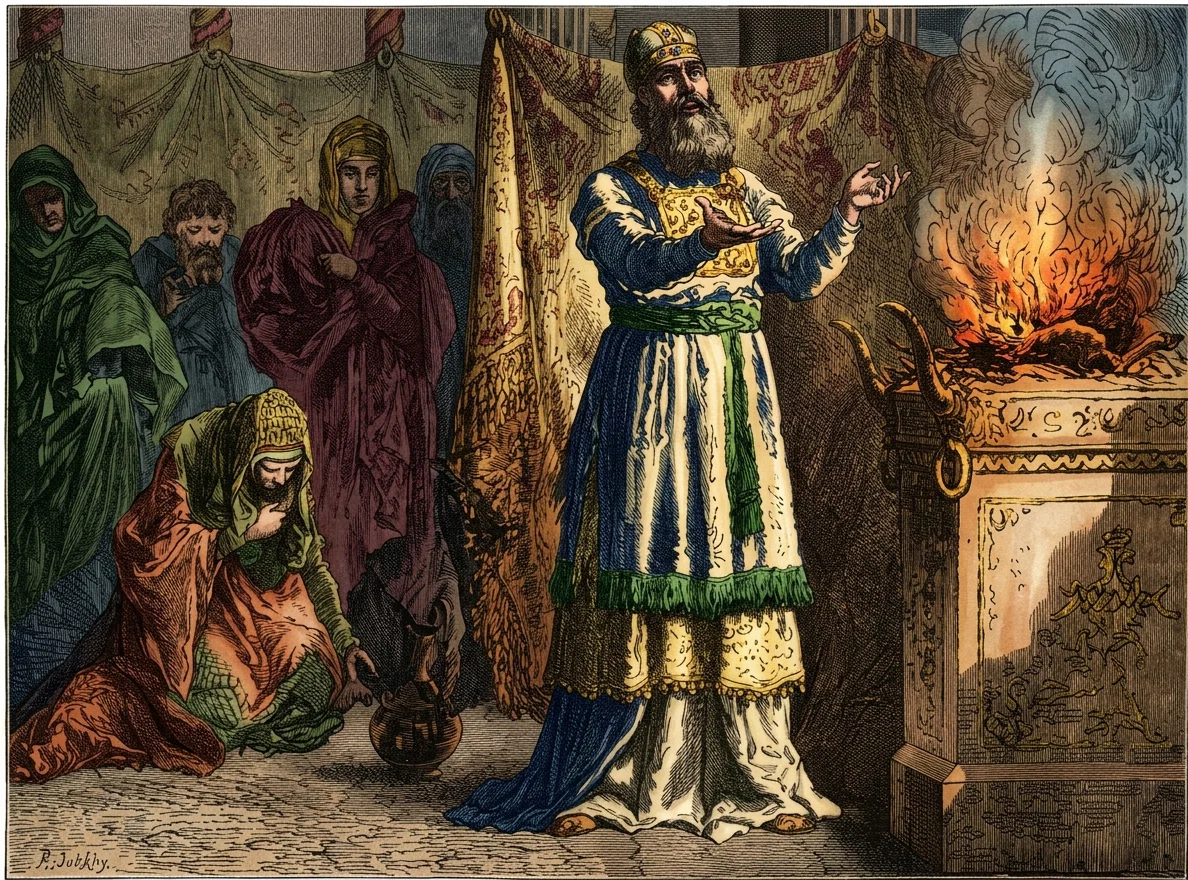
The sacrifice of the peace-offerings, which were made as an expression of thanksgiving to God, afforded a favorable opportunity for unscrupulous priests to enrich themselves at the expense of the people.
THE Lord had, through Moses, given the most explicit directions concerning the sacrificial offerings. But selfish, avaricious priests, to serve their own interests, had departed from these instructions. The sacrifice of the peace-offerings especially, which were made as an expression of thanksgiving to God, and were presented in great numbers when the people assembled at the annual feasts, afforded a favorable opportunity for unscrupulous priests to enrich themselves at the expense of the people. The Lord had directed that the fat of the peace-offering should be burned upon the altar as a type of the great Sacrifice. A specified portion, the breast and the right shoulder, with some minor parts, were given to the priest as his perquisite. The remainder was to be eaten by those who brought the offering.
Infinite Wisdom had foreseen that the clamor of appetite, and a covetous desire for gain, might lead the priest to appropriate to himself the sacrifices solemnly devoted to the Lord. That there might be no room for confusion or misunderstanding, the most exact and minute directions had been given.
Hophni and Phinehas, the sons of Eli, disregarded the laws of the sanctuary more boldly than had any of their predecessors. While they arrayed themselves in the sacerdotal garments and ministered before the Lord, they cared only for the gratification of their own debased appetites and passions. The priests not being content with their rightful share of the peace-offerings, it had become customary for one of their servants to come while the offerers were cooking their portion in some apartment adjacent to the sanctuary, and to carry away whatever could be taken up with the flesh-hook. The great numbers of sacrifices offered, made this a considerable addition to the priest’s perquisite.
But even this departure from the Lord’s commands failed to satisfy Hophni and Phinehas. They desired the fat, which the Lord had expressly stated should never be eaten, but burned on the altar as an offering to Himself. As they had learned to despise the authority of their father, they now despised the authority of God, and sent their servants to demand the flesh of the peace-offerings before the fat had been separated from it. When the offerer remonstrated, “Let them not fail to burn the fat presently, and then take as much as thy soul desireth,” the answer was, “Nay; but thou shalt give it me now; and if not, I will take it by force.” The people stood in awe of the priests, and submitted to their unlawful claims, robbing themselves of their rightful share of the offering. Thus appetite, selfishness, and avarice triumphed, exerting their evil influence upon the people at the very time when every heart should have been directed in penitence and faith to the great Sacrifice which was to take away the sins of the world. These things had a telling influence upon the people, and they were fast losing all sense of the sacredness of the sacrificial offerings, and of the importance of attending upon the services of the sanctuary.
The recreant priests added licentiousness to the dark catalog of their crimes; yet they still polluted by their presence the tabernacle of the Lord, and, laden with sin, dared to come into the presence of a holy God. As the men of Israel witnessed the corrupt course of the priests, they thought it safer for their families not to come up to the appointed place of worship. Many went from Shiloh with their peace disturbed, their indignation aroused, until they at last determined to offer their sacrifices themselves, concluding that this would be fully as acceptable to God as to sanction in any manner the abominations practised in the sanctuary.
The worship which Jehovah Himself had ordained, was despised and neglected because associated with the sins of wicked men. This was a critical time for the people of God. Ungodliness, profligacy, and even idolatry prevailed to a fearful extent among them. And where now was the priest and judge of Israel? Eli was not ignorant of the course pursued by his sons. Faithful men, who mourned over the corruption of the priesthood, presented the matter in its true character before him. The indignation of the people had been aroused, and complaints were coming to him from every side. He had passed over these transgressions till he dared remain silent no longer.
But the aged father still manifested the same partiality which he had ever shown his wayward sons. He took no decisive measures to bring them to justice, but mildly remonstrated with them, as with persons of tender conscience, who had for once fallen under temptation:
“And he said unto them, Why do ye such things? for I hear of your evil dealings by all this people. Nay, my sons; for it is no good report that I hear: ye make the Lord’s people to transgress. If one man sin against another, the judge shall judge him: but if a man sin against the Lord, who shall entreat for him?”
Eli had long known that his sons were not what God would have them be. He knew that they did not give to Israel an example worthy of imitation. But he was growing old, and the burden of official care rested heavily upon him. Some one must assist him in bearing this responsibility. Should he deal justly with his sons, they would be speedily rejected from the priestly office, and punished with death. He dreaded thus to bring public disgrace and condemnation upon them. By passing over their crimes again and again without punishment, his own abhorrence of sin was lessened, and in his efforts to shield them, he became accessory to their guilt.
God held Eli, as priest and judge of Israel, accountable for the moral and religious standing of his people, and in a special sense for the character of his sons. The most severe punishment should have been meted out to them, as due the insulted honor of God, and as needful to counteract the influence of their daring sacrilege and grossimmorality. Well had it been for Eli and for all Israel, had the high priest manifested such zeal for the honor of God, and such a desire to avert His wrath, as had been shown by the tribe of Levi in slaying the worshipers of the golden calf. On that occasion the priests, at God’s command, executed justice upon the leaders in transgression, without regard to rank or kindred. Those who faithfully performed this painful duty, were approved and honored of the Lord.
Had not Eli’s love for his wicked sons surpassed his zeal for the honor of God, he would have pursued a similar course. He should have exercised his authority to repress crime and uphold righteousness, thus saying to all Israel: “Sin is sin, even if found in the sons of the high priest; and altho a most painful duty devolves upon me as a father, God shall not be dishonored by my sons before the people. Holiness and iniquity shall not be confounded in the minds of Israel, because men in high position dare to sin.” But the aged priest loved ease and peace; and rather than endure the pain and strife of meeting and resisting wrong, he remained silent, and suffered the work of iniquity to go on, and the clouds of divine wrath to gather above a guilty nation.

The Mystery of Our Lord’s Two Advents

By J. O. Corliss
ABOUT nineteen hundred years ago there lay in one of Bethlehem’s mangers a mysterious Infant. He possessed no comeliness of form to attract attention, nor beauty of countenance for human admiration. Yet He had been begotten by “the power of the Highest,” and was therefore, in very truth, the “Son of God.” This mysterious Stranger had, however, a wondrous mission among men. Having been conceived in fleshly mold, and thereby united with humanity, the connection of earth’s sin-clad family with spotless divinity became a fixed possibility. Through this mysterious manifestation of God in the flesh, the “Babe of Bethlehem” became Emmanuel, which is “God with us.”
There was no other way for immaculate purity to touch the needs of a sin-cursed existence. But what a condescension on the part of the Holy One to risk connection with such depraved and forsaken associates! How humiliating must have been the descent! But here mystery again enters to obstruct human reasoning. One is told that love for the fallen was the incentive that led to this wonderful union; but that does not make clear the solution of the problem, because love has unknown limits. Mystery is defined to be something known only to the initiated; but the poor sin-darkened human mind, having never been initiated in the depths of infinite love, is positively not capable of fathoming its mystery. All that one can do under the circumstances is to admit the premise, in the simple faith that God declares it, and thank Him for so wondrous a plan by which earth and heaven, once so widely separated, can now be fully united in the divine purpose.

To Be Born Again

But how is this to be accomplished? Simply by sinful creatures’ becoming children of God through the same “overshadowing” of the Holy Spirit which gave Christ to the human race for its redemption. That is to say, the sinner must be “born again” by the mystic soul reception of the life of Christ, which is bestowed as the “unsearchable riches” of infinite love. The “new birth” received, the sinner has become a son of God, and joint heir with Jesus Christ, to be glorified together with Him. Rom. 8: 17.
The grand glorification of Christ will be complete when He comes the second time to perfect the honor of His saints. 2 Thess. 1: 10. This will be accomplished by sharing His own glory with all who were made His heirs by loyalty to His precepts. Thus they become entirely and absolutely like Him. 1 John 3: 2. But how can this be done? Most of the faithful will then have moldered to dust in the long sleep of death; while some will be alive, and carrying the stamp of humanity. The apostle answers: “Behold, I show you a mystery; we shall not all sleep, but we shall all be changed, in a moment, in the twinkling of an eye, at the last trump: for the trumpet shall sound, and the dead shall be raised incorruptible, and we shall be changed.” 1 Cor. 15: 51, 52.

An Act of Creation

This is indeed a mystery, as profound as any on record. What differs it from the act of creation, or the visible embodiment of God in the flesh? Let us think. Imagine the resonant call of the trump of God penetrating the age-chambers of sleeping dust, and assembling it in bodily forms of brightest glory, even like the glorious body of the blessed Lord (Phil. 3: 21), and this in a moment, in the twinkling of an eye. 1 Cor. 15: 52. Also fancy the same sound transforming living humans after the same fashion. Is it within common reason?
Great indeed is the mystery, not only of godliness itself, but the loving plan of saving grace as well, which reaches from creation’s birth to the salvation of the lost. As a part of this great mystery was revealed to the great apostle (Eph. 3: 2-6), so in due time the entire fulness of it will be made known to all whose lives have been hidden in Christ. This will be when He comes to earth in His own glory, and the glory of the Father, accompanied by all the holy angels in their glory. That—
“He comes not an infant in Bethlehem born; He comes not to lie in a manger; He comes not again to be treated with scorn; He comes not a shelterless stranger; He comes not to Gethsemane, To weep and sweat blood in the garden; He comes not to die on the tree, To purchase, for rebels a pardon. O, no! Glory, Bright glory environs Him now.”

Ye Are the Light

Jesus, while here, was the light of the world. But He left the world, and went back to heaven. He still is the light, but must now shine through those who believe on Him. The light is in the life. It was the kindness, the loving deeds, the gracious words falling from the lips of the Saviour, that constituted the light. “In Him was life; and the life was the light of men.”
It now is the life of the man, the woman, the youth, the child, having given himself, herself, to Christ, that is the light of the world. The light of the life of Jesus can be seen by the world only as it is seen in the every-day life of the Christian.
Follower of Christ, what is seen in your life that constitutes the light? There is no more light in the world to-day than is shed forth by the combined lives of Christians. What a tremendous responsibility rests upon every believer! And individually it will be well to put to ourselves often the questions suggested above. Jesus is looking to us to furnish His medium for the world’s light. Does the light of His life shine out through our lives into its dense darkness? Heaven puts the responsibility squarely upon us—“Ye are the light of the world.” Appropriately the word comes to every follower of Christ: “Arise, shine; for thy light is come, and the glory of the Lord is risen upon thee. For, behold, the darkness shall cover the earth, and gross darkness the people: but the Lord shall arise upon thee, and His glory shall be seen upon thee. And the Gentiles [nations] shall come to thy light, and kings to the brightness of thy rising.” Isa. 60: 1-3.
T. E. Bowen.

Christ’s Experience with the Jewish Nation

The Parable of the Rich Man and Lazarus—No. 1

By A. R. Bell
“There was a certain rich man, which was clothed in purple and fine linen, and fared sumptuously every day: and there was a certain beggar named Lazarus, which was laid at his gate, full of sores, and desiring to be fed with the crumbs which fell from the rich man’s table: moreover the dogs came and licked his sores. And it came to pass, that the beggar died, and was carried by the angels into Abraham’s bosom: the rich man also died, and was buried; and in hell he lift up his eyes, being in torments, and seeth Abraham afar off, and Lazarus in his bosom. And he cried and said, Father Abraham, have mercy on me, and send Lazarus, that he may dip the tip of his finger in water, and cool my tongue; for I am tormented in this flame. But Abraham said, Son, remember that thou in thy lifetime receivedst thy good things, and likewise Lazarus evil things: but now he is comforted, and thou art tormented. And beside all this, between us and you there is a great gulf fixed: so that they which would pass from hence to you can not; neither can they pass to us, that would come from thence. Then he said, I pray thee therefore, father, that thou wouldest send him to my father’s house: for I have five brethren; that he may testify unto them, lest they also come into this place of torment. Abraham saith unto him, They have Moses and the prophets; let them hear them. And he said, Nay, Father Abraham: but if one went unto them from the dead, they will repent. And he said unto him, If they hear not Moses and the prophets, neither will they be persuaded, though one rose from the dead.” Luke 16:19-31.
THIS parable was set to rebuke covetousness among the professed people of God for all time, but it had its special application in the Jewish people. Favored with every temporal and spiritual blessing, made the depository of sacred truth, the bread of eternal life, they forgot that they were simply stewards of the manifold grace of God; and becoming filled with covetousness and pride, they made their boast that they were rich and increased with goods, and had need of nothing. Theythanked God they were not like the rest of men, and thus showed their ignorance of the fact that they were “wretched, and miserable, and poor, and blind, and naked.”
In the parable, the Lord “held up before His hearers a mirror wherein they might see themselves in their true relation to God;” that they might know “that no man is valued for his possessions,” and that “a misuse of these gifts will place him below the poorest and most afflicted man who loves God and trusts in Him.”

Christ’s Experience with the Jewish Nation

There is also an application of the parable that fits every detail of Christ’s experience with the Jewish nation, their treatment of Him, and the consequences of that treatment to them.
Under the figure of a “rich man, which was clothed in purple and fine linen,” the Jewish nation is fittingly presented. At his gate, “a certain beggar named Lazarus . . . was laid.” This gate was the gate of the nation. We read of Daniel that he “sat in the gate of the king.” Dan. 2:49. The gate of the king was the place of judgment. We read in 2 Sam. 15:2, 3: “And Absalom rose up early, and stood beside the way of the gate: and it was so, that when any man that had a controversy came to the king for judgment, then Absalom called unto him, and said, . . . See, thy matters are good and right; but there is no man deputed of the king to hear thee.”
Again, under a different order than that of kingly rule, the gate of a city was the place of judgment. See Deut. 21:18-21.
The gate, then, is the place of judgment; and in the parable, the place of the judgment of the nation.
Now it was a beggar who was placed there. The Emphatic Diaglott renders it, “And a certain poor man.” Who was this “poor man”? We read of One who, “tho He was rich, yet for your sakes He became poor, that ye through His poverty might be rich.” 2 Cor. 8:9.
He was so poor that He said to one who would follow Him, “The foxes have holes, and the birds of the air have nests; but the Son of Man hath not where to lay His head.” Matt. 8:20.
And in the prophecy of Psalm 34 we read of Christ in verse 6, “This poor man cried, and the Lord heard him.” See also verse 20 and John 19:36.
In the parable, Christ is revealed in the person of Lazarus, who was laid at the rich man’s gate; and that this was really the experience which Christ passed through, and that the “gate” was the place of His judgment, is clearly shown in the prophecy in Psalm 69. This scripture is a prophecy of Christ’s judgment and suffering and death. We read in verses 20, 21: “Reproach hath broken my heart; and I am full of heaviness: and I looked for some to take pity, but there was none; and for comforters, but I found none. They gave me also gall for my meat; and in my thirst they gave me vinegar to drink.” And again in verse 9, “For the zeal of Thine house hath eaten me up; and the reproaches of them that reproached Thee are fallen upon me.”
How true all this is regarding Christ and the sad and bitter experiences He passed through!
One other experience He underwent is recorded in verse 12. We read, “They that sit in the gate speak against me; and I was the song of the drunkards.”
He was brought before the highest tribunal in Israel, in the “palace of the high priest.” Surely is it true that there they spoke against Him. He was found, in the words of the multitude, “guilty of death” (Matt. 26:66), and was led away “from Caiaphas unto the hall of judgment” (John 18:28), to have Pilate confirm and approve their sentence. Surely there too they spoke against Him.
It is said of Lazarus that he was “full of sores.” In a spiritual sense this was absolutely true, and in a literal sense also to a certain degree. We read, “For He hath made Him to be sin for us, who knew no sin.” 2 Cor. 5:21. In Isaiah 1 sin is revealed in all its hideousness. The prophet, speaking of Israel’s sinful condition, says, “From the sole of the foot even unto the head there is no soundness in it; but wounds, and bruises, and putrefying sores.” Isa. 1:6.
And Peter tells us Jesus “bare our sins in His own body on the tree.” 1 Peter 2:24.
And of His physical wounds we read, “But He was wounded for our transgressions, He was bruised for our iniquities: the chastisement of our peace was upon Him; and with His stripes we are healed.” Isa. 53:5.
We read also that Lazarus desired “to be fed with the crumbs which fell from the rich man’s table.” Luke 16:21.
He was hungry. The Jews had been made the depositaries of truth—the bread of eternal life. It had been given them to feed men who were starving. Christ was hungry. His burning desire was that they might recognize Him, and share with Him the bread of life. They treated Him as they treated the rest of men, denying even the crumbs.
“Moreover the dogs came and licked his sores.” For ages it has been held that the licking of a sore by a dog is the healing of the wound.
No Jew would have any difficulty over the matter of the dog. Every Gentile was a dog to him. Mark 7:25-28; margin.
We read in John 12:20-23: “And there were certain Greeks among them that came up to worship at the feast: the same came therefore to Philip, which was of Bethsaida of Galilee, and desired him, saying, Sir, we would see Jesus. Philip cometh and telleth Andrew; and again Andrew and Philip tell Jesus. And Jesus answered them, saying, The hour is come, that the Son of Man should be glorified.”
Here were Gentiles desiring to see Jesus. He who could read the heart, knew this was no desire such as idle curiosity prompts. Christ saw in their desire the hunger of a world. Do the Gentiles desire to see Me? The hour is come when I shall be glorified in them, and they shall receive the gospel.
“He came unto His own, and His own received Him not. But as many as received Him, to them gave He the right [margin] to become the sons of God, even to them that believe on His name.” John 1:11, 12.
This was the healing of His wounds, the Gentiles receiving the gospel. It had its beginning practically at Antioch; where Paul, speaking to the Jews, said: “It was necessary that the word of God should first have been spoken to you: but seeing ye put it from you, and judge yourselves unworthy of everlasting life, lo, we turn to the Gentiles. For so hath the Lord commanded us, saying, I have set thee to be a light of the Gentiles, that thou shouldest be for salvation unto the ends of the earth. And when the Gentiles heard this, they were glad, and glorified the word of the Lord: and as many as were ordained to eternal life believed.” Acts 13:46-48. And its complete fulfilment will be in the day when, from every kindred, nation, tongue, and people, will be gathered a redeemed host, and as says the prophet Isaiah, “He shall see of the travail of His soul, and shall be satisfied.” Isa. 53:11.
[Next week Mr. Bell will give the meaning of “Abraham’s bosom,” and tell how and when the “poor man” went there. He offers some suggestions about a parable’s being such in fact. He furthermore presents what the Bible teaches concerning the condition of man in death.—EDITOR.]
Continue reading: Seek, and Ye Shall Find