Your ShelfYour Projects

Signs of the Times, Vol. 37, No. 22.

Question Corner

Signs of the Times

Jun 7, 1910

Pacific Press Publishing Association · Mountain View, California · Jun 7, 1910

Question Corner

“IF YE WILL INQUIRE, INQUIRE YE.”

This Inquirers’ Department is conducted for the purpose of helping those who are studying the Bible. The answers are oftentimes only suggestive. They are never to be considered infallible, only as they agree with the infallible Word. The writer who may answer them does not consider that his opinion is infallible. He will simply give the best that he has, and plead with the inquirer to search the Word. Such questions only will be answered as, to the editors, seem to minister to the good of the readers and to the mission of the paper. We can not answer repeatedly in the same volume questions upon the same scripture. The name and address must accompany question, not for publication, but as an evidence of good faith, and that answer may be made by letter if deemed advisable. No letters are answered which do not contain the name of the writer. It is well always to enclose stamp for reply.

3145.—Day of Christ’s Resurrection

Did Christ rise on the first day of the week? W. H.
There is one passage of Scripture which very clearly seems to indicate that He did.—Mark 16:9, “Now when Jesus was risen early on the first day of the week.” The Syriac translation by Murdock is very definite. That translation reads, “And in the morning of the first day of the week He arose.” We do not know how anything could be more positive than this. An attempt to crowd in between that and the supposed time of His death a lot of inferences from other texts like Matt. 12:40 is to our mind entirely unwarranted, and yet if our readers find satisfaction in that we have nothing to say. The question of time has no bearing on the day of the week at all. It was a fulfilment of the type. The great event itself and what the event should mean is the important thing in connection with our Lord’s death and resurrection.

3146.—Sunday the Sabbath

It has been said that Sunday is the Sabbath of the New Testament; that the Holy Spirit was poured out on the apostles on the Day of Pentecost, and that day was Sunday. A. B.
It is difficult to tell just what day the Day of Pentecost was. It depends upon the beginning of the reckoning. There are some scholars who contend that it occurred that year on the first day of the week; there are others who feel just as clear that it occurred on the seventh day of the week. If the day of the week had been important on which the Day of Pentecost occurred, God would have told us just what day of the week that Pentecost was; but He did not do this. Pentecost came and Pentecost went, but the Lord says nothing whatever about the day of the week. If it had been the resurrection day which our Lord designed to honor, why did He allow one first day to pass over in silence before Pentecost came? We read in the first chapter of Acts that He was with the disciples forty days. Pentecost came at the end of fifty days, the very meaning of the word “Pentecost.” Between the time that Jesus ascended and the time of the outpouring of the Spirit was ten days. One Sunday at least was passed over during that time. But there is not one single word concerning it. Why the Spirit was poured out upon Pentecost was not because Jesus arose upon that day; was not to make a Sabbath day; was not to show that the day of the Spirit’s outpouring was holy. It was simply to fulfil the type as found in Lev. 23:15-17. The expression “the sabbath” in verse 15 does not mean the seventh-day Sabbath, but the yearly sabbath of the Passover. Pentecost was the offering of the first-fruits to the Lord. Lev. 23:15-17. On this Pentecost was the bringing in of the first-fruits in the Gospel harvest. That type was fulfilled; but so far from its making any day holy, there is not an indication of it in the Word.

3147.—In Closing Days. Isa. 66:22-24

Will you please explain this passage? It seems as though all this might last for months. M. E. M. D.
The closing verses of Isaiah 66 do not present things in consecutive order. The Lord through the prophet carries us forward to the new earth state, to that which is promised in Revelation 20 and 21; but the new heavens and the new earth are mentioned to show that the seed, the children of God, will abide as the new heavens and the new earth remain before the Lord. And in that new heaven and new earth they will go up from week to week and from month to month to worship the Lord of Hosts, from all parts of that new earth to the holy city. The 24th verse describes what will take place when the change from the old sin-cursed earth to the new earth occurs. According to Revelation 20 the wicked, instigated by Satan, will come up against the camp of the saints and the beloved city, which has descended from God out of heaven and rests upon the plain prepared for it by Christ’s coming. Zech. 14:4, 5. When the wicked surround the city in that way, God appears, and the great glory of God destroys the wicked. Then it is that Isa. 66:24 occurs. “They shall go forth, and look upon the dead bodies of the men that have transgressed against Me; for their worm shall not die, neither shall their fire be quenched; and they shall be an abhorring unto all flesh.” Note that it is not living persons upon which the righteous may look. It is “dead bodies” according to the Revised Version, “carcasses” in the Common Version, both meaning the same thing, which will be seen. Then just as in the Valley of Hinnom or Gehenna of old, when the worm preyed upon the dead carcasses and the fire consumed what the worms left, these carcasses will be consumed, and the destroying agencies will not die nor be quenched until the judgment written shall be carried out.

3148.—Plagues of Egypt

Exodus 9 states that there was a very grievous murrain on the cattle and other beasts, and that all the cattle of Egypt died, and in the very next plague cattle are again mentioned, and also in 11:5 and 12:29 and chapter 14 that Pharaoh pursued Israel with horses. In what manner did Pharaoh obtain the cattle and horses during that time after they all died in the plague of the murrain? S. C. S.
The Lord does nothing to satisfy our curiosity. The very fact that the record reads as it does, is evidence of its truth. Certainly if one had been writing that which was not truth, he would have taken great care to explain about those seemingly impossible things; but the simple fact that He did not, demonstrates very clearly that He was designing to state only the great essentials of the story, and not cover it with details. The expression, “All the cattle of Egypt died,” may have reference simply to the cattle that were afflicted. The expression in the third verse is that it shall be “upon thy cattle which are in the field.” Those which were not in the field may not have been so afflicted, and there may have been many cattle not in the field. The expression, “All the cattle of Egypt died,” may mean therefore those which were afflicted with the murrain. Secondly, there was some time intervened between plagues. We read that the cattle of Israel were not affected; and they had many. The Egyptians may have taken some of the cattle of the children of Israel. Now in either of these suppositions we can quite clearly understand that the truth was told.

3149.—Rising and Setting of the Sun

Why should not one who believes that the Scriptures are given by inspiration of God, believe that the earth revolves around the sun, when the Scriptures abundantly teach that the sun rises and sets? Note the 19th Psalm for instance, where the sun is said to have a circuit. Why should we not believe that the sun moves and not the earth? A Subscriber.
The Bible uses language that touches things on the side of appearance sometimes. It is said, for instance, that men came to Abraham; but we know they were angels. So it is said that a man came to Daniel,—“the man Gabriel;” but we know that Gabriel is not a man, but an angel. He came, however, as a man and in the appearance of a man. The Bible speaks of the “circle of the earth,” indicating that it is round; it also speaks of the four corners of the earth. One might gather from that that it was square; but we know that common, ordinary language is used, meaning in all quarters. The sun appears to rise and to set; and so in common speech, which nobody misunderstands, which nobody would interpret as a wrong statement in any way, the language of appearance is used. Scientists speak of the rising and the setting of the sun just as much as do ordinary people. Of course they understand that it is the earth which revolves, but which seems to show that the sun rises and sets. There are various proofs, which we have not space to give, which quite clearly prove that the earth, as other heavenly bodies, does revolve, turns around on its axis, or an imaginary line that might be its axis. The earth is a planet the same as the other planets; it is a spherical body the same as the other planets. One of the very best proofs of the shape of the earth is its shadow on the moon at the time of an eclipse.

3150.—The Battle of Armageddon

When does the battle of Armageddon take place? Is it not at the second coming of Christ? or does it take place after the one thousand years are expired? A. Y.
The battle of Armageddon—or better, the war of Armageddon, because more than a battle is implied—will certainly begin before Christ comes. This is clearly shown by Rev. 16:16, “And they,” the evil spirits, “gathered them,” the armies of the nations, “together into the place which is called in Hebrew Har-Magedon,” literally the Valley of Megiddo. Christ comes in the very time of that battle, and men perish by His presence. When the wicked come up in the second resurrection, they are still filled with the spirit of war, and again they come up to the great battle in the closing part of the day of God Omnipotent, and Gog and Magog are gathered together from the whole world; but in the Lord’s presence again they are destroyed. Primarily, then, the war takes place before the thousand years begin, and in a different sense perhaps at the end of the thousand years. That, however, is not called the battle of Armageddon; but the nations will come up around Jerusalem, and will there be destroyed.

3151.—Forgive

Why did Jesus say, “When ye stand praying, forgive”? M. E. M. D.
The whole passage is found in Mark 11:25, and the reason why Jesus said it is told in the very verse itself: “And when ye stand praying, forgive, if ye have aught against any: that your Father also which is in heaven may forgive you your trespasses.” God can not forgive trespasses which we hold in our hearts. He can not forgive the unforgiving. The unforgiving will not let go their sins. He holds forgiveness for every one, and will always extend it whenever they are in the condition to receive it; but he who will not forgive his fellow men, is not in a condition to receive the forgiveness of God. Mercy shall be extended to those who show mercy; so whenever one thinks to pray or may be called upon to pray, if he desires that his prayers shall be heard, and he knows aught that he has done against any one or that any one has done against him, he must yield it all to the Lord Jesus Christ and forgive, hold the heart of forgiveness, if he expects forgiveness of God.

3152.—Son of David. Luke 1:32

Please explain why our Saviour is called the Son of David. A Subscriber.
Because He “was born of the seed of David according to the flesh.” Rom. 1:3. It is a common usage of Scripture to call one the son of another who may be removed many generations from that one. How Christ was descended from David is shown in the third chapter of Luke.

Higher Criticism

By Earle Albert Rowell

V. The Higher Critics and Christ

AFTER dissecting the Old Testament, dissolving the accounts of the fall, the Flood, the Exodus, into myths, and the stories of Adam, Noah, Abraham, Joseph, Moses, Job, Samson, David, Jonah, and even Solomon into legends; after discounting or flatly denying all that is supernatural in the Old Testament, and leaving us with a “patch-work of legends” and a “collection of forgeries” as the result of their methods, the Higher Critics turned their scalpel upon the New Testament, and have now been dissecting it, and would fain turn their weapon of destruction upon Christ Himself.
Dr. Briggs, who holds a brief for Higher Criticism, says: “The Higher Criticism of Holy Scripture is a science, and its results are as sure as those of any other science.”—“Study of Holy Scripture,” page 105. Let us see, then, what some of the “sure results” of this “science” are when applied to Christ.
“Back to Christ,” has been the cry; and so in the last fifty years more lives of Christ have been written than in all the eighteen hundred years preceding. Having discarded most of the Old Testament as legend or myth, and discredited a large part of the New, Higher Critics at last began to realize that they were on dangerous ground. To excuse their course and steel their arm for further dissecting, they claimed that they were discarding only the inconsequential husk or outer shell to get to the kernel—Christ. Yet in spite of their claim to sacrifice nothing essential, they are making a desperate struggle to convince themselves that they haven’t given up Jesus. When it is pointed out that their understanding is different from ours, they inform us that they have “rediscovered Jesus,” that they have “cast new light upon His life.”

The Inexorable Logic of the Theory

Where Paul or James or John contradicts their interpretation of Him, they calmly tell us that the apostles were wrong. When the facts are against the theory, why, the facts must be altered or excluded, that the theory may stand. In short, the Christ gave His Spirit to guide His disciples “into all truth,” these Spirit-guided disciples “misinterpreted Christ” in many instances, falsified His words in others; and it has been left to modern Higher Critics to interpret Him aright. Now let us briefly review a few points of this new interpretation which is casting so much new light on Christ. Since they had previously regarded the creation, the fall, the Flood, the destruction of Sodom, the Exodus, and much else as myths and in no sense historical, and all the personages mentioned in the books of Moses, with Moses himself, and Job, Jonah, David, Solomon, and even Ezra, as alike unhistorical pure myths; when they found that Christ, in every instance that He has occasion to refer to any of these persons or events, invariably accepts them as actual, real, and historical, they were for a while staggered, and endeavored, with a zeal worthy of a better cause, to reconcile the facts with their theory.
But they soon recognized its impossibility, and so the inexorable logic of their theory led them to take another step in the history of the movement—they boldly said that Christ was mistaken in His belief in these accounts. Christ, then, erred; for hadn’t they, the Higher Critics, proved that Moses and Abraham were myths, and the Flood and the destruction of Sodom moss-covered fables? Christ believed these old myths and legends as actual history, so here was a flat disagreement between the Critics and Christ. The Critics couldn’t be wrong, so of course Christ must be!

Infidelity Then and Now

When Ingersoll lectured on “the mistakes of Moses,” the Christian world was shocked; but to-day, when hundreds of ministers are lecturing on “the mistakes of Christ,” there is hardly a whispered protest in the same churches that were so horrified by Ingersoll. Once the attacks were made by skeptics upon despicable trivialities; but now they are made by ministers in the pulpit the world over, by Catholics and Protestants, not against trifles, but against the foundations of the Christian religion.
Since the fall is discarded as a legend, the fact of sin is ignored or denied; or as Campbell, minister of London City Temple, says, “Sin is, after all, a quest for God.”—“New Theology,” page 151. “Sin is the transgression of the law.” “He that committeth sin is of the devil; for the devil sinneth from the beginning.” 1 John 3: 4, 8. The devil, then, was engaged in “a quest for God.” But in spite of Campbell’s dictum, we know that “the wages of sin is death” (Rom. 6: 23), and not, as this sugar theology would have us believe, eternal life.

The Atonement and Incarnation

Since the atonement is founded upon the fact that “all have sinned, and come short of the glory of God” (Rom. 3: 23), and is the very heart of our redemption, and the burden of the Bible, and the object of the Gospel, we need not be surprised that their logic compels them to reject this also; nay, they even spurn it.
“The doctrine” of the atonement, says Campbell, “as popularly held, is not only not true, but it ought not to be true: it is a serious hindrance to spiritual religion. Why in the world should God require such a sacrifice before feeling Himself free to forgive His erring children?”—Id., page 115. This view is everywhere prevalent in Higher Critical books, and is the logical outcome of their fundamentally infidel theories. It is their vicious theory that is sapping the spirituality and cutting the sinews of faith in so many churches.
Of course, with the atonement goes the belief in the incarnation. “The nativity stories belong to the poetry of religion, not to history. To regard them as narratives of actual fact, is to misunderstand them.” So “the simple and natural conclusion is that Jesus was the child of Joseph and Mary.”—Id., pages 101, 102.
Since the Bible says the contrary, the Higher Critics meet the fact thus: “Now one of the greatest stumbling-blocks in the way of many devout and intelligent minds to-day is that of the supposed binding authority of the letter of Scripture.”—Id., page 176.
Yet God opened the heavens to say: “This is My beloved Son: hear Him.” Mark 9: 7. And Christ said, “The word which ye hear is not Mine, but the Father’s who sent Me;” and, “The word that I speak, the same shall judge him in the last days. For I speak not from Myself; but the Father that sent Me, He hath given Me a commandment, what I should say, and what I should speak. And I know that His commandment is life eternal; the things therefore which I speak, even as the Father hath said unto Me, so I speak.” John 14: 24; 12: 48-50. What could have greater “binding authority” than the words of our Creator?

Another Gospel

While claiming to return to the historical Christ, this New Theology disbelieves His most explicit utterances, disowns His lordship over them, repudiates His claims to divinity, calls His belief in the Old Testament a snare and a delusion, rejects completely His authenticated miracles, criticizes, discards, and even spurns much of the Gospel accounts of Him as largely fiction and wholly subject to reason’s pronouncement; and in fact these Higher Critics not only exclude the supernatural and deny or discount prophecy, but hand over nature to science, leave history to secular writers, abandon truth to philosophy, and leave only “feeling, imagination, and illusion” to religion.
What emerges from this man-made chaos is not the Christianity of the apostles, nor the “mind of the Master,” but a perversion, a miserable mongrel, that is another gospel, which indeed is not another. In order to evade the force of their open denial of the authority of Christ, the claim is made that while much of the Gospels is myth and legend, this is really better than if they were true history! Says Campbell, “Myth and legend are truer than history, for they take us to the inside of things, whereas history only shows us the outside.”—Id., page 255. This is an astounding statement. Lies and error truer than truth! Lies and deception the core and center, and truth only the outside or husk! Such a vain imagination refutes itself, but it shows to what makeshifts the New Theologians are driven in order to defend their actual infidelity.
But with it all and through it all, they doggedly affirm that they at least have saved enough out of the wreck for salvation, that the kernel of God’s truth imbedded in the Bible myths and legends remains untouched by their scorching fires of criticism. But who shall say what and how much is essential to salvation? From Acts 10: 35; Psalm 19; Rom. 10: 5-18; 1: 18-32; 2: 14, 15; John 1: 9, and other Scriptures, we find it clearly taught that some who have never heard of the Bible or of Christ may be saved. Then to them neither the Bible nor any part of it is absolutely necessary to their salvation.
Therefore if the Bible is trustworthy only in what is essential to salvation, their logic leads to the necessary but glaring conclusion that it is not trustworthy in anything, is not needful, and may be a superfluity.
That this is not a far-fetched conclusion deduced from their theories, is evident from the bold declaration of one of the Higher Critical ministers, R. J. Campbell: “I close by solemnly adding: Never mind what the Bible says if you are in search for truth, but trust the voice of God within you.”—Id., page 199.
As if the truth that came direct from God through Jesus (John 12: 49, 50), who is “the Way, the Truth, and the Life” (John 14: 6), and who is “full of grace and truth” (John 1: 14), and who said of the Bible, “Thy Word is Truth” (John 17: 17)—as if this truth could be contradicted by the God of truth speaking in the heart!
Since, then, Higher Criticism is a frank denial and open repudiation of the teachings of Christ, of His atonement, of His saving grace, shall we drink at these broken cisterns of infidelity the waters of skepticism? Instead, “let him that is athirst come. And whosoever will, let him take the water of life freely.” Rev. 22: 17.

Success

By Flora E. Warren
JUST to sense my nothingness; Just to know God's power to bless; Just to yield to Him my will; Just to trust Him, and “be still,”— This is grand success!
I would be as potter’s clay, Molded by Him day by day; I would let God fashion me As He wills—for He can see My need of success.
If I let God hold my hand, And obey His least command, Doubting not, tho the winds are wild; Heeding His “Fear not, My child,”— This is real success!
I would know Love’s Pattern true; Follow Him in all I do; Trust His wondrous love and pow’r; Learn of Him each day—each hour, How He gained success.
He, the Christ of Calvary, Lived the sinless life, and free; Died that all might live to be With Him through eternity Sharing His success.
All the greatest deeds of men Seeking fame by voice or pen, All the glories of each land, Are like bubbles in the hand, Not the true success.
O ye strivers after gain, Heed, O heed Love’s counsel plain; Seek not fleeting wealth or fame, Make eternal wealth your aim, Then you’ll have success.

The Holy Spirit

By John Orr Corliss

VIII. The Gifts of Miracles, Healings, and Tongues
LIKE all associated gifts of the Spirit, those mentioned at the head of this paper, must have a special significance; otherwise they would be but an undivided portion of all the others, and as such, be absorbed in them as invisible parts of the whole. These therefore must have been considered factors in the studied plan of grace, by the infinite Dispenser of events, or the minds of men need not have been troubled to consider them.
In the chapter which names the gifts (1 Corinthians 12), their value is presented by way of illustration. The human form is introduced, and many of its members particularly named as important to the complete organization and unimpeded action of the body. Some of these might not seem to the uninitiated as related to each other, being so remote from and so unlike each other, as the foot, hand, ear, and eye. But none of these could be spared from a properly organized body; for as queried by the inspired writer: “If the whole body were an eye,” where would the hearing find place? Besides, what a monstrosity would appear if the whole body were but an eye, an ear, a hand, or a foot.
After thus demonstrating the importance of a well-balanced human body having all these and other members to act a part in its life-work, the apostle proceeds to present the church as Christ’s body, needing corresponding parts in order to the fulfilment of its earthly mission. For this reason he says that God placed in His church the differing gifts necessary to meet the modifying experiences of its existence. It would not, therefore, be reasonable, because it would not be edifying, for one speaking in an unknown tongue, to interpret the words spoken by himself; so God consistently put alongside the gift of tongues possessed by one, the gift to another person to interpret these. 1 Cor. 14: 27, 28.
Properly understood, a miracle is anything wonderful; that is, any happening not explainable by the common action of natural law. All such are considered portents for either good or evil, according to the particular appearance observed. This definition is not without reason; for the original word used to express the miracles of Christ, with scarcely a single exception, is one the meaning of which is a “sign.” In other words, the miracles which Christ performed when here in the flesh, are expressed by a word which indicates them to be signs of something outside of natural law performances, but not entirely explainable by their beholders, because the source of their might was obscure. Stated in a sentence, the Saviour’s miracles were designed to be simply signs of His Messiahship.
But, strange to say, in every New Testament reference to miracle exhibitions through human beings, a very different word is used to express such supernatural manifestations. The word employed for this is dunamis, meaning “power.” The most suggestive reason, in the writer’s mind, for the change, is that Christ, as the Son of God, was manifested expressly as a “sign” of God’s devotion to Israel (Isa. 7: 14; Luke 2: 12), yet one to be “spoken against” by His own people. Luke 2: 34. But because of a wrong conception of His earthly mission, His miracles became simply educational signs of His eternal Sonship of God. Miracle signs having the same significance could not well be manifested through mere humans, but were rather reserved to appear in the heavens,—in the sun, moon, and stars, as signs of the Lord’s second coming to earth.
In the meantime the church must work miracles for another purpose. Its mission is to convince the world of an infinite power to save, since human resources are insufficient. It has to present before longing hearts a sure refuge from storms of oppressive avarice and wo, and to offer positive consolation to those facing the imperative demands of a yawning tomb. Something startlingly attractive must be presented to reveal the certainty of needed help in the absence of every earthly expedient. Certain power beyond human energy must then be apparent. The willingness of Christ to “save to the uttermost,” has provided this very instrumentality in the bosom of the church, thatbelievers might the more be “added to the Lord.” Acts 5: 12-15.
Without such power the church is shorn of its calling, and is left subject to frivolous human inventions by which to attract attention to its existence. The might of God’s Spirit manifested through man, is not given, however, to be a sign of human elevation, or for an undue exaltation of the church, but is to be a positive expression of the power of Christ through the church and its members. It is the Spirit’s gift of power, for the purpose of bringing men under the grace of God’s salvation.
The gift is also an essential part of the church’s equipment to represent the power of Christ to save. The word from which “salvation” is derived, is also used in the sense of healing, or health, and means primarily safety, or soundness. It is therefore not strange that in His commission to the twelve, the Saviour said: “Preach, saying, The kingdom of heaven is at hand. Heal the sick, cleanse the lepers, raise the dead, cast out devils: freely ye have received, freely give.” Matt. 10: 7, 8. How natural that when one is commissioned of Heaven to tell diseased and sinful men of a possible kingdom for them, in which no one is sick, or leprous, or possessed of evil motives, he should be enabled to make good his word by an exhibition of the power of the King of that country, upon His subjects. Especially would this be desirable when the one proclaiming such a changed condition, does it in the name of the mighty King he represents.
It does not necessarily follow that the exercise of this gift is independent of the judgment of the one through whom it is manifested, any more than in the special gifts of “wisdom,” “knowledge,” “helps,” and “governments,” mentioned in 1 Cor. 12: 8, 28. In the appliance of these last named gifts, it is essential only that the judgment be specially wrought upon, to fit it for the practise of the duties these gifts enjoin. So in the case of healing. The Spirit of God calls men and women to take up this line of work, not simply as a means of livelihood, but as a part of His great work in the salvation of souls. The discernment and judgment of such, when submitted entirely to the Lord’s management, are endowed by the Spirit with superior power to reach and help cases, and so gain an influence for good over those thus served. It is one of the highest callings, when directed by the living Spirit of the Master.
The gift of tongues is for special occasions, when one burns to reveal God’s love to another not using the same language as himself, as in the case of Paul on his travels through Asia Minor. See Acts 14: 11-18. There could be no reason for the exercise of such a gift by a speaker when he and his audience understand the same language. The gift may, however, be given to one individual in such an audience who, while earnestly desiring to know God’s message of love, does not know the language used by the minister. The following case will illustrate: A lady thus situated on a certain occasion, later declared to one of her own nativity that she understood all the minister said. This was all that was necessary to reach the lady’s case. Special help of the Spirit has been and will also continue to be given, for quickly learning a foreign language, when one desires it solely for the glory of God. The Spirit is ready to give power at all times to assist men in disseminating light concerning the things of the kingdom of Christ. May we learn to cherish the gifts of the Spirit in all its manifestations.

Out of Babylon to Zion

By Prof. Lucas J. Reed
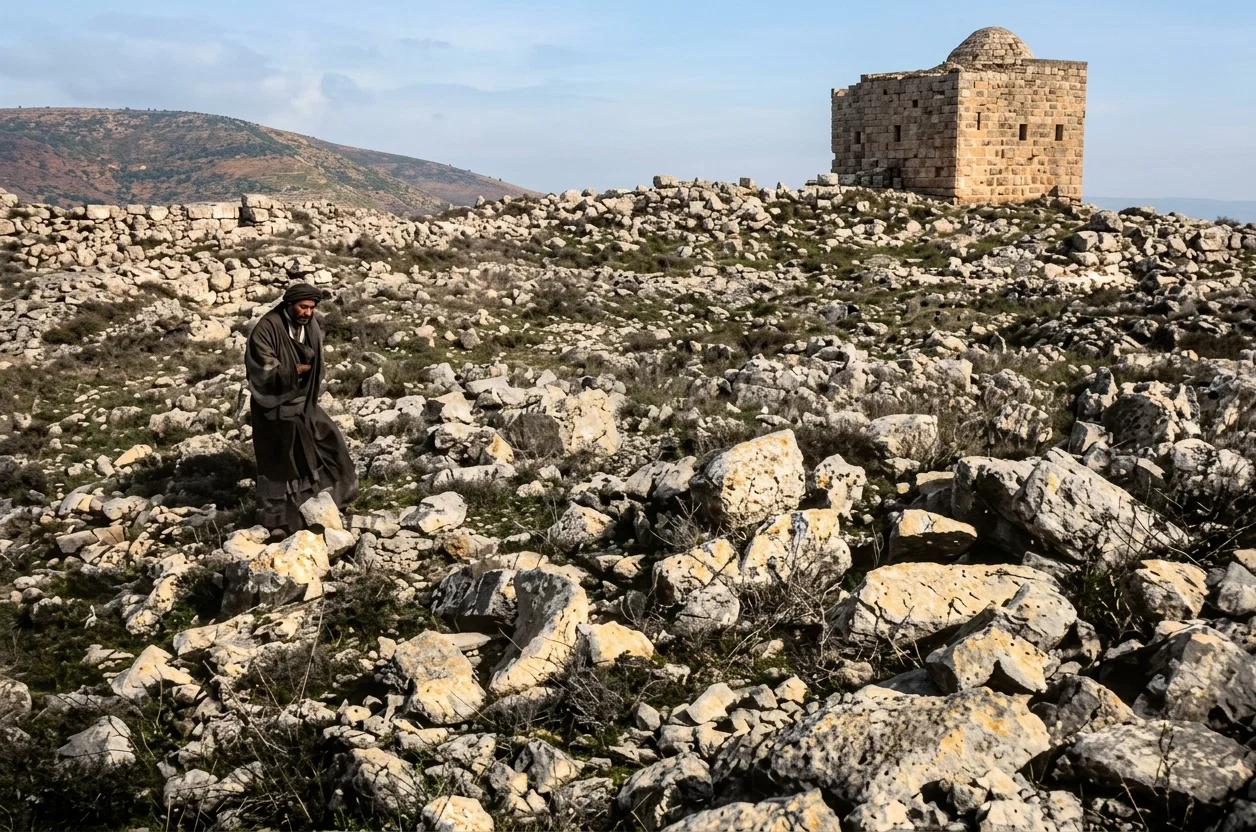
Place of Sacrifice by Samaritans on Mt. Gerizim

IV. Cambyses and the Pseudo-Smerdis

Before Cyrus the Persian died, he arranged that his son Cambyses should succeed him in the kingdom. He also arranged that a second son Smerdis should have certain dominions. As soon as Cambyses began to rule after his father's death, he was jealous of his brother Smerdis and had him secretly put to death — so secretly that very few in the nation knew anything about it. This very crime was to be the means of the undoing of Cambyses eventually, for crime has a strange power often of punishing the perpetrator.
Cambyses had an ambition to acquire fame as a conqueror, like his father; and being master of the three richest capitals in the world, he had ample resources with which to meet the expense of almost anything he was of a mind to undertake.
Hatching up a pretext for invasion, he marched against Egypt. He seems to have been a very cruel king in his conquests. He outraged the mummied corpse of the previous Pharaoh, on account of his having insulted the Persian monarchy. The fragments of the mummy were thrown into the fire. This act offended both Persians and Egyptians. The Persians thought that, fire being the purest of the elements, and an express symbol of Deity, it was unpardonably wicked to feed it with any dead, especially a corpse; and the Egyptians, on account of their idea of the resurrection, when the soul was to come back to the body, made it an article of faith to preserve every human body with the greatest care. This is an example of a great many of his fits of anger and unwise conduct.
Finally Cambyses received word that his brother Smerdis had seized the crown, and that all Persia had acknowledged him. Cambyses knew that this must be a usurper, since the real Smerdis he had already secretly put to death; and so in hot haste and indignation he left Egypt to return to the seat of insurrection. On mounting his horse, he wounded himself seriously with his sword, but refused to rest. He insisted on being carried in a litter; and the fatigue of such a journey increased his illness, and the tyrant found a premature and unhappy death in a poor Syrian village, where he apparently put an end to himself. By a conspiracy, the details of which we do not need to go into, a man by the name of Gomates, who resembled Smerdis, had taken advantage of the absence of Cambyses, to assume the crown under the name of “Smerdis, son of Cyrus.” When Cambyses first heard that Smerdis had seized the government, he questioned whether his brother was really alive, or whether another had assumed his character. It happened, however, that Prexaspes, the Persian nobleman to whom the assassination had been entrusted years before, was with the army; and by him the king was reassured that the perfidious deed had really been accomplished. He who now impersonated him must be an impostor; but notice the peculiar position in which this crime places Cambyses.
If he now denounced Smerdis as a usurper, he would have to betray his own crime, for no one knew that his brother Smerdis had been slain. Even if Cambyses should proclaim the truth, he would not be believed; his assertion would be accepted as fiction, and a lie of a failing power. Prexaspes suggested that the impostor was probably Gomates, to whose brother Cambyses had committed the government of his palace; and this conjecture proved to be correct, but it helped nothing in the present situation for Cambyses. It was probably this desperate state of affairs for himself, and the belief that the Persians were forsaking him for the man they supposed to be his brother, that brought him to the despaired place where he committed suicide.
When Cambyses died, and Smerdis had undisputed sway, as we have already said, the Samaritans at once sent word to this new king of Persia, asking him to stop the work at Jerusalem. In Ezra 4:7-24 we have a record of the accusation which the Samaritans made, and of the success that it met. In this letter which the Samaritans sent to Gomates — or Artaxerxes, as Ezra calls him — they told the king of Persia that the Jews were building the city of Jerusalem, the rebellious and the bad city, and that they had set up the walls and had joined the foundations. They said that if the Jews were successful in building the city and setting up the walls, they would cease to pay toll and tribute and custom to the Persians, and so the revenue of the king would be endamaged. They give two reasons for wishing to see the revenue of the king unmolested:
“Now because we have maintenance from the king’s palace, and it was not meet for us to see the king’s dishonor, therefore have we sent and certified the king.” Ezra 4:14.
So they asked the king to search in the book of the records of his father and he would find that the city of Jerusalem had been a rebellious city, and hurtful to kings and provinces, and that they had moved sedition in the old time, and on that account the city was destroyed. And now they say, If this city is rebuilt, you will have no portion further on this side the river.
This accusation and charge had its effect. At once Gomates sent a decree stating that he had hunted up the records, and had found that Jerusalem, just as they said, had made insurrection against kings, and that rebellion and sedition had been met therein; and moreover he found that there had been mighty kings also over Jerusalem, who had ruled over all the countries beyond the river, and that toll, tribute, and custom were paid to them. So he gave commandment to cause the men to cease, and that the city be not built. And they were warned especially to see that the work was stopped.
Armed with this letter from the royal court of Persia, Rehum and Shimshai and their companions and the adversaries of the Jews, went up in haste to Jerusalem to the Jews, and made them to cease by force and power. And so the work of the house of God ceased to the second year of the reign of Darius king of Persia.

The Gentle Pressure of Sorrow

The damps of autumn sink into the leaves and prepare them for the necessity of their fall; and thus insensibly are we, as years close around us, detached from our tenacity of life by the gentle pressure of recorded sorrow.—W. S. Landor.
Continue reading: Be Still in God's Will