Your ShelfYour Projects

Signs of the Times, Vol. 25, No. 25.

FOR OUR SAKES HE BECAME POOR

Signs of the Times

Jun 21, 1899

Pacific Press Publishing Company · Oakland, California · Jun 21, 1899

"FOR OUR SAKES HE BECAME POOR."
CHRIST is the great Missionary to the poor, the sick, and the suffering. "The poor have the Gospel preached unto them," He declared. The King of heaven, He could have lived among the wealthiest, but He chose poverty, honoring it by making it His lot, redeeming it from its humiliation by consecrating Himself to a life of poverty, stripping from it forever the reproach of scorn by blessing the poor, the inheritors of God's kingdom. Poverty with Christ is wealth of the highest value. Such poverty is sanctified and blessed.
Poverty abounds in this world; and why?——Because of selfishness. Many are made poor by the dishonest stewardship of those who are trading on their Lord's goods. To-day, crime of every kind is practised in order to obtain money. Selfishness, deceit, robbery, and bloodshed are making this world a veritable Sodom, and its inhabitants as the inhabitants of the antediluvian world. In the greed for possession, God's law is transgressed. But retribution will overtake the wrong-doers. Riches can not save one soul from death. He who gives himself up to work the works of Satan creates a force of evil that he can not repress.
There is a false religion, endangering the souls of all who advance it, which teaches that selfish pleasure and enjoyment is the sum of happiness. The parable of the rich man and Lazarus shows us that this is false. It was the rich man's duty to help Lazarus by giving of his abundance. But he refused to do this, and gave himself up to intemperate, luxurious living. There came a time when the rich man would have given all he possessed to exchange places with Lazarus, once poor and covered with sores. He fell sick, and during his sickness he learned what suffering meant. He is represented as calling constantly upon Lazarus to relieve him in his burning fever. But he had no knowledge of God, and Abraham is represented as answering, "Between us and you there is a great gulf fixed, so that they which would pass from hence to you can not; neither can they pass to us, that would come from thence."
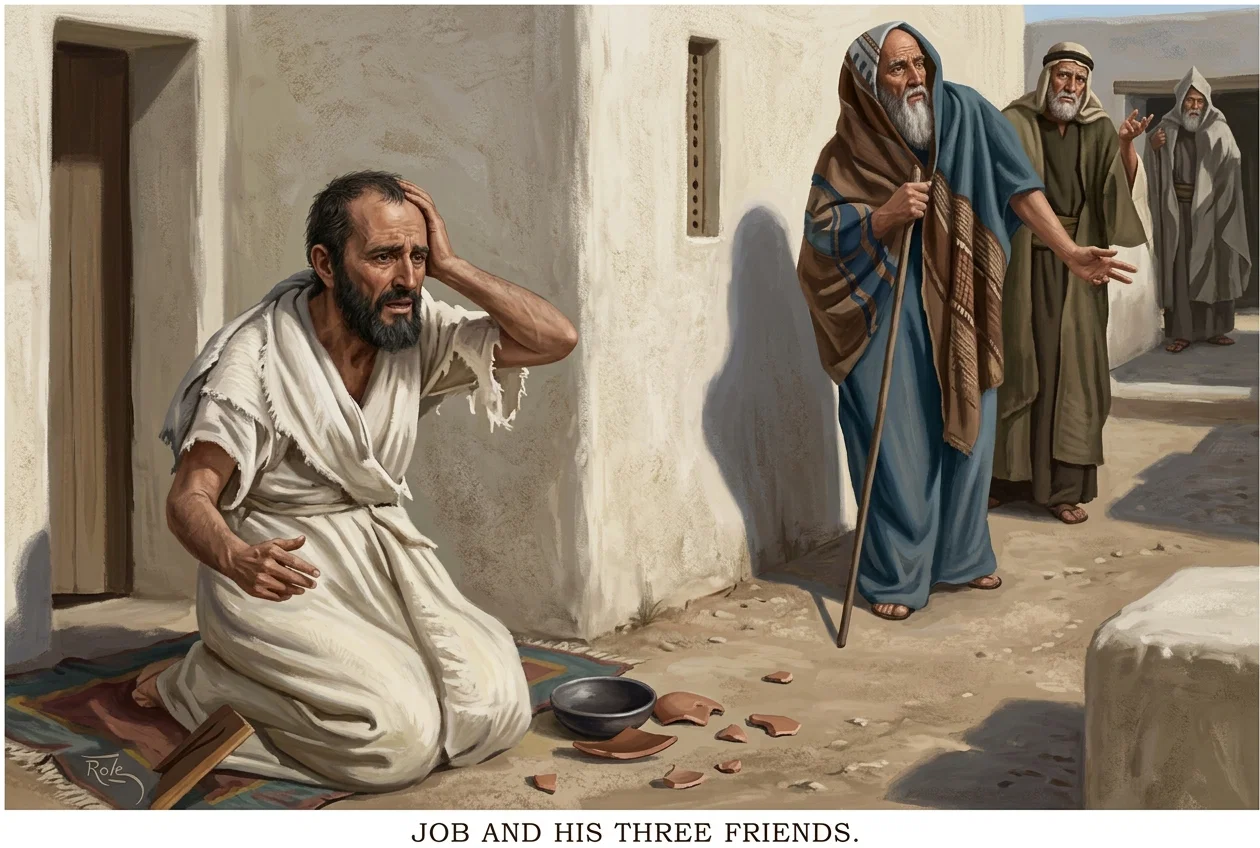
JOB AND HIS THREE FRIENDS.
Christ took His position with the poor, that He might lift from poverty the stigma that the world has attached to it. He knows the danger of the love of riches. He knows that this love proves the ruin of many souls. It places those who are rich where they indulge every wish for grandeur. It develops the weakness of humanity, and shows that, notwithstanding their abundance, many of the rich are not rich toward God. The man possessing houses and lands, uplifted and deceived by the respect paid to him, looks down upon the poor man, who, nevertheless, may possess virtues that the rich man does not. When weighed in the balances of the sanctuary, the selfish, covetous rich man will be found wanting, while the poor man who has depended only upon God for his goodness, will be pronounced heir to eternal riches.
God has made the rich man His steward, and if he walks in Christ's steps, maintaining a humble, godly life, he will become meek and lovely in heart. He will realize that his possessions are only lent treasures, and will feel that a sacred trust has been committed to him to help the needy and suffering. This work will bring its reward in rich treasures laid up beside the throne of God. Thus the rich man may make a success of life, as a faithful steward of his Lord's goods.All suffering is not the result of a perverted life. Job is brought before us as a man whom the Lord permitted Satan to afflict. The enemy stripped him of all he possessed; his family ties were broken; his children were taken from him. For a time his body was covered with loathsome sores, and he suffered greatly. His friends tried to make him see that he was responsible, by his sinful course, for all his afflictions. But he denied the charge, declaring, "Miserable comforters are ye all." By seeking to prove Job guilty before God, and deserving of punishment, his friends brought a grievous test upon him, and placed God in a false light; but Job did not swerve from his loyalty, and God rewarded his faithful servant.
There is a connection between the religion of Christ and poverty. Christianity is the solace of the poor. Christ has ever been the poor man's Friend. In His humanity there are golden threads that bind the believing, trusting poor to His own soul of infinite love. He is the Great Physician, the mighty Healer of all diseases. While in our world, He bore our infirmities and carried our sorrows. He was poor, yet He was the source of all goodness, all blessings. He is a reservoir of power to all who consecrate themselves to the work He came to do.
Jesus, the world's Redeemer, possessed heaven's activity, heaven's ambition. He longed to extend His kingdom to all parts of the world. He endured the agony of the cross to accomplish this work, cheered by the prospect of a universal triumph. In dying for the sinful race, He destroyed him who had the power of death. The blood of the cross sealed the irrevocable covenant which ensures to our Redeemer the heathen for His inheritance, and the uttermost parts of the earth for His possession.
Christians have a sacred duty to perform in carrying forward the work that Christ came to accomplish. He declared, "The Spirit of the Lord is upon Me, because He hath anointed Me to preach the Gospel to the poor; He hath sent Me to heal the broken-hearted, to preach deliverance to the captives, and recovering of sight to the blind, to set at liberty them that are bruised." He longs to have men and women cooperate with Him. They may be ignorant, but if they are meek and lowly, He will make them vessels fit for the Master's use. They will be whole-hearted, sincere disciples, who can comprehend God's great design in favor of a perishing race.
The Lord calls for volunteers who will be self-denying, who will endure hardness as good soldiers of the cross of Christ. He calls for workers who are willing to be laborers together with Him. We can do much to help the poor and brighten their lives, if we will but realize it. Those who work with unselfish hearts, who share Christ's sympathies, who strive earnestly to fulfil His purpose for humanity, will help to swell the tide of His joy, and will give honor, majesty, and praise to His name.
The last great battle in behalf of truth and righteousness is to be fought, and God would have His soldiers go forth in faith. Christians, do you discern the signs of the times? Can you, with humble tread, put your feet in the footsteps of your Redeemer? Can you give yourselves heartily to a good work, a perilous undertaking? Verily, the Lord has need of armies of workers, and some of the most precious souls will be found in the pit of degradation. God calls upon us to work for this class. Do not lose your purity because you are among the impure, but "building up yourselves on your most holy faith, praying in the Holy Ghost, keep yourselves in the love of God, looking for the mercy of our Lord Jesus Christ unto eternal life. And of some have compassion, making a difference; and others save with fear, pulling them out of the fire; hating even the garment spotted by the flesh. Now unto Him that is able to keep you from falling, and to present you faultless before the presence of His glory with exceeding joy, to the only wise God our Saviour, be glory and majesty, dominion and power, both now and for ever." MRS. E. G. WHITE.

THE TEMPLE OF KNOWLEDGE.

An Allegory.

O N the sands of Time, on the shore of the great Sea (Rev. 17:15), is built a grand and imposing structure called the Temple of Knowledge. Like a bubble of glass it arises in glittering domes, and towers, and massive bulwarks of much seeming solidity. Here is the seat of all worldly knowledge, human science, and philosophy. Every department of human thought and belief is assigned a room for the development of its favorite 'ism or 'osophy by the presiding genius of the temple.
In the left wing of the rotunda, enshrined in a noble auditorium, stands on her high pedestal the Historic Muse, in her right hand the scroll of Fame, and in her left the laurel wreath of Honor. Behind her, arranged in vast tomes dusty with the ages, and portrayed on the panels of the walls, is the history of the nations. From the pillars are hanging the banners and regalia of dead heroes, dynasties, and nations—the symbols of departed human glory.
In the right wing rises the stately dome of the Hall of Science. Here, behind an honored shrine, on a lofty throne, sits the Genius of Science. The microscope of the naturalist, the telescope of the astronomer, the hammer of the geologist, and the crucible of the chemist, are all at her command. With eagle eye she searches for the hidden springs of life, and from evident effects seeks to fathom the cause and nature of organic law. With Reason for her guide and counselor, she spins her theories for the various phenomena of nature; but even her piercing ken can not search out Infinity, "seeing it is hid from the eyes of all living;" no, not so much as to explain the law
of life and growth in a blade of grass. "The way of an eagle in the air," the way of a fish in his native element, and "the way of a serpent upon a rock," are still "too wonderful" for her. The sublime powers of nature—light, heat, sound, fire, electricity, are beyond her crucible of analysis, and their nature is still the subject of vague and unsatisfactory conjecture and theorizing.
Yonder, in her judgment-hall, Justice compiles her codes, or, blindfold, holds aloft the scales of equity, too oft o'erbalanced by the gold of bribery and corruption.
Here in the grand central rotunda is the Arena of Literature. Here Fame has hung her laurels on the memorial urn and tablet. Here, down the ages, have rung in ever-changing cadences the musical intonations of human thought. Bards, poets, orators, philosophers, sages, have here in turn swayed the minds of men, and taken captive the popular heart. Here the modern authors blow their gay bubbles, and mix their intoxicating draughts to appease the esthetic cravings of the fashionable literary appetite. Here Wit, effervescent and sparkling, hands her ringing goblets round. Here the Furies, Malice, Envy, and Cruelty, braid the scorpion-lash of satire, and hew the venomed shaft of sarcasm, wherewith to impale the unfortunate victims of their displeasure.
Here is the world's great amphitheater of Thought, in whose arena has been fought, since the beginning, the great controversy of the ages, between the Prince of Light and His friends and the Prince of Darkness and his deceived followers—Truth versus Error.
Here Jesus, the Son of God, met the craft and subtle intrigue of the Archenemy with wisdom and spiritual judgment so heart-searching and confounding to His adversaries that they durst no more meet Him in open combat; but under cover of darkness and solitude they laid violent hands on His sacred person, and by means of fear, force, and perjury accomplished His condemnation, when they could openly find no just cause against Him.
Here Luther met the combined powers of the enemy in the persons of antichrist and his council. Fearing neither papal anathema nor blazing faggot, he wielded the sword of the Spirit with no other shield than his unwavering faith in his heavenly Captain.
But time would fail in which to tell of the faithful ones who have met the friends of the Prince of Evil on this hard-fought arena, and have triumphed by the "blood of the Lamb, and by the word of their testimony." Even in death and torture have they glorified their God, being "made a spectacle unto the world and to angels and to men." Behold, their names are written in glory and chronicled in the earth.
But let us consider the arena. Outside the circle of the arena, between the great spaces assigned to the multitudes, are arcades leading out to the different departments of human thought and investigation; and through these channels flow, in a continuous stream, the newly-manufactured wares. Within the circle of the arena these are exhibited for sale in the gay booths or stately pavilions representing the different departments, each displaying the colors and the badge of its order.
Here, as always, what the enemy can not compass by open hostilities, he essays to accomplish by guileful seduction. In the guise of a charitable and friendly solicitude for the welfare of humanity, and in all-seeming candor and honesty, he offers his victim the poisoned nectar, as he did Eve in the garden. Here and there a silvery-tongued enthusiast who has drunk deeply of the intoxicating cup, pours forth honeyed and ornate oratory; the
quick hand of the stenographer feeds the ready printing press, and the poisonous stream finds its way in copious draughts to the thirsty multitudes.
Wandering through this Vanity Fair, one sees wares of every description gotten up to suit the lusts of the motley crowd. Here are delicious bonbons flavored with delicate flattery, sharp and spicy pickles heightened by the essence of self-conceit; scientific salads, plain, practical sandwiches, and political pastry, embellished with frosted and candied theories on the social problem and its possible cure. Here may be found in nearly every booth, in unlimited quantities, the blood pudding and scandal sausages, upon which the ravenous masses, high and low, daily gorge themselves.
Here the enchantress Romance, cupid encircled and floral-crowned, brews her rosy wine for youth and beauty, drugging the seductive draught with the treble extract of idolatry, sensuality, and fornication, according to the taste of the multitudes she serves. Whether in the vellum dress and cultured, elegant phrasing of the popular novelist, or in the plebian paper garb of the third-rate article, the drugs are the same; they emanate from the same source, have the same malevolent purpose, and produce the same deadly effects.
At the entrance of each arcade stands the advocate of the 'ism or 'osophy of his department. He is an eloquent enthusiast and a zealous proselyter. His cry is ever: 'This is the way! Here is truth [O much-abused word]. Turn in hither, O all ye sons of men.' The Babel voices of these advocates of the arcades, supplemented by the clashing harmonies of the various bands and orchestras of Vanity Fair, produce a pandemonium of discord most awful and bewildering.
Let us glance through the arcades into some of these departments of human philosophy. Here in this Temple, Christian Science, twin sorceress with Spiritualism and legitimate offspring of the master magician, weaves her mazy spells on her willing dupes. And here—go not too near—wierd Spiritualism works her hypnotic charms, and performs her hellish orgies.
This stately and costly shrine is dedicated to the siren Theosophy. Daughter of the East, she revels in the wierd, fantastic imagery of that ancient oriental Spiritualism, and many an uneasy conscience is lulled to rest by her siren song.
Here, at their hell-heated forges, Materialism, Agnosticism, Infidelity, and Evolution "sear" with their "hot irons" every troublesome conscience that applies. And Higher Criticism, with her X-ray lens and dissecting knife, sits in judgment on the Word of the most high God, and performs her monstrous vivisection act.
But what is this great splendor, this high and dazzling seat of royal dignity and authority, that seems to brood over the vast rotunda as if it were the presiding genius of the whole? Now, that shout—the swelling tide of acclamation, like the sound of seething seas—what is it?—'Tis the triumphal entry of the "queen." Rev. 18:7. Down on your knees! let all heads but the cardinal's be bared, and shout till your throat is rent. Chant, seraphic choir, your Latin Mariolatry, and, organ, heave your vast thunders of triumphal homage. Up, up, high above the highest pavilion, above all principalities and powers, authority or creed—still higher, "above all that is called God, or that is worshiped" (2 Thess. 2:4)—see! they have enthroned her on that temple-throne "that far outshines the splendors of Ormus and Ind" in royal magnificence.
Who is this after whom all the world wonders (Rev. 17:6; 13:8)?—It is Mystery, Babylon the Great, the mother of harlots and abominations of the earth," arrayed in her purple and scarlet robes, and decked with her jewels, the gifts of her lovers, "the kings of the earth," and holding aloft the "cup" of "the wine of her fornication," wherewith she has made "drunk" the "inhabitants of the earth." Rev. 18:9; 17:2, 4, 5, 8.
What is that veil behind her throne, that so carefully enshrouds the background? Hush! that is her nineteenth century "liberal" policy, a pleasing glamour which has blinded the eyes of her "liberal" admirers to her record of the Dark Ages. Let us get an insight into that vailed past. Never mind the frowns of the goddess, or the thunderbolt of papal wrath. Better to feel the "wrath of the dragon" than "the wrath of God." Lift the veil.
O God, what a sight! Are these thy holy martyrs, Lord—these mangled, reeking slain—these scorching funeral pyres of living victims, with their agonizing, tortured prayers, their exile tears, their living graves? Is this sea of blood the dye-vat where her robes were stained? Rev. 18:24.
How long, O Lord, shall martyr-blood tears cry unto Thee from the dungeon, the rack, the stake, and the slaughter-pen? "Arise, Lord, to judgment," forget her not, O Thou God of justice and vengeance. Rev. 18:7, 8, 20. Save, Lord, thy faithful ones from the clutch of her fell power, according to thy good promise.
RUTH.
(To be continued.)

NO SCAR IN HEAVEN.

THERE'LL be no scar in heaven, No blemish, no defect; The sin that's all forgiven No soul will e'er reflect. Redemption's plan so perfect is, That beauty's fulness none will miss.
We, who have marred our features By years of sin and woe, Will all be fair, new creatures, With souls as pure as snow. The nails we've driven will not mar, He who is love will heal each scar.
No scar will be in heaven, And yet there will abide Stamp of the nails we've driven In Christ, the Crucified; But, O, they will not be as scars, They will outshine the brightest stars. HOPE ONSLOW.

JONAH AND THE WHALE.

THE Lord has forewarned us that the time would come when professed Bible expositors would arise, having itching ears, and who would turn away from the truth unto fables. 2 Tim. 4:1-5. That this time foreshadowed by the inspired penman has come there can be no doubt. Infidelity has always stalked the earth, boasting how great things it could do, yet the light of truth has gone on spreading, until the most remote corners of the globe, festooned with cobwebs of error, are being enlightened.
A nineteenth century high priest of infidelity has for years been lecturing on the "Mistakes of Moses" for a handsome nightly stipend. Yet his eloquence has not in any way retarded the work of the printing press, which has gone on multiplying annually millions of copies of these "mistakes" to be scattered to the ends of the earth.
But now we are having in this hue and cry against the Scriptures a multitude of other voices. "Higher critics," gathered from the ranks of the clergy, are subjecting the statements of the Deity to human scrutiny, and from the bar of human reason they give, as their verdict, that it contains inaccuracies, and that it is not all the inspired word of the Lord. One of the specimen bricks which they hand us from their babylon of research is that the story of Jonah and the whale is wholly traditionary, and that it never happened. They reason and philosophize regarding the dimensions of the throat of a whale. From their researches in ichthyology they claim to have discovered that a whale can not swallow a man.
Perhaps this is true of some whales, but that does not prove that God could not make a whale with a throat sufficiently large to swallow a man, should He think it best to do so. Let us look at the record a moment. "Now the Lord had PREPARED a great fish to swallow up Jonah. And Jonah was in the belly of the fish three days and three nights." Jonah 1:17. And what is there about all that which is so impossible? Could not the God who made all the whales and fishes which people all the oceans, lakes and rivers of the earth, prepare another to deliver His servant? This is what the Word says was done.
Again, we note that the Saviour, when on earth, while conversing with the carping Pharisees, the "higher critics" of His day, set the seal of the authenticity to the record concerning Jonah's experience. "But He answered and said unto them, An evil and adulterous generation seeking after a sign; and there shall no sign be given it, but the sign of the prophet Jonah. For as Jonah was three days and three nights in the whale's belly; so shall the Son of Man be three days and three nights in the heart of the earth." Matt. 12:39, 40. The Saviour says that Jonah was in the belly of the whale, and there for three days, as the book of Jonah declares. Of course the books of Jonah and Matthew, being written by the same Holy Spirit, must agree. And the Saviour uses the fact of Jonah being in the belly of the fish as an illustration of His being in the earth. Hence, if Jonah was not in the belly of the whale, as our modern critics declare, then the Saviour never was in the earth, never died, never was buried or rose again. It is, therefore, clear that no man who doubts in the authenticity of Jonah's experience can have any faith in the words of Jesus Christ, can never believe that He hung on the cross, died, rose again, and ascended to heaven.
Reader, the Bible is the Word of Him who can not lie. It does not simply contain the truth; many other books do this, but it is the truth. It will stand forever. When the world is shivering to pieces, when islands with all their living freight are disappearing, and the mountain can not be found, the Word of the Lord will endure this wreck of matter, and those who are found standing upon it, will be safe. It points to a land undimmed by sin, where the footprints of the deceiver will never come; where funeral corteges will never go by; where no sculptor will ever be seen chiseling in stone the epitaph of a loved one; where tears, pain and sorrow will be unknown.
Having set our face toward that Heavenly Canaan, we do not propose to turn round and go back, because we chance, like Christian, in Pilgrim's Progress, to meet a man who is going the other way, declaring that the chart is not correct. The chart is the revelation of Him who is the "way, the truth, and the life." G. B. THOMPSON.

SHORT RULES FOR LONG COMFORTS.

PuT self last. Be prompt at every meal. Take little annoyances out of the way. When good comes to any one, rejoice. When any one suffers, speak a word of sympathy. Tell neither of your own faults, nor those of others. Have a place for everything, and everything in its place. Hide your own troubles, but watch to help others out of theirs. Never interrupt any conversation, but watch patiently your turn to speak. Look for beauty in everything, and take a cheerful view of every event. Carefully clean the snow and mud from your feet on entering the house. Always speak politely and kindly to servants. When inclined to give an angry answer, press your lips together and say the alphabet. When pained by an unkind word or deed, ask yourself, "Have I never done an ill and desired forgiveness?"—Soldier and Servant.

THE BEGINNINGS OF MODERN EDUCATION.

THE heavens had been opened and a flood of light far surpassing the brightness of the sun had shone upon the earth. As vegetation responds to the call of the sunlight, so the natural result would have been that all men should turn their faces Christ-ward, and the principles of education which had rendered His life a success would have become the all-pervading influence of the world. Would that it might have been thus! Imagine watching a cloudless sky on a June day. Depths of blue unfathomable—what could be more beautiful? And yet, as a shimmering cloud spreads over the azure surface and reflects the light in myriad tints and hues, even tho this is a portent of coming storm, does it not enhance the beauty of the scene?
It was thus that a cloud, thin, white and inoffensive to all appearances first caught the eyes of those who had been watching the leadings of Christ. So subtle is the growth of error that it often at first presents an appearance more attractive than unadulterated truth. Little by little subjection to man-made power took the place of the principles of faith and freedom. Little by little the pagan ideas which had been crushed to earth under the full blaze of a pure Christianity, again reared their heads, and the dragon's voice, smothered and smooth of tone, was once more heard throughout the world.
The deadliest error is that which so nearly resembles truth that the unsuspecting grasp it unwittingly. The principles of an education by faith in Christ were thus replaced, not by principles lacking faith, but by those forms which revealed another center than Christ for the faith. The papal system did not remove faith, but transferred it to deeds of men. And the true, pure miracles performed through faith in Christ were replaced by the supposed miraculous healing power of the bones of the prophet Samuel, or the skull of Saint Anne, or the ability of bits of Christ's cross to raise the dead. Physicians were not needed, for could not the napkin which covered the face of an entombed Saviour heal all bodily infirmities? Sciences were not needed. Had not the priests the right, and the only right, to interpret natural phenomena? Chemical experiments had the odor of the infernal regions, and were to be avoided as the fires of hell. Reading, writing, mathematics,—what use had the "common herd" of humanity with such things, since every man had access to some monk who could read and interpret to him all he needed to know? The Bible became an unknown book. Mass was said in an unknown tongue. Pictures of Christ and saints took the place of the real Son of God. It was the period in which the "two witnesses" prophesied in sackcloth. It came upon the world gradually, and men knew not that they were in the bonds of sin; they dreamed that they were free.
Had not Christ bidden His followers abstain from all fleshly lust, to crucify the flesh and die to the world? It was the perversion of such teaching that led to the establishment of monasteries. Thousands left the world and its allurements; the hot, sandy desert of northern Africa fairly swarmed with monks. The only faith of the world was in their hands. Not only did monarchs tremble when threatened by these creatures, but thrones tottered when the head of the hierarchy of which they formed an essential part uttered its voice.
It was a despicable era, a time which Draper describes as the "tyranny of theology over thought." That One who lighteth every man that cometh into the world was disregarded, and the "noonday of the Papacy was the world's moral midnight."
To show that freedom of thought was entirely out of the question, one needs but to recall the experience of Hypatia, which has been so vividly portrayed by Charles Kingsley. This woman was a highly-educated pagan, living in Alexandria in the fifth century. She represented a class of educators which was fast dying away. Though pagan, she taught in her school many things which far excelled the learning of the fanatics of the church. So far had Christianity and true education fallen that paganism was rather to be chosen than the apostasy. Realizing that there was a power in her work, the monks formed a mob, dragged Hypatia from her chariot, and tore her body in pieces. It was an age of persecution; for one original thought, if uttered, nay more, if but suspected, was sufficient cause for kindling the fires of the stake.
It is one of the most interesting of historical facts to note the rise of the Mohammedan power, on the very eve of this intense darkness; to watch its progress, first by the power of the sword; and when that failed, to see the leaders turn to scientific research and silently, but none the less surely, override the enemy before whom they had fallen when the weapon was the sword. To a people held in the iron grasp of the Papacy for hundreds of years, the intellectual growth of Spain during the twelfth and thirteenth centuries was little less than blasphemy. Yet so powerful is the influence of thought that gradually France, and then more distant nations, caught the spirit.
The narrowness of patristical education is seen when one reads in the writings of the fathers, which were then the only text-books in the hands of Europeans, that at the equator the water boiled; that sailing west, vessels could never return; that the earth was flat, and Europe was the center, not only of this world, but of the universe. It was when men began to oppose these well-established theories that De Gama made his voyage around the cape of Good Hope; that Magellan circumnavigated the globe. It was because men were breaking loose from a thousand such slavish ideas and were beginning to think, that Columbus was enabled to man his boats and sail for a north-west passage to the Indies.
The volumes of events which took place in this period are the results of a violent rending of the fetters woven by the papal church, and which had crushed out reason and hidden God from men for centuries.
It is true that there was a little knowledge hidden in the monasteries—and we are willing to give them due credit for the spark of life they kept alive—but so devoid were they of the life-giving element of true education that men were dying by thousands without knowledge, even within the shadow of the convent walls. The principles inculcated by Christ were wholly neutralized by pagan principles, which in education, as in religion, were at this time decked in Christian garb and presented under Christian names.
Looking more carefully into the higher forms of monastic education in those years when it became necessary for them to compete with the pagan schools, we find a seven years' course, in Latin, while, as Painter says, the mother tongue was almost wholly neglected. Logic, that subject which exalts man's reasoning powers to the debasing of faith, was one of the chief studies, especially in a theological course.
How quickly one feels that he is approaching modern collegiate instruction, and especially the curriculum of our theological seminaries. It is when peering into the annals of our ancient universities that the real secret of modern education is discovered. The Christian youth who flocked to the Mohammedan schools in Cordova or Salamanca, returned to France, England or Italy with the fires of education burning in their veins. Soon universities were established, the oldest being at Paris, Salerno, and Bologna. These were at first free corporations, but the Papacy, recognizing that the power they wielded was turning minds away from the church, in her death struggles grasped these institutions, wheeled them into line with her dogmas, again turning thousands of youth toward her walls. The universities of to-day, although they have passed through the period of Reformation of the sixteenth century, still cling to these medieval courses of study, and the subjects then taught. It is a combination consisting of an overwhelming amount of paganism, with enough Christian principle to flavor and deceive, and hence lacks the life of either taken alone. Here you have the foundation for the long classical and scientific courses, with the degrees and diplomas. Here you find the precedent for an education placing reason ahead of faith, and relegating God and the science of salvation to the background.
Is it not time that, as educators, we should arouse and let the light of truth illumine our minds, instead of holding to the forms which were rooted in the dark ages and fed from the sap of Greco-pagan philosophy? There is a deeper, truer channel in which the minds of youth should run, a spiritual life which is much needed, an education which will form a character which even the world admires but has not the power to produce.
E. A. SUTHERLAND.

AFFLICTIONS AND DELIVERANCE.

THE excuse that many offer for not embracing Christianity is that it brings too much persecution and affliction.
While it is true that the followers of the meek and lowly Jesus have as much trouble, and oftentimes apparently more than other people, it is also true that there is divine help for them in the time of trouble.
Every Christian should have the following words burnt deep into his heart; "Many are the afflictions of the righteous; but the Lord delivereth him out of them all."
Nowhere does the Word of God predict the Christian's walk through the road of time to be one of ease, but it constantly warns the traveler of dangers, temptations, tribulations, and afflictions.
"In the world ye shall have tribulation" is the warning spoken to each one who sets out upon the strait and narrow way, and then to offset any discouragement or gloom, follows the blessed words: "But be of good cheer; I have overcome the world."Tho the cold, cruel world has naught to offer in the way of satisfaction and peace, we who are in the world, but not of it, have the promise, "In Me ye have peace."
It is indeed blessed to know that the Master has overcome for us, and that tho the storms of sin may beat fiercely about us, there is peace and calm for those who are in Him, resting sweetly and peacefully midst storm and strife.
Tho the afflictions are many, He has promised to deliver from them all, and He is able to fulfil His promise, and He will.
C. F. LADD.
Continue reading: SOUL AND SPIRIT