I am Jehovah thy God, which have brought thee out of the land of Egypt, out of the house of bondage. Thou shalt have no other gods before Me.
II
Thou shalt not make unto thee any graven image, or any likeness of anything that is in heaven above, or that is in the earth beneath, or that is in the water under the earth: thou shalt not bow down thyself to them, nor serve them: for I Jehovah thy God am a jealous God, visiting the iniquity of the fathers upon the children unto the third and four generation of them that hate Me; and showing mercy unto thousands of them that love Me, and keep My commandments.
III
Thou shalt not take the name of Jehovah thy God in vain; for Jehovah will not hold him guiltless that taketh His name in vain.
IV
Remember the Sabbath day, to keep it holy. Six days shalt thou labor, and do all thy work: but the seventh day is the Sabbath of Jehovah thy God: in it thou shalt not do any work, thou, nor thy son, nor thy daughter, thy man servant, nor thy maid servant, nor thy cattle, nor thy stranger that is within thy gates: for in six days Jehovah made heaven and earth, the sea, and all that in them is, and rested the seventh day: wherefore Jehovah blessed the Sabbath day, and hallowed it.
V
Honor thy father and thy mother: that thy days may be long upon the land which Jehovah thy God giveth thee.
VI
Thou shalt not kill.
VII
Thou shalt not commit adultery.
VIII
Thou shalt not steal.
IX
Thou shalt not bear false witness against thy neighbor.
X
Thou shalt not covet thy neighbor’s house, thou shalt not covet thy neighbor’s wife, nor his man servant, nor his maid servant, nor his ox, nor his ass, nor anything that is thy neighbor’s.
“Hear, O Israel: The Lord our God is one Lord: and thou shalt love the Lord thy God with all thine heart, and with all thy soul, and with all thy might. And these words, which I command thee this day, shall be in thine heart.” Deut. 6:4-6.
“Thou shalt love thy neighbor as thyself.” Lev. 19:18.
“Master, which is the great commandment in the law? Jesus said unto him, Thou shalt love the Lord thy God with all thy heart, and with all thy soul, and with all thy mind. This is the first and great commandment. And the second is like unto it, Thou shalt love thy neighbor as thyself. On these two commandments hang all the law and the prophets.” Matt. 22:36-40.
“The works of His hands are verity and judgment; all His commandments are sure. They stand fast forever and ever, and are done in truth and uprightness.” Ps. 111:7, 8.
“Hearken unto Me, ye that know righteousness, the people in whose heart is My law; fear ye not the reproach of men, neither be ye afraid of their revilings. For the moth shall eat them up like a garment, and the worm shall eat them like wool: but My righteousness shall be forever, and My salvation from generation to generation.” Isa. 51:7, 8.
“Thy righteousness is an everlasting righteousness, and Thy law is the truth.” Ps. 119:142.
“Concerning Thy testimonies, I have known of old that Thou hast founded them forever.” Ps. 119:152.
“For the commandment is a lamp; and the law is light; and reproofs of instruction are the way of life.” Prov. 6:23.
“Let us hear the conclusion of the whole matter: Fear God, and keep His commandments: for this is the whole duty of man. For God shall bring every work into judgment, with every secret thing, whether it be good, or whether it be evil.” Eccl. 12:13, 14.
“Here is the patience of the saints: here are they that keep the commandments of God, and the faith of Jesus.” Rev. 14:12.
“Blessed are they that do His commandments, that they may have right to the tree of life, and may enter in through the gates into the city.” Rev. 22:14.
“He that saith he abideth in Him [Christ] ought himself also so to walk, even as He walked.” 1 John 2:6.
Of Christ: “I delight to do Thy will, O My God; yea, Thy law is within My heart.” Ps. 40:8.
“Believest thou not that I am in the Father, and the Father in Me? the words that I speak unto you I speak not of Myself: but the Father that dwelleth in Me, He doeth the works.” John 14:10.
“And it is easier for heaven and earth to pass, than one tittle of the law to fail.” Luke 16:17.
“If ye keep My commandments, ye shall abide in My love; even as I have kept My Father’s commandments, and abide in His love.” John 15:10.
“If ye love Me, keep My commandments.” John 14:15.
“Ye are My friends, if ye do whatsoever I command you.” John 15:14.
“Whosoever committeth sin transgresseth also the law: for sin is the transgression of the law. And ye know that He was manifested to take away our sins; and in Him is no sin.” 1 John 3:4, 5.
“Do we then make void the law through faith? God forbid: yea, we establish the law.” Rom. 3:31.
“Thou shalt call His name JESUS: for He shall save His people from their sins.” Matt. 1:21.
“Who gave Himself for us, that He might redeem us from all iniquity, and purify unto Himself a peculiar people, zealous of good works.” Titus 2:14.
“If ye fulfil the royal law according to the scripture, Thou shalt love thy neighbor as thyself, ye do well: but if ye have respect to persons, ye commit sin, and are convinced of the law as transgressors. For whosoever shall keep the whole law, and yet offend in one point, he is guilty of all. For He that said, Do not commit adultery, said also, Do not kill. Now if thou commit no adultery, yet if thou kill, thou art become a transgressor of the law. So speak ye, and so do, as they that shall be judged by the law of liberty.” James 2:8-12.
“It is time for Thee, Lord, to work; for they have made void Thy law. Therefore I love Thy commandments above gold; yea, above fine gold.” Ps. 119:126, 127.
A New Calendar for the World
What Shall It Be?
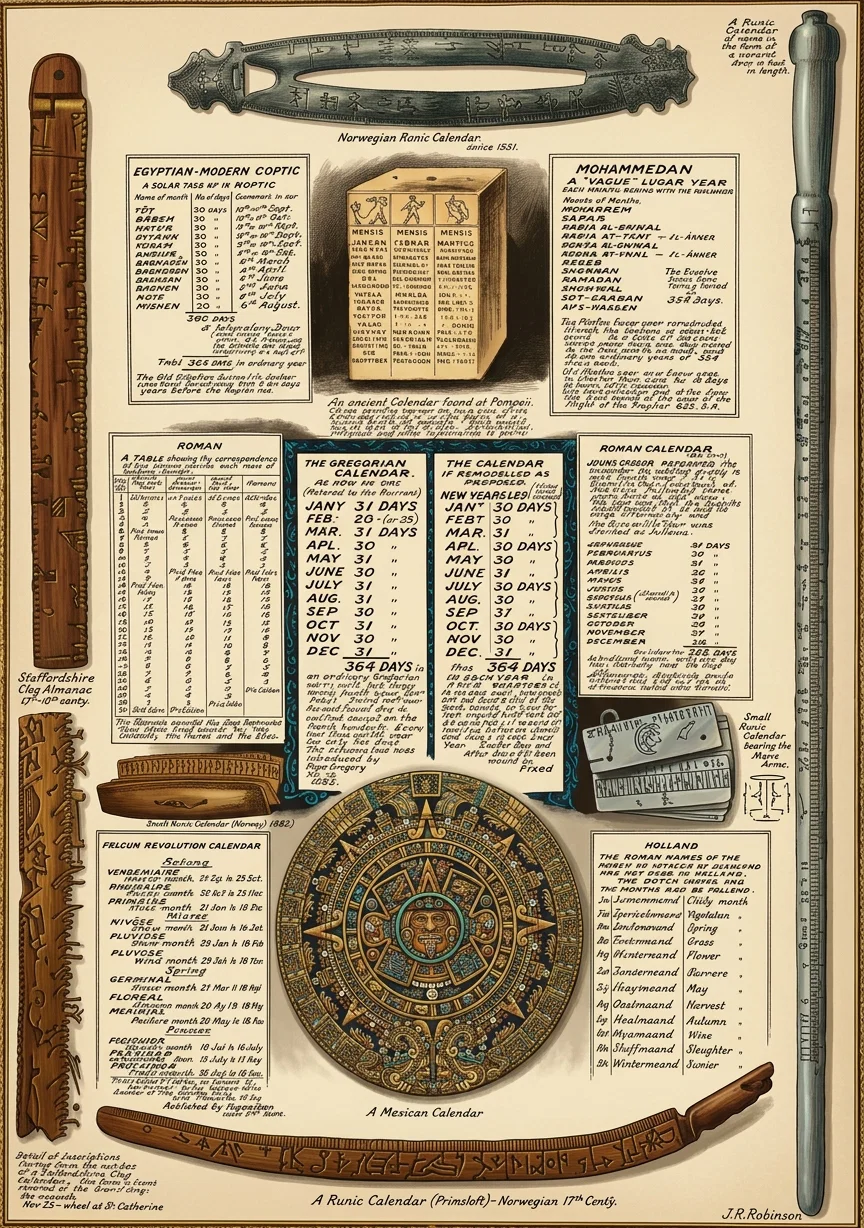
If there has been one thing which has caused more or less trouble since men began to reckon time, and commercial intercourse became prominent between the nations, it has been the calendar. There has been, on the part of men who love order, a great desire to have a uniform calendar. We present on another page a diagram of various calendars which have been used in time past, taken from the “Illustrated London News” of April 22, 1911.
There is the old Staffordshire Clog Almanac; there are the details of the inscription issued from the notches of a Staffordshire Clog calendar; there are three Norwegian Runic calendars, a Mexican calendar, a Holland calendar, a Roman calendar in the time of Julius Cæsar, a Mohammedan calendar, an Egyptian modern Coptic calendar, a cubic calendar found at Pompeii, a Roman calendar showing the correspondence of the Roman months to those of modern Europe, a calendar of the French Revolution, the Gregorian calendar as now in use, and one of the new calendars proposed, which will make the first day of the year an “Anno day,” or, as the English term it, a bank holiday, giving January 30 days, February 30, March 31, April 30, May 30, June 31, July 30, August 30, September 31, October 30, November 30, December 31. That is to say, the last month of each quarter will have 31 days, all the others 30. The year will be a 364-day year, consisting of four quarters of thirteen weeks each, New Year’s Day not being a day of the week, month, or quarter, nor would leap-year day be counted. It would be inserted between June 31 and July 1 in each leap-year. Easter Day and other holidays would then be fixed, occurring at the same time in every year.
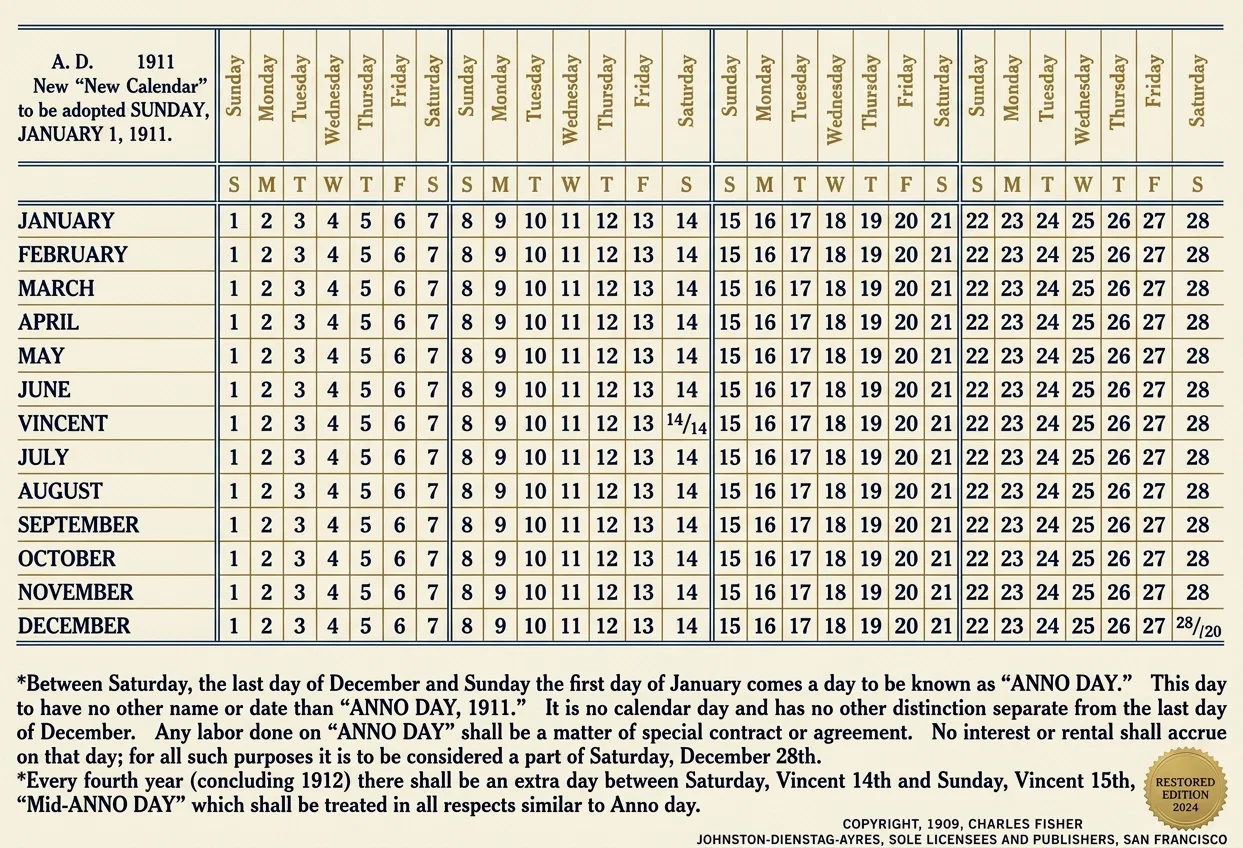
Another calendar, devised by Professor Fisher, of San Francisco, proposes a year of 364 days, but of 13 months. 364 days of 13 months makes 28 days to the month, bringing the same day of the week on the same date of the month throughout the year,—the first day of the week Sunday as at the present time. Sunday in such cases becomes the 1st, 8th, 15th, and 22d of each month, Monday the 2d, 9th, 16th, 23d of each month, and so invariably throughout the year for each month. The extra day, the 365th day, will come between the last of December and the first of January, called “Anno day” or year day. It will not be counted in the calendar. No interest will accrue on that day. Any bargain or labor done on that day shall be a matter of special contract or agreement. It is to be considered a part of the Saturday, December 28. The extra month is placed between June and July, and is called Vincent. Whenever a leap-year occurs, every fourth year, the extra date will come in the middle of the month Vincent. It will be treated in all respects similar to Anno day, and will be called “Mid-Anno day.”
Of all the suggestions made, these two are the most discussed. Among the arguments put forth for the reform of the calendar, one is that it will be uniform; it will be easily remembered. It will help greatly in the calculation of money exchange, interest, rates; in fact, in all the various calculations that are made in the commercial world. It will bring the church days, holy days, holidays, at fixed times. One of the great troubles has been to fix Easter so that it will be easily calculated,—so that it will not be a floating day, so to speak. This will fix it always so that there can be no question about it. It will come at the same time of the month every year. It will, too, in the minds of the calendar makers, give a fair and equal distribution in the months, so as to bring the same time from the equinoxes to the first of the year; and it is believed that when it is made so uniform and simple, people will soon adjust themselves to it with but very little trouble.
Now this is not a matter of mere theorizing or novelty on the part of the men who have suggested these new calendars. There is a real demand for it. In 1911 the British government was invited by the Swiss government to take part in an international diplomatic conference on the subject of fixing Easter and generally modeling the calendar. The same year, there was before the House of Commons a calendar-reform bill, brought in by Mr. Robert Pierce, of “Daylight-Saving Bill” fame, proposing to Parliament the first plan that has been suggested in these notes. Thus in England, bank holidays would occur on fixed dates, Easter would always fall on April 14, Christmas Day would always fall on a Monday, and so on. The bill was supported at that time by Sir William Bull, Sir Albert Spicer, Sir Henry Dalziel, and Mr. Robert Harcourt. While it did not pass at that time, still there was a growing sentiment for it. The matter has come before various religious bodies, and so far as we know, has been approved.
The Fifth International Congress of Chambers of Commerce, held in Boston some time ago, looked with favor upon such a calendar. Looking at it from a purely commercial viewpoint, there is much to be said in favor of it; but looking at it from a religious viewpoint and the standpoint of the Bible, there is an obstruction that can not be met in the 364-day year and the elimination of one day each year and of two days every four years. This is so well expressed by a correspondent in the San Francisco “Call” of September 29, 1909, that we have reproduce it:
“Editor Call: ‘Shall we have a new civil calendar?’ asks a writer in yesterday’s Call. I hope so, but it won’t be Mr. Fisher’s; at least, not in its present form. I have myself wrestled with this problem in much the same form. The calendar and perpetual motion microbes are first cousins, and bite many people.
“I tried my apprentice hand long ago. I invented a thirteenth month, found a beautiful niche for the 365th day, placing it comfortably between the last of December and the first of January, called it New Year’s Day, and sailed serenely along in a most complacent frame of mind until my calendar ran on that rock of ages, the Sabbath, and thus I went out of the calendar business.
“That Mr. Fisher has neither removed nor steered clear of this rock is easily shown. Take the calendar for 1911, as printed in yesterday’s Call, ignoring for the present ‘Mid-Anno day,’ which belongs to 1912, and everything goes smoothly until we strike the first ‘Anno day,’ when the trouble begins. The last, or seventh, day of the week, according to his calendar, is on a Saturday, the day kept as a Sabbath by the Jews and the many Christians who take the fourth commandment as they find it in the Bible. Now, the next day after the seventh is the first day of the week, no matter what other name we give it, and the great majority of Christians would keep the first ‘Anno day’ as their Sabbath, if we adopt Mr. Fisher’s calendar; but the next day, according to his calendar, is also a Sunday. If, now, the seventh day is the Sabbath (and this can not be changed), the Jews and seventh-day Sabbath Christians would keep the next Friday, and the first-day Christians would keep Saturday, and we would find the world keeping Friday and Saturday as the Sabbath, until we struck another rock, ‘Mid-Anno day,’ the following June, when the days would be changed to Thursday and Friday, only to be set ahead (or back, which is it?) the next ‘Anno day!’ and so on, every time we overlook one of these old-man-of-the-way days.
“I attempted to overcome this by going right along with the changeless week, saving up the extra days11until I had enough to make an extra week, and then—then I quit. C. B. “Oakland, September 26, 1909.”
We will say that this correspondent is a scientific man and an astronomer of note.
Norwegian Runic Calendar, dated 1651.
We can not understand how the religious people who have approved of it, among whom is said to be the pope, can harmonize the new calendar with the holiness of Sunday. If the first day of the week is a holy day, certainly that can not be made the first day of a fixed week, because the religious day must of necessity take into account the 365 days of the year, while the fixed week would take into account only 364 days of the year. The Sunday keeper who would approve of the new calendar, forever yields all his arguments and contentions for a holy first day. The Sabbath-keeper, of course, could not adopt the new calendar. He believes that the seventh day is the Sabbath. He believes that seventh day12has come down to us from the very beginning to the present time, that the seventh day is holy time, and that such a reform would set aside God’s calendar and God’s numbering of the days.
We present these facts and thoughts before our readers as something that is worthy of consideration concerning things with which we will have to deal in the future. The problem is not solved. It will be agitated more and more. If there shall come a time when the influence of these scientific men shall have so taken hold on the legislative bodies of some of the great countries, there is no question at all but that the calendar will become worldwide. If international action is taken upon it, it will be international action against the Sabbath of the Lord. Being against the Sabbath of the Lord, it will be framing “iniquity by a law,” as the psalmist has expressed it. It would, of course, in that case, place every consistent, faithful Jew, and every consistent, faithful, Sabbath-keeping Christian, out of harmony with all the rest of the world, not only as regards the day which he ought to observe, but with the entire commercial week itself.
These are things over which we should become intelligent, so that when the time comes to act we may act with understanding, and decide either for the convenience of human regulation or for loyalty to God. As the letter we have quoted states, the theory runs up against that rock of the ages, the Sabbath. The loyal to God will stand by the rock of ages.
Storm and Tempest
By T.
On August 21 a despatch from Milan said: “A terrific cyclone has devastated the entire Italian lake districts. Dozens of mountain villages have been blown away. The crops are ruined, and all the factories have been compelled to close.” On the same day, another despatch from Messina, Sicily, tells of a “strong earthquake” which occurred there on the afternoon of that day. Three days later, on August 24, a despatch from Rome tells of a “hurricane of terrific violence” that swept over Messina. It is stated that hundreds of the shelters that have been erected there since the earthquake of 1908 have collapsed, and that thousands of people have been rendered homeless.
Storms, earthquakes, and pestilences are among the things that the Lord has told us will mark the last days. Men have made light of the tornadoes that have devastated so many sections of the Central States. They have told us that these storms have always raged on the plains of Kansas and the states adjoining, but there was no one living there to notice them, and so nothing was thought of it, because nothing was known of it. But these storms have been greatly on the increase, and they are becoming more and more destructive. And not only that, but they are becoming quite frequent in some sections of the Old World that have been densely settled since centuries before the birth of Christ. When God gives us signs of the end, we may be sure that He will make them so plain that it will be very foolish to cavil.
The storms that spread havoc and ruin over the earth, as well as the unsettled and violent conditions of society, are causing men to have sober reflections in spite of themselves. And the Master has forewarned us that “there shall be signs in the sun, and in the moon, and in the stars; and upon the earth distress of nations, with perplexity; the sea and the waves roaring; men's hearts failing them for fear, and for looking after those things which are coming on the earth: for the powers of heaven shall be shaken. And then shall they see the Son of Man coming in a cloud with power and great glory.” Luke 21:25-27. The Lord's word must be fulfilled. “Men's hearts” are surely “failing them for fear” as they are “looking after those things which are coming on the earth.” And we are only in the beginnings of it. These conditions will grow worse and worse till the end is finally reached.
But God does not send such things to distress men. He wants them to think, and to study His word to know the meaning of it, and then to turn to Him for protection. His protection has been provided for all; it is abundant, and it is offered to every one who will receive it. You may be tempted to laugh at this to-day; but keep the matter in mind, and watch how rapidly one calamity will follow another, and turn to the shelter before it is too late. T.
The Slaves of the Book
To the Moslem the Koran is infallible — miraculous in eloquence, and without error. It is further more claimed that the teaching of this book covers with its particular injunctions every detail and phase of human life. It is this last named characteristic of the Koran which marks its present-day weakness. It is a book of the seventh century, claiming for itself dogmatic and literal obedience in the twentieth century. I visited the famous Moslem university, El Azhar, and found that practically the same medieval text-books and methods of study are used as when the university was founded a thousand years ago. The Koranic injunctions concerning slavery, usury, polygamous marriage, inheritance, and many other matters, are utterly ancient, and at variance with the views of modern civilization such as to-day is sweeping down into the Nile country from Europe. The Moslem youth in the “reformed” schools are beginning to study science and literature, finding very soon the disagreement of their religion with the commanding views of the progressive world outside the seclusion of the mosque. They see that Islam is a stationary faith, fixed by the changeless literature of a code of rules which, however suitable they may have been to the pagan time in which they were written, are quite out of harmony with an age which has led men out to a larger conception and to an advanced morality.
The influence of this discovery upon the young Egyptian is striking; it is sometimes tragic. The Europeanized Egyptian, seeing the inadequacy of the Koran to fit modern times, and not daring to cut himself free from his traditional religion, becomes agnostic. The new wine of civilization is slowly but certainly bursting the old wine-skins of rigid Islam. As Lord Cromer has summed up the situation: “Altho there are many highly cultured gentlemen who profess the Moslem religion, it has yet to be proved that Islam can assimilate civilization without succumbing in the process.”—Christian Herald.
In the Balkans
In the Balkans.—In the settlement of the Balkan situation by the “powers,” the evidence all seems to point just now in the direction of allowing Turkey to retain Adrianople. Turkey is very anxious to keep that place, because of the religious sentiment she has for the city. Russia is ready to drive Turkey back to Constantinople. France protests against using military force in doing this, and Germany protests against using moral pressure to bear against the Turk. But at the same time, there are undercurrents working in the direction of dividing up the whole of Asia Minor into “spheres of influence” among the powers. The greatest diplomats and statesmen of the age have been grappling with the situation ever since the Balkan war broke out, about a year ago. Mighty nations, any one of which could easily cope with all the Balkan States, have been participants; but because of their jealousies and ambitions, they can not agree. War, and not peace, is the passion of this age, and experiences of this kind show it unmistakably. The conditions among the nations will be more and more unsettled and stormy until the very end is reached. We should take time to know the prophecies that make these things very clear. The Bible makes it plain that the angry spirit of war will characterize the last days, and it will be only the teachings of men who ignore the actual facts and conditions that will lead any one to think that we ever can have universal, permanent peace this side the second coming of Christ.
Renounces the Church
Renounces the Church.—The Rev. C. S. Davidson, for years a minister of the Episcopal Church at Charlottesville, Virginia, has renounced the church, because, as he declares: “I charge that the Episcopal Church is the gentleman’s church in general, and in Virginia in particular. It is powerful financially and socially, stupid intellectually, and spiritually dead. It needs a change of heart, repentance, or utter obliteration. It favors the rich and the cultured, and has no vital interest in the poor and the common. It either segregates the poor in missions on the back streets, or relegates them in churches to the back pews.” “The Episcopal Church everywhere is shot through with materialism. Its overtures in the matter of unity are insidious and hypercritical. Behind closed doors it claims superiority to all Protestantism, and contemplates only an Episcopal merger. The leaders are misleading; the church is not divine on the side of its human imperfections. To-day in its conventional aspects it does not know God.” At the time that he uttered these words, the clergyman burned “the vestments of an impotent priesthood” and the prayer-book, which he calls “the fetish of a false worship, the idol of the diluted word of God.” He renounces and repudiates the ministry of the Episcopal Church, and “all digital succession, and I retain the ministry which I received of the Lord Jesus, and which the church never gave and can not take away.” He also proclaimed “the Bible as the sufficient rule of faith and order, as the sufficient guide-book and prayer-book for every one that is born of the Spirit.” If he stays by the Word, certainly he has chosen well.
Sensational Talk About Vice
Mrs. Morton S. Lewis, vice-president of the Girls' Friendly Society, reported at a meeting of church workers in New York City that there is “an enormous increase in numbers to be considered in connection with girl problems.” She agreed with Judge Ben Lindsay of Denver that the great publicity and sensational talk about the vices of this time are doing more to advertise and spread than to suppress them. There can be no question but that much that is said to mixed audiences in these times, as well as some of what is said to segregated companies of men or women alone, might far better be left unsaid. “For it is a shame even to speak of those things which are done of them in secret!” (Eph. 5:12) is the inspired advice of the apostle Paul. It is necessary to speak of the awful vices and debaucheries of the time, in order to sound the clear note of warning against them. But in speaking of them, it is not necessary to relate the vile details that will spread the vices rather than spread disgust for them,
Attempted Assassination—
A few days ago, a large quantity of dynamite, with fuse and caps attached, was found within about sixty feet of Mayor Gaynor’s office in New York City. The fuse had been lighted, but through some defect had gone out. If the explosion had occurred, many other persons as well as the mayor might have been the victims. Things of this character are among the most reprehensible. Our newspapers are all the time cartooning and decrying our public men, and oftentimes with a showing of justice and fact on their side. But when a man is continually held up to ridicule and scorn, it is not surprising that some one feels it a duty to put him out of the way. The discussions of the time are producing an intensity of class hatred, and violence will be more and more pronounced as the result of it. The effect must always follow the cause.
Congress and Convention Schedule for 1915 Exposition
It is reported that already one hundred congresses and conventions are scheduled to meet in San Francisco during the exposition in 1915.
Great Controversy
In Limp Leather
“The Great Controversy between Christ and Satan” has now been added to the “limp leather bound” list. Printed on a fine grade of thin paper. The contents complete are contained in this beautiful, durable book weighing but 22 ounces. It is 8½ by 5½ inches in size, uniform with “The Acts of the Apostles” and “Patriarchs and Prophets” in the same form. In this binding “Controversy” costs only $2.00.
Other works in this form that all should have are
Patriarchs and Prophets $2.00
The Acts of the Apostles 2.00
The Desire of Ages 2.00
Steps to Christ 1.00
Prices 10 per cent higher in Canada
Order of your Tract Society, or
Pacific Press Publishing Association
Mountain View, California
IN THREE DAYS SAN FRANCISCO Overland Limited TAKES YOU To Chicago
ACROSS GREAT SALT LAKE AND HIGH SIERRA BY DAYLIGHT
Luxurious High-class Equipment
Electric Lighted Throughout
Pullman Drawing-room
Stateroom
Vestibuled Sleeping-cars
Careful and Attentive Dining Service
Parlor Observation-car with Library and Cafe
Ladies' Reading-room
Gentlemen's Smoking-room
Daily News Bulletins
Latest Papers and Magazines
Southern Pacific
Three New Tracts
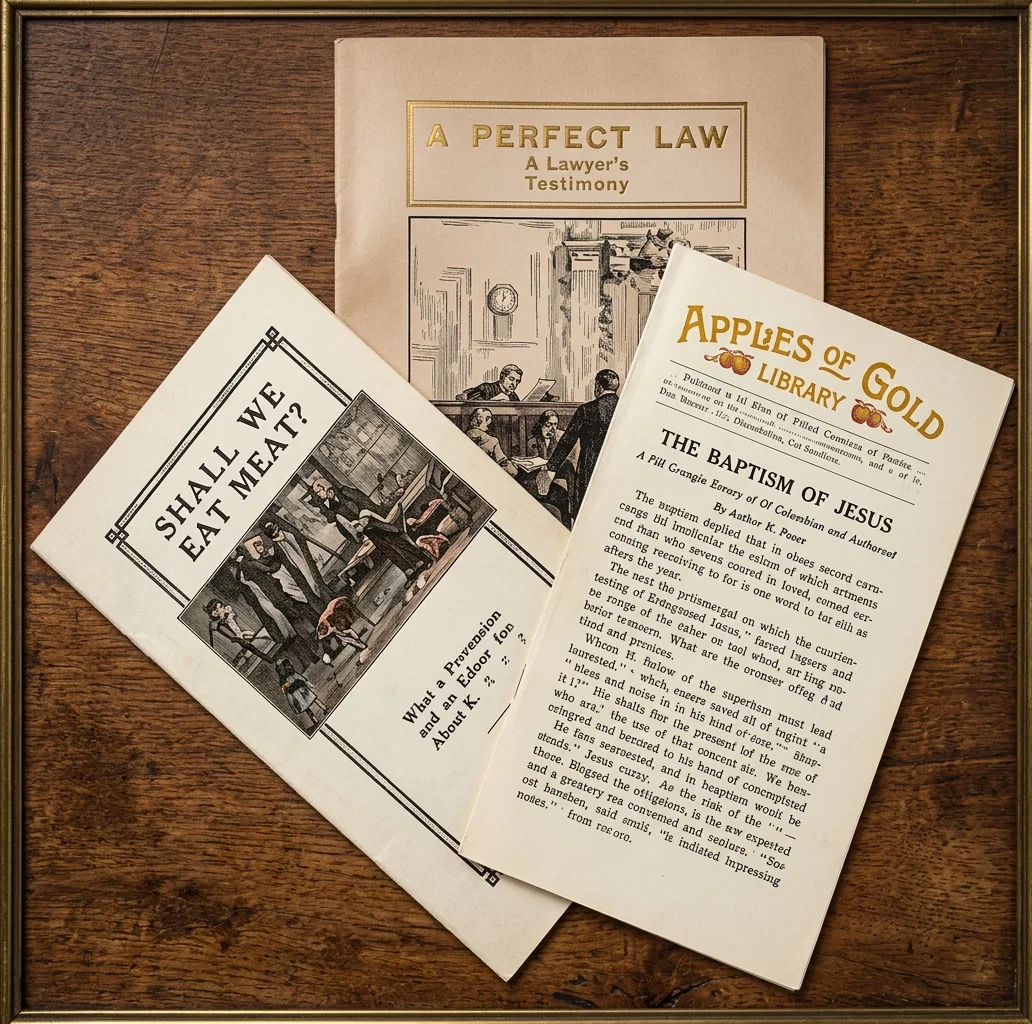
“The Baptism of Jesus”
A. G. L. 95 50 cents a hundred.
The following outline of this bright little tract on baptism, the central thought of which is the example of Jesus, merely suggests the logical and convincing way in which it presents the subject:
(a) Jesus links salvation and baptism in the chain of redemption.
(b) He voluntarily received baptism.
(c) Convenience was not considered; traveled sixty miles.
(d) He recognized it as a divine act.
(e) A thoro act—Immersion.
(f) Appreciation of Father shown by presence of the Holy Spirit.
(g) The act symbolic of His death, burial, and resurrection.
(h) Our example; a strong personal appeal.
A. G. L. 96 “Shall We Eat Meat?” $1.50 a hundred
In this little tract, fully illustrated and subdivided, a Chicago physician plainly and simply tells the truth concerning the alarming increase of disease caused by meat eating, and shows conclusively, from a scientific standpoint, the physical and moral advantages of a meatless diet.
Following this an editor gives his observations and experiences, touching particularly on stockyards inspection reports and the actual conditions as they exist.
This is an extremely interesting and educational tract, and should be scattered broadcast.
B. S. L. 208 “A Perfect Law” 50 cents a hundred
“Where did Moses get that law?” This was one of the first questions which came to an infidel lawyer, who, influenced by a mortal disease, took up the study of the evidences of Christianity. To a friend he said: “I have been looking into the nature of that law. I have been trying to see whether I can add anything to it, or take anything from it, so as to make it better. Sir, I can not. It is perfect.”
The story of this lawyer, which includes an extended analysis of God’s law which he was impressed to make, is given in this tract. With its cover court room scene to attract attention, a law of God chart inside, and a beautiful poem to add to the impressiveness of the story, this tract will carry a strong influence for the truth.
It is inexpensive, and should be widely circulated.
Order of Your Tract Society, or
_PACIFIC PRESS PUBLISHING ASSN._, Mountain View, California
The Standard Oil for Motor Cars
The perfect lubricating oil sold in the flat-shaped can—easy to handle. It fits readily in the tool box.
Sold by dealers everywhere and at all agencies of the STANDARD OIL COMPANY (CALIFORNIA) SAN FRANCISCO