Your ShelfYour Projects

Review and Herald, Vol. 91, No. 18.

Pilgrim Fathers, Church Monopoly, and True Patriotism Number
Earlier text: Brazil

Camp Meeting Suggestions

THIS word comes from the secretary in Western New York:—
"In our conference work I believe we should begin early in the year to plan for camp meeting. Invite and urge the youth and children to attend. Get them interested in some one else. Write each of them a personal letter or post card.
"If the camp meeting is held in the early summer, it is a good time to urge the young people to present a finished Reading Course work by that time. Have their certificates for them, if possible. Have the names of all who have completed their work nicely written or printed on large cardboard, or otherwise, and placed in the young people's tent. Later the list can be changed to the book
tent. It is surprising to see the interest this creates.
"When the certificates are distributed, call the names and have those who have earned certificates come forward to receive them. A few words of commendation for their faithful work are a real encouragement, and serve as an incentive to others to join the next reading circle. Call attention to the course that begins in a few months. Distribute the enrollment blanks, to be signed then or brought to the next meeting. Do not let this conclude the effort, but talk it in public, talk it to parents and to individuals. Solicit orders for the first books, and many will order the complete set. Have both Senior and Junior books at the young people's tent, and of course at the book stand. Read some interesting selections from them. Then begin a campaign for the summer by visiting or corresponding with those who could not attend the camp meeting. By the time the course begins in October, there will be a good list of names; but do not cease the effort then. Individuals have enrolled as late as February and finished their work by June."
Another secretary in the Atlantic Union writes:—
"I make it my business to see all young persons as soon as they come on the ground, and ask them to write their names, ages, and addresses in a little book I always have with me. I tell them where and when the youth's meetings are held, ask them to attend, and to invite others. As soon as possible, I find out who are Christians and who are not, and early enlist those who are, to work in a quiet way for those who are not. I hope to organize societies in churches where none are held, and to enlist some of these who attend camp meeting to take responsibilities in them, as I know no better way to make the camp meeting work permanent than by putting the youth where they may use what they have learned, and getting them to work directly for others."
This word comes from Southern California:—
"We had two reception tents for the young people near the Volunteer pavilion,—one for the young men, and the other for the young women. In each of these reception tents we had a register. These registers are of value throughout the year.
"The picture talk period each evening from 6:45 to 7:20 was helpful and very instructive. Our tent could not accommodate the attendance at any picture talk. We plan to have the stereopticon in the main pavilion next year.
"We arranged with the tract society secretary to offer slightly soiled or shelf-worn denominational books at reduced rates, also left-over Reading Course books used in previous years.
"The young people rendered splendid service in scattering the placards among stores for window display, and announcements among the homes within a radius of twenty blocks of the camp. This was done the first day of the encampment. Several assisted each day in giving out literature to strangers and visitors as they left the camp."
Another secretary writes:—
"We found that the most convenient time for the meeting of the prayer band was before the devotional meeting earlyin the morning. Some of us found it necessary to rise before the rising bell rang, in order to be there on time, but this hour seemed the best of all the day for our prayer service. There was quite an attendance at these band meetings, and the results that followed demonstrated their value. There was hardly a person present for whom special prayer was offered who did not yield his heart to the Lord.
"At one of our camp meetings last season, a reception and reading tent was fitted up by one who has a special interest in boys. The plan was a success. Restless boys who otherwise would have been strolling about the city spent much time between meetings in this tent. Some read as many as four books.
"Besides our regular meetings for the young people, we had two special meetings. One of these was devoted to the reading of papers and discussions on 'The Needs of Our Young People, Spiritual, Educational, and Social.' This gave us an opportunity to present before the people the Reading Courses and Standard of Attainment. Our other special meeting was a temperance rally."

To Health Seekers

THIS is a restless age. Money is plenty, and railroads and interurban and steamship lines encircle the globe. Rates of travel are quite reasonable, and the time has come when many run to and fro.
Curiosity, pleasure seeking, health, and financial betterment lead thousands to go from home into other countries. Just now there is a great influx of people from the North into the South. Some of these are land speculators. Many are buying farms in the delta region along the Gulf of Mexico. This land has been under water for centuries, but is now being reclaimed. It is very rich, and will in time produce large crops of early fruits and vegetables.
However, when feeble or aged persons come South to reside permanently, they generally find that they have made a mistake. Every country suffers from the curse, and it seems that the last few years we have had peculiar freaks of weather here in the South. New Orleans has just had a real snowstorm, and the cold, damp winds along the Gulf chill one through, even with the protection of a heavy overcoat. In some of our large cities in the South much of the sewerage is open, and the stench is almost intolerable in some localities. The mosquitoes breed by millions in the lakes and low, marshy lands.
The curse is seen everywhere. Fires, floods, and windstorms, destroying lives and property, are visiting localities supposed to be immune from these things. The old earth groans under the curse of sin; and go where you will, sickness, sin, and suffering exist. A change of climate may for a time prove helpful to some who are afflicted, but what a blessing it is to know that it is God who healeth all our diseases, and there is not a sparrow which falls to the ground without his notice. God is everywhere, "for in him we live, and move, and have our being." Truly we may say, "Blessed is the man that trusteth in him."
C. H. BLISS.

Hankow, China

We have now been in China four and one-half years. Much has been crowded into these years. But in it all, we have seen the hand of God leading us for our good. We are of good courage in our work here, and the prospect is bright for a good harvest of souls this coming year. Many are the inquiries we get concerning the truth, from every part of the province. One pastor, just from reading, began keeping the Sabbath. He had to leave his work as pastor, but before leaving taught his flock the Sabbath. He stayed at one of our chapels to study until his money ran out. Now he has returned home to sell some of his property, that he may have means to learn more of the truth, like the man in Christ's parable who sold what he had that he might secure the treasure. Two other young men in a Bible school, after hearing the truth, left the school and returned home. Now I hear that at the home of one of these young men there is a company of about twenty-five meeting every Sabbath. Many are the experiences I could relate of how God is going before us in China, and preparing for the loud cry. I pray that at that time we may not be behind the work, but that we in our experience may keep pace with it.
Many are the times we think of the homeland and loved ones, and desire once more to see them. But we know we could not long remain away from China without a deep longing to return. There is no work greater, and no work more pressing, than that which we have to do in this great and needy field.
We are happy for the many recruits you have sent to China. They are doing faithful work in Shanghai, studying the language, and will soon be able to go forth and fill up the needy gaps.
FREDERICK LEE.

Colporteur Work in Uruguay

Brother A. R. Dennis sends the following encouraging report from Montevideo, Uruguay:—
"After finishing my part of the city, mostly with 'Coming King' and 'Patriarchs and Prophets,' I began some long trips, handling 'Coming King' and La Salud y Vida. I have now visited every town of any size, with the exception of three or four, and, thanks to the Lord, I have had good success. As you no doubt know, for twelve or fourteen months past we have had a scarcity of money as well as of work in South America. Nevertheless, on my last trip, in 75 or 80 hours I sold $373 worth of books, and delivered $309 worth (Uruguay gold) of 'Coming King,' or about 85 per cent of my orders.
"In Rivera, a border town between Uruguay and Brazil, it seemed as if the Lord surely came to my aid, for in one day he gave me thirty-two good orders. Among those ordering were the mayor of the town, the secretary, and others of the town officials, the superintendent of public instruction, the postmaster and others in the post office, a lawyer, the manager of the Bank of the Republic and nearly every clerk, the chief of police, two captains in the army, the collector of customs, and other public officials, together with most of the leading merchants. In many other towns I have had similar experiences, but never such a complete sweep for a religious book. Several merchants followed me around the main street and induced others to buy; and on delivering, some took two books, one for a friend or partner. Some day I hope a good company of believers can be raised up here as it is in many respects the most up-to-date and bustling place I have seen outside of Montevideo, and the people are willing to listen to the message.
"Last May, or very soon after I came here, I sold a copy of 'Coming King' to a lady, and afterward my wife gave her Bible readings. The husband, wife, daughter, and two children are now keeping the Sabbath, and are nearly ready for baptism; so we can truly thank the Lord for his kindness to us, that even in this dark land we can see some fruit of our labors. Mrs. Dennis has about twelve or fifteen readers weekly, most of whom are keeping the Sabbath."

Missionary Work by Correspondence

The great lack of men to go from place to place and preach the word may be in a great degree supplied by tracts and papers and by intelligent correspondence.—"Missionary Work by Correspondence," page 2.
A MOST effective way of using periodicals is in connection with missionary correspondence. A letter should be written explaining that a paper is being sent free of charge, and a copy of the weekly Signs of the Times or some other missionary periodical should be mailed with it. The paper should be sent for several weeks, and then if no reply has come to the first letter, a second should be written, and the papers continued for some time longer. The question may be raised, "Why write a letter to send with the first paper?" There are several reasons for doing this. One is to let the person to whom the paper is sent know that there will be no charge made for it. In these days there are so many tricks played upon people in order to extort money from them, that they are naturally suspicious. When a paper comes to them which they have not ordered, they think at once that it is a device on the part of the publishers of the paper to get them to take it, and that later on it will be followed by a bill.
Another reason is that a letter warm with the love of Christ will be likely to incline the receiver to read the paper. The personal interest shown is likely to have a good effect. Still another reason is that it opens the way to get into personal touch with honest seekers after truth.
The letters should be written with care and prayer. Every letter will make some impression, favorable or unfavorable. It has been said of one of the successful missionary workers in the early days of the message that she would write a letter, pray over it, rewrite it, and pray again, and perhaps repeat this several times before she felt that the letter was what the Lord wanted it to be. When finally ready to go, it would be such a letter as might appeal to even a heart of stone. As in all missionary work, there must be a deep burden for souls, and much prayer, in order that the letters and papers may be used by the Holy Spirit to win souls.
In writing to strangers care should be taken to state in some pleasant way that the paper is being sent free of charge, and that other copies will follow. Attention may be drawn to some article of especial interest. The address should be plainly given, and the signature should indicate the sex of the writer, and if a woman, should indicate whether single or married. The papers should be neatly wrapped, as all these details make an impression on the receiver.
Care should be taken to avoid the use of expressions not generally understood, such as "present truth," "third angel's message." Expressions should not be used that would imply in any way that the writer considered himself wiser than the person addressed, or in any way superior to him, or that the person addressed was regarded as a subject for missionary labor. It is better to approach a person as a fellow seeker after truth, rather than as one to be instructed.
Missionary correspondence has been the means of bringing many people into the church. One sister in the early days labored earnestly in this way, and raised up several churches. Though feeble in body, she was as successful in bringing people into the truth as many ministers have been. What she and others have done, other church members can do now.
E. M. GRAHAM.

The Colporteurs' Convention in the Southwest

The ministerial institute and union conference was preceded in the Southwest by a three days' colporteurs' convention. All the laborers of the various conferences, with the presidents and tract society secretaries, were present and participated in the proceedings of this convention, which added greatly to its interest and strength. This plan of holding a convention prior to the ministerial institute we believe to be far preferable to any attempt to hold them in conjunction with each other. This plan gave ample time for free discussion of the different phases of our colporteur work as represented in our books and magazines, and the convention seemed to be very much appreciated by all the brethren.
Twenty-two colporteurs in the union had each sold and delivered $1,000 worth or more of books during 1913, which entitled them to free transportation to the conference and free entertainment while there, according to the proposal made by the union conference committee at the beginning of 1913. One evening of the convention was spent in listening to the experiences of these men as related by the fifteen who had availed themselves of this opportunity and were present at the meeting; Brother A. F. Harrison, the general agent of the union, also made brief statements concerning their work. The occasion gave an inspiration to others present to enter this grand and good work.
We confidently believe this convention will bear fruits in the advancement of the work, in that all classes of workers were drawn close together, and not only had their personal interest revived in this important branch of the work, but became more intelligent as to how to co-operate in its advancement in their respective conferences.
W. W. EASTMAN.

Love Took Up the Glass of Time

Love took up the glass of time and turned it with his glowing hands; every moment lightly shaken, ran itself in golden sands. Love took up the harp of life and smote on all the chords with might; smote the chord of self, that, trembling, passed in music out of sight. — Tennyson.

College of Medical Evangelists

ONE of the most encouraging meetings of the board and constituency of the College of Medical Evangelists was held March 25-29, 1914, at Loma Linda, Cal. Many members of the General Conference and North American Division Conference, as well as many other members of the constituency, were present. Among those in attendance were the following: I. H. Evans, W. A. Spicer, W. T. Knox, R. D. Quinn, B. G. Wilkinson, Chas. Thompson, O. Montgomery, S. E. Wight, G. F. Watson, G. B. Thompson, E. E. Andross, C. W. Flaiz, H. S. Shaw, M. N. Campbell, J. J. Ireland, W. A. Ruble, F. Griggs, E. W. Farnsworth, J. H. Behrens, C. H. Jones, W. C. White, C. E. Weaks, M. C. Wilcox, Claude Conard, C. L. Taggart, L. M. Bowen, F. M. Burg, M. E. Cady, W. W. Eastman, W. L. Burgan, P. I. Richardson, H. G. Childs, V. H. Lucas, J. A. Burden, S. S. Merrill, G. K. Abbott, T. J. Evans, Julia A. White, R. S. Owen, Luther Warren, Josephine Gotzian, C. Santee, G. A. Snyder, and C. McReynolds.
After extended prayerful consideration, the following recommendations concerning the policy for the future of the college were adopted:—
"1. That two courses be conducted for the preparation of advanced medical evangelists:—
"a. A full medical course that will enable students to pass the State medical examinations as prescribed by law.
"b. A three-year medical evangelistic course giving special preparation in evangelistic lines, with sufficient medical education to enable the graduates therefrom to engage in active medical missionary service.
"2. That the instructors carrying principal responsibilities in the college be men and women who give their entire time to the work of the school and the denomination on a regular missionary wage.
"3. That at least three years of the medical course be conducted at Loma Linda. That two years, or such part thereof as seems advisable, be conducted in Los Angeles in dispensary and hospital practice, as a part of the college. We recommend that as full privileges as possible be secured for the college in the county hospital in Los Angeles.
"4. a. That in the way of support the resources at Loma Linda be developed to their fullest extent to meet the expense of the school, and that the board take immediate steps to place the institution in such condition as to accomplish that end, giving as full heed to the report of the finance commission as is practicable.
"b. That for the immediate future the North American Division Conference be requested to appropriate $10,000 during 1915 and $10,000 during 1916 for the support of the college. That the Pacific Union Conference and its local conferences and institutions be asked to make up an appropriation of $5,000 in 1914 and $5,000 in 1915 and $5,000 in 1916 toward the support of the college.
"c. That we urge that the work in Los Angeles be so planned as to bring financial returns for medical work that will make the city department self-supporting.
"5. That we instruct the management of Loma Linda to bring the expenses of the school within these provisions, cutting back work temporarily if required, in order to avoid increasing liabilities for current operation of the school.
"6. That beginning with 1917 the allied interests in Loma Linda and Los Angeles aim to become fully self-supporting.
"Recommended, That the tuition in the college be raised to $125 a year, not including fees; this to apply to students entering in 1914 and thereafter."
It will be readily seen that this action places the College of Medical Evangelists on a more secure and favorable basis than ever before.
The provisions made during this late meeting at Loma Linda have given great courage to those who are endeavoring to promote the work of this college. Plans are laid for carrying on the work of the school in a stronger way than ever before. With this provision for our medical school, is it not time that every Seventh-day Adventist student seeking a medical training secure it in our own college, and not in outside institutions? If only those who are attending other schools were in our own medical school, the income of the college would be increased several thousand dollars each year. This of itself would greatly assist in the support of the school. Then, too, of much more importance than the financial consideration is the matter of educating our young people medically for work in the third angel's message. The principles of health reform and of rational methods of treating disease, largely without drugs, is of great importance. It has been for these reasons that the denomination, at great expense, has provided a medical college. Is it not time that the support of all our people be turned to this school as to other schools of the denomination?
Students desiring to enter this fall, even if they have some preparatory subjects to make up, should correspond with the college at once. Further information in reference to the college will be given next week.
W. A. RUBLE, M. D., President.

Washington (D. C.) Sanitarium City Hospital

FOR two years past the Foreign Mission Seminary and the Washington Sanitarium have conjointly operated a dispensary in the Southwest section of Washington for the needy poor. The work of the dispensary has been threefold:—
First, to afford a place for foreign mission appointees, nurses, and postgraduate nurses to gain a practical experience in meeting the poor in their homes, treating their diseases, and also acquainting themselves with the simpler medical and surgical ailments.
Secondly, to provide proper care and treatment for a very needy class of poor, who at a minimum charge have the benefit of physicians' and trained nurses' services.
Thirdly, to constitute a missionary center, an effort being continually put forth to bring a knowledge of the message to a class of people most of whom could be reached in no other way.
From the first, the dispensary has been a success in accomplishments along each of these lines. During the past two years 10,550 treatments were given at the dispensary, besides numerous treatments in the homes; and attendance at from three to four obstetrical cases each week. Several are observing the Sabbath as a result of the house-to-house work of the nurses. The dispensary has been duplicated many times by those who have received a training there, and are now conducting a similar work in the mission fields. Perhaps the greatest drawback to the work has been the cramped quarters of the present building, which is situated in a business section occupied by pawnshops and small stores.
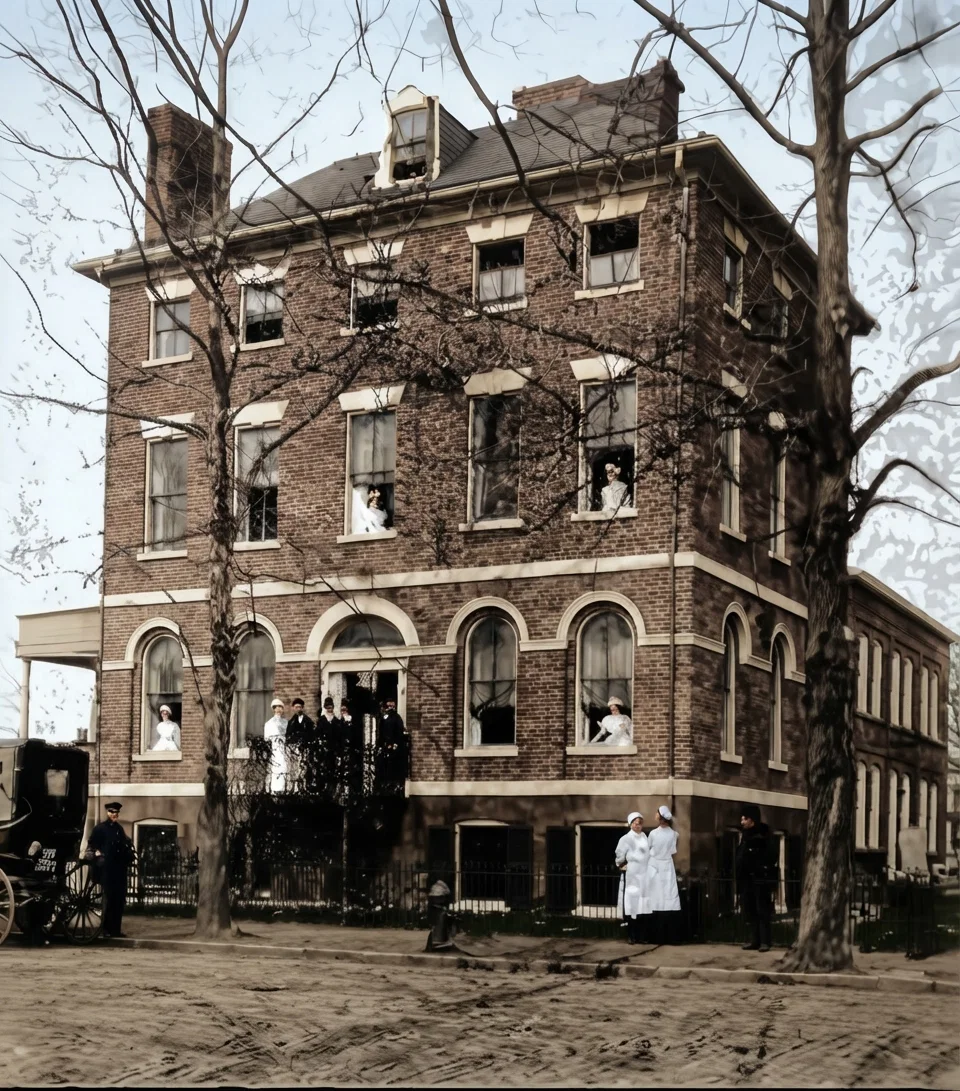
As a natural outgrowth of a prosperous dispensary, the board of management has for several months been looking for a building that would be suitable for a dispensary and also for a hospital. A very desirable building was found, which is shown in the illustration on page 19. It is located not far from the site of the old dispensary, being situated on a corner lot, with no tall buildings surrounding it, thus affording it abundant light and splendid ventilation. Being only a short distance from the bank of the Potomac River, toward which it faces, there is in view from its rooms a beautiful landscape. The building, which has just undergone improvements within and without, was secured for a rental no higher than that which we have been paying for the other dispensary, and this building contains at least four times as much room as the other.
The basement will be occupied by the dispensary. The operating room will be on the third floor. There will be three main wards and a few private rooms for patients, besides kitchen, dining room, and doctor's office.
The requirements for the establishment of a hospital in the city of Washington are very rigid. In the first place, it is necessary to obtain the written consent of two thirds of the householders and their tenants within a radius of one hundred feet, after which the building is inspected by building and medical inspectors. It was with considerable difficulty that the signatures of barely two thirds of the people owning the properties and of the tenants occupying them was obtained to the petition. One of the property owners who refused to sign, held three properties adjoining, and if she should count for three votes, then the necessary two thirds would be lacking. The petition was handed in to the city council, who passed upon it, ruling in favor of the dispensary.
Heretofore, all the cases coming to the dispensary requiring surgery had to be referred to one of the hospitals in the city. Many of those requiring surgical work would have preferred to have their operations at the dispensary had there been the necessary facilities for such work. This building will now provide a place for the medical and surgical care of all such cases, and will also afford a place where Seventh-day Adventists who are unable to go to a sanitarium can be treated. Some of our brethren and sisters have had to enter a city hospitalwhere they could obtain a free operation at a low weekly rate. All such persons can now come to our own hospital, in which the physicians and nurses are Seventh-day Adventists, and in which the rates will be as low as those of the city hospital, or lower. While the management will be able to quote a very low rate for the surgical and medical care of patients, the hospital will be conducted on a strictly cash basis. All fees, as well as the weekly charges for room and nursing, must be paid in advance.
In order to enable the hospital to maintain good service at such reduced rates, it will be necessary for the institution to have subscriptions and liberal donations. Particularly is this needed in the initial furnishing of the building. Pictures, bedding, dishes, rugs, chairs, furniture, etc., are solicited, and the hospital will appreciate at any time donations of clothing for the poor. Dr. L. E. Elliott, under whose careful management the dispensary has become self-supporting during the last few months, is superintendent of the new hospital, which is located at the corner of Sixth and N Streets, S. W., Washington, D. C. Contributions of money or equipment, as well as letters of inquiry regarding rates for surgery or treatment, should be addressed to him. This enterprise has met with much local support, and we trust that it may prove an efficient means of advancing the work and the message at the nation's capital.
H. W. M.

The Pure Food Label

THE label "Guaranteed under the National Food and Drugs Act, June 30, 1906, Serial No. —," appearing on packages, does not always mean as much as may be intended by those using the label, nor as may be thought by those who use the goods.
Some people believe that this label is a guaranty by the government that the article sold under it is pure. Such is not the case. The generally accepted supposition that the label insures the purity of the goods is based upon what ought to be the fact, but which in truth proves not to be. In its workings, the guaranty is only a protection for the retailer in case of prosecution, the manufacturer or packer thereby guaranteeing to bear all liabilities of prosecution.
The activities of the national authorities in the enforcement of the Pure Food Law are confined to food products that enter into interstate commerce that are shipped from one State to another. Foods produced and consumed within a State are not subject to government inspection or analysis.
The last report of the Bureau of Chemistry of the United States Department of Agriculture shows the number of cases passed upon as violations of the Pure Food Law to have reached 2,829. This would indicate that the law has not yet put an end to attempts to defraud.
Some of the violations are about as gross as any that have ever occurred, showing the imperative need of strict pure food regulations. They cover practically all kinds of food products subject to adulteration. We mention a few of them.
A brand of olive oil was labeled "Extra Fine Olive Oil—Lucca, Italy. Olio d'Oliva Torricelli Brand—Marca Depositata." Analysis showed the product to be chiefly cottonseed oil.
A number of confectionery products under attractive names, appealing especially to children, are alleged to be adulterated because containing arsenic in quantities sufficient to be deleterious to health. In a number of instances candy is coated with shellac. Frequently the word maple is used in connection with the name, whereas the product may contain no maple whatever.
WASHINGTON (D. C.) SANITARIUM CITY HOSPITAL
A product labeled "Delight Brand for Soup Tomato Pulp Made From Clippings and Trimmings" was found to consist in whole or in part of a filthy and decomposing vegetable substance.
Several cases of adulteration and misbranding of evaporated and condensed milk are given, in which it is alleged the milk is below required standard, notwithstanding the guaranty label.
Frozen, dried, evaporated, and desiccated eggs in a number of instances were found to be wholly or in part filthy, putrid, and decomposed.
Tomato sauce, catchup, pulp, conserve, and paste are found in many instances to be so filthy with bacteria that they are condemned as unfit for food or as an ingredient of food.
Several brands of molasses, maple sirup, sorghum sirups, and drips, with fancy names and labels, are found under false names and descriptions.
Flavoring extracts and essential oils of a number of brands are found to be adulterated and misbranded, being colored with coal-tar dyes, and containing little or no true flavoring material.
A number of so-called remedies for various ailments fall under the ban of condemnation in that they are not what they are said to be, and cannot do what they claim to do.
Macaroni labeled to indicate that the product is of foreign manufacture, made of the highest grade of gluten flour, and with eggs, by patented hygienic mechanical method, is found to be a domestic product made of ordinary wheat flour and artificially colored with a yellow coal-tar dye so as to resemble the appearance of egg, but containing practically no egg.
Several brands of "Lithia Water" and other mineral waters are found misbranded, their labels giving analyses showing valuable constituents, the number of which is exceeded by the list of diseases for which the water is recommended.
A so-called gelatin shipped to a manufacturer supposed to make a high grade ice cream is found to be hide glue.
Some brands of canned peas represented as being early June or green peas are found to be matured peas soaked. The word soaked was on the label in inconspicuous letters. A similar misrepresentation is found with several brands of canned Lima beans.
A widely advertised pepsin chewing gum, with the statements that it is "a delicious remedy for all forms of indigestion" and that each tablet contains sufficient pure pepsin to digest two thousand grams of food, is found by analysis to contain practically no pepsin. When three tablets of the gum, which, according to the statement of the manufacturer, should contain about one-tenth gram of pepsin, were finely divided and substituted for the one-tenth gram of pepsin as per the U. S. P. assay for pepsin, the gum solution showed no effect whatever upon the egg albumen, while the pure pepsin dissolved the albumen almost completely.
Several brands of "unfermented grape juice" fail to meet their claims, in that, for one thing, they are fermented.
So-called temperance beers and temperance tonics come under the charge of misbranding simply because they are not temperance beers or temperance tonics.
A bottled water claiming medicinal properties of unusual value, with a label giving an almost exhaustless list of diseases that may be cured by the use of the water, was alleged to be adulterated "for the reason that the product contained an added deleterious ingredient which may render it injurious to health, to wit, excremental material of animal origin, and further in that it consisted of filthy, decomposed, and putrid animal substances."
Several brands of preserves, jams, and jellies were found to be falsely labeled, some containing more benzoate of soda than the label set forth, and some containing phosphoric acid in excess of the amount declared on the label. Others contained more glucose than the amount stated.
Contrary to the statements found onthe package of a malt breakfast food, it was found that the ingredients contained no barley, was not rich in malt, did not consist of "the choicest whole wheat, scientifically combined with the best barley and malt," and did not possess "all the virtues of malt."
Some hair tonics were found to be misbranded for the reason that the product did not do what the label said it would do.
A "Walnut Oil" hair color restorer said to be "Nature's Own Remedy, Simplest and Best on Earth. . . . Price, One Dollar. The Only Hair Dye on Earth Made From Pure Vegetables and Oils. . . . A Strictly Vegetable Remedy," was found misbranded because in truth and in fact it contained no walnut oil and was not made from vegetables and oils.
Several instances of adulteration of ice cream are given, with findings in some cases of conditions that rendered the product unwholesome because of the large number of bacteria. Some ice cream cones are also found to be misrepresented, containing boric acid, and being artificially colored.
Various beauty preparations, such as lotions and freckle ointments, come under the list of condemnation for claiming to contain nothing harmful, or to be absolutely harmless, whereas they are harmful.
Several so-called drug habit cures fall under condemnation in that their claims are false and misleading, the articles containing alcohol and morphine in different quantities or proportions than stated on the labels.
Shredded coconut so rancid as to be unfit for food finds condemnation.
A shipment of twenty-six tierces of butter was condemned, some of it being so rancid that the decision was rendered that it be marked "Moldy grease not to be used for food purposes."
In a number of cases rice was found mislabeled, the product being an inferior one and coated with glucose and talc. One brand labeled "Fancy Head Rice" consisted almost entirely of broken rice usually classed as about number two screenings.
A number of convictions were for short weight, the difference in some instances being ten per cent or more between the actual contents of the package and what was stated on the label.
This all goes to show that the individual purchaser of goods must still be guarded in his selections. Care on the part of consumers to ascertain what goods are really reliable and to purchase only such will perhaps do most toward bringing about the needed reform.
L. A. H.
Continue reading: News and Miscellany