So much of the current, daily news refers to Chinese geography, that the following definitions of proper names, from the Boston Transcript, are both interesting and instructive: “First, prefixes: Ta, as in Taku, means great, and siao, as in Siao-Ping-Thou, means small. Pei or pe, nan, tung, and si are respectively north, south, east, and west. Thus the Pei-Ho is the North River, etc. Shang and hai are upper and lower. Pai, hei, and whang are white, black, and yellow. Suffixes are more numerous and familiar. Kiang, ho, tchuan, ula, muren, and tohu, each and all mean river. Thus Yalu Kiang and Liao Ho are simply Yalu River and Liao River. Shui, kou, tshuan, khi, gol, and ussu are unfamiliar terms, meaning a brook or small river. Hu, nor, and omo mean lake, as in the well-known Lob Nor and Kossi Gol Po; tse and tien mean a small lake or swamp, or a town situated near such a place. Hai means sea; thus Whang-Hai is the Yellow Sea, Tung-Hai is the Eastern Sea, and Nan-Hai is the Southern Sea. Tao, and sometimes shan means island, but shan more often means a mountain range. Ling is a pass over a mountain range.”
The Finest Toilet Soap
Glenn's Sulphur Soap will outwear two or three cakes of ordinary “highly perfumed” soaps. It sweetens and beautifies the skin and contains enough pure sulphur to make it a specific for skin diseases. Refuse any substitute for
Glenn's Sulphur Soap
25c. a cake at all drug stores or mailed for 30c. by The Charles N. Crittenton Co., 115 Fulton Street, New York.
WANTED
A Sabbath-keeping partner with $300 to invest in a Novelty. Boiler for the business is set and machinery on the ground. Write to Albert P. Daniels, Clarks, Neb.
WANTED
Strong, healthy Adventist ladies and gentlemen, to take the nurses' course, and soon prepare themselves for usefulness. Write for particulars.
QUEEN CITY SANITARIUM,
Kalamazoo, Mich.
IDOL-WORSHIP IN CHINA.
By Maud A. Miller, M.D.
BY MAUD A. MILLER, M.D.
The study of the Chinese language is so difficult that one will never gain the mastery over it, except by continual work. So most of our time is spent at this task. We expect that within a year from the time that we came here we will be able to teach the Gospel in the Chinese tongue. This we are very anxious to do; for as we look upon this land with its 426,000,000 of heathen, who know not God, but when they desire good things, bow down and worship their idol of brass, wood, or stone, we feel the great responsibility laid upon us. In this city I saw one idol of gold.
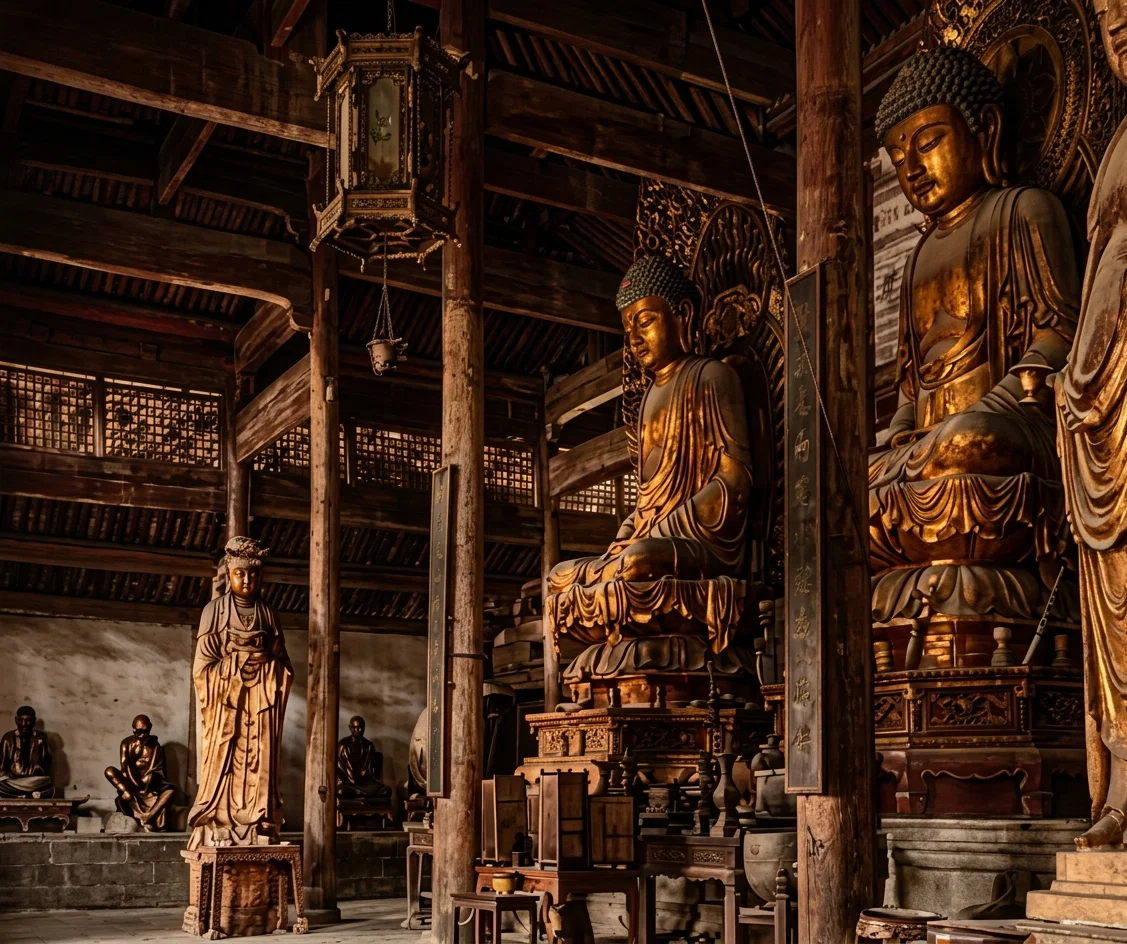
The other day I visited the Buddhist temple in which they have many gods. The priests received us very friendly and allowed us to see all the different gods, a favor which they seldom grant visitors. On our way to the temple we were followed by a long procession of Chinese, so by the time we reached the temple there were at least two hundred spectators, who were anxiously expecting to see foreigners worship their gods; but they were disappointed, for, as they closed around to look at us, and particularly at the ladies’ large feet, we were busily occupied looking at their hideous gods. Some have countenances so terrible that even a believer in the true God shudders to look upon them. Some are patterned after their idea of the great and terrible dragon, while others have their bodies covered with fish scales, a heavy armor, or many heads placed in all parts of its body.
In one place there stood a god, in front of the others, bearing on his arm a large number of ear tabs; these were to keep the ears of their dead ancestors from getting cold. Another god had many eyes which were also for the use of these same people who needed them. The Chinese, as a rule, have bad eyes, and many are blind, so these are provided for by these gods. In this they acknowledge the weakness of their gods, as they know them to have no creative power, but they hold in store that which they need after they die, and will at that time give what has been placed in their keeping.
Some of the gods have great iron spears, and others fierce-looking weapons; while others are in an attitude of a king or queen wearing stately robes, and having a good-natured look upon their faces. In this section of the temple there were ninety-four gods; other rooms had many more gods.
We now took our departure from this temple and visited another only a short distance from our home. Here we saw many more hideous idols in the form of different animals, some being quite large. In the room were great drums and large bells. The room was filled with incense, most of it burning in front of the large idols, where were boxes of ashes accumulated as the result of combustion of large quantities of incense. The Chinese seem to have no respect whatever for these gods, as they crowded around us in the temple to see us, with no sense of reverence whatever. I am sure they would respect the true God, if they only knew about Him, much more than these idols.
Interior of a Chinese Temple.
We passed out of this room into a courtyard, which was limited on either side by great long stables of idols, which made me think of the animal exhibits at the county fairs. Each room contained ninety idols. The number of idols counted in both temples were over five hundred. The worshipers bow down in front of the idols and eat, asking for good things in this present life.
They will often place one or more idols in a sedan chair and carry them through the streets with a great deal of pomp and glory; and they also carry long sticks of incense in the form of a coil, which are fastened to the flesh of the forearm by an old rusty hook thrust through the skin. A little over a week ago there were at least one thousand people that endured this inhuman torture, and marched the entire day through the city, carrying the incense by means of this hook in the skin. This worship was for the purpose of bringing down rain, as we had had dry weather for five months and the crops were perishing.
Yesterday was the day to worship Adam, the first man, and also Noah. They carried Noah’s three sons to bow before him. They worship these gods in order that they may have abundance of food, money, and goodness.
They have gods for everything: gods to bring rain and gods to stop rain. We have now had six days of hard rain, so the people are worshiping the god to stop rain. They carry the gods to each of the four gates of the city, and after the god has been carried out through the gate, he is then brought back into the city face backwards so he will not bring rain back in the city again.
They have gods to stop the thunder, to keep away evil spirits, to grant them a safe journey, to bear them male children, etc. The most common one is for righteousness. They go before this god and burn paper, and no difference what they have done, this god clears their case.
In every home is a kitchen god which they worship daily during the year. At New Year’s time they put sweetmeats on its lips, and all over it, then they burn it, believing that as it ascends to their ancestors it will only have sweet things to tell us.
I often feel that if the people in the home could only realize the extent of heathen work, it would certainly arouse them to hasten the glad tidings to the heathen. It seems a shame that a million a month of idol worshipers should go to the grave without a knowledge of the Savior. God places human agents under obligations to do their best. Bring this question to yourself. Does it lie in my sphere to do something for China’s millions? Pray for us.—Welcome Visitor.
Mission Work in China
By A. C. Selmon
FROM SIN TSAI HSIEN, CHINA.
BY A. C. SELMON, M.D.
All hearts here were made glad at hearing the Lord had answered our appeal for help. The thousand dollars sent us by the brethren in Wisconsin has been received, and we are searching for a place where the Lord would have us start the work. This sum will enable us to secure a small plot of ground, and a few Chinese mud houses to meet our present emergencies. We value this gift because of the sacrifice it cost to make it, and we are earnestly seeking the Lord that He may guide us in the way of it.
Fifty miles to the west of us is a large city of some sixty or seventy thousand people. Dr. Miller and I, having been in the city, have felt impressed that it would be a favorable place. Two weeks ago I went to look for an opening. The roads were very bad, and we were not able to make more than twenty miles a day. Stopping the first night at an inn in a small village, we had an opportunity to see the fearful effects of opium-smoking, for the lord and his wife, and their only son, a boy of fifteen, all smoked large quantities of the drug. They were miserable-looking creatures, poor in flesh, and so weak that they could hardly move around. The opium-smoker cares for nothing but his pipe. He does not even braid his cue, but lets his hair fall in a tangled mat. He has no idea of honesty or any other virtue, and comes as near the state of the lower beasts as it is possible for man to get. It is quite common to see young children who use opium, having been taught its use by their parents. After they begin its use their growth ceases and they soon die. At present the opium fields are in bloom, and13we can get an idea of the immense amount of opium used in China, for the white and red poppy fields are thickly dotted all over the country. Much of the ground that formerly was used for rice is now devoted to opium-growing, and this has caused a rise in the price of rice, which is the staple article of food of the masses. In the cities practically every one who can afford it uses opium, although its use is not so common among the women as among the men. In the country opium-smoking is not so common. There are coming to be many places throughout the country where opium users are treated, and all the large missionary societies have hospitals for this purpose. While some are cured, it is only temporarily, for there is but one cure for this habit that is permanent, and that is the “blood cure.” When they learn to trust the Lord they can be cured; otherwise it is almost a waste of time.
Leaving this village, we had not gone far when our cart upset. Our bedding and other things in the cart were wet, and our Chinese teacher, who was in the cart, was hurt. Reaching the city which I mentioned, we found a very desirable location; but as the owners found that foreigners wished to secure it they asked such a high price that we had to give up the attempt to secure it, for a time at least. But we have seen enough evidence that the Lord is leading us to that city that we believe we shall yet secure a location there.
The weather at present is not much warmer here than it is in Iowa during the month of May. The wheat crop will be poor, because of dry weather, and that will mean very expensive flour for us, for where there are no railroads the prices of food-stuffs in a place depend upon the crops in the immediate vicinity.
Please remember when praying for the work here to pray for two definite objects; first, that we may have some thoroughly converted, earnest Chinese men and women for evangelists and Bible workers; second, that the Lord will send us some one who knows something of the printing trade, so we can begin to get some literature out with the truths for this time made prominent.—Workers' Bulletin.
DUTY DOING.
By Anon.
WITH love and pity all aflame,
The story of the cross I heard,
And straight a pilgrim I became,
Through all the world to seek my Lord;
To bind for Him with loving hands
His wounded feet and bleeding hands.
Then in a quiet hour I heard,
Plain as a whisper in the ear,
“I am thy ever-present Lord,
Why seek for Me?—Lo, I am here.
Who doeth what My Word commands,
Hath kissed My feet and touched My hands.
“Who giveth to the starving—bread,
Who stays the steps of wayward youth,
Who raises up the sorrowing head,
And best of all—who spreads the truth.
He binds for Me with loving bands,
My wounded feet and bleeding hands.”
—Anon.
THE GERMAN AND SCANDINAVIAN BIBLE SCHOOLS AT UNION COLLEGE.
By C. C. Lewis
As these are the only schools of the kind in the United States, it would seem desirable that our people in general should become better acquainted with their work. Accordingly, I give below the course of study as pursued in each of the German, Danish-Norwegian, and Swedish languages:—
First Year.
Beginning Grammar, 1, 2, 3; History I., 1, 2, 3; Old Testament History, 1; New Testament History, 1, 2; Eighth Grade Arithmetic (English), 1, 2, 3; Penmanship, 1, 2, 3.
Second Year.
Advanced Grammar and Language, 1, 2, 3; History II., 1, 2, 3; Bible doctrines, 1, 2; History of Missions, 3; English Grammar, eighth grade, 1, 2, 3; Singing, 1, 2, 3.
Third Year.
Rhetoric and Literature, 1, 2, 3; Daniel and Revelation, 1, 2, 3; Physiology and Hydrotherapy, 1, 2, 3; Bookkeeping, 1; Epistles, 2, 3; Public Speaking and Ministers' Training-class, 1, 2, 3.
A fourth year is offered to those who feel the need of a more thorough preparation, during which time a practical training for the ministry will be offered in Public Speaking, Testimony Study, Church-school Pedagogy, History of Missions, New Testament Greek, and Old Testament Hebrew. These studies will be pursued in conjunction with the English-speaking classes that pursue the same studies.
The teachers employed for the coming year are as follows:—
In the German Department: Prof. August Kunze, translator of several of our standard denominational books, once editor of our German paper, and perhaps the oldest teacher in the denomination; also Prof. G. A. Grauer, formerly a minister in the Wisconsin Conference. If needed, another teacher will be secured.
In the Danish-Norwegian Department: Prof. Peter E. Berthelsen, who has labored so long and faithfully at the head of the department, will continue his work, assisted by Elder Christian A. Thorp, editor of the Evangeliets Sändebud og Sandhedens Tidende.
The Swedish Department will have as teachers, Elder August Anderson, formerly a student of the Swedish Department of Union College, recently from ministerial work in New York City, and A. Swedberg, now editor of Sions Vaktare och Sanningens Härold, also editor and teacher in the denomination for nearly twenty-five years.
With this corps of experienced instructors, the Union College Bible Schools in the German and Scandinavian languages afford the best opportunity in this country for the preparation of ministers and missionary workers to engage in the work of the Third Angel's Message among these nationalities.
We would cordially invite our brethren and sisters everywhere who speak these languages to work for the Union College Bible Schools. Call the attention of promising men and women to the advantages offered. Encourage young men and women to prepare themselves to engage in some branch of the Lord's work. Send for copies of the new Year Book, which gives a full description of these Bible Schools. Send us addresses of interested persons, to whom the Year Book may be sent. Aid with your means worthy students who are not able to attend the college; it will be treasure laid up in heaven. Above all, pray for the outpouring of the Holy Spirit upon our college the coming year, that sound instruction from the Word of God may be given, that pride and worldliness may be subdued, and that from its walls may go forth an army of Christian warriors to meet the enemy in the closing conflict.
C. C. LEWIS,
President Union College.
Our Work and Workers.
THE post-office address of Brother J. H. Rogers has been changed from Los Angeles to Riverside, Cal.
BROTHER T. H. JEYS, of Iowa Conference, has gone to North Carolina, to make that his field of labor.
THE Indiana Reporter notes the recent baptism of three candidates at Lafayette, by Brother A. W. Bartlett.
AT the recent session of South Dakota Conference it was decided to maintain a religious liberty department with a secretary at its head.
IN connection with the recent quarterly-meeting at Baraboo, Wis., three candidates were baptized in Baraboo River by Brother F. F. Peterson.
THE Central American field is soon to have an additional Bible worker in the person of Sister Elizabeth McHugh, of Grand Rapids, Mich.
A LARGE farm has been purchased near Nashville, Tenn., where a training-school is to be established, in charge of Professors E. A. Sutherland and P. T. Magan.
THE headquarters of the Indiana Conference is now located at Room 23, Unity Building, Indianapolis. The office of Lake Union Conference is to be in the same building.
JUNE 18 Brother F. Stebbeds baptized six candidates at Milton Junction, Wis. The company gathered at Clear Lake for the occasion were addressed by Brother Samuel Shadel.
DEDICATION services were held in the new house of worship in Springfield, Ohio, June 26. Services were conducted by Brethren H. H. Burkholder, R. R. Kennedy, and W. W. Miller.
DURING meetings held at Dowling, Ohio, by Brethren F. M. Fairchild and J. P. Gaede, the United Brethren have discontinued their weekly prayer-meetings in order to attend the tent-meetings.
THE Southwestern Union Record gives a report of a good interest in meetings held at Jonesboro, Ark., by Brother J. A. Sommerville. Six adults had commenced the observance of the Lord’s Sabbath, and others were studying the Word with much interest.
FROM Porto Rico, Brother R. E. Connerly reports that two promising young men have begun keeping the Sabbath. Brother Moulton, a young colored man who speaks Spanish, has joined the meager force of workers on that island, and his wife is soon to follow.
AT Thorp, Wis., Brother C. D. AcMoody is holding a course of meetings in the Baptist Church. In the spring he held a series of meetings in the Congregational Church at Amery. These opportunities show the opening providence of God, and a desire on the part of the people to hear more of His truth.
WRITING from Ru Ning Fu, China, Dr. H. W. Miller says: “We are daily finding people searching after something which they have not, and that is a living God. To-day four men came forty miles to be baptized. We ought to have a hundred missionaries in China to-day. ‘Come over and help us.’ China has millions who are perishing. Who are responsible for the lost? And who will come? We ask you to remember the workers already on the ground.”
THE following officers have been elected for the South Dakota Conference: President, C. A. Burman; vice-president, E. G. Hayes; secretary, N. M. Jörgensen; treasurer, L. D. Randall; recording secretary missionary department, L. D. Randall; corresponding secretary, Leona Burman; field secretary, F. L. Perry; secretary Sabbath-school department, Mattie Randall; health and temperance secretary, Dan Isaacs; superintendent educational department, C. F. Betts.
IN the Workers’ Record Brother R. C. Porter, president of Missouri Conference, says: “The SIGNS OF THE TIMES is our pioneer missionary paper for the United States especially. I regard it as the best pioneer missionary paper published by our people. . . . It is now decidedly ‘our paper,’ and its circulation should be greatly increased. Will not each church call up the matter of increasing their clubs and make a special SIGNS campaign in Missouri. Many souls will be brought into the truth if we do all we should in this matter. Shall we not do our best?”
PROF. F. R. ROGERS, who has been an efficient laborer in the school work of Mississippi Conference for several years, has been elected superintendent of the Huntsville (Ala.) Training-school, and Brother J. E. White, who has also been a pioneer in this work, has been made a member of the board of trustees. A meeting of the Southern Union Conference Committee, at which Sister E. G. White was also present, was recently held there, and it was voted to raise $5,000 to place the institution on a more effective basis.
FROM a letter to the secretary of East Michigan Conference, written by Brother R. W. Munson, of Sumatra, East India, we take these extracts: “I am glad to say that, while we have no great things to report, we can say that we are of good courage in the Lord, and the Spirit of God is working with us. There are several adult converts who keep the Sabbath, and a score or two of interested Chinese, who either attend our Sabbath services or are in some way under our influence. The outlook is promising, and we hope for good. . . . I am studying Hokkien Chinese, so as to be able to preach to the large immigrant community found here and all through the East Indies. It is a very difficult language, and I need your prayers, that God may be pleased to give me such a passion for the language, and such a retentive memory, that I can quickly learn it. The gift of tongues is one of the gifts promised to the church in the gifts of the Spirit. I desire with an exceeding great desire to be able to present the truths of the Third Angel’s Message to these poor heathen. We love them, even tho they are dirty and unattractive to the eye.”
WANTED FOR MISSIONARY WORK.
(Always prepay postage.)
SIGNS, Instructor, and Little Friend. Address, Mrs. Sarah A. Scovil, Willard, Mo., R. F. D. 2.
SIGNS and any other of our denominational literature. Address, H. Crippen, Alamogordo, N. M.
FOLDING CHARTS.
We have a customer who desires one of the $3.00 Folding Prophetic Charts. Any of our readers having a copy for sale, will kindly communicate with us, giving price. Address, Pacific Press Publishing Co., Oakland, Calif.
(1) “And Elijah the Tishbite, who was of the sojourners of Gilead, said unto Ahab, As Jehovah, the God of Israel, liveth, before whom I stand, there shall not be dew nor rain these years, but according to my word.” (2) And the word of Jehovah came unto him, saying, (3) Get thee hence, and turn thee eastward, and hide thyself by the brook Cherith, that is before the Jordan. (4) And it shall be, that thou shalt drink of the brook; and I have commanded the ravens to feed thee there. (5) So he went and did according unto the word of Jehovah; for he went and dwelt by the brook Cherith, that is before the Jordan. (6) And the ravens brought him bread and flesh in the morning, and bread and flesh in the evening; and he drank of the brook. (7) And it came to pass after a while, that the brook dried up, because there was no rain in the land.
(8) “And the word of Jehovah came unto him, saying, (9) Arise, get thee to Zarephath, which belongeth to Sidon, and dwell there: behold, I have commanded a widow there to sustain thee. (10) So he arose and went to Zarephath; and when he came to the gate of the city, behold, a widow was there gathering sticks: and he called to her, and said, Fetch me, I pray thee, a little water in a vessel, that I may drink. (11) And as she was going to fetch it, he called to her, and said, Bring me, I pray thee, a morsel of bread in thy hand. (12) And she said, As Jehovah thy God liveth, I have not a cake, but a handful of meal in the jar, and a little oil in the cruse: and, behold, I am gathering two sticks, that I may go in and dress it for me and my son, that we may eat it, and die. (13) And Elijah said unto her, Fear not; go and do as thou hast said; but make me thereof a little cake first, and bring it forth unto me, and afterward make for thee and for thy son. (14) For thus saith Jehovah, the God of Israel, The jar of meal shall not waste, neither shall the cruse of oil fail, until the day that Jehovah sendeth rain upon the earth. (15) And she went and did according to the saying of Elijah: and she, and he, and her house, did eat many days. (16) The jar of meal wasted not, neither did the cruse of oil fail, according to the word of Jehovah, which he spake by Elijah.”
(1) What prophet is brought to view in this lesson? From what part of the country did he hail? What message did he bring to King Ahab? Verse 1. Note 1. (2) Then what word came to the prophet from the Lord? Verses 2, 3. Note 2. (3) Where should he find water? And how would he be fed? Verse 4. (4) How did Elijah respond to this command? Verse 5. (5) Then how was the prophet’s life sustained for a time? Verse 6. (6) What came to pass after awhile? What caused this drying of the brook? Verse 7. (7) What further word came to Elijah from the Lord? Verses 8, 9. Note 3. (8) Therefore what did the prophet do? When he approached the gate of the city, what did he see? What did the prophet request of the woman? Verse 10. (9) As she went to fetch the water, what further request did the prophet make? Verse 11. (10) What did the woman say of her stock of food? What was her ultimate expectation? Verse 12. Note 4. (11) What encouraging word did Elijah speak to her? Then how did he repeat his former request? Verse 13. (12) What encouraging promise was added to this request? Verse 14. Note 5. (13) How did the woman show her faith in the prophet’s promise? Verse 15, first part. (14) How was the promise fulfilled? Verse 15, last part, and 16. Note 6.
NOTES.
1. Elijah is abruptly introduced in history, this being the first mention of him, without genealogy even so much as the name of his father. So his message to Ahab is as abrupt as his appearance as a prophet. Then, after an active career of about sixteen years, he was as suddenly removed by a translation to heaven without the experience of death. His positive declaration is evidence of his extraordinary faith, and, after a test of three and a half years, his word was doubly vindicated in a most remarkable manner on Mount Carmel. See chapter 18; James 5:17, 18. There were two prominent reasons for this dreadful visitation: 1. The people were so utterly given over to idolatry that nothing short of severe chastening would bring them to a sense of their apostate condition. 2. The drought was a direct challenge to Baal, who was regarded as the god of agriculture and fertility. If he could not help the people in the emergency of an extended drought, it would naturally emphasize the further tests which were in the mind of the Lord.
2. “Eastward.”—That is, from Samaria, where King Ahab’s court was located. “Before Jordan.”—Or across Jordan, on the east side.
3. The command to go to Zarephath, which was in Phoenicia, in the jurisdiction of Ethbaal, was another test of Elijah’s faith and courage, especially as he was to depend upon a poor widow for support in a time when the scarcity of food was being felt by even the wealthy.
4. The water had not yet failed in Phoenicia, for the woman said nothing of scarcity when Elijah asked for a drink. But when he mentioned even a morsel of bread, she felt obliged to plead her poverty in that respect. “Thy God.”—The woman was a heathen, and she knew that Elijah was an Israelite. It is well to keep this fact in mind. It is not the first nor the only time that the true servants of God have had to seek refuge among the heathen from the vengeance of professed servants; and Elijah is a type of a people who shall stand in his spirit and power just “before the coming of the great and dreadful day of the Lord”—a people who, like Elijah, will be translated without seeing death. See Mal. 4:4-6; 1 Thess. 4:15-17.
5. Self-sacrifice for the cause of the Lord is always more than repaid. He never asks any one to do anything for Him for nothing. He tests faith by apparently exorbitant or even apparently impossible demands; but the answer of faith makes all things possible (Mark 9:23), and “verily there is a reward for the righteous” (Ps. 58:11).
6. A double purpose is manifest in this providence of God—the sustenance of His servant, and the conversion and care of a needy widow whose heart the Spirit knew was susceptible to the truth. There were many widows in Israel, but the prophet was sent to this stranger. Luke 4:25, 26. This act of Elijah’s was an example of “pure religion.” James 1:27.
THE SABBATH SCHOOL
INTERNATIONAL SERIES
LESSON VI.—THE FINAL WARNING.
(Study for Sabbath, August 6.)
NOTE.—I then saw the third angel. Said my accompanying angel: “Fearful is his work. Awful is his mission. He is the angel that is to select the wheat from the tares, and seal, or bind, the wheat for the heavenly garner. These things should engross the whole mind, the whole attention.”—“Early Writings,” page 31 (Supplement).
QUESTIONS.
1. WHAT message is introduced in Rev. 14: 9? How is the message delivered? Against what is the warning uttered? Note 1.
2. If this warning follows the judgment message given in the 1844 movement, when must it be given to the world?
3. Is this message world wide? Give proof. Note 2.
4. What is the beast power? The image? The mark? See lessons 3 and 4.
5. What terrible penalty is threatened for worshiping the beast and his image, and receiving the mark of his name? Rev. 14: 9-11. Note 3.
6. How is the remnant church described in contrast with the worshipers of the beast power? Whose commandments do they keep? Whose faith? What is a further characteristic of this people? Rev. 14: 12; 12: 17.
7. What angel unites his voice with that of the third angel? Rev. 18: 1. Note 4.
8. During this struggle, what does a voice from heaven say? Rev. 14: 13.
9. What great event follows the proclamation of this message? Upon what is the Saviour seated? What has He upon His head? What in His hand? Verse 14.
1. “I have been shown that but a small number of the people in our churches know for themselves what constitutes the Third Angel’s Message.”—“Gospel Workers,” page 229. The judgment message will continue till the close of time; likewise that of the second angel. With these go the terrible warning of the third angel, making a great threefold message with which to close human probation, and end the problem of sin.
2. The fact that this message follows the other two shows it to be world-wide, for they went to “every nation, and kindred, and tongue, and people.”
3. By consulting any standard Greek lexicon, it will be seen that, while the terms from which “for ever and ever” are translated sometimes mean absolute duration, they are also used to denote limited duration. Compare Ex. 21: 6. They are used in the lesson text to indicate finality of punishment, as the beast and his image are to be entirely destroyed, and the territory they now occupy becomes the home of the redeemed. The doctrine of eternal torture in a lake of fire is contrary to the attributes of God, and foreign to the teachings of the Bible.
4. “I saw angels hurrying to and fro in heaven, descending to earth, and again ascending to heaven, preparing for the fulfillment of some important event. Then I saw another mighty angel commissioned to descend to earth, to unite his voice with the third angel, and give power and force to his message. Great power and glory were imparted to the angel, and as he ascended the earth was lightened with his glory. . . . This message seemed to be an addition to the third angel, joining it as the midnight cry joined the second angel’s message in 1844. . . . Mighty miracles were wrought, the sick were healed, and signs and wonders followed the believers. God was in the work, and every saint, fearless of consequences, followed the conviction of his own conscience, and united with those who were keeping all the commandments of God; and with power they sounded abroad the third message. I saw that this will close with power and strength, far exceeding the midnight cry.”—“Early Writings,” pages 137-139.
BURLINGTON TREATMENT ROOMS
THE Burlington treatment parlors have made arrangements to have Dr. Ball (formerly with the N. E. Sanitarium) make regular visits to its patients each week, thus affording, with the present facilities, all the requisites of a small sanitarium at home.
We are thoroughly equipped with all the necessary apparatus to do effective work, and with our increased help feel free to call the attention of the Vermont people once more to our work in Burlington.
Those desiring information as to prices, rooms, railroad connections, etc., address the manager, H. F. Litchfield, 308 N. Main Street, Burlington, Vt. Telephone, 358-11.
Medical communications sent to Dr. C. F. Ball, 80 Crescent Street, Rutland, Vt. Telephone 52-4.
Three Times a Day to CHICAGO
THE ONLY DOUBLE TRACK RAILWAY between the Missouri River and Chicago.
THREE TRAINS DAILY via the Southern Pacific, Union Pacific, and Chicago and Northwestern Railways.
OVERLAND LIMITED, Vestibuled. Leaves San Francisco at 10.00 a. m. The most luxurious train in the world. Electric lighted throughout. Buffet smoking cars with barber and bath, Booklovers' Library, dining cars, standard and compartment sleeping cars and observation cars. Less than three days to Chicago without change.
EASTERN EXPRESS, Vestibuled. Leaves San Francisco at 6.00 p. m. Through Standard and Tourist sleeping cars to Chicago. Dining cars, free reclining chair cars.
ATLANTIC EXPRESS, Vestibuled. Leaves San Francisco at 9.00 a. m. Standard and Tourist sleepers.
Personally Conducted Excursions
WEDNESDAYS, THURSDAYS and FRIDAYS
The best of everything
R. R. RITCHIE, G. A. P. C.
CHICAGO & NORTHWESTERN RY.
617 MARKET ST. (PALACE HOTEL) SAN FRANCISCO
OR S. P. COMPANY'S AGENT
Excursion Rates
ST. LOUIS
Round-trip Excursion Tickets to St. Louis and Chicago on sale July 1, 2, 7, 8, 13, 14; August 8, 9, 10, 18, 19; September 5, 6, 7, 8, and October 3, 4, 5, 6, at the following rates:—
To St. Louis — $67.50
To Chicago (Passing one way through St. Louis) — 72.50
Return limit, three months; stop-overs allowed on both going and returning trips.