Your ShelfYour Projects

Signs of the Times, Vol. 30, No. 30.

THE AWFUL CHASM BRIDGED

Signs of the Times

Jul 27, 1904

Pacific Press Publishing Company · Oakland, California · Jul 27, 1904

THE AWFUL CHASM BRIDGED.
Picture to yourself, kind reader, a high, rugged range of mountains, ending in a bold, precipitous crag, standing out sharp and clear against the blue of heaven’s dome, bending to the resplendent glory of a crimson sunset in the west. Only by a narrow isthmus of ledge is the bold crag joined to the parent range,—the only pathway by which human foot could gain its otherwise inaccessible height. A solitary man reclines in a restful spot upon the summit of that high crag, contemplating the sublime, the glorious panorama spread out before him, his soul feasting upon the matchless marvels of his Maker’s might.
WHILE basking in seeming security and peace, the man feels the throes of an earthquake shock, the very mountain seems lifted as a boat upon the billows, trembles a moment, and then settles down to rest. He feels safer when the convulsion is over, till he looks toward the great mountain range, and, horrors unspeakable! he finds himself separated from the mountain mass by a bottomless, yawning chasm, which he has no means of crossing. To attempt to leap it is to dash to death in the yawning gulf. To remain on the mountain-top there is to die of starvation and despair. He goes all around the top of the crag, but finds no path by which he can escape. The precipitous sides present no possible descent save that of destruction. Words can not describe his feelings, no pen can portray his loneliness, desolation, and despair. The night settles down, but it brings no restful repose. The man prayed as he never prayed before “out of the depths,” for help he knew not how could come. Even God seemed far away. At last, overcome by his feelings, he sinks into
“a watchful sleep, Wearier than another’s waking.”
He awakes with a start, feeling that he is falling down the black, bottomless abyss. Presently there steals over him again the sense of his despairing situation. He moans and weeps and cries in agony. He clutches at the cold, unfeeling rock, which seems mutely to mock at his misery. He dare not at first even look toward the frightful chasm, lest he shall go mad and plunge into its depths. Finally, in the calmness of despair, he turns toward the mountains, where the last greeting of the night was the blackness of a fathomless abyss, which separated him from all that was dear. But, O, joy of joys, the chasm is bridged! Strong and firm, a ladder of rock reaches from the crag to the mountain, and joyfully his feet are planted upon its blessed steps till he stands rejoicing in the pathway of safety, leading to home and happiness.
IT is no fancy picture, reader. When sin entered Eden, Earth broke from the Continent of Heaven. The mighty convulsion left a chasm so deep that man could not fill it, so black that he could not pierce its shadows, so wide that he could not span its yawning, hungry mouth. He was in himself helpless, doomed, lost. He knew that he deserved his awful fate of eternal death, but this was no consolation in losing life, and all the love and liberty and glory and beauty which life brought.
YET, in man’s despair he was not forgotten. The great Father will not leave the wayward son till the son forever turns away from Him. Therefore God bridged that gulf by the giving of Him whose life was more precious than that of all creatures, because He possessed in Himself the potencies of all creation. Yet God “gave His only-begotten Son,” that Son “gave Himself” for the disobedient. The Eternal Son of God spanned the fearful chasm in Himself, and made a safe and living way for man to reach again the land of love and light and life.
THE deceiver would have men forget the awful gulf which sin made, to forget that as truly as it broke the earth from Heaven’s Land, so truly does it separate each soul from God,and that forever, unless the awful gulf is bridged.
SOMETIMES God lets man stand alone in the darkness, that man may appreciate his lost condition. So He did Jacob, “the supplanter.” Better than Esau in principle tho he was, he was still selfish and sinful. He took advantage of his brother’s hunger to buy his birthright for a mess of pottage, and then, through his mother’s connivance, he deceived his father and stole the blessing of his brother Esau. Little wonder, then, that when news came to their ears that Esau was about to kill him, the mother calls him, and sends him away to distant Padan-aram to his uncle’s house. How a guilty conscience makes cowards of us all!
WITH heavy, despairing heart Jacob takes leave of his mother, never to see her again. He lies down upon the bare ground at night, feeling utterly forsaken of God and man. His sins, like a great gulf, had separated him from Heaven.
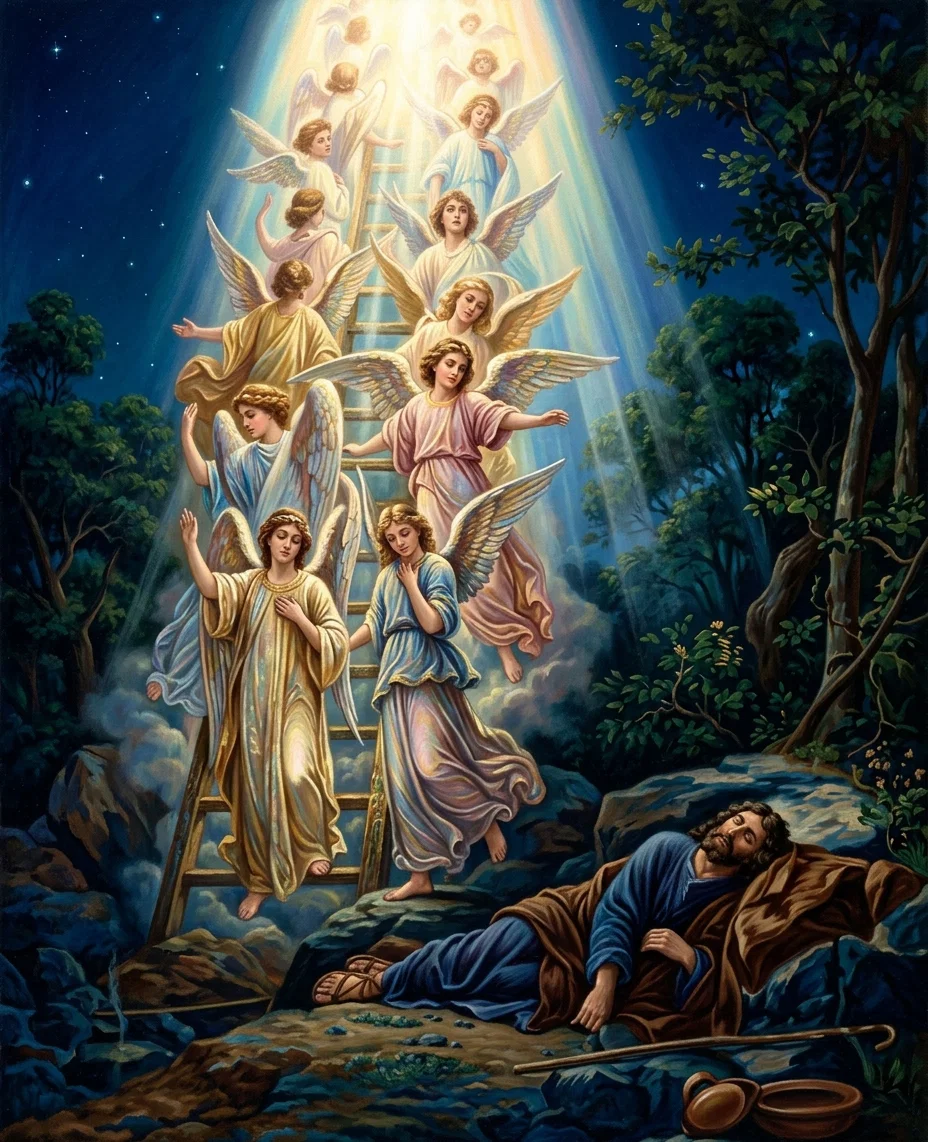
YET God had not left him. In a vision of the night He revealed His love and care to Jacob, and left it on record for all generations to come, that Infinite Love and Infinite Sacrifice had bridged the chasm between earth and heaven. Resting upon the earth and reaching to the glorious gate of the City of God, Jacob saw a shining ladder, and upon that ladder angels of God, passing to and fro from earth to heaven in tireless ministry for the lost and needy ones of earth. The erstwhile despairing pilgrim awoke with a great feeling of awe in his soul, yet with new hope in his heart, and new purposes in his life. “Surely,” said he, “Jehovah is in this place; and I knew it not. And he was afraid, and said, How dreadful is this place! this is none other than the house of God, and this is the gate of heaven. And Jacob rose up early in the morning, and took the stone that he had put under his head, and set it up for a pillar, and poured oil upon the top of it. And he called the name of the place Beth-el [the house of God]; but the name of the city was Luz [separation] at first.” And then followed his solemn vow to do faithful service for God and render to the Master His own.
READER, whosoever you are, howsoever separated by the black, yawning gulf of sin, there is salvation for you. Christ has bridged the gulf and made a safe pathway for you. Let faith behold the shining ladder and set foot upon its golden steps. It will bear your weight. Every round has been tested by almost infinite temptation, till its living fiber will bear the stress of any burden. Look up, lift up the head. Are you separated and lonely, the presence of Christ will change the Vale of Separation to the House of God and the Gate of Heaven.

ONLY ONE GATE.

The old city of Troy had but one gate. You would search in vain for a second through all its high walls in their ample circumference. There was only one way, and no other could be found that led into the city. Nevertheless, the one gate was passable for all save an enemy.
Even so is the way into life eternal in the city of God. “I am the door,” said Christ. “Strait is the gate,” He also said; and again, “Enter ye in at the strait gate.” Troy was, but Jerusalem, the golden, is. Its door is wide open, its gate ever accessible. The way there is narrow, but all the lowly can walk in it. The gate is difficult, but all may find it. There is room enough in the great heart of Jesus, room enough within the pearly gate of the ample city for the perishing millions. None need remain outside.
But the one way, the one gate—do you find it? Are you seeking it? Is your hand on the latch, and hold of the door? Do you hear the wide, wide welcome shouted through the shining portal—
“Come in! come in! Eternal glory thou shalt win”?
Will you pass in by the only appointed way, the one gate, and be forever blessed? Come and enter now before the door is closed against you, and the star of hope sinks from sight behind the dark mountains of judgment.—D. T. Taylor.

THE CHRISTIAN PATHWAY.

BY MRS. E. G. WHITE.
We are pilgrims and strangers on this earth, looking for a city that hath foundations, whose builder and maker is God. The path in which we travel is narrow, and calls for self-denial and self-sacrifice, but God has not left us without help. He has filled His Word with wonderful promises to strengthen and cheer His children. In these promises He draws back the veil from eternity, and gives us glimpses of the far more exceeding and eternal weight of glory that awaits the overcomer.
All along the pathway God places the fair flowers of promise, to brighten our journey. But many refuse to gather these flowers, choosing, instead, the thorns and thistles. At every step they weep and mourn, when they might rejoice in the Lord.
How much joy we might bring into our life here below if we would but make these promises our own. As we talk of the mansions that Christ is preparing for us, we shall forget the petty annoyances that we meet day by day. It is our privilege to sing the songs of Zion now, to turn our eyes to the light, to bring hope into our hearts and into the hearts of others. God desires us to gather up His promises, that we may be strengthened and refreshed. Let us take our eyes from the curse, and fix them on the grace so abundantly provided.
This life will be much brighter for us if we will gather the flowers and leave the briers alone. Comfort, encouragement, and support have been provided for every circumstance and condition of life. No temptation comes to us that Christ has not withstood, no trial that He has not borne. He knows each one of us by name. When a burden is placed on us, He stands by to lift the heaviest weight. He assures us that His grace is sufficient. To-day we have His help. To-morrow we may be placed in new circumstances of trial, but the promise is, “As thy days, so shall thy strength be.”
Let us rejoice in the love of God. Let us praise Him who has made promises so royal. Let these promises keep our hearts in perfect peace. Jesus lives. His hand is guiding us. Constantly our hearts may be filled with the peace that passeth all understanding, even the peace that Jesus gives.
The Saviour will never abandon the soul for whom He has died. The soul may leave Him, and be overwhelmed with temptation; but Christ can never turn from one for whom He has paid the ransom of His own life. Could our spiritual vision be quickened, we should see souls bowed under oppression and burdened with grief, pressed as a cart beneath sheaves, and ready to die in discouragement. We should see angels flying swiftly to these tempted ones who are standing on the brink of a precipice. The angels from heaven force back the hosts of evil that encompass these souls, and guide them to plant their feet on the sure foundation.
Thank God, we are not left alone. He who “so loved the world, that He gave His only-begotten Son, that whosoever believeth in Him should not perish, but have everlasting life,” will not desert us in the battle with the adversary. “Behold,” He says, “I give unto you power to tread on serpents and scorpions, and over all the power of the enemy; and nothing shall by any means hurt you.”
Live in contact with the living Christ, and He will hold you firmly by a hand that will never let go. Know and believe the love that God has to us, and you are secure; that love is a fortress impregnable to all the delusions and assaults of Satan. “The name of the Lord is a strong tower; the righteous runneth into it, and is safe.”

THE ROYAL ORDER.

To the front! the cry is ringing, To the front! your place is there; In the conflict men are wanted, Men of hope, and faith, and prayer. Selfish ends shall claim no right From the battle-post to take us; Fear shall vanish in the fight, For triumphant, God will make us.
To the front! the fight is raging, Christ's own banner leads the way, Every power and thought engaging, Might divine shall be our stay. We have heard the cry for help, From the dying millions ’round us; We've received the royal order From our Lord who found us.
To the front! no more delaying, Wounded spirits need thy care; To the front! thy Lord obeying, Stop to help the dying there, Broken hearts and blighted hopes, Slaves of sin and degradation, Wait for thee in love to living, Holy peace and liberation. —Anon.

THE DOCTRINE OF A UNIVERSAL FATHERHOOD.

[Quoted in the Literary Digest from a new book by the Rev. A. Lincoln Shute.]
THE Old Testament knows nothing of a universal divine Fatherhood. In perfect harmony and consistency with the writers of the old dispensation, Christ and His apostles teach a conditional moral and spiritual fatherhood and sonship. In the divine family this sonship is by grace and not by nature, not from Adam, but from Christ, not based on creation, but grounded in redemption. Christ, by His atonement makes it universal in infancy, universally possible for all free intelligences, but not thereby actually universal for all classes regardless of their moral choice or nature.
Also . . . the doctrine of the universal fatherhood is weak, in that it is based neither on Scripture nor in any necessity of reason, that it is inconsistent with evangelical Christianity, involves horrible absurdities, is fraught with the gravest dangers because of its fundamental relation to unscriptural systems of theology, and, therefore, is a most cruel and deceptive doctrine.

A VITAL QUESTION.

BY O. E. JONES.
“Good Master, what good thing shall I do, that I may have eternal life?” The answer to this important question is, “If thou wilt enter into life, keep the commandments.” Matt. 19:16, 17.
God’s will is manifested through His law. “I delight to do Thy will, O my God; yea, Thy law is within my heart.” Ps. 40:8.
Obedience to this law is the key-note of the scriptures. In Eccl. 12:13, 14, we read: “Let us hear the conclusion of the whole matter: Fear God, and keep His commandments; for this is the whole duty of man. For God shall bring every work into judgment, with every secret thing, whether it be good, or whether it be evil.”
The prophet Samuel makes the following statement on the point of obedience. “Hath the Lord as great delight in burnt-offerings and sacrifices, as in obeying the voice of the Lord? Behold, to obey is better than sacrifice, and to hearken than the fat of rams.” 1 Sam. 15:22.
The Word gives us the rule of conduct where human laws run counter to the commandments of God. “We ought to obey God rather than men.” “In vain do they worship Me,” said Jesus, “teaching for doctrines the commandments of men.” Matt. 15:9. God placed His approval upon the three worthies when their course was in direct opposition to the commandment of the king (the law of the land). They stood firm for the commandments of God. The commandment says, “Thou shalt not make unto thee any graven image. . . . Thou shalt not bow down thyself to them, nor serve them.” Ex. 20:4, 5.
The king of Babylon set up a great image of gold, and commanded the assembled multitude to bow down and worship the golden image which he had set up. “And whoso falleth not down and worshipeth shall the same hour be cast in the midst of a burning fiery furnace.” As the three Hebrews stood gazing upon the great image the commandment of God rang in their ears. “Thou shalt not bow down.” Would they heed this command, and go to the fiery furnace?
Hear their reply. “O Nebuchadnezzar, we are not careful to answer thee in this matter. If it be so, our God whom we serve is able to deliver us from the burning fiery furnace, and He will deliver us out of thine hand, O king. But if not, be it known unto thee, O king, that we will not serve thy gods, nor worship the golden image which thou hast set up.” They obeyed God. The king’s command was urgent, and the fiery furnace was heated one seven times more than it was wont to be heated. The servants of God were bound in their coats, their hosen, their hats, and their other garments, and were cast into the midst of the burning fiery furnace. “And these three men, Shadrach, Meshach, and Abednego, fell down bound in the midst of the burning fiery furnace.”
The king, astonished and terrified, exclaimed: “Did we not cast three men bound into the midst of the fire? . . . Lo, I see four men loose, walking in the midst of the fire, and they have no hurt; and the form of the fourth is like the Son of God.” Then the king commanded Shadrach, Meshach, and Abednego to “come forth, and come hither,” and they “came forth of the midst of the fire.” The multitudes looked with astonishment upon the “men, upon whose bodies the fire had no power, nor was a hair of their head singed.” Daniel 3. God stands by His faithful servants as they stand by His commandments. Every true child of God will choose obedience to Him, and if need be go to the fiery furnace rather than be disloyal to God and His divine precepts. “We ought to obey God rather than men.” Acts 5:29.
To-day the world is again brought to a test. Exalted before us is the perfect law of God which commands the observance of the seventh-day Sabbath. On the other hand an apostate power has substituted the first day of the week as a day of rest and worship, and demands our allegiance to it. “Choose you, this day whom ye will serve.”
It does make a difference whether we are particular in obedience to God. In the experience of Nadab and Abihu we have an example of disloyalty to God, and the fatal result. “And Nadab and Abihu, the sons of Aaron, took either of them his censer and put fire therein, and put incense thereon, and offered strange fire before the Lord, which He commanded them not. And there went out fire from before the Lord, and devoured them, and they died before the Lord.” Lev. 10:1, 2.
The Lord is reasonable in all His commands, and desires that they shall all be carried out just as He has given them. He says: “Ye shall not add unto the word which I command you, neither shall ye diminish aught from it, that ye may keep the commandments of the Lord your God which I command you.” Deut. 4:2.
Many and rich are the promises to the obedient. To them will be opened the gates of the city of God. “Open ye the gates, that the righteous nation which keepeth the truth may enter in.” Isa. 26:2.
“Blessed are they that do His commandments, that they may have right to the tree of life, and may enter in through the gates into the city.” Rev. 22:14.
To the faithful and obedient will come the most precious invitation ever given to man. “Come, ye blessed of My Father, inherit the kingdom prepared for you from the foundation of the world.”
College View, Neb.

LIFE IN THE VEGETABLE KINGDOM.

NO. 2.
BY WILLIAM COVERT.

Plants Foretell the Weather.

THE majority of people love fair weather, and, if a storm is expected, they try to fortify against it. But the farmer and the gardener wish for moisture upon their growing crops, and therefore welcome the rainfall. In these things men find themselves closely imitated in the vegetable family.
The plant, being in accord with nature, can feel the influence of the coming storm more readily than man can feel it. If the florist finds at nine o’clock that his tulips and marigolds are folded up, he expects rain that day. These, and many other flowers, close doors to keep the rain from soiling their beauty, and injuring the life of the seeds they are holding in embryo.
The Canada thistle, being a very hardy plant, keeps open door in stormy weather, the same as when the sun shines. Many small flowers, like the pimpernel, which expand near the ground, close up tight in moist weather. Several varieties of the most delicate flowers close up for the night and for the storm. Some flowers that bloom very early in the spring, before the insects begin their work, close up at night for the purpose of fertilization. The rose never closes. It fears neither the night nor the day of rain. The sun can not be too hot, nor the clouds too dark, for the roses.
Let the Christian be in character like the delicate flowers that protect their charge in the day of storm. Let him also be as the rose, which shows a cheerful face, and sends forth its fragrance both night and day.

Time-keeping Plants.

The student who will carefully observe the movement and the attitude of plants, will find many of them very good time-keepers. They mark the hours of the day with almost the precision of a clock.
Many of the brightest flowers have their appointed hours for display.
A few make their toilet as early as two in the morning.
The morning-glory is full and bright at five.
The dandelion opens up at six.
About seven the water-lilies are awake.
Many little flowers that sleep near the ground are showing their best features by eight o’clock.
The marigold and the tulip will usually be in full dress at nine.
The “star of Bethlehem” shuts up at eleven, while most of the day flowers are making their best show.
Noon is the choice hour for sweet peas and passion flowers.
Two in the afternoon will find wild daisies the brightest.
Then come the “four-o’clocks.”
An hour later the “beauty-of-the-night” has blown.
At six the evening primrose appears, followed by some of the same family at a later hour.
Some flowers bloom only in the night.
Perhaps every hour of the day and night has been selected by nature for a fresh display of her beauty. Plants sometimes have freaks, and bloom out of their regular season.
Through every plant God is speaking, and each several class is designed to set in vibration some particular chord of man’s best nature.

Of Varieties.

Of the multiplicity of things which God does, the psalmist exclaims, “O Lord, how manifold are Thy works! In wisdom hast Thou made them all; the earth is full of Thy riches.” Ps. 104:24.
Life in the vegetable kingdom may be studied through several thousand forms and sizes. There are plants too small to be seen without the aid of the microscope. Beginning with these minute forms of life, every integral niche of the whole scale, or measure, is occupied by some plant, each exceeding the one before it in size, until the dimension of the largest tree is attained.

Color in Plants.

One very interesting element of plant life is color. Green is the great body hue for foliage. There are many exceptions to this rule, but the variation is found almost wholly among plants which make little display in their bloom, and which do not propagate through seed.
The Creator has adapted color in plants to the restfulness and entertainment of the optical sense in animals. Green, being the groundwork, gives to the eye rest and comfort. The variegated and brighter hues give it delight, and at the same time serve as guides and signs to the insects that God has appointed to fertilize every plant after its kind.
The Creator has placed the food for these little creatures among the petals and the pollen of the flowers. Every flying or creeping bug and insect is taught of the Lord where to findthe dish or cup which it relishes most. They are guided day and night by the vision that God has given them. The color and the fragrance in the flowers are invitations to the table which Providence has spread for their benefit.
These insects usually visit a number of flowers while satisfying their appetite, eating but one variety of food at a time. The Lord has taught them not to pollute the vegetable kingdom by promiscuous visiting.
A great variety in color is also seen among the seeds and the fruits of plants. These variations are not only interesting, but they are useful in making selections. The Saviour says, “the tree is known by its fruit;” but fruit is usually selected by its form and color. There must be some distinguishing features for every product. Color bears an important part in labeling nature’s goods.
Color does not make a blunder. It never upsets its cup, nor drops its brush. The right tinge is put in the appointed place. The lily gets its white; the tulip receives its complement in stripes; the buttercup is given its gold; the violet secures its blue; while the roses are profusely painted in various shades of pink, of orange, of white, and of red, but never of blue.

SECOND SAMUEL.

BY F. D. STARR.
As stated in the preceding article, the books of Samuel might more consistently be called the first and second books of Kings, the latter part of the title as found in the English translation.
This book we are now considering covers practically the forty years’ reign of King David, commencing with the events connected with his accession to the throne, upon the death of Saul, and closing with the later acts of his rule, which took place a trifle over one thousand years before the birth of Christ.
With David commences a new epoch in the history of the Jews, God’s chosen people. This constitutes one of the division lines between Abraham and Christ, as seen by referring to Matt. 1:17. So the events recorded in the books of Samuel took place about midway between creation and our own time.
The life of David is one of thrilling interest and significance. By the Spirit of God he was enabled to write the beautiful psalms that have been such a comfort to millions of souls, and these were written in connection with some of his experiences, and in order to correctly understand the circumstances which called forth these noble poetic utterances, we need to become familiar with them; and these circumstances are recorded in the history of David as given in the two books of Samuel. Perhaps no portion of Holy Writ has been brought into more extensive use in a devotional way, around the family altar, and elsewhere, than these psalms composed while the author was passing through the varied experiences recorded in the books in question.
David is called the man after God’s own heart; and those who are disposed to criticize the Bible, indulge in ridicule at the idea of such a man, who committed such a grievous sin against Uriah, being called a man “after God’s own heart.” But when was this expression used in reference to David? Was it after he had committed this heinous crime? We find David’s fall occurred B.C. 1035 (2 Samuel 11), when he was about fifty years of age. The Scripture text criticized will be found in 1 Sam. 13:14. The words were spoken by Samuel to Saul: “But now thy kingdom shall not continue; the Lord hath sought Him a man after His own heart, and the Lord hath commanded him to be captain over his people, because thou hast not kept that which the Lord commanded thee.” We find these words were spoken B. C. 1095, sixty years before David’s great sin, and, consequently, ten years before David’s birth. David did fulfil this description in a remarkable manner during the earlier years of his life, and the same infinite mind that mentioned Cyrus by name more than a century before his birth (Isa. 45:1), and spoke of many other individuals before they were brought into existence, saw fit to honor David in the same way.
But another prophetic utterance that should cause these Bible critics to pause and consider what they are doing, is found in the reproof the prophet of the Lord administered to the royal transgressor. “Howbeit, because by this deed thou hast given great occasion to the enemies of the Lord to blaspheme, the child also that is born unto thee shall surely die.” 2 Sam. 12:14.
So not only David, but those who find fault with God and His holy Book on David’s account are pointed out beforehand. And who are they who thus venture to find fault? As the text says, they are the enemies of the Lord, blasphemous scoffers.
The Lord knew all about them long before they were born. Who would want to be numbered with them? The Lord’s intense displeasure at David’s conduct, and the severe penalty visited upon David, are enough to plainly prove that such conduct is not sanctioned in the Word of God. We may all read with much profit his words of penitence recorded in Psalm 51.
The magnanimous disposition of David, as manifested in his grief upon hearing of the death of Saul, is shown in 2 Samuel 1. There is one expression in this chapter to which we would call attention, that in verse 20. The Septuagint renders this: “Tell it not in Gath, evangelize it not in Askelon.” From this we get an idea about the meaning of the Greek term, evangelize. It means to proclaim tidings, especially glad tidings. The word Gospel is from this term, and evangelizing is simply preaching the Gospel. The world is to be evangelized, that is, the Gospel is to be preached in all the world.
But that does not mean that the world is to be converted—it is to be warned. Another instance to the point is found in 2 Sam. 4:10. Wicked men thought to evangelize David.
The plan of salvation is most beautifully referred to in 2 Sam. 14:14: “For we must needs die, and are as water spilt on the ground, which can not be gathered up again; neither doth God respect any person; yet doth He devise means, that His banished be not expelled from Him.”
Man was banished from the presence of God when, on the account of sin, he was driven from the Garden of Eden. But he is not expelled from Him. It is one thing for a scholar to be suspended from school on account of disorderly conduct, and quite another thing for him to be expelled from the school.
Thank the Lord, we are not necessarily expelled from Him, tho we are temporarily banished from our paradise abode. Through the means God has devised,—the blessed Gospel of Christ,—we see redeemed man restored to his original Eden home. The expression, “Neither doth God respect any person,” is rendered in the German, French, and Spanish translations: “Neither hath God taken away life;” and with this agrees our own marginal reading. No, the Lifegiver did not take away life, he delighteth not in the death of any. The devil, who has the power of death, caused life to be taken away. He is a murderer from the beginning.
Do not fail to consider the eloquent description of the abating of physical power in old age, found in 2 Sam. 19:35, in connection with Eccl. 12:1-7.
But we must content ourselves with merely plucking a bouquet from this, another flower garden of the Lord’s planting, and close this interview with the words of David in Ps. 27:4: “One thing have I asked of Jehovah, that will I seek after; that I may dwell in the house of Jehovah all the days of my life, to behold the beauty of Jehovah, and to inquire in His temple.”

JACK'S ARITHMETIC.

Jack was poring over his mental arithmetic. It was a new study to him, and he found it interesting. When Jack undertook anything, he went about it with heart, head, and hand.
He sat on his high stool at the table, while his father and mother sat just opposite. He was such a tiny fellow, scarcely large enough to hold the book, you would think, much less to study and calculate. But he could do both, as you shall see.
Jack's father had been speaking to his mother; and the child had been so intent on his book that he had not heard a word; but as he leaned back in his high chair to rest a moment, he heard his father say, “Dean got beastly drunk last night, drank ten glasses of wine; I was disgusted with him.”
Jack looked up with bright eyes. “How many did you drink, father?”
“I drank but one, my son,” said the father, smiling down upon his little boy.
“Then you were only one-tenth drunk,” said Jack reflectively.
“Jack!” cried his parent, sternly, in a breath; but Jack continued, with a studious air:—
“Why, yes; if ten glasses of wine make a man beastly drunk, one glass will make him one-tenth part drunk, and—”
“There, there!” interrupted the father, biting his lip to hide the smile that would come; “I think it is bedtime for you; we will have no more arithmetic to-night.”
So Jack was tucked away in bed, and was soon asleep after turning the problem over and over to see if he were wrong; but just before he had lost himself in slumber he had thought: “One thing is sure; if Dean hadn't taken that one glass, he wouldn't have been drunk; and if father had taken nine more, he would have been drunk. So it's the safest way not to take any; and I never will.”
And the next thing he was snoring, while Jack's father was thinking: “There is something in Jack's calculation after all. It is not safe to take one glass, and I will ask Dean to sign a total abstinence pledge with me to-morrow”; and he did so, and they both kept it. So great things grew out of Jack's studying mental arithmetic, you see.—Christian Advocate.

Use Your Talents Well

MAKE good use of the talents God has given you, be they great or small; apply your whole energy to the business you have in hand, and look up for the divine blessing on your toil; do this and—no fear of you!—Rev. Thain Davidson, D. D.
Continue reading: The Industrial Conflict in the Light of Revelation