The Quaker No. 4 is a ball-bearing, tinned disc-adjustable grind-all-things mill; the cook's friend; the hygienist's delight. Never rusts nor wears out; never runs hard nor chokes up like taper mills; weighs ten pounds; expressed cheap. Price $4.00. See circulars.
Spanish peanuts and nut butter at lowest market prices
WM. T. DAWSON, 981 Joseph Place, Memphis, Tenn.
HOW TO REST THE BRAIN.
By Annie Payson Call
[Annie Payson Call, in Leslie's Monthly for March.]
THERE are five things to remember that help to rest an overtired brain: 1. A healthy indifference to wakefulness. 2. Concentration of the mind on simple things. 3. Relaxation of the body. 4. Gentle, rhythmic breathing of fresh air. 5. Regular nourishment. If we do not lose courage, but keep on steadily night after night, with a healthy persistence in remembering and practising these five things, we shall often find that what might have been a very long period of sleeplessness may be materially shortened, and that the sleep which follows the practise of the exercises is better, sounder, and more refreshing, than the sleep that came before. In many cases a long or short period of insomnia can be absolutely prevented by just these simple means.
Here is, perhaps, the place to say that all narcotics are, in such cases, absolutely pernicious.
SUMMER COTTAGE SITES.
Lots for sale, $20 and upwards, at Camp Tyrone, Monte Rio Park, Mesa Grande, Sheridans, Camp Meeker or Cazadero, in the Redwoods or Hill-sides of the picturesque Russian River and tributary streams. Ideal summer climate. Agent on grounds. Round trip every Sunday, $2.00 to $2.50. Friday to Monday, $2.50 to $3.00; excursion good until October 31, $3.00 to $3.75. Cottages for rent and sale. Free camp sites. Full information at North Shore Office, No. 626 Market Street, San Francisco. Send for free copy of "Sunny Summer Homes" or "Summer Outings."
Eggs for Hatching
Eggs for hatching, S. C. White Leghorns; free range on farm; 15 for $1.00. Ida Klein, Berea, Stafford Co., Va.
TO SUIT EVERYBODY! JUST OUT!
For Sunday Schools, Young People's Societies, Revival Meetings, etc.
100 New Songs. 256 Pages. Bound in cloth.
Young People's Songs of Praise
4 EDITIONS: REGULAR, EPWORTH LEAGUE, CHRISTIAN ENDEAVOR, BAPTIST Y. P. UNION.
25c. per copy. RETURNABLE SAMPLE FREE
THE BIGLOW & MAIN CO., New York-Chicago.
EDITIONS: REGULAR, EPWORTH LEAGUE, CHRISTIAN ENDEAVOR, BAPTIST Y. P. UNION. 25c. per copy. RETURNABLE SAMPLE FREE THE BIGLOW & MAIN CO., New York-Chicago.
CATHOLICISM IN MEXICO.
SOME have held that Protestants have no excuse for carrying on missionary operations in Catholic countries. The following from World Wide Missions shows that there are no fields more needy:—
Indulgences.
Indulgences, which so fired the zeal of Martin Luther against the Roman Church in the sixteenth century, are bartered on a wide scale in Mexico. In front of the Church of Santo Domingo, in the city of Puebla, there is a cross mounted upon a stone pedestal, upon which is inscribed in Spanish:—
Ten thousand years of indulgences for each one who, in a state of grace and before this cross, shall repeat five times the words of the Lord's Prayer, and hail Mary with glory in memory of the ascension of Jesus Christ.
The above translation was made on the spot by Dr. Borton, who knows Spanish perfectly. It is estimated that the form required can be repeated four times an hour, so that one hour's service before this cross would lay up indulgences for forty thousand years, and twenty-four hours would secure nine hundred and sixty thousand years. This certainly offers an opportunity for dealing in futures that would delight the soul of a Wall Street broker.
A drawing of the Virgin's shoe is used in Mexico for the purpose of securing indulgences. Within the lines drawn for the bottom of the shoe is the following:—
This is the exact measure of the foot of the most holy mother of God in her infantile age as taken from her own shoe, which is venerated with great devotion in the convent of Lareto, in the kingdom of Italy, in which city is preserved her most holy house, brought miraculously by the hands of the angels from Jerusalem. Pope John XXII. conceded three hundred years of indulgences to those who kissed three times this measure and recited three Ave Marias. Said indulgences were confirmed by Pope Clement VIII. in the year of our redemption, 1603. We have no prescribed number, and indulgences can be granted as many times as are wished by the worshipers of the most holy Virgin Mary, and they may be applied to the souls in purgatory. It is permitted for the greater glory of the queen of heaven and earth to make other copies of this measure, all of which have the same indulgences.
Raffles.
Raffles for souls are still practised on a large scale. The following is a literal translation of an item that appeared in the El Pais in Puebla, Mexico, Nov. 3, 1899:—
In a parochial church of St. Joseph, to-day, were celebrated solemn funeral honors and twenty masses in behalf of the faithful departed who drew the prizes in the spiritual lottery of said church. The mass was sung by Licentiate D. Manuel Diaz Calderon, and the choir loft was occupied by a magnificent orchestra directed by the choir master, Obueros.
In company with Dr. John W. Butler, I visited the parish church at El Oro, on the walls of which, in a conspicuous place, was posted a written document, of which the following is a translation made by Dr. Butler, whose knowledge of Spanish is well known:—
List of the dead who drew prizes in the mass which was said in the raffle for souls which took place Oct. 31, 1903, in the parish church of El Oro.
Then follows a list of twenty-three names of deceased persons who drew prizes, to which the signature of the parish priest, the Rev. Amilio Penpobre, is affixed. These raffles are still widely practised in Mexico.
Penance.
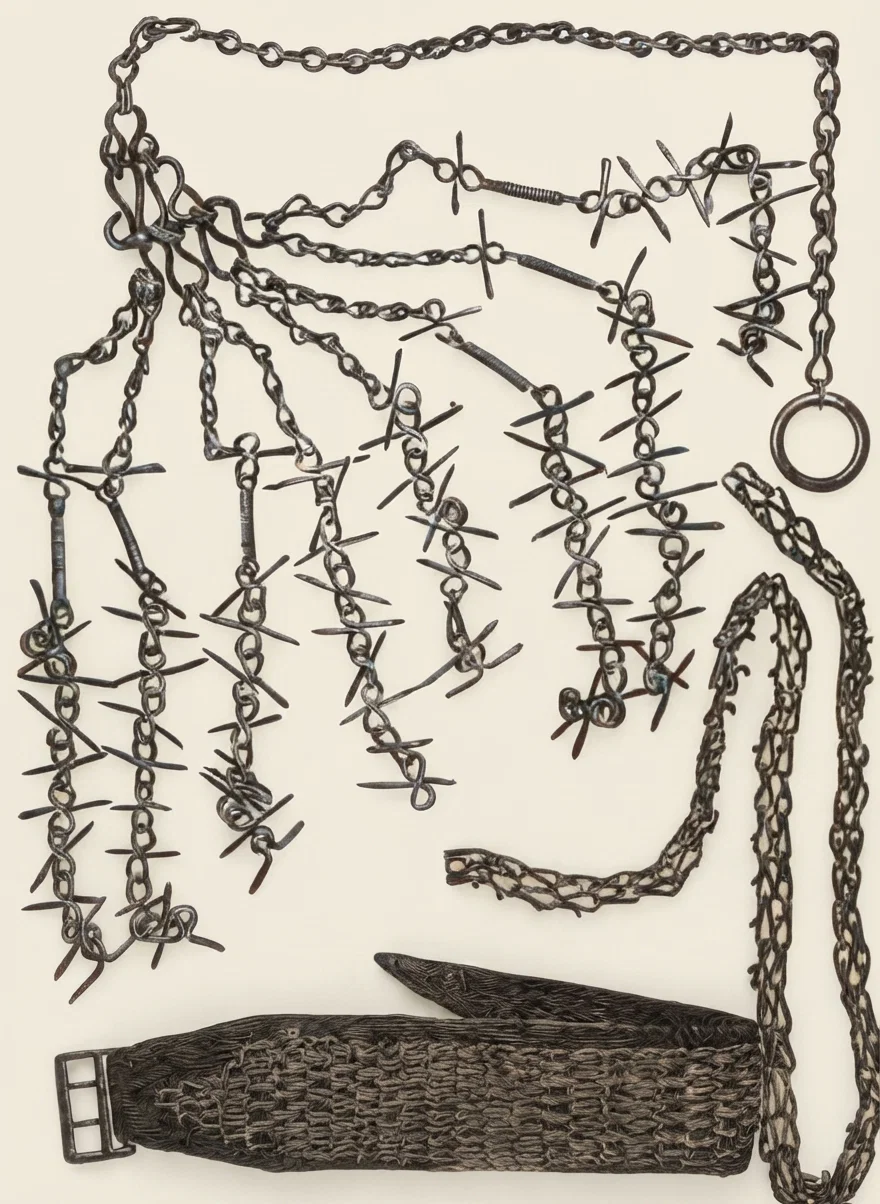
Penance in the forms practised when the power of Rome was supreme and undisturbed in Mexico, while less open and general than formerly, has not been discontinued by any means. The instruments of torture are still in use. The disciplinas are applied to the naked flesh. Samples of these disciplinas brought from Mexico by the writer can be seen at any time at the Missionary Office. These self-tortures are practised not only in old Mexico, but also in New Mexico, in the United States.
Mexican 'Disciplinas,' Wristlet and Scourge Used by Self-torturing 'Penitentes.'
A writer in the New York Evening Post, March 12, 1904, says:—
Up in the secluded mountain valleys, where few or no white settlers have moved in, Holy Week was observed with all the solemn, fanatical barbarity of old. There were processions of men almost naked, whipping themselves with cactuses, soapweed, and other scourges which made their backs a mass of raw flesh and running blood. . . . We were off at one side, and at first were inclined to make light of the punishment, as they could not hit themselves hard, raising the whip with both hands over their heads, and bringing it down on their backs with a jerk of the wrist. At last a turn of the procession brought them close.
Then we saw that the backs of the fifteen men thus doing penance were literally raw and running with blood. Their scourges were made of the soapweed, and as they hit their backs they gave a quick upward pull which bedded the thorn in the flesh and tore off the skin and the flesh with it. When a man relaxed his self-punishing zeal for a moment he was urged on by the old men and the women.
HOME AND FOREIGN MISSIONS.
THE church that would measure up to the standard of the divine Master must be a missionary church. It must go out to seek and to save the lost. That was the mission of our Lord into this world, and into the hands of His followers has been entrusted the continuation of this great work. We may find a field of labor at the very doors of the church, and a large and inviting one it truly is. The harvest it presents is great, and not every one is willing to work in it. We should, therefore, earnestly pray that the Lord of the vineyard may provide laborers for the harvest, and that He may fit us and make us worthy to be co-laborers with Him in the ingathering work.
Every member of the church should be a missionary for Christ. He, above all others, should be able to appreciate the blessings of salvation. He has realized the horrors of the pit from whence he was taken; he can understand, in some degree, the value of a soul, and he can not but feel the weight of obligations resting upon him through the mercies of God of which he is the continual recipient, to make whatever return may lie in his power. In the home field he finds everything ready to his hand. It needs no long study of a foreign tongue, no acquisition of new and strange habits and customs and modes of thought and speech. He only needs a heart filled with the love of souls, and quickened by the grace of Christ. Let him go to the Master in prayer, seeking for these, and his work will be both easy and successful. He who, in addition to himself, thus becomes13instrumental in the conversion of but one soul, doubles his effectiveness in the great work of the salvation of the world, and he may go on to multiply it indefinitely.
We believe that there is at this time a special call to this work. Let us pray for a larger spirit of tolerance for ourselves, and for that spirit of gentleness and tenderness toward the doubter and the questioner which, in the end, is sure to gain the victory. Let us not be discouraged if at times we seem to fail. The kingdom of heaven in the heart has been likened to a mustard seed, the smallest among seeds, but it grows to be a tree, and to mature its fruit. The Christian's work may show but small results, perhaps even none at all. But he is not to concern himself about that, however gratifying it might be. His share is to work, to sow the good seed, and to leave the results to God.—Selected.
UNDER HIS WINGS.
By R. A. Gilstrap
BY R. A. GILSTRAP.
"The children of men take refuge under the shadow of Thy wings." Ps. 36: 7.
BENEATH Thy wings, O God, my Lord,
The sons of men may safely trust;
Thou formest all by Thy strong word,
And we are frail—we are but dust.
We trust Thy power that rules the tide,
That places bound on rolling wave.
The sea is deep, the world is wide,
But Thou alone hast power to save.
O God above, help us to see—
Show us each day Thy power divine.
Show us how small and weak are we,
And ever keep our hand in Thine.
So shall our lives be ever blest,
So shall we spread Thy blessings round,
Until we find eternal rest
In golden day that has no bound.
Selma, Cal.
A LETTER FROM INDIA.
By Iva I. Cauble
[Iva I. Cauble, in Pentecost Herald.]
THIS finds me in darkened India, surrounded by heathenism and superstition, but the Lord is near us here, as He was in the homeland. I can't realize I'm so far away; I haven't had one longing for home, or one moment of dissatisfaction since I came. Thank God!
Nature unfolds her beauties here; tropical plants, fruit trees loaded with delicious fruit, and some of the most beautiful flowers send forth their beauty and fragrance on every hand. The most beautiful sunrise and sunset that nature can afford, meet our eyes every morning and evening, and the southern cross can be seen every morning before daybreak. Many times I am reminded of the poem, "Every prospect pleases, and only man is vile."
It is not all flowers and sunshine. As we come in contact with the people, and realize their need, it makes our hearts groan. One evening, while walking down to the bazaar, we met some priests besmeared with ashes and with some of the most hideous-looking marks on their foreheads. I asked my friend why they did that. She answered, saying, "O, that is one of their religious duties." We also passed a temple; they were ringing bells, beating drums, and making a lot of noise. Of course I was inquisitive enough to ask what they were doing; I found out they were ringing those bells to put their gods to sleep. Their gods are numerous; I wondered how they could tell when all of them were asleep.
Words are too weak to express the darkness and wickedness we gaze upon, but "thanks be to God for His unspeakable gift." "Where sin abounds, grace doth much more abound." There are hungry hearts all around us. We go to the villages and hold meetings among the natives; they gather around and listen so attentively to the story of Jesus and His love.
Another sight we see is the lepers; we have the blessed privilege of working among them. The first time I saw them it seemed my heart would break. Some have their toes and fingers eaten off; and some, their faces are disfigured by the dreadful disease. India needs salvation. Remember these poor, be-nighted ones at the throne of mercy.
Duty Done
"LET others bask in glories won,
Be thou content with duty done,
Better to rest on wheaten sheaves,
Than on the greenest laurel leaves."
WASHINGTON, D. C.
By J. S. Washburn
THE work here is onward. The most successful meeting we have ever had in all my experience in Washington was held Sunday evening, March 6. I am certain there was the largest outside attendance I have ever seen here, and when the character of the people is considered, and the deep interest manifested, it was certainly most encouraging. Brother Spicer spoke on the subject of Russia in prophecy, the coming Armageddon, and the sealing work, and we believe that all saw the truth in a new and startling light.
Our public meetings are held in a very good hall, located in a most central position, accessible to all parts of the city. For fourteen weeks, from ten to twenty thousand leaflets have been placed in as many homes weekly. These leaflets are large (four-page), and contain a comprehensive summary of the last discourse, and an announcement of the subject for the next Sunday. These are also given to the people at the close of the meeting, so they may take home with them a very complete statement of all they have heard, with scriptures quoted and indicated, historical extracts, etc. These leaflets are doing good work. Many desire the whole set from the beginning of the series.
A number of lawyers and professional men are deeply interested. One of the lawyers has not missed a meeting. There are more openings for visiting and Bible work than can be filled. This field is ripe for the harvest. Great opportunities,—unlimited possibilities,—are before the workers here. I believe that every one who reads this article is deeply interested in the prosperity of the work in Washington. Plans are being laid for buildings, and we are hoping that a good amount of money will be sent in before a foundation stone has been laid or a nail driven. We have often been told that our people much prefer to pay for our institutions before they are built, rather than after. We believe it is so. You who read this article have the privilege of proving this to be true.
Very few will come in person, but all can send that which represents their love and sympathy for the work, and their faith in this move. You can send the representative of your strength, your energy, that which stands for your very heart; your treasure, “the sinews of war.”
Send all gifts to W. T. Bland, 222 North Capitol St., Washington, D. C. J. S. WASHBURN.
OUR WORK AND WORKERS.
By Editor
MARCH 12 four candidates were baptized in the church at Denver, Colo.
AT Helsingfors, Finland, nine candidates were baptized by Brother Fred Anderson, the first of March.
THE Central Union Conference has purchased a new Gospel tent, 30x56 feet dimensions, to be sent to Brother J. Nethery, in Scotland.
THE Pacific Press Publishing Company has established a branch depository at Lincoln, Neb., taking over the stock of the Nebraska Tract Society.
ON the 9th inst., six persons were baptized in the church in this city, five of whom united with the church in Berkeley, of which Brother J. D. Rice is pastor.
THE Central Advance announces the death of another of our ministers, Brother W. B. Everhart, of Sac City, Iowa, which occurred March 29. Consumption was the cause.
THE Workers' Bulletin says: "An interesting item in connection with the school work in the South is the fact that thus far every church school established has resulted in a church being organized."
WE learn from the Review that Brother F. H. Westphal, of College View, Neb., will go to Chili at the close of the present term of Union College. He has had former experience on the east coast of South America.
THE brethren in Canada are actively engaged in circulating religious liberty literature anent the proposed Act of Parliament to compel the observance of Sunday. Several special tracts have been written on the subject.
A NEW chapel was dedicated at Galesburg, Ill., March 5. Brother L. D. Santee, who had preached the first Seventh-day Adventist sermon in the city about eight years ago, delivered the dedication address. As a result of recent labors of Brethren G. G. Johnson and G. E. Nord, a dozen new members have been added.
THE Southern Missionary, organ of the Southern Missionary Society, is published monthly at Nashville, Tenn.; subscription price, 10 cents a year. The March number notes the erection of two churches the present year—one at Nashville and one at Jackson, Miss.; also the gift of a new 50-foot tent from Brother J. F. Bahler, of Keene, Texas. This is quite an accession to the society's working facilities.
LITERARY NOTICES.
By Editor
"The Lover's Love; or John Three-Sixteen." By William P. Pearce. 176 pages, cloth, 75 cents. Review and Herald, Battle Creek, Mich.
This little book of ten chapters, with an introduction by Dr. J. Wilbur Chapman, is a beautiful treatise of that wonderful scripture, John 3:16. We do not exactly like the title; it seems too sentimental; but the subject matter is excellent. The character and scope of the work is well set forth in the chapter titles as follows: Love Counteth Not the Cost; John Three-Sixteen; The Lover, "God"; The Lover's Intensity of Love, "So Loved"; The Lover's Object, "the World"; The Lover's Proof, "That He Gave"; The Lover's Gift, "His Only-Begotten Son"; The Lover's Proviso, "Whosoever Believeth"; The Lover's Purpose, "Should Not Perish"; The Lover's Pledge, "Have Everlasting Life." We do not know how it could be read and the reader not be helped. Its object is to bring men to God and deepen the love of the believer.
"Russia at the Bar of the American People, a Memorial of Kishinef." By Isidore Singer, Ph. D., projector and managing editor of the Jewish Encyclopedia. 12 mo., cloth. Price, $1.50; by mail, $1.65. Funk & Wagnalls Co., New York.
Dr. Singer has collected records and documents concerning the massacre at Kishinef, and sets forth what certainly must be, from the Jewish side, the best statement of the case. The book is written not only that Jews may keep in remembrance those who suffered, but that the world may know the truth of the matter. It is worth reading,—a good example of the intolerance generated by a union of church and state.
"The Vegetarian Cook Book." By E. G. Fulton. Cloth, 75 cents. Pacific Press Publishing Co., Oakland, Cal.
The instruction in this book, and the preparation and compilation of recipes, are from one who has had years of successful experience in catering to the public in vegetarian lines; and these recipes, we understand, are true and tried. In the variable prices of meat, and the variable and uncertain qualities of meat, this book should come as a boon. We know the diet is good. The book contains numerous recipes on all foods which man needs to have prepared.
"The Aristocracy of Health." A Study of Physical Culture, Our Favorite Poisons, and a National and International League for the Advancement of Physical Culture. By Mary Foote Henderson. 772 pages. Colton Publishing Co., Washington, D. C.
Such is the title-page of a book which ought to have tremendous effect among reasoning, thinking men and women. It is written by a woman of influence and of large opportunity of observation, the widow of the well-known Ex-Senator J. B. Henderson. Her discussion of the "Favorite Poisons," tobacco, alcohol, opium, cocaine, tea and coffee, will open the eyes of many, if it does not close their stomachs (the more's the pity). May it speed on and do good.
MANUAL LABOR AS MISSIONARY WORK.
INDUSTRIAL work is the outgrowth of close observation of the needs of the Indian people. It has received a new impulse since the recent famine, when over 3,000 children were left upon our missions for training and protection. It was imperative that the most of these children should be taught to do something with their own hands in order to show them the true dignity of labor, to afford the discipline that such training gives, to provide them with a means of earning a living when they were set adrift to care for themselves, and also to enable them to help, in a measure, to provide for their expenses while still in the orphan homes. It is also evident that the people of India as a class, in order that they may be independent and self-supporting, need to be instructed in various lines of industry. Carpentry, cabinet work, brass hammering, blacksmithing, weaving, rug-making, stone-cutting, farming, tinsmithing, lace-making, and embroidery are among the industries taught with marked success in many parts of the field. Many of the orphan children have already become self-supporting, and the thrift which this department of mission work engenders is of great permanent value to the entire Christian community.
These missions present a wide-open field into which we are invited to enter, even the non-Christian or Hindu communities joining in the invitation. The Hindus urge us to open more schools, build more hospitals, send more missionaries, and do more Christian work, for they have learned to respect the Christian faith, and to admire the life that it produces.—Corr. Missionary Herald.
INFANT FUNERALS IN CHINA.
A LADY, writing from Peking, China, says that you will be surprised that you never see or hear of the funeral of a child. Gorgeous processions tell of the death of an adult, but it seems that children never die in China. Perhaps some sight-seer will write home to that effect.
But suppose you get up by daylight and stand out in the street. Now the mystery will be explained. A large covered wagon, drawn by oxen, comes creaking along with a sign on the front.
It is piled to the top with the bodies and fragments of bodies of dead infants that have been cast in the street at night as garbage. Most of them are naked; some of them are in old baskets, and one or two in plain board coffins. Some are half devoured by dogs. Perhaps the wagon contains a hundred of these ghastly forms. No weeping mother or sighing father follows in procession. The garbage is cast into a dump heap outside the city wall and covered with quicklime. This is done every day. Many of these babies are girls, and were strangled at birth, or soon afterwards, because of the curse of womanhood. Such is one of the curses of the Chinese religion, and one of the fruits of its demoralizing code of ethics.—Selected.
GIVING BY HINDU CHRISTIANS.
By John Peter Jones
A FEW years ago I investigated carefully the economic conditions of the most prosperous and largest village congregation of the Madura mission. I discovered that 5 rupees (that is, $1.66) was the average monthly income of each family of that congregation. And that meant only 33 cents a month for the support of each member of a family! We have congregations whose income is less than this. And yet the Christians of that mission contributed over 2 rupees (75 cents) per church-member as their offering for 1900. For all the Protestant missions of South India the average offering per church-member during 1900 was 1 rupee and 9 annas (52 cents). For South India this represented an aggregate sum of 248,852 rupees ($83,000), or about seven and one-half per cent of the total sum expended in the missions during that year. An American can easily realize how much this offering is as an absolute gift; but he can not realize how much of self-denial it means to that very poor people, nor how large an offering it is as related to the best offerings of our home churches to-day.—Rev. J. P. Jones.
WANTED FOR MISSIONARY WORK.
(Always prepay postage.)
ANY of our publications, a liberal supply. Address, Otis Flinn, Kearney, Neb.
CLEAN copies of the SIGNS, Life Boat, Bible Training-school, and tracts. Address, Mrs. Amanda Maloney, 667 Hoyt Avenue, Muncie, Ind.
(35) "LET your loins be girded about, and your lamps burning; (36) and be ye yourselves like unto men looking for their lord, when he shall return from the marriage feast; that, when he cometh and knocketh, they may straightway open unto him. (37) Blessed are those servants, whom the lord when he cometh shall find watching: verily I say unto you, that he shall gird himself, and make them sit down to meat, and shall come and serve them. (38) And if he shall come in the second watch, and if he in the third, and find them so, blessed are those servants. (39) But know this, that if the master of the house had known in what hour the thief was coming, he would have watched, and not have left his house to be broken through. (40) Be ye also ready: for in an hour that ye think not the Son of Man cometh.
(41) "And Peter said, Lord, speakest Thou this parable unto us, or even unto all? (42) And the Lord said, Who then is the faithful and wise steward, whom his lord shall set over his household, to give them their portion of food in due season? (43) Blessed is that servant, whom his lord when he cometh shall find so doing. (44) Of a truth I say unto you, that he will set him over all that he hath. (45) But if that servant shall say in his heart, My lord delayeth his coming; and shall begin to beat the menservants and the maidservants, and to eat and drink, and to be drunken; (46) the lord of that servant shall come in a day when he expecteth not, and in an hour when he knoweth not, and shall cut him asunder, and appoint his portion with the unfaithful. (47) And that servant, who knew his lord's will, and made not ready, nor did according to his will, shall be beaten with many stripes; (48) but he that knew not, and did things worthy of stripes, shall be beaten with few stripes. And to whomsoever much is given, of him shall much be required: and to whom they commit much, of him will they ask the more."
Golden Text.—"Blessed are those servants, whom the Lord when He cometh shall find watching." Verse 37.
SUGGESTIVE QUESTIONS.
(1) With what striking figure does the Lord enjoin watchfulness upon His people? Verse 35. Note 1. (2) Unto what class of men are His vigilant servants likened? Verse 36. (3) What is said of those whom the Lord will find watching at His coming? How will He specially honor them? Verse 37. Note 2. (4) What is said in regard to the time of His coming? Verse 38. Note 3. (5) By what common principle does the Lord illustrate His lesson? Verse 39. (6) Then how does He further emphasize the lesson? Verse 40. Note 4. (7) In what was Peter's special interest manifested? Verse 41. (8) How did the Lord distinctly show to whom the lesson primarily applied? Verse 42. Note 5. (9) At what time will the faithful servant be especially blessed? Verse 43; 2 Tim. 4:7, 8. (10) What great honor will be bestowed upon such a servant? Verse 44. (11) How is the natural tendency of the unfaithful servant indicated? Verse 45. Note 6. (12) What will be the result of such conduct? Verse 46. Note 7. (13) What is said of the proportionate punishment of the delinquent servant who knew his lord's will but failed to do it? Verse 47. (14) What of him who was ignorant of his duty? Verse 48. Note 8.
NOTES.
1. From the first verse of this chapter we learn that it is an address especially to the Lord's own people. Verses 31-48, including the lesson scripture, have direct reference to the kingdom and second advent of Christ. The key-note of the lesson is watchfulness lest the coming of the Master take us unawares and find us unprepared. The loose clothing worn by the ancients was very comfortable and appropriate for leisure, but when action was required, the garments must necessarily be girded up securely to give freedom to the limbs. The lights trimmed and burning implies watching at all hours for the coming of one who is expected, but whose definite time is not known. See, also, parable of ten virgins, Matthew 25.
2. "Blessed."—The "Expositor's Greek Testament" says that "the Greek word here implies rare felicity, the reward of heroic virtue." This thought is carried out in the latter part of the verse, by the statement that the Lord will honor them by personally serving them at table.
3. The "watch" refers to the divisions of the night. The Romans divided the night into four watches, but the Jewish division was into three watches. The last watch, that which precedes the day, is usually deemed the most trying, the time when it is most difficult to keep awake. We are living in the last watch of the long, dark night, and the enemy would fain lull us to sleep with many vain assurances. Therefore it is a time to keep the loins of the mind (1 Peter 1:13) well girded with truth (Eph. 6:14), and the pathway well lighted by the inspired Word (Ps. 119:105).
4. That all time-setting theories concerning the Lord's coming are vain is manifest in His telling us that it will be in a time when we think not. For this very reason we are warned to be always ready and watching. This would not be so important if we could figure out the exact time. But He has given us signs by which we may know when His coming "is near, even at the doors" (see Matthew 24), and these signs are nearly all in the past.
5. The question of Peter's (verse 41) brought out even a more emphatic statement as to what people are especially addressed in this chapter. "Meat in due season."—What would be meat in due season at such a time? Would it not be [[FIGURE]] such instruction as would lead the people to prepare the way of the Lord, and to make His paths straight? Would it not be such a proclamation as preceded the first advent—"Repent, for the kingdom of heaven is at hand"? Matt. 3:2, 3; 4:17. Meat in due season would be calling attention to the prophecies concerning the coming of the Lord, and those pertaining to the investigative judgment preceding that momentous event. The study of this lesson would logically lead to a study of these themes. The prophecy (Rev. 14:12) shows a people at the coming of the Lord to judgment, of whom it is said, "Here are they that keep the commandments of God, and the faith of Jesus." Then meat in due season will develop such a people.
6. The servants, or teachers, who are not giving meat in due season to the "little flock," are the ones who are saying, "My Lord delayeth His coming," and otherwise acting accordingly.
7. Notwithstanding the profession, or the ardent labors, or the accredited wisdom, or even the "wonderful works," of those servants who neglect or refuse to give the meat in due season, they will be reckoned as unbelievers. See, also, Matt. 7:21-23.
8. The justice of the principle that requirement be according to that which is entrusted, is recognized among all rational beings. A knowledge of the everlasting Gospel and the gift of teaching it comprise a most valuable endowment, and the perversion of such endowment is to assume a fearful responsibility. But from Matt. 7:22, 23, cited in note 7, the final judgment will discover "many" of that class.